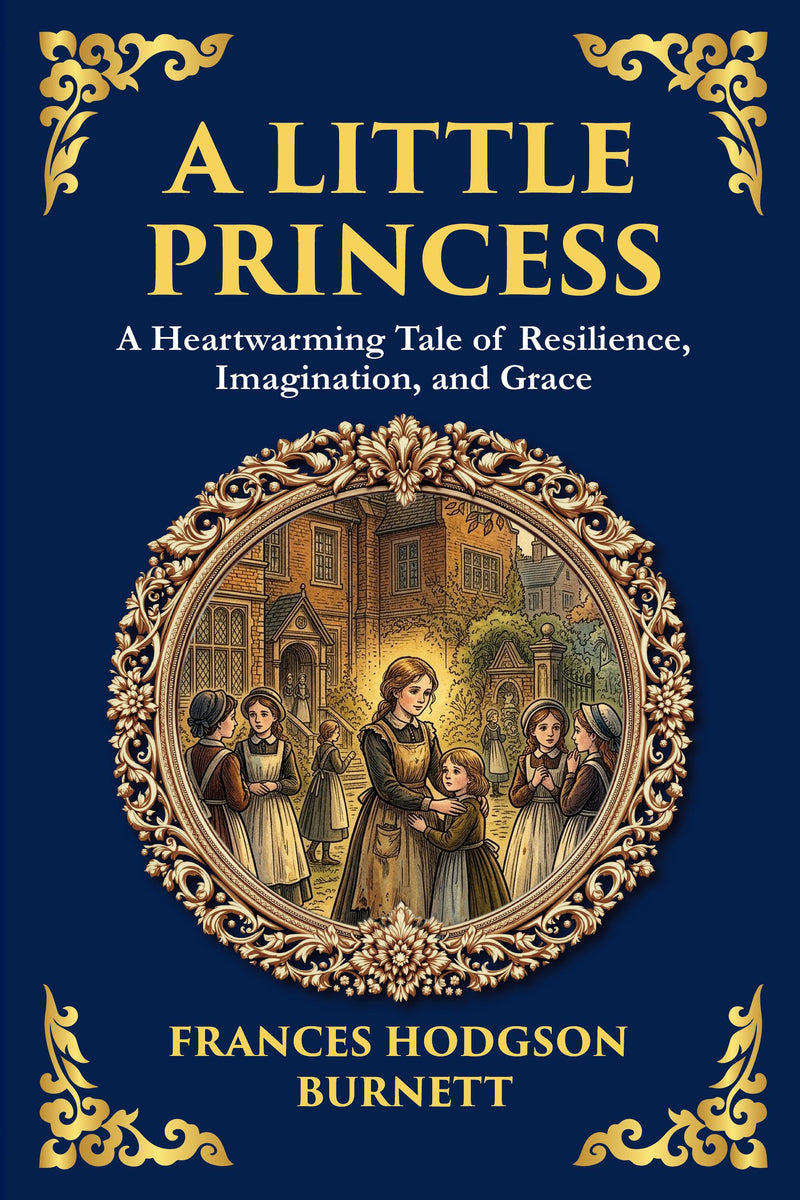
A Little Princess
In a world where fortunes shift and appearances deceive, A Little Princess tells the unforgettable story of a girl whose heart remains noble in the face of adversity.
or free app
10,000+ hrs library
30-day guarantee
The complete A Little Princess appears in modern English through Library of Alexandria Press, available online with audiobook narration included for members.
Have you ever wondered why true royalty is a matter of heart, not birth? A Little Princess: A Heartwarming Tale of Resilience, Imagination, and Grace is the beloved masterpiece by Frances Hodgson Burnett that continues to enchant readers of all ages with its message of inner strength and kindness. Set in Victorian London, the story follows the remarkable journey of Sara Crewe, a young girl raised in privilege who finds herself suddenly thrust into poverty and hardship.
But Sara refuses to let her circumstances define her. Armed with imagination, hope, and unwavering compassion, she transforms even the bleakest moments into opportunities to uplift those around her. Whether she is sharing crumbs in a cold attic or spinning stories of far-off lands, her gentle courage touches everyone she meets.
What you’ll discover in this modern edition
- A Powerful Heroine with Inner Nobility Witness how Sara’s quiet determination and generosity endure even when she loses everything.
| Formats | eBook (EPUB + PDF) · Audiobook · Paperback · Hardcover · Large Print |
| Language | English |
| Trim size (print) | 6 × 9 in |
| Binding | Paperback — perfect-bound · Hardcover — casewrap |
| Large Print edition | Same text in a larger, easy-read type — a larger font, not a larger trim |
| Print pricing | Every physical book at our true cost — at-cost, no profit (members) |
| Library | 873 restored titles, always growing |
| Length | 65,360 words · ~4 hr 21 min reading |
| Reading level | Grade 5 · an easy, flowing read (this modern-English edition) |
| Edition | Modern English translation · 2026 |
Member reviews for this edition are collected as readers finish it — be the first. Across the library: 12,000+ books shipped, every plan covered by a 365-day print guarantee.
About this edition
A faithful, unabridged modern-English edition by The Library of Alexandria — carefully rendered for today's reader and verified paragraph-by-paragraph against the public-domain source. Available as eBook, audiobook, paperback, hardcover, and large print.
- Complete & unabridgedVerified paragraph by paragraph against the source — never a scan, never abridged.
- Modern English, faithfulReadable today, with the author’s meaning kept intact. Readable — not simplified.
- Every format, one membershipRead in your browser or the free app, or listen to the full audiobook.
Included free with your membership
Cancel anytime, one click · 30-day money-back guarantee
Edition last updated July 2026
What’s inside
A Little Princess — complete and unabridged: all 20 sections included with membership, plus the full audiobook.
Begin reading A Little Princess
In clear modern English — the complete text is included with membership.
Introduction
Some books arrive in the world quietly and then refuse to leave it. They pass from one generation to the next, slipped into the hands of children by parents who once read them in their own childhood, recommended by teachers, rediscovered by adults who find that the story they half-remember still has the power to move them. A Little Princess is one of those rare books. Since its first appearance more than a century ago, it has remained continuously in print, beloved across continents and languages, adapted again and again for stage and screen, and cherished by readers who never quite outgrow it. There is a reason for this endurance, and it is not nostalgia alone. The story carries within it something deeply true about human dignity, about the way imagination can become a form of resistance, and about the quiet heroism of remaining kind when the world has given you every reason not to be.
This edition presents that story in a modern translation, carefully adapted for the contemporary reader. The phrase “modern translation” may at first seem curious, since the book was written in English. But anyone who has handed an older classic to a young reader knows how quickly the experience can falter against unfamiliar phrasing, antiquated turns of speech, and the dense, ornamental sentence structures that once delighted Victorian and Edwardian audiences but can feel like wading through thick fog to a reader today. The aim of this adaptation is not to simplify the story or to strip it of its richness, but to clear away the obstacles that stand between the reader and the heart of the tale. The wit remains. The wonder remains. The emotional power remains entirely intact. What changes is only the friction—the small frustrations that can cause a wonderful story to be set aside before it has had the chance to work its magic.
For readers encountering the book for the first time, this means you can simply lose yourself in it, as countless readers have done before you. For those returning to a story they loved long ago, this edition offers the pleasure of reunion without the labor of decoding. And for parents and teachers hoping to share it with younger readers, it provides a version that respects the intelligence of its audience while making the journey smooth and inviting. However you come to it, you are about to enter one of the most enduring stories ever written for young people—and, as is true of all the very best children’s books, a story that has just as much to say to grown-ups.
The author of this remarkable work, Frances Hodgson Burnett, lived a life that in many ways reads like one of her own novels. Born in Manchester, England, in 1849, she grew up in a household that knew both comfort and sudden hardship. Her father died when she was a child, and the family’s fortunes declined sharply afterward, eventually leading them to emigrate to the United States in search of a fresh start. The young Frances thus knew firsthand the experience of watching security slip away, of moving from one world into another, of having to imagine a better life when the present offered little. She knew, too, the particular kind of bookishness that flowers in children who feel themselves somehow set apart—the way a vivid inner life can become both refuge and resource. These early experiences would echo through her fiction for the rest of her career, and nowhere more powerfully than in the book you now hold.
Burnett began writing to help support her family, selling her first stories to magazines while still a young woman. She possessed an unusual gift: she could write for adults and for children with equal skill, and she did both prolifically throughout her life. Among her enormous output, three works have proven immortal—Little Lord Fauntleroy, which made her famous and wealthy almost overnight; The Secret Garden, perhaps her most celebrated novel; and the book before you. What unites these three is a profound interest in transformation, in the way the inner condition of a person shapes their entire world. Burnett believed, with an almost mystical conviction, that thoughts and attitudes were not merely private feelings but active forces that could remake reality. This conviction was unusual for her time, and it gives her best work a strange, glowing quality that lifts it above ordinary storytelling. She was not simply telling tales; she was illustrating a philosophy of life, one rooted in the radical idea that the way we choose to see and treat the world can change it.
It is worth knowing that A Little Princess had an unusual evolution. Burnett first told a shorter version of the tale, and only later expanded and deepened it into the full novel that readers have treasured ever since. The longer version is richer in every way—fuller in its portrait of its central character, more developed in its supporting cast, more satisfying in its emotional architecture. This expansion was not mere padding; it was the work of an author who recognized that her story had more to give, that the characters she had created deserved a larger stage on which to live out their fates. The result is the version that has come down to us, the one that has been loved for generations, and the one that this edition presents in its modern adaptation.
The Heart of the Story and Why It Still Matters
Without revealing the turns the narrative takes—for part of the pleasure of this book lies in experiencing its events as they unfold—it is fair to say that A Little Princess concerns itself with one of the oldest and most resonant questions a person can ask: what makes us who we are? Is our worth determined by our circumstances—by wealth, by station, by the comforts and protections that surround us? Or does it reside in something deeper, something that remains untouched no matter how fortune treats us? This is not an abstract philosophical puzzle in the book; it is dramatized through the life of a single, unforgettable young heroine, and it is made urgent by the trials she faces. The story asks whether a person can hold on to their essential self—their kindness, their imagination, their inner nobility—even when everything external that supported that self has been stripped away.
This question gives the book a moral seriousness that many children’s stories lack, yet Burnett never lets it become heavy or preachy. The ideas are carried lightly, woven so thoroughly into character and incident that young readers absorb them without ever feeling lectured. A child reading the book simply experiences a gripping, emotionally vivid story. An adult reading it recognizes the depth beneath the surface—the way the narrative quietly insists that dignity is not a possession that can be confiscated but a way of being that one chooses and renews each day. This is why the book rewards rereading across a lifetime. The story you encounter as a child is not quite the same story you encounter as an adult, though every word remains the same. You bring more to it, and so it gives more back.
Central to the book’s power is its treatment of imagination. The heroine is, above all, a teller of stories and a maker of inner worlds. When circumstances grow harsh, she does not deny her suffering, but she refuses to be defined by it. Instead, she uses her imagination as a kind of armor and a kind of light—transforming bleak surroundings into something bearable, even beautiful, through the sheer force of her vision. This is not presented as escapism or as a way of avoiding reality. Rather, Burnett suggests that imagination is itself a form of strength, perhaps the deepest form, because it allows a person to hold on to hope and meaning when the visible world offers neither. There is a profound truth here that resonates far beyond the world of children’s literature. Many readers who have faced real hardship in their own lives have found in this book a kind of validation—a recognition that the inner life is real, that it matters, and that it can sustain us through the darkest passages.
Equally central is the book’s insistence on kindness, and particularly on kindness extended when one has nothing left to give. The heroine’s generosity does not depend on her having abundance; it flows from who she is. Some of the most moving moments in the entire novel involve acts of compassion performed by characters who have very little themselves, who choose to share what they have rather than hoard it. Burnett understood that true kindness is not the easy charity of the comfortable but the harder, more beautiful generosity of those who know what it is to go without. This vision of kindness as something independent of circumstance—as a choice available to anyone, in any condition—is one of the book’s most enduring gifts to its readers. It suggests a way of being in the world that does not wait for permission, that does not require wealth or security, that begins simply with the decision to treat others as if they mattered.
The supporting characters who populate the story are drawn with remarkable vividness and economy. There are figures who embody cruelty and small-mindedness, rendered with such precision that they become almost archetypal—the kind of people every reader recognizes from their own experience. There are figures of warmth and loyalty whose devotion provides both comfort and quiet heroism. And there are mysterious presences whose roles only gradually become clear, lending the narrative an element of suspense and wonder. Burnett had a keen eye for the social world, for the way hierarchies of class and money shape human behavior, and she does not soften her observation of how unkindly the powerful can treat the powerless. Yet the book is never bitter. Even in its sharpest moments, it retains a fundamental faith in the possibility of goodness, in the eventual triumph of decency over cruelty. This balance—clear-eyed about the world’s harshness yet ultimately hopeful—is one of the things that makes the story feel emotionally honest rather than sentimental.
It is also worth noting how the book handles the theme of loneliness. Its heroine spends much of the story isolated, misunderstood, and alone, and Burnett does not minimize the pain of this isolation. Yet the book demonstrates how connection can be found in unexpected places, how small kindnesses can pierce even the deepest solitude, and how the bonds we form—with friends, with strangers, even with animals—can become lifelines. For young readers who have ever felt alone or out of place, the story offers profound comfort. It says, in effect, that you are not the only one who has felt this way, and that loneliness is not the end of the story but often only a chapter in it. This message has consoled generations of readers, and it remains as relevant today as it was when the book first appeared.
The setting of the story—a world of grand houses and grim attics, of crowded city streets and warm, candlelit rooms—is evoked with Burnett’s characteristic richness of detail. She had a gift for making places feel real and atmospheric, for using the physical environment to mirror and amplify the emotional states of her characters. The contrast between warmth and cold, between abundance and want, between light and darkness, runs throughout the book and gives it much of its visual and emotional power. Readers often find that the images of this story stay with them for years afterward—certain scenes, certain rooms, certain small moments of transformation that lodge themselves in the memory and refuse to fade. This is the mark of writing that operates at the level of the imagination itself, that does not merely describe but conjures.
Reading This Edition and the Pleasures That Await
A word should be said about the experience of reading this particular adaptation. The decision to present A Little Princess in a modern translation was made in service of one goal above all: to ensure that the story reaches you with its full power, undiminished by the barriers that time inevitably erects between an old text and a new reader. Language changes. Words fall out of use; sentence rhythms that once felt natural come to feel stilted; references that every reader once understood become obscure. Over the span of more than a century, these changes accumulate until a book that was once perfectly accessible can become genuinely difficult, especially for younger readers. This is a great loss, because it means that wonderful stories go unread, set aside in frustration when they might have become lifelong companions.
Cancel anytime, one click · 30-day money-back guarantee
Founding annual rate available now — your price locks for life when you join.
Not ready? Get this free chapter by email — read it anytime.
✓ Sent — check your inbox for A Little Princess.
Questions about A Little Princess
What is A Little Princess about?
In a world where fortunes shift and appearances deceive, A Little Princess tells the unforgettable story of a girl whose heart remains noble in the face of adversity. When young Sara Crewe is cast from riches to rags, her unshakable spirit, vivid imagination, and quiet dignity illuminate the darkest corners of her life. More than just a children’s classic, this novel is a celebration of resilience, empathy, and the belief that true royalty lies in one’s character.
Who wrote A Little Princess?
A Little Princess was written by Frances Hodgson Burnett. This edition presents the complete work in clear modern English, faithfully rendered from the public-domain original by Library of Alexandria Press.
Is A Little Princess free to read?
The opening chapter is free to read on this page. Members read and listen to the complete work — and the entire library — free, and can order any physical book at our true print cost.
How long is A Little Princess?
20 chapters (~65,360 words) — about 4 hr 21 min of reading in this modern-English edition.
Is this an abridged version of A Little Princess?
No. This is the complete, unabridged A Little Princess, carefully rendered into clear modern English and verified paragraph-by-paragraph against the public-domain source — nothing is cut or summarised.
What formats does A Little Princess come in?
A Little Princess is available as eBook, paperback, hardcover and large print. eBook and audiobook are included with membership; printed editions ship at our true print cost.
Shipping & returns
Billing & membership
More from the library


Explore Children's Classics
- Jack and Jill · Louisa May Alcott
- The Wonderful Wizard of Oz · L. Frank Baum
- Peter Pan · J. M. Barrie
- The Prince and the Pauper · Mark Twain
- The Red Fairy Book · Andrew Lang
- Old Christmas: from the Sketch Book of Washington Irving · Washington Irving
- A Houseful of Girls · Sarah Tytler
- In the hollow of His hand · Hesba Stretton
- Miss Primrose · Agnes Giberne
- Five Little Peppers and How They Grew · Margaret Sidney
- The Loss of the Swansea: A Story of the Florida Coast · W. L. Alden
- Sky Island · L. Frank Baum
- The Book of Dragons · E. Nesbit
- Wild Animals I Have Known · Ernest Thompson Seton
- Skinny McCord · Percy Keese Fitzhugh
- The Hunniwell Boys and the Platinum Mystery · L. P. Wyman
- Rainbow Valley · L. M. Montgomery
- "Us and Our Donkey" · Amy Le Feuvre
- Dorothy and the Wizard in Oz · L. Frank Baum
- The Home Book of Verse — Volume 4 · Burton Egbert Stevenson
- The Story of Doctor Dolittle · Hugh Lofting
- The Tale of Benjamin Bunny · Beatrix Potter
- Fifty Famous Stories Retold · James Baldwin
- Rilla of Ingleside · L. M. Montgomery
- The House at Pooh Corner · A. A. Milne
- Rich and Humble: A Story for Young People · Oliver Optic
- The Three Bears · A. E. Kennedy
- Peter and Wendy · J. M. Barrie
- The Marvelous Land of Oz · L. Frank Baum
- Andersen’s Fairy Tales · H. C. Andersen
A Little Princess
A Little Princess
A Heartwarming Story of Strength, Imagination, and Kindness
Frances Hodgson Burnett
Contents
- Introduction
- Chapter 1
- Chapter 2
- Chapter 3
- Chapter 4
- Chapter 5
- Chapter 6
- Chapter 7
- Chapter 8
- Chapter 9
- Chapter 10
- Chapter 11
- Chapter 12
- Chapter 13
- Chapter 14
- Chapter 15
- Chapter 16
- Chapter 17
- Chapter 18
- Chapter 19
Introduction
Some books arrive in the world quietly and then refuse to leave it. They pass from one generation to the next, slipped into the hands of children by parents who once read them in their own childhood, recommended by teachers, rediscovered by adults who find that the story they half-remember still has the power to move them. A Little Princess is one of those rare books. Since its first appearance more than a century ago, it has remained continuously in print, beloved across continents and languages, adapted again and again for stage and screen, and cherished by readers who never quite outgrow it. There is a reason for this endurance, and it is not nostalgia alone. The story carries within it something deeply true about human dignity, about the way imagination can become a form of resistance, and about the quiet heroism of remaining kind when the world has given you every reason not to be.
This edition presents that story in a modern translation, carefully adapted for the contemporary reader. The phrase “modern translation” may at first seem curious, since the book was written in English. But anyone who has handed an older classic to a young reader knows how quickly the experience can falter against unfamiliar phrasing, antiquated turns of speech, and the dense, ornamental sentence structures that once delighted Victorian and Edwardian audiences but can feel like wading through thick fog to a reader today. The aim of this adaptation is not to simplify the story or to strip it of its richness, but to clear away the obstacles that stand between the reader and the heart of the tale. The wit remains. The wonder remains. The emotional power remains entirely intact. What changes is only the friction—the small frustrations that can cause a wonderful story to be set aside before it has had the chance to work its magic.
For readers encountering the book for the first time, this means you can simply lose yourself in it, as countless readers have done before you. For those returning to a story they loved long ago, this edition offers the pleasure of reunion without the labor of decoding. And for parents and teachers hoping to share it with younger readers, it provides a version that respects the intelligence of its audience while making the journey smooth and inviting. However you come to it, you are about to enter one of the most enduring stories ever written for young people—and, as is true of all the very best children’s books, a story that has just as much to say to grown-ups.
The author of this remarkable work, Frances Hodgson Burnett, lived a life that in many ways reads like one of her own novels. Born in Manchester, England, in 1849, she grew up in a household that knew both comfort and sudden hardship. Her father died when she was a child, and the family’s fortunes declined sharply afterward, eventually leading them to emigrate to the United States in search of a fresh start. The young Frances thus knew firsthand the experience of watching security slip away, of moving from one world into another, of having to imagine a better life when the present offered little. She knew, too, the particular kind of bookishness that flowers in children who feel themselves somehow set apart—the way a vivid inner life can become both refuge and resource. These early experiences would echo through her fiction for the rest of her career, and nowhere more powerfully than in the book you now hold.
Burnett began writing to help support her family, selling her first stories to magazines while still a young woman. She possessed an unusual gift: she could write for adults and for children with equal skill, and she did both prolifically throughout her life. Among her enormous output, three works have proven immortal—Little Lord Fauntleroy, which made her famous and wealthy almost overnight; The Secret Garden, perhaps her most celebrated novel; and the book before you. What unites these three is a profound interest in transformation, in the way the inner condition of a person shapes their entire world. Burnett believed, with an almost mystical conviction, that thoughts and attitudes were not merely private feelings but active forces that could remake reality. This conviction was unusual for her time, and it gives her best work a strange, glowing quality that lifts it above ordinary storytelling. She was not simply telling tales; she was illustrating a philosophy of life, one rooted in the radical idea that the way we choose to see and treat the world can change it.
It is worth knowing that A Little Princess had an unusual evolution. Burnett first told a shorter version of the tale, and only later expanded and deepened it into the full novel that readers have treasured ever since. The longer version is richer in every way—fuller in its portrait of its central character, more developed in its supporting cast, more satisfying in its emotional architecture. This expansion was not mere padding; it was the work of an author who recognized that her story had more to give, that the characters she had created deserved a larger stage on which to live out their fates. The result is the version that has come down to us, the one that has been loved for generations, and the one that this edition presents in its modern adaptation.
The Heart of the Story and Why It Still Matters
Without revealing the turns the narrative takes—for part of the pleasure of this book lies in experiencing its events as they unfold—it is fair to say that A Little Princess concerns itself with one of the oldest and most resonant questions a person can ask: what makes us who we are? Is our worth determined by our circumstances—by wealth, by station, by the comforts and protections that surround us? Or does it reside in something deeper, something that remains untouched no matter how fortune treats us? This is not an abstract philosophical puzzle in the book; it is dramatized through the life of a single, unforgettable young heroine, and it is made urgent by the trials she faces. The story asks whether a person can hold on to their essential self—their kindness, their imagination, their inner nobility—even when everything external that supported that self has been stripped away.
This question gives the book a moral seriousness that many children’s stories lack, yet Burnett never lets it become heavy or preachy. The ideas are carried lightly, woven so thoroughly into character and incident that young readers absorb them without ever feeling lectured. A child reading the book simply experiences a gripping, emotionally vivid story. An adult reading it recognizes the depth beneath the surface—the way the narrative quietly insists that dignity is not a possession that can be confiscated but a way of being that one chooses and renews each day. This is why the book rewards rereading across a lifetime. The story you encounter as a child is not quite the same story you encounter as an adult, though every word remains the same. You bring more to it, and so it gives more back.
Central to the book’s power is its treatment of imagination. The heroine is, above all, a teller of stories and a maker of inner worlds. When circumstances grow harsh, she does not deny her suffering, but she refuses to be defined by it. Instead, she uses her imagination as a kind of armor and a kind of light—transforming bleak surroundings into something bearable, even beautiful, through the sheer force of her vision. This is not presented as escapism or as a way of avoiding reality. Rather, Burnett suggests that imagination is itself a form of strength, perhaps the deepest form, because it allows a person to hold on to hope and meaning when the visible world offers neither. There is a profound truth here that resonates far beyond the world of children’s literature. Many readers who have faced real hardship in their own lives have found in this book a kind of validation—a recognition that the inner life is real, that it matters, and that it can sustain us through the darkest passages.
Equally central is the book’s insistence on kindness, and particularly on kindness extended when one has nothing left to give. The heroine’s generosity does not depend on her having abundance; it flows from who she is. Some of the most moving moments in the entire novel involve acts of compassion performed by characters who have very little themselves, who choose to share what they have rather than hoard it. Burnett understood that true kindness is not the easy charity of the comfortable but the harder, more beautiful generosity of those who know what it is to go without. This vision of kindness as something independent of circumstance—as a choice available to anyone, in any condition—is one of the book’s most enduring gifts to its readers. It suggests a way of being in the world that does not wait for permission, that does not require wealth or security, that begins simply with the decision to treat others as if they mattered.
The supporting characters who populate the story are drawn with remarkable vividness and economy. There are figures who embody cruelty and small-mindedness, rendered with such precision that they become almost archetypal—the kind of people every reader recognizes from their own experience. There are figures of warmth and loyalty whose devotion provides both comfort and quiet heroism. And there are mysterious presences whose roles only gradually become clear, lending the narrative an element of suspense and wonder. Burnett had a keen eye for the social world, for the way hierarchies of class and money shape human behavior, and she does not soften her observation of how unkindly the powerful can treat the powerless. Yet the book is never bitter. Even in its sharpest moments, it retains a fundamental faith in the possibility of goodness, in the eventual triumph of decency over cruelty. This balance—clear-eyed about the world’s harshness yet ultimately hopeful—is one of the things that makes the story feel emotionally honest rather than sentimental.
It is also worth noting how the book handles the theme of loneliness. Its heroine spends much of the story isolated, misunderstood, and alone, and Burnett does not minimize the pain of this isolation. Yet the book demonstrates how connection can be found in unexpected places, how small kindnesses can pierce even the deepest solitude, and how the bonds we form—with friends, with strangers, even with animals—can become lifelines. For young readers who have ever felt alone or out of place, the story offers profound comfort. It says, in effect, that you are not the only one who has felt this way, and that loneliness is not the end of the story but often only a chapter in it. This message has consoled generations of readers, and it remains as relevant today as it was when the book first appeared.
The setting of the story—a world of grand houses and grim attics, of crowded city streets and warm, candlelit rooms—is evoked with Burnett’s characteristic richness of detail. She had a gift for making places feel real and atmospheric, for using the physical environment to mirror and amplify the emotional states of her characters. The contrast between warmth and cold, between abundance and want, between light and darkness, runs throughout the book and gives it much of its visual and emotional power. Readers often find that the images of this story stay with them for years afterward—certain scenes, certain rooms, certain small moments of transformation that lodge themselves in the memory and refuse to fade. This is the mark of writing that operates at the level of the imagination itself, that does not merely describe but conjures.
Reading This Edition and the Pleasures That Await
A word should be said about the experience of reading this particular adaptation. The decision to present A Little Princess in a modern translation was made in service of one goal above all: to ensure that the story reaches you with its full power, undiminished by the barriers that time inevitably erects between an old text and a new reader. Language changes. Words fall out of use; sentence rhythms that once felt natural come to feel stilted; references that every reader once understood become obscure. Over the span of more than a century, these changes accumulate until a book that was once perfectly accessible can become genuinely difficult, especially for younger readers. This is a great loss, because it means that wonderful stories go unread, set aside in frustration when they might have become lifelong companions.
One dark winter day, the yellow fog in London was so thick and heavy that the streetlamps were lit and shop windows glowed with gas light, just as they do at night. An unusual-looking little girl sat in a carriage with her father, traveling slowly through the main streets.
She sat with her feet tucked under her, leaning against her father. As he held her in his arm, she gazed out the window at the people passing by, a strange, old-fashioned thoughtfulness in her large eyes.
She was so young that you wouldn’t expect to see such an expression on her small face. It would have seemed like an old look for a twelve-year-old, and Sara Crewe was only seven. In reality, however, she was always dreaming and thinking about strange things; she couldn’t remember a time when she hadn’t wondered about adults and the world they lived in. She felt as though she had been alive for a very long time.
At that moment, she was remembering the trip she had just taken from Bombay with her father, Captain Crewe. She thought about the massive ship, the Lascars moving silently back and forth across the decks, the children playing in the hot sun, and the young officers’ wives who tried to get her to talk and laughed at the things she said.
Mostly, she was thinking about how strange it was to be in the scorching sun of India one moment, in the middle of the ocean the next, and now riding in an unfamiliar carriage through strange streets where the day felt as dark as night. This felt so confusing to her that she leaned closer to her father.
“Papa,” she said in a quiet, mysterious voice that was almost a whisper, “papa.”
End of the free sample
Keep reading, free
Members read and listen to the complete book — and the entire library. Cancel anytime, one click · 30-day money-back guarantee.