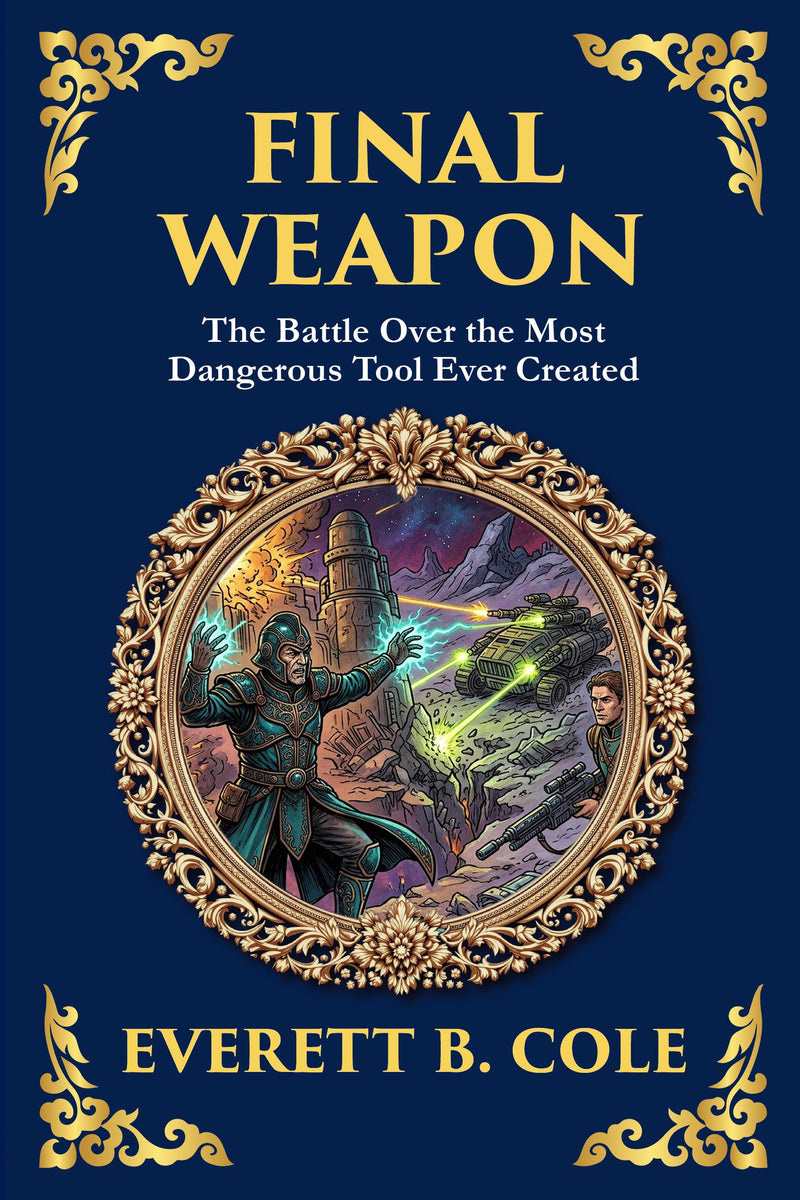
Final Weapon — Large Print
What if the deadliest weapon in the universe wasn’t a bomb, a beam, or a battleship—but an idea? In Final Weapon, military strategist turned author Everett B. Cole delivers a bold and chilling vision of future warfare—where intelligence is more dangerous than destruction, and the fate of civilizations hinges on who con
or free app
10,000+ hrs library
30-day guarantee
The complete Final Weapon appears in modern English through Library of Alexandria Press, available online with audiobook narration included for members.
Have you ever wondered why the most powerful forces in the universe are the ones you never see? Final Weapon is a riveting science fiction classic that redefines the meaning of warfare. With stunning foresight and military precision, Everett B. Cole crafts a taut, cerebral thriller about a cosmic arms race—not of machines, but of minds.
In a distant future where interplanetary alliances teeter on the edge of collapse, a group of scouts is dispatched to a seemingly insignificant world. But what they uncover there could destabilize everything. For hidden within the archives of this backwater planet lies a technology so profound, so adaptable, and so deceptively simple that it threatens to render all other weapons obsolete.
But the true power of this final weapon isn’t in how it destroys—but in how it reshapes the battlefield, the mind, and the meaning of victory.
What you’ll discover in this modern edition
- A visionary look at psychological warfare and nonviolent domination
- A thrilling narrative where diplomacy, deception, and knowledge are the real weapons
| Formats | eBook (EPUB + PDF) · Audiobook · Paperback · Hardcover · Large Print |
| Language | English |
| Trim size (print) | 6 × 9 in |
| Binding | Paperback — perfect-bound · Hardcover — casewrap |
| Large Print edition | Same text in a larger, easy-read type — a larger font, not a larger trim |
| Print pricing | Every physical book at our true cost — at-cost, no profit (members) |
| Library | 873 restored titles, always growing |
| Length | 22,911 words · ~1 hr 32 min reading |
| Reading level | Grade 3 · an easy, flowing read (this modern-English edition) |
| Edition | Modern English translation · 2026 |
Member reviews for this edition are collected as readers finish it — be the first. Across the library: 12,000+ books shipped, every plan covered by a 365-day print guarantee.
About this edition
A faithful, unabridged modern-English edition by The Library of Alexandria — carefully rendered for today's reader and verified paragraph-by-paragraph against the public-domain source. Available as eBook, audiobook, paperback, hardcover, and large print.
- Complete & unabridgedVerified paragraph by paragraph against the source — never a scan, never abridged.
- Modern English, faithfulReadable today, with the author’s meaning kept intact. Readable — not simplified.
- Every format, one membershipRead in your browser or the free app, or listen to the full audiobook.
Included free with your membership
Cancel anytime, one click · 30-day money-back guarantee
Edition last updated July 2026
What’s inside
Final Weapon — Large Print — complete and unabridged, included in full with membership, plus the full audiobook.
Begin reading Final Weapon — Large Print
In clear modern English — the complete text is included with membership.
Introduction
There is a particular thrill that comes from opening a story written in an age that believed wholeheartedly in the future. Mid-twentieth-century science fiction was not merely entertainment; it was a kind of secular prophecy, a literature of bold extrapolation in which writers gazed at the accelerating machinery of their own era and asked, with equal parts hope and dread, where it might all be leading. Final Weapon belongs squarely to that tradition. It is a work that takes the deepest anxieties of its time—the fear that humanity might construct a device so powerful it could no longer be controlled by the very hands that built it—and transforms them into a propulsive, morally serious, and frequently exhilarating adventure of ideas. To read it now, in a contemporary translation prepared with care for the modern reader, is to step into a conversation that has lost none of its urgency in the intervening decades.
Everett B. Cole was a writer of the so-called Golden Age of science fiction, a period roughly bracketed by the late 1930s and the early 1960s, when the genre matured from pulp spectacle into something genuinely capable of philosophical weight. Cole was among the contributors to Astounding Science Fiction, the magazine that, under the editorship of John W. Campbell, served as the crucible for much of what we now consider classic in the field. Campbell demanded rigor from his writers. He wanted technological speculation grounded in plausibility, characters who reasoned their way through their dilemmas rather than simply reacting to them, and stories that treated the future not as a backdrop for swashbuckling but as a real and consequential place. Cole absorbed those lessons thoroughly. His fiction tends to foreground the disciplined mind at work—the engineer, the administrator, the trained problem-solver confronting circumstances that test not only his ingenuity but his ethics. Final Weapon is very much a product of that sensibility, and understanding its lineage helps a new reader appreciate exactly what kind of pleasures lie ahead.
The title alone announces the book’s central preoccupation. A “final weapon” is, by definition, a thing that ends arguments—a tool of such overwhelming force that its mere existence reshapes every calculation around it. The subtitle sharpens the point still further: this is The Battle Over the Most Dangerous Tool Ever Created. Notice the precise word chosen there. Not the most dangerous weapon, but the most dangerous tool. That distinction is at the heart of everything the novel has to say, and it rewards careful attention before you even turn to the first chapter. A weapon is built to destroy; its purpose is unambiguous. A tool, by contrast, is morally neutral until a human hand directs it. A hammer can build a house or break a skull. The same principle of leverage that lets a single person move a great weight can, when scaled up and turned to malign ends, become an instrument of catastrophe. By framing its central object as a tool that has become—or might become—a weapon, the story refuses to let us off the hook with the comforting fiction that some technologies are simply evil in themselves. The danger, the book insists, lies not in the device but in the contest over who shall wield it, to what end, and under what restraint. That is the “battle” the subtitle promises, and it is a battle fought as much in the conscience and the council chamber as on any field of conflict.
This is precisely the question that haunted the generation in which Cole wrote, and it is the question that makes the novel feel startlingly current to us today. The men and women who lived through the middle of the twentieth century had watched human ingenuity unlock forces that seemed to belong to the gods—forces that could illuminate cities or incinerate them, depending entirely on the intentions of those in command. The literature of that era is shot through with a profound unease about the gap between technical capability and moral wisdom. We had learned how to do things faster than we had learned whether we ought to do them. Science fiction became one of the few cultural spaces where that gap could be examined honestly, where writers could run the experiment forward in their imaginations and report back on what they found. Cole’s contribution to that examination is distinctive because he refuses easy answers. He does not simply warn that power corrupts, nor does he indulge the naïve optimism that good engineering will always save us. Instead he dramatizes the genuine difficulty of the problem—the way that responsible people, acting from defensible motives, can nonetheless find themselves on opposite sides of a question with no clean resolution.
One of the great satisfactions of vintage science fiction at its best is the architecture of its worlds. The writers of Cole’s generation did not regard setting as mere decoration; they constructed their futures with an engineer’s respect for how things actually fit together. A society with a particular technology would have particular institutions, particular pressures, particular blind spots. The careful reader is invited not just to be entertained but to inhabit a fully realized hypothesis about how human beings might organize themselves under conditions we have not yet encountered. Final Weapon exemplifies this constructive imagination. Without revealing the specifics of its plot, I can say that you are about to enter a world that has been thought through, where the existence of the central technology has consequences that ripple outward into politics, into the structure of authority, into the relationships between those who hold knowledge and those who hold power.
This is worth dwelling on, because it shapes how the book ought to be read. Modern readers, accustomed to the breakneck pacing and cinematic spectacle of contemporary blockbusters, sometimes approach older science fiction expecting either the same rhythms or a quaint, dated simplicity. They will find neither here. What they will find instead is a story that trusts its reader to think. Cole assumes you are interested in the how and the why, not merely the what. He lays out the logic of his world with patience and precision, and the tension he generates arises organically from that logic. When the stakes rise—and they do rise, dramatically—they rise because the reader has been brought to understand exactly what is at risk and exactly why the choices facing the characters are so agonizing. This is suspense of a particularly durable kind, the suspense of consequence rather than mere surprise. It does not depend on withholding information so much as on making us feel the full weight of the information we have been given.
There is also a distinctly procedural pleasure to Cole’s storytelling, in the best sense of that word. His protagonists tend to be competent people doing difficult jobs, and the novel takes genuine interest in the texture of that competence. We watch them reason. We watch them weigh options, anticipate the moves of those who oppose them, marshal resources, and adapt when their plans collide with reality. There is something deeply satisfying about following an intelligent mind as it grapples with a hard problem, and Cole is a master of this register. The Golden Age produced many heroes of this type—the capable individual whose chief weapon is his understanding—and they remain compelling precisely because they flatter and engage the reader’s own intelligence. We are invited to solve alongside them, to test our own conclusions against theirs, to feel the click of recognition when a piece of the puzzle falls into place.
Yet it would be a mistake to imagine that the book is merely an intellectual exercise dressed up in the costume of adventure. Cole understood that ideas only matter in fiction when they are embodied in people who care about the outcome. The battle over the final weapon is not an abstract debate conducted by interchangeable mouthpieces; it is a human struggle, with all the friction, ambition, fear, and conviction that human struggles entail. The danger of the central tool becomes vivid not because we are told it is dangerous but because we come to understand what its misuse would mean for the people we have come to know. This is the alchemy by which speculative fiction turns thought into feeling, and it is the reason the genre’s best work endures long after the specific technologies it imagined have been overtaken or rendered obsolete by history. We do not read these stories to predict the future accurately. We read them to rehearse, in safety, the moral and emotional challenges that any future will bring.
The present edition has been prepared as a modern translation and adaptation for the contemporary reader, and a word about what that means—and what it does not mean—will serve you well as you begin. The aim of such an adaptation is never to overwrite the author’s voice or to sand away the distinctive flavor of the period in which the work was written. That flavor is part of the pleasure, and any sensitive editor knows it. What an adaptation of this kind seeks to do, rather, is to clear away the small obstacles that can stand between a modern reader and a story written for an audience with different assumptions and habits of attention. Conventions of phrasing that have grown stiff with age, references whose context has faded, structures of presentation that once felt natural but now interrupt the flow—these can be gently modernized so that the living core of the narrative comes through with maximum clarity and force. The goal is fidelity of experience: to let you feel what the original readers felt, the excitement and the provocation, without the friction that the passage of time inevitably introduces. Think of it as the careful cleaning of a fine old painting, removing the yellowed varnish so that the original colors can shine again, while leaving every brushstroke of the artist intact.
It is tempting, when introducing a work of vintage science fiction, to dwell on how prescient it was—to play the game of cataloguing all the ways in which yesterday’s imagination anticipated today’s reality. There is some fun in that game, and an attentive reader of Final Weapon will certainly notice moments that resonate uncannily with our present circumstances. But I want to suggest that the deeper value of the book lies elsewhere, in something more lasting than mere prophecy. The questions Cole raises are not questions that any particular era can answer once and for all. They are perennial questions, and each generation must confront them anew in the specific forms its own technologies present.
Consider our own moment. We live in an age in which the gap between capability and wisdom that so troubled Cole’s generation has, if anything, widened. We have built tools of extraordinary power—systems that can shape what billions of people think and believe, machines that can make decisions faster than any human can follow, technologies whose long-term consequences we are only beginning to glimpse. And around each of these tools rages a battle precisely like the one this novel dramatizes: a contest over who shall control them, who shall be trusted with them, what limits ought to be placed upon their use, and whether the people who create such things bear a special responsibility for what is done with them. The vocabulary has changed. The fundamental dilemma has not. When you read about the struggle at the center of this book, you are reading about a struggle that is being conducted, in different language and with different particulars, in laboratories and boardrooms and legislatures all around you right now. That is what gives the novel its strange and persistent power. Cole was not writing about any one technology. He was writing about the permanent predicament of a species clever enough to build things it is not always wise enough to govern.
The book also has something valuable to say about the nature of responsibility itself. One of the recurring questions in fiction of this kind is whether the maker of a dangerous thing can wash his hands of the consequences. Is the engineer who builds the tool culpable for the uses to which others put it? Or does responsibility lie solely with the hand that pulls the trigger? Cole does not deliver a simple verdict, and this refusal is part of his integrity as a writer. He allows the question to remain genuinely difficult, to be argued from multiple sides by characters who each have something worth hearing. The reader is not handed a conclusion to swallow but is instead drawn into the deliberation, made a participant in the moral reckoning. This is a much more demanding and rewarding kind of fiction than the sort that flatters us by confirming what we already believe. It leaves us, when we close the book, still turning the problem over in our minds—which is exactly where a serious work of speculative fiction wants to leave us.
Cancel anytime, one click · 30-day money-back guarantee
Founding annual rate available now — your price locks for life when you join.
Not ready? Get this free chapter by email — read it anytime.
✓ Sent — check your inbox for Final Weapon — Large Print.
Questions about Final Weapon — Large Print
What is Final Weapon about?
What if the deadliest weapon in the universe wasn’t a bomb, a beam, or a battleship—but an idea? In Final Weapon, military strategist turned author Everett B. Cole delivers a bold and chilling vision of future warfare—where intelligence is more dangerous than destruction, and the fate of civilizations hinges on who controls the truth. As interstellar empires face off in a quiet war of minds, one planet hides a secret that could rewrite the rules of power forever.
Who wrote Final Weapon?
Final Weapon was written by Everett B. Cole. This edition presents the complete work in clear modern English, faithfully rendered from the public-domain original by Library of Alexandria Press.
Is Final Weapon free to read?
The opening chapter is free to read on this page. Members read and listen to the complete work — and the entire library — free, and can order any physical book at our true print cost.
How long is Final Weapon?
2 chapters (~22,911 words) — about 1 hr 32 min of reading in this modern-English edition.
Is this an abridged version of Final Weapon?
No. This is the complete, unabridged Final Weapon, carefully rendered into clear modern English and verified paragraph-by-paragraph against the public-domain source — nothing is cut or summarised.
What formats does Final Weapon come in?
Final Weapon is available as eBook, paperback, hardcover and large print. eBook and audiobook are included with membership; printed editions ship at our true print cost.
Shipping & returns
Billing & membership
More from the library


Explore Free eBooks
- Kant's Prolegomena to Any Future Metaphysics · Immanuel Kant
- The Advancement of Learning · Francis Bacon
- The Dawn of Day · Friedrich Nietzsche
- Peter and Wendy · J. M. Barrie
- Meditations · Marcus Aurelius
- The Confessions of St. Augustine · Saint Augustine of Hippo
- Resurrection · Leo Tolstoy
- Dialogues Concerning Natural Religion · David Hume
- As You Like It · William Shakespeare
- Jack and Jill · Louisa May Alcott
- Dream Psychology: Psychoanalysis for Beginners · Sigmund Freud
- The Raven · Edgar Allan Poe
- Considerations on Representative Government · John Stuart Mill
- The Will to Power: An Attempted Transvaluation of All Values. Book III and IV · Friedrich Nietzsche
- Tarzan of the Apes · Edgar Rice Burroughs
- Fundamental Principles of the Metaphysic of Morals · Immanuel Kant
- The Confessions of Jean Jacques Rousseau — Complete · Jean-Jacques Rousseau
- The Merchant of Venice · William Shakespeare
- Democracy in America — Volume 2 · Alexis de Tocqueville
- Ecce Homo · Friedrich Wilhelm Nietzsche
- Second Treatise of Government · John Locke
- The Wonderful Wizard of Oz · L. Frank Baum
- The Prince · Niccolò Machiavelli
- Anne of Green Gables · L. M. Montgomery
- De Profundis · Oscar Wilde
- Thus Spake Zarathustra: A Book for All and None · Friedrich Nietzsche
- Anna Karenina · Leo Tolstoy
- Great Expectations · Charles Dickens
- The Island of Doctor Moreau · H. G. Wells
- A Midsummer Night's Dream · William Shakespeare
Final Weapon — Large Print
Final Weapon — Large Print
The Battle Over the Most Dangerous Tool Ever Created
Everett B. Cole
Contents
- Introduction
- Final Weapon
Introduction
There is a particular thrill that comes from opening a story written in an age that believed wholeheartedly in the future. Mid-twentieth-century science fiction was not merely entertainment; it was a kind of secular prophecy, a literature of bold extrapolation in which writers gazed at the accelerating machinery of their own era and asked, with equal parts hope and dread, where it might all be leading. Final Weapon belongs squarely to that tradition. It is a work that takes the deepest anxieties of its time—the fear that humanity might construct a device so powerful it could no longer be controlled by the very hands that built it—and transforms them into a propulsive, morally serious, and frequently exhilarating adventure of ideas. To read it now, in a contemporary translation prepared with care for the modern reader, is to step into a conversation that has lost none of its urgency in the intervening decades.
Everett B. Cole was a writer of the so-called Golden Age of science fiction, a period roughly bracketed by the late 1930s and the early 1960s, when the genre matured from pulp spectacle into something genuinely capable of philosophical weight. Cole was among the contributors to Astounding Science Fiction, the magazine that, under the editorship of John W. Campbell, served as the crucible for much of what we now consider classic in the field. Campbell demanded rigor from his writers. He wanted technological speculation grounded in plausibility, characters who reasoned their way through their dilemmas rather than simply reacting to them, and stories that treated the future not as a backdrop for swashbuckling but as a real and consequential place. Cole absorbed those lessons thoroughly. His fiction tends to foreground the disciplined mind at work—the engineer, the administrator, the trained problem-solver confronting circumstances that test not only his ingenuity but his ethics. Final Weapon is very much a product of that sensibility, and understanding its lineage helps a new reader appreciate exactly what kind of pleasures lie ahead.
The title alone announces the book’s central preoccupation. A “final weapon” is, by definition, a thing that ends arguments—a tool of such overwhelming force that its mere existence reshapes every calculation around it. The subtitle sharpens the point still further: this is The Battle Over the Most Dangerous Tool Ever Created. Notice the precise word chosen there. Not the most dangerous weapon, but the most dangerous tool. That distinction is at the heart of everything the novel has to say, and it rewards careful attention before you even turn to the first chapter. A weapon is built to destroy; its purpose is unambiguous. A tool, by contrast, is morally neutral until a human hand directs it. A hammer can build a house or break a skull. The same principle of leverage that lets a single person move a great weight can, when scaled up and turned to malign ends, become an instrument of catastrophe. By framing its central object as a tool that has become—or might become—a weapon, the story refuses to let us off the hook with the comforting fiction that some technologies are simply evil in themselves. The danger, the book insists, lies not in the device but in the contest over who shall wield it, to what end, and under what restraint. That is the “battle” the subtitle promises, and it is a battle fought as much in the conscience and the council chamber as on any field of conflict.
This is precisely the question that haunted the generation in which Cole wrote, and it is the question that makes the novel feel startlingly current to us today. The men and women who lived through the middle of the twentieth century had watched human ingenuity unlock forces that seemed to belong to the gods—forces that could illuminate cities or incinerate them, depending entirely on the intentions of those in command. The literature of that era is shot through with a profound unease about the gap between technical capability and moral wisdom. We had learned how to do things faster than we had learned whether we ought to do them. Science fiction became one of the few cultural spaces where that gap could be examined honestly, where writers could run the experiment forward in their imaginations and report back on what they found. Cole’s contribution to that examination is distinctive because he refuses easy answers. He does not simply warn that power corrupts, nor does he indulge the naïve optimism that good engineering will always save us. Instead he dramatizes the genuine difficulty of the problem—the way that responsible people, acting from defensible motives, can nonetheless find themselves on opposite sides of a question with no clean resolution.
One of the great satisfactions of vintage science fiction at its best is the architecture of its worlds. The writers of Cole’s generation did not regard setting as mere decoration; they constructed their futures with an engineer’s respect for how things actually fit together. A society with a particular technology would have particular institutions, particular pressures, particular blind spots. The careful reader is invited not just to be entertained but to inhabit a fully realized hypothesis about how human beings might organize themselves under conditions we have not yet encountered. Final Weapon exemplifies this constructive imagination. Without revealing the specifics of its plot, I can say that you are about to enter a world that has been thought through, where the existence of the central technology has consequences that ripple outward into politics, into the structure of authority, into the relationships between those who hold knowledge and those who hold power.
This is worth dwelling on, because it shapes how the book ought to be read. Modern readers, accustomed to the breakneck pacing and cinematic spectacle of contemporary blockbusters, sometimes approach older science fiction expecting either the same rhythms or a quaint, dated simplicity. They will find neither here. What they will find instead is a story that trusts its reader to think. Cole assumes you are interested in the how and the why, not merely the what. He lays out the logic of his world with patience and precision, and the tension he generates arises organically from that logic. When the stakes rise—and they do rise, dramatically—they rise because the reader has been brought to understand exactly what is at risk and exactly why the choices facing the characters are so agonizing. This is suspense of a particularly durable kind, the suspense of consequence rather than mere surprise. It does not depend on withholding information so much as on making us feel the full weight of the information we have been given.
There is also a distinctly procedural pleasure to Cole’s storytelling, in the best sense of that word. His protagonists tend to be competent people doing difficult jobs, and the novel takes genuine interest in the texture of that competence. We watch them reason. We watch them weigh options, anticipate the moves of those who oppose them, marshal resources, and adapt when their plans collide with reality. There is something deeply satisfying about following an intelligent mind as it grapples with a hard problem, and Cole is a master of this register. The Golden Age produced many heroes of this type—the capable individual whose chief weapon is his understanding—and they remain compelling precisely because they flatter and engage the reader’s own intelligence. We are invited to solve alongside them, to test our own conclusions against theirs, to feel the click of recognition when a piece of the puzzle falls into place.
Yet it would be a mistake to imagine that the book is merely an intellectual exercise dressed up in the costume of adventure. Cole understood that ideas only matter in fiction when they are embodied in people who care about the outcome. The battle over the final weapon is not an abstract debate conducted by interchangeable mouthpieces; it is a human struggle, with all the friction, ambition, fear, and conviction that human struggles entail. The danger of the central tool becomes vivid not because we are told it is dangerous but because we come to understand what its misuse would mean for the people we have come to know. This is the alchemy by which speculative fiction turns thought into feeling, and it is the reason the genre’s best work endures long after the specific technologies it imagined have been overtaken or rendered obsolete by history. We do not read these stories to predict the future accurately. We read them to rehearse, in safety, the moral and emotional challenges that any future will bring.
The present edition has been prepared as a modern translation and adaptation for the contemporary reader, and a word about what that means—and what it does not mean—will serve you well as you begin. The aim of such an adaptation is never to overwrite the author’s voice or to sand away the distinctive flavor of the period in which the work was written. That flavor is part of the pleasure, and any sensitive editor knows it. What an adaptation of this kind seeks to do, rather, is to clear away the small obstacles that can stand between a modern reader and a story written for an audience with different assumptions and habits of attention. Conventions of phrasing that have grown stiff with age, references whose context has faded, structures of presentation that once felt natural but now interrupt the flow—these can be gently modernized so that the living core of the narrative comes through with maximum clarity and force. The goal is fidelity of experience: to let you feel what the original readers felt, the excitement and the provocation, without the friction that the passage of time inevitably introduces. Think of it as the careful cleaning of a fine old painting, removing the yellowed varnish so that the original colors can shine again, while leaving every brushstroke of the artist intact.
It is tempting, when introducing a work of vintage science fiction, to dwell on how prescient it was—to play the game of cataloguing all the ways in which yesterday’s imagination anticipated today’s reality. There is some fun in that game, and an attentive reader of Final Weapon will certainly notice moments that resonate uncannily with our present circumstances. But I want to suggest that the deeper value of the book lies elsewhere, in something more lasting than mere prophecy. The questions Cole raises are not questions that any particular era can answer once and for all. They are perennial questions, and each generation must confront them anew in the specific forms its own technologies present.
Consider our own moment. We live in an age in which the gap between capability and wisdom that so troubled Cole’s generation has, if anything, widened. We have built tools of extraordinary power—systems that can shape what billions of people think and believe, machines that can make decisions faster than any human can follow, technologies whose long-term consequences we are only beginning to glimpse. And around each of these tools rages a battle precisely like the one this novel dramatizes: a contest over who shall control them, who shall be trusted with them, what limits ought to be placed upon their use, and whether the people who create such things bear a special responsibility for what is done with them. The vocabulary has changed. The fundamental dilemma has not. When you read about the struggle at the center of this book, you are reading about a struggle that is being conducted, in different language and with different particulars, in laboratories and boardrooms and legislatures all around you right now. That is what gives the novel its strange and persistent power. Cole was not writing about any one technology. He was writing about the permanent predicament of a species clever enough to build things it is not always wise enough to govern.
The book also has something valuable to say about the nature of responsibility itself. One of the recurring questions in fiction of this kind is whether the maker of a dangerous thing can wash his hands of the consequences. Is the engineer who builds the tool culpable for the uses to which others put it? Or does responsibility lie solely with the hand that pulls the trigger? Cole does not deliver a simple verdict, and this refusal is part of his integrity as a writer. He allows the question to remain genuinely difficult, to be argued from multiple sides by characters who each have something worth hearing. The reader is not handed a conclusion to swallow but is instead drawn into the deliberation, made a participant in the moral reckoning. This is a much more demanding and rewarding kind of fiction than the sort that flatters us by confirming what we already believe. It leaves us, when we close the book, still turning the problem over in our minds—which is exactly where a serious work of speculative fiction wants to leave us.
Humans have created many lethal weapons. Today, the most effective tool for destroying a person’s hopes and security is the file folder... and that was the weapon Morely knew and loved. However, something even more powerful was about to arrive.
District Leader Howard Morely leaned back in his seat and glanced down at the bay. He let his eyes wander across the water between the two blunt points of land, then looked back at the skeletal spire rising from the green hills he had just flown over. He remembered when that ruin had been a support for one of the world’s greatest bridges.
Now, a crumbling symbol of the past, it stubbornly withstood the weather, just as it had once survived much more powerful explosions. It stubbornly pointed its rusty frame toward the sky, reminding anyone who saw it of past conflicts—and more.
Along with the tangled cables barely visible in the shallow water, the line of debris in the channel, and the weed-covered strip of broken concrete cutting through the hills, it proved that the age of flight had arrived. Bridges, highways, and harbors were all obsolete.
Not far from the ruined bridge support, Morely saw the massive, well-kept intake of one of the chemical extraction plants. He shook his head at the contrast.
“That eyesore should be torn down,” he muttered. “It should have been removed long ago. I suggested it in a report, but I guess it never reached the Old Man. He relies on his staff too much. If I ran the region, I would—”
He shook his head. He wasn’t the regional director—not yet. One day, the old director would retire. Then, Central Coordination would review the records of the various district leaders to find a successor. Then—
End of the free sample
Keep reading, free
Members read and listen to the complete book — and the entire library. Cancel anytime, one click · 30-day money-back guarantee.