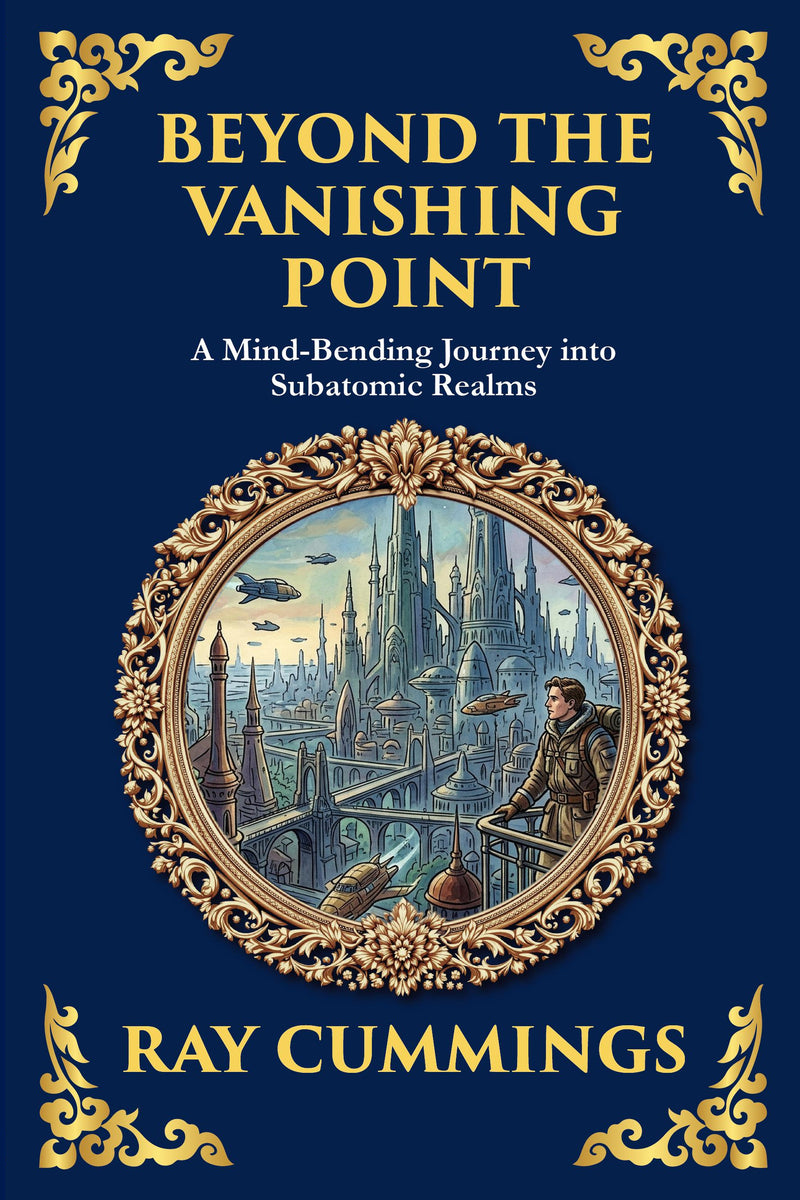
Beyond the Vanishing Point
What lies beneath the surface of the visible world? In Beyond the Vanishing Point, visionary author Ray Cummings takes readers on an unforgettable plunge into the microscopic universe.
or free app
10,000+ hrs library
30-day guarantee
The complete Beyond the Vanishing Point appears in modern English through Library of Alexandria Press, available online with audiobook narration included for members.
Have you ever wondered why the universe inside an atom might be just as vast—and dangerous—as the stars above? In Beyond the Vanishing Point, Ray Cummings—pioneering master of early science fiction— invites readers into a reality where the infinitely small becomes unimaginably vast. This groundbreaking novella fuses classic adventure, scientific speculation, and philosophical wonder into one extraordinary journey.
When famed physicist George Randolph invents a way to shrink matter beyond molecular scale, he does the unthinkable—he enters a world within a world. As he descends past atoms into the subatomic frontier, he finds cities, creatures, and intelligent beings living in realms untouched by the eye of man. But the deeper he goes, the more warped reality becomes.
Can the human mind survive in a world where time and scale mean nothing? At once thrilling and intellectually provocative, Beyond the Vanishing Point challenges every assumption we have about scale, perception, and the structure of the universe. Originally published during the Golden Age of pulp science fiction, this story remains a mind-bending masterpiece for readers of all ages.
What you’ll discover in this modern edition
- A Daring Descent into the Subatomic World – Follow a scientist as he journeys past molecules and electrons into unknown worlds.
| Formats | eBook (EPUB + PDF) · Audiobook · Paperback · Hardcover · Large Print |
| Language | English |
| Trim size (print) | 6 × 9 in |
| Binding | Paperback — perfect-bound · Hardcover — casewrap |
| Large Print edition | Same text in a larger, easy-read type — a larger font, not a larger trim |
| Print pricing | Every physical book at our true cost — at-cost, no profit (members) |
| Library | 873 restored titles, always growing |
| Length | 31,386 words · ~2 hr 6 min reading |
| Reading level | Grade 6 · an easy, flowing read (this modern-English edition) |
| Edition | Modern English translation · 2026 |
Member reviews for this edition are collected as readers finish it — be the first. Across the library: 12,000+ books shipped, every plan covered by a 365-day print guarantee.
About this edition
A faithful, unabridged modern-English edition by The Library of Alexandria — carefully rendered for today's reader and verified paragraph-by-paragraph against the public-domain source. Available as eBook, audiobook, paperback, hardcover, and large print.
- Complete & unabridgedVerified paragraph by paragraph against the source — never a scan, never abridged.
- Modern English, faithfulReadable today, with the author’s meaning kept intact. Readable — not simplified.
- Every format, one membershipRead in your browser or the free app, or listen to the full audiobook.
Included free with your membership
Cancel anytime, one click · 30-day money-back guarantee
Edition last updated July 2026
What’s inside
Beyond the Vanishing Point — complete and unabridged: all 13 sections included with membership, plus the full audiobook.
Begin reading Beyond the Vanishing Point
In clear modern English — the complete text is included with membership.
Introduction
There is a particular kind of wonder that belongs to the early decades of the twentieth century—a wonder born at the precise moment when science fiction was discovering its own enormous possibilities, when the boundaries of the imaginable were being pushed outward in every conceivable direction. It was an age in which writers, gazing through the freshly polished lenses of new physics, new chemistry, and new astronomy, began to ask questions that no storyteller had ever dared to ask before. What lies at the edge of the very small? What if the atom, that mysterious building block of all matter, were not the end of the road but the beginning of an entirely new universe? What if a single drop of water, a fleck of dust, or the polished gold of a wedding ring contained within it landscapes, cities, oceans, and lives as rich and tumultuous as our own?
These are the questions that animate the pages that follow, and they are questions that Ray Cummings answered with a verve and inventiveness that helped define an entire genre. The book you are about to read is a journey, in the most literal and exhilarating sense of the word. It is a descent—or perhaps an ascent, for direction becomes a slippery concept in tales like this—into realms that exist beneath the threshold of ordinary perception. It is a story that takes the abstract and frequently bewildering discoveries of modern physics and transforms them into a stage upon which adventure, romance, peril, and discovery can play out at a human scale, even as that human scale is shrunk to dimensions almost too small to comprehend.
This edition has been carefully prepared as a modern translation, adapted for the contemporary reader. What does that mean, and why does it matter? It means that while the heart of the story—the ideas, the imagery, the propulsive sense of forward motion—remains entirely intact, the language and presentation have been gently brought into closer harmony with the expectations of today’s audience. The result is a reading experience that preserves the flavor and the audacity of the original while smoothing away some of the more dated conventions that can, for the present-day reader, occasionally interrupt the pleasure of immersion. Think of it not as a replacement for the original but as a doorway—a means by which a remarkable work of imaginative fiction, first conceived in an era very different from our own, can be encountered freshly, vividly, and without unnecessary friction.
To appreciate fully what you hold in your hands, it helps to understand a little about the man who created it and the moment in which he wrote. Ray Cummings (1887–1957) occupies a place of genuine importance in the history of science fiction, a position earned through both the sheer volume of his output and the influence he exerted on the writers who came after him. He was, in many ways, one of the founding architects of the genre as we have come to know it—a figure whose work helped bridge the gap between the scientific romances of pioneers like H. G. Wells and Jules Verne and the great explosion of pulp-magazine science fiction that would dominate the middle decades of the twentieth century.
Cummings came to writing by an unusual and rather telling route. For a period of his early career, he worked as a personal assistant to none other than Thomas Edison—a detail that cannot help but illuminate the spirit of his fiction. Here was a young man who had stood close to the very engine of American invention, who had breathed the air of laboratories where the future was being assembled bolt by bolt and wire by wire. It is no surprise, then, that his stories crackle with a fascination for machinery, for apparatus, for the gadgetry of discovery. His characters are forever tinkering, calibrating, peering through instruments, adjusting dials, and recording observations. Science in his fiction is not a remote abstraction but a hands-on, sleeves-rolled-up enterprise, and this gives his work a wonderfully tactile quality. You can almost smell the ozone and hear the hum of the equipment.
But Cummings was no mere chronicler of machinery. His real gift lay in his ability to take a scientific premise and run with it to its most dizzying imaginative conclusions. He is perhaps best remembered for his explorations of scale and of time—two of the most fundamental and slippery concepts in all of physics. His most famous early work, “The Girl in the Golden Atom,” published in 1919, introduced readers to the breathtaking idea that an entire inhabited world might exist within the structure of a single atom, invisible to us simply because it is so unimaginably small. That story electrified its readers and established Cummings as a writer of singular vision. The book you are about to read belongs to this same magnificent tradition of inquiry into the subatomic frontier, extending and enriching the themes that made Cummings a household name among the readers of the early science-fiction magazines.
It is worth pausing here to reflect on just how bold these ideas were at the time of their conception. In the 1910s and 1920s, the structure of the atom was itself a matter of fevered scientific debate. The work of Ernest Rutherford, Niels Bohr, and others was only beginning to reveal the strange architecture of the atomic interior—the dense nucleus, the orbiting electrons, the vast proportional emptiness within what had once been imagined as a solid, indivisible particle. To the popular imagination, the atom presented a tantalizing parallel: if it was a tiny solar system, with electrons circling a nucleus much as planets circle a sun, then might not those electrons themselves be worlds? Might there not be, upon their surfaces, mountains and seas and beings looking up at their own miniature heavens? It was a fantastical leap, scientifically speaking, but it was precisely the kind of leap that great speculative fiction is made to perform. Cummings seized upon this idea and gave it flesh, motion, and drama.
The world in which Cummings wrote was one hungry for exactly this kind of storytelling. The early twentieth century was a period of staggering technological transformation. Within a single generation, humanity had witnessed the arrival of the automobile, the airplane, the telephone, the radio, and the motion picture. The pace of change was intoxicating and, to many, almost frightening. Science seemed capable of anything, and the public appetite for stories that explored the wilder shores of scientific possibility was enormous. The pulp magazines—those cheap, colorful, wood-pulp-paper periodicals that flooded newsstands—became the vehicle for this appetite, and writers like Cummings became its champions. They wrote quickly, prolifically, and with an unembarrassed enthusiasm for the marvelous. Their stories were not always polished in the literary sense, but they possessed something arguably more valuable: a contagious sense of awe.
What awaits you in these pages is, at its core, an adventure—and a grand one. But it is an adventure of a very particular and rather rare kind, one that depends upon a single, transformative idea: that size is relative, that the boundary between the large and the small is not a wall but a horizon, and that beyond the so-called vanishing point—the limit beyond which the unaided eye can no longer perceive—there lies not nothingness but an entire cosmos waiting to be explored.
The premise invites us to reconsider some of our most deeply held assumptions about the nature of reality. We tend to think of the world we inhabit as the world, the definitive scale at which existence properly occurs. But why should this be so? Our perception of size is, after all, entirely a matter of perspective. A creature the size of an ant experiences a blade of grass as a towering pillar; a creature the size of a whale would scarcely notice the same blade at all. If we could somehow alter our own scale—if we could shrink ourselves down, down, ever down, past the limits of the microscope and into the realm of molecules and atoms—what would we find? Would the laws of nature still apply in the same way? Would we encounter dangers and marvels for which our ordinary experience has left us wholly unprepared?
Cummings answers these questions with an imagination of remarkable fertility, and one of the great pleasures of the book lies in watching him work out the implications of his premise with logical care. He does not simply assert that such journeys are possible; he constructs, with the diligence of an engineer, the mechanism by which they might be accomplished, and he attends faithfully to the consequences. The result is a narrative that feels grounded even as it soars into the fantastical—a quality that distinguishes the very best science fiction from mere fantasy. There are rules in Cummings’s universe, and the tension of the story arises in no small part from the characters’ efforts to understand and navigate those rules as they venture ever deeper into the unknown.
Without revealing the particulars of the plot—for the discovery of those particulars is among the chief joys awaiting you—it can be said that the story unfolds with a steady accumulation of wonder. There is a sense of perpetual descent into the unfamiliar, of each new layer of the subatomic world revealing something stranger and more arresting than the last. The reader, accompanying the characters on their journey, experiences the vertiginous thrill of stepping into territory where ordinary intuitions no longer hold. Distances expand and contract in bewildering ways. Time itself takes on unfamiliar properties. The very concepts of “up” and “down,” “near” and “far,” begin to lose their fixed meanings. It is a literary experience designed to induce that most precious of sensations: the dizzying, exhilarating recognition that the universe is far larger, far stranger, and far more various than our everyday lives ever allow us to suspect—and that this vastness extends not only outward toward the stars but inward, into the infinitesimal heart of matter itself.
Yet for all its conceptual daring, the book never loses sight of the human element that gives any story its emotional weight. Cummings understood that wonder alone is not enough to sustain a narrative; there must also be characters whose fates we come to care about, perils that quicken the pulse, and relationships that engage the heart. And so, woven throughout the scientific marvels, you will find the timeless ingredients of great adventure fiction: courage tested against overwhelming odds, loyalty and friendship strained and proven, the spark of romance, and the constant, propulsive question of what happens next. The characters who undertake this extraordinary journey are not mere observers cataloging the strangeness around them; they are participants, caught up in events that demand resourcefulness, bravery, and quick thinking. Their humanity provides the anchor that keeps the story tethered to our sympathies even as it carries us into realms utterly beyond the range of ordinary experience.
This balance—between the cosmic and the personal, between the abstractly scientific and the urgently human—is one of the hallmarks of Cummings’s craft and one of the reasons his work has endured. He never forgot that the purpose of his speculation was, finally, to tell a story about people, and that the most outlandish setting becomes meaningful only when populated by individuals whose hopes and fears we can share. As you read, you will find yourself drawn not only by the marvels of the subatomic landscape but by the desire to know how its human travelers will fare amid those marvels.
It is also worth noting the influence that stories like this one have exerted on the broader culture of imaginative fiction. The notion of journeys into the very small—of microscopic or subatomic worlds teeming with life and incident—has become a recurring motif in science fiction, fantasy, film, and television, recurring again and again in forms both serious and playful. When we encounter a tale of characters shrunk to miniature size, navigating a world transformed by their altered scale, we are encountering, whether we know it or not, the legacy of pioneers like Ray Cummings, who first charted these imaginative territories and demonstrated their dramatic potential. To read this book, then, is to return to a wellspring—to experience, in something close to its original form, an idea that has since rippled outward through a century of storytelling. There is a particular satisfaction in this, the satisfaction of seeing where a great tradition began and recognizing the freshness and audacity it possessed before it became familiar.
Cancel anytime, one click · 30-day money-back guarantee
Founding annual rate available now — your price locks for life when you join.
Not ready? Get this free chapter by email — read it anytime.
✓ Sent — check your inbox for Beyond the Vanishing Point.
Questions about Beyond the Vanishing Point
What is Beyond the Vanishing Point about?
What lies beneath the surface of the visible world? In Beyond the Vanishing Point, visionary author Ray Cummings takes readers on an unforgettable plunge into the microscopic universe. When a brilliant scientist discovers a way to shrink himself beyond comprehension, he enters a subatomic realm teeming with civilizations, dangers, and mysteries no human was ever meant to witness.
Who wrote Beyond the Vanishing Point?
Beyond the Vanishing Point was written by Ray Cummings. This edition presents the complete work in clear modern English, faithfully rendered from the public-domain original by Library of Alexandria Press.
Is Beyond the Vanishing Point free to read?
The opening chapter is free to read on this page. Members read and listen to the complete work — and the entire library — free, and can order any physical book at our true print cost.
How long is Beyond the Vanishing Point?
13 chapters (~31,386 words) — about 2 hr 6 min of reading in this modern-English edition.
Is this an abridged version of Beyond the Vanishing Point?
No. This is the complete, unabridged Beyond the Vanishing Point, carefully rendered into clear modern English and verified paragraph-by-paragraph against the public-domain source — nothing is cut or summarised.
What formats does Beyond the Vanishing Point come in?
Beyond the Vanishing Point is available as eBook, paperback, hardcover and large print. eBook and audiobook are included with membership; printed editions ship at our true print cost.
Shipping & returns
Billing & membership
More from the library


Explore Free eBooks
- Kant's Prolegomena to Any Future Metaphysics · Immanuel Kant
- The Advancement of Learning · Francis Bacon
- The Dawn of Day · Friedrich Nietzsche
- Peter and Wendy · J. M. Barrie
- Meditations · Marcus Aurelius
- The Confessions of St. Augustine · Saint Augustine of Hippo
- Resurrection · Leo Tolstoy
- Dialogues Concerning Natural Religion · David Hume
- As You Like It · William Shakespeare
- Jack and Jill · Louisa May Alcott
- Dream Psychology: Psychoanalysis for Beginners · Sigmund Freud
- The Raven · Edgar Allan Poe
- Considerations on Representative Government · John Stuart Mill
- The Will to Power: An Attempted Transvaluation of All Values. Book III and IV · Friedrich Nietzsche
- Tarzan of the Apes · Edgar Rice Burroughs
- Fundamental Principles of the Metaphysic of Morals · Immanuel Kant
- The Confessions of Jean Jacques Rousseau — Complete · Jean-Jacques Rousseau
- The Merchant of Venice · William Shakespeare
- Democracy in America — Volume 2 · Alexis de Tocqueville
- Ecce Homo · Friedrich Wilhelm Nietzsche
- Second Treatise of Government · John Locke
- The Wonderful Wizard of Oz · L. Frank Baum
- The Prince · Niccolò Machiavelli
- Anne of Green Gables · L. M. Montgomery
- De Profundis · Oscar Wilde
- Thus Spake Zarathustra: A Book for All and None · Friedrich Nietzsche
- Anna Karenina · Leo Tolstoy
- Great Expectations · Charles Dickens
- The Island of Doctor Moreau · H. G. Wells
- A Midsummer Night's Dream · William Shakespeare
Beyond the Vanishing Point
Beyond the Vanishing Point
A Mind-Bending Journey into Subatomic Realms
Ray Cummings
Contents
- Introduction
- Chapter 1
- Chapter 2
- Chapter 3
- Chapter 4
- Chapter 5
- Chapter 6
- Chapter 7
- Chapter 8
- Chapter 9
- Chapter 10
- Chapter 11
- Chapter 12
Introduction
There is a particular kind of wonder that belongs to the early decades of the twentieth century—a wonder born at the precise moment when science fiction was discovering its own enormous possibilities, when the boundaries of the imaginable were being pushed outward in every conceivable direction. It was an age in which writers, gazing through the freshly polished lenses of new physics, new chemistry, and new astronomy, began to ask questions that no storyteller had ever dared to ask before. What lies at the edge of the very small? What if the atom, that mysterious building block of all matter, were not the end of the road but the beginning of an entirely new universe? What if a single drop of water, a fleck of dust, or the polished gold of a wedding ring contained within it landscapes, cities, oceans, and lives as rich and tumultuous as our own?
These are the questions that animate the pages that follow, and they are questions that Ray Cummings answered with a verve and inventiveness that helped define an entire genre. The book you are about to read is a journey, in the most literal and exhilarating sense of the word. It is a descent—or perhaps an ascent, for direction becomes a slippery concept in tales like this—into realms that exist beneath the threshold of ordinary perception. It is a story that takes the abstract and frequently bewildering discoveries of modern physics and transforms them into a stage upon which adventure, romance, peril, and discovery can play out at a human scale, even as that human scale is shrunk to dimensions almost too small to comprehend.
This edition has been carefully prepared as a modern translation, adapted for the contemporary reader. What does that mean, and why does it matter? It means that while the heart of the story—the ideas, the imagery, the propulsive sense of forward motion—remains entirely intact, the language and presentation have been gently brought into closer harmony with the expectations of today’s audience. The result is a reading experience that preserves the flavor and the audacity of the original while smoothing away some of the more dated conventions that can, for the present-day reader, occasionally interrupt the pleasure of immersion. Think of it not as a replacement for the original but as a doorway—a means by which a remarkable work of imaginative fiction, first conceived in an era very different from our own, can be encountered freshly, vividly, and without unnecessary friction.
To appreciate fully what you hold in your hands, it helps to understand a little about the man who created it and the moment in which he wrote. Ray Cummings (1887–1957) occupies a place of genuine importance in the history of science fiction, a position earned through both the sheer volume of his output and the influence he exerted on the writers who came after him. He was, in many ways, one of the founding architects of the genre as we have come to know it—a figure whose work helped bridge the gap between the scientific romances of pioneers like H. G. Wells and Jules Verne and the great explosion of pulp-magazine science fiction that would dominate the middle decades of the twentieth century.
Cummings came to writing by an unusual and rather telling route. For a period of his early career, he worked as a personal assistant to none other than Thomas Edison—a detail that cannot help but illuminate the spirit of his fiction. Here was a young man who had stood close to the very engine of American invention, who had breathed the air of laboratories where the future was being assembled bolt by bolt and wire by wire. It is no surprise, then, that his stories crackle with a fascination for machinery, for apparatus, for the gadgetry of discovery. His characters are forever tinkering, calibrating, peering through instruments, adjusting dials, and recording observations. Science in his fiction is not a remote abstraction but a hands-on, sleeves-rolled-up enterprise, and this gives his work a wonderfully tactile quality. You can almost smell the ozone and hear the hum of the equipment.
But Cummings was no mere chronicler of machinery. His real gift lay in his ability to take a scientific premise and run with it to its most dizzying imaginative conclusions. He is perhaps best remembered for his explorations of scale and of time—two of the most fundamental and slippery concepts in all of physics. His most famous early work, “The Girl in the Golden Atom,” published in 1919, introduced readers to the breathtaking idea that an entire inhabited world might exist within the structure of a single atom, invisible to us simply because it is so unimaginably small. That story electrified its readers and established Cummings as a writer of singular vision. The book you are about to read belongs to this same magnificent tradition of inquiry into the subatomic frontier, extending and enriching the themes that made Cummings a household name among the readers of the early science-fiction magazines.
It is worth pausing here to reflect on just how bold these ideas were at the time of their conception. In the 1910s and 1920s, the structure of the atom was itself a matter of fevered scientific debate. The work of Ernest Rutherford, Niels Bohr, and others was only beginning to reveal the strange architecture of the atomic interior—the dense nucleus, the orbiting electrons, the vast proportional emptiness within what had once been imagined as a solid, indivisible particle. To the popular imagination, the atom presented a tantalizing parallel: if it was a tiny solar system, with electrons circling a nucleus much as planets circle a sun, then might not those electrons themselves be worlds? Might there not be, upon their surfaces, mountains and seas and beings looking up at their own miniature heavens? It was a fantastical leap, scientifically speaking, but it was precisely the kind of leap that great speculative fiction is made to perform. Cummings seized upon this idea and gave it flesh, motion, and drama.
The world in which Cummings wrote was one hungry for exactly this kind of storytelling. The early twentieth century was a period of staggering technological transformation. Within a single generation, humanity had witnessed the arrival of the automobile, the airplane, the telephone, the radio, and the motion picture. The pace of change was intoxicating and, to many, almost frightening. Science seemed capable of anything, and the public appetite for stories that explored the wilder shores of scientific possibility was enormous. The pulp magazines—those cheap, colorful, wood-pulp-paper periodicals that flooded newsstands—became the vehicle for this appetite, and writers like Cummings became its champions. They wrote quickly, prolifically, and with an unembarrassed enthusiasm for the marvelous. Their stories were not always polished in the literary sense, but they possessed something arguably more valuable: a contagious sense of awe.
What awaits you in these pages is, at its core, an adventure—and a grand one. But it is an adventure of a very particular and rather rare kind, one that depends upon a single, transformative idea: that size is relative, that the boundary between the large and the small is not a wall but a horizon, and that beyond the so-called vanishing point—the limit beyond which the unaided eye can no longer perceive—there lies not nothingness but an entire cosmos waiting to be explored.
The premise invites us to reconsider some of our most deeply held assumptions about the nature of reality. We tend to think of the world we inhabit as the world, the definitive scale at which existence properly occurs. But why should this be so? Our perception of size is, after all, entirely a matter of perspective. A creature the size of an ant experiences a blade of grass as a towering pillar; a creature the size of a whale would scarcely notice the same blade at all. If we could somehow alter our own scale—if we could shrink ourselves down, down, ever down, past the limits of the microscope and into the realm of molecules and atoms—what would we find? Would the laws of nature still apply in the same way? Would we encounter dangers and marvels for which our ordinary experience has left us wholly unprepared?
Cummings answers these questions with an imagination of remarkable fertility, and one of the great pleasures of the book lies in watching him work out the implications of his premise with logical care. He does not simply assert that such journeys are possible; he constructs, with the diligence of an engineer, the mechanism by which they might be accomplished, and he attends faithfully to the consequences. The result is a narrative that feels grounded even as it soars into the fantastical—a quality that distinguishes the very best science fiction from mere fantasy. There are rules in Cummings’s universe, and the tension of the story arises in no small part from the characters’ efforts to understand and navigate those rules as they venture ever deeper into the unknown.
Without revealing the particulars of the plot—for the discovery of those particulars is among the chief joys awaiting you—it can be said that the story unfolds with a steady accumulation of wonder. There is a sense of perpetual descent into the unfamiliar, of each new layer of the subatomic world revealing something stranger and more arresting than the last. The reader, accompanying the characters on their journey, experiences the vertiginous thrill of stepping into territory where ordinary intuitions no longer hold. Distances expand and contract in bewildering ways. Time itself takes on unfamiliar properties. The very concepts of “up” and “down,” “near” and “far,” begin to lose their fixed meanings. It is a literary experience designed to induce that most precious of sensations: the dizzying, exhilarating recognition that the universe is far larger, far stranger, and far more various than our everyday lives ever allow us to suspect—and that this vastness extends not only outward toward the stars but inward, into the infinitesimal heart of matter itself.
Yet for all its conceptual daring, the book never loses sight of the human element that gives any story its emotional weight. Cummings understood that wonder alone is not enough to sustain a narrative; there must also be characters whose fates we come to care about, perils that quicken the pulse, and relationships that engage the heart. And so, woven throughout the scientific marvels, you will find the timeless ingredients of great adventure fiction: courage tested against overwhelming odds, loyalty and friendship strained and proven, the spark of romance, and the constant, propulsive question of what happens next. The characters who undertake this extraordinary journey are not mere observers cataloging the strangeness around them; they are participants, caught up in events that demand resourcefulness, bravery, and quick thinking. Their humanity provides the anchor that keeps the story tethered to our sympathies even as it carries us into realms utterly beyond the range of ordinary experience.
This balance—between the cosmic and the personal, between the abstractly scientific and the urgently human—is one of the hallmarks of Cummings’s craft and one of the reasons his work has endured. He never forgot that the purpose of his speculation was, finally, to tell a story about people, and that the most outlandish setting becomes meaningful only when populated by individuals whose hopes and fears we can share. As you read, you will find yourself drawn not only by the marvels of the subatomic landscape but by the desire to know how its human travelers will fare amid those marvels.
It is also worth noting the influence that stories like this one have exerted on the broader culture of imaginative fiction. The notion of journeys into the very small—of microscopic or subatomic worlds teeming with life and incident—has become a recurring motif in science fiction, fantasy, film, and television, recurring again and again in forms both serious and playful. When we encounter a tale of characters shrunk to miniature size, navigating a world transformed by their altered scale, we are encountering, whether we know it or not, the legacy of pioneers like Ray Cummings, who first charted these imaginative territories and demonstrated their dramatic potential. To read this book, then, is to return to a wellspring—to experience, in something close to its original form, an idea that has since rippled outward through a century of storytelling. There is a particular satisfaction in this, the satisfaction of seeing where a great tradition began and recognizing the freshness and audacity it possessed before it became familiar.
It was just after noon on December 31, 1970, when a series of strange and shocking events began. These events pulled me into the tiny world of a gold atom, past the vanishing point and beyond the reach of even the most powerful electron microscopes. My name is George Randolph. On that pivotal afternoon, I was working as an assistant chemist for the Ajax International Dye Company, which was headquartered in New York City.
At 12:20, the telephone operator announced that Alan was calling from Quebec.
“Hello, George? Listen, you need to get up here immediately. I’m at the Chateau Frontenac in Quebec. Will you come?”
I could see his reflection in the small mirror on my desk; the stress and tension in his voice were clearly visible on his face.
“You have to, George. Babs and I really need you. Look...”
At first, he tried to make it sound like an invitation for a New Year’s Eve vacation. But I knew that wasn’t the case. Alan and Barbara were my closest friends. They were eighteen-year-old twins. I felt that Alan would always be my best friend, but my feelings for Babs ran much deeper, even though I hadn’t yet found the courage to tell her.
“You have to, George! I can’t explain everything over the phone. But I’ve seen him: he’s evil. I know it now!”
Him! Out of everyone in the world, it could only mean one person.
“He’s here!” Alan continued. “Somewhere nearby. We saw him today! I didn’t want to tell you, but that’s the reason we came. It seemed like a long shot, but I’m positive it’s him!”
I stared at the image of Alan’s eyes; they were filled with horror. His voice sounded the same. “God, George, it’s strange! Truly strange. The way he looks—he—oh, I can’t explain it now! Just get here!”
End of the free sample
Keep reading, free
Members read and listen to the complete book — and the entire library. Cancel anytime, one click · 30-day money-back guarantee.