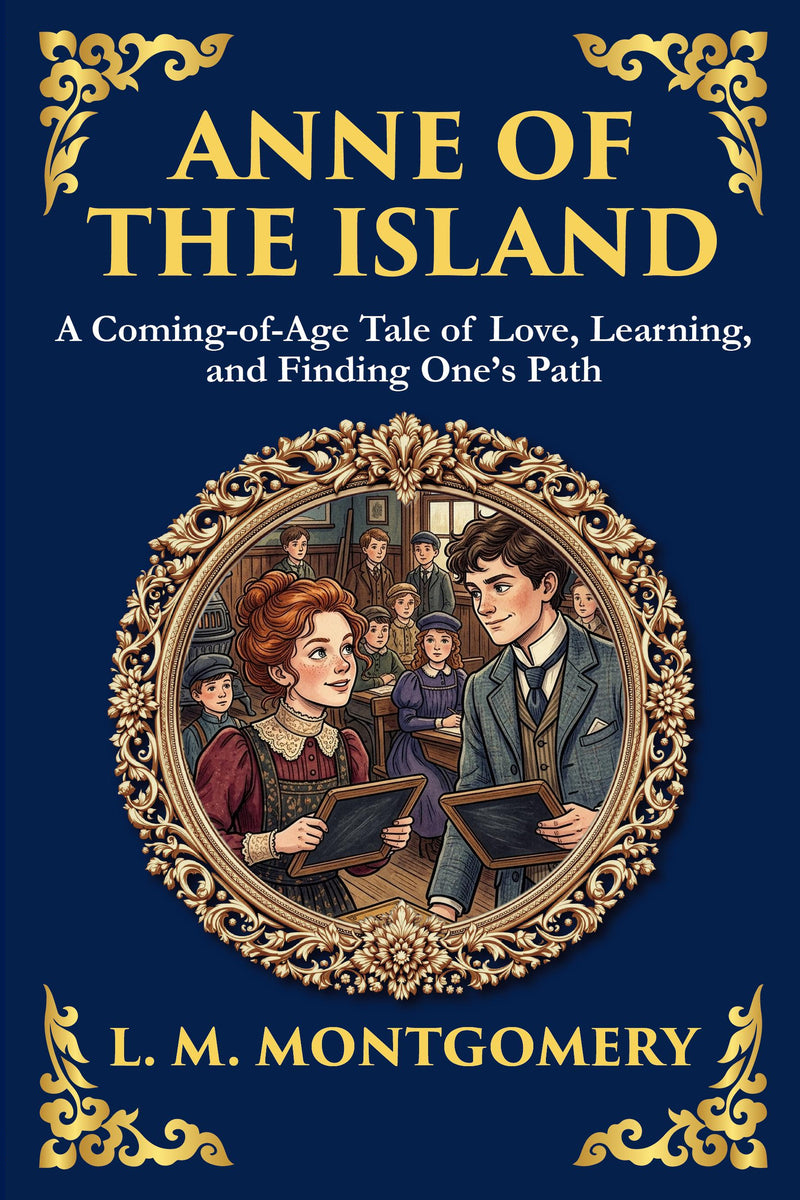
Anne of the Island
Anne Shirley has always been a dreamer, but now her dreams take her far beyond the beloved green fields of Avonlea. Leaving behind the world she knows, Anne embarks on a new journey at Redmond College, where friendship, love, and self-discovery await.
or free app
10,000+ hrs library
30-day guarantee
The complete Anne of the Island appears in modern English through Library of Alexandria Press, available online with audiobook narration included for members.
Have you ever wondered why the most meaningful journeys begin when we leave home behind? In Anne of the Island, L. M. Montgomery continues the beloved story of Anne Shirley as she takes her first steps into adulthood. Leaving Green Gables and the quiet charm of Avonlea, Anne travels to Kingsport to attend Redmond College, eager to expand her horizons and chase her dreams.
But growing up is never simple. Between demanding studies, forming new friendships, and navigating the complexities of romance, Anne faces challenges that test her character and her heart. As proposals come her way and her cherished ideals are challenged, she must decide what truly matters: ambition or simplicity, independence or partnership, dreams or reality.
This coming-of-age novel is filled with humor, heartfelt moments, and the lyrical descriptions that have made Montgomery’s writing beloved for generations. With her trademark optimism and spirit, Anne shows readers that life’s journey is as much about the heart as it is about the mind.
What you’ll discover in this modern edition
- Anne’s Journey of Self-Discovery: Watch Anne evolve from a spirited young girl into a thoughtful young woman with dreams and dilemmas of her own.
- Romance and Heartbreak: Follow Anne as she navigates matters of the heart, including unexpected proposals and the slow realization of her true feelings.
- Friendships That Last a Lifetime: Meet new friends and revisit familiar faces who shape Anne’s growth and enrich her college experience.
- Themes of Growth and Independence: Explore timeless lessons about identity, love, and the courage to make life’s defining choices.
- A Beloved Sequel to Anne of Green Gables: Continue the unforgettable story that has charmed readers for over a century.
| Formats | eBook (EPUB + PDF) · Audiobook · Paperback · Hardcover · Large Print |
| Language | English |
| Trim size (print) | 6 × 9 in |
| Binding | Paperback — perfect-bound · Hardcover — casewrap |
| Large Print edition | Same text in a larger, easy-read type — a larger font, not a larger trim |
| Print pricing | Every physical book at our true cost — at-cost, no profit (members) |
| Library | 873 restored titles, always growing |
| Length | 76,656 words · ~5 hr 7 min reading |
| Reading level | Grade 7 · an easy, flowing read (this modern-English edition) |
| Edition | Modern English translation · 2026 |
Member reviews for this edition are collected as readers finish it — be the first. Across the library: 12,000+ books shipped, every plan covered by a 365-day print guarantee.
About this edition
A faithful, unabridged modern-English edition by The Library of Alexandria — carefully rendered for today's reader and verified paragraph-by-paragraph against the public-domain source. Available as eBook, audiobook, paperback, hardcover, and large print.
- Complete & unabridgedVerified paragraph by paragraph against the source — never a scan, never abridged.
- Modern English, faithfulReadable today, with the author’s meaning kept intact. Readable — not simplified.
- Every format, one membershipRead in your browser or the free app, or listen to the full audiobook.
Included free with your membership
Cancel anytime, one click · 30-day money-back guarantee
Edition last updated July 2026
What’s inside
Anne of the Island — complete and unabridged: all 42 sections included with membership, plus the full audiobook.
Begin reading Anne of the Island
In clear modern English — the complete text is included with membership.
Introduction
When Lucy Maud Montgomery introduced the world to a red-haired, freckle-faced orphan with an imagination as wide as Prince Edward Island skies, she could scarcely have anticipated the enduring devotion that her creation would inspire across more than a century of readers. Anne Shirley arrived on the literary scene in 1908 as a chattering, dreaming, accident-prone girl whose heart was larger than her circumstances, and she has remained ever since one of the most beloved characters in English-language fiction. The novel you now hold continues her story, carrying her beyond the green gables of Avonlea and into a wider world of possibility, ambition, and self-discovery. This is the third installment in the chronicle of Anne’s life, and it occupies a particularly tender and significant place in her journey: the years of young adulthood, when childhood is fully behind and the responsibilities and revelations of grown-up life beckon with both promise and uncertainty.
To meet Anne again at this stage of her life is to encounter a familiar friend who has grown, and who continues to grow before our eyes. The girl who once captured our hearts with her runaway tongue and her endless capacity for wonder is now a young woman poised on the threshold of independence. She is leaving the only true home she has ever known to pursue higher education, and in doing so she steps into experiences that will test her, expand her, and ultimately reveal to her the truths she has long carried within without fully understanding them. The story explores what it means to chase a dream, to make new friendships while honoring old ones, to navigate the complicated terrain of the heart, and to discover that the things we search for most desperately are sometimes already close at hand. It is a story about education in the broadest sense of the word, encompassing not only books and lectures but also the deeper learning that comes from love, loss, friendship, and the slow, sometimes painful process of understanding oneself.
This particular edition has been thoughtfully prepared as a modern translation, adapted for the contemporary reader. What this means, and why it matters, deserves some explanation, for it speaks directly to the kind of reading experience you can expect to have. Montgomery wrote in the literary idiom of the early twentieth century, a style rich with the cadences, vocabulary, and cultural assumptions of her era. While that original prose possesses an undeniable charm, it can occasionally present obstacles to readers encountering it for the first time today. Certain words have fallen out of use, certain references have grown obscure, and certain sentence structures may feel ornate or unfamiliar to modern eyes. This adaptation seeks to smooth those obstacles without sacrificing the essential spirit, warmth, and beauty of the original. The goal has been to preserve everything that makes the story wonderful while ensuring that nothing stands between you and the pleasure of immersing yourself fully in Anne’s world. Whether you are returning to a cherished tale or discovering it for the very first time, this edition aims to make the experience as seamless, delightful, and emotionally resonant as possible.
A Story of Growing up and Finding One's Way
At its heart, this is a coming-of-age novel, and it belongs to a tradition that stretches back centuries and forward into our own day. The journey from youth to adulthood is one of the most universal of human experiences, and yet it never loses its capacity to move and instruct us, because each person undergoes it anew, and each generation must rediscover its lessons for itself. What makes Montgomery’s treatment of this theme so remarkable is the gentle precision with which she captures the small moments that, accumulated, amount to a life being formed. She understood that growing up is rarely a matter of dramatic turning points alone; more often it is composed of quiet realizations, gradual shifts in perspective, and the slow recognition of who we are becoming.
Anne enters these pages still very much the romantic dreamer we have always known. She has a head full of poetry and a heart full of grand ambitions. She imagines her future in vivid, idealized colors, and she approaches the world with an earnestness that is by turns endearing and gently comic. Part of the great pleasure of this story lies in watching the collision between Anne’s lofty imaginings and the realities she encounters. Life, as it has a way of doing, refuses to conform neatly to her expectations. The romantic notions she has cherished are tested against actual experience, and in that testing she learns, sometimes joyfully and sometimes painfully, to distinguish between the dreams that are worth holding onto and the illusions that must be released. This process of disillusionment is never bitter or cynical in Montgomery’s hands. Rather, it is portrayed as a necessary and even beautiful part of maturing, a refining fire that does not diminish Anne’s essential idealism but rather tempers and deepens it.
The theme of education runs throughout the narrative, and it operates on several levels at once. On the surface, Anne is pursuing formal academic study, and the novel offers a vivid portrait of student life: the lectures and examinations, the friendships forged in dormitories and boarding houses, the intellectual awakening that comes from encountering new ideas and new minds. For Anne, who has always hungered for knowledge and who has fought hard for every educational opportunity she has been given, this period represents the fulfillment of long-held aspirations. Yet Montgomery is too wise a storyteller to suggest that education is confined to the classroom. The deeper curriculum of Anne’s life unfolds in her relationships, in her encounters with people whose values and circumstances differ from her own, and in the emotional challenges she must confront. She learns about loyalty and disappointment, about the difference between admiration and love, about the ways in which people change and the ways in which true affection endures. By the novel’s close, Anne has been educated not merely in the subjects of her studies but in the far more demanding discipline of the heart.
Love, too, occupies a central place in this stage of Anne’s story, and it is handled with a delicacy and emotional intelligence that have endeared the book to generations of readers. The romantic dimensions of the narrative are woven with great subtlety. Montgomery resists the easy sentimentality that lesser writers might have indulged, and instead she traces the development of feeling with patience and psychological truth. Anne, for all her imaginative powers, proves curiously blind when it comes to certain matters of her own heart. She constructs elaborate ideals of what love ought to look like, and these ideals sometimes prevent her from recognizing the genuine article when it stands before her. The reader, perhaps, perceives things more clearly than Anne does herself, and this gentle dramatic irony lends the story much of its charm and its emotional power. Without revealing the particulars, it is fair to say that the path to understanding is neither straight nor simple, and that the journey toward clarity involves detours, misjudgments, and moments of genuine heartache. When understanding finally arrives, it does so with a sense of rightness that feels both surprising and inevitable, the mark of a story constructed with real artistry.
Friendship is another of the novel’s great preoccupations, and Montgomery renders it with the same care she lavishes on romantic love. Anne’s capacity for friendship has always been one of her defining traits, and in these pages we see her form new bonds while sustaining the cherished ties of her childhood. The new friends she makes are vividly drawn individuals, each with her own personality, ambitions, and quirks, and the dynamics among this circle of young women provide some of the book’s most delightful scenes. There is laughter here, and gossip, and shared dreams, and the particular intimacy that arises among people who are passing through an important phase of life together. At the same time, the story honors the older friendships that have shaped Anne, and it explores the bittersweet reality that as we grow and change, our relationships must grow and change with us. Some friendships deepen; others quietly fade; still others are transformed into something new. Montgomery understands that this evolution is one of the inevitable consequences of growing up, and she treats it with both tenderness and unflinching honesty.
Beneath all of these themes lies a deeper meditation on the meaning of home. Anne has known what it is to be homeless, to belong nowhere and to no one, and the home she eventually found is precious to her beyond measure. As she ventures out into the world, the question of home takes on new dimensions. What does it mean to leave home? Can one carry home within oneself? Is home a place, or is it the people who love us, or is it something we must continually seek and create throughout our lives? These questions resonate throughout the narrative, and they speak to one of the most fundamental of human longings: the desire to belong, to be rooted, to have a place in the world that is truly one’s own. Anne’s relationship to home and her ongoing negotiation of independence and belonging give the story an emotional weight that lingers long after the final page.
Part of what has made Lucy Maud Montgomery’s work so beloved across the decades is her extraordinary gift for evoking place. Prince Edward Island, the setting of so much of Anne’s life, is rendered with such loving detail that it becomes almost a character in its own right. Montgomery drew upon her own deep familiarity with the island’s landscapes, and her descriptions of its red roads, its blossoming orchards, its sweeping shores, and its changing seasons possess a vividness and a sensory richness that transport the reader directly into Anne’s world. In this novel, the action expands beyond the familiar boundaries of Avonlea, and we are introduced to new settings that broaden the canvas of the story. Yet wherever Anne goes, Montgomery’s keen eye for the beauty of the natural world accompanies her. The author had a remarkable ability to find significance and splendor in ordinary things, to see the poetry in a sunset or a garden or a quiet country lane. This sensibility infuses the entire narrative and offers the reader a constant invitation to slow down, to look closely, and to appreciate the loveliness that surrounds us.
This attentiveness to beauty is closely connected to Anne’s own character, for she has always been someone who sees the world more intensely and more imaginatively than those around her. Where others might pass by an ordinary scene without a second glance, Anne perceives wonder and possibility. She names the places she loves, she invests her surroundings with personal meaning, and she experiences the world with a heightened emotional and aesthetic sensitivity. This quality, which made her such an enchanting child, has matured into something richer in young adulthood. Anne’s imaginative engagement with life is not merely a charming eccentricity; it is the source of her resilience, her creativity, and her capacity for joy. Throughout the trials and disappointments she encounters, it is this imaginative spirit that sustains her, and Montgomery makes a quiet but powerful case for the value of seeing the world with imagination and wonder.
The novel is also notable for its humor, which lightens and enlivens the more serious themes. Montgomery possessed a sharp eye for human foible and a delicious sense of comic timing. The supporting characters who populate Anne’s world are often gently satirized, their pretensions and peculiarities held up for affectionate amusement. There are misunderstandings and mishaps, social awkwardnesses and absurd situations, and Anne herself, despite her growing maturity, is not above the occasional comic blunder. This humor is never cruel; it springs from a deep affection for human nature in all its imperfection, and it reflects Montgomery’s fundamentally generous and forgiving view of the world. The result is a story that balances its emotional depth with genuine lightness, so that even in its more poignant moments it never becomes heavy or oppressive. Readers will find themselves smiling and laughing as often as they are moved, and this blend of warmth and wit is one of the defining pleasures of Montgomery’s writing.
Cancel anytime, one click · 30-day money-back guarantee
Founding annual rate available now — your price locks for life when you join.
Not ready? Get this free chapter by email — read it anytime.
✓ Sent — check your inbox for Anne of the Island.
Questions about Anne of the Island
What is Anne of the Island about?
Anne Shirley has always been a dreamer, but now her dreams take her far beyond the beloved green fields of Avonlea. Leaving behind the world she knows, Anne embarks on a new journey at Redmond College, where friendship, love, and self-discovery await. As she navigates the challenges of young adulthood, Anne faces choices that will shape her future—between ambition and contentment, fantasy and reality, and love and independence.
Who wrote Anne of the Island?
Anne of the Island was written by L. M. Montgomery. This edition presents the complete work in clear modern English, faithfully rendered from the public-domain original by Library of Alexandria Press.
Is Anne of the Island free to read?
The opening chapter is free to read on this page. Members read and listen to the complete work — and the entire library — free, and can order any physical book at our true print cost.
How long is Anne of the Island?
42 chapters (~76,656 words) — about 5 hr 7 min of reading in this modern-English edition.
Is this an abridged version of Anne of the Island?
No. This is the complete, unabridged Anne of the Island, carefully rendered into clear modern English and verified paragraph-by-paragraph against the public-domain source — nothing is cut or summarised.
What formats does Anne of the Island come in?
Anne of the Island is available as eBook, paperback, hardcover and large print. eBook and audiobook are included with membership; printed editions ship at our true print cost.
Shipping & returns
Billing & membership
More from the library


Explore Children's Classics
- Jack and Jill · Louisa May Alcott
- The Wonderful Wizard of Oz · L. Frank Baum
- Peter Pan · J. M. Barrie
- The Prince and the Pauper · Mark Twain
- The Red Fairy Book · Andrew Lang
- Old Christmas: from the Sketch Book of Washington Irving · Washington Irving
- A Houseful of Girls · Sarah Tytler
- In the hollow of His hand · Hesba Stretton
- Miss Primrose · Agnes Giberne
- Five Little Peppers and How They Grew · Margaret Sidney
- The Loss of the Swansea: A Story of the Florida Coast · W. L. Alden
- Sky Island · L. Frank Baum
- The Book of Dragons · E. Nesbit
- Wild Animals I Have Known · Ernest Thompson Seton
- Skinny McCord · Percy Keese Fitzhugh
- The Hunniwell Boys and the Platinum Mystery · L. P. Wyman
- Rainbow Valley · L. M. Montgomery
- "Us and Our Donkey" · Amy Le Feuvre
- Dorothy and the Wizard in Oz · L. Frank Baum
- The Home Book of Verse — Volume 4 · Burton Egbert Stevenson
- The Story of Doctor Dolittle · Hugh Lofting
- The Tale of Benjamin Bunny · Beatrix Potter
- Fifty Famous Stories Retold · James Baldwin
- Rilla of Ingleside · L. M. Montgomery
- The House at Pooh Corner · A. A. Milne
- Rich and Humble: A Story for Young People · Oliver Optic
- The Three Bears · A. E. Kennedy
- Peter and Wendy · J. M. Barrie
- The Marvelous Land of Oz · L. Frank Baum
- Andersen’s Fairy Tales · H. C. Andersen
Anne of the Island
Anne of the Island
A Coming-of-Age Tale of Love, Learning, and Finding One’s Path
L. M. Montgomery
Contents
- Introduction
- Chapter 1
- Chapter 2
- Chapter 3
- Chapter 4
- Chapter 5
- Chapter 6
- Chapter 7
- Chapter 8
- Chapter 9
- Chapter 10
- Chapter 11
- Chapter 12
- Chapter 13
- Chapter 14
- Chapter 15
- Chapter 16
- Chapter 17
- Chapter 18
- Chapter 19
- Chapter 20
- Chapter 21
- Chapter 22
- Chapter 23
- Chapter 24
- Chapter 25
- Chapter 26
- Chapter 27
- Chapter 28
- Chapter 29
- Chapter 30
- Chapter 31
- Chapter 32
- Chapter 33
- Chapter 34
- Chapter 35
- Chapter 36
- Chapter 37
- Chapter 38
- Chapter 39
- … and 2 more chapters
Introduction
When Lucy Maud Montgomery introduced the world to a red-haired, freckle-faced orphan with an imagination as wide as Prince Edward Island skies, she could scarcely have anticipated the enduring devotion that her creation would inspire across more than a century of readers. Anne Shirley arrived on the literary scene in 1908 as a chattering, dreaming, accident-prone girl whose heart was larger than her circumstances, and she has remained ever since one of the most beloved characters in English-language fiction. The novel you now hold continues her story, carrying her beyond the green gables of Avonlea and into a wider world of possibility, ambition, and self-discovery. This is the third installment in the chronicle of Anne’s life, and it occupies a particularly tender and significant place in her journey: the years of young adulthood, when childhood is fully behind and the responsibilities and revelations of grown-up life beckon with both promise and uncertainty.
To meet Anne again at this stage of her life is to encounter a familiar friend who has grown, and who continues to grow before our eyes. The girl who once captured our hearts with her runaway tongue and her endless capacity for wonder is now a young woman poised on the threshold of independence. She is leaving the only true home she has ever known to pursue higher education, and in doing so she steps into experiences that will test her, expand her, and ultimately reveal to her the truths she has long carried within without fully understanding them. The story explores what it means to chase a dream, to make new friendships while honoring old ones, to navigate the complicated terrain of the heart, and to discover that the things we search for most desperately are sometimes already close at hand. It is a story about education in the broadest sense of the word, encompassing not only books and lectures but also the deeper learning that comes from love, loss, friendship, and the slow, sometimes painful process of understanding oneself.
This particular edition has been thoughtfully prepared as a modern translation, adapted for the contemporary reader. What this means, and why it matters, deserves some explanation, for it speaks directly to the kind of reading experience you can expect to have. Montgomery wrote in the literary idiom of the early twentieth century, a style rich with the cadences, vocabulary, and cultural assumptions of her era. While that original prose possesses an undeniable charm, it can occasionally present obstacles to readers encountering it for the first time today. Certain words have fallen out of use, certain references have grown obscure, and certain sentence structures may feel ornate or unfamiliar to modern eyes. This adaptation seeks to smooth those obstacles without sacrificing the essential spirit, warmth, and beauty of the original. The goal has been to preserve everything that makes the story wonderful while ensuring that nothing stands between you and the pleasure of immersing yourself fully in Anne’s world. Whether you are returning to a cherished tale or discovering it for the very first time, this edition aims to make the experience as seamless, delightful, and emotionally resonant as possible.
A Story of Growing up and Finding One's Way
At its heart, this is a coming-of-age novel, and it belongs to a tradition that stretches back centuries and forward into our own day. The journey from youth to adulthood is one of the most universal of human experiences, and yet it never loses its capacity to move and instruct us, because each person undergoes it anew, and each generation must rediscover its lessons for itself. What makes Montgomery’s treatment of this theme so remarkable is the gentle precision with which she captures the small moments that, accumulated, amount to a life being formed. She understood that growing up is rarely a matter of dramatic turning points alone; more often it is composed of quiet realizations, gradual shifts in perspective, and the slow recognition of who we are becoming.
Anne enters these pages still very much the romantic dreamer we have always known. She has a head full of poetry and a heart full of grand ambitions. She imagines her future in vivid, idealized colors, and she approaches the world with an earnestness that is by turns endearing and gently comic. Part of the great pleasure of this story lies in watching the collision between Anne’s lofty imaginings and the realities she encounters. Life, as it has a way of doing, refuses to conform neatly to her expectations. The romantic notions she has cherished are tested against actual experience, and in that testing she learns, sometimes joyfully and sometimes painfully, to distinguish between the dreams that are worth holding onto and the illusions that must be released. This process of disillusionment is never bitter or cynical in Montgomery’s hands. Rather, it is portrayed as a necessary and even beautiful part of maturing, a refining fire that does not diminish Anne’s essential idealism but rather tempers and deepens it.
The theme of education runs throughout the narrative, and it operates on several levels at once. On the surface, Anne is pursuing formal academic study, and the novel offers a vivid portrait of student life: the lectures and examinations, the friendships forged in dormitories and boarding houses, the intellectual awakening that comes from encountering new ideas and new minds. For Anne, who has always hungered for knowledge and who has fought hard for every educational opportunity she has been given, this period represents the fulfillment of long-held aspirations. Yet Montgomery is too wise a storyteller to suggest that education is confined to the classroom. The deeper curriculum of Anne’s life unfolds in her relationships, in her encounters with people whose values and circumstances differ from her own, and in the emotional challenges she must confront. She learns about loyalty and disappointment, about the difference between admiration and love, about the ways in which people change and the ways in which true affection endures. By the novel’s close, Anne has been educated not merely in the subjects of her studies but in the far more demanding discipline of the heart.
Love, too, occupies a central place in this stage of Anne’s story, and it is handled with a delicacy and emotional intelligence that have endeared the book to generations of readers. The romantic dimensions of the narrative are woven with great subtlety. Montgomery resists the easy sentimentality that lesser writers might have indulged, and instead she traces the development of feeling with patience and psychological truth. Anne, for all her imaginative powers, proves curiously blind when it comes to certain matters of her own heart. She constructs elaborate ideals of what love ought to look like, and these ideals sometimes prevent her from recognizing the genuine article when it stands before her. The reader, perhaps, perceives things more clearly than Anne does herself, and this gentle dramatic irony lends the story much of its charm and its emotional power. Without revealing the particulars, it is fair to say that the path to understanding is neither straight nor simple, and that the journey toward clarity involves detours, misjudgments, and moments of genuine heartache. When understanding finally arrives, it does so with a sense of rightness that feels both surprising and inevitable, the mark of a story constructed with real artistry.
Friendship is another of the novel’s great preoccupations, and Montgomery renders it with the same care she lavishes on romantic love. Anne’s capacity for friendship has always been one of her defining traits, and in these pages we see her form new bonds while sustaining the cherished ties of her childhood. The new friends she makes are vividly drawn individuals, each with her own personality, ambitions, and quirks, and the dynamics among this circle of young women provide some of the book’s most delightful scenes. There is laughter here, and gossip, and shared dreams, and the particular intimacy that arises among people who are passing through an important phase of life together. At the same time, the story honors the older friendships that have shaped Anne, and it explores the bittersweet reality that as we grow and change, our relationships must grow and change with us. Some friendships deepen; others quietly fade; still others are transformed into something new. Montgomery understands that this evolution is one of the inevitable consequences of growing up, and she treats it with both tenderness and unflinching honesty.
Beneath all of these themes lies a deeper meditation on the meaning of home. Anne has known what it is to be homeless, to belong nowhere and to no one, and the home she eventually found is precious to her beyond measure. As she ventures out into the world, the question of home takes on new dimensions. What does it mean to leave home? Can one carry home within oneself? Is home a place, or is it the people who love us, or is it something we must continually seek and create throughout our lives? These questions resonate throughout the narrative, and they speak to one of the most fundamental of human longings: the desire to belong, to be rooted, to have a place in the world that is truly one’s own. Anne’s relationship to home and her ongoing negotiation of independence and belonging give the story an emotional weight that lingers long after the final page.
Part of what has made Lucy Maud Montgomery’s work so beloved across the decades is her extraordinary gift for evoking place. Prince Edward Island, the setting of so much of Anne’s life, is rendered with such loving detail that it becomes almost a character in its own right. Montgomery drew upon her own deep familiarity with the island’s landscapes, and her descriptions of its red roads, its blossoming orchards, its sweeping shores, and its changing seasons possess a vividness and a sensory richness that transport the reader directly into Anne’s world. In this novel, the action expands beyond the familiar boundaries of Avonlea, and we are introduced to new settings that broaden the canvas of the story. Yet wherever Anne goes, Montgomery’s keen eye for the beauty of the natural world accompanies her. The author had a remarkable ability to find significance and splendor in ordinary things, to see the poetry in a sunset or a garden or a quiet country lane. This sensibility infuses the entire narrative and offers the reader a constant invitation to slow down, to look closely, and to appreciate the loveliness that surrounds us.
This attentiveness to beauty is closely connected to Anne’s own character, for she has always been someone who sees the world more intensely and more imaginatively than those around her. Where others might pass by an ordinary scene without a second glance, Anne perceives wonder and possibility. She names the places she loves, she invests her surroundings with personal meaning, and she experiences the world with a heightened emotional and aesthetic sensitivity. This quality, which made her such an enchanting child, has matured into something richer in young adulthood. Anne’s imaginative engagement with life is not merely a charming eccentricity; it is the source of her resilience, her creativity, and her capacity for joy. Throughout the trials and disappointments she encounters, it is this imaginative spirit that sustains her, and Montgomery makes a quiet but powerful case for the value of seeing the world with imagination and wonder.
The novel is also notable for its humor, which lightens and enlivens the more serious themes. Montgomery possessed a sharp eye for human foible and a delicious sense of comic timing. The supporting characters who populate Anne’s world are often gently satirized, their pretensions and peculiarities held up for affectionate amusement. There are misunderstandings and mishaps, social awkwardnesses and absurd situations, and Anne herself, despite her growing maturity, is not above the occasional comic blunder. This humor is never cruel; it springs from a deep affection for human nature in all its imperfection, and it reflects Montgomery’s fundamentally generous and forgiving view of the world. The result is a story that balances its emotional depth with genuine lightness, so that even in its more poignant moments it never becomes heavy or oppressive. Readers will find themselves smiling and laughing as often as they are moved, and this blend of warmth and wit is one of the defining pleasures of Montgomery’s writing.
“Harvest is over and summer is gone,” Anne Shirley quoted, gazing dreamily across the shorn fields. She and Diana Barry had been picking apples in the Green Gables orchard, but they were now resting in a sunny corner. Airy drifts of thistledown floated by on a breeze that still smelled of summer and the ferns of the Haunted Wood.
But everything in the landscape around them signaled the arrival of autumn. In the distance, the sea roared with a hollow sound. The fields were bare and dry, streaked with goldenrod, and the brook valley below Green Gables was overflowing with ethereal purple asters. The Lake of Shining Waters was blue—deep, vivid blue. It wasn’t the shifting blue of spring or the pale azure of summer, but a clear, steady, serene blue, as if the water had moved past all emotional turmoil and settled into a peace undisturbed by fleeting dreams.
“It’s been a lovely summer,” Diana said, smiling as she twisted the new ring on her left hand. “And Miss Lavendar’s wedding felt like the perfect finale. I imagine Mr. and Mrs. Irving are on the Pacific coast by now.”
“It feels to me like they’ve been gone long enough to travel the whole world,” Anne sighed.
“I can’t believe they were married only a week ago. Everything has changed. Miss Lavendar and the Allans are gone—the manse looks so lonely with the shutters closed! I walked past it last night, and it felt as if everyone inside had died.”
“We’ll never find another minister as nice as Mr. Allan,” Diana said with gloomy certainty. “I bet we’ll have all sorts of temporary replacements this winter, and some Sundays there won’t be any preaching at all. And with you and Gilbert gone, it’s going to be incredibly boring.”
End of the free sample
Keep reading, free
Members read and listen to the complete book — and the entire library. Cancel anytime, one click · 30-day money-back guarantee.