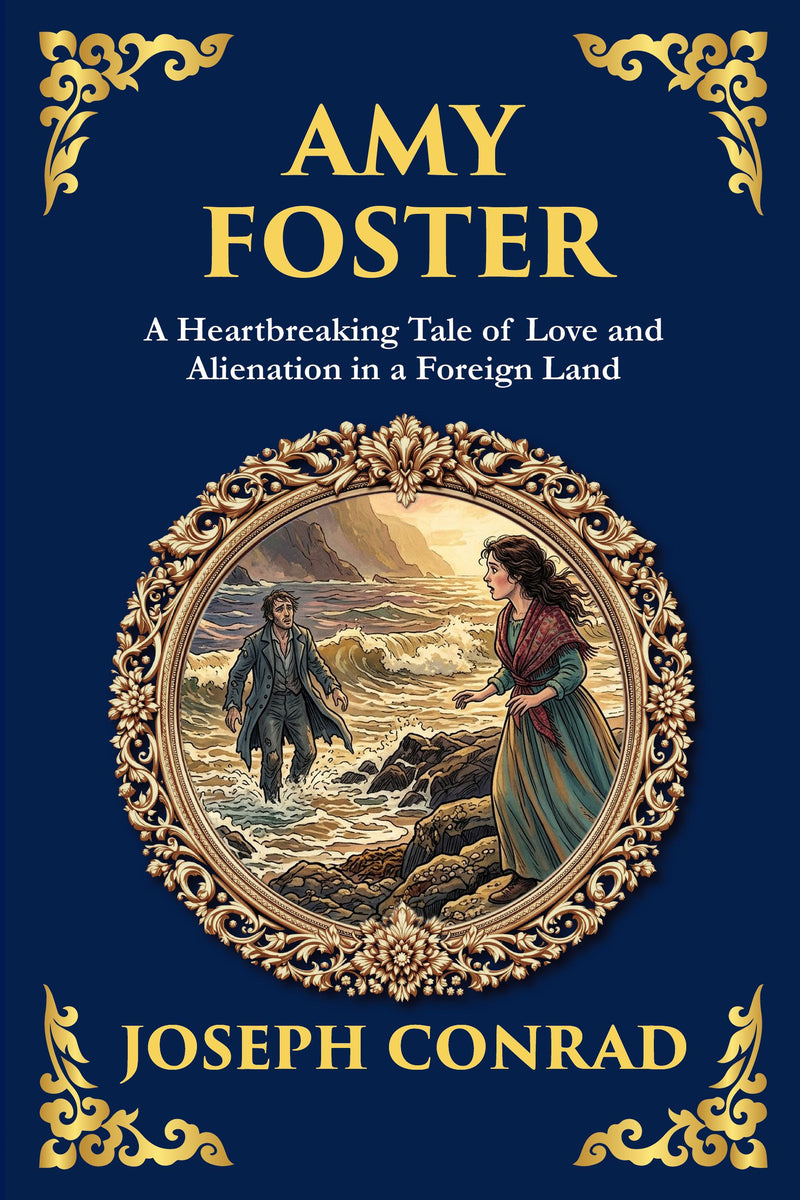
Amy Foster — Large Print
When a shipwrecked foreigner washes ashore in rural England, he is met with fear, suspicion— and ultimately, love. But the language he cannot speak becomes a wall too high to climb, and even affection cannot protect him from the cruelty of isolation.
or free app
10,000+ hrs library
30-day guarantee
The complete Amy Foster appears in modern English through Library of Alexandria Press, available online with audiobook narration included for members.
Have you ever wondered why the purest love can still be undone by fear of the unfamiliar? In Amy Foster, Joseph Conrad, the master of psychological realism, turns his attention from high-seas adventure to intimate human tragedy. This short but searing tale introduces us to Yanko Goorall—a shipwreck survivor of Eastern European descent—who finds refuge in the English countryside.
Though unable to speak the language and initially viewed with suspicion, Yanko slowly carves out a modest life for himself and eventually finds love in the gentle, reserved Amy Foster. But love is not always enough. Even as Amy offers him a home and companionship, the surrounding community’s unease never subsides.
Misunderstandings mount, and Yanko’s inability to communicate becomes a silent poison in their relationship. When crisis strikes, Amy is forced to make a choice—one that will reveal the true cost of loving a stranger in a world unwilling to accept him. Conrad’s storytelling in Amy Foster is subtle, heartbreaking, and timeless—a study of human connection suffocated by the weight of cultural alienation.
What you’ll discover in this modern edition
- A Poignant Immigrant Narrative – Experience the isolation and resilience of a foreigner struggling to find a place in a closed-off society.
| Formats | eBook (EPUB + PDF) · Audiobook · Paperback · Hardcover · Large Print |
| Language | English |
| Trim size (print) | 6 × 9 in |
| Binding | Paperback — perfect-bound · Hardcover — casewrap |
| Large Print edition | Same text in a larger, easy-read type — a larger font, not a larger trim |
| Print pricing | Every physical book at our true cost — at-cost, no profit (members) |
| Library | 873 restored titles, always growing |
| Length | 15,510 words · ~1 hr 2 min reading |
| Reading level | Grade 3 · an easy, flowing read (this modern-English edition) |
| Edition | Modern English translation · 2026 |
Member reviews for this edition are collected as readers finish it — be the first. Across the library: 12,000+ books shipped, every plan covered by a 365-day print guarantee.
About this edition
A faithful, unabridged modern-English edition by The Library of Alexandria — carefully rendered for today's reader and verified paragraph-by-paragraph against the public-domain source. Available as eBook, audiobook, paperback, hardcover, and large print.
- Complete & unabridgedVerified paragraph by paragraph against the source — never a scan, never abridged.
- Modern English, faithfulReadable today, with the author’s meaning kept intact. Readable — not simplified.
- Every format, one membershipRead in your browser or the free app, or listen to the full audiobook.
Included free with your membership
Cancel anytime, one click · 30-day money-back guarantee
Edition last updated July 2026
What’s inside
Amy Foster — Large Print — complete and unabridged, included in full with membership, plus the full audiobook.
Begin reading Amy Foster — Large Print
In clear modern English — the complete text is included with membership.
Introduction
There are stories that entertain us, and there are stories that haunt us. Amy Foster belongs unmistakably to the second category. First published in 1901, this slender yet profound tale by Joseph Conrad has accompanied generations of readers long after they have closed the final page. It is a work that lingers in the mind like a half-remembered dream, returning unbidden in quiet moments, asking questions that refuse to be neatly answered. To approach it for the first time is to encounter one of literature’s most piercing meditations on what it means to be a stranger in the world — and on the fragile, miraculous, and ultimately heartbreaking possibility of being understood by another human being.
This modern translation, adapted with care for the contemporary reader, seeks to preserve the emotional intensity and lyrical beauty of Conrad’s original prose while ensuring that nothing stands between you and the heart of the story. Conrad wrote in English — remarkably, his third language, after Polish and French — and his sentences can sometimes feel dense, ornate, and shaped by the cadences of a foreign ear. That very quality is, of course, deeply meaningful given the subject matter of this particular tale. Yet for readers encountering the story for the first time, or returning to it after many years, this edition aims to make the experience as immediate and luminous as possible, clearing away the occasional thicket of nineteenth-century phrasing so that the raw human drama can shine through unobstructed. What you hold in your hands is not a dilution of Conrad’s vision but an invitation into it — a doorway opened a little wider, so that the cold wind of the story and the warmth of its tenderness can reach you all the more directly.
To understand why Amy Foster carries such an unusual weight of authenticity, it helps to know something about the extraordinary man who wrote it. Joseph Conrad was born Józef Teodor Konrad Korzeniowski in 1857, in a part of Poland that was then under the control of the Russian Empire. His childhood was marked by upheaval and loss. His father, a poet, translator, and passionate Polish patriot, was arrested by Russian authorities for his political activities, and the family was sent into internal exile in the harsh northern provinces of Russia. The conditions of that exile broke the health of both his parents; his mother died when he was just seven, and his father followed a few years later. By the age of eleven, Conrad was an orphan, raised thereafter by a devoted uncle.
These were not the ordinary sorrows of childhood. They were the formative experiences of a boy who learned early what it meant to be displaced, to be at the mercy of forces beyond his control, to belong to a culture and a language that the surrounding world neither valued nor understood. The themes of exile, isolation, and the longing for home were not literary devices Conrad reached for from a comfortable distance. They were the very substance of his life.
At sixteen, restless and yearning for escape, Conrad left landlocked Poland to become a sailor — first in the French merchant marine at Marseille, and later in the British. For roughly two decades he traveled the oceans of the world, rising eventually to the rank of master mariner and obtaining British citizenship along the way. He sailed to the Far East, to Australia, to Africa, to South America, witnessing the colonial world at the height of its expansion and accumulating the vast storehouse of experience that would later feed his fiction. He did not begin writing seriously until he was nearly forty, and when he did, he chose to write not in Polish, the language of his heart, nor in French, the language he spoke most fluently, but in English — the language he had acquired in his twenties, on the decks of British ships, among rough sailors and the slang of port towns.
Think for a moment about what this means. One of the greatest stylists in the history of the English language was a man who spoke English with a heavy foreign accent until the end of his days, a man whose contemporaries reported they could barely understand him in conversation. He wrote in an adopted tongue, laboriously, painfully, shaping each sentence with the deliberate care of someone for whom the language would never be entirely natural. And out of that struggle he created prose of such richness and precision that he stands today among the supreme masters of English literature.
This biographical reality is essential to appreciating Amy Foster, because in this story Conrad turned his attention directly to the experience that had defined his own existence: the experience of being a foreigner. He had spent his life as an outsider — a Polish exile in Russia, a sailor without a country, a Slav among Englishmen, a writer working in borrowed words. In the central figure of this tale, a man cast ashore in an unfamiliar land where no one can understand his speech and where his very gestures and customs mark him as alien and frightening, Conrad poured something deeply, achingly personal. There is a confession buried in this fiction. The author knew, from the inside, exactly what it felt like to speak and not be heard, to reach out and find only suspicion, to carry within oneself an entire world of feeling that the surrounding society had no interest in receiving.
The story is told through the framing voice of a country doctor named Kennedy — a thoughtful, observant man who narrates the events to a visiting friend as they survey the quiet coastal countryside. This narrative technique, in which a tale is relayed at one remove through a sympathetic but limited observer, was a favorite of Conrad’s, and he used it to masterful effect throughout his career, most famously in Heart of Darkness. The advantage of such a structure is that it allows the reader to feel both close to the events and held at a contemplative distance from them. We see the central figures not directly but through the filter of an intelligent witness who is himself moved, puzzled, and ultimately humbled by what he has observed. The doctor’s voice lends the tale the quality of something half legend, half local memory — a thing that happened in this very place, among these very fields and cottages, and yet which seems almost too strange and too sorrowful to be entirely real.
It is worth pausing to note how unusual it was, at the dawn of the twentieth century, for a major writer to center a work of fiction on the inner life of an impoverished, voiceless foreigner — to insist that this person, regarded by the surrounding community as little more than a frightening curiosity, possessed a soul as deep and a heart as capable of love and grief as any of them. In an age of confident empire and unexamined prejudice, when the foreign and the strange were so often dismissed or feared, Conrad’s profound act of empathy was quietly radical. He compels us to look at the very people we are most inclined to overlook, and to recognize in them the full measure of our common humanity.
The Heart of the Story: Love, Language, and the Loneliness of Being Misunderstood
Without revealing the turns of the plot — for the unfolding of this tale is part of its devastating power, and you deserve to discover it fresh — it is worth speaking about the deeper currents that run beneath the surface of the narrative, so that you may read with a heightened sensitivity to what Conrad is doing.
At its core, Amy Foster is a story about communication and its failures. It asks one of the most fundamental questions a human being can ask: Can we ever truly know another person? Can love bridge the gulf that separates one soul from another, or does that gulf remain, in the end, uncrossable? The story dramatizes these abstract questions with heartbreaking concreteness through the figure of a man who literally cannot speak the language of the people around him. His words come out as meaningless sounds to their ears; their words are equally opaque to him. He is surrounded by people, and yet he is utterly, terribly alone.
But Conrad is far too subtle a writer to suggest that the barrier between people is merely linguistic. The tragedy of the story is that even when a kind of connection seems to form — even when one person reaches across the divide and offers tenderness, recognition, a sense of being seen — that connection proves fragile in ways that have nothing to do with vocabulary. The deepest isolation, Conrad suggests, is not the inability to translate one language into another, but the inability of one human heart to fully inhabit and understand another. We are all, in some sense, foreigners to one another. We all carry within us memories, fears, longings, and instincts that we can never wholly convey, no matter how fluent our speech. The story takes the extreme case of a man who shares no language with his neighbors and uses it to illuminate the quieter, more universal loneliness that lives within all human relationships.
This is what makes the tale so enduringly relevant. We live now in an age of unprecedented movement and migration, an age in which countless people find themselves transplanted into societies whose customs, languages, and expectations are bewilderingly different from those they knew. The figure of the stranger washed up among indifferent or hostile strangers speaks to our moment with extraordinary force. But even the reader who has never left their hometown, who has never struggled with a foreign tongue or felt the alienation of a new country, will recognize the emotional truth at the heart of this story. Who among us has not, at some point, felt unseen, misheard, fundamentally misunderstood by those around us — even, perhaps especially, by those who claim to love us? Who has not experienced the loneliness of carrying an inner life that no one around us seems able or willing to perceive? Conrad’s genius is to take a situation that appears extreme and exotic and reveal within it the most ordinary and universal of human sorrows.
The character of Amy Foster herself deserves special attention. She is not a heroine in any conventional sense — not beautiful, not clever, not eloquent. She is described as dull, slow, ordinary, a servant girl of no particular distinction, easily overlooked and lightly dismissed by those around her. And yet it is precisely she, of all the people in the story, who possesses the capacity for the one thing that matters most: an instinctive, wordless compassion. She is capable of seeing past the strangeness, the fear, the prejudice that blinds everyone else, and of responding to the humanity of another person with simple kindness. Conrad invests this seemingly unremarkable young woman with a quiet moral grandeur. In a world full of people who pride themselves on their respectability and good sense, it is the supposedly dim and limited Amy who is capable of the most generous act of the heart.
And yet — and here lies the unbearable poignancy of the tale — even Amy’s compassion has its limits. Even her love, real as it is, contains within it the seeds of misunderstanding and fear. The story does not offer the consolation of a love that conquers all. Instead, it offers something harder, truer, and more lasting: a vision of love as a thing both miraculous and tragically incomplete, capable of offering refuge and yet incapable, finally, of fully bridging the distance between two human beings. To say more would be to rob you of the experience of discovering for yourself how these themes unfold. But you should read knowing that Conrad is not telling a simple story of love triumphant or love betrayed. He is doing something more profound and more painful: he is showing us the precise point at which human tenderness meets the wall of human limitation, and he is asking us to feel the full weight of that encounter.
The natural world plays a crucial role in this drama as well. The story is set on the English coast, in a landscape of grey seas, windswept fields, and small, insular villages. Conrad, the master mariner, renders the sea and the land with the authority of a man who has known them intimately. But the setting is never merely scenic. The vast, indifferent sea that casts the stranger ashore is also a symbol of the immense, impersonal forces that shape human destinies — chance, catastrophe, the blind movements of fate that can in an instant tear a person from everything they have known and deposit them, helpless, in an alien world. The countryside, with its rooted, suspicious, slow-moving community of farmers and laborers, represents the opposite pole: a world of fixed customs and inherited prejudices, deeply attached to its own ways and instinctively wary of anything that comes from beyond its narrow horizons. Between these two great forces — the chaos of the sea and the rigidity of the land — the human figures of the story are caught and crushed.
Cancel anytime, one click · 30-day money-back guarantee
Founding annual rate available now — your price locks for life when you join.
Not ready? Get this free chapter by email — read it anytime.
✓ Sent — check your inbox for Amy Foster — Large Print.
Questions about Amy Foster — Large Print
What is Amy Foster about?
When a shipwrecked foreigner washes ashore in rural England, he is met with fear, suspicion— and ultimately, love. But the language he cannot speak becomes a wall too high to climb, and even affection cannot protect him from the cruelty of isolation. In Amy Foster, Joseph Conrad explores the tragic cost of otherness through a quietly devastating tale of love, fear, and the deep human need to belong.
Who wrote Amy Foster?
Amy Foster was written by Joseph Conrad. This edition presents the complete work in clear modern English, faithfully rendered from the public-domain original by Library of Alexandria Press.
Is Amy Foster free to read?
The opening chapter is free to read on this page. Members read and listen to the complete work — and the entire library — free, and can order any physical book at our true print cost.
How long is Amy Foster?
2 chapters (~15,510 words) — about 1 hr 2 min of reading in this modern-English edition.
Is this an abridged version of Amy Foster?
No. This is the complete, unabridged Amy Foster, carefully rendered into clear modern English and verified paragraph-by-paragraph against the public-domain source — nothing is cut or summarised.
What formats does Amy Foster come in?
Amy Foster is available as eBook, paperback, hardcover and large print. eBook and audiobook are included with membership; printed editions ship at our true print cost.
Shipping & returns
Billing & membership
More from the library


Explore Short Stories
- My Man Jeeves · P. G. Wodehouse
- Men without women · Ernest Hemingway
- Four Short Stories by Emile Zola · Émile Zola
- The Wisdom of Father Brown · G. K. Chesterton
- The Cask of Amontillado · Edgar Allan Poe
- Tales of Unrest · Joseph Conrad
- The Man with Two Left Feet, and Other Stories · P. G. Wodehouse
- The Book of Dragons · E. Nesbit
- The Four Million · O. Henry
- Ghost Stories of an Antiquary · M. R. James
- Carry On, Jeeves · P. G. Wodehouse
- Wild Animals I Have Known · Ernest Thompson Seton
- The Queen of Spades and Other Stories · Aleksandr Sergeevich Pushkin
- The Man Who Would Be King · Rudyard Kipling
- The Monkey’s Paw · W. W. Jacobs
- The Adventures of Heine · Edgar Wallace
- The Life-Eater · Harold Ward
- What Men Live By, and Other Tales · graf Leo Tolstoy
- The Innocence of Father Brown · G. K. Chesterton
- The Black Kiss
- The Beasts in the Void · Paul W. Fairman
- John Jones’s Dollar · Harry Stephen Keeler
- Subversive · Mack Reynolds
- The Mississippi Saucer · Frank Belknap Long
- Man of Distinction · Michael Shaara
- The Golden Judge · Nathaniel Gordon
- The Big Fix · George O. Smith
- Time and Time Again · H. Beam Piper
- Missing Link · Frank Herbert
- We're Civilized!
Amy Foster — Large Print
Amy Foster — Large Print
A Heartbreaking Story of Love and Isolation in a Foreign Land
Joseph Conrad
Contents
- Introduction
- Amy Foster
Introduction
There are stories that entertain us, and there are stories that haunt us. Amy Foster belongs unmistakably to the second category. First published in 1901, this slender yet profound tale by Joseph Conrad has accompanied generations of readers long after they have closed the final page. It is a work that lingers in the mind like a half-remembered dream, returning unbidden in quiet moments, asking questions that refuse to be neatly answered. To approach it for the first time is to encounter one of literature’s most piercing meditations on what it means to be a stranger in the world — and on the fragile, miraculous, and ultimately heartbreaking possibility of being understood by another human being.
This modern translation, adapted with care for the contemporary reader, seeks to preserve the emotional intensity and lyrical beauty of Conrad’s original prose while ensuring that nothing stands between you and the heart of the story. Conrad wrote in English — remarkably, his third language, after Polish and French — and his sentences can sometimes feel dense, ornate, and shaped by the cadences of a foreign ear. That very quality is, of course, deeply meaningful given the subject matter of this particular tale. Yet for readers encountering the story for the first time, or returning to it after many years, this edition aims to make the experience as immediate and luminous as possible, clearing away the occasional thicket of nineteenth-century phrasing so that the raw human drama can shine through unobstructed. What you hold in your hands is not a dilution of Conrad’s vision but an invitation into it — a doorway opened a little wider, so that the cold wind of the story and the warmth of its tenderness can reach you all the more directly.
To understand why Amy Foster carries such an unusual weight of authenticity, it helps to know something about the extraordinary man who wrote it. Joseph Conrad was born Józef Teodor Konrad Korzeniowski in 1857, in a part of Poland that was then under the control of the Russian Empire. His childhood was marked by upheaval and loss. His father, a poet, translator, and passionate Polish patriot, was arrested by Russian authorities for his political activities, and the family was sent into internal exile in the harsh northern provinces of Russia. The conditions of that exile broke the health of both his parents; his mother died when he was just seven, and his father followed a few years later. By the age of eleven, Conrad was an orphan, raised thereafter by a devoted uncle.
These were not the ordinary sorrows of childhood. They were the formative experiences of a boy who learned early what it meant to be displaced, to be at the mercy of forces beyond his control, to belong to a culture and a language that the surrounding world neither valued nor understood. The themes of exile, isolation, and the longing for home were not literary devices Conrad reached for from a comfortable distance. They were the very substance of his life.
At sixteen, restless and yearning for escape, Conrad left landlocked Poland to become a sailor — first in the French merchant marine at Marseille, and later in the British. For roughly two decades he traveled the oceans of the world, rising eventually to the rank of master mariner and obtaining British citizenship along the way. He sailed to the Far East, to Australia, to Africa, to South America, witnessing the colonial world at the height of its expansion and accumulating the vast storehouse of experience that would later feed his fiction. He did not begin writing seriously until he was nearly forty, and when he did, he chose to write not in Polish, the language of his heart, nor in French, the language he spoke most fluently, but in English — the language he had acquired in his twenties, on the decks of British ships, among rough sailors and the slang of port towns.
Think for a moment about what this means. One of the greatest stylists in the history of the English language was a man who spoke English with a heavy foreign accent until the end of his days, a man whose contemporaries reported they could barely understand him in conversation. He wrote in an adopted tongue, laboriously, painfully, shaping each sentence with the deliberate care of someone for whom the language would never be entirely natural. And out of that struggle he created prose of such richness and precision that he stands today among the supreme masters of English literature.
This biographical reality is essential to appreciating Amy Foster, because in this story Conrad turned his attention directly to the experience that had defined his own existence: the experience of being a foreigner. He had spent his life as an outsider — a Polish exile in Russia, a sailor without a country, a Slav among Englishmen, a writer working in borrowed words. In the central figure of this tale, a man cast ashore in an unfamiliar land where no one can understand his speech and where his very gestures and customs mark him as alien and frightening, Conrad poured something deeply, achingly personal. There is a confession buried in this fiction. The author knew, from the inside, exactly what it felt like to speak and not be heard, to reach out and find only suspicion, to carry within oneself an entire world of feeling that the surrounding society had no interest in receiving.
The story is told through the framing voice of a country doctor named Kennedy — a thoughtful, observant man who narrates the events to a visiting friend as they survey the quiet coastal countryside. This narrative technique, in which a tale is relayed at one remove through a sympathetic but limited observer, was a favorite of Conrad’s, and he used it to masterful effect throughout his career, most famously in Heart of Darkness. The advantage of such a structure is that it allows the reader to feel both close to the events and held at a contemplative distance from them. We see the central figures not directly but through the filter of an intelligent witness who is himself moved, puzzled, and ultimately humbled by what he has observed. The doctor’s voice lends the tale the quality of something half legend, half local memory — a thing that happened in this very place, among these very fields and cottages, and yet which seems almost too strange and too sorrowful to be entirely real.
It is worth pausing to note how unusual it was, at the dawn of the twentieth century, for a major writer to center a work of fiction on the inner life of an impoverished, voiceless foreigner — to insist that this person, regarded by the surrounding community as little more than a frightening curiosity, possessed a soul as deep and a heart as capable of love and grief as any of them. In an age of confident empire and unexamined prejudice, when the foreign and the strange were so often dismissed or feared, Conrad’s profound act of empathy was quietly radical. He compels us to look at the very people we are most inclined to overlook, and to recognize in them the full measure of our common humanity.
The Heart of the Story: Love, Language, and the Loneliness of Being Misunderstood
Without revealing the turns of the plot — for the unfolding of this tale is part of its devastating power, and you deserve to discover it fresh — it is worth speaking about the deeper currents that run beneath the surface of the narrative, so that you may read with a heightened sensitivity to what Conrad is doing.
At its core, Amy Foster is a story about communication and its failures. It asks one of the most fundamental questions a human being can ask: Can we ever truly know another person? Can love bridge the gulf that separates one soul from another, or does that gulf remain, in the end, uncrossable? The story dramatizes these abstract questions with heartbreaking concreteness through the figure of a man who literally cannot speak the language of the people around him. His words come out as meaningless sounds to their ears; their words are equally opaque to him. He is surrounded by people, and yet he is utterly, terribly alone.
But Conrad is far too subtle a writer to suggest that the barrier between people is merely linguistic. The tragedy of the story is that even when a kind of connection seems to form — even when one person reaches across the divide and offers tenderness, recognition, a sense of being seen — that connection proves fragile in ways that have nothing to do with vocabulary. The deepest isolation, Conrad suggests, is not the inability to translate one language into another, but the inability of one human heart to fully inhabit and understand another. We are all, in some sense, foreigners to one another. We all carry within us memories, fears, longings, and instincts that we can never wholly convey, no matter how fluent our speech. The story takes the extreme case of a man who shares no language with his neighbors and uses it to illuminate the quieter, more universal loneliness that lives within all human relationships.
This is what makes the tale so enduringly relevant. We live now in an age of unprecedented movement and migration, an age in which countless people find themselves transplanted into societies whose customs, languages, and expectations are bewilderingly different from those they knew. The figure of the stranger washed up among indifferent or hostile strangers speaks to our moment with extraordinary force. But even the reader who has never left their hometown, who has never struggled with a foreign tongue or felt the alienation of a new country, will recognize the emotional truth at the heart of this story. Who among us has not, at some point, felt unseen, misheard, fundamentally misunderstood by those around us — even, perhaps especially, by those who claim to love us? Who has not experienced the loneliness of carrying an inner life that no one around us seems able or willing to perceive? Conrad’s genius is to take a situation that appears extreme and exotic and reveal within it the most ordinary and universal of human sorrows.
The character of Amy Foster herself deserves special attention. She is not a heroine in any conventional sense — not beautiful, not clever, not eloquent. She is described as dull, slow, ordinary, a servant girl of no particular distinction, easily overlooked and lightly dismissed by those around her. And yet it is precisely she, of all the people in the story, who possesses the capacity for the one thing that matters most: an instinctive, wordless compassion. She is capable of seeing past the strangeness, the fear, the prejudice that blinds everyone else, and of responding to the humanity of another person with simple kindness. Conrad invests this seemingly unremarkable young woman with a quiet moral grandeur. In a world full of people who pride themselves on their respectability and good sense, it is the supposedly dim and limited Amy who is capable of the most generous act of the heart.
And yet — and here lies the unbearable poignancy of the tale — even Amy’s compassion has its limits. Even her love, real as it is, contains within it the seeds of misunderstanding and fear. The story does not offer the consolation of a love that conquers all. Instead, it offers something harder, truer, and more lasting: a vision of love as a thing both miraculous and tragically incomplete, capable of offering refuge and yet incapable, finally, of fully bridging the distance between two human beings. To say more would be to rob you of the experience of discovering for yourself how these themes unfold. But you should read knowing that Conrad is not telling a simple story of love triumphant or love betrayed. He is doing something more profound and more painful: he is showing us the precise point at which human tenderness meets the wall of human limitation, and he is asking us to feel the full weight of that encounter.
The natural world plays a crucial role in this drama as well. The story is set on the English coast, in a landscape of grey seas, windswept fields, and small, insular villages. Conrad, the master mariner, renders the sea and the land with the authority of a man who has known them intimately. But the setting is never merely scenic. The vast, indifferent sea that casts the stranger ashore is also a symbol of the immense, impersonal forces that shape human destinies — chance, catastrophe, the blind movements of fate that can in an instant tear a person from everything they have known and deposit them, helpless, in an alien world. The countryside, with its rooted, suspicious, slow-moving community of farmers and laborers, represents the opposite pole: a world of fixed customs and inherited prejudices, deeply attached to its own ways and instinctively wary of anything that comes from beyond its narrow horizons. Between these two great forces — the chaos of the sea and the rigidity of the land — the human figures of the story are caught and crushed.
Kennedy is a local doctor who lives in Colebrook, located on the coast of Eastbay. The town’s quaint High Street is squeezed against a sea wall, with steep hills rising sharply behind the red roofs of the small village. Beyond that wall, a barren pebble beach curves for miles in a wide, steady arc. Across the water, the village of Brenzett appears as a dark silhouette, its church spire poking out from a group of trees. Even further out, a lighthouse stands like a straight column; from a distance, it looks no larger than a pencil, marking the point where the land disappears from view. The landscape behind Brenzett is low and flat, but the bay is well-protected from the open ocean. Every so often, a large ship—either trapped by the wind or pushed by bad weather—will drop anchor about a mile and a half north of where you would stand at the back door of the “Ship Inn” in Brenzett. Small boat captains recognize two local landmarks: a broken-down windmill with shattered sails sitting on a small mound, and a squat Martello tower on the shoreline, half a mile south of the Coastguard cottages. These are the official markers for a reliable anchoring spot, shown on the Admiralty charts as an irregular oval of dots containing several number sixes, a tiny anchor symbol, and the label “mud and shells.”
The top of the hill overlooks the square tower of Colebrook Church. The slope is green and crossed by a white road. As you go up this road, a broad, shallow valley opens up—a wide green stretch of pastures and hedges that blends into a distant view of purple hues and flowing lines.
My friend Kennedy has his medical practice in this valley, covering the area from Brenzett and Colebrook up to Darnford, a market town fourteen miles away. He started his career as a Navy surgeon and later traveled with a famous explorer back when there were still continents with unexplored interiors. His scientific papers on plants and animals made him well-known in academic circles. Now, by choice, he has settled into a country practice. I suspect that his sharp mind, acting like a corrosive acid, eventually destroyed his ambition. He possesses a scientific intelligence and a habit of investigation, driven by an endless curiosity and the belief that every mystery contains a piece of a larger truth.
End of the free sample
Keep reading, free
Members read and listen to the complete book — and the entire library. Cancel anytime, one click · 30-day money-back guarantee.