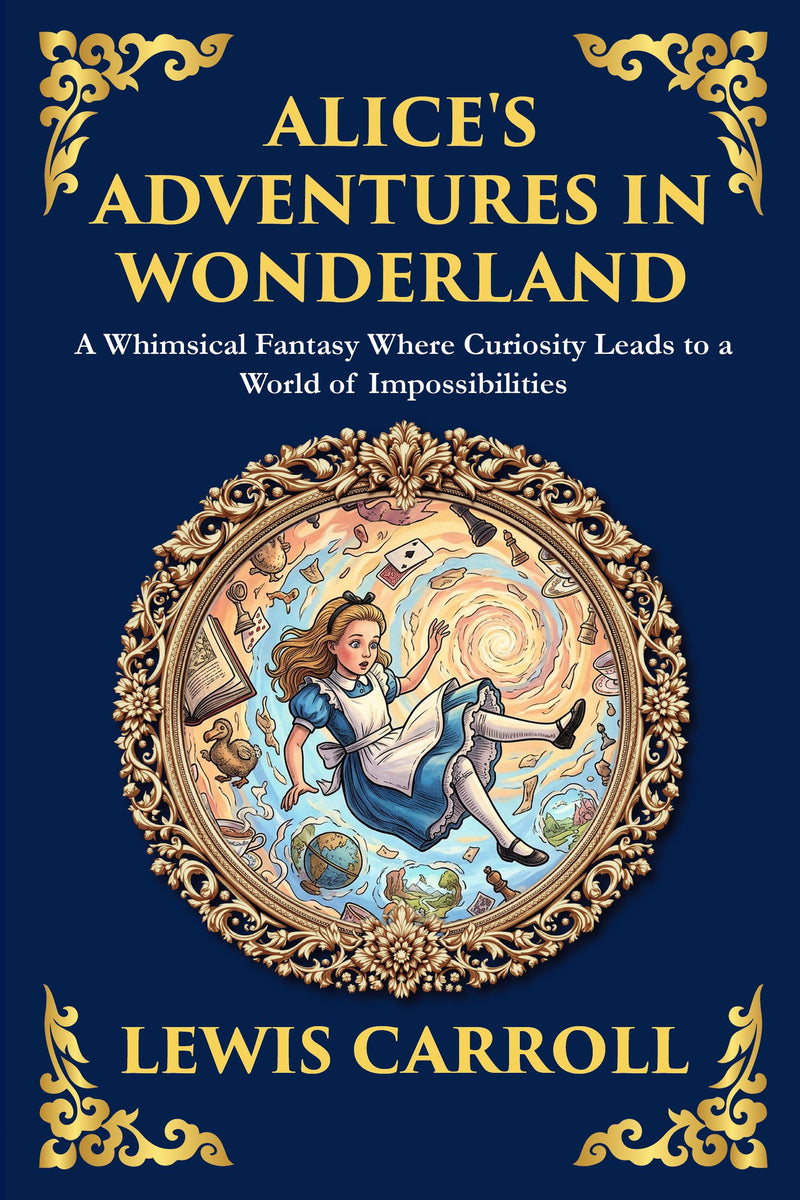
Alice’s Adventures in Wonderland — Large Print
Tumble down the rabbit hole into a world unlike any other—where logic is turned upside down, time dances to its own tune, and nonsense rules supreme.
or free app
10,000+ hrs library
30-day guarantee
The complete Alice's Adventures in Wonderland appears in modern English through Library of Alexandria Press, available online with audiobook narration included for members.
Have you ever wondered why the world makes more sense when it doesn’t follow the rules? Alice’s Adventures in Wonderland is a literary marvel that has enchanted generations of readers with its wit, whimsy, and wild imagination. Written by Lewis Carroll—mathematician, logician, and master of wordplay—this timeless novel is more than a children's story.
It’s a celebration of absurdity, imagination, and the joyful subversion of logic. When Alice spots a peculiar White Rabbit with a pocket watch and follows him into a mysterious rabbit hole, she finds herself in a world that challenges everything she thought she knew. In Wonderland, cakes can make you grow, cats can vanish into thin air, and tea parties never seem to end.
Through her encounters with unforgettable characters and puzzling situations, Alice must navigate a realm where meaning is slippery, and reality is redefined at every turn. This modern edition captures Carroll’s original brilliance while offering a clean, accessible reading experience for both young readers and adults who wish to revisit a classic with new eyes.
What you’ll discover in this modern edition
- in This Edition of Alice’s Adventures in Wonderland:
- A World of Pure Imagination – Follow Alice as she journeys through a surreal landscape filled with bizarre creatures and delightful nonsense.
- Iconic Characters that Live On – Meet the White Rabbit, Mad Hatter, Caterpillar, and Queen of Hearts in their full eccentric glory.
- Endlessly Quotable Wisdom – Explore themes of identity, perception, time, and meaning through Carroll’s playful yet profound prose.
- A Perfect Blend of Wit and Whimsy – Carroll’s wordplay and satire entertain on every level—from silly rhymes to clever philosophical insights.
- A Story That Defies Time – This edition keeps the magic alive for today’s readers with modern formatting while preserving the heart of the original text.
| Formats | eBook (EPUB + PDF) · Audiobook · Paperback · Hardcover · Large Print |
| Language | English |
| Trim size (print) | 6 × 9 in |
| Binding | Paperback — perfect-bound · Hardcover — casewrap |
| Large Print edition | Same text in a larger, easy-read type — a larger font, not a larger trim |
| Print pricing | Every physical book at our true cost — at-cost, no profit (members) |
| Library | 873 restored titles, always growing |
| Length | 26,592 words · ~1 hr 46 min reading |
| Reading level | Grade 7 · an easy, flowing read (this modern-English edition) |
| Edition | Modern English translation · 2026 |
Member reviews for this edition are collected as readers finish it — be the first. Across the library: 12,000+ books shipped, every plan covered by a 365-day print guarantee.
About this edition
A faithful, unabridged modern-English edition by The Library of Alexandria — carefully rendered for today's reader and verified paragraph-by-paragraph against the public-domain source. Available as eBook, audiobook, paperback, hardcover, and large print.
- Complete & unabridgedVerified paragraph by paragraph against the source — never a scan, never abridged.
- Modern English, faithfulReadable today, with the author’s meaning kept intact. Readable — not simplified.
- Every format, one membershipRead in your browser or the free app, or listen to the full audiobook.
Included free with your membership
Cancel anytime, one click · 30-day money-back guarantee
Edition last updated July 2026
What’s inside
Alice’s Adventures in Wonderland — Large Print — complete and unabridged: all 13 sections included with membership, plus the full audiobook.
Begin reading Alice’s Adventures in Wonderland — Large Print
In clear modern English — the complete text is included with membership.
Introduction
There are very few books that have escaped their own pages and taken up permanent residence in the collective imagination of the world. This is one of them. Mention a white rabbit checking a pocket watch, a grinning cat that fades into thin air, a tea party with no end, or a small girl tumbling endlessly down a dark hole, and almost anyone you meet will recognize the images at once—often without ever having read the source. The story has soaked so completely into our shared cultural memory that it feels less like a single book and more like a place we have all, at some point, visited in our dreams. To open these pages, then, is to do something curious in itself: to return to a familiar landscape and discover, perhaps for the first time, just how strange, sly, and dazzlingly inventive it truly is.
What you hold is a modern translation, adapted thoughtfully for the contemporary reader. That phrase deserves a moment of attention, because adapting a work this beloved is a delicate art. The aim has never been to flatten the magic or to strip away the eccentric voice that makes the original so unmistakable. Rather, the goal is to clear away the small obstacles that a century and a half of changing language inevitably places between a reader and a text—the archaic turns of phrase, the period idioms, the jokes that depended on customs and schoolroom recitations long since forgotten. With those barriers gently lowered, what remains is the pure pleasure of the journey: the leaps of logic, the wordplay, the wild characters, and the bottomless sense of wonder. You are meeting an old friend, but the conversation now flows freely, without the need to pause and translate.
Before you step through the looking glass of these opening chapters, it is worth pausing to consider what kind of book you are about to read, where it came from, and how best to surrender yourself to its peculiar delights. Because make no mistake—surrender is the right word. This is not a story to be conquered or solved. It is a story to be tumbled into.
The tale of how this book came to exist is nearly as charming as the book itself, and it bears repeating because it explains so much about the spirit you are about to encounter. It began not with a publisher’s commission or an author’s grand ambition, but with a boat. On a warm summer afternoon, a quiet, stammering Oxford mathematician took three young sisters out rowing on the river. To pass the lazy hours, he began to spin a story aloud—an improvised, nonsensical adventure invented on the spot to amuse his small companions, with one of the girls placed firmly at its center as the heroine.
There was no map, no outline, no plan. The story wandered wherever the storyteller’s imagination led it, doubling back, contradicting itself, delighting in absurdity for its own sake. This origin is the single most important thing to understand about what follows. The book was never engineered to teach a moral lesson or to deliver a tidy plot with a satisfying resolution at the end. It was created to enchant a child on a sunny afternoon, to make her laugh, to surprise her, to keep her leaning forward asking, “And then what happened?” That improvisational, playful, deeply personal quality survived the long process of being written down, revised, and published. It still pulses on every page.
The author who performed this feat lived a double life that perfectly mirrors the doubled nature of his most famous creation. By profession he was a logician and mathematician, a man who spent his working hours among the strict, unbending rules of formal reasoning. By temperament he was a lover of riddles, puns, games, and gleeful nonsense. These two halves of his mind did not cancel one another out—instead, they fused into something extraordinary. The world he built operates on a kind of relentless, internal logic, but it is logic stretched, inverted, and turned inside out until it becomes hilarious. The characters reason with great precision toward utterly insane conclusions. They follow rules that have no purpose. They take figures of speech literally and metaphors at face value, producing a comedy that is at once childishly simple and dizzyingly sophisticated.
This is why the book has charmed readers of every possible age and disposition for so long. A young reader delights in the talking animals, the size-changing magic, the silliness of a creature that vanishes leaving only its smile behind. An older reader, returning to the story, suddenly perceives the satire buried in those same scenes—the gentle mockery of pompous authority, of meaningless ceremony, of adults who insist on rules they cannot explain and behave more childishly than any child. The genius of the work is that it never forces these layers upon you. The deeper meanings are there if you wish to find them, but the story works perfectly well as pure, unfiltered fun if you do not. Few books are so generous to their readers, asking nothing and offering everything.
It is also worth appreciating just how revolutionary this approach was when it first appeared. The children’s literature of its era was, for the most part, a grim and improving affair, stuffed with cautionary tales designed to frighten the young into good behavior. Stories existed to warn against laziness, disobedience, and vanity, usually by visiting horrible fates upon characters who misbehaved. Into this world of finger-wagging and moralizing dropped a book whose entire purpose was joy. There is no lesson here about being a better child. The heroine is not punished for her curiosity; her curiosity is celebrated as the very engine of the adventure. She questions everything, refuses to accept nonsense quietly, and stands up to bullying authority with admirable nerve. This was a quietly radical act—giving children a story that respected their intelligence and trusted them to enjoy wit and wonder for their own sake. We take such books for granted now, but only because this one helped invent the possibility.
As you read, you may notice the verses scattered throughout—the songs and poems that the characters recite or sing. Many of these were originally parodies of well-known poems that every schoolchild of the period was forced to memorize. The humor came from the contrast between the solemn, moralizing original and the gleeful absurdity of the version offered here. Most modern readers will not recognize the targets of these parodies, and that is perfectly all right. In this adaptation, they stand on their own as delightful nonsense, and they lose none of their charm for being unmoored from their forgotten sources. Read them aloud if you can; their rhythm and silliness are best appreciated by the ear, just as the original audience first heard them spoken across the water on that summer river.
The Pleasures and Peculiarities of Wonderland
Let us speak plainly about what makes this book so unlike almost anything else you may have read, so that you can adjust your expectations and settle into the experience with the right frame of mind. If you approach it expecting a conventional adventure—a clear quest, mounting obstacles, a final confrontation, a neat resolution—you may find yourself disoriented. That disorientation is not a flaw in the book; it is the entire point.
This is a story that operates by the logic of dreams. Things happen because they happen. A character appears, holds a bewildering conversation, and vanishes, never to return or be explained. Scenes shift without warning. Sizes change, distances stretch and shrink, time itself misbehaves. The heroine moves through this shifting landscape with remarkable composure, treating each impossibility as a problem to be examined rather than a horror to be fled. The reader is invited to do the same: to stop demanding sense and instead to enjoy the marvelous nonsense as it unfolds. There is a profound freedom in this. So much of our reading—so much of our living—is spent trying to impose order, to predict, to control. Here, in the delicious pages ahead, you are encouraged to let go of all that and simply follow where the story leads, trusting that the journey itself is the reward.
The characters you will meet are among the most vivid ever committed to paper, and they have earned their immortality. Each one is a small comic masterpiece, defined by a single idea pushed to its limit. There are creatures obsessed with punctuality, others with politeness, others with their own importance, others still who exist seemingly to argue, to lecture, to weep, or to terrify. What makes them so memorable is not depth in the ordinary sense—they have little inner life, no backstory, no arc of growth—but rather their absolute commitment to being exactly what they are. They are like the pieces in a strange game, each moving according to its own fixed and ridiculous rule. The comedy and the strangeness arise from the collisions between them, and between all of them and the sensible, curious girl who has wandered into their midst.
That girl deserves a moment of appreciation, because she is the still center around which all the madness whirls. She is the reader’s anchor and proxy, the one normal presence in a world gone wonderfully mad. What is striking about her is her resilience. She is occasionally frightened, frequently confused, sometimes brought to tears by frustration, but she never gives up, never stops asking questions, and never abandons her own good sense even when everyone around her insists that sense has no place here. She corrects the rude, stands her ground against the powerful, and maintains her dignity through a parade of indignities. There is something quietly heroic in her steadfastness. She represents the part of all of us that refuses to be told that two plus two equals five simply because someone important says so. In a world built entirely of nonsense, her insistence on meaning is the most charming thing of all.
The language itself is one of the great pleasures awaiting you. The author was a master of the pun, the double meaning, the literalized metaphor. Conversations spiral into delightful confusion as characters seize upon the multiple meanings of a single word and gallop off in opposite directions. Phrases we use without thinking are suddenly taken apart and examined, revealing the absurdity hidden inside our everyday speech. This kind of wordplay is notoriously difficult to carry across the years, as the meanings and uses of words shift, but the care taken in this modern adaptation aims to preserve the spark of the wit while ensuring it lands cleanly for a present-day ear. The jokes should feel immediate and bright, not like museum pieces requiring a guide.
A word, too, about the book’s emotional texture, which is more varied than its reputation as a comic romp might suggest. Beneath the laughter runs a gentle current of something more wistful—a sense of smallness, of being lost in a vast and incomprehensible world where the rules keep changing and no one will explain them. Anyone who has been a child remembers this feeling exactly: the bewilderment of moving through a world built and governed by enormous, powerful beings whose logic seems arbitrary and whose moods are unpredictable. In this sense, the dream world you are about to enter is a kind of mirror held up to childhood itself, with all its disorientation, its powerlessness, and its surprising courage. This is part of why the book resonates so deeply with adults, who recognize in it a truth about their own early years that they had half forgotten. The story is funny, yes, gloriously funny—but it is also, in its quiet way, true.
I want to encourage you especially to read this book aloud if you have the chance—to a child, to a companion, or even to yourself. Remember its origins as a spoken tale, improvised for listeners. The rhythms of the language, the timing of the jokes, the music of the nonsense verses all come alive when given voice. There is a reason this story has been read aloud in countless homes and classrooms for generations. It was built for the ear before it was built for the eye, and something of that original magic returns when you let the words leave your lips. Even reading silently, you may find it helps to imagine the cadence of a storyteller spinning the tale, leaning into the absurd moments, pausing for effect before the next impossible turn.
Cancel anytime, one click · 30-day money-back guarantee
Founding annual rate available now — your price locks for life when you join.
Not ready? Get this free chapter by email — read it anytime.
✓ Sent — check your inbox for Alice’s Adventures in Wonderland — Large Print.
Questions about Alice’s Adventures in Wonderland — Large Print
What is Alice's Adventures in Wonderland about?
Tumble down the rabbit hole into a world unlike any other—where logic is turned upside down, time dances to its own tune, and nonsense rules supreme. Alice’s Adventures in Wonderland is the unforgettable journey of a young girl whose boundless curiosity transports her into a land of talking animals, shrinking potions, mad tea parties, and riddles with no answers. From the ever-late White Rabbit to the grinning Cheshire Cat and the tyrannical Queen of Hearts, Lewis Carroll’s fantastical characters and clever wordpla
Who wrote Alice's Adventures in Wonderland?
Alice's Adventures in Wonderland was written by Lewis Carroll. This edition presents the complete work in clear modern English, faithfully rendered from the public-domain original by Library of Alexandria Press.
Is Alice's Adventures in Wonderland free to read?
The opening chapter is free to read on this page. Members read and listen to the complete work — and the entire library — free, and can order any physical book at our true print cost.
How long is Alice's Adventures in Wonderland?
13 chapters (~26,592 words) — about 1 hr 46 min of reading in this modern-English edition.
Is this an abridged version of Alice's Adventures in Wonderland?
No. This is the complete, unabridged Alice's Adventures in Wonderland, carefully rendered into clear modern English and verified paragraph-by-paragraph against the public-domain source — nothing is cut or summarised.
What formats does Alice's Adventures in Wonderland come in?
Alice's Adventures in Wonderland is available as eBook, paperback, hardcover and large print. eBook and audiobook are included with membership; printed editions ship at our true print cost.
Shipping & returns
Billing & membership
More from the library


Explore Children's Classics
- Jack and Jill · Louisa May Alcott
- The Wonderful Wizard of Oz · L. Frank Baum
- Peter Pan · J. M. Barrie
- The Prince and the Pauper · Mark Twain
- The Red Fairy Book · Andrew Lang
- Old Christmas: from the Sketch Book of Washington Irving · Washington Irving
- A Houseful of Girls · Sarah Tytler
- In the hollow of His hand · Hesba Stretton
- Miss Primrose · Agnes Giberne
- Five Little Peppers and How They Grew · Margaret Sidney
- The Loss of the Swansea: A Story of the Florida Coast · W. L. Alden
- Sky Island · L. Frank Baum
- The Book of Dragons · E. Nesbit
- Wild Animals I Have Known · Ernest Thompson Seton
- Skinny McCord · Percy Keese Fitzhugh
- The Hunniwell Boys and the Platinum Mystery · L. P. Wyman
- Rainbow Valley · L. M. Montgomery
- "Us and Our Donkey" · Amy Le Feuvre
- Dorothy and the Wizard in Oz · L. Frank Baum
- The Home Book of Verse — Volume 4 · Burton Egbert Stevenson
- The Story of Doctor Dolittle · Hugh Lofting
- The Tale of Benjamin Bunny · Beatrix Potter
- Fifty Famous Stories Retold · James Baldwin
- Rilla of Ingleside · L. M. Montgomery
- The House at Pooh Corner · A. A. Milne
- Rich and Humble: A Story for Young People · Oliver Optic
- The Three Bears · A. E. Kennedy
- Peter and Wendy · J. M. Barrie
- The Marvelous Land of Oz · L. Frank Baum
- Andersen’s Fairy Tales · H. C. Andersen
Alice’s Adventures in Wonderland — Large Print
Alice’s Adventures in Wonderland — Large Print
A Whimsical Fantasy Where Curiosity Leads to a World of Impossibilities
Lewis Carroll
Contents
- Introduction
- Chapter 1
- Chapter 2
- Chapter 3
- Chapter 4
- Chapter 5
- Chapter 6
- Chapter 7
- Chapter 8
- Chapter 9
- Chapter 10
- Chapter 11
- Chapter 12
Introduction
There are very few books that have escaped their own pages and taken up permanent residence in the collective imagination of the world. This is one of them. Mention a white rabbit checking a pocket watch, a grinning cat that fades into thin air, a tea party with no end, or a small girl tumbling endlessly down a dark hole, and almost anyone you meet will recognize the images at once—often without ever having read the source. The story has soaked so completely into our shared cultural memory that it feels less like a single book and more like a place we have all, at some point, visited in our dreams. To open these pages, then, is to do something curious in itself: to return to a familiar landscape and discover, perhaps for the first time, just how strange, sly, and dazzlingly inventive it truly is.
What you hold is a modern translation, adapted thoughtfully for the contemporary reader. That phrase deserves a moment of attention, because adapting a work this beloved is a delicate art. The aim has never been to flatten the magic or to strip away the eccentric voice that makes the original so unmistakable. Rather, the goal is to clear away the small obstacles that a century and a half of changing language inevitably places between a reader and a text—the archaic turns of phrase, the period idioms, the jokes that depended on customs and schoolroom recitations long since forgotten. With those barriers gently lowered, what remains is the pure pleasure of the journey: the leaps of logic, the wordplay, the wild characters, and the bottomless sense of wonder. You are meeting an old friend, but the conversation now flows freely, without the need to pause and translate.
Before you step through the looking glass of these opening chapters, it is worth pausing to consider what kind of book you are about to read, where it came from, and how best to surrender yourself to its peculiar delights. Because make no mistake—surrender is the right word. This is not a story to be conquered or solved. It is a story to be tumbled into.
The tale of how this book came to exist is nearly as charming as the book itself, and it bears repeating because it explains so much about the spirit you are about to encounter. It began not with a publisher’s commission or an author’s grand ambition, but with a boat. On a warm summer afternoon, a quiet, stammering Oxford mathematician took three young sisters out rowing on the river. To pass the lazy hours, he began to spin a story aloud—an improvised, nonsensical adventure invented on the spot to amuse his small companions, with one of the girls placed firmly at its center as the heroine.
There was no map, no outline, no plan. The story wandered wherever the storyteller’s imagination led it, doubling back, contradicting itself, delighting in absurdity for its own sake. This origin is the single most important thing to understand about what follows. The book was never engineered to teach a moral lesson or to deliver a tidy plot with a satisfying resolution at the end. It was created to enchant a child on a sunny afternoon, to make her laugh, to surprise her, to keep her leaning forward asking, “And then what happened?” That improvisational, playful, deeply personal quality survived the long process of being written down, revised, and published. It still pulses on every page.
The author who performed this feat lived a double life that perfectly mirrors the doubled nature of his most famous creation. By profession he was a logician and mathematician, a man who spent his working hours among the strict, unbending rules of formal reasoning. By temperament he was a lover of riddles, puns, games, and gleeful nonsense. These two halves of his mind did not cancel one another out—instead, they fused into something extraordinary. The world he built operates on a kind of relentless, internal logic, but it is logic stretched, inverted, and turned inside out until it becomes hilarious. The characters reason with great precision toward utterly insane conclusions. They follow rules that have no purpose. They take figures of speech literally and metaphors at face value, producing a comedy that is at once childishly simple and dizzyingly sophisticated.
This is why the book has charmed readers of every possible age and disposition for so long. A young reader delights in the talking animals, the size-changing magic, the silliness of a creature that vanishes leaving only its smile behind. An older reader, returning to the story, suddenly perceives the satire buried in those same scenes—the gentle mockery of pompous authority, of meaningless ceremony, of adults who insist on rules they cannot explain and behave more childishly than any child. The genius of the work is that it never forces these layers upon you. The deeper meanings are there if you wish to find them, but the story works perfectly well as pure, unfiltered fun if you do not. Few books are so generous to their readers, asking nothing and offering everything.
It is also worth appreciating just how revolutionary this approach was when it first appeared. The children’s literature of its era was, for the most part, a grim and improving affair, stuffed with cautionary tales designed to frighten the young into good behavior. Stories existed to warn against laziness, disobedience, and vanity, usually by visiting horrible fates upon characters who misbehaved. Into this world of finger-wagging and moralizing dropped a book whose entire purpose was joy. There is no lesson here about being a better child. The heroine is not punished for her curiosity; her curiosity is celebrated as the very engine of the adventure. She questions everything, refuses to accept nonsense quietly, and stands up to bullying authority with admirable nerve. This was a quietly radical act—giving children a story that respected their intelligence and trusted them to enjoy wit and wonder for their own sake. We take such books for granted now, but only because this one helped invent the possibility.
As you read, you may notice the verses scattered throughout—the songs and poems that the characters recite or sing. Many of these were originally parodies of well-known poems that every schoolchild of the period was forced to memorize. The humor came from the contrast between the solemn, moralizing original and the gleeful absurdity of the version offered here. Most modern readers will not recognize the targets of these parodies, and that is perfectly all right. In this adaptation, they stand on their own as delightful nonsense, and they lose none of their charm for being unmoored from their forgotten sources. Read them aloud if you can; their rhythm and silliness are best appreciated by the ear, just as the original audience first heard them spoken across the water on that summer river.
The Pleasures and Peculiarities of Wonderland
Let us speak plainly about what makes this book so unlike almost anything else you may have read, so that you can adjust your expectations and settle into the experience with the right frame of mind. If you approach it expecting a conventional adventure—a clear quest, mounting obstacles, a final confrontation, a neat resolution—you may find yourself disoriented. That disorientation is not a flaw in the book; it is the entire point.
This is a story that operates by the logic of dreams. Things happen because they happen. A character appears, holds a bewildering conversation, and vanishes, never to return or be explained. Scenes shift without warning. Sizes change, distances stretch and shrink, time itself misbehaves. The heroine moves through this shifting landscape with remarkable composure, treating each impossibility as a problem to be examined rather than a horror to be fled. The reader is invited to do the same: to stop demanding sense and instead to enjoy the marvelous nonsense as it unfolds. There is a profound freedom in this. So much of our reading—so much of our living—is spent trying to impose order, to predict, to control. Here, in the delicious pages ahead, you are encouraged to let go of all that and simply follow where the story leads, trusting that the journey itself is the reward.
The characters you will meet are among the most vivid ever committed to paper, and they have earned their immortality. Each one is a small comic masterpiece, defined by a single idea pushed to its limit. There are creatures obsessed with punctuality, others with politeness, others with their own importance, others still who exist seemingly to argue, to lecture, to weep, or to terrify. What makes them so memorable is not depth in the ordinary sense—they have little inner life, no backstory, no arc of growth—but rather their absolute commitment to being exactly what they are. They are like the pieces in a strange game, each moving according to its own fixed and ridiculous rule. The comedy and the strangeness arise from the collisions between them, and between all of them and the sensible, curious girl who has wandered into their midst.
That girl deserves a moment of appreciation, because she is the still center around which all the madness whirls. She is the reader’s anchor and proxy, the one normal presence in a world gone wonderfully mad. What is striking about her is her resilience. She is occasionally frightened, frequently confused, sometimes brought to tears by frustration, but she never gives up, never stops asking questions, and never abandons her own good sense even when everyone around her insists that sense has no place here. She corrects the rude, stands her ground against the powerful, and maintains her dignity through a parade of indignities. There is something quietly heroic in her steadfastness. She represents the part of all of us that refuses to be told that two plus two equals five simply because someone important says so. In a world built entirely of nonsense, her insistence on meaning is the most charming thing of all.
The language itself is one of the great pleasures awaiting you. The author was a master of the pun, the double meaning, the literalized metaphor. Conversations spiral into delightful confusion as characters seize upon the multiple meanings of a single word and gallop off in opposite directions. Phrases we use without thinking are suddenly taken apart and examined, revealing the absurdity hidden inside our everyday speech. This kind of wordplay is notoriously difficult to carry across the years, as the meanings and uses of words shift, but the care taken in this modern adaptation aims to preserve the spark of the wit while ensuring it lands cleanly for a present-day ear. The jokes should feel immediate and bright, not like museum pieces requiring a guide.
A word, too, about the book’s emotional texture, which is more varied than its reputation as a comic romp might suggest. Beneath the laughter runs a gentle current of something more wistful—a sense of smallness, of being lost in a vast and incomprehensible world where the rules keep changing and no one will explain them. Anyone who has been a child remembers this feeling exactly: the bewilderment of moving through a world built and governed by enormous, powerful beings whose logic seems arbitrary and whose moods are unpredictable. In this sense, the dream world you are about to enter is a kind of mirror held up to childhood itself, with all its disorientation, its powerlessness, and its surprising courage. This is part of why the book resonates so deeply with adults, who recognize in it a truth about their own early years that they had half forgotten. The story is funny, yes, gloriously funny—but it is also, in its quiet way, true.
I want to encourage you especially to read this book aloud if you have the chance—to a child, to a companion, or even to yourself. Remember its origins as a spoken tale, improvised for listeners. The rhythms of the language, the timing of the jokes, the music of the nonsense verses all come alive when given voice. There is a reason this story has been read aloud in countless homes and classrooms for generations. It was built for the ear before it was built for the eye, and something of that original magic returns when you let the words leave your lips. Even reading silently, you may find it helps to imagine the cadence of a storyteller spinning the tale, leaning into the absurd moments, pausing for effect before the next impossible turn.
Alice was starting to get very bored sitting on the bank with her sister, with nothing to do. Once or twice she peeked at the book her sister was reading, but it had no pictures or dialogue. “What’s the point of a book,” Alice thought, “if it doesn’t have pictures or conversations?”
So she was wondering to herself—as best she could, since the heat of the day made her feel sleepy and sluggish—if the joy of making a daisy chain would be worth the effort of getting up to pick the flowers. Just then, a White Rabbit with pink eyes ran right past her.
There wasn’t anything particularly strange about that. Alice didn’t even think it was odd to hear the Rabbit mutter to itself, “Oh dear! Oh dear! I’ll be late!” (Looking back on it later, she realized she should have found that weird, but at the time it seemed perfectly normal). However, when the Rabbit actually pulled a watch out of its waistcoat pocket, looked at it, and hurried away, Alice jumped to her feet. It hit her that she had never seen a rabbit with a waistcoat pocket, let alone a watch to keep in it. Burning with curiosity, she raced across the field after it and was just in time to see it disappear down a large rabbit hole under the hedge.
A moment later, Alice jumped in after it, without once stopping to think about how she would ever get back out.
The rabbit hole went straight like a tunnel for a while, then suddenly dropped off. It happened so fast that Alice didn’t have a second to try and stop herself before she was falling down a very deep well.
Either the well was incredibly deep or she was falling very slowly, because she had plenty of time to look around and wonder what would happen next. First, she tried to look down to see where she was heading, but it was too dark to see anything. Then she looked at the walls of the well and noticed they were lined with cupboards and bookshelves. Here and there, she saw maps and pictures hanging from pegs. As she passed one of the shelves, she grabbed a jar. It was labeled “ORANGE MARMALADE,” but to her disappointment, it was empty. She didn’t want to drop it for fear of hitting someone below, so she managed to tuck it into one of the cupboards as she fell past.
End of the free sample
Keep reading, free
Members read and listen to the complete book — and the entire library. Cancel anytime, one click · 30-day money-back guarantee.