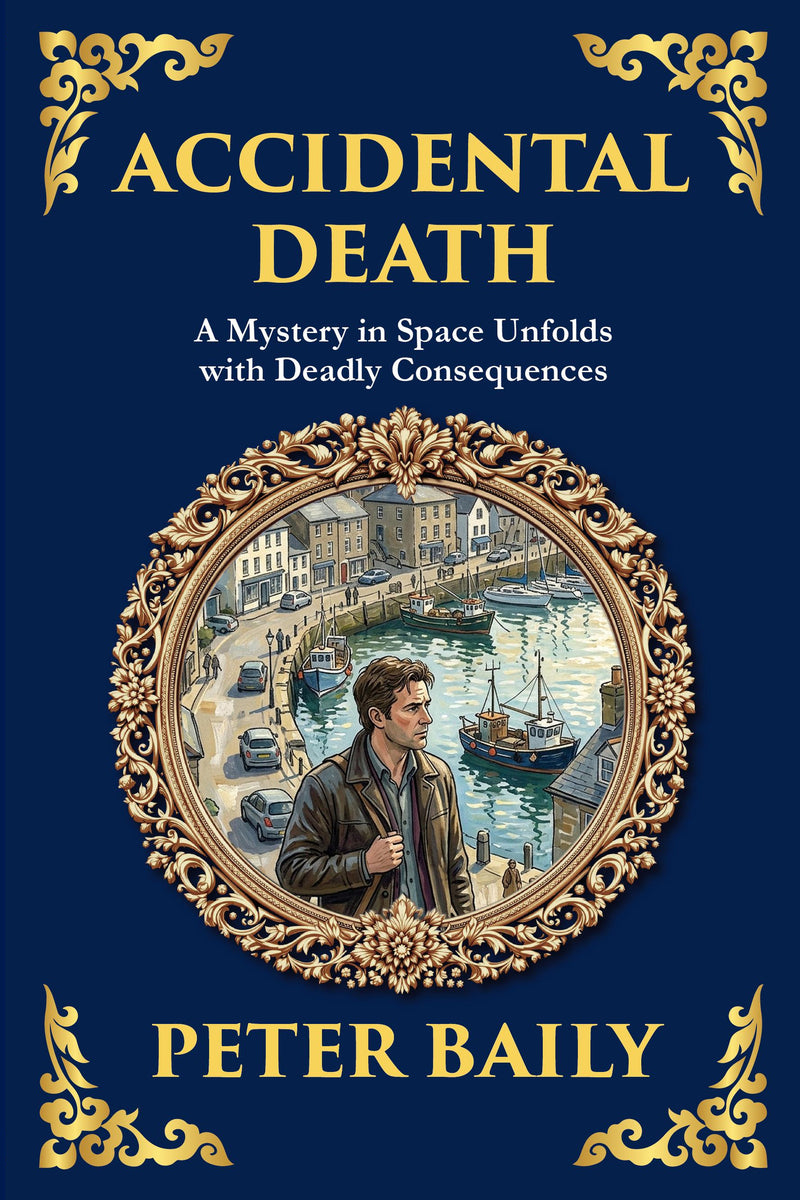
Accidental Death
In the silence of space, an unexpected death rattles the entire mission. Was it an accident—or something far more sinister?
or free app
10,000+ hrs library
30-day guarantee
The complete Accidental Death appears in modern English through Library of Alexandria Press, available online with audiobook narration included for members.
Have you ever wondered why the most dangerous thing in space might be your fellow crewmate? In Accidental Death, Peter Baily combines hard science fiction with razor-sharp mystery to deliver a suspenseful tale set in the cold void of space. A team of astronauts embarks on a deep-space mission with precision, protocol, and trust—or so they think.
When one of the crew members dies in what appears to be a tragic accident, subtle inconsistencies begin to surface. But in an environment where survival depends on unity, paranoia is a deadly passenger. As the investigation unfolds, cracks in the crew's relationships begin to widen.
Conflicting reports. Altered logs. Unanswered transmissions.
What starts as a standard inquiry spirals into a desperate search for truth. Because in space, the only thing more terrifying than the unknown... is betrayal.
What you’ll discover in this modern edition
- A Suspenseful Space Narrative – Follow a tense, closed-door investigation where every crew member is a suspect.
| Formats | eBook (EPUB + PDF) · Audiobook · Paperback · Hardcover · Large Print |
| Language | English |
| Trim size (print) | 6 × 9 in |
| Binding | Paperback — perfect-bound · Hardcover — casewrap |
| Large Print edition | Same text in a larger, easy-read type — a larger font, not a larger trim |
| Print pricing | Every physical book at our true cost — at-cost, no profit (members) |
| Library | 873 restored titles, always growing |
| Length | 6,766 words · ~27 min reading |
| Reading level | Grade 9 · a comfortable read (this modern-English edition) |
| Edition | Modern English translation · 2026 |
Member reviews for this edition are collected as readers finish it — be the first. Across the library: 12,000+ books shipped, every plan covered by a 365-day print guarantee.
About this edition
A faithful, unabridged modern-English edition by The Library of Alexandria — carefully rendered for today's reader and verified paragraph-by-paragraph against the public-domain source. Available as eBook, audiobook, paperback, hardcover, and large print.
- Complete & unabridgedVerified paragraph by paragraph against the source — never a scan, never abridged.
- Modern English, faithfulReadable today, with the author’s meaning kept intact. Readable — not simplified.
- Every format, one membershipRead in your browser or the free app, or listen to the full audiobook.
Included free with your membership
Cancel anytime, one click · 30-day money-back guarantee
Edition last updated July 2026
What’s inside
Accidental Death — complete and unabridged, included in full with membership, plus the full audiobook.
Begin reading Accidental Death
In clear modern English — the complete text is included with membership.
Introduction
A Space Mystery Unfolds with Fatal Results – A Modern Translation – Adapted for the Contemporary Reader
There is a particular kind of pleasure that comes from opening a story set among the stars, written in an era when humanity had only just begun to dream seriously of leaving its home world. The mid-twentieth century produced an extraordinary flowering of imaginative fiction, a body of work that took the boundless possibilities of space travel and married them to the oldest narrative instincts we possess: curiosity, fear, the hunger to understand the unknown, and the simple, irresistible question of what happens next. The tale you are about to read belongs to that proud tradition. It is a work that fuses the wide-open frontier of the cosmos with the tightly wound tension of a mystery, and in doing so it offers a reading experience that is at once thrilling and quietly thoughtful.
This edition has been prepared as a modern translation, adapted for the contemporary reader. That phrase deserves a moment of explanation, because it shapes how you will encounter the pages ahead. The intention behind this adaptation is not to rewrite or to second-guess the original author’s vision, but to remove the small frictions that can accumulate over the decades and make older prose feel more distant than it should. Idioms that have fallen out of use, sentence rhythms that once felt natural but now read as stiff, references that have quietly slipped from common knowledge—these are the kinds of things that can stand between a reader and a genuinely good story. By gently smoothing them, this version aims to let the narrative breathe with the immediacy it surely had for its first audience. The goal is invisibility: you should feel the pull of the plot and the texture of the world without stumbling over the scaffolding of the language. What remains is the story itself, the imagination of its creator, and the steady forward momentum that makes a mystery so difficult to set down.
Before you begin, it is worth taking a little time to consider what makes this particular blend of genres so compelling, why stories like this one have endured, and how best to settle into the frame of mind that will reward you most generously as a reader. The pages that follow are an invitation, not a summary; you will find no spoilers here, no unraveling of the careful threads the author has woven. Instead, think of this introduction as a companion who walks with you to the threshold, points out a few features of the landscape you are about to enter, and then steps aside to let you cross over alone.
There is something almost inevitable about the union of the detective story and the science fiction tale. Both genres are, at their hearts, engines of inquiry. The classic mystery presents us with a puzzle and dares us to solve it before the final page. It assumes a universe governed by rules—by cause and effect, by motive and consequence—and it promises that careful attention will be rewarded with understanding. Science fiction makes a strikingly similar promise. It, too, asks us to reason our way through an unfamiliar set of circumstances, to accept a handful of premises and then to follow their logical implications wherever they lead. When a writer combines these two impulses, the result can be uniquely satisfying, because the reader is invited to play detective not only within the story but within the very fabric of the world the author has built.
Consider for a moment the special challenge that space imposes on a mystery. On Earth, the conventions of the detective story rest on a vast web of assumptions we never think to question. There is air to breathe, gravity to hold us down, a sky that behaves predictably, distances that can be crossed in known ways, and a body of forensic knowledge that has been refined over generations. Remove humanity from that comfortable cradle and place it in the void, and every one of those assumptions becomes a variable. What does it mean to die accidentally—or otherwise—in an environment that is itself lethal, where the thin membrane between life and death may be nothing more than a sheet of metal or a seal of rubber? In space, the ordinary becomes precarious, and the precarious becomes ordinary. A mistake that would be trivial on the ground can be catastrophic among the stars, and this fact gives a space mystery a constant undercurrent of menace that an earthbound tale must work much harder to achieve.
The title of this work itself plays upon that tension. An accidental death, by definition, is one that no one intended, one that resulted from chance or carelessness or the cruel indifference of circumstance. Yet the word “accidental” carries within it a quiet question, almost a dare. Was it truly an accident? Could it have been anything else? In the harsh and unforgiving setting of space, where so many things can go wrong without any human hand to blame, the line between misfortune and design becomes blurred and treacherous. To investigate a death in such a place is to wrestle with a fundamental uncertainty: in an environment that is itself hostile to life, how can one ever be sure where the danger truly originated? This is the rich and unsettling soil from which the story grows, and the author cultivates it with patience and skill.
What makes the genre so durable is that it never loses sight of the human element. For all its rivets and bulkheads, its calculations and machinery, a story like this one remains fundamentally about people—their fears and ambitions, their loyalties and betrayals, their capacity for both heroism and weakness when pressed to the limit. The vacuum of space strips away the distractions and comforts of ordinary life and forces characters to confront one another, and themselves, with a clarity that few other settings can provide. In a sealed environment, far from any help, every relationship is intensified, every secret more dangerous, every act of trust more consequential. The mystery becomes not merely a question of who did what, but of who these people are when everything they rely upon could fail at any moment.
It is also worth appreciating how this kind of fiction reflects the spirit of the age in which it was written. The decades that produced so much classic science fiction were decades of genuine wonder and genuine anxiety about the future. Humanity stood at the edge of a new frontier, looking up at a sky that had suddenly become reachable, and the writers of the period channeled both the optimism and the unease of that moment into their work. They imagined what life among the stars might look like—not as distant prophecy but as a plausible tomorrow—and they populated their visions with recognizable human beings facing recognizable human problems in extraordinary circumstances. Reading such a story today offers a double pleasure: the pleasure of the tale itself, and the pleasure of glimpsing how an earlier generation dreamed about the very future we now partly inhabit. There is a charm and an honesty in these imaginings, an earnest engagement with possibility that can feel refreshing in a time when so much of our entertainment is steeped in irony.
A Story Built on Atmosphere, Tension, and Restraint
One of the great strengths of a well-crafted space mystery is its atmosphere, and this is something to savor as you read. The setting itself becomes a character—a brooding, ever-present force that shapes the mood of every scene. The author understands that suspense is not merely a matter of events but of environment, of the slow accumulation of unease that comes from knowing how thin the margins of survival truly are. There is a particular quality of dread that belongs to enclosed spaces surrounded by emptiness, a claustrophobia made all the more acute by the knowledge that there is nowhere to run. To step outside is death; to remain inside is to be trapped with whatever danger lurks within. This is the paradox at the heart of so many of the finest stories in this tradition, and it lends every quiet moment an edge of anticipation.
You will likely notice, as you read, how much the story trusts you. It does not rush to explain everything, nor does it spell out every implication of its events. Instead, it lays out details with care and allows you to assemble them in your own mind, to form theories and test them against new revelations. This is the essence of a good mystery: a partnership between writer and reader in which both parties are engaged in the same act of discovery. The pleasure lies not in being told the answer but in working toward it, in feeling the satisfaction of a piece clicking into place or the delicious frustration of a clue that refuses to yield its meaning. Approach the book in this spirit, and you will find it far more rewarding. Read slowly enough to notice; question what you are told; pay attention to what is said and, just as importantly, to what is left unsaid.
The pacing of a story like this is worth a word as well. Older science fiction often moves with a deliberateness that modern readers, accustomed to the breakneck velocity of contemporary thrillers, may find unfamiliar at first. This is not a flaw but a feature. The measured pace allows tension to build, lets the world establish itself, and gives the characters room to become real. There is a craftsmanship in this restraint, a confidence that the reader will reward patience with attention. As you settle into the rhythm of the prose, you may find that this slower burn produces a more lasting and more satisfying kind of suspense than the relentless acceleration of so much modern fiction. The anxiety that creeps up on you gradually has a way of lingering, of making you genuinely uncertain about how the story will resolve. This adaptation has been careful to preserve that deliberate rhythm even as it modernizes the language, because the pacing is inseparable from the atmosphere, and the atmosphere is the soul of the tale.
It is also a story that respects the intelligence of its audience. There is a tendency in some quarters to assume that older fiction must necessarily be simpler or less sophisticated than what we produce today, but this assumption does a disservice both to the writers of the past and to the readers of the present. The best science fiction of the period engaged seriously with questions of science, technology, ethics, and human nature, and it did so with a rigor that demanded much of its audience. This work asks you to think—to consider the implications of its premises, to weigh the motives and actions of its characters, to inhabit a way of thinking shaped by a world quite different from our own. That intellectual engagement is part of the pleasure. A mystery is, after all, an invitation to reason, and reasoning is most enjoyable when the puzzle is worthy of the effort.
The setting deserves to be appreciated on its own terms as well. The author has imagined a future in considerable detail, and part of the joy of reading lies in inhabiting that vision—in learning the textures and routines of a life lived beyond the bounds of Earth. There is a craftsmanship to world-building that often goes unremarked, a careful labor of imagination that creates a place coherent enough to believe in and strange enough to fascinate. As you read, allow yourself to be drawn into this world. Notice the small details that establish its reality: the way people live and work, the technologies they take for granted, the dangers they have learned to manage and the ones they have not. These details are not mere decoration; they are the foundation upon which the mystery rests. The plausibility of the puzzle depends entirely on the plausibility of the world, and the author has built that world with evident care.
There is, finally, a kind of timelessness to a well-told mystery that transcends the particulars of its setting. Strip away the spacesuits and the starships, and what remains is something ancient and universal: the desire to know the truth, the struggle to make sense of a death, the moral weight of discovering what really happened and deciding what to do about it. These concerns are as old as storytelling itself, and they are what give a tale like this its emotional resonance. The science fiction trappings are the costume; the human drama is the substance. As you follow the investigation to its conclusion, you may find that the questions the story raises linger in your mind long after the specific details of its futuristic setting have faded. That is the mark of a story that has done its work well.
Cancel anytime, one click · 30-day money-back guarantee
Founding annual rate available now — your price locks for life when you join.
Not ready? Get this free chapter by email — read it anytime.
✓ Sent — check your inbox for Accidental Death.
Questions about Accidental Death
What is Accidental Death about?
In the silence of space, an unexpected death rattles the entire mission. Was it an accident—or something far more sinister? Peter Baily’s gripping science fiction mystery unravels a tangled web of human error, hidden agendas, and moral dilemmas aboard an isolated spacecraft.
Who wrote Accidental Death?
Accidental Death was written by Peter Baily. This edition presents the complete work in clear modern English, faithfully rendered from the public-domain original by Library of Alexandria Press.
Is Accidental Death free to read?
The opening chapter is free to read on this page. Members read and listen to the complete work — and the entire library — free, and can order any physical book at our true print cost.
How long is Accidental Death?
2 chapters (~6,766 words) — about 27 min of reading in this modern-English edition.
Is this an abridged version of Accidental Death?
No. This is the complete, unabridged Accidental Death, carefully rendered into clear modern English and verified paragraph-by-paragraph against the public-domain source — nothing is cut or summarised.
What formats does Accidental Death come in?
Accidental Death is available as eBook, paperback, hardcover and large print. eBook and audiobook are included with membership; printed editions ship at our true print cost.
Shipping & returns
Billing & membership
More from the library


Explore Free eBooks
- Kant's Prolegomena to Any Future Metaphysics · Immanuel Kant
- The Advancement of Learning · Francis Bacon
- The Dawn of Day · Friedrich Nietzsche
- Peter and Wendy · J. M. Barrie
- Meditations · Marcus Aurelius
- The Confessions of St. Augustine · Saint Augustine of Hippo
- Resurrection · Leo Tolstoy
- Dialogues Concerning Natural Religion · David Hume
- As You Like It · William Shakespeare
- Jack and Jill · Louisa May Alcott
- Dream Psychology: Psychoanalysis for Beginners · Sigmund Freud
- The Raven · Edgar Allan Poe
- Considerations on Representative Government · John Stuart Mill
- The Will to Power: An Attempted Transvaluation of All Values. Book III and IV · Friedrich Nietzsche
- Tarzan of the Apes · Edgar Rice Burroughs
- Fundamental Principles of the Metaphysic of Morals · Immanuel Kant
- The Confessions of Jean Jacques Rousseau — Complete · Jean-Jacques Rousseau
- The Merchant of Venice · William Shakespeare
- Democracy in America — Volume 2 · Alexis de Tocqueville
- Ecce Homo · Friedrich Wilhelm Nietzsche
- Second Treatise of Government · John Locke
- The Wonderful Wizard of Oz · L. Frank Baum
- The Prince · Niccolò Machiavelli
- Anne of Green Gables · L. M. Montgomery
- De Profundis · Oscar Wilde
- Thus Spake Zarathustra: A Book for All and None · Friedrich Nietzsche
- Anna Karenina · Leo Tolstoy
- Great Expectations · Charles Dickens
- The Island of Doctor Moreau · H. G. Wells
- A Midsummer Night's Dream · William Shakespeare
Accidental Death
Accidental Death
A Space Mystery Unfolds with Fatal Results
Peter Baily
Contents
- Introduction
- Accidental Death
Introduction
A Space Mystery Unfolds with Fatal Results – A Modern Translation – Adapted for the Contemporary Reader
There is a particular kind of pleasure that comes from opening a story set among the stars, written in an era when humanity had only just begun to dream seriously of leaving its home world. The mid-twentieth century produced an extraordinary flowering of imaginative fiction, a body of work that took the boundless possibilities of space travel and married them to the oldest narrative instincts we possess: curiosity, fear, the hunger to understand the unknown, and the simple, irresistible question of what happens next. The tale you are about to read belongs to that proud tradition. It is a work that fuses the wide-open frontier of the cosmos with the tightly wound tension of a mystery, and in doing so it offers a reading experience that is at once thrilling and quietly thoughtful.
This edition has been prepared as a modern translation, adapted for the contemporary reader. That phrase deserves a moment of explanation, because it shapes how you will encounter the pages ahead. The intention behind this adaptation is not to rewrite or to second-guess the original author’s vision, but to remove the small frictions that can accumulate over the decades and make older prose feel more distant than it should. Idioms that have fallen out of use, sentence rhythms that once felt natural but now read as stiff, references that have quietly slipped from common knowledge—these are the kinds of things that can stand between a reader and a genuinely good story. By gently smoothing them, this version aims to let the narrative breathe with the immediacy it surely had for its first audience. The goal is invisibility: you should feel the pull of the plot and the texture of the world without stumbling over the scaffolding of the language. What remains is the story itself, the imagination of its creator, and the steady forward momentum that makes a mystery so difficult to set down.
Before you begin, it is worth taking a little time to consider what makes this particular blend of genres so compelling, why stories like this one have endured, and how best to settle into the frame of mind that will reward you most generously as a reader. The pages that follow are an invitation, not a summary; you will find no spoilers here, no unraveling of the careful threads the author has woven. Instead, think of this introduction as a companion who walks with you to the threshold, points out a few features of the landscape you are about to enter, and then steps aside to let you cross over alone.
There is something almost inevitable about the union of the detective story and the science fiction tale. Both genres are, at their hearts, engines of inquiry. The classic mystery presents us with a puzzle and dares us to solve it before the final page. It assumes a universe governed by rules—by cause and effect, by motive and consequence—and it promises that careful attention will be rewarded with understanding. Science fiction makes a strikingly similar promise. It, too, asks us to reason our way through an unfamiliar set of circumstances, to accept a handful of premises and then to follow their logical implications wherever they lead. When a writer combines these two impulses, the result can be uniquely satisfying, because the reader is invited to play detective not only within the story but within the very fabric of the world the author has built.
Consider for a moment the special challenge that space imposes on a mystery. On Earth, the conventions of the detective story rest on a vast web of assumptions we never think to question. There is air to breathe, gravity to hold us down, a sky that behaves predictably, distances that can be crossed in known ways, and a body of forensic knowledge that has been refined over generations. Remove humanity from that comfortable cradle and place it in the void, and every one of those assumptions becomes a variable. What does it mean to die accidentally—or otherwise—in an environment that is itself lethal, where the thin membrane between life and death may be nothing more than a sheet of metal or a seal of rubber? In space, the ordinary becomes precarious, and the precarious becomes ordinary. A mistake that would be trivial on the ground can be catastrophic among the stars, and this fact gives a space mystery a constant undercurrent of menace that an earthbound tale must work much harder to achieve.
The title of this work itself plays upon that tension. An accidental death, by definition, is one that no one intended, one that resulted from chance or carelessness or the cruel indifference of circumstance. Yet the word “accidental” carries within it a quiet question, almost a dare. Was it truly an accident? Could it have been anything else? In the harsh and unforgiving setting of space, where so many things can go wrong without any human hand to blame, the line between misfortune and design becomes blurred and treacherous. To investigate a death in such a place is to wrestle with a fundamental uncertainty: in an environment that is itself hostile to life, how can one ever be sure where the danger truly originated? This is the rich and unsettling soil from which the story grows, and the author cultivates it with patience and skill.
What makes the genre so durable is that it never loses sight of the human element. For all its rivets and bulkheads, its calculations and machinery, a story like this one remains fundamentally about people—their fears and ambitions, their loyalties and betrayals, their capacity for both heroism and weakness when pressed to the limit. The vacuum of space strips away the distractions and comforts of ordinary life and forces characters to confront one another, and themselves, with a clarity that few other settings can provide. In a sealed environment, far from any help, every relationship is intensified, every secret more dangerous, every act of trust more consequential. The mystery becomes not merely a question of who did what, but of who these people are when everything they rely upon could fail at any moment.
It is also worth appreciating how this kind of fiction reflects the spirit of the age in which it was written. The decades that produced so much classic science fiction were decades of genuine wonder and genuine anxiety about the future. Humanity stood at the edge of a new frontier, looking up at a sky that had suddenly become reachable, and the writers of the period channeled both the optimism and the unease of that moment into their work. They imagined what life among the stars might look like—not as distant prophecy but as a plausible tomorrow—and they populated their visions with recognizable human beings facing recognizable human problems in extraordinary circumstances. Reading such a story today offers a double pleasure: the pleasure of the tale itself, and the pleasure of glimpsing how an earlier generation dreamed about the very future we now partly inhabit. There is a charm and an honesty in these imaginings, an earnest engagement with possibility that can feel refreshing in a time when so much of our entertainment is steeped in irony.
A Story Built on Atmosphere, Tension, and Restraint
One of the great strengths of a well-crafted space mystery is its atmosphere, and this is something to savor as you read. The setting itself becomes a character—a brooding, ever-present force that shapes the mood of every scene. The author understands that suspense is not merely a matter of events but of environment, of the slow accumulation of unease that comes from knowing how thin the margins of survival truly are. There is a particular quality of dread that belongs to enclosed spaces surrounded by emptiness, a claustrophobia made all the more acute by the knowledge that there is nowhere to run. To step outside is death; to remain inside is to be trapped with whatever danger lurks within. This is the paradox at the heart of so many of the finest stories in this tradition, and it lends every quiet moment an edge of anticipation.
You will likely notice, as you read, how much the story trusts you. It does not rush to explain everything, nor does it spell out every implication of its events. Instead, it lays out details with care and allows you to assemble them in your own mind, to form theories and test them against new revelations. This is the essence of a good mystery: a partnership between writer and reader in which both parties are engaged in the same act of discovery. The pleasure lies not in being told the answer but in working toward it, in feeling the satisfaction of a piece clicking into place or the delicious frustration of a clue that refuses to yield its meaning. Approach the book in this spirit, and you will find it far more rewarding. Read slowly enough to notice; question what you are told; pay attention to what is said and, just as importantly, to what is left unsaid.
The pacing of a story like this is worth a word as well. Older science fiction often moves with a deliberateness that modern readers, accustomed to the breakneck velocity of contemporary thrillers, may find unfamiliar at first. This is not a flaw but a feature. The measured pace allows tension to build, lets the world establish itself, and gives the characters room to become real. There is a craftsmanship in this restraint, a confidence that the reader will reward patience with attention. As you settle into the rhythm of the prose, you may find that this slower burn produces a more lasting and more satisfying kind of suspense than the relentless acceleration of so much modern fiction. The anxiety that creeps up on you gradually has a way of lingering, of making you genuinely uncertain about how the story will resolve. This adaptation has been careful to preserve that deliberate rhythm even as it modernizes the language, because the pacing is inseparable from the atmosphere, and the atmosphere is the soul of the tale.
It is also a story that respects the intelligence of its audience. There is a tendency in some quarters to assume that older fiction must necessarily be simpler or less sophisticated than what we produce today, but this assumption does a disservice both to the writers of the past and to the readers of the present. The best science fiction of the period engaged seriously with questions of science, technology, ethics, and human nature, and it did so with a rigor that demanded much of its audience. This work asks you to think—to consider the implications of its premises, to weigh the motives and actions of its characters, to inhabit a way of thinking shaped by a world quite different from our own. That intellectual engagement is part of the pleasure. A mystery is, after all, an invitation to reason, and reasoning is most enjoyable when the puzzle is worthy of the effort.
The setting deserves to be appreciated on its own terms as well. The author has imagined a future in considerable detail, and part of the joy of reading lies in inhabiting that vision—in learning the textures and routines of a life lived beyond the bounds of Earth. There is a craftsmanship to world-building that often goes unremarked, a careful labor of imagination that creates a place coherent enough to believe in and strange enough to fascinate. As you read, allow yourself to be drawn into this world. Notice the small details that establish its reality: the way people live and work, the technologies they take for granted, the dangers they have learned to manage and the ones they have not. These details are not mere decoration; they are the foundation upon which the mystery rests. The plausibility of the puzzle depends entirely on the plausibility of the world, and the author has built that world with evident care.
There is, finally, a kind of timelessness to a well-told mystery that transcends the particulars of its setting. Strip away the spacesuits and the starships, and what remains is something ancient and universal: the desire to know the truth, the struggle to make sense of a death, the moral weight of discovering what really happened and deciding what to do about it. These concerns are as old as storytelling itself, and they are what give a tale like this its emotional resonance. The science fiction trappings are the costume; the human drama is the substance. As you follow the investigation to its conclusion, you may find that the questions the story raises linger in your mind long after the specific details of its futuristic setting have faded. That is the mark of a story that has done its work well.
A northwest wind howled, blinded by snow and stinging with ice crystals. It clawed and tore at groaning slabs of ice all the way up the half-mile cliff. The wind screamed over the peak, swirling snow in a wild dance around a hollow, and piling it into a long, straight groove that cut through the smooth mounds of snow.
The sun glinted off ice-covered black rock, deep chasms, ridges, and frozen bridges. It turned the snowy slope into a blinding glare, cast a thin black shadow down the long groove, and flashed at the end of that groove on an object made of metal and plastic—a man-made thing dropped into the dead wilderness.
Nothing grew, flew, walked, or spoke. But the object in the hollow was moving in stiff, jerky motions, like a snake with a broken back or a wind-up toy running out of power. When the movement stopped, there was a click, and a strange sound began. It was thin, scratchy, and barely audible more than a yard away. Though it sounded tired, it was still confident; the sound of a human voice leaked from the shape in the hollow.
“I’ve tried my hands and arms, and they seem to work,” it began. “I’ve wiggled my toes successfully. It looks likely that I’m in one piece and not broken at all, though I don’t see how that’s possible. Right now, I don’t feel like struggling to get up and find out. I’m fine where I am. I’ll just lie here for a bit, relax, and record some of the story. This suit has a built-in recorder, so I might as well use it. That way, even if I’m not as healthy as I feel, I’ll leave a message. You probably know we’ve returned and are wondering what went wrong.”
End of the free sample
Keep reading, free
Members read and listen to the complete book — and the entire library. Cancel anytime, one click · 30-day money-back guarantee.