3 h 53 minAudiobook9 minSummaryRead it, hear it, the 15-minute summary, and print and large print at costPaperback · 6 × 9 in · 95 pagesHardcover · 6 × 9 in · 95 pages
About this book
What if changing your voice opens doors—but leaves everyone else claiming the right to decide who you are?
On a rainy night in London's Covent Garden, flower seller Eliza Doolittle meets Henry Higgins, a brilliant, rude professor of speech. He boasts that he can pass her off as a duchess by changing her voice. Eliza wants something more practical: speech that will help her find work in a shop.
In Bernard Shaw's five-act comedy Pygmalion, lessons become a test of manners, money and respect. Colonel Pickering offers Eliza courtesy, while Higgins treats her as an experiment. From relentless vowel drills to a visit at Mrs Higgins's home, each social test raises a sharper question: who gets to define Eliza's worth?
What you’ll discover
- A voice worth hearing Meet a proud, quick-tempered flower girl whose ambitions reach beyond a professor's clever wager.
- Lessons beyond pronunciation Watch speech lessons expose the distance between sounding respectable and treating another person with respect.
- Comedy in the drawing room Follow Eliza into Mrs Higgins's gathering, where her new speech faces its first social test.
- The price of respectability Hear Alfred Doolittle challenge a morality that he believes the poor cannot afford.
- More than a makeover Explore Shaw's pointed questions about class, independence and the limits of remaking another person.
Is it for you?
This summary suits anyone who wants a quick, clear route into a play they may have met only as a film or musical, and readers curious about class and speech. It may suit less those who want a plain romance.
What’s inside
The key ideas, in the 15-minute summary
- Rain in Covent Garden starts the bet
- A flower girl comes for lessons
- Doolittle and the price of a daughter
- Learning to speak is learning to be seen
- The test at Mrs Higgins's at-home
- What the play argues and how it is built
Who’s who
- Eliza DoolittleA Cockney flower girl with a quick temper and real pride, who wants to speak well enough to work in a shop.
- Henry HigginsA brilliant, rude professor of phonetics who bets that he can turn a street girl into a lady through speech alone.
- Colonel PickeringA courteous scholar of Indian dialects who joins Higgins's wager and treats Eliza with a politeness she has never known.
- Alfred DoolittleEliza's father, a dustman with a sharp tongue, who sees respectable morality as something the poor cannot afford.
- Mrs HigginsHenry's sensible mother, who sees at once that the experiment treats a living young woman as a plaything.
- Mrs PearceHiggins's housekeeper, who tries to keep order in a bachelor household and to protect Eliza from his careless cruelty.
- Freddy Eynsford HillA young, easily charmed gentleman of little money who is quickly taken with Eliza after meeting her at Mrs Higgins's home.
Formats and delivery
- eBook
- On your phone, tablet, computer or Kindle, with the type as large as you like.
- Large-print eBook
- The same book in bigger, clearer type, from the first page.
- Audiobook
- 3 h 53 min, complete, read by Lucas Linden.
- 15-minute summary
- The key ideas in about 9 minutes, to read or to hear.
- Paperback
- 6 × 9 in, 95 pages: USD 6.95 when you start free, USD 13.95 on its own.
- Hardcover
- 6 × 9 in, 95 pages: USD 13.95 when you start free, USD 20.95 on its own.
- Large print paperback
- 8.5 × 11 in. Printing soon: leave your email under Paperback or Hardcover above.
- Large print hardcover
- 8.5 × 11 in. Printing soon: leave your email under Paperback or Hardcover above.
eBooks and audiobooks open right away. Download EPUB or PDF, or send the book to your Kindle. Every printed copy is made when you order it and shipped worldwide; shipping is shown at checkout.
How it works · 60-day guarantee
- Start free. Nothing to pay today; the eBook of this book is yours to keep.
- Read, listen and print. 200,000+ classics as eBook, large-print eBook, audiobook and 15-minute summary, and any book printed at cost as a paperback, hardcover or large print, for the whole household.
- We remind you first. We email you 7 days before your first payment. Then your first year is 50% off: USD 0.14 a day, then USD 0.27 a day, never raised. Or USD 0.66 a day on the monthly plan. Cancel online in two clicks.
60-day money-back guarantee. If the library is not for you, ask within 60 days of your first payment and we refund it in full.
25 languages, side by side
Read and hear Pygmalion in 25 languages and switch at any time. Or read two side by side, paragraph by paragraph: the way to learn a language with a book you love.
Read it side by side
Poetry & DramaFree to read
Pygmalion
 by Bernard Shaw· 1913
A flower seller’s speech lessons challenge her place in society.
Excellent
- The whole book free
- Read or listen
- 25 languages, side by side
- Print and large print at cost
Opens right away, on any device
Read the whole book freeNo sign-upNothing to pay


Language: English
From the 15-minute summary · Key idea 1 of 6
Rain in Covent Garden starts the bet
The play opens on a wet night outside St Paul's church in Covent Garden. Theatregoers shelter from the storm beside market people and passersby. Among them is a young flower girl named Eliza Doolittle, who speaks in a thick London accent and sells small bunches of violets. Her voice is loud, her vowels are crushed, and the well dressed people nearby hear in them nothing but poverty.
A stranger in the crowd is writing in a notebook. He is taking down, in special symbols, every sound the people around him make. This is Henry Higgins, a professor of phonetics, who can tell where a person was born, often within a street or two, just by listening. Eliza fears he is a police informer and cries out in alarm. The crowd, amused, watches him name the home district of one bystander after another.
Renews every year · Cancel anytime
The author
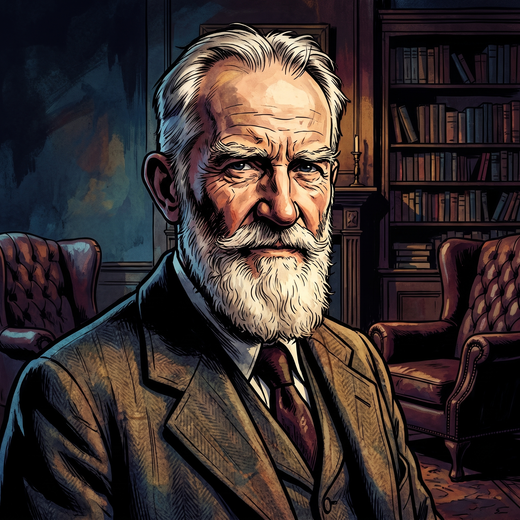
Bernard Shaw
1856–1950 · Irish playwright and critic
George Bernard Shaw (1856–1950) was an Irish playwright and critic. Born in Dublin, he moved to London in 1876 and later lived in Ayot St Lawrence, Hertfordshire, where he died. His plays include Arms and the Man (1894), Man and Superman (1903), Major Barbara (1905), and Pygmalion (1912).
Free gifts
USD 580 in free gifts when you start
Every book in every format and in 25 languages, for the whole household. Nothing to pay today.
- 200,000+ classic eBooksIn 25 languages, side by side
USD 170FREE - Every audiobookIn 25 languages, any device
USD 120FREE - 15-minute summariesRead or listen, in 25 languages
USD 60FREE - Print at cost, no markupPaperback, hardcover, large print
USD 60FREE - The whole householdUp to 5 readers
USD 170FREE - A part in rebuilding the libraryNew languages and books for all
FREE


More like this

 Free

 Free

 Free


 Free


Our mission
The library burned once. We are building it back.
Every great book, in every language and every format, for every family. Every plan helps pay for new languages, new audiobooks and books for readers who have never had them. Join the movement.
Read our story- Every language25 languages today, side by side, and more every year
- No wastePrinted on demand: no warehouses, no unsold stock, no pulped copies
- For everyonePaperback, hardcover and large print at the cost of printing
Questions about Pygmalion
Is the whole book really free?
Yes. Pygmalion is one of 200 complete books that are free to read and hear, with no sign-up and nothing to pay. Start free and you also get 200,000+ more classics, the 15-minute summaries, and any book printed at cost as a paperback, hardcover or large print.
Can I buy just the printed book?
Yes. The paperback costs USD 13.95 on its own. Start free and you pay the cost of printing: USD 6.95 for this paperback, and any other book at cost as a paperback, hardcover or large print.
Can my family read too?
Yes. The whole household reads and listens: up to 5 readers, each with their own shelf and their own place in every book.
What if it is not for me?
Cancel online in two clicks at any time and nothing more is charged. If you have paid and the library is not for you, ask within 60 days of your first payment and we refund it in full.
What is Pygmalion about?
It tells of a phonetics professor, Henry Higgins, who bets that he can teach a Cockney flower girl, Eliza Doolittle, to speak so well that she passes as a duchess. It looks at class, language and respect.
Why is the play called Pygmalion?
The title comes from a Greek myth, retold by Ovid, in which a sculptor loves a statue he has made and it comes to life. Shaw uses the idea of a creator shaping a person.
When was Pygmalion written and first performed?
Shaw wrote it in 1912 and early 1913. It was first staged in Vienna in 1913 and reached London in 1914. It is fiction, though it draws on real phonetics and English class habits.
Popular in poetry and plays
See all Free
 Free

 Free
 Free
 Free
 Free
 Free


 Free
 Free