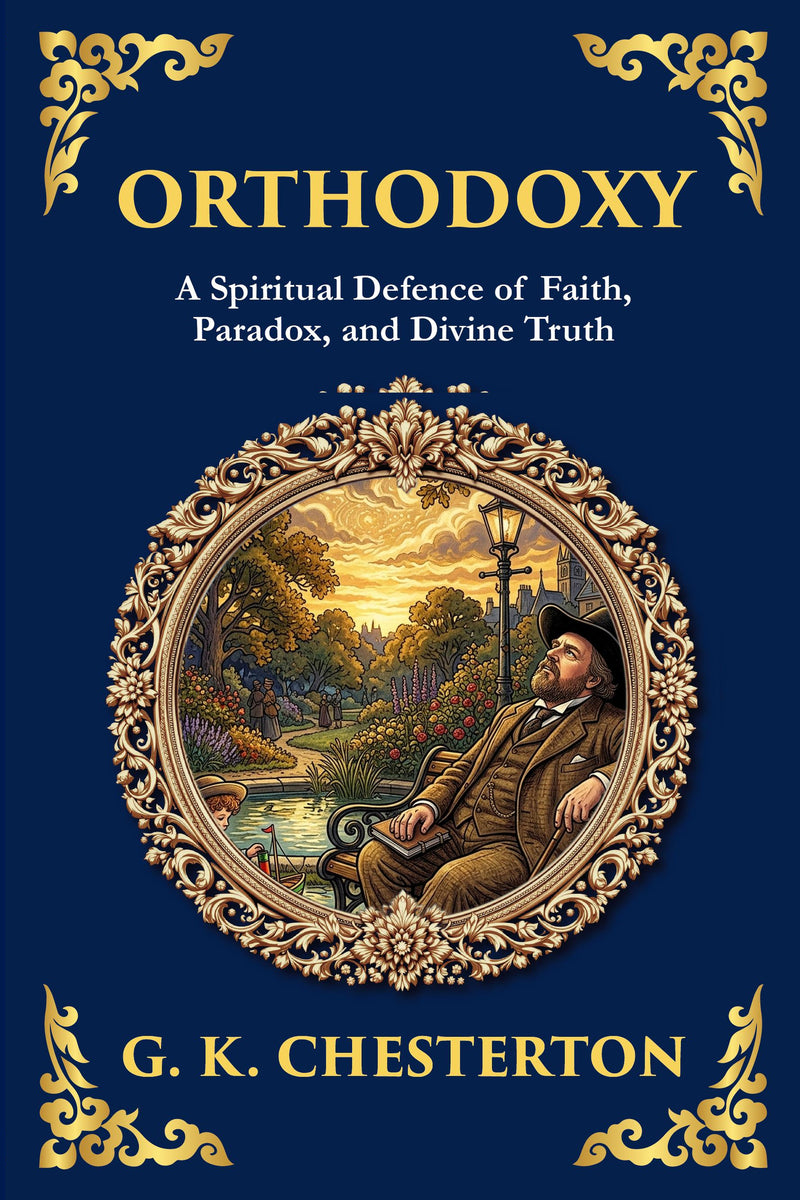
Orthodoxy
Orthodoxy is not a dry theological treatise—it is a joyful sword fight with doubt itself. With wit, poetry, and paradox, G. K. Chesterton invites readers into a world where reason dances with wonder and belief triumphs over cynicism.
or free app
10,000+ hrs library
30-day guarantee
The complete Orthodoxy appears in modern English through Library of Alexandria Press, available online with audiobook narration included for members.
What if an old creed offers not a cage for the mind, but room for wonder?
In Orthodoxy, G. K. Chesterton answers critics who ask him to state his own beliefs. He tells the story of his mind rather than writing a textbook. Like his imagined yachtsman who discovers a new island only to land at Brighton, he seeks something new and finds something old.
Chesterton makes a personal case for Christian faith through jokes, startling images, and reversals. He questions reason cut off from everything else, doubt that undermines thought, and progress without a clear ideal. Along the way, fairy tales, courage, and joy help him argue that the Christian creed fits the world's stubborn strangeness.
What you'll discover
- Reason and its limits – Consider Chesterton's challenge to a mind that trusts logic but shuts out everything else.
- Wonder in fairy tales – Explore why nursery stories shape his sense of gratitude and the strangeness of ordinary life.
- Love that wants change – Ask how loving the world can strengthen the wish to make it better.
- Opposites held in balance – Follow his argument that Christian virtues hold together qualities that seem to pull apart.
- Belief as an adventure – Meet a defence of faith that makes room for mystery, courage, and exuberant joy.
Perfect for believers and doubters who enjoy ideas argued with wit, and anyone curious about why Christianity draws thinkers.
Open the first page and follow Chesterton into an argument alive with jokes, questions, and wonder.
| Formats | eBook (EPUB + PDF) · Audiobook · Paperback · Hardcover · Large Print |
| Language | English |
| Trim size (print) | 6 × 9 in |
| Binding | Paperback — perfect-bound · Hardcover — casewrap |
| Large Print edition | Same text in a larger, easy-read type — a larger font, not a larger trim |
| Print pricing | Every physical book at our true cost — at-cost, no profit (members) |
| Library | 873 restored titles, always growing |
| Length | 66,260 words · ~4 hr 25 min reading |
| Reading level | Grade 3 · an easy, flowing read (this modern-English edition) |
| Edition | Modern English translation · 2026 |
Member reviews for this edition are collected as readers finish it — be the first. Across the library: 12,000+ books shipped, every plan covered by a 365-day print guarantee.
About this edition
A faithful, unabridged modern-English edition by The Library of Alexandria — carefully rendered for today's reader and verified paragraph-by-paragraph against the public-domain source. Available as eBook, audiobook, paperback, hardcover, and large print.
- Complete & unabridgedVerified paragraph by paragraph against the source — never a scan, never abridged.
- Modern English, faithfulReadable today, with the author’s meaning kept intact. Readable — not simplified.
- Every format, one membershipRead in your browser or the free app, or listen to the full audiobook.
Included free with your membership
Cancel anytime, one click · 30-day money-back guarantee
Edition last updated July 2026
What’s inside
Orthodoxy — complete and unabridged: all 11 sections included with membership, plus the full audiobook.
Begin reading Orthodoxy
In clear modern English — the complete text is included with membership.
Introduction
There are books that argue, and there are books that dance. Orthodoxy does both at once, and the spectacle is so exhilarating that many readers finish it feeling as though they have not so much read an argument as survived a fireworks display in which every explosion turned out, on inspection, to be a perfectly reasoned proposition. G. K. Chesterton wrote it in 1908, near the height of his powers, in answer to a challenge that had been thrown at him almost in jest. A critic had complained that Chesterton was forever telling the world what was wrong with everything—wrong with materialism, wrong with pessimism, wrong with the fashionable thinkers of the day—but that he never stood still long enough to say what he actually believed. The complaint stung, because it was fair. Chesterton accepted the dare. The result is a book that attempts the most difficult thing a writer can attempt: to explain, with honesty and delight, why a man believes what he believes.
What you hold in your hands is a modern translation, adapted carefully for the contemporary reader. That phrase deserves a word of explanation, because Chesterton did not write in a foreign language—he wrote in English, and gloriously so. But he wrote in the English of Edwardian London, an English crowded with references to forgotten controversies, with the names of philosophers and journalists whose quarrels have long since gone quiet, with idioms and turns of phrase that have shifted their meaning over more than a century. The purpose of this adaptation is not to improve upon Chesterton, which would be an act of supreme arrogance, but to clear away the underbrush of obsolete reference so that the living tree of his thought can be seen in full. Where a sentence once required a footnote, it has been gently opened up. Where a long Victorian period might lose a reader trained on shorter rhythms, the architecture has been preserved while the load has been lightened. The aim throughout has been fidelity to meaning and to music, so that the wit lands as it was meant to land, and the arguments arrive with their original force intact.
To approach this book well, you should know two things before you begin. The first is that Orthodoxy is not a work of theology in the technical sense, and you do not need to share Chesterton’s faith—or any faith—to be swept along by it. It is, rather, the story of how one particular mind found its way home. Chesterton describes it himself with characteristic mischief: he imagines an English yachtsman who, through a slight error in navigation, discovers England under the impression that it is a new island in the South Seas. He plants his flag on what he takes to be a barbarous and undiscovered shore, only to find that he has landed at Brighton. Chesterton says this is precisely the comedy of his own life. He set out, with all the confidence of a clever young man, to invent a brand-new philosophy of his own, a heresy entirely original, a truth nobody had ever thought of before. And when at last he had perfected it, he discovered that it was orthodoxy. He had taken the trouble to be eighteen hundred years late. The book is the record of that voyage—a personal, almost autobiographical account of how a skeptic argued his way, against his own intentions, into belief.
The second thing to know is that this is a book built almost entirely out of paradox, and you must not be frightened by that word. In ordinary speech a paradox sounds like a trick, a clever contradiction designed to make the speaker seem deep. Chesterton’s paradoxes are nothing of the kind. For him, a paradox is a truth standing on its head to attract attention. He noticed something that more cautious thinkers tended to miss: that reality itself is paradoxical, that the deepest truths about life arrive in pairs that seem to contradict each other and yet are both required. Courage, he points out, is almost a contradiction in terms—it means a strong desire to live taking the form of a readiness to die. Humility and confidence, properly understood, are not opposites but partners. The man who loves something must be at once fiercely loyal to it and fiercely critical of it. Chesterton does not soften these tensions; he celebrates them. He believes that a creed which can hold two strong colors side by side without blending them into a muddy gray is a creed worth having. So when you find, page after page, a sentence that turns suddenly inside out and surprises you with its sense, do not assume you are being teased. You are being shown something. The whole method of the book is to take ideas you thought you understood and rotate them just enough that you see a face of them you had never noticed.
It may help to have a sense of where the journey is headed, though I will be careful to spoil nothing of the pleasure of the route. Chesterton opens by setting the problem. What does a sane and healthy human being actually need from a philosophy of life? He answers that we need two things which seem to pull against each other. We need to be astonished by the world, to find it wild and surprising and full of wonder—and at the same time we need to feel at home in it, to feel that it is ours, that we belong here. We need, he says, a way of being romantic about the world while remaining at peace in it. The whole rest of the book is an account of how he came to find a vision of life that satisfied both of these hungers at once.
Along the way he conducts a kind of trial. He puts the spirit of his age in the dock and cross-examines it. He looks hard at the fashionable confidence in pure reason and finds, surprisingly, that the man who trusts reason and nothing but reason often ends up in the madhouse—not because reason is bad, but because reason cut off from everything else, reason with no horizon, becomes a small and airless prison. The maniac, Chesterton observes, is not the man who has lost his reason; he is the man who has lost everything except his reason. There is a famous passage in which he describes the materialist’s universe as something both very large and very small—as vast as a prison cell can be and yet shutting out the stars. These early chapters contain some of the most penetrating psychology in the book, an analysis of how ideas make us feel, of how a worldview can be perfectly logical and yet leave the soul starved.
From there he turns to the great rival philosophies of his moment—and here is where the modern reader may need a touch of patience and a touch of imagination. The specific intellectual fashions Chesterton was fighting have changed their costumes, but they have not gone away. He argues against a certain kind of fatalism that dressed itself up as scientific certainty. He argues against a worship of the strong and a contempt for the weak that, in his day, marched under banners borrowed from a half-understood theory of evolution. He argues against a creeping pessimism that pretended to be wisdom and a shallow optimism that pretended to be cheerfulness, and he insists that true loyalty to the world is neither the one nor the other. He insists that the proper attitude toward existence is something stranger and stronger than optimism or pessimism—a primal loyalty to a place precisely because it is yours, the way a patriot loves his country not because it is the best but because it is his. The names of his opponents may have faded, but anyone who has ever felt that the spirit of the age was pressuring them into a despair they did not really feel, or a complacency they could not honestly hold, will recognize the battle at once.
Then comes the heart of the book, the chapter Chesterton himself considered the center of the whole thing, in which he describes the ethics of what he calls Elfland. This is perhaps the most enchanting argument ever made for taking fairy tales seriously. Chesterton claims that everything he learned that was sound and sensible about life, he learned in the nursery, from fairy stories. The fairy tale, he says, taught him the great truth that this world is a wonder and not a machine. In a fairy tale, a thing happens because it happens, and there is no reason it could not have happened otherwise—the apple is golden because it might just as easily have been silver, the sky is blue because it might just as easily have been green. The modern scientific mind, he argues, had fallen into the lazy habit of confusing a law of nature with a necessity, of supposing that because the sun has risen every morning it is somehow compelled to rise tomorrow. Chesterton recovers the child’s wiser instinct: that the sunrise is not a dull repetition but a daily miracle, that the world is not a clockwork but an act of will, that we ought to be perpetually astonished that anything exists at all. This single insight—that existence is a gift to be received with gratitude and wonder rather than a fact to be filed away with boredom—is the seed from which everything else in his philosophy grows.
The later chapters draw the threads together. Chesterton describes the strange and wonderful moment when he discovered that the very things he had come to believe on his own, the truths he had pieced together out of nursery rhymes and street life and his own stubborn delight in the world, turned out to be the things that an ancient creed had been saying all along. He found that the criticisms hurled at that creed contradicted each other—that it was accused at the same time of being too gloomy and too cheerful, too meek and too warlike, too plain and too gorgeous—and that this very pattern of contradictory accusations was itself a clue. A thing attacked from every side at once, he reasoned, might just be standing in the center. The book closes not in triumph but in joy, with one of the most moving final passages in modern prose, a meditation on the strange shyness of joy and the curious thunder of mirth.
A few words of practical counsel may make the experience richer. The first and most important is this: read Orthodoxy slowly, and do not be discouraged if you cannot hold the whole argument in your head at once. Chesterton does not build his case the way a lawyer builds a brief, brick by careful brick. He builds it the way a painter builds a picture, with broad strokes of color that only resolve into a coherent image when you step back. Individual sentences will dazzle you; whole pages will seem to consist of nothing but a shower of brilliant images. Let them wash over you. The cumulative effect is what matters, and it is enormous. If you find yourself underlining one sentence in three, you are reading the book correctly.
The second piece of counsel concerns Chesterton’s humor, which is constant and which is not decoration. Many readers, especially those approaching a book with the word “spiritual” in its subtitle, expect solemnity. They expect the hush and the heavy tread of a serious religious work. Chesterton offers nothing of the kind. He is funny on nearly every page, and his funniness is not a relief from his seriousness but the very vehicle of it. He believed that gravity—the long-faced solemnity that so often passes for depth—is actually a sign of shallowness, a way of holding still because one is afraid of falling. Angels can fly, he says famously, because they take themselves lightly. He believed that joy is the great secret at the heart of things and that laughter is closer to the truth of the universe than gloom will ever be. So when he makes you laugh, pay attention. The joke usually contains the point. He delights in standing a cliché on its head, in taking a phrase everyone uses without thinking and forcing you to think about it until it cracks open and reveals something you had never seen. This is exhausting if you fight it and exhilarating if you go along.
The third piece of counsel is to remember the personal nature of the project. This is not a man telling you what you must believe. It is a man telling you, with disarming candor, how he came to believe what he believes, and inviting you to walk the road beside him and see whether the scenery looks as it looked to him. He is generous to his reader in a way that is rare among writers on these subjects. He does not condescend, he does not threaten, he does not pretend to a certainty he has not earned. He simply opens his mind and lets you watch it work, and the spectacle is so honest and so alive that you find yourself trusting him even when you disagree. You will disagree, at times. You should. Chesterton would have been the last man to want a passive reader. He loved a good argument the way other men love a good meal, and the highest compliment you can pay him is to argue back. But argue back having actually heard him, and you will find that he has anticipated most of your objections and answered several of them before you thought to raise them.
Cancel anytime, one click · 30-day money-back guarantee
Founding annual rate available now — your price locks for life when you join.
Not ready? Get this free chapter by email — read it anytime.
✓ Sent — check your inbox for Orthodoxy.
Questions about Orthodoxy
What is Orthodoxy by G. K. Chesterton about?
It is Chesterton's personal defence of the old Christian creed. He tells how his own thinking led him back to it, and argues that it fits the facts of life better than modern doubt or materialism.
Why did Chesterton write Orthodoxy?
Critics of his earlier book Heretics said he attacked other views without stating his own. Orthodoxy, published in 1908, is his answer, a statement of what he believes and why.
What does orthodoxy mean in this book?
By orthodoxy Chesterton means the ancient Christian teaching summed up in the Apostles Creed. He treats it not as a dull rule book but as a balanced, lively view of God and the world.
Is Orthodoxy hard to read?
The prose is lively and full of jokes and images, but the argument moves by leaps and paradox. Readers may need to slow down, especially in the chapters on logic and skepticism.
Shipping & returns
Billing & membership
More from the library


Explore Philosophy & Ideas
- Kant's Prolegomena to Any Future Metaphysics · Immanuel Kant
- The Advancement of Learning · Francis Bacon
- The Dawn of Day · Friedrich Nietzsche
- Meditations · Marcus Aurelius
- The Confessions of St. Augustine · Saint Augustine of Hippo
- Autobiography of a Yogi — Large Print · Paramahansa Yogananda
- Essays — First Series — Large Print · Ralph Waldo Emerson
- Dream Psychology: Psychoanalysis for Beginners — Large Print · Sigmund Freud
- Dream Psychology: Psychoanalysis for Beginners · Sigmund Freud
- De Profundis · Oscar Wilde
- Dialogues Concerning Natural Religion · David Hume
- Considerations on Representative Government · John Stuart Mill
- The Will to Power: An Attempted Transvaluation of All Values. Book III and IV · Friedrich Nietzsche
- Fundamental Principles of the Metaphysic of Morals · Immanuel Kant
- Democracy in America — Volume 2 · Alexis de Tocqueville
- Ecce Homo · Friedrich Wilhelm Nietzsche
- Second Treatise of Government · John Locke
- The Prince · Niccolò Machiavelli
- Thus Spake Zarathustra: A Book for All and None · Friedrich Nietzsche
- Autobiography of a Yogi · Paramahansa Yogananda
- Utopia — Large Print · Thomas More
- The Essays of Arthur Schopenhauer: The Wisdom of Life — Large Print · Arthur Schopenhauer
- The Science of Getting Rich · Wallace D. Wattles
- One Thousand Ways to Make Money · Page Fox
- The Science of Getting Rich — Large Print · Wallace D. Wattles
- Sophist — Large Print · Plato
- One Thousand Ways to Make Money — Large Print · Page Fox
- Apology — Large Print · Plato
- On Heroes, Hero-Worship, and the Heroic in History — Large Print · Thomas Carlyle
- The Book of the Damned — Large Print · Charles Fort
Orthodoxy
Orthodoxy
A Spiritual Defence of Faith, Paradox, and Divine Truth
G. K. Chesterton
Contents
- Introduction
- Preface by the Author
- Chapter 1
- Chapter 2
- Chapter 3
- Chapter 4
- Chapter 5
- Chapter 6
- Chapter 7
- Chapter 8
- Chapter 9
Introduction
There are books that argue, and there are books that dance. Orthodoxy does both at once, and the spectacle is so exhilarating that many readers finish it feeling as though they have not so much read an argument as survived a fireworks display in which every explosion turned out, on inspection, to be a perfectly reasoned proposition. G. K. Chesterton wrote it in 1908, near the height of his powers, in answer to a challenge that had been thrown at him almost in jest. A critic had complained that Chesterton was forever telling the world what was wrong with everything—wrong with materialism, wrong with pessimism, wrong with the fashionable thinkers of the day—but that he never stood still long enough to say what he actually believed. The complaint stung, because it was fair. Chesterton accepted the dare. The result is a book that attempts the most difficult thing a writer can attempt: to explain, with honesty and delight, why a man believes what he believes.
What you hold in your hands is a modern translation, adapted carefully for the contemporary reader. That phrase deserves a word of explanation, because Chesterton did not write in a foreign language—he wrote in English, and gloriously so. But he wrote in the English of Edwardian London, an English crowded with references to forgotten controversies, with the names of philosophers and journalists whose quarrels have long since gone quiet, with idioms and turns of phrase that have shifted their meaning over more than a century. The purpose of this adaptation is not to improve upon Chesterton, which would be an act of supreme arrogance, but to clear away the underbrush of obsolete reference so that the living tree of his thought can be seen in full. Where a sentence once required a footnote, it has been gently opened up. Where a long Victorian period might lose a reader trained on shorter rhythms, the architecture has been preserved while the load has been lightened. The aim throughout has been fidelity to meaning and to music, so that the wit lands as it was meant to land, and the arguments arrive with their original force intact.
To approach this book well, you should know two things before you begin. The first is that Orthodoxy is not a work of theology in the technical sense, and you do not need to share Chesterton’s faith—or any faith—to be swept along by it. It is, rather, the story of how one particular mind found its way home. Chesterton describes it himself with characteristic mischief: he imagines an English yachtsman who, through a slight error in navigation, discovers England under the impression that it is a new island in the South Seas. He plants his flag on what he takes to be a barbarous and undiscovered shore, only to find that he has landed at Brighton. Chesterton says this is precisely the comedy of his own life. He set out, with all the confidence of a clever young man, to invent a brand-new philosophy of his own, a heresy entirely original, a truth nobody had ever thought of before. And when at last he had perfected it, he discovered that it was orthodoxy. He had taken the trouble to be eighteen hundred years late. The book is the record of that voyage—a personal, almost autobiographical account of how a skeptic argued his way, against his own intentions, into belief.
The second thing to know is that this is a book built almost entirely out of paradox, and you must not be frightened by that word. In ordinary speech a paradox sounds like a trick, a clever contradiction designed to make the speaker seem deep. Chesterton’s paradoxes are nothing of the kind. For him, a paradox is a truth standing on its head to attract attention. He noticed something that more cautious thinkers tended to miss: that reality itself is paradoxical, that the deepest truths about life arrive in pairs that seem to contradict each other and yet are both required. Courage, he points out, is almost a contradiction in terms—it means a strong desire to live taking the form of a readiness to die. Humility and confidence, properly understood, are not opposites but partners. The man who loves something must be at once fiercely loyal to it and fiercely critical of it. Chesterton does not soften these tensions; he celebrates them. He believes that a creed which can hold two strong colors side by side without blending them into a muddy gray is a creed worth having. So when you find, page after page, a sentence that turns suddenly inside out and surprises you with its sense, do not assume you are being teased. You are being shown something. The whole method of the book is to take ideas you thought you understood and rotate them just enough that you see a face of them you had never noticed.
It may help to have a sense of where the journey is headed, though I will be careful to spoil nothing of the pleasure of the route. Chesterton opens by setting the problem. What does a sane and healthy human being actually need from a philosophy of life? He answers that we need two things which seem to pull against each other. We need to be astonished by the world, to find it wild and surprising and full of wonder—and at the same time we need to feel at home in it, to feel that it is ours, that we belong here. We need, he says, a way of being romantic about the world while remaining at peace in it. The whole rest of the book is an account of how he came to find a vision of life that satisfied both of these hungers at once.
Along the way he conducts a kind of trial. He puts the spirit of his age in the dock and cross-examines it. He looks hard at the fashionable confidence in pure reason and finds, surprisingly, that the man who trusts reason and nothing but reason often ends up in the madhouse—not because reason is bad, but because reason cut off from everything else, reason with no horizon, becomes a small and airless prison. The maniac, Chesterton observes, is not the man who has lost his reason; he is the man who has lost everything except his reason. There is a famous passage in which he describes the materialist’s universe as something both very large and very small—as vast as a prison cell can be and yet shutting out the stars. These early chapters contain some of the most penetrating psychology in the book, an analysis of how ideas make us feel, of how a worldview can be perfectly logical and yet leave the soul starved.
From there he turns to the great rival philosophies of his moment—and here is where the modern reader may need a touch of patience and a touch of imagination. The specific intellectual fashions Chesterton was fighting have changed their costumes, but they have not gone away. He argues against a certain kind of fatalism that dressed itself up as scientific certainty. He argues against a worship of the strong and a contempt for the weak that, in his day, marched under banners borrowed from a half-understood theory of evolution. He argues against a creeping pessimism that pretended to be wisdom and a shallow optimism that pretended to be cheerfulness, and he insists that true loyalty to the world is neither the one nor the other. He insists that the proper attitude toward existence is something stranger and stronger than optimism or pessimism—a primal loyalty to a place precisely because it is yours, the way a patriot loves his country not because it is the best but because it is his. The names of his opponents may have faded, but anyone who has ever felt that the spirit of the age was pressuring them into a despair they did not really feel, or a complacency they could not honestly hold, will recognize the battle at once.
Then comes the heart of the book, the chapter Chesterton himself considered the center of the whole thing, in which he describes the ethics of what he calls Elfland. This is perhaps the most enchanting argument ever made for taking fairy tales seriously. Chesterton claims that everything he learned that was sound and sensible about life, he learned in the nursery, from fairy stories. The fairy tale, he says, taught him the great truth that this world is a wonder and not a machine. In a fairy tale, a thing happens because it happens, and there is no reason it could not have happened otherwise—the apple is golden because it might just as easily have been silver, the sky is blue because it might just as easily have been green. The modern scientific mind, he argues, had fallen into the lazy habit of confusing a law of nature with a necessity, of supposing that because the sun has risen every morning it is somehow compelled to rise tomorrow. Chesterton recovers the child’s wiser instinct: that the sunrise is not a dull repetition but a daily miracle, that the world is not a clockwork but an act of will, that we ought to be perpetually astonished that anything exists at all. This single insight—that existence is a gift to be received with gratitude and wonder rather than a fact to be filed away with boredom—is the seed from which everything else in his philosophy grows.
The later chapters draw the threads together. Chesterton describes the strange and wonderful moment when he discovered that the very things he had come to believe on his own, the truths he had pieced together out of nursery rhymes and street life and his own stubborn delight in the world, turned out to be the things that an ancient creed had been saying all along. He found that the criticisms hurled at that creed contradicted each other—that it was accused at the same time of being too gloomy and too cheerful, too meek and too warlike, too plain and too gorgeous—and that this very pattern of contradictory accusations was itself a clue. A thing attacked from every side at once, he reasoned, might just be standing in the center. The book closes not in triumph but in joy, with one of the most moving final passages in modern prose, a meditation on the strange shyness of joy and the curious thunder of mirth.
A few words of practical counsel may make the experience richer. The first and most important is this: read Orthodoxy slowly, and do not be discouraged if you cannot hold the whole argument in your head at once. Chesterton does not build his case the way a lawyer builds a brief, brick by careful brick. He builds it the way a painter builds a picture, with broad strokes of color that only resolve into a coherent image when you step back. Individual sentences will dazzle you; whole pages will seem to consist of nothing but a shower of brilliant images. Let them wash over you. The cumulative effect is what matters, and it is enormous. If you find yourself underlining one sentence in three, you are reading the book correctly.
The second piece of counsel concerns Chesterton’s humor, which is constant and which is not decoration. Many readers, especially those approaching a book with the word “spiritual” in its subtitle, expect solemnity. They expect the hush and the heavy tread of a serious religious work. Chesterton offers nothing of the kind. He is funny on nearly every page, and his funniness is not a relief from his seriousness but the very vehicle of it. He believed that gravity—the long-faced solemnity that so often passes for depth—is actually a sign of shallowness, a way of holding still because one is afraid of falling. Angels can fly, he says famously, because they take themselves lightly. He believed that joy is the great secret at the heart of things and that laughter is closer to the truth of the universe than gloom will ever be. So when he makes you laugh, pay attention. The joke usually contains the point. He delights in standing a cliché on its head, in taking a phrase everyone uses without thinking and forcing you to think about it until it cracks open and reveals something you had never seen. This is exhausting if you fight it and exhilarating if you go along.
The third piece of counsel is to remember the personal nature of the project. This is not a man telling you what you must believe. It is a man telling you, with disarming candor, how he came to believe what he believes, and inviting you to walk the road beside him and see whether the scenery looks as it looked to him. He is generous to his reader in a way that is rare among writers on these subjects. He does not condescend, he does not threaten, he does not pretend to a certainty he has not earned. He simply opens his mind and lets you watch it work, and the spectacle is so honest and so alive that you find yourself trusting him even when you disagree. You will disagree, at times. You should. Chesterton would have been the last man to want a passive reader. He loved a good argument the way other men love a good meal, and the highest compliment you can pay him is to argue back. But argue back having actually heard him, and you will find that he has anticipated most of your objections and answered several of them before you thought to raise them.
The only real justification for this book is that it serves as a response to a challenge. Even a poor marksman gains a certain dignity when he agrees to a duel. Some time ago, I published a collection of quick but honest essays called “Heretics.” Several critics whom I deeply respect intellectually (specifically Mr. G.S. Street) noted that while it was all well and good for me to encourage everyone else to state their own worldview, I had carefully avoided providing my own as an example. Mr. Street remarked, “I’ll start worrying about my own philosophy once Mr. Chesterton has shared his.” It was perhaps a risky suggestion to make to someone who is far too eager to write books at the slightest provocation. However, even though Mr. Street inspired the creation of this book, he doesn’t actually have to read it. If he does, he will see that I have tried to describe the philosophy I believe in through a series of personal mental images rather than a chain of logical proofs. I won’t call it my own philosophy, because I didn’t invent it. God and humanity created it, and in turn, it shaped me.
I have often imagined writing a story about an English sailor who makes a small mistake in navigation and discovers England, believing it to be a new island in the South Seas. However, I always find that I am either too busy or too lazy to actually write this masterpiece, so I might as well use the idea as a philosophical example. Most people would probably assume that the man who landed—heavily armed and communicating through gestures—to plant the British flag on a “barbaric temple” that turned out to be the Pavilion at Brighton, felt like a complete idiot. I am not trying to deny that he looked like a fool. But if you think he felt foolish, or that embarrassment was his primary or strongest emotion, then you haven’t truly appreciated the rich, romantic spirit of this character. His mistake was actually something to be envied, and he knew it, assuming he is the kind of man I imagine him to be. What could be more exciting than experiencing all the thrilling fears of traveling abroad and the warm security of returning home at the exact same time? What could be better than the adventure of discovering South Africa without the unpleasant need to actually be there? What could be more wonderful than preparing yourself to discover New South Wales, only to realize with a burst of happy tears that it was actually old South Wales? To me, this seems to be the central challenge for philosophers, and it is essentially the main point of this book. How can we manage to be amazed by the world while still feeling completely at home in it? How can this strange cosmic city, with its multi-legged inhabitants and its monstrous, ancient lights, give us both the allure of a foreign land and the comfort and pride of our own hometown?
End of the free sample
Keep reading, free
Members read and listen to the complete book — and the entire library. Cancel anytime, one click · 30-day money-back guarantee.