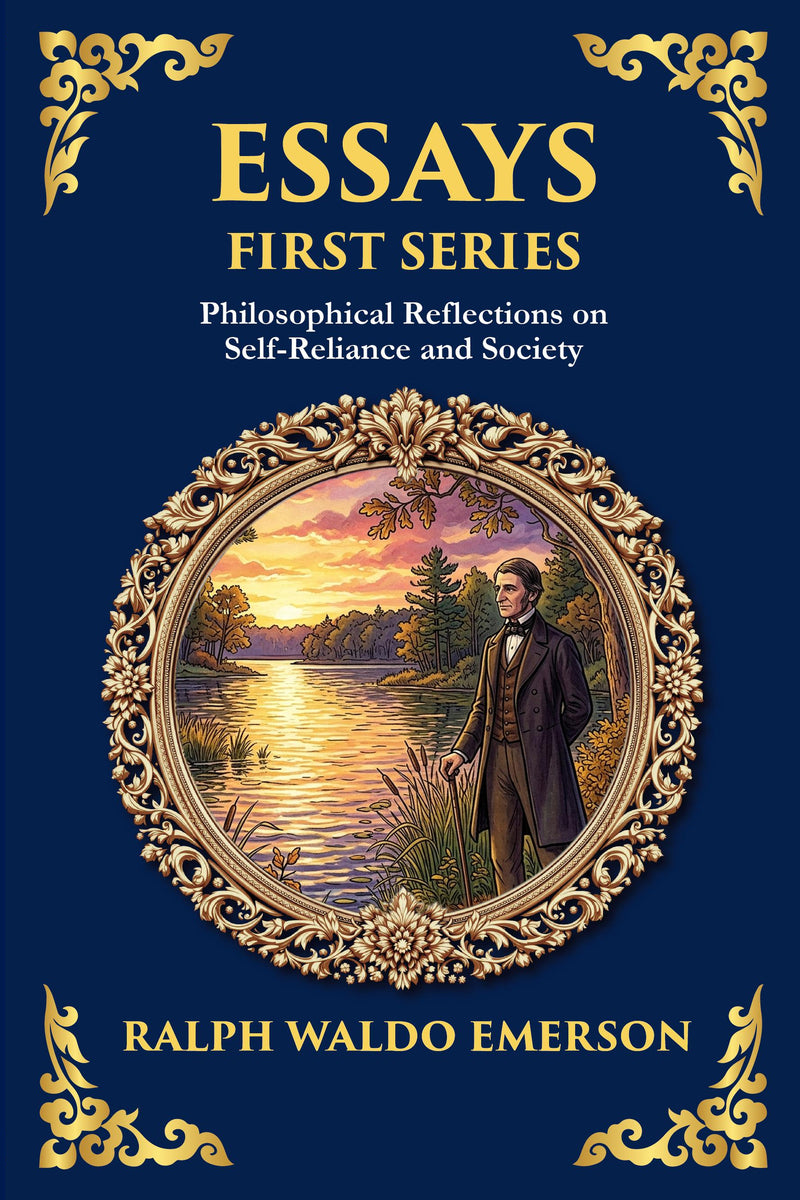
Essays — First Series — Large Print
With fiery eloquence and unshakable belief in the power of the individual, Essays — First Series by Ralph Waldo Emerson remains one of the most foundational texts of American thought.
or free app
10,000+ hrs library
30-day guarantee
The complete Essays — First Series appears in modern English through Library of Alexandria Press, available online with audiobook narration included for members.
Have you ever wondered why true freedom begins within the mind—and why trusting yourself is the most radical act? Ralph Waldo Emerson’s Essays — First Series is a masterwork of transcendental philosophy and American individualism. First published in 1841, these essays explore the moral, spiritual, and intellectual foundations of human freedom.
Emerson, a former minister turned visionary thinker, encourages readers to trust in their inner voice over external expectations. With passionate prose and crystalline insight, Emerson’s essays dissect the illusions of social conformity, the tyranny of tradition, and the need for authentic experience. His belief that the universe lives within each soul forms the beating heart of his most celebrated work, Self- Reliance—an enduring call to live bravely, think independently, and act from one’s deepest convictions.
What you’ll discover in this modern edition
- Self-Reliance – Emerson’s most famous and empowering essay, inspiring generations to embrace independence and personal truth.
- Compensation, Spiritual Laws, and The Over-Soul – Deeply contemplative essays that unveil the hidden balances and spiritual energies guiding life.
- Love and Friendship – Emerson’s poetic insights into the emotional and metaphysical dimensions of human relationships.
- The Power of Intuition – A constant call to trust inner knowing above external dogma.
- The Beauty of Nature and the Divine in the Everyday – Explore Emerson’s belief in nature as both teacher and mirror of the soul.
- A Blueprint for Intellectual and Moral Independence – Essays that shaped American identity and continue to inspire readers seeking depth and direction.
| Formats | eBook (EPUB + PDF) · Audiobook · Paperback · Hardcover · Large Print |
| Language | English |
| Trim size (print) | 6 × 9 in |
| Binding | Paperback — perfect-bound · Hardcover — casewrap |
| Large Print edition | Same text in a larger, easy-read type — a larger font, not a larger trim |
| Print pricing | Every physical book at our true cost — at-cost, no profit (members) |
| Library | 873 restored titles, always growing |
| Length | 77,249 words · ~5 hr 9 min reading |
| Reading level | Grade 11 · a confident, adult read (this modern-English edition) |
| Edition | Modern English translation · 2026 |
Member reviews for this edition are collected as readers finish it — be the first. Across the library: 12,000+ books shipped, every plan covered by a 365-day print guarantee.
About this edition
A faithful, unabridged modern-English edition by The Library of Alexandria — carefully rendered for today's reader and verified paragraph-by-paragraph against the public-domain source. Available as eBook, audiobook, paperback, hardcover, and large print.
- Complete & unabridgedVerified paragraph by paragraph against the source — never a scan, never abridged.
- Modern English, faithfulReadable today, with the author’s meaning kept intact. Readable — not simplified.
- Every format, one membershipRead in your browser or the free app, or listen to the full audiobook.
Included free with your membership
Cancel anytime, one click · 30-day money-back guarantee
Edition last updated July 2026
What’s inside
Essays — First Series — Large Print — complete and unabridged: all 42 sections included with membership, plus the full audiobook.
Begin reading Essays — First Series — Large Print
In clear modern English — the complete text is included with membership.
Introduction
There is a particular kind of book that does not merely ask to be read but insists on being lived with — a book that refuses to stay on the shelf once you have opened it, that follows you into the kitchen in the morning and sits beside you on the train and interrupts your sleep with a sentence you thought you had finished with hours ago. Ralph Waldo Emerson’s first collection of essays, published in 1841, is exactly that kind of book. It arrived into a world that was not entirely sure what to make of it, and it has been unsettling comfortable assumptions ever since. To read it now, in a carefully prepared contemporary-English edition, is to discover that the unsettling has lost none of its force. If anything, the distance of nearly two centuries has clarified rather than dimmed the provocation. These twelve essays — on History, Self-Reliance, Compensation, Spiritual Laws, Love, Friendship, Prudence, Heroism, The Over-Soul, Circles, Intellect, and Art — constitute one of the most sustained and searching attempts in the English language to answer a question that most of us spend our lives carefully avoiding: what does it actually mean to be a thinking, feeling, morally responsible human being alive in the world right now?
That question, posed with such directness, might sound like the opening of a self-help manual or a motivational lecture. It is worth saying immediately, and with some emphasis, that Emerson is neither of those things. He is something considerably more demanding and considerably more rewarding. He does not offer programs or prescriptions. He does not tell you what to do on Monday morning. What he does instead is something stranger and more valuable: he changes the angle from which you see, so that when Monday morning arrives, you are a slightly different person standing in it. The philosopher Stanley Cavell, one of the most penetrating readers Emerson has ever had, described this quality as a kind of philosophical perfectionism — not the perfectionism of achieving some fixed ideal self, but the perfectionism of perpetual becoming, of refusing to accept that the self you happen to be today is the self you are condemned to remain. That description is accurate, but it does not quite capture the electricity of the experience. Reading Emerson is less like receiving instruction and more like being struck by lightning in a way that, somehow, leaves you more alive than before.
Ralph Waldo Emerson was born in Boston in 1803, the son of a Unitarian minister who died when Emerson was eight years old, leaving the family in considerable poverty. He was educated at Harvard, became a minister himself, and then, following the death of his first wife Ellen Tucker from tuberculosis in 1831 and a deepening crisis of faith, resigned his pastorate and sailed for Europe. He met Coleridge, Wordsworth, and — most consequentially — Thomas Carlyle, with whom he maintained a lifelong correspondence and friendship. When he returned to America, he settled in Concord, Massachusetts, remarried, and began the career as lecturer and essayist that would define the rest of his long life. He died in 1882, having watched the country he loved tear itself apart in civil war and then, haltingly, begin to reconstitute itself.
That biographical sketch, compressed as it is, matters because it explains something about the particular quality of Emerson’s voice — its combination of hard-won serenity and barely suppressed urgency. He was not a man who had arrived at his convictions easily or cheaply. He had buried a wife, resigned a vocation, crossed an ocean, and returned to build something new from the ruins of what he had been. The essays in this collection were not written from a position of comfortable certainty. They were written from a position of achieved clarity — which is a very different thing, and which carries a very different kind of authority. When Emerson tells you that the soul is its own place and that no institution, no tradition, and no other person’s opinion can substitute for your own direct encounter with truth, he is not speaking as someone who has never been tempted to outsource that encounter. He is speaking as someone who knows exactly how tempting the outsourcing is, and who has chosen, at considerable personal cost, not to do it.
The circle of thinkers and writers who gathered around Emerson in Concord and Cambridge in the 1830s and 1840s — the movement that came to be called Transcendentalism — included figures such as Henry David Thoreau, Margaret Fuller, Bronson Alcott, and others. Emerson was not the founder of this movement in any formal sense, and he was always somewhat suspicious of movements as such, but he was unquestionably its animating intelligence. The Transcendentalists shared a conviction that the dominant materialism and institutional conformity of American life were impoverishing the human spirit, and that a recovery of direct, unmediated experience — of nature, of the self, of what Emerson called the Over-Soul — was both possible and urgently necessary. These essays are the fullest and most enduring expression of that conviction.
It would be a mistake to approach this book the way you might approach a work of systematic philosophy or a collection of arguments to be evaluated and either accepted or rejected. Emerson is not building a logical structure that stands or falls on the validity of its individual steps. He is doing something more like what a great musician does: developing themes, returning to them in new keys, allowing them to resonate against each other, trusting the reader to hear the harmonics that no single note can produce alone. The twelve essays in this collection are not twelve separate topics. They are twelve angles of approach to a single, inexhaustible subject — the nature of the human mind and its relationship to the world it inhabits and, in some sense, creates.
This means that the best way to read the book is not necessarily straight through from beginning to end, though that is certainly one valid approach. It means reading slowly, and reading with a pencil. It means pausing when a sentence stops you — not because you do not understand it, but because you understand it too well, because it has named something you knew but had never found words for — and sitting with that pause rather than hurrying past it. Emerson’s prose rewards this kind of attention in a way that very few writers’ prose does. His sentences are not merely vehicles for conveying information. They are events. They happen to you. The famous opening of the essay on Self-Reliance — “To believe your own thought, to believe that what is true for you in your private heart is true for all men — that is genius” — is not a proposition to be assessed. It is a challenge to be met, or declined, and the meeting or declining of it tells you something important about where you are in your own life at the moment of reading.
It is also worth knowing, before you begin, that Emerson’s essays originated as lectures. He was one of the great public speakers of the nineteenth century, and the rhythms of his prose carry the memory of the spoken voice — the pause for emphasis, the sudden acceleration, the rhetorical question that is not really a question at all but a kind of invitation. Reading him aloud, even quietly to yourself, unlocks dimensions of the writing that silent reading can miss. The cadences are not ornamental. They are structural. They are part of how the meaning is made.
You will also encounter, particularly in the earlier essays, a density of classical and literary allusion that can feel initially daunting. Emerson moves with easy familiarity through Greek and Roman history, through Shakespeare and Milton and Goethe and Swedenborg, through Hindu scripture and Neoplatonic philosophy. This edition has been prepared with that challenge in mind, and brief contextual notes are provided where they are genuinely needed. But it is worth saying that you do not need to recognize every reference to follow the argument. Emerson is not showing off his learning. He is using the whole of human history as evidence for a claim about the whole of human nature, and the specific examples matter less than the cumulative weight of the pattern they establish. If you do not know who Asdrubal was, or what the Animal Magnetism controversy in Paris involved, you can still feel the force of what Emerson is saying about the universality of human experience. The allusions are illustrations, not prerequisites.
What these essays will ask of you, more than any particular body of knowledge, is a willingness to take yourself seriously as a thinking being. Emerson’s fundamental conviction — the conviction that underlies every essay in this collection, that gives the whole book its peculiar moral urgency — is that each individual human mind is not a diminished or partial version of some greater intelligence but is, in its own right, an inlet to the universal. “There is one mind common to all individual men,” he writes in the opening pages of the first essay. “Every man is an inlet to the same and to all of the same. He that is once admitted to the right of reason is made a freeman of the whole estate.” This is not a comfortable idea. It is, in fact, a deeply demanding one. If you are an inlet to the universal mind, then your laziness, your conformity, your willingness to let other people do your thinking for you, is not merely a personal failing. It is a kind of cosmic dereliction. Emerson will not let you off the hook, and he will not pretend that the hook is not there.
The twelve essays are arranged in a sequence that is not arbitrary, though it is not rigidly systematic either. The collection opens with History and closes with Art, and between those two poles it traces something like a complete map of the human mind in its encounter with the world. History establishes the foundational claim: that all of human experience is, at its deepest level, the experience of a single mind, and that the proper way to read the past is as a mirror in which you recognize yourself. Self-Reliance, the essay that has probably been more quoted, more misunderstood, and more transformative than any other in the collection, follows with the logical consequence of that claim: if the universal mind speaks through each individual, then the individual’s first obligation is to trust that speaking, to resist the enormous social pressure toward conformity and imitation, and to act from the deepest promptings of his or her own nature. Compensation then asks what the moral structure of a universe built on these principles actually looks like — how justice operates not through external enforcement but through the inherent nature of things.
Spiritual Laws, Love, and Friendship form a kind of middle movement, exploring the ways in which the individual soul relates to the larger forces that surround and sustain it — the impersonal laws that govern spiritual life, the particular intimacies of erotic and friendly love, the ways in which our deepest connections with other people both express and challenge our self-reliance. Prudence and Heroism offer what might seem like a surprising pair — the practical and the transcendent — but Emerson’s treatment of both is characteristically unexpected. His Prudence is not the timid calculation of the risk-averse; it is the intelligent management of the conditions of life in service of something larger than mere comfort. His Heroism is not the heroism of the battlefield but the heroism of the person who refuses, quietly and persistently, to be less than what they know themselves to be.
The Over-Soul is perhaps the most metaphysically ambitious essay in the collection, and the one that most directly addresses the religious dimension of Emerson’s thought. It is here that he articulates most fully his conviction that beneath the surface of individual consciousness there is a deeper unity — not a personal God in the traditional sense, but something more like the ground of being itself, accessible to every human being through moments of heightened attention and genuine self-surrender. Circles follows with one of the most beautiful and vertiginous ideas in all of Emerson: that every truth, every achievement, every apparently final boundary is merely the circumference of a circle that will itself be enclosed by a larger circle, and that the only honest response to this infinite regress is not despair but exhilaration. Intellect and Art bring the collection to its close by examining the two great human faculties through which the mind most fully realizes its own nature — the capacity for pure thought and the capacity for making things that embody thought in sensuous form.
Cancel anytime, one click · 30-day money-back guarantee
Founding annual rate available now — your price locks for life when you join.
Not ready? Get this free chapter by email — read it anytime.
✓ Sent — check your inbox for Essays — First Series — Large Print.
Questions about Essays — First Series — Large Print
What is Essays — First Series about?
With fiery eloquence and unshakable belief in the power of the individual, Essays — First Series by Ralph Waldo Emerson remains one of the most foundational texts of American thought. These essays challenge readers to embrace intuition, honor their conscience, and reject conformity. From the radical declaration of Self-Reliance to the transcendent truths of Nature, Emerson urges us to awaken the divine spark within ourselves and live with moral courage.
Who wrote Essays — First Series?
Essays — First Series was written by Ralph Waldo Emerson. This edition presents the complete work in clear modern English, faithfully rendered from the public-domain original by Library of Alexandria Press.
Is Essays — First Series free to read?
The opening chapter is free to read on this page. Members read and listen to the complete work — and the entire library — free, and can order any physical book at our true print cost.
How long is Essays — First Series?
42 chapters (~77,249 words) — about 5 hr 9 min of reading in this modern-English edition.
Is this an abridged version of Essays — First Series?
No. This is the complete, unabridged Essays — First Series, carefully rendered into clear modern English and verified paragraph-by-paragraph against the public-domain source — nothing is cut or summarised.
What formats does Essays — First Series come in?
Essays — First Series is available as eBook, paperback, hardcover and large print. eBook and audiobook are included with membership; printed editions ship at our true print cost.
Shipping & returns
Billing & membership
More from the library


Explore Philosophy & Ideas
- Kant's Prolegomena to Any Future Metaphysics · Immanuel Kant
- The Advancement of Learning · Francis Bacon
- The Dawn of Day · Friedrich Wilhelm Nietzsche
- Meditations · Marcus Aurelius
- The Confessions of St. Augustine · Saint Augustine
- Dialogues Concerning Natural Religion · David Hume
- Considerations on Representative Government · John Stuart Mill
- The Will to Power: An Attempted Transvaluation of All Values. Book III and IV · Friedrich Nietzsche
- Groundwork of the Metaphysics of Morals · Immanuel Kant
- The Confessions of Jean-Jacques Rousseau — Complete · Jean-Jacques Rousseau
- Democracy in America — Volume 2 · Alexis de Tocqueville
- Ecce Homo · Friedrich Wilhelm Nietzsche
- Second Treatise of Government · John Locke
- The Prince · Niccolò Machiavelli
- Thus Spake Zarathustra: A Book for All and None · Friedrich Wilhelm Nietzsche
- The Island of Doctor Moreau · H. G. Wells
- Sophist · Plato
- The Seven Lamps of Architecture · John Ruskin
- Essays — First Series · Ralph Waldo Emerson
- The Book of the Damned · Charles Fort
- The Everlasting Man · G. K. Chesterton
- The Initiates of the Flame · Manly P. Hall
- The Book of Tea · Kakuzo Okakura
- The Japanese Spirit · Yoshisaburo Okakura
- The Analysis of Mind · Bertrand Russell
- Orthodoxy · G. K. Chesterton
- Apology, Crito, and Phaedo of Socrates · Plato
- Euthyphro · Plato
- Timaeus · Plato
- Ion · Plato
Essays — First Series — Large Print
Essays — First Series — Large Print
A Modern Translation
Ralph Waldo Emerson
Contents
- Introduction
- Chapter 1
- Chapter 2
- Chapter 3
- Chapter 4
- Chapter 5
- Chapter 6
- Chapter 7
- Chapter 8
- Chapter 9
- Chapter 10
- Chapter 11
- Chapter 12
- Chapter 13
- Chapter 14
- Chapter 15
- Chapter 16
- Chapter 17
- Chapter 18
- Chapter 19
- Chapter 20
- Chapter 21
- Chapter 22
- Chapter 23
- Chapter 24
- Chapter 25
- Chapter 26
- Chapter 27
- Chapter 28
- Chapter 29
- Chapter 30
- Chapter 31
- Chapter 32
- Chapter 33
- Chapter 34
- Chapter 35
- Chapter 36
- Chapter 37
- Chapter 38
- Chapter 39
- … and 2 more chapters
Introduction
There is a particular kind of book that does not merely ask to be read but insists on being lived with — a book that refuses to stay on the shelf once you have opened it, that follows you into the kitchen in the morning and sits beside you on the train and interrupts your sleep with a sentence you thought you had finished with hours ago. Ralph Waldo Emerson’s first collection of essays, published in 1841, is exactly that kind of book. It arrived into a world that was not entirely sure what to make of it, and it has been unsettling comfortable assumptions ever since. To read it now, in a carefully prepared contemporary-English edition, is to discover that the unsettling has lost none of its force. If anything, the distance of nearly two centuries has clarified rather than dimmed the provocation. These twelve essays — on History, Self-Reliance, Compensation, Spiritual Laws, Love, Friendship, Prudence, Heroism, The Over-Soul, Circles, Intellect, and Art — constitute one of the most sustained and searching attempts in the English language to answer a question that most of us spend our lives carefully avoiding: what does it actually mean to be a thinking, feeling, morally responsible human being alive in the world right now?
That question, posed with such directness, might sound like the opening of a self-help manual or a motivational lecture. It is worth saying immediately, and with some emphasis, that Emerson is neither of those things. He is something considerably more demanding and considerably more rewarding. He does not offer programs or prescriptions. He does not tell you what to do on Monday morning. What he does instead is something stranger and more valuable: he changes the angle from which you see, so that when Monday morning arrives, you are a slightly different person standing in it. The philosopher Stanley Cavell, one of the most penetrating readers Emerson has ever had, described this quality as a kind of philosophical perfectionism — not the perfectionism of achieving some fixed ideal self, but the perfectionism of perpetual becoming, of refusing to accept that the self you happen to be today is the self you are condemned to remain. That description is accurate, but it does not quite capture the electricity of the experience. Reading Emerson is less like receiving instruction and more like being struck by lightning in a way that, somehow, leaves you more alive than before.
Ralph Waldo Emerson was born in Boston in 1803, the son of a Unitarian minister who died when Emerson was eight years old, leaving the family in considerable poverty. He was educated at Harvard, became a minister himself, and then, following the death of his first wife Ellen Tucker from tuberculosis in 1831 and a deepening crisis of faith, resigned his pastorate and sailed for Europe. He met Coleridge, Wordsworth, and — most consequentially — Thomas Carlyle, with whom he maintained a lifelong correspondence and friendship. When he returned to America, he settled in Concord, Massachusetts, remarried, and began the career as lecturer and essayist that would define the rest of his long life. He died in 1882, having watched the country he loved tear itself apart in civil war and then, haltingly, begin to reconstitute itself.
That biographical sketch, compressed as it is, matters because it explains something about the particular quality of Emerson’s voice — its combination of hard-won serenity and barely suppressed urgency. He was not a man who had arrived at his convictions easily or cheaply. He had buried a wife, resigned a vocation, crossed an ocean, and returned to build something new from the ruins of what he had been. The essays in this collection were not written from a position of comfortable certainty. They were written from a position of achieved clarity — which is a very different thing, and which carries a very different kind of authority. When Emerson tells you that the soul is its own place and that no institution, no tradition, and no other person’s opinion can substitute for your own direct encounter with truth, he is not speaking as someone who has never been tempted to outsource that encounter. He is speaking as someone who knows exactly how tempting the outsourcing is, and who has chosen, at considerable personal cost, not to do it.
The circle of thinkers and writers who gathered around Emerson in Concord and Cambridge in the 1830s and 1840s — the movement that came to be called Transcendentalism — included figures such as Henry David Thoreau, Margaret Fuller, Bronson Alcott, and others. Emerson was not the founder of this movement in any formal sense, and he was always somewhat suspicious of movements as such, but he was unquestionably its animating intelligence. The Transcendentalists shared a conviction that the dominant materialism and institutional conformity of American life were impoverishing the human spirit, and that a recovery of direct, unmediated experience — of nature, of the self, of what Emerson called the Over-Soul — was both possible and urgently necessary. These essays are the fullest and most enduring expression of that conviction.
It would be a mistake to approach this book the way you might approach a work of systematic philosophy or a collection of arguments to be evaluated and either accepted or rejected. Emerson is not building a logical structure that stands or falls on the validity of its individual steps. He is doing something more like what a great musician does: developing themes, returning to them in new keys, allowing them to resonate against each other, trusting the reader to hear the harmonics that no single note can produce alone. The twelve essays in this collection are not twelve separate topics. They are twelve angles of approach to a single, inexhaustible subject — the nature of the human mind and its relationship to the world it inhabits and, in some sense, creates.
This means that the best way to read the book is not necessarily straight through from beginning to end, though that is certainly one valid approach. It means reading slowly, and reading with a pencil. It means pausing when a sentence stops you — not because you do not understand it, but because you understand it too well, because it has named something you knew but had never found words for — and sitting with that pause rather than hurrying past it. Emerson’s prose rewards this kind of attention in a way that very few writers’ prose does. His sentences are not merely vehicles for conveying information. They are events. They happen to you. The famous opening of the essay on Self-Reliance — “To believe your own thought, to believe that what is true for you in your private heart is true for all men — that is genius” — is not a proposition to be assessed. It is a challenge to be met, or declined, and the meeting or declining of it tells you something important about where you are in your own life at the moment of reading.
It is also worth knowing, before you begin, that Emerson’s essays originated as lectures. He was one of the great public speakers of the nineteenth century, and the rhythms of his prose carry the memory of the spoken voice — the pause for emphasis, the sudden acceleration, the rhetorical question that is not really a question at all but a kind of invitation. Reading him aloud, even quietly to yourself, unlocks dimensions of the writing that silent reading can miss. The cadences are not ornamental. They are structural. They are part of how the meaning is made.
You will also encounter, particularly in the earlier essays, a density of classical and literary allusion that can feel initially daunting. Emerson moves with easy familiarity through Greek and Roman history, through Shakespeare and Milton and Goethe and Swedenborg, through Hindu scripture and Neoplatonic philosophy. This edition has been prepared with that challenge in mind, and brief contextual notes are provided where they are genuinely needed. But it is worth saying that you do not need to recognize every reference to follow the argument. Emerson is not showing off his learning. He is using the whole of human history as evidence for a claim about the whole of human nature, and the specific examples matter less than the cumulative weight of the pattern they establish. If you do not know who Asdrubal was, or what the Animal Magnetism controversy in Paris involved, you can still feel the force of what Emerson is saying about the universality of human experience. The allusions are illustrations, not prerequisites.
What these essays will ask of you, more than any particular body of knowledge, is a willingness to take yourself seriously as a thinking being. Emerson’s fundamental conviction — the conviction that underlies every essay in this collection, that gives the whole book its peculiar moral urgency — is that each individual human mind is not a diminished or partial version of some greater intelligence but is, in its own right, an inlet to the universal. “There is one mind common to all individual men,” he writes in the opening pages of the first essay. “Every man is an inlet to the same and to all of the same. He that is once admitted to the right of reason is made a freeman of the whole estate.” This is not a comfortable idea. It is, in fact, a deeply demanding one. If you are an inlet to the universal mind, then your laziness, your conformity, your willingness to let other people do your thinking for you, is not merely a personal failing. It is a kind of cosmic dereliction. Emerson will not let you off the hook, and he will not pretend that the hook is not there.
The twelve essays are arranged in a sequence that is not arbitrary, though it is not rigidly systematic either. The collection opens with History and closes with Art, and between those two poles it traces something like a complete map of the human mind in its encounter with the world. History establishes the foundational claim: that all of human experience is, at its deepest level, the experience of a single mind, and that the proper way to read the past is as a mirror in which you recognize yourself. Self-Reliance, the essay that has probably been more quoted, more misunderstood, and more transformative than any other in the collection, follows with the logical consequence of that claim: if the universal mind speaks through each individual, then the individual’s first obligation is to trust that speaking, to resist the enormous social pressure toward conformity and imitation, and to act from the deepest promptings of his or her own nature. Compensation then asks what the moral structure of a universe built on these principles actually looks like — how justice operates not through external enforcement but through the inherent nature of things.
Spiritual Laws, Love, and Friendship form a kind of middle movement, exploring the ways in which the individual soul relates to the larger forces that surround and sustain it — the impersonal laws that govern spiritual life, the particular intimacies of erotic and friendly love, the ways in which our deepest connections with other people both express and challenge our self-reliance. Prudence and Heroism offer what might seem like a surprising pair — the practical and the transcendent — but Emerson’s treatment of both is characteristically unexpected. His Prudence is not the timid calculation of the risk-averse; it is the intelligent management of the conditions of life in service of something larger than mere comfort. His Heroism is not the heroism of the battlefield but the heroism of the person who refuses, quietly and persistently, to be less than what they know themselves to be.
The Over-Soul is perhaps the most metaphysically ambitious essay in the collection, and the one that most directly addresses the religious dimension of Emerson’s thought. It is here that he articulates most fully his conviction that beneath the surface of individual consciousness there is a deeper unity — not a personal God in the traditional sense, but something more like the ground of being itself, accessible to every human being through moments of heightened attention and genuine self-surrender. Circles follows with one of the most beautiful and vertiginous ideas in all of Emerson: that every truth, every achievement, every apparently final boundary is merely the circumference of a circle that will itself be enclosed by a larger circle, and that the only honest response to this infinite regress is not despair but exhilaration. Intellect and Art bring the collection to its close by examining the two great human faculties through which the mind most fully realizes its own nature — the capacity for pure thought and the capacity for making things that embody thought in sensuous form.
Nothing is too great or too small For the Soul that creates it all: Wherever it arrives, all things exist, And it arrives everywhere.
I own the entire universe, The seven stars and the solar year, The hand of Caesar, the brain of Plato, The heart of Christ, and the voice of Shakespeare.
There is one mind shared by all individual human beings. Every person is an entry point to this same mind, and to all of it. Anyone who is granted the right of reason becomes a free citizen of this entire estate. He can think what Plato thought; he can feel what a saint felt; he can understand anything that has ever happened to any person. Whoever has access to this universal mind is a participant in everything that is or can be done, because this mind is the only true and sovereign actor.
History is the record of the works of this mind. Its genius is demonstrated by the entire sequence of days. A human being cannot be explained by anything less than the entirety of human history. Without rushing and without stopping, the human spirit moves forward from the beginning to embody every faculty, every thought, and every emotion belonging to it through appropriate events. However, the thought always comes before the fact; all historical facts exist beforehand in the mind as laws. Each law, in turn, is created by the dominant circumstances of the time, and the limits of nature allow only one law to hold power at a time. A single person is a complete encyclopedia of facts. The creation of a thousand forests is contained in one acorn, and Egypt, Greece, Rome, Gaul, Britain, and America already lie folded within the first man. Epoch after epoch—camp, kingdom, empire, republic, democracy—are simply the applications of his diverse spirit to a diverse world.
End of the free sample
Keep reading, free
Members read and listen to the complete book — and the entire library. Cancel anytime, one click · 30-day money-back guarantee.