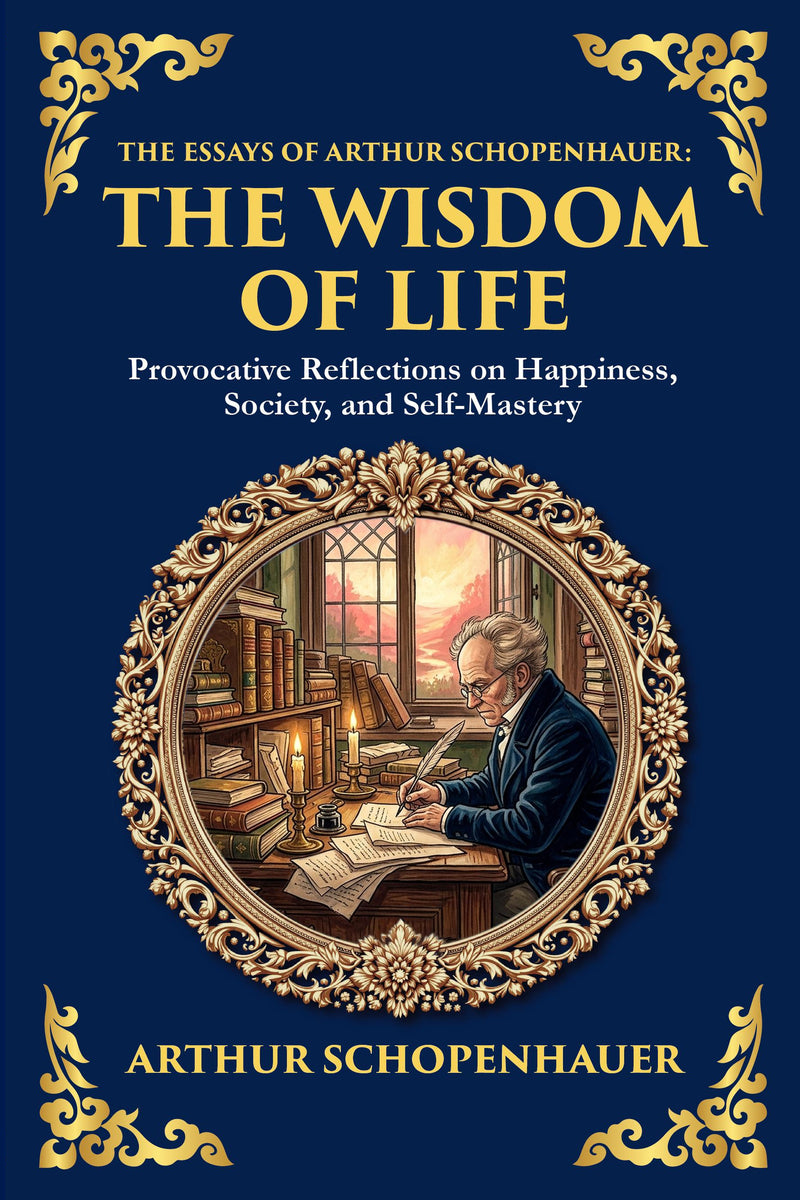
The Essays of Arthur Schopenhauer: The Wisdom of Life — Large Print
Few thinkers have examined the human condition with the same depth, clarity, and sharpness as Arthur Schopenhauer. In The Wisdom of Life, he turns his penetrating gaze toward the pursuit of happiness, the illusions of society, and the importance of understanding oneself.
or free app
10,000+ hrs library
30-day guarantee
The complete The Essays of Arthur Schopenhauer: The Wisdom of Life appears in modern English through Library of Alexandria Press, available online with audiobook narration included for members.
Have you ever wondered why true happiness so often escapes us—even when we seem to have everything? In The Essays of Arthur Schopenhauer: The Wisdom of Life, one of the most compelling minds of the 19th century offers a powerful exploration of how we should live, what we should value, and why contentment begins within. Drawing from centuries of philosophical thought, Schopenhauer presents a brutal yet brilliant breakdown of human nature.
He examines how we chase happiness through money, status, pleasure, and social approval—and why these pursuits often end in disappointment. Through his stark clarity and biting realism, Schopenhauer argues that peace and satisfaction are found not in chasing the world’s rewards, but in mastering our inner world. This modern translation retains all the force of the original German while delivering Schopenhauer’s insights in accessible and impactful language for today’s reader.
What you’ll discover in this modern edition
- The Three Pillars of Human Happiness Understand Schopenhauer’s framework for what truly governs our sense of well-being: what we are, what we have, and how we are regarded.
| Formats | eBook (EPUB + PDF) · Audiobook · Paperback · Hardcover · Large Print |
| Language | English |
| Trim size (print) | 6 × 9 in |
| Binding | Paperback — perfect-bound · Hardcover — casewrap |
| Large Print edition | Same text in a larger, easy-read type — a larger font, not a larger trim |
| Print pricing | Every physical book at our true cost — at-cost, no profit (members) |
| Library | 873 restored titles, always growing |
| Length | 34,734 words · ~2 hr 19 min reading |
| Reading level | Grade 3 · an easy, flowing read (this modern-English edition) |
| Edition | Modern English translation · 2026 |
Member reviews for this edition are collected as readers finish it — be the first. Across the library: 12,000+ books shipped, every plan covered by a 365-day print guarantee.
About this edition
A faithful, unabridged modern-English edition by The Library of Alexandria — carefully rendered for today's reader and verified paragraph-by-paragraph against the public-domain source. Available as eBook, audiobook, paperback, hardcover, and large print.
- Complete & unabridgedVerified paragraph by paragraph against the source — never a scan, never abridged.
- Modern English, faithfulReadable today, with the author’s meaning kept intact. Readable — not simplified.
- Every format, one membershipRead in your browser or the free app, or listen to the full audiobook.
Included free with your membership
Cancel anytime, one click · 30-day money-back guarantee
Edition last updated July 2026
What’s inside
The Essays of Arthur Schopenhauer: The Wisdom of Life — Large Print — complete and unabridged: all 6 sections included with membership, plus the full audiobook.
Begin reading The Essays of Arthur Schopenhauer: The Wisdom of Life — Large Print
In clear modern English — the complete text is included with membership.
Introduction
There are thinkers we read to be comforted, and thinkers we read to be challenged. Arthur Schopenhauer belongs emphatically to the second category, yet by a strange paradox he often comforts us more deeply than the optimists ever could. To open The Wisdom of Life is to enter the company of a man who refuses to flatter you, who declines to promise that everything will work out, and who insists instead on showing you the world precisely as it is — its disappointments, its illusions, its quiet absurdities — and who then, with a steadiness that feels almost paternal, hands you the tools to live within it with dignity and even with a hard-won serenity. This is philosophy not as abstraction but as counsel; not as a system to be admired from a distance but as a hand on the shoulder, guiding you through the practical business of being a human being who must somehow get through the day, the year, the decades, with as little misery and as much meaning as possible.
The collection of reflections gathered here represents Schopenhauer at his most accessible and, many readers would argue, his most useful. While his monumental philosophical work, The World as Will and Representation, lays out the vast metaphysical architecture of his thought — a demanding edifice of ideas about the blind, striving force he called the “Will” that underlies all existence — these essays bring that thought down from the mountain and into the marketplace of daily life. Here Schopenhauer addresses the questions that actually keep us awake at night. What is happiness, and why does it slip through our fingers? Why do we care so desperately about the opinions of others? What does our health, our temperament, our wealth, and our reputation truly contribute to our well-being? How should we conduct ourselves toward the world and toward our own restless minds? These are not the rarefied puzzles of the seminar room. They are the urgent, ordinary, and yet endlessly difficult problems of how to be alive without being perpetually unhappy about it.
This modern translation has been prepared with one overriding ambition: to let Schopenhauer speak to you as directly as he spoke to his original readers, without the static of archaic phrasing or the distancing fog of nineteenth-century convention. Schopenhauer was, by the standards of philosophers, a remarkably good writer — clear, vivid, frequently funny, and never afraid of a sharp turn of phrase or a memorable image. He believed that obscurity in writing was usually a sign of confused thinking, and he reserved some of his most withering scorn for the cloudy, self-important prose of certain contemporaries (his contempt for Hegel is the stuff of intellectual legend). It would be a betrayal of his own standards to present him in a manner that obscured his lucidity. The aim throughout has been to preserve his bite, his irony, and his bracing honesty while ensuring that the contemporary reader encounters him as a living voice rather than a dusty monument.
To read Schopenhauer well, it helps to know something of the temperament from which these reflections sprang. He was born in 1788 in Danzig, the son of a prosperous merchant who hoped his boy would follow him into commerce, and a mother who would become a celebrated novelist and a fixture of literary society. The relationship between Arthur and his mother, Johanna, was famously, bitterly difficult, and it is hard not to hear echoes of that domestic friction in some of his sharper observations about human nature and the difficulty of genuine companionship. His father’s death — possibly a suicide — when Arthur was still a young man freed him financially, and this independence is no small detail. Unlike most philosophers of his era, Schopenhauer never needed to court the approval of universities, patrons, or the reading public. He could afford to say exactly what he thought, and he did so with a frankness that can still startle.
This independence shaped not only the content of his thought but its tone. There is in these pages a man who has decided that he owes the world no comforting lies. He had studied widely — medicine, the natural sciences, Plato, Kant, and, crucially, the ancient wisdom traditions of India, which were only beginning to reach European readers in his lifetime. The Upanishads and Buddhist thought left a profound mark on him, and you will sense throughout these essays a sensibility that is, in some respects, closer to the East than to the bustling, progress-worshipping Europe of the Industrial Revolution. Where his contemporaries trumpeted human advancement and the inevitable march toward a better world, Schopenhauer kept his eye fixed on the unchanging realities of suffering, desire, boredom, and the brief, flickering nature of satisfaction.
For most of his career he was ignored. The World as Will and Representation, published in 1818, sold almost nothing for decades; he liked to joke, with characteristic gallows humor, that the printer must have used most of the copies as scrap paper. He took a lectureship in Berlin and deliberately scheduled his lectures at the same hour as the wildly popular Hegel, in a gesture of defiance that backfired spectacularly — almost no one came. He withdrew, settled eventually in Frankfurt, and lived a quiet, regulated, solitary life with a succession of poodles for company, reading the newspaper, playing the flute, dining out, and continuing to write. Fame, when it finally arrived, came late — in the 1850s, in the last decade of his life, largely on the strength of the very kind of accessible, worldly essays you now hold. The public that had no appetite for his metaphysics discovered that he was a peerless guide to the conduct of life, and his reputation has only grown since.
It is worth dwelling on this biographical arc because it illuminates the peculiar authority of these reflections. Schopenhauer is often labeled a pessimist, and in a strict philosophical sense the label fits: he genuinely believed that existence is shot through with suffering and that the optimistic creeds of his age were comforting delusions. But to read these essays as the grumblings of a sour misanthrope is to misunderstand them entirely. There is a difference between despair and clear-sightedness, and Schopenhauer practiced the latter. His pessimism is not a counsel of hopelessness but a foundation for realism. Precisely because he expects little from the world, he is able to teach us how to extract the most from what little it offers, and how to fortify ourselves against the disappointments that the cheerful optimist, forever surprised by misfortune, suffers all the more keenly. There is something almost bracing, even liberating, in being told the truth by someone who has no interest in selling you anything.
The man who emerges from these pages, then, is not a depressive but a kind of seasoned strategist of the inner life. He has surveyed the battlefield of human existence — the rivalries and vanities, the chasing after wealth and reputation, the cycle of craving and ennui — and he reports back to us, like a scout returning from difficult terrain, with hard intelligence about where the dangers lie and how they might be avoided. He is, in this sense, profoundly practical. The Stoics, whom he admired, sought tranquility through the disciplining of desire; Schopenhauer takes up a similar project but with a modern, psychologically acute, and often mordantly witty sensibility that feels strikingly contemporary.
What This Book Asks of You, and What It Offers
The central argument running through The Wisdom of Life is deceptively simple, and once grasped it reorganizes the way you think about happiness. Schopenhauer divides the things that determine a person’s lot in life into three categories. There is what a person is — meaning personality in the widest sense: health, temperament, intelligence, moral character, the capacity for cheerfulness or its absence. There is what a person has — property, possessions, wealth. And there is what a person represents — that is, how one stands in the estimation of others, one’s reputation, rank, and honor, the whole apparatus of social standing and public opinion.
Schopenhauer’s contention, argued with relentless force and copious illustration, is that the first of these three — what a person is — vastly outweighs the other two in its contribution to genuine happiness. The same external circumstances, he observes, produce wildly different effects on different people, because each of us experiences the world through the medium of our own consciousness. A dull person in paradise is bored; a rich inner life can find nourishment in modest surroundings. “The world in which a man lives,” he writes in effect, “shapes itself chiefly by the way in which he looks at it.” Two men may sit in the same room, attend the same dinner, witness the same event, and yet inhabit utterly different realities depending on what they bring to it. This is why, he argues, we should invest our deepest care in cultivating the self — in health, in the life of the mind, in temperament and the capacity for inner contentment — rather than squandering our energies in the frantic pursuit of money or, worst of all, the good opinion of strangers.
The longest and in some ways most penetrating sections of these reflections concern that last category: what we represent, and the tyranny that the opinions of others exercise over our lives. Here Schopenhauer is at his most psychologically incisive and, for the modern reader, perhaps most disconcertingly relevant. He dissects our craving for approval, our terror of ridicule, our enslavement to vanity and to the imagined judgments of people whose esteem, on reflection, we should hardly value at all. He shows how much of human misery springs from caring too much what others think, from living, as it were, in the heads of other people rather than in our own. Anyone who has ever lost sleep over a slight, refreshed a screen to count the reactions of strangers, or shaped a decision around how it would look rather than how it would feel will find in these pages an uncannily prescient diagnosis. Schopenhauer wrote long before the age of social media, yet his analysis of the human hunger for recognition reads like a manual for understanding the anxieties of our own connected, perpetually-observed era. There is real medicine here for the soul that has grown sick on the approval of the crowd.
This brings us to one of the great pleasures and challenges of reading Schopenhauer: he will not always tell you what you want to hear, and he will sometimes provoke you into vigorous disagreement. He held views — on the differences between the sexes, on certain peoples, on the prospects for human improvement — that were products of his time and that a thoughtful modern reader will rightly question, qualify, or reject. Part of the experience of engaging with a thinker of this stature is learning to read with both sympathy and discernment: to take what is illuminating and enduring while holding the rest up to the light of one’s own judgment. Schopenhauer himself would have expected nothing less. He despised intellectual deference and prized independent thought above almost everything. The worst way to honor him would be to accept his every pronouncement as gospel; the best way is to argue with him, to test his claims against your own experience, to let him sharpen your thinking even where he fails to convince you. These essays are not scripture. They are an invitation to a conversation with one of the most formidable minds of the modern world, and the conversation works best when you bring your own voice to it.
A word about how to read this book, for the experience can be greatly enriched by approaching it in the right spirit. These are not chapters of a novel to be raced through in pursuit of a resolution, nor are they links in a single chain of argument that must be followed step by step on pain of losing the thread. They are reflections — meditations, really — and they reward a slower, more deliberate kind of reading. Many readers find it valuable to take them in small portions, a few pages at a time, allowing each observation to settle before moving on. Schopenhauer has a gift for the aphorism, for the sentence that lodges in the memory and continues to unfold its meaning hours or days later. You will find yourself wanting to pause, to underline, to look up from the page and consider how a particular insight applies to your own life. This is exactly the right response. The book is meant to be lived with rather than merely consumed. Keep it on a bedside table or in a bag; return to it; reread the passages that struck you. You will find that they yield different meanings at different stages of your life, which is one of the surest marks of genuine wisdom literature.
Cancel anytime, one click · 30-day money-back guarantee
Founding annual rate available now — your price locks for life when you join.
Not ready? Get this free chapter by email — read it anytime.
✓ Sent — check your inbox for The Essays of Arthur Schopenhauer: The Wisdom of Life — Large Print.
Questions about The Essays of Arthur Schopenhauer: The Wisdom of Life — Large Print
What is The Essays of Arthur Schopenhauer: The Wisdom of Life about?
Few thinkers have examined the human condition with the same depth, clarity, and sharpness as Arthur Schopenhauer. In The Wisdom of Life, he turns his penetrating gaze toward the pursuit of happiness, the illusions of society, and the importance of understanding oneself. This modern edition of Schopenhauer’s essays offers timeless philosophical insight into the art of living.
Who wrote The Essays of Arthur Schopenhauer: The Wisdom of Life?
The Essays of Arthur Schopenhauer: The Wisdom of Life was written by Arthur Schopenhauer. This edition presents the complete work in clear modern English, faithfully rendered from the public-domain original by Library of Alexandria Press.
Is The Essays of Arthur Schopenhauer: The Wisdom of Life free to read?
The opening chapter is free to read on this page. Members read and listen to the complete work — and the entire library — free, and can order any physical book at our true print cost.
How long is The Essays of Arthur Schopenhauer: The Wisdom of Life?
6 chapters (~34,734 words) — about 2 hr 19 min of reading in this modern-English edition.
Is this an abridged version of The Essays of Arthur Schopenhauer: The Wisdom of Life?
No. This is the complete, unabridged The Essays of Arthur Schopenhauer: The Wisdom of Life, carefully rendered into clear modern English and verified paragraph-by-paragraph against the public-domain source — nothing is cut or summarised.
What formats does The Essays of Arthur Schopenhauer: The Wisdom of Life come in?
The Essays of Arthur Schopenhauer: The Wisdom of Life is available as eBook, paperback, hardcover and large print. eBook and audiobook are included with membership; printed editions ship at our true print cost.
Shipping & returns
Billing & membership
More from the library


Explore Philosophy & Ideas
- Kant's Prolegomena to Any Future Metaphysics · Immanuel Kant
- The Advancement of Learning · Francis Bacon
- The Dawn of Day · Friedrich Wilhelm Nietzsche
- Meditations · Marcus Aurelius
- The Confessions of St. Augustine · Saint Augustine
- Dialogues Concerning Natural Religion · David Hume
- Considerations on Representative Government · John Stuart Mill
- The Will to Power: An Attempted Transvaluation of All Values. Book III and IV · Friedrich Nietzsche
- Groundwork of the Metaphysics of Morals · Immanuel Kant
- The Confessions of Jean-Jacques Rousseau — Complete · Jean-Jacques Rousseau
- Democracy in America — Volume 2 · Alexis de Tocqueville
- Ecce Homo · Friedrich Wilhelm Nietzsche
- Second Treatise of Government · John Locke
- The Prince · Niccolò Machiavelli
- Thus Spake Zarathustra: A Book for All and None · Friedrich Wilhelm Nietzsche
- The Island of Doctor Moreau · H. G. Wells
- Sophist · Plato
- The Seven Lamps of Architecture · John Ruskin
- Essays — First Series · Ralph Waldo Emerson
- The Book of the Damned · Charles Fort
- The Everlasting Man · G. K. Chesterton
- The Initiates of the Flame · Manly P. Hall
- The Book of Tea · Kakuzo Okakura
- The Japanese Spirit · Yoshisaburo Okakura
- The Analysis of Mind · Bertrand Russell
- Orthodoxy · G. K. Chesterton
- Apology, Crito, and Phaedo of Socrates · Plato
- Euthyphro · Plato
- Timaeus · Plato
- Ion · Plato
The Essays of Arthur Schopenhauer: The Wisdom of Life — Large Print
The Essays of Arthur Schopenhauer: The Wisdom of Life — Large Print
Thought-Provoking Reflections on Happiness, Society, and Self-Control
Arthur Schopenhauer
Contents
- Introduction
- Author's Introduction
- Chapter 1
- Chapter 2
- Chapter 3
- Chapter 4
Introduction
There are thinkers we read to be comforted, and thinkers we read to be challenged. Arthur Schopenhauer belongs emphatically to the second category, yet by a strange paradox he often comforts us more deeply than the optimists ever could. To open The Wisdom of Life is to enter the company of a man who refuses to flatter you, who declines to promise that everything will work out, and who insists instead on showing you the world precisely as it is — its disappointments, its illusions, its quiet absurdities — and who then, with a steadiness that feels almost paternal, hands you the tools to live within it with dignity and even with a hard-won serenity. This is philosophy not as abstraction but as counsel; not as a system to be admired from a distance but as a hand on the shoulder, guiding you through the practical business of being a human being who must somehow get through the day, the year, the decades, with as little misery and as much meaning as possible.
The collection of reflections gathered here represents Schopenhauer at his most accessible and, many readers would argue, his most useful. While his monumental philosophical work, The World as Will and Representation, lays out the vast metaphysical architecture of his thought — a demanding edifice of ideas about the blind, striving force he called the “Will” that underlies all existence — these essays bring that thought down from the mountain and into the marketplace of daily life. Here Schopenhauer addresses the questions that actually keep us awake at night. What is happiness, and why does it slip through our fingers? Why do we care so desperately about the opinions of others? What does our health, our temperament, our wealth, and our reputation truly contribute to our well-being? How should we conduct ourselves toward the world and toward our own restless minds? These are not the rarefied puzzles of the seminar room. They are the urgent, ordinary, and yet endlessly difficult problems of how to be alive without being perpetually unhappy about it.
This modern translation has been prepared with one overriding ambition: to let Schopenhauer speak to you as directly as he spoke to his original readers, without the static of archaic phrasing or the distancing fog of nineteenth-century convention. Schopenhauer was, by the standards of philosophers, a remarkably good writer — clear, vivid, frequently funny, and never afraid of a sharp turn of phrase or a memorable image. He believed that obscurity in writing was usually a sign of confused thinking, and he reserved some of his most withering scorn for the cloudy, self-important prose of certain contemporaries (his contempt for Hegel is the stuff of intellectual legend). It would be a betrayal of his own standards to present him in a manner that obscured his lucidity. The aim throughout has been to preserve his bite, his irony, and his bracing honesty while ensuring that the contemporary reader encounters him as a living voice rather than a dusty monument.
To read Schopenhauer well, it helps to know something of the temperament from which these reflections sprang. He was born in 1788 in Danzig, the son of a prosperous merchant who hoped his boy would follow him into commerce, and a mother who would become a celebrated novelist and a fixture of literary society. The relationship between Arthur and his mother, Johanna, was famously, bitterly difficult, and it is hard not to hear echoes of that domestic friction in some of his sharper observations about human nature and the difficulty of genuine companionship. His father’s death — possibly a suicide — when Arthur was still a young man freed him financially, and this independence is no small detail. Unlike most philosophers of his era, Schopenhauer never needed to court the approval of universities, patrons, or the reading public. He could afford to say exactly what he thought, and he did so with a frankness that can still startle.
This independence shaped not only the content of his thought but its tone. There is in these pages a man who has decided that he owes the world no comforting lies. He had studied widely — medicine, the natural sciences, Plato, Kant, and, crucially, the ancient wisdom traditions of India, which were only beginning to reach European readers in his lifetime. The Upanishads and Buddhist thought left a profound mark on him, and you will sense throughout these essays a sensibility that is, in some respects, closer to the East than to the bustling, progress-worshipping Europe of the Industrial Revolution. Where his contemporaries trumpeted human advancement and the inevitable march toward a better world, Schopenhauer kept his eye fixed on the unchanging realities of suffering, desire, boredom, and the brief, flickering nature of satisfaction.
For most of his career he was ignored. The World as Will and Representation, published in 1818, sold almost nothing for decades; he liked to joke, with characteristic gallows humor, that the printer must have used most of the copies as scrap paper. He took a lectureship in Berlin and deliberately scheduled his lectures at the same hour as the wildly popular Hegel, in a gesture of defiance that backfired spectacularly — almost no one came. He withdrew, settled eventually in Frankfurt, and lived a quiet, regulated, solitary life with a succession of poodles for company, reading the newspaper, playing the flute, dining out, and continuing to write. Fame, when it finally arrived, came late — in the 1850s, in the last decade of his life, largely on the strength of the very kind of accessible, worldly essays you now hold. The public that had no appetite for his metaphysics discovered that he was a peerless guide to the conduct of life, and his reputation has only grown since.
It is worth dwelling on this biographical arc because it illuminates the peculiar authority of these reflections. Schopenhauer is often labeled a pessimist, and in a strict philosophical sense the label fits: he genuinely believed that existence is shot through with suffering and that the optimistic creeds of his age were comforting delusions. But to read these essays as the grumblings of a sour misanthrope is to misunderstand them entirely. There is a difference between despair and clear-sightedness, and Schopenhauer practiced the latter. His pessimism is not a counsel of hopelessness but a foundation for realism. Precisely because he expects little from the world, he is able to teach us how to extract the most from what little it offers, and how to fortify ourselves against the disappointments that the cheerful optimist, forever surprised by misfortune, suffers all the more keenly. There is something almost bracing, even liberating, in being told the truth by someone who has no interest in selling you anything.
The man who emerges from these pages, then, is not a depressive but a kind of seasoned strategist of the inner life. He has surveyed the battlefield of human existence — the rivalries and vanities, the chasing after wealth and reputation, the cycle of craving and ennui — and he reports back to us, like a scout returning from difficult terrain, with hard intelligence about where the dangers lie and how they might be avoided. He is, in this sense, profoundly practical. The Stoics, whom he admired, sought tranquility through the disciplining of desire; Schopenhauer takes up a similar project but with a modern, psychologically acute, and often mordantly witty sensibility that feels strikingly contemporary.
What This Book Asks of You, and What It Offers
The central argument running through The Wisdom of Life is deceptively simple, and once grasped it reorganizes the way you think about happiness. Schopenhauer divides the things that determine a person’s lot in life into three categories. There is what a person is — meaning personality in the widest sense: health, temperament, intelligence, moral character, the capacity for cheerfulness or its absence. There is what a person has — property, possessions, wealth. And there is what a person represents — that is, how one stands in the estimation of others, one’s reputation, rank, and honor, the whole apparatus of social standing and public opinion.
Schopenhauer’s contention, argued with relentless force and copious illustration, is that the first of these three — what a person is — vastly outweighs the other two in its contribution to genuine happiness. The same external circumstances, he observes, produce wildly different effects on different people, because each of us experiences the world through the medium of our own consciousness. A dull person in paradise is bored; a rich inner life can find nourishment in modest surroundings. “The world in which a man lives,” he writes in effect, “shapes itself chiefly by the way in which he looks at it.” Two men may sit in the same room, attend the same dinner, witness the same event, and yet inhabit utterly different realities depending on what they bring to it. This is why, he argues, we should invest our deepest care in cultivating the self — in health, in the life of the mind, in temperament and the capacity for inner contentment — rather than squandering our energies in the frantic pursuit of money or, worst of all, the good opinion of strangers.
The longest and in some ways most penetrating sections of these reflections concern that last category: what we represent, and the tyranny that the opinions of others exercise over our lives. Here Schopenhauer is at his most psychologically incisive and, for the modern reader, perhaps most disconcertingly relevant. He dissects our craving for approval, our terror of ridicule, our enslavement to vanity and to the imagined judgments of people whose esteem, on reflection, we should hardly value at all. He shows how much of human misery springs from caring too much what others think, from living, as it were, in the heads of other people rather than in our own. Anyone who has ever lost sleep over a slight, refreshed a screen to count the reactions of strangers, or shaped a decision around how it would look rather than how it would feel will find in these pages an uncannily prescient diagnosis. Schopenhauer wrote long before the age of social media, yet his analysis of the human hunger for recognition reads like a manual for understanding the anxieties of our own connected, perpetually-observed era. There is real medicine here for the soul that has grown sick on the approval of the crowd.
This brings us to one of the great pleasures and challenges of reading Schopenhauer: he will not always tell you what you want to hear, and he will sometimes provoke you into vigorous disagreement. He held views — on the differences between the sexes, on certain peoples, on the prospects for human improvement — that were products of his time and that a thoughtful modern reader will rightly question, qualify, or reject. Part of the experience of engaging with a thinker of this stature is learning to read with both sympathy and discernment: to take what is illuminating and enduring while holding the rest up to the light of one’s own judgment. Schopenhauer himself would have expected nothing less. He despised intellectual deference and prized independent thought above almost everything. The worst way to honor him would be to accept his every pronouncement as gospel; the best way is to argue with him, to test his claims against your own experience, to let him sharpen your thinking even where he fails to convince you. These essays are not scripture. They are an invitation to a conversation with one of the most formidable minds of the modern world, and the conversation works best when you bring your own voice to it.
A word about how to read this book, for the experience can be greatly enriched by approaching it in the right spirit. These are not chapters of a novel to be raced through in pursuit of a resolution, nor are they links in a single chain of argument that must be followed step by step on pain of losing the thread. They are reflections — meditations, really — and they reward a slower, more deliberate kind of reading. Many readers find it valuable to take them in small portions, a few pages at a time, allowing each observation to settle before moving on. Schopenhauer has a gift for the aphorism, for the sentence that lodges in the memory and continues to unfold its meaning hours or days later. You will find yourself wanting to pause, to underline, to look up from the page and consider how a particular insight applies to your own life. This is exactly the right response. The book is meant to be lived with rather than merely consumed. Keep it on a bedside table or in a bag; return to it; reread the passages that struck you. You will find that they yield different meanings at different stages of your life, which is one of the surest marks of genuine wisdom literature.
In these pages, I will discuss “The Wisdom of Life” in the general sense of the term. I mean the art of organizing our lives to achieve the highest possible level of pleasure and success. The theory behind this art can be called Eudaemonology, as it teaches us how to live a happy life. Such a life could be defined as one that—when viewed objectively or after careful, mature reflection—would be clearly better than not existing at all. This implies that we would hold onto life for its own sake, not just because we fear death, and that we would never want it to end.
Now, whether human life actually matches this ideal, or could ever match it, is a question to which my own philosophical system answers “no.” However, if we assume that happiness is possible, we must answer “yes.” In the second volume of my main work (chapter 49), I demonstrated that this assumption is based on a fundamental mistake. Therefore, to develop a plan for a happy existence, I have had to set aside the higher metaphysical and ethical perspectives that my own theories provide. Everything I say here is based on a compromise; I am adopting the common, everyday perspective and accepting the error that underlies it. Because of this, my remarks have only limited value, as the very term “eudaemonology” is a bit of a polite fiction. Furthermore, I do not claim to be exhaustive, partly because the subject is endless, and partly because I don’t want to repeat what others have already said.
As far as I recall, the only other book written with a purpose similar to this collection of aphorisms is Cardan’s De utilitate ex adversis capienda, which is worth reading and can supplement this work. It is true that Aristotle mentions eudaemonology briefly in the fifth chapter of the first book of his Rhetoric, but he doesn’t say much. Since I am not writing a compilation, I haven’t relied on these earlier authors. I feel that when you simply compile information, you lose the unique perspective of the author, and that individual perspective is the core of works like this. In general, the wise people of every era have always said the same things, and the fools—who have always been the vast majority—have always acted the same way, doing the exact opposite. This will never change. As Voltaire put it, we will leave this world just as foolish and wicked as we found it when we arrived.
End of the free sample
Keep reading, free
Members read and listen to the complete book — and the entire library. Cancel anytime, one click · 30-day money-back guarantee.