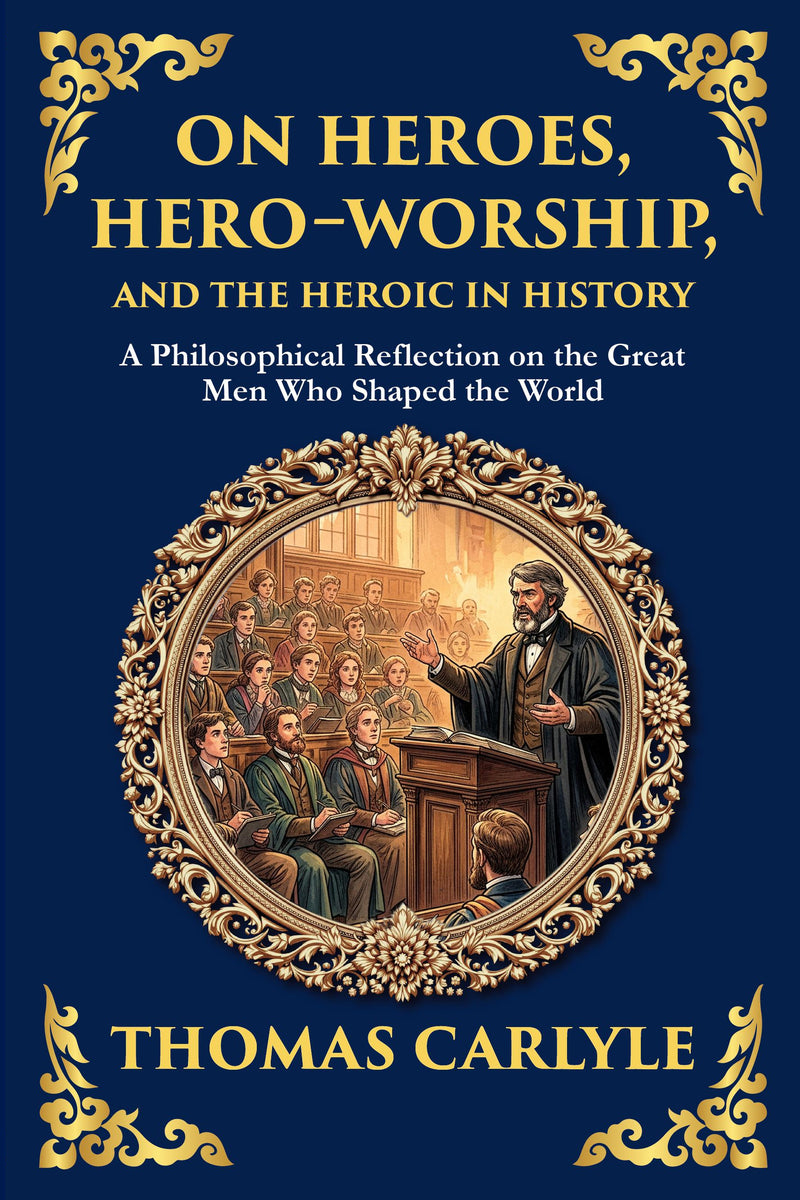
On Heroes, Hero-Worship, and the Heroic in History — Large Print
Who shapes the course of civilization? According to Victorian thinker Thomas Carlyle, it is the hero—the prophet, the poet, the leader—whose vision, courage, and force of character bend history to their will.
or free app
10,000+ hrs library
30-day guarantee
The complete On Heroes, Hero-Worship, and the Heroic in History appears in modern English through Library of Alexandria Press, available online with audiobook narration included for members.
Have you ever wondered why history remembers the few—and forgets the many? In On Heroes, Hero-Worship, and the Heroic in History, Thomas Carlyle delivers a passionate and penetrating analysis of leadership, culture, and the nature of greatness. Drawing from a series of public lectures given in 1840, Carlyle profiles six archetypes of the hero: the divinity, the prophet, the poet, the priest, the man of letters, and the king.
Through these figures, he weaves a narrative of civilization itself—arguing that great individuals, not social systems, are the true drivers of progress. Carlyle’s reflections reach beyond mere biography. He seeks to understand the spiritual and moral force that makes someone a hero.
His choices are bold, sometimes controversial, but always enlightening: from Odin as the Hero as Divinity, to Dante and Shakespeare as Poets, and Napoleon as the Hero as King. This unabridged edition restores Carlyle’s masterful rhetoric and intellectual vigor, while remaining accessible to modern readers interested in philosophy, leadership, and historical reflection.
What you’ll discover in this modern edition
- The Hero as Divinity – Explore the mythic foundations of leadership in the story of Odin.
- The Hero as Prophet – Analyze Muhammad's rise and Carlyle's admiration for conviction and vision.
| Formats | eBook (EPUB + PDF) · Audiobook · Paperback · Hardcover · Large Print |
| Language | English |
| Trim size (print) | 6 × 9 in |
| Binding | Paperback — perfect-bound · Hardcover — casewrap |
| Large Print edition | Same text in a larger, easy-read type — a larger font, not a larger trim |
| Print pricing | Every physical book at our true cost — at-cost, no profit (members) |
| Library | 873 restored titles, always growing |
| Length | 91,332 words · ~6 hr 5 min reading |
| Reading level | Grade 3 · an easy, flowing read (this modern-English edition) |
| Edition | Modern English translation · 2026 |
Member reviews for this edition are collected as readers finish it — be the first. Across the library: 12,000+ books shipped, every plan covered by a 365-day print guarantee.
About this edition
A faithful, unabridged modern-English edition by The Library of Alexandria — carefully rendered for today's reader and verified paragraph-by-paragraph against the public-domain source. Available as eBook, audiobook, paperback, hardcover, and large print.
- Complete & unabridgedVerified paragraph by paragraph against the source — never a scan, never abridged.
- Modern English, faithfulReadable today, with the author’s meaning kept intact. Readable — not simplified.
- Every format, one membershipRead in your browser or the free app, or listen to the full audiobook.
Included free with your membership
Cancel anytime, one click · 30-day money-back guarantee
Edition last updated July 2026
What’s inside
On Heroes, Hero-Worship, and the Heroic in History — Large Print — complete and unabridged: all 7 sections included with membership, plus the full audiobook.
Begin reading On Heroes, Hero-Worship, and the Heroic in History — Large Print
In clear modern English — the complete text is included with membership.
Introduction
There are books that describe the world as it is, and there are books that try to explain why it became that way. Thomas Carlyle’s celebrated series of lectures, delivered in London in the spring of 1840 and published the following year, belongs firmly to the second kind. It is a book about causes rather than effects, about the hidden springs of human action, and above all about a single, audacious proposition that Carlyle pursued with the relentless energy of a man who believed he had glimpsed something true and necessary. That proposition can be stated simply, though its consequences are vast: the history of the world, Carlyle argued, is at bottom the history of the great individuals who lived in it.
For Carlyle, the truly significant figures of any age were not merely products of their circumstances but the very force that shaped those circumstances. The poets, prophets, kings, and reformers who tower over the historical record were, in his striking phrase, the lightning that kindled the dry fuel of their times. Without them, he believed, the fuel would have lain dormant and dark. With them, civilizations caught fire, religions were born, nations rose, and the course of human affairs was bent in directions it would otherwise never have taken. To read this book is to enter into that conviction wholeheartedly, to feel the pull of a mind utterly persuaded that the heroic is not an accident of history but its engine.
This modern translation has been prepared with a single purpose in mind: to make Carlyle’s extraordinary vision accessible to readers who live nearly two centuries after he first spoke. Carlyle wrote in a prose style that was famous, and notorious, even among his contemporaries. His sentences erupt and tumble; his rhetoric thunders and exhorts; his vocabulary is studded with German philosophical borrowings, biblical allusions, and inventions of his own coining. Many a willing reader has opened the original and found the path forward obstructed by thickets of antique idiom and unfamiliar reference. The aim here has been to clear that path without flattening the landscape, to preserve the grandeur, the urgency, and the unmistakable voice of the author while rendering his meaning in language a contemporary reader can grasp on first encounter. What follows is Carlyle made approachable, not Carlyle diminished.
To understand why this book burns with such conviction, it helps to understand something of the man who wrote it and the world into which it emerged. Thomas Carlyle was born in 1795 in the small Scottish village of Ecclefechan, the son of a stonemason of stern and devout Calvinist faith. That upbringing left a permanent mark. Though Carlyle abandoned the orthodox religion of his parents during his university years, he never lost the moral intensity, the sense of duty, and the hunger for transcendent meaning that the faith had instilled in him. Throughout his life he searched for a way to recover, in a secular and skeptical age, the certainty and the seriousness that traditional belief had once provided. This book is, among many other things, one record of that search. When Carlyle writes of heroes, he is writing of figures who embody for him a kind of spiritual reality, a connection to what he calls the eternal and the divine, that the modern world seemed in danger of forgetting.
The age into which Carlyle came of age was one of profound upheaval. The shadow of the French Revolution lay heavy over Europe, and Carlyle himself had recently written a monumental, fevered history of that very event, a book that had established his reputation. The Industrial Revolution was transforming Britain with terrifying speed, uprooting old ways of life, swelling the cities, and creating new forms of both wealth and misery. Older certainties were crumbling. Religious authority was being challenged by science and by the new spirit of doubt. Political authority was being challenged by the rising clamor for democracy and reform. To many observers, the period felt like an interval of dissolution, an age in which the binding forces of society were coming apart and no one quite knew what would replace them.
Carlyle felt this dissolution acutely, and he hated it. He was, by temperament and conviction, a man who craved order, sincerity, and authentic greatness, and he looked out upon a world that seemed to him increasingly governed by sham, by mechanical routine, by the cold calculation of profit and the empty noise of public opinion. The lectures collected in this book were, in part, his answer to that crisis. If the modern world had lost its bearings, Carlyle proposed, then perhaps the remedy lay in recovering a proper reverence for genuine greatness, for the rare individuals who see truth where others see only confusion and who possess the courage and the vision to lead. The capacity to recognize and honor such figures, what Carlyle calls hero-worship, was for him not a relic of a more credulous past but a permanent and noble feature of the human soul, one that a healthy society neglected at its peril.
It is worth pausing here to acknowledge that this is, in important ways, a deeply contentious argument, and that the controversy surrounding it is part of what makes the book so worth reading today. Carlyle’s emphasis on the great individual stands in direct opposition to a powerful current in modern thought, which holds that history is shaped chiefly by impersonal forces, by economics, by class, by geography, by the slow movements of vast populations rather than by the will of singular men. Within a generation of Carlyle’s lectures, thinkers were already pushing back hard against the idea that any single person, however gifted, could be the true author of historical change. That debate has never been settled, and it continues in various forms to this day. When you read Carlyle, you are encountering one of the most eloquent and uncompromising statements ever made on one side of an argument that touches the deepest questions of how human societies actually work. You need not agree with him, and many thoughtful readers will not, to find the encounter electrifying.
There is, too, a further dimension of the book’s reception that deserves honest mention. Because Carlyle placed such enormous weight on the strong, visionary leader, his ideas have at times been claimed, fairly or not, by movements and individuals who used the worship of the powerful to justify domination and tyranny. Later generations, reading Carlyle through the dark lens of the twentieth century’s catastrophes, sometimes found in him an uncomfortable foreshadowing of authoritarian thinking. A modern reader should approach the text with this awareness, neither dismissing the book because of how it was later misused nor accepting its arguments uncritically. Carlyle himself was a more complicated and, in places, a more humane figure than the caricature suggests, and his heroes are admired not primarily for raw power but for sincerity, insight, and a kind of moral and spiritual authenticity. Still, the questions the book raises about the relationship between greatness and authority, between leadership and submission, are precisely the questions that make it so urgent and so worth thinking through carefully. To read Carlyle well is to read him in conversation, agreeing here, resisting there, and emerging with one’s own convictions clarified by the friction.
What gives the book its enduring power, regardless of where one finally lands on its central thesis, is the astonishing seriousness and passion Carlyle brings to it. This is not a dry academic treatise. It is a performance, in the best sense, the record of a man speaking aloud to a live audience about matters he believed to be of the highest importance. You can almost hear his voice rising and falling, leaning in to press a point, sweeping outward to encompass the centuries. He is by turns prophetic, sarcastic, tender, indignant, and rapturous. He admires his subjects with a fervor that is genuinely moving, and he despises sham and cowardice with a contempt that can be bracing to witness. Whatever else this book is, it is alive, and that aliveness has kept it in print and in conversation for nearly two hundred years.
The structure of the book is one of its great pleasures and one of its most original features. Rather than offering a single abstract argument about heroism, Carlyle approaches his subject through a series of concrete portraits, organizing his lectures around six distinct kinds of hero. Each lecture takes up a different category, and each category is illuminated through one or more specific historical figures whom Carlyle treats as its supreme example. The effect is cumulative and remarkably satisfying, for as you move through the sequence you begin to see how Carlyle understands heroism not as a single fixed thing but as a quality that can manifest in radically different forms depending on the age, the culture, and the needs of the time.
Carlyle’s sequence is also, in a sense, a historical progression, a journey through the changing shapes that human greatness has assumed as civilization has developed. He begins in the remote and mythic past, where the hero appears in his most exalted and least understood form, regarded by his contemporaries as something more than human, and he moves gradually toward the modern world, where the hero must operate amid skepticism, complexity, and the diminished reverence of a more worldly age. This arc gives the book a quiet narrative momentum. You are not merely reading six independent essays; you are following the story of how humanity’s relationship to its greatest individuals has evolved across the long span of recorded experience.
Without revealing too much of the particular arguments and surprising judgments that give each lecture its savor, it is fair to sketch the territory Carlyle covers, since knowing the map will help you navigate the journey. He begins with the hero in his most ancient guise, the figure who emerges in the dawn of human consciousness and is received by his people with a reverence so total that it shades into the worship of a god. Carlyle is fascinated by this earliest stage because it reveals, in its purest form, the instinct he considers fundamental to human nature, the impulse to look up, to admire, to recognize something vast and luminous in another human being. From there he proceeds to the hero understood as a divinely inspired messenger, the towering religious figure who brings to his people a new vision of the sacred and reorders their entire way of living around it. In this lecture, Carlyle offers a treatment of a major world religion’s founder that struck many of his contemporaries as startlingly sympathetic and broad-minded, a quality that still gives the chapter its capacity to surprise.
The middle lectures turn to forms of greatness more recognizable to the modern reader. Carlyle considers the hero as a supreme artist, the poet whose imagination gives lasting voice and shape to the deepest truths of human experience, and here he brings his formidable powers of literary appreciation to bear on figures whose names remain among the most revered in Western culture. He then takes up the hero as spiritual reformer, the courageous individual who, in an age of corruption and complacency, dares to confront established power in the name of conscience and truth. These chapters reveal Carlyle the critic and the moralist at his most engaged, weighing character, probing motive, and asking always what it was in these men that allowed them to see further and act more boldly than their contemporaries.
The final lectures bring the inquiry into the realm of letters and of statecraft. Carlyle examines the hero as a man of the written word, the writer and thinker who, in the modern world, exercises a kind of influence and authority that earlier ages reserved for priests and prophets. This is a subject especially close to Carlyle’s own heart, for he was himself a man of letters who took with the utmost seriousness the vocation of the writer as a guide and teacher of his society. And he concludes with the hero as ruler, the leader who must translate vision into action, who bears the burden of command, and who must somehow impose order upon the chaos of practical affairs. Here Carlyle’s deepest preoccupations come into sharpest focus, for the question of the heroic ruler is, in the end, the question of how a society can be well governed, of who should hold power and why, and of what we owe to those rare individuals capable of leading us.
Cancel anytime, one click · 30-day money-back guarantee
Founding annual rate available now — your price locks for life when you join.
Not ready? Get this free chapter by email — read it anytime.
✓ Sent — check your inbox for On Heroes, Hero-Worship, and the Heroic in History — Large Print.
Questions about On Heroes, Hero-Worship, and the Heroic in History — Large Print
What is On Heroes, Hero-Worship, and the Heroic in History about?
Who shapes the course of civilization? According to Victorian thinker Thomas Carlyle, it is the hero—the prophet, the poet, the leader—whose vision, courage, and force of character bend history to their will. In On Heroes, Hero-Worship, and the Heroic in History, Carlyle meditates on legendary figures across time, from Odin and Muhammad to Napoleon and Shakespeare, offering a sweeping yet intimate exploration of what it means to be truly great.
Who wrote On Heroes, Hero-Worship, and the Heroic in History?
On Heroes, Hero-Worship, and the Heroic in History was written by Thomas Carlyle. This edition presents the complete work in clear modern English, faithfully rendered from the public-domain original by Library of Alexandria Press.
Is On Heroes, Hero-Worship, and the Heroic in History free to read?
The opening chapter is free to read on this page. Members read and listen to the complete work — and the entire library — free, and can order any physical book at our true print cost.
How long is On Heroes, Hero-Worship, and the Heroic in History?
7 chapters (~91,332 words) — about 6 hr 5 min of reading in this modern-English edition.
Is this an abridged version of On Heroes, Hero-Worship, and the Heroic in History?
No. This is the complete, unabridged On Heroes, Hero-Worship, and the Heroic in History, carefully rendered into clear modern English and verified paragraph-by-paragraph against the public-domain source — nothing is cut or summarised.
What formats does On Heroes, Hero-Worship, and the Heroic in History come in?
On Heroes, Hero-Worship, and the Heroic in History is available as eBook, paperback, hardcover and large print. eBook and audiobook are included with membership; printed editions ship at our true print cost.
Shipping & returns
Billing & membership
More from the library


Explore History
- The Advancement of Learning · Francis Bacon
- Democracy in America — Volume 2 · Alexis de Tocqueville
- Second Treatise of Government · John Locke
- The Prince · Niccolò Machiavelli
- Society in America, Volume 1 (of 2) · Harriet Martineau
- The Everlasting Man · G. K. Chesterton
- The Book of Tea · Kakuzo Okakura
- The Japanese Spirit · Yoshisaburo Okakura
- Give Me Liberty or Give Me Death · Patrick Henry
- Ion · Plato
- John F. Kennedy’s Inaugural Address · John F. Kennedy
- The Declaration of Independence of the United States of America · Thomas Jefferson
- On Heroes, Hero-Worship, and the Heroic in History · Thomas Carlyle
- The Communist Manifesto
- The Souls of Black Folk · W. E. B. Du Bois
- Letters on the Equality of the Sexes, and the Condition of Woman · Sarah Grimké
- The Romance of Biography (Vol. 1 of 2) · Mrs. Jameson
- The Erotic Motive in Literature · Albert Mordell
On Heroes, Hero-Worship, and the Heroic in History — Large Print
On Heroes, Hero-Worship, and the Heroic in History — Large Print
A Philosophical Reflection on the Great Men Who Shaped the World
Thomas Carlyle
Contents
- Introduction
- Chapter 1
- Chapter 2
- Chapter 3
- Chapter 4
- Chapter 5
- Chapter 6
Introduction
There are books that describe the world as it is, and there are books that try to explain why it became that way. Thomas Carlyle’s celebrated series of lectures, delivered in London in the spring of 1840 and published the following year, belongs firmly to the second kind. It is a book about causes rather than effects, about the hidden springs of human action, and above all about a single, audacious proposition that Carlyle pursued with the relentless energy of a man who believed he had glimpsed something true and necessary. That proposition can be stated simply, though its consequences are vast: the history of the world, Carlyle argued, is at bottom the history of the great individuals who lived in it.
For Carlyle, the truly significant figures of any age were not merely products of their circumstances but the very force that shaped those circumstances. The poets, prophets, kings, and reformers who tower over the historical record were, in his striking phrase, the lightning that kindled the dry fuel of their times. Without them, he believed, the fuel would have lain dormant and dark. With them, civilizations caught fire, religions were born, nations rose, and the course of human affairs was bent in directions it would otherwise never have taken. To read this book is to enter into that conviction wholeheartedly, to feel the pull of a mind utterly persuaded that the heroic is not an accident of history but its engine.
This modern translation has been prepared with a single purpose in mind: to make Carlyle’s extraordinary vision accessible to readers who live nearly two centuries after he first spoke. Carlyle wrote in a prose style that was famous, and notorious, even among his contemporaries. His sentences erupt and tumble; his rhetoric thunders and exhorts; his vocabulary is studded with German philosophical borrowings, biblical allusions, and inventions of his own coining. Many a willing reader has opened the original and found the path forward obstructed by thickets of antique idiom and unfamiliar reference. The aim here has been to clear that path without flattening the landscape, to preserve the grandeur, the urgency, and the unmistakable voice of the author while rendering his meaning in language a contemporary reader can grasp on first encounter. What follows is Carlyle made approachable, not Carlyle diminished.
To understand why this book burns with such conviction, it helps to understand something of the man who wrote it and the world into which it emerged. Thomas Carlyle was born in 1795 in the small Scottish village of Ecclefechan, the son of a stonemason of stern and devout Calvinist faith. That upbringing left a permanent mark. Though Carlyle abandoned the orthodox religion of his parents during his university years, he never lost the moral intensity, the sense of duty, and the hunger for transcendent meaning that the faith had instilled in him. Throughout his life he searched for a way to recover, in a secular and skeptical age, the certainty and the seriousness that traditional belief had once provided. This book is, among many other things, one record of that search. When Carlyle writes of heroes, he is writing of figures who embody for him a kind of spiritual reality, a connection to what he calls the eternal and the divine, that the modern world seemed in danger of forgetting.
The age into which Carlyle came of age was one of profound upheaval. The shadow of the French Revolution lay heavy over Europe, and Carlyle himself had recently written a monumental, fevered history of that very event, a book that had established his reputation. The Industrial Revolution was transforming Britain with terrifying speed, uprooting old ways of life, swelling the cities, and creating new forms of both wealth and misery. Older certainties were crumbling. Religious authority was being challenged by science and by the new spirit of doubt. Political authority was being challenged by the rising clamor for democracy and reform. To many observers, the period felt like an interval of dissolution, an age in which the binding forces of society were coming apart and no one quite knew what would replace them.
Carlyle felt this dissolution acutely, and he hated it. He was, by temperament and conviction, a man who craved order, sincerity, and authentic greatness, and he looked out upon a world that seemed to him increasingly governed by sham, by mechanical routine, by the cold calculation of profit and the empty noise of public opinion. The lectures collected in this book were, in part, his answer to that crisis. If the modern world had lost its bearings, Carlyle proposed, then perhaps the remedy lay in recovering a proper reverence for genuine greatness, for the rare individuals who see truth where others see only confusion and who possess the courage and the vision to lead. The capacity to recognize and honor such figures, what Carlyle calls hero-worship, was for him not a relic of a more credulous past but a permanent and noble feature of the human soul, one that a healthy society neglected at its peril.
It is worth pausing here to acknowledge that this is, in important ways, a deeply contentious argument, and that the controversy surrounding it is part of what makes the book so worth reading today. Carlyle’s emphasis on the great individual stands in direct opposition to a powerful current in modern thought, which holds that history is shaped chiefly by impersonal forces, by economics, by class, by geography, by the slow movements of vast populations rather than by the will of singular men. Within a generation of Carlyle’s lectures, thinkers were already pushing back hard against the idea that any single person, however gifted, could be the true author of historical change. That debate has never been settled, and it continues in various forms to this day. When you read Carlyle, you are encountering one of the most eloquent and uncompromising statements ever made on one side of an argument that touches the deepest questions of how human societies actually work. You need not agree with him, and many thoughtful readers will not, to find the encounter electrifying.
There is, too, a further dimension of the book’s reception that deserves honest mention. Because Carlyle placed such enormous weight on the strong, visionary leader, his ideas have at times been claimed, fairly or not, by movements and individuals who used the worship of the powerful to justify domination and tyranny. Later generations, reading Carlyle through the dark lens of the twentieth century’s catastrophes, sometimes found in him an uncomfortable foreshadowing of authoritarian thinking. A modern reader should approach the text with this awareness, neither dismissing the book because of how it was later misused nor accepting its arguments uncritically. Carlyle himself was a more complicated and, in places, a more humane figure than the caricature suggests, and his heroes are admired not primarily for raw power but for sincerity, insight, and a kind of moral and spiritual authenticity. Still, the questions the book raises about the relationship between greatness and authority, between leadership and submission, are precisely the questions that make it so urgent and so worth thinking through carefully. To read Carlyle well is to read him in conversation, agreeing here, resisting there, and emerging with one’s own convictions clarified by the friction.
What gives the book its enduring power, regardless of where one finally lands on its central thesis, is the astonishing seriousness and passion Carlyle brings to it. This is not a dry academic treatise. It is a performance, in the best sense, the record of a man speaking aloud to a live audience about matters he believed to be of the highest importance. You can almost hear his voice rising and falling, leaning in to press a point, sweeping outward to encompass the centuries. He is by turns prophetic, sarcastic, tender, indignant, and rapturous. He admires his subjects with a fervor that is genuinely moving, and he despises sham and cowardice with a contempt that can be bracing to witness. Whatever else this book is, it is alive, and that aliveness has kept it in print and in conversation for nearly two hundred years.
The structure of the book is one of its great pleasures and one of its most original features. Rather than offering a single abstract argument about heroism, Carlyle approaches his subject through a series of concrete portraits, organizing his lectures around six distinct kinds of hero. Each lecture takes up a different category, and each category is illuminated through one or more specific historical figures whom Carlyle treats as its supreme example. The effect is cumulative and remarkably satisfying, for as you move through the sequence you begin to see how Carlyle understands heroism not as a single fixed thing but as a quality that can manifest in radically different forms depending on the age, the culture, and the needs of the time.
Carlyle’s sequence is also, in a sense, a historical progression, a journey through the changing shapes that human greatness has assumed as civilization has developed. He begins in the remote and mythic past, where the hero appears in his most exalted and least understood form, regarded by his contemporaries as something more than human, and he moves gradually toward the modern world, where the hero must operate amid skepticism, complexity, and the diminished reverence of a more worldly age. This arc gives the book a quiet narrative momentum. You are not merely reading six independent essays; you are following the story of how humanity’s relationship to its greatest individuals has evolved across the long span of recorded experience.
Without revealing too much of the particular arguments and surprising judgments that give each lecture its savor, it is fair to sketch the territory Carlyle covers, since knowing the map will help you navigate the journey. He begins with the hero in his most ancient guise, the figure who emerges in the dawn of human consciousness and is received by his people with a reverence so total that it shades into the worship of a god. Carlyle is fascinated by this earliest stage because it reveals, in its purest form, the instinct he considers fundamental to human nature, the impulse to look up, to admire, to recognize something vast and luminous in another human being. From there he proceeds to the hero understood as a divinely inspired messenger, the towering religious figure who brings to his people a new vision of the sacred and reorders their entire way of living around it. In this lecture, Carlyle offers a treatment of a major world religion’s founder that struck many of his contemporaries as startlingly sympathetic and broad-minded, a quality that still gives the chapter its capacity to surprise.
The middle lectures turn to forms of greatness more recognizable to the modern reader. Carlyle considers the hero as a supreme artist, the poet whose imagination gives lasting voice and shape to the deepest truths of human experience, and here he brings his formidable powers of literary appreciation to bear on figures whose names remain among the most revered in Western culture. He then takes up the hero as spiritual reformer, the courageous individual who, in an age of corruption and complacency, dares to confront established power in the name of conscience and truth. These chapters reveal Carlyle the critic and the moralist at his most engaged, weighing character, probing motive, and asking always what it was in these men that allowed them to see further and act more boldly than their contemporaries.
The final lectures bring the inquiry into the realm of letters and of statecraft. Carlyle examines the hero as a man of the written word, the writer and thinker who, in the modern world, exercises a kind of influence and authority that earlier ages reserved for priests and prophets. This is a subject especially close to Carlyle’s own heart, for he was himself a man of letters who took with the utmost seriousness the vocation of the writer as a guide and teacher of his society. And he concludes with the hero as ruler, the leader who must translate vision into action, who bears the burden of command, and who must somehow impose order upon the chaos of practical affairs. Here Carlyle’s deepest preoccupations come into sharpest focus, for the question of the heroic ruler is, in the end, the question of how a society can be well governed, of who should hold power and why, and of what we owe to those rare individuals capable of leading us.
We have decided to talk briefly about Great Men—how they enter the affairs of our world, how they have shaped history, what people thought of them, and what they actually achieved. Specifically, I want to discuss Heroes, how they were received, and what they accomplished; what I call Hero-worship and the role of the Heroic in human life. It is obvious that this is a massive topic, and it deserves a much more thorough treatment than I can provide right now. It is an endless subject, as broad as Universal History itself. In my view, Universal History—the record of everything humans have achieved in this world—is essentially the history of the Great Men who worked here. These great figures were the leaders of humanity; they were the designers, the models, and in a broad sense, the creators of everything the general public managed to do or achieve. Everything we see completed in the world is actually the physical result and practical embodiment of the ideas that lived within the Great Men sent into the world. It is fair to say that the soul of all world history is the history of these individuals. Clearly, we cannot do full justice to such a topic in this setting!
One comfort is that Great Men, regardless of how you look at them, are beneficial company. Even if we only see them imperfectly, we gain something by observing a great man. He is like a living fountain of light, and it is pleasant to be near him. He provides the light that clears the darkness of the world; not just as a lit lamp, but as a natural sun shining by a gift from Heaven. He is a flowing source of original insight, strength, and heroic nobility—someone whose presence makes all souls feel at peace. No matter the circumstances, you would not mind spending some time in such company. These six types of Heroes, chosen from very different countries and eras and appearing completely different on the surface, should illustrate several things for us if we look closely. If we could understand them well, we would get a glimpse into the very core of world history. I would be so happy if I could, even slightly, reveal to you the meaning of Heroism in these times; the divine connection—for I might call it that—which has always linked a Great Man to other people. In doing so, I wouldn’t exhaust the subject, but I would at least start the conversation. In any case, I must try.
End of the free sample
Keep reading, free
Members read and listen to the complete book — and the entire library. Cancel anytime, one click · 30-day money-back guarantee.