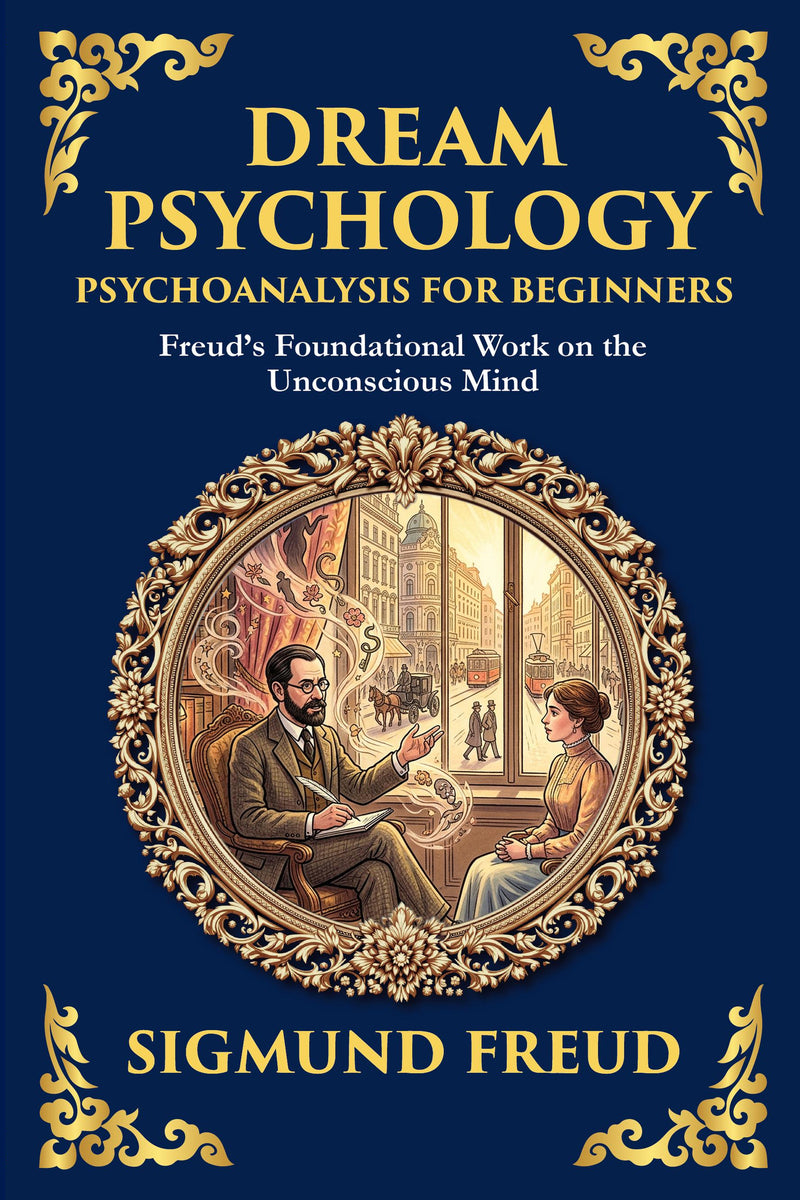
Dream Psychology: Psychoanalysis for Beginners — Large Print
Why do we dream? What hidden desires and fears lie beneath the surface of our unconscious minds? In Dream Psychology, the father of psychoanalysis, Sigmund Freud, invites readers into the symbolic world of dreams, revealing how our nightly visions are the key to understanding our inner lives.
or free app
10,000+ hrs library
30-day guarantee
The complete Dream Psychology: Psychoanalysis appears in modern English through Library of Alexandria Press, available online with audiobook narration included for members.
Have you ever wondered why your dreams feel so real—and what they might be trying to tell you? Dream Psychology: Psychoanalysis for Beginners is Sigmund Freud’s most accessible and compelling introduction to the mysteries of the unconscious mind. First published in 1920, this classic work presents Freud’s revolutionary ideas in a form designed for general readers, distilling decades of groundbreaking research into a concise, readable, and endlessly fascinating guide.
Freud explains how dreams are constructed from fragments of suppressed memories, repressed desires, and unresolved conflicts—and how these are expressed through symbols and distortions unique to each individual. He lays the foundation for modern psychoanalysis by exploring how dreams relate to wish fulfillment, sexual development, and the psychological architecture of the self.
What you’ll discover in this modern edition
- The Origins and Purpose of Dreams – Understand why we dream, what dreams represent, and how they help resolve inner tension.
- Key Concepts of Psychoanalysis Made Simple – Learn about repression, resistance, transference, and the unconscious in clear terms.
- Symbolism and Interpretation – Decode the hidden meanings in common dream imagery and recurring themes.
- How Childhood and Trauma Influence Dreams – See how early experiences shape our inner life and dream world.
- A Foundation for Modern Psychology – Freud’s pioneering insights laid the groundwork for countless therapies and academic fields.
- Ideal for Beginners – No prior knowledge of psychology required—just a curious mind.
| Formats | eBook (EPUB + PDF) · Audiobook · Paperback · Hardcover · Large Print |
| Language | English |
| Trim size (print) | 6 × 9 in |
| Binding | Paperback — perfect-bound · Hardcover — casewrap |
| Large Print edition | Same text in a larger, easy-read type — a larger font, not a larger trim |
| Print pricing | Every physical book at our true cost — at-cost, no profit (members) |
| Library | 873 restored titles, always growing |
| Length | 48,396 words · ~3 hr 14 min reading |
| Reading level | Grade 8 · an easy, flowing read (this modern-English edition) |
| Edition | Modern English translation · 2026 |
Member reviews for this edition are collected as readers finish it — be the first. Across the library: 12,000+ books shipped, every plan covered by a 365-day print guarantee.
About this edition
A faithful, unabridged modern-English edition by The Library of Alexandria — carefully rendered for today's reader and verified paragraph-by-paragraph against the public-domain source. Available as eBook, audiobook, paperback, hardcover, and large print.
- Complete & unabridgedVerified paragraph by paragraph against the source — never a scan, never abridged.
- Modern English, faithfulReadable today, with the author’s meaning kept intact. Readable — not simplified.
- Every format, one membershipRead in your browser or the free app, or listen to the full audiobook.
Included free with your membership
Cancel anytime, one click · 30-day money-back guarantee
Edition last updated July 2026
What’s inside
Dream Psychology: Psychoanalysis for Beginners — Large Print — complete and unabridged: all 10 sections included with membership, plus the full audiobook.
Begin reading Dream Psychology: Psychoanalysis for Beginners — Large Print
In clear modern English — the complete text is included with membership.
Introduction
There are few thinkers in the history of human thought who have so thoroughly reshaped the way we understand ourselves as Sigmund Freud. Whether we agree with him, argue against him, or find ourselves somewhere in between, we live in a world that has absorbed his ideas so completely that they have become part of the very language we use to describe our inner lives. When we speak of being “in denial,” of harboring an “unconscious” motive, of a “Freudian slip” that betrays our hidden desires, or of the symbolic meaning of a dream, we are speaking Freud’s language whether we know it or not. The book you are about to read sits at the very heart of that revolution. It is a concise, accessible distillation of the ideas that made Freud one of the most influential figures of the modern age, and it offers a doorway into a way of seeing the mind that, more than a century after it was first articulated, still has the power to surprise, unsettle, and illuminate.
This volume was conceived as an entry point. Freud’s monumental work The Interpretation of Dreams, first published in 1899, was a dense, sprawling, and at times forbidding text—a book that the author himself returned to and revised repeatedly across the decades of his career, and one that even devoted readers found challenging to navigate. The shorter work presented here was designed to bring the essence of those ideas to a wider audience, to strip away some of the technical scaffolding and present the central insights in a form that a curious reader without specialized training could follow. It is, in the truest sense, psychoanalysis for beginners: not a watered-down version of Freud’s thought, but a clarified one, focused on the single phenomenon that Freud believed was the surest path into the mysteries of the unconscious—the dream.
The present edition continues that spirit of accessibility. This is a modern translation, adapted for the contemporary reader, which means that the language has been rendered into clear, readable English that respects both the precision of Freud’s thinking and the comfort of a present-day audience. The goal has been to remove the unnecessary obstacles—the dated phrasing, the convoluted sentence structures, the obscure references—while preserving the substance, the rigor, and the distinctive voice of the original. What remains is Freud as he wished to be understood: a careful observer, a patient interpreter, and a writer who genuinely wanted his readers to follow him step by step into territory that had never before been mapped with such ambition.
To appreciate what you are holding, it helps to understand the moment from which it emerged. Freud was born in 1856 in the small Moravian town of Freiberg, then part of the Austro-Hungarian Empire, and his family moved to Vienna while he was still a child. Vienna would remain his home for almost his entire life, and the city—glittering, intellectually feverish, socially rigid, and seething beneath its polished surface with all the desires it could not openly acknowledge—was in many ways the perfect laboratory for his discoveries. The late nineteenth century was an age of extraordinary confidence in science and reason. Medicine was advancing, technology was transforming daily life, and the educated classes of Europe largely believed that the human being was a fundamentally rational creature whose behavior could be explained by conscious thought and deliberate choice.
Freud trained as a neurologist, steeped in this scientific worldview, and he began his career expecting to find physical, mechanical explanations for the disorders he encountered in his patients. But the cases that came before him—particularly those involving what was then called “hysteria,” a catchall term for a range of psychological and physical symptoms that had no apparent organic cause—refused to fit the tidy framework he had been taught. Patients suffered from paralyses, blindness, fits, and obsessions that no examination of the body could account for. Something else was at work, something hidden, something that operated below the threshold of awareness. The more closely Freud listened to his patients, the more he became convinced that the mind contained vast regions of which the conscious self was entirely unaware, regions that nonetheless exerted a powerful and often disruptive influence on thought, feeling, and behavior.
This was the radical wager at the center of everything Freud would go on to write: that we are, to a far greater degree than we like to imagine, strangers to ourselves. The conscious mind, with its reasoning and its sense of mastery, is only a small part of a much larger psychic apparatus. Beneath it lies the unconscious—a churning reservoir of memories, wishes, fears, and impulses that we have pushed out of awareness because they are too painful, too forbidden, or too threatening to acknowledge directly. These buried contents do not simply disappear. They press constantly toward expression, and they find their way to the surface through disguised channels: through slips of the tongue, through symptoms, through jokes, and, above all, through dreams.
It is difficult, from our vantage point, to grasp how genuinely scandalous these ideas were. To suggest that respectable, rational people were driven by hidden sexual and aggressive forces, that children possessed an inner life of desire and conflict, that the polite surface of civilized behavior concealed a turbulent and largely unknowable interior—this was not merely a scientific proposal but an affront to the entire self-image of an era. Freud knew this. He understood that he was asking his readers to accept a profoundly humbling truth, one that overturned the comforting belief that we are the masters of our own minds. He compared his discovery to the great blows that science had already dealt to human vanity: Copernicus had shown that the Earth was not the center of the universe, Darwin had shown that humans were not a special creation set apart from the animal kingdom, and now Freud claimed to show that the conscious ego was “not even master in its own house.”
The dream became Freud’s great proof and his chosen instrument. He called it “the royal road to the unconscious,” and the phrase captures both his enthusiasm and his method. Where others saw dreams as meaningless neural noise, as the random firings of a sleeping brain, or at best as quaint omens to be read in popular dream-books, Freud saw them as meticulously constructed messages—coded communications from the deepest layers of the self. Every dream, he insisted, had a meaning. Every dream, however absurd or chaotic it might appear, could be interpreted. And the meaning, once decoded, would reveal something essential about the dreamer’s hidden wishes. This was the central claim that the present book sets out to explain, and it remains, even now, one of the most provocative and fascinating ideas ever proposed about the workings of the human mind.
Approaching Freud for the first time can be both exhilarating and disorienting, and a few words of guidance may help you get the most from the experience. The first thing to understand is that this is a work of method as much as of theory. Freud does not simply assert that dreams have meaning; he attempts to show you, through worked examples and patient analysis, how that meaning can be uncovered. He introduces a vocabulary that may at first seem technical but quickly becomes intuitive once you see it in action. You will encounter the crucial distinction between the manifest content of a dream—the story as we remember it, the strange events and images that pass through our sleeping minds—and the latent content, the hidden thoughts and wishes that lie beneath the surface and that the dream has disguised. The work of interpretation, as Freud describes it, is the work of moving from the manifest to the latent, of peeling back the disguise to reveal what the dream is really about.
To explain how this disguise is constructed, Freud introduces the concept of the dream-work—the set of mental operations that transform the raw, often unacceptable latent thoughts into the acceptable, if bizarre, manifest dream. He describes processes with names like condensation, in which a single image in a dream may stand for several different thoughts compressed together, and displacement, in which the emotional emphasis is shifted from something important onto something apparently trivial, so that the true significance of the dream is concealed. He explores the role of symbolism, the way in which certain images recur across the dreams of different people and seem to carry shared meanings. And he discusses the function of what he calls the censor—a kind of internal guardian that stands between the unconscious and consciousness, permitting forbidden material to pass only if it is sufficiently disguised. These ideas form the architecture of the book, and as you read, you will see them assembled piece by piece into a complete and surprisingly coherent system.
A second piece of advice: read patiently, and resist the urge to accept or reject too quickly. Freud is a builder of arguments, and he constructs his case the way a careful detective assembles evidence, returning again and again to the same examples and viewing them from new angles. Some of his interpretations may strike you as brilliant and self-evidently true; others may seem like a stretch, or even arbitrary. This is part of the experience, and it is worth sitting with the discomfort rather than dismissing it. Freud was working without precedent, charting territory that no one had mapped before, and he was inevitably feeling his way, making bold leaps that sometimes landed and sometimes did not. To read him well is to engage with him as a partner in inquiry—to test his claims against your own experience, to notice when you are persuaded and when you are not, and to ask yourself why.
This brings us to the question of dreams themselves, which you almost certainly have. There is hardly a reader alive who has not woken from a dream that seemed urgent and meaningful, only to watch it dissolve as the day’s demands took over. Freud’s book invites you to take those experiences seriously, perhaps for the first time. You may find yourself, as you read, beginning to pay closer attention to your own dreams—remembering them more vividly, noticing the strange logic by which they unfold, wondering what hidden thoughts they might be expressing. This is one of the quiet pleasures of the book, and one of its most enduring gifts. Whatever you ultimately conclude about Freud’s theories, the simple act of treating your own inner life as worthy of curiosity and respect is a valuable one, and it is something this work encourages on every page.
It is also worth saying a word about the sexual dimension of Freud’s thought, which has often been the focus of controversy and misunderstanding. Freud believed that sexuality—understood in a broad sense, as a fundamental life force present from early childhood—played a central role in the unconscious and therefore in dreams. This emphasis shocked his contemporaries and has continued to provoke strong reactions ever since. As you read, it is helpful to keep two things in mind. First, Freud’s concept of sexuality is far wider and more complex than the everyday use of the word; it encompasses a whole range of desires, attachments, and bodily pleasures that begin in infancy and shape the entire course of psychological development. Second, while this dimension is genuinely important to Freud’s view of the mind, it is not the whole of his thinking, and a reader who reduces Freud to a single obsession will miss the richness and subtlety of his larger vision. Approach this material with an open and adult curiosity, and you will find it far more interesting than its reputation might suggest.
Finally, a note on the experience of the prose itself. Freud was not only a scientist and a clinician but a writer of real distinction—indeed, he was awarded a major literary prize for the quality of his writing, and his works have been read as much for their style as for their substance. There is a warmth and a conversational intimacy to his voice that this translation has tried to preserve. He shares his own dreams with disarming candor, he confesses his uncertainties, he addresses the reader directly and draws you into the process of discovery as a fellow traveler rather than a passive student. This personal quality is one of the great pleasures of reading Freud, and it is part of what makes even his most challenging ideas feel approachable. You are not being lectured at; you are being invited to think alongside one of the most original minds of the modern era.
Cancel anytime, one click · 30-day money-back guarantee
Founding annual rate available now — your price locks for life when you join.
Not ready? Get this free chapter by email — read it anytime.
✓ Sent — check your inbox for Dream Psychology: Psychoanalysis for Beginners — Large Print.
Questions about Dream Psychology: Psychoanalysis for Beginners — Large Print
What is Dream Psychology: Psychoanalysis about?
Why do we dream? What hidden desires and fears lie beneath the surface of our unconscious minds? In Dream Psychology, the father of psychoanalysis, Sigmund Freud, invites readers into the symbolic world of dreams, revealing how our nightly visions are the key to understanding our inner lives.
Who wrote Dream Psychology: Psychoanalysis?
Dream Psychology: Psychoanalysis was written by Sigmund Freud. This edition presents the complete work in clear modern English, faithfully rendered from the public-domain original by Library of Alexandria Press.
Is Dream Psychology: Psychoanalysis free to read?
The opening chapter is free to read on this page. Members read and listen to the complete work — and the entire library — free, and can order any physical book at our true print cost.
How long is Dream Psychology: Psychoanalysis?
10 chapters (~48,396 words) — about 3 hr 14 min of reading in this modern-English edition.
Is this an abridged version of Dream Psychology: Psychoanalysis?
No. This is the complete, unabridged Dream Psychology: Psychoanalysis, carefully rendered into clear modern English and verified paragraph-by-paragraph against the public-domain source — nothing is cut or summarised.
What formats does Dream Psychology: Psychoanalysis come in?
Dream Psychology: Psychoanalysis is available as eBook, paperback, hardcover and large print. eBook and audiobook are included with membership; printed editions ship at our true print cost.
Shipping & returns
Billing & membership
More from the library


Explore Classic & Literary
- Dream Psychology: Psychoanalysis for Beginners · Sigmund Freud
- Great Expectations · Charles Dickens
- The Brothers Karamazov · Fyodor Dostoyevsky
- The Great Gatsby · F. Scott Fitzgerald
- Wild Flowers Worth Knowing · Neltje Blanchan
- Italian Hours · Henry James
- A Popular History of France from the Earliest Times, Volume 5 · François Guizot
- A history of English literature: A practical text-book · Edward Albert
- Italian Highways and Byways from a Motor Car · M. F. Mansfield
- The Heart-Cry of Jesus · Byron J. Rees
- Castes and Tribes of Southern India. Vol. 6 of 7 · Edgar Thurston
- Against the Grain · J.-K. Huysmans
- Dombey and Son · Charles Dickens
- How to Invest Money · George Garr Henry
- The Great Controversy Between Christ and Satan · Ellen Gould Harmon White
- One Hundred Proofs That the Earth Is Not a Globe · William Carpenter
- Southern Literature From 1579–1895 · Louise Manly
- The Renaissance: Studies in Art and Poetry · Walter Pater
- Mark Twain’s Speeches · Mark Twain
- Tacitus on Germany · Cornelius Tacitus
- The Rosary · Florence L. Barclay
- Peculiarities of American Cities · Willard W. Glazier
- Tennis for Girls · Florence A. Ballin
- The World’s Greatest Books — Volume 02 — Fiction
- Shirley · Charlotte Brontë
- Daisy Miller: A Study · Henry James
- Louis Lambert · Honoré de Balzac
- Historic Jamaica · Frank Cundall
- The Gambler · Fyodor Dostoyevsky
- The Mayor of Casterbridge · Thomas Hardy
Dream Psychology: Psychoanalysis for Beginners — Large Print
Dream Psychology: Psychoanalysis for Beginners — Large Print
Freud’s Essential Work on the Unconscious Mind
Sigmund Freud
Contents
- Introduction
- Chapter 1
- Chapter 2
- Chapter 3
- Chapter 4
- Chapter 5
- Chapter 6
- Chapter 7
- Chapter 8
- Chapter 9
Introduction
There are few thinkers in the history of human thought who have so thoroughly reshaped the way we understand ourselves as Sigmund Freud. Whether we agree with him, argue against him, or find ourselves somewhere in between, we live in a world that has absorbed his ideas so completely that they have become part of the very language we use to describe our inner lives. When we speak of being “in denial,” of harboring an “unconscious” motive, of a “Freudian slip” that betrays our hidden desires, or of the symbolic meaning of a dream, we are speaking Freud’s language whether we know it or not. The book you are about to read sits at the very heart of that revolution. It is a concise, accessible distillation of the ideas that made Freud one of the most influential figures of the modern age, and it offers a doorway into a way of seeing the mind that, more than a century after it was first articulated, still has the power to surprise, unsettle, and illuminate.
This volume was conceived as an entry point. Freud’s monumental work The Interpretation of Dreams, first published in 1899, was a dense, sprawling, and at times forbidding text—a book that the author himself returned to and revised repeatedly across the decades of his career, and one that even devoted readers found challenging to navigate. The shorter work presented here was designed to bring the essence of those ideas to a wider audience, to strip away some of the technical scaffolding and present the central insights in a form that a curious reader without specialized training could follow. It is, in the truest sense, psychoanalysis for beginners: not a watered-down version of Freud’s thought, but a clarified one, focused on the single phenomenon that Freud believed was the surest path into the mysteries of the unconscious—the dream.
The present edition continues that spirit of accessibility. This is a modern translation, adapted for the contemporary reader, which means that the language has been rendered into clear, readable English that respects both the precision of Freud’s thinking and the comfort of a present-day audience. The goal has been to remove the unnecessary obstacles—the dated phrasing, the convoluted sentence structures, the obscure references—while preserving the substance, the rigor, and the distinctive voice of the original. What remains is Freud as he wished to be understood: a careful observer, a patient interpreter, and a writer who genuinely wanted his readers to follow him step by step into territory that had never before been mapped with such ambition.
To appreciate what you are holding, it helps to understand the moment from which it emerged. Freud was born in 1856 in the small Moravian town of Freiberg, then part of the Austro-Hungarian Empire, and his family moved to Vienna while he was still a child. Vienna would remain his home for almost his entire life, and the city—glittering, intellectually feverish, socially rigid, and seething beneath its polished surface with all the desires it could not openly acknowledge—was in many ways the perfect laboratory for his discoveries. The late nineteenth century was an age of extraordinary confidence in science and reason. Medicine was advancing, technology was transforming daily life, and the educated classes of Europe largely believed that the human being was a fundamentally rational creature whose behavior could be explained by conscious thought and deliberate choice.
Freud trained as a neurologist, steeped in this scientific worldview, and he began his career expecting to find physical, mechanical explanations for the disorders he encountered in his patients. But the cases that came before him—particularly those involving what was then called “hysteria,” a catchall term for a range of psychological and physical symptoms that had no apparent organic cause—refused to fit the tidy framework he had been taught. Patients suffered from paralyses, blindness, fits, and obsessions that no examination of the body could account for. Something else was at work, something hidden, something that operated below the threshold of awareness. The more closely Freud listened to his patients, the more he became convinced that the mind contained vast regions of which the conscious self was entirely unaware, regions that nonetheless exerted a powerful and often disruptive influence on thought, feeling, and behavior.
This was the radical wager at the center of everything Freud would go on to write: that we are, to a far greater degree than we like to imagine, strangers to ourselves. The conscious mind, with its reasoning and its sense of mastery, is only a small part of a much larger psychic apparatus. Beneath it lies the unconscious—a churning reservoir of memories, wishes, fears, and impulses that we have pushed out of awareness because they are too painful, too forbidden, or too threatening to acknowledge directly. These buried contents do not simply disappear. They press constantly toward expression, and they find their way to the surface through disguised channels: through slips of the tongue, through symptoms, through jokes, and, above all, through dreams.
It is difficult, from our vantage point, to grasp how genuinely scandalous these ideas were. To suggest that respectable, rational people were driven by hidden sexual and aggressive forces, that children possessed an inner life of desire and conflict, that the polite surface of civilized behavior concealed a turbulent and largely unknowable interior—this was not merely a scientific proposal but an affront to the entire self-image of an era. Freud knew this. He understood that he was asking his readers to accept a profoundly humbling truth, one that overturned the comforting belief that we are the masters of our own minds. He compared his discovery to the great blows that science had already dealt to human vanity: Copernicus had shown that the Earth was not the center of the universe, Darwin had shown that humans were not a special creation set apart from the animal kingdom, and now Freud claimed to show that the conscious ego was “not even master in its own house.”
The dream became Freud’s great proof and his chosen instrument. He called it “the royal road to the unconscious,” and the phrase captures both his enthusiasm and his method. Where others saw dreams as meaningless neural noise, as the random firings of a sleeping brain, or at best as quaint omens to be read in popular dream-books, Freud saw them as meticulously constructed messages—coded communications from the deepest layers of the self. Every dream, he insisted, had a meaning. Every dream, however absurd or chaotic it might appear, could be interpreted. And the meaning, once decoded, would reveal something essential about the dreamer’s hidden wishes. This was the central claim that the present book sets out to explain, and it remains, even now, one of the most provocative and fascinating ideas ever proposed about the workings of the human mind.
Approaching Freud for the first time can be both exhilarating and disorienting, and a few words of guidance may help you get the most from the experience. The first thing to understand is that this is a work of method as much as of theory. Freud does not simply assert that dreams have meaning; he attempts to show you, through worked examples and patient analysis, how that meaning can be uncovered. He introduces a vocabulary that may at first seem technical but quickly becomes intuitive once you see it in action. You will encounter the crucial distinction between the manifest content of a dream—the story as we remember it, the strange events and images that pass through our sleeping minds—and the latent content, the hidden thoughts and wishes that lie beneath the surface and that the dream has disguised. The work of interpretation, as Freud describes it, is the work of moving from the manifest to the latent, of peeling back the disguise to reveal what the dream is really about.
To explain how this disguise is constructed, Freud introduces the concept of the dream-work—the set of mental operations that transform the raw, often unacceptable latent thoughts into the acceptable, if bizarre, manifest dream. He describes processes with names like condensation, in which a single image in a dream may stand for several different thoughts compressed together, and displacement, in which the emotional emphasis is shifted from something important onto something apparently trivial, so that the true significance of the dream is concealed. He explores the role of symbolism, the way in which certain images recur across the dreams of different people and seem to carry shared meanings. And he discusses the function of what he calls the censor—a kind of internal guardian that stands between the unconscious and consciousness, permitting forbidden material to pass only if it is sufficiently disguised. These ideas form the architecture of the book, and as you read, you will see them assembled piece by piece into a complete and surprisingly coherent system.
A second piece of advice: read patiently, and resist the urge to accept or reject too quickly. Freud is a builder of arguments, and he constructs his case the way a careful detective assembles evidence, returning again and again to the same examples and viewing them from new angles. Some of his interpretations may strike you as brilliant and self-evidently true; others may seem like a stretch, or even arbitrary. This is part of the experience, and it is worth sitting with the discomfort rather than dismissing it. Freud was working without precedent, charting territory that no one had mapped before, and he was inevitably feeling his way, making bold leaps that sometimes landed and sometimes did not. To read him well is to engage with him as a partner in inquiry—to test his claims against your own experience, to notice when you are persuaded and when you are not, and to ask yourself why.
This brings us to the question of dreams themselves, which you almost certainly have. There is hardly a reader alive who has not woken from a dream that seemed urgent and meaningful, only to watch it dissolve as the day’s demands took over. Freud’s book invites you to take those experiences seriously, perhaps for the first time. You may find yourself, as you read, beginning to pay closer attention to your own dreams—remembering them more vividly, noticing the strange logic by which they unfold, wondering what hidden thoughts they might be expressing. This is one of the quiet pleasures of the book, and one of its most enduring gifts. Whatever you ultimately conclude about Freud’s theories, the simple act of treating your own inner life as worthy of curiosity and respect is a valuable one, and it is something this work encourages on every page.
It is also worth saying a word about the sexual dimension of Freud’s thought, which has often been the focus of controversy and misunderstanding. Freud believed that sexuality—understood in a broad sense, as a fundamental life force present from early childhood—played a central role in the unconscious and therefore in dreams. This emphasis shocked his contemporaries and has continued to provoke strong reactions ever since. As you read, it is helpful to keep two things in mind. First, Freud’s concept of sexuality is far wider and more complex than the everyday use of the word; it encompasses a whole range of desires, attachments, and bodily pleasures that begin in infancy and shape the entire course of psychological development. Second, while this dimension is genuinely important to Freud’s view of the mind, it is not the whole of his thinking, and a reader who reduces Freud to a single obsession will miss the richness and subtlety of his larger vision. Approach this material with an open and adult curiosity, and you will find it far more interesting than its reputation might suggest.
Finally, a note on the experience of the prose itself. Freud was not only a scientist and a clinician but a writer of real distinction—indeed, he was awarded a major literary prize for the quality of his writing, and his works have been read as much for their style as for their substance. There is a warmth and a conversational intimacy to his voice that this translation has tried to preserve. He shares his own dreams with disarming candor, he confesses his uncertainties, he addresses the reader directly and draws you into the process of discovery as a fellow traveler rather than a passive student. This personal quality is one of the great pleasures of reading Freud, and it is part of what makes even his most challenging ideas feel approachable. You are not being lectured at; you are being invited to think alongside one of the most original minds of the modern era.
In what we might call “pre-scientific times,” people had no doubts about what dreams meant. When people remembered their dreams after waking up, they viewed them as either friendly or hostile messages from higher powers, whether demonic or divine. As scientific thinking grew, this entire system of mythology shifted into the realm of psychology. Today, only a small number of educated people doubt that a dream is a mental process created by the dreamer themselves.
However, since the decline of mythological explanations, we have lacked a proper way to interpret dreams. Many questions have gone unanswered for hundreds of years: how dreams begin; how they relate to our mental life while we are awake; why they seem independent of the physical disturbances that usually grab our attention during sleep; the many strange details that contradict our waking logic; the mismatch between the images we see and the emotions they cause; and finally, how quickly dreams fade, how our minds dismiss them as weird upon waking, and how our memories distort or delete them. Above all, there is the question of the dream’s meaning, which has two sides. First, there is the psychological significance of the dream—its role in mental processes or its possible biological purpose. Second, does a dream have a specific meaning—can we make sense of an individual dream the same way we do with other mental thoughts?
There are three common ways people view dreams. Many philosophers have promoted one of these views, which still holds onto some of the old, exaggerated importance of dreams. To them, dreaming is a unique state of mental activity that they even describe as a rise to a higher level of existence. For example, Schubert claimed: “The dream is the liberation of the spirit from the pressure of external nature, a detachment of the soul from the fetters of matter.” Not everyone goes that far, but many believe that dreams stem from real spiritual stimulation and are the outward signs of spiritual powers that are restricted during the day. A large number of observers also admit that dreaming can achieve extraordinary things, at least in certain areas like memory.
End of the free sample
Keep reading, free
Members read and listen to the complete book — and the entire library. Cancel anytime, one click · 30-day money-back guarantee.