
 13 minSummaryRead it, the 15-minute summary, and print and large print at cost
 Audiobook editionPaperback · 6 × 9 in · printing soonHardcover · 6 × 9 in · printing soon
About this book
What if chance is simply a name for what we do not know?
In A Philosophical Essay on Probabilities, Pierre-Simon Laplace takes uncertainty out of the gambling room and into daily judgment. Writing for readers who are not mathematicians, he uses almost no formulas. Dice, coins, coloured balls, birth records and court verdicts show how probability helps us reason when the facts are incomplete.
Laplace imagines a mind that knows every force and position in nature and can see the whole future. We have no such knowledge. Instead, he explores how to combine chances, trace effects back to likely causes, and weigh evidence. The stakes reach from trust in a witness to the strength of a scientific hypothesis.
What you’ll discover
- A clear starting point Explore what probability means through equally possible cases, coins, dice and coloured balls.
- Clues that lead backward Follow the reasoning that moves from an observed effect toward its likely cause.
- Evidence in human affairs Consider how probability can help weigh testimony, jury decisions and votes.
- Patterns beneath uncertain events See how averages settle toward steady values even when single outcomes remain uncertain.
- Common sense under scrutiny Examine why a long run of one outcome need not make its opposite likelier.
Who will love it
Readers who enjoy clear thinking about luck, evidence and risk will appreciate this essay. It also suits those curious about how scientists and judges weigh uncertain facts.
What’s inside
The key ideas, in the 15-minute summary
- Uncertainty begins with what we lack
- Probability depends on what you know
- Every uncertain link reduces confidence
- Evidence helps us reason toward causes
- A prize means different things
- Many events reveal a steadier pattern
- Test the claim and the teller
- Public decisions need informed judgment
- Let evidence guide your confidence
Formats and delivery
- eBook
- On your phone, tablet, computer or Kindle, with the type as large as you like.
- Large-print eBook
- The same book in bigger, clearer type, from the first page.
- 15-minute summary
- The key ideas in about 13 minutes, to read today.
- Paperback
- 6 × 9 in. Printing soon: leave your email under Paperback or Hardcover above.
- Hardcover
- 6 × 9 in. Printing soon: leave your email under Paperback or Hardcover above.
- Large print paperback
- 8.5 × 11 in. Printing soon: leave your email under Paperback or Hardcover above.
- Large print hardcover
- 8.5 × 11 in. Printing soon: leave your email under Paperback or Hardcover above.
Every printed copy is made when you order it and shipped worldwide; shipping is shown at checkout. The eBook opens when the book texts go online.
How it works
- Start free. Nothing to pay today; the eBook of this book is yours to keep.
- Read and print. 200,000+ classics as eBook, large-print eBook and 15-minute summary, and any book printed at cost as a paperback, hardcover or large print, 5 accounts for the price of one.
- We remind you first. Free for 3 months, and we email you 7 days before your first payment. Then USD 0.14 a day in your first year on the yearly plan and USD 0.27 a day after, or USD 0.66 a day on the monthly plan. Cancel online in two clicks.
Bought on its own? Every eBook and printed book you buy without the plan carries our 30-day money-back guarantee.
25 languages, side by side
A Philosophical Essay on Probabilities in 25 languages, side by side, paragraph by paragraph, once the book texts are online: the way to learn a language with a book you love.

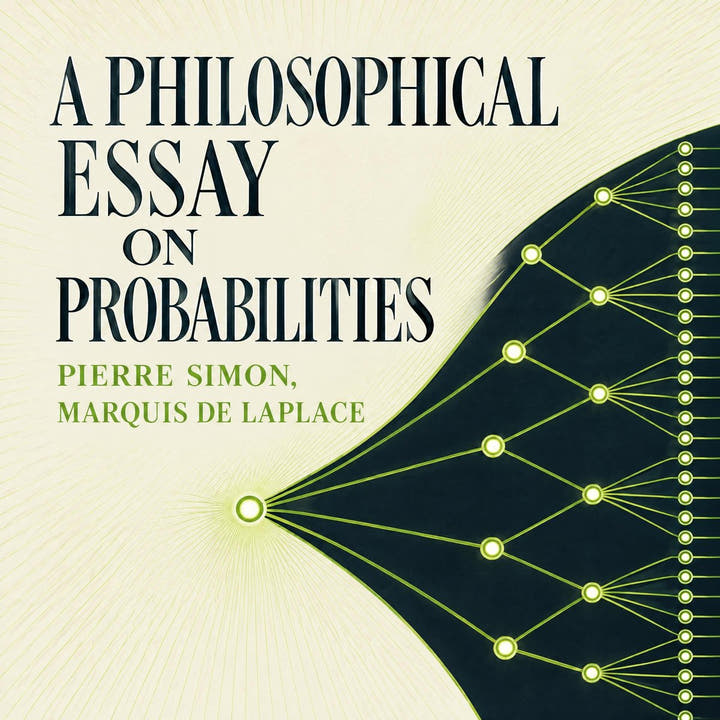
A Philosophical Essay on Probabilities
 by Pierre-Simon Laplace · 1814
A French mathematician imagines a mind that knows every force in nature and sees the future as clearly as the past.
Challenging2–5 hours to read20 languages
Learn a language with challenging classicsSpanishFrenchGermanItalianJapanesePortugueseEnglishHow we measure levels
Excellent
Free for 3 months · starts right away, on any device
Read free3 months free · cancel anytimeRenews every year · Cancel anytimeHow it works


- Read, large type too
- 25 languages, side by side
- Print and large print at cost
- 5 accounts for the price of one
“the theory of probabilities is, at bottom, only common sense reduced to calculation”
In short
Imagine a mind that knows every force in nature and every position of every atom at a single instant. For that mind, Laplace says, nothing is uncertain, and the future lies open like the past.
A Philosophical Essay on Probabilities at a glance
- Reading time
- About 3 h 15 min2 h 35 min fast, 3 h 50 min slow
- Length
- 46,300 words
- Library level
- Challenging long sentences, a rich vocabulary
- First published
- 1814by Pierre-Simon Laplace
Reading time at 238 words a minute (fast 300, slow 200). How long the classics take to read · Updated
From the 15-minute summary · Key idea 1
Chance is only a measure of our ignorance
Laplace begins with a firm claim. Every event follows from the laws of nature as surely as the sun follows its course. People speak of chance only when they cannot see the causes. As knowledge grows, those imaginary causes fade away.
Then comes his best-known picture. Imagine an intelligence that knows all the forces of nature and the positions of all things at one instant, and that can analyze them. It would express in one formula the motion of the largest bodies and the lightest atom. For it, the future would be as present as the past.
Renews every year · Cancel anytime
You looked at
Which edition is right for me
- eBook
- On your phone, tablet or computer. Your place follows you, and you can make the type as big as you like.
- 15-minute summary
- The key ideas of the whole book in about 13 minutes. A good first look, or a refresher.
Details
- First published
- 1814
- Language
- English
- Reading time
- 3 h 50 min
- Level
- Challenging
Cite this edition
Laplace, Pierre-Simon. A Philosophical Essay on Probabilities. Library of Alexandria, 2026, libraryofalexandria.com/products/a-philosophical-essay-on-probabilities.
Laplace, P.-S. (2026). A philosophical essay on probabilities. Library of Alexandria. https://libraryofalexandria.com/products/a-philosophical-essay-on-probabilities (Original work published 1814)
Laplace, Pierre-Simon. A Philosophical Essay on Probabilities. Library of Alexandria, 2026. https://libraryofalexandria.com/products/a-philosophical-essay-on-probabilities.
@book{laplace2026philosophical,
  author = {Laplace, Pierre-Simon},
  title = {A Philosophical Essay on Probabilities},
  publisher = {Library of Alexandria},
  year = {2026},
  url = {https://libraryofalexandria.com/products/a-philosophical-essay-on-probabilities},
  note = {First published 1814}
}
Free gifts
USD 580 in free gifts when you start
Every book in every format and in 25 languages, 5 accounts for the price of one. Nothing to pay today.
- 200,000+ classic eBooksIn 25 languages, side by side
USD 170FREE - Every eBookIn 25 languages, any device
USD 120FREE - 15-minute summariesRead in 25 languages
USD 60FREE - Print at cost, no markupPaperback, hardcover, large print
USD 60FREE - 5 accounts for the price of oneA shelf for everyone at home
USD 170FREE - A part in rebuilding the libraryNew languages and books for all
FREE
Questions about A Philosophical Essay on Probabilities
Can I read it free?
Yes. The first key idea of the 15-minute summary is free with no sign-up. Start free and the whole book is yours for 3 months, with the eBook to keep, plus 200,000+ more classics and any book printed at cost as a paperback, hardcover or large print. Nothing to pay today: we email you 7 days before your first payment, and you can cancel online in two clicks.
Can I buy the printed book?
Soon. The paperback, hardcover and large print editions are being prepared. Choose Paperback or Hardcover above, leave your email, and we tell you the day you can order it, printed at cost.
How many accounts do I get?
Five, for the price of one: you and 4 more people, each with their own login, shelf and their own place in every book.
Can I cancel anytime?
Yes. Cancel online in two clicks at any time and nothing more is charged. Nothing is charged in your first 3 months, and we email you 7 days before your first payment.
What is A Philosophical Essay on Probabilities about?
It explains how to measure chance and uncertainty. Laplace sets out the principles of probability in plain language, then applies them to games, astronomy, witnesses, juries, mortality tables and insurance, and warns against common errors in judging odds.
What is Laplace's demon in this book?
It is his picture of a vast intelligence that knows every force and position in nature at one instant. For it the future is as clear as the past. Humans, he says, approach it only faintly, through science.
Is the essay written for general readers or only mathematicians?
Laplace wrote it without algebra for a general audience. It grew from a 1795 lecture to the normal schools, and most chapters explain ideas through urns, coins, dice and real examples from astronomy, births and courts.

The author
Pierre-Simon Laplace
1749–1827 · French mathematician and astronomer
Pierre-Simon Laplace was a French mathematician and astronomer. He was born in Beaumont-en-Auge, Normandy, in 1749 and died in Paris in 1827. He worked in Paris and wrote on mathematics, astronomy, and probability. His works include Celestial Mechanics, published from 1799 to 1825, and A Philosophical Essay on Probabilities, published in 1814.
“the theory of probabilities is, at bottom, only common sense reduced to calculation”
More like this
Our mission
The library burned once. We are building it back.
Every great book, in every language and every format, for every family. Every plan helps pay for new languages and books for readers who have never had them. Join the movement.
Read our story- Every language25 languages today, side by side, and more every year
- No wastePrinted on demand: no warehouses, no unsold stock, no pulped copies
- For everyonePaperback, hardcover and large print at the cost of printing





