
 14 h 21 minAudiobook13 minSummaryRead it, hear it, the 15-minute summary, and print and large print at cost
 Audiobook edition · 14 h 21 minPaperback · 6 × 9 in · printing soonHardcover · 6 × 9 in · printing soon
About this book
What if history feels less like a heap of dates and more like a mountain range you can finally see?
In The Story of Mankind, Hendrik Willem van Loon follows human history from the first people to the years just after the First World War. Egypt, Greece and Rome lead into the Middle Ages, the Renaissance and great revolutions. His aim is not to tell everything, but to make the broad shape clear.
Van Loon writes as a lively, personal guide, choosing moments that shape how people live, work and believe. His story asks what curiosity makes possible and what fear destroys. It also reveals his own early twentieth-century outlook: opinionated, warm and focused chiefly on Europe and its neighbors.
What you’ll discover
- A view from above Picture the past as a mountain range, then step back to see its larger shape.
- Life beside great rivers Follow settled life along the Nile and between the Tigris and Euphrates, where farmers grow grain.
- Cities with their own minds Meet the small Greek city states, each with its own government and fierce pride.
- A world in motion Trace the Renaissance, religious wars and revolutions as ideas and machines reshape daily life.
- Curiosity against fear Explore Van Loon's belief that tolerance and curiosity offer a better path than cruelty.
Who will love it
This book suits curious readers who like history told as a story, with vivid people and a lively guide. It is ideal for students, parents, teachers and anyone wanting one sweeping picture of the world.
What’s inside
The key ideas, in the 15-minute summary
- History becomes clearer from above
- Cold turns survival into invention
- Writing lets generations speak across time
- Small cities give neighbors a voice
- Rome's victories weaken its foundations
- Money and curiosity loosen medieval power
- Religious certainty divides neighbors and nations
- Machines move faster than governments
- Each age grows from the last
Formats and delivery
- eBook
- On your phone, tablet, computer or Kindle, with the type as large as you like.
- Large-print eBook
- The same book in bigger, clearer type, from the first page.
- Audiobook
- Read by Lucas Linden, complete. It opens once the recording is online.
- 15-minute summary
- The key ideas in about 13 minutes, to read today.
- Paperback
- 6 × 9 in. Printing soon: leave your email under Paperback or Hardcover above.
- Hardcover
- 6 × 9 in. Printing soon: leave your email under Paperback or Hardcover above.
- Large print paperback
- 8.5 × 11 in. Printing soon: leave your email under Paperback or Hardcover above.
- Large print hardcover
- 8.5 × 11 in. Printing soon: leave your email under Paperback or Hardcover above.
Every printed copy is made when you order it and shipped worldwide; shipping is shown at checkout. The eBook and the audiobook open when the book texts go online.
How it works
- Start free. Nothing to pay today; the eBook of this book is yours to keep.
- Read, listen and print. 200,000+ classics as eBook, large-print eBook, audiobook and 15-minute summary, and any book printed at cost as a paperback, hardcover or large print, 5 accounts for the price of one.
- We remind you first. Free for 3 months, and we email you 7 days before your first payment. Then USD 0.14 a day in your first year on the yearly plan and USD 0.27 a day after, or USD 0.66 a day on the monthly plan. Cancel online in two clicks.
Bought on its own? Every eBook, audiobook and printed book you buy without the plan carries our 30-day money-back guarantee.
25 languages, side by side
The Story of Mankind in 25 languages, side by side, paragraph by paragraph, once the book texts are online: the way to learn a language with a book you love.

The Story of Mankind
 by Hendrik Willem Van Loon · 1921
A boy climbs a church tower in Rotterdam and sees the whole of human history spread below him.
Challenging5–10 hours to read20 languages
Learn a language with challenging classicsSpanishFrenchGermanItalianJapanesePortugueseEnglishHow we measure levels
Newbery Medal, 1922
Excellent
Free for 3 months · starts right away, on any device
Read free3 months free · cancel anytimeFree for 3 months, then USD 0.14 a dayCancel anytimeHow it works


- Read or listen
- 25 languages, side by side
- Print and large print at cost
- 5 accounts for the price of one
“We live beneath the shadow of a gigantic question mark.”
In short
Picture a boy of twelve climbing the tower of Old Saint Lawrence in Rotterdam. The whole town lies below him like a toy.
The Story of Mankind at a glance
- Reading time
- About 8 h6 h 20 min fast, 9 h 35 min slow
- Length
- 114,700 words
- Library level
- Challenging long sentences, a rich vocabulary
- First published
- 1921by Hendrik Willem Van Loon
Reading time at 238 words a minute (fast 300, slow 200). How long the classics take to read · Updated
From the 15-minute summary · Key idea 1
Climb the tower to see the whole
Van Loon opens with his own memory of the tower in Rotterdam. His uncle takes him up through the dark, past the town clock and the bells, to the open gallery. There the watchman, a man who had read almost nothing, tells him that this bend in the river is where the Prince of Orange cut the dikes to save Leyden.
The tower is the picture Van Loon uses for the whole book. History, he says, is a mighty tower of experience built by time. He admits that his own upbringing shapes what he writes.
Free for 3 months · Cancel anytime
You looked at
Which edition is right for me
- eBook
- On your phone, tablet or computer. Your place follows you, and you can make the type as big as you like.
- 15-minute summary
- The key ideas of the whole book in about 13 minutes. A good first look, or a refresher.
Details
- First published
- 1921
- Language
- English
- Level
- Challenging
Cite this edition
Van Loon, Hendrik Willem. The Story of Mankind. Library of Alexandria, 2026, libraryofalexandria.com/products/the-story-of-mankind.
Van Loon, H. W. (2026). The story of mankind. Library of Alexandria. https://libraryofalexandria.com/products/the-story-of-mankind (Original work published 1921)
Van Loon, Hendrik Willem. The Story of Mankind. Library of Alexandria, 2026. https://libraryofalexandria.com/products/the-story-of-mankind.
@book{vanloon2026story,
  author = {Van Loon, Hendrik Willem},
  title = {The Story of Mankind},
  publisher = {Library of Alexandria},
  year = {2026},
  url = {https://libraryofalexandria.com/products/the-story-of-mankind},
  note = {First published 1921}
}
Free gifts
USD 580 in free gifts when you start
Every book in every format and in 25 languages, 5 accounts for the price of one. Nothing to pay today.
- 200,000+ classic eBooksIn 25 languages, side by side
USD 170FREE - Every audiobookIn 25 languages, any device
USD 120FREE - 15-minute summariesRead or listen, in 25 languages
USD 60FREE - Print at cost, no markupPaperback, hardcover, large print
USD 60FREE - 5 accounts for the price of oneA shelf for everyone at home
USD 170FREE - A part in rebuilding the libraryNew languages and books for all
FREE
Questions about The Story of Mankind
Can I read it free?
Yes. The first key idea of the 15-minute summary is free with no sign-up. Start free and the whole book is yours for 3 months, with the eBook to keep, plus 200,000+ more classics and any book printed at cost as a paperback, hardcover or large print. Nothing to pay today: we email you 7 days before your first payment, and you can cancel online in two clicks.
Can I buy the printed book?
Soon. The paperback, hardcover and large print editions are being prepared. Choose Paperback or Hardcover above, leave your email, and we tell you the day you can order it, printed at cost.
How many accounts do I get?
Five, for the price of one: you and 4 more people, each with their own login, shelf and their own place in every book.
Can I cancel anytime?
Yes. Cancel online in two clicks at any time and nothing more is charged. Nothing is charged in your first 3 months, and we email you 7 days before your first payment.
What is The Story of Mankind about?
It is a single-volume history of the world, from the first living cells and early humans through Egypt, Greece, Rome, the Middle Ages, the Reformation, the revolutions and the engine age to the years after the Great War.
Who wrote The Story of Mankind and when?
Hendrik Willem Van Loon, a Dutch-born writer living in New York, wrote it for young readers. It was first published in 1921, and its closing pages refer to the world just after the Great War.
Is The Story of Mankind easy to read?
Yes, in its friendly way. Van Loon writes in a plain, chatty voice, uses jokes, comparisons and short stories, and explains unfamiliar terms as he goes, so the sweep of history is easy to follow.
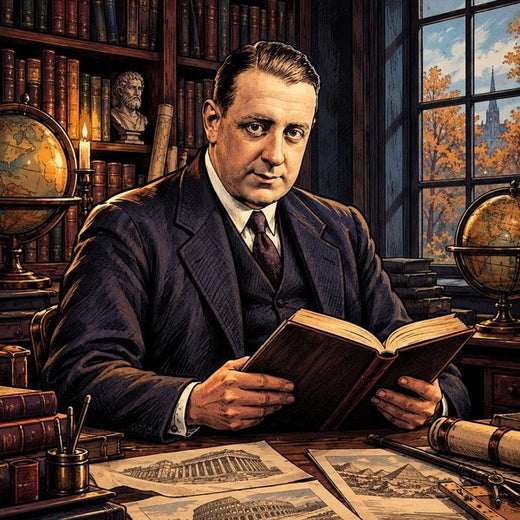
The author
Hendrik Willem Van Loon
1882–1944 · Dutch-American historian and illustrator
Hendrik Willem van Loon (1882–1944) was a Dutch-American historian, journalist, illustrator, and author. He was born in Rotterdam, the Netherlands, and later lived in the United States. He wrote The Story of Mankind, published in 1921, and illustrated his own books. He died in Old Greenwich, Connecticut.
“We live beneath the shadow of a gigantic question mark.”
More like this
Our mission
The library burned once. We are building it back.
Every great book, in every language and every format, for every family. Every plan helps pay for new languages, new audiobooks and books for readers who have never had them. Join the movement.
Read our story- Every language25 languages today, side by side, and more every year
- No wastePrinted on demand: no warehouses, no unsold stock, no pulped copies
- For everyonePaperback, hardcover and large print at the cost of printing





