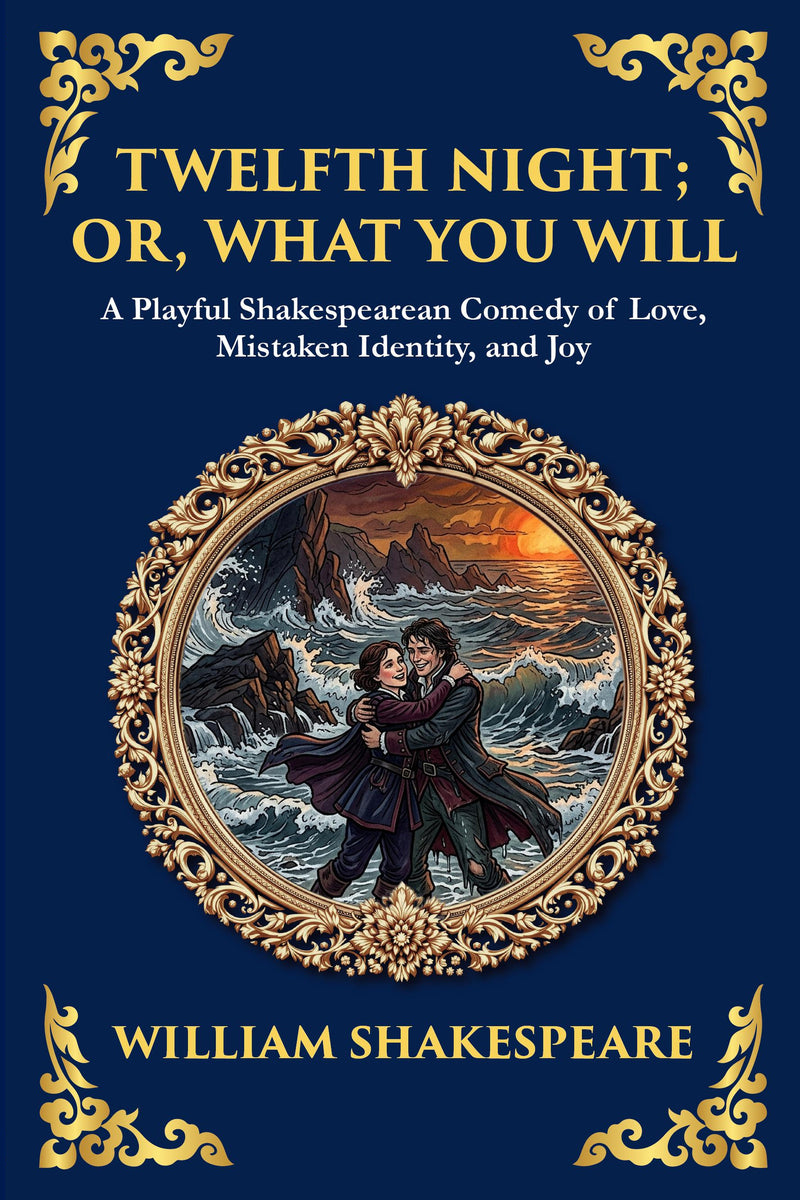
Twelfth Night; Or, What You Will — Large Print
Set on the whimsical shores of Illyria, Twelfth Night is William Shakespeare’s sparkling comedy of cross-dressing, mistaken identity, and love in all its bewildering forms.
or free app
10,000+ hrs library
30-day guarantee
The complete Twelfth Night; Or, What You Will appears in modern English through Library of Alexandria Press, available online with audiobook narration included for members.
Have you ever wondered why falling in love can make fools of us all? Twelfth Night; Or, What You Will is Shakespeare’s dazzling comedy of romantic confusion, hidden identities, and the joyful madness of love. Written at the peak of his comedic genius, this play whirls through themes of disguise, unrequited affection, gender fluidity, and festive celebration with lyrical beauty and timeless wit.
When Viola survives a shipwreck and disguises herself as “Cesario” to serve Duke Orsino, she quickly finds herself at the center of a love triangle: Orsino pines for the grieving Lady Olivia, Olivia falls for Cesario, and Viola secretly longs for Orsino. As mistaken identities multiply and fools run riot, the play crescendos toward a revelation-filled finale that restores harmony and highlights love’s unpredictable path.
What you’ll discover in this modern edition
- A Joyful Entanglement of Love and Identity – Experience the chaos and comedy as characters fall for the wrong people—and sometimes, the right ones in disguise.
| Formats | eBook (EPUB + PDF) · Audiobook · Paperback · Hardcover · Large Print |
| Language | English |
| Trim size (print) | 6 × 9 in |
| Binding | Paperback — perfect-bound · Hardcover — casewrap |
| Large Print edition | Same text in a larger, easy-read type — a larger font, not a larger trim |
| Print pricing | Every physical book at our true cost — at-cost, no profit (members) |
| Library | 873 restored titles, always growing |
| Length | 23,265 words · ~1 hr 33 min reading |
| Reading level | Grade 5 · an easy, flowing read (this modern-English edition) |
| Edition | Modern English translation · 2026 |
Member reviews for this edition are collected as readers finish it — be the first. Across the library: 12,000+ books shipped, every plan covered by a 365-day print guarantee.
About this edition
A faithful, unabridged modern-English edition by The Library of Alexandria — carefully rendered for today's reader and verified paragraph-by-paragraph against the public-domain source. Available as eBook, audiobook, paperback, hardcover, and large print.
- Complete & unabridgedVerified paragraph by paragraph against the source — never a scan, never abridged.
- Modern English, faithfulReadable today, with the author’s meaning kept intact. Readable — not simplified.
- Every format, one membershipRead in your browser or the free app, or listen to the full audiobook.
Included free with your membership
Cancel anytime, one click · 30-day money-back guarantee
Edition last updated July 2026
What’s inside
Twelfth Night; Or, What You Will — Large Print — complete and unabridged: all 20 sections included with membership, plus the full audiobook.
Begin reading Twelfth Night; Or, What You Will — Large Print
In clear modern English — the complete text is included with membership.
Introduction
There is a particular kind of magic that happens when a play opens with music. Before a single character has revealed their name, before any plot has set itself in motion, we are invited to feel something — a mood, a longing, an atmosphere of sweet and dangerous excess. Twelfth Night, or What You Will begins in exactly this way, with one of the most famous opening lines in all of English drama, a man asking for music as though it were food, asking to be overfed on it until his appetite for love sickens and dies. From that first breath, we know we have entered a world where feeling runs high and self-knowledge runs low, where everyone is hungry for something they cannot quite name, and where the path to happiness will wind through disguise, confusion, foolishness, and grace before it arrives, somewhat breathless, at its destination.
This edition presents the play in a modern translation, adapted for the contemporary reader, and that choice deserves a word of welcome at the outset. There are readers who come to Shakespeare already fluent in his idiom, who can glide through the Elizabethan syntax and the dense web of puns without breaking stride. For them, the original remains a treasure. But there are far more readers — curious, intelligent, eager — who have been quietly intimidated by the language, who suspect that beneath the thicket of archaic phrasing lies a story they would adore if only they could reach it. This version is for them, and indeed for anyone who wishes to experience the play first as a living drama of human beings rather than as a linguistic puzzle. The aim has been to carry across the meaning, the wit, the tenderness, and the comic timing into language that moves easily for a reader today, while preserving the spirit, the rhythm, and above all the joy of the original. What you hold is not a replacement for Shakespeare but an open door into him.
And what a play to walk through that door into. Among the comedies, Twelfth Night occupies a place of special affection. It is widely considered the finest of them — the most perfectly balanced, the most musical, the most generous of heart. It has everything a comedy could want: a heroine of dazzling intelligence and courage, a tangle of romantic confusion that grows more delicious with every scene, a cast of foolish and self-important characters who get exactly what they deserve, a clown who is wiser than all of them, and beneath the laughter, a current of genuine melancholy that gives the whole thing its haunting depth. It is a play that makes you laugh out loud and then, in a quiet moment, catches your throat. That mixture — comedy threaded with sorrow, festivity shadowed by loss — is what raises it above mere farce and makes it endure.
The title itself is a clue to the play’s whole spirit. “Twelfth Night” refers to the twelfth night after Christmas, the feast of the Epiphany, which in Elizabethan England marked the climax and conclusion of the long Christmas revels. It was a night of festivity turned up to its highest pitch — a moment of license, of celebration, of letting go before the ordinary world resumed. In many old traditions, this was the season of misrule, when the usual order of things was playfully overturned. Servants might be waited upon by masters, a “Lord of Misrule” might be crowned to preside over the chaos, and the rigid hierarchies of everyday life were suspended for a brief, intoxicating spell. The world was turned upside down, and in that inversion lay a strange wisdom: by reversing the order of things, one could see it freshly, question it, and ultimately return to it renewed.
This is the atmosphere Shakespeare breathes into every scene. The play is, at its core, about things being out of their proper place and finding their way back. Identities are mistaken. Genders are disguised and confused. People fall in love with the wrong people, or with people who are not at all what they appear to be. A servant dreams above his station. A fool speaks the truth while the wise speak nonsense. Everyone is, in some sense, not who they are supposed to be, and the comedy springs from the collisions that follow. Yet underneath the merry confusion runs a serious inquiry into the nature of love and the nature of the self. What do we love when we love someone? Their outward form? Their voice? Some image we have built in our own imagination? And who are we, really, when the costumes and the social roles are stripped away?
The second half of the title — “What You Will” — only deepens the playful spirit. It is a phrase of carefree permission, as if Shakespeare were shrugging and saying: call it whatever you like, take from it what you please, this is a holiday entertainment and you are free to enjoy it on your own terms. There is something wonderfully generous in that gesture. The play does not demand to be taken solemnly; it invites you to participate in its festive misrule, to give yourself over to its pleasures without worrying too much about decorum. At the same time, the phrase carries a sly double meaning, as Shakespeare’s phrases so often do, hinting at desire, at willfulness, at the way human beings pursue what they want with a stubbornness that is by turns ridiculous and moving. The whole play, in a sense, is about what people will — what they want, what they choose, what they refuse to give up even when reason tells them to. And it is about how desire, left to its own devices, leads us into the most absurd and the most beautiful places.
Set in the imaginary land of Illyria — a name that sounds like illusion, like delirium, like some bright shore at the edge of the real world — the play unfolds in a place that feels both specific and dreamlike. Illyria is a country of the heart more than a country on any map. It is a place where shipwrecked strangers can wash ashore and remake their lives, where grand passions and petty schemes can flourish side by side, where music drifts through the air and the line between waking and dreaming grows wonderfully thin. The setting gives Shakespeare license to suspend the ordinary rules and to let his characters behave with the heightened intensity that comedy demands. We are not in the everyday world here. We are in a holiday world, a world of “what you will,” where anything might happen and very nearly does.
What makes the play so satisfying is the way these festive elements are woven together with such craft. Shakespeare keeps several stories spinning at once — a romantic plot, a comic subplot, a thread of mischief and revenge — and he braids them together so skillfully that they illuminate one another. The high romance of the main characters is reflected and refracted in the low comedy of the household below. The grand professions of love are echoed, mockingly, by the self-deceptions of the foolish. Every time the play threatens to become too sweet, a sharp note of comedy cuts through; every time it threatens to become too silly, a moment of real feeling restores the balance. This is the work of a dramatist at the height of his powers, in complete command of his materials, writing with the confidence and ease of a master who knows exactly how to delight an audience.
It would be easy to describe Twelfth Night as simply a romp, a frothy entertainment full of disguises and mix-ups, and to a degree that description is true and the romp is glorious. But to leave it there would be to miss what gives the play its lasting power. For all its laughter, this is a work that takes love seriously — not as a joke, but as one of the great mysteries and torments of human life. The characters in Illyria are genuinely suffering. They are lovesick, grief-stricken, lonely, yearning. Beneath the comic surface runs a deep vein of melancholy, a recognition that desire is rarely returned in the way we hope, that we so often love what we cannot have, and that the heart is a stubborn and irrational thing that pays no attention to what is good for us.
This is one of the great achievements of Shakespearean comedy, and Twelfth Night may be its purest example: the play holds joy and sorrow together without letting either cancel the other out. The melancholy does not destroy the comedy; it enriches it, gives it weight, makes the eventual happiness feel earned rather than merely arranged. When the laughter comes, it comes with an undertone of tenderness, because we have been allowed to see how much these people ache. And when the moments of feeling arrive, they are all the more piercing for being surrounded by foolishness. Shakespeare understood, as few writers ever have, that the comic and the tragic are not opposites but neighbors, and that the same situation can be hilarious from one angle and heartbreaking from another. The disguises that produce so many laughs also produce real anguish for those caught in them. The schemes that delight us also wound someone. Nothing here is purely one thing.
The play is also, in a way that feels remarkably modern, deeply interested in questions of identity and the fluidity of the self. Through its central conceit of disguise, it raises questions that we are still wrestling with today — about how much of who we are is performance, how we present ourselves to the world, how the masks we wear can become entangled with our true faces, and how love sees past or through or because of these surfaces. The play plays endlessly and wittily with the gap between appearance and reality, between what people seem and what they are. Watching the characters fall in love with images, with disguises, with versions of people that exist only in their own imaginations, we are invited to wonder how much of any love is built on illusion. And yet the play is not cynical about this. It suggests, rather, that even love founded on confusion can blossom into something real — that the imagination is not the enemy of love but perhaps its very engine.
Among the play’s cast is one figure who deserves particular mention, because he stands somewhat apart from the others and gives the play much of its philosophical depth. The clown — the professional fool, paid to entertain but possessed of a sharp and melancholy intelligence — wanders through the action commenting on it, mocking it, and quietly understanding it better than anyone. In Shakespeare, the fool is often the wisest person on stage, licensed by his lowly position to speak truths that no one else dares to utter. This fool is one of his finest: a singer of haunting songs, a master of wordplay, a man who sees through every pretense and yet treats human folly with a kind of weary affection. His songs punctuate the play, and they are among the most beautiful Shakespeare ever wrote, shot through with that bittersweet awareness of time passing, of youth fading, of love and laughter as fragile and precious things snatched from the jaws of mortality. When the play ends, it is the fool who has the last word, and what he says lingers in the air long after the comedy has resolved itself, reminding us that beyond the bright holiday world of Illyria lies the ordinary world of “the wind and the rain,” to which we must all eventually return.
This counterpoint of festivity and reflection is, finally, what makes the play so rewarding to read slowly and to revisit. On first encounter, you may be swept along by the sheer momentum of the plot — the disguises, the confusions, the gulling of the foolish, the breathless near-misses, the satisfying snapping-together of all the pieces at the close. That is a wonderful experience, and you should give yourself over to it completely. But the play repays a second reading, and a third, because it is so densely woven, so full of echoes and ironies and quiet resonances that reveal themselves only gradually. Lines that seemed merely funny turn out to carry a sting of sadness. Characters who seemed merely ridiculous turn out to be touchingly human. The whole structure, which on first reading feels like a delightful chaos, reveals itself to be a marvel of design, every element placed with intention, every thread eventually drawn home.
Cancel anytime, one click · 30-day money-back guarantee
Founding annual rate available now — your price locks for life when you join.
Not ready? Get this free chapter by email — read it anytime.
✓ Sent — check your inbox for Twelfth Night; Or, What You Will — Large Print.
Questions about Twelfth Night; Or, What You Will — Large Print
What is Twelfth Night; Or, What You Will about?
Set on the whimsical shores of Illyria, Twelfth Night is William Shakespeare’s sparkling comedy of cross-dressing, mistaken identity, and love in all its bewildering forms. When Viola is shipwrecked and assumes the disguise of a man, she becomes entangled in a series of hilarious and heartfelt misunderstandings involving noble suitors, melancholy dukes, and riotous pranksters. With dazzling wordplay, rich characters, and joyful chaos, this beloved play is both a light- hearted romantic romp and a deeper exploration
Who wrote Twelfth Night; Or, What You Will?
Twelfth Night; Or, What You Will was written by William Shakespeare. This edition presents the complete work in clear modern English, faithfully rendered from the public-domain original by Library of Alexandria Press.
Is Twelfth Night; Or, What You Will free to read?
The opening chapter is free to read on this page. Members read and listen to the complete work — and the entire library — free, and can order any physical book at our true print cost.
How long is Twelfth Night; Or, What You Will?
20 chapters (~23,265 words) — about 1 hr 33 min of reading in this modern-English edition.
Is this an abridged version of Twelfth Night; Or, What You Will?
No. This is the complete, unabridged Twelfth Night; Or, What You Will, carefully rendered into clear modern English and verified paragraph-by-paragraph against the public-domain source — nothing is cut or summarised.
What formats does Twelfth Night; Or, What You Will come in?
Twelfth Night; Or, What You Will is available as eBook, paperback, hardcover and large print. eBook and audiobook are included with membership; printed editions ship at our true print cost.
Shipping & returns
Billing & membership
More from the library


Explore Poetry & Drama
- As You Like It · William Shakespeare
- The Raven · Edgar Allan Poe
- The Merchant of Venice · William Shakespeare
- A Midsummer Night’s Dream · William Shakespeare
- Romeo and Juliet · William Shakespeare
- The Imaginary Invalid · Molière
- A Woman of No Importance · Oscar Wilde
- Gitanjali · Rabindranath Tagore
- Sonnets from the Portuguese · Elizabeth Barrett Browning
- The New Life (La Vita Nuova) · Dante Alighieri
- The Rime of the Ancient Mariner · Samuel Taylor Coleridge
- Lady Windermere’s Fan · Oscar Wilde
- The Home Book of Verse — Volume 4 · Burton Egbert Stevenson
- Ghosts · Henrik Ibsen
- Mrs. Warren’s Profession · Bernard Shaw
- An Enemy of the People · Henrik Ibsen
- Gawayne and the Green Knight: A Fairy Tale · Charlton M. Lewis
- The Nibelungenlied · G. H. Needler
- Julius Caesar · William Shakespeare
- The Aeneid of Virgil · Virgil
- Troilus and Criseyde · Geoffrey Chaucer
- The Post Office · Rabindranath Tagore
- Lamia · John Keats
- The Ballad of the White Horse · G. K. Chesterton
- A Shropshire Lad · A. E. Housman
- The Birth of the War-God: A Poem by Kalidasa · Kálidása
- Riders to the Sea · J. M. Synge
- The Prophet · Kahlil Gibran
- Twelfth Night; Or, What You Will · William Shakespeare
- Othello, the Moor of Venice · William Shakespeare
Twelfth Night; Or, What You Will — Large Print
Twelfth Night; Or, What You Will — Large Print
A Playful Shakespearean Comedy of Love, Mistaken Identity, and Joy
William Shakespeare
Contents
- Introduction
- Cast of Characters
- Act 1, Scene 1
- Act 1, Scene 2
- Act 1, Scene 3
- Act 1, Scene 4
- Act 1, Scene 5
- Act 2, Scene 1
- Act 2, Scene 2
- Act 2, Scene 3
- Act 2, Scene 4
- Act 2, Scene 5
- Act 3, Scene 1
- Act 3, Scene 2
- Act 3, Scene 3
- Act 3, Scene 4
- Act 4, Scene 1
- Act 4, Scene 2
- Act 4, Scene 3
- Act 5, Scene 1
Introduction
There is a particular kind of magic that happens when a play opens with music. Before a single character has revealed their name, before any plot has set itself in motion, we are invited to feel something — a mood, a longing, an atmosphere of sweet and dangerous excess. Twelfth Night, or What You Will begins in exactly this way, with one of the most famous opening lines in all of English drama, a man asking for music as though it were food, asking to be overfed on it until his appetite for love sickens and dies. From that first breath, we know we have entered a world where feeling runs high and self-knowledge runs low, where everyone is hungry for something they cannot quite name, and where the path to happiness will wind through disguise, confusion, foolishness, and grace before it arrives, somewhat breathless, at its destination.
This edition presents the play in a modern translation, adapted for the contemporary reader, and that choice deserves a word of welcome at the outset. There are readers who come to Shakespeare already fluent in his idiom, who can glide through the Elizabethan syntax and the dense web of puns without breaking stride. For them, the original remains a treasure. But there are far more readers — curious, intelligent, eager — who have been quietly intimidated by the language, who suspect that beneath the thicket of archaic phrasing lies a story they would adore if only they could reach it. This version is for them, and indeed for anyone who wishes to experience the play first as a living drama of human beings rather than as a linguistic puzzle. The aim has been to carry across the meaning, the wit, the tenderness, and the comic timing into language that moves easily for a reader today, while preserving the spirit, the rhythm, and above all the joy of the original. What you hold is not a replacement for Shakespeare but an open door into him.
And what a play to walk through that door into. Among the comedies, Twelfth Night occupies a place of special affection. It is widely considered the finest of them — the most perfectly balanced, the most musical, the most generous of heart. It has everything a comedy could want: a heroine of dazzling intelligence and courage, a tangle of romantic confusion that grows more delicious with every scene, a cast of foolish and self-important characters who get exactly what they deserve, a clown who is wiser than all of them, and beneath the laughter, a current of genuine melancholy that gives the whole thing its haunting depth. It is a play that makes you laugh out loud and then, in a quiet moment, catches your throat. That mixture — comedy threaded with sorrow, festivity shadowed by loss — is what raises it above mere farce and makes it endure.
The title itself is a clue to the play’s whole spirit. “Twelfth Night” refers to the twelfth night after Christmas, the feast of the Epiphany, which in Elizabethan England marked the climax and conclusion of the long Christmas revels. It was a night of festivity turned up to its highest pitch — a moment of license, of celebration, of letting go before the ordinary world resumed. In many old traditions, this was the season of misrule, when the usual order of things was playfully overturned. Servants might be waited upon by masters, a “Lord of Misrule” might be crowned to preside over the chaos, and the rigid hierarchies of everyday life were suspended for a brief, intoxicating spell. The world was turned upside down, and in that inversion lay a strange wisdom: by reversing the order of things, one could see it freshly, question it, and ultimately return to it renewed.
This is the atmosphere Shakespeare breathes into every scene. The play is, at its core, about things being out of their proper place and finding their way back. Identities are mistaken. Genders are disguised and confused. People fall in love with the wrong people, or with people who are not at all what they appear to be. A servant dreams above his station. A fool speaks the truth while the wise speak nonsense. Everyone is, in some sense, not who they are supposed to be, and the comedy springs from the collisions that follow. Yet underneath the merry confusion runs a serious inquiry into the nature of love and the nature of the self. What do we love when we love someone? Their outward form? Their voice? Some image we have built in our own imagination? And who are we, really, when the costumes and the social roles are stripped away?
The second half of the title — “What You Will” — only deepens the playful spirit. It is a phrase of carefree permission, as if Shakespeare were shrugging and saying: call it whatever you like, take from it what you please, this is a holiday entertainment and you are free to enjoy it on your own terms. There is something wonderfully generous in that gesture. The play does not demand to be taken solemnly; it invites you to participate in its festive misrule, to give yourself over to its pleasures without worrying too much about decorum. At the same time, the phrase carries a sly double meaning, as Shakespeare’s phrases so often do, hinting at desire, at willfulness, at the way human beings pursue what they want with a stubbornness that is by turns ridiculous and moving. The whole play, in a sense, is about what people will — what they want, what they choose, what they refuse to give up even when reason tells them to. And it is about how desire, left to its own devices, leads us into the most absurd and the most beautiful places.
Set in the imaginary land of Illyria — a name that sounds like illusion, like delirium, like some bright shore at the edge of the real world — the play unfolds in a place that feels both specific and dreamlike. Illyria is a country of the heart more than a country on any map. It is a place where shipwrecked strangers can wash ashore and remake their lives, where grand passions and petty schemes can flourish side by side, where music drifts through the air and the line between waking and dreaming grows wonderfully thin. The setting gives Shakespeare license to suspend the ordinary rules and to let his characters behave with the heightened intensity that comedy demands. We are not in the everyday world here. We are in a holiday world, a world of “what you will,” where anything might happen and very nearly does.
What makes the play so satisfying is the way these festive elements are woven together with such craft. Shakespeare keeps several stories spinning at once — a romantic plot, a comic subplot, a thread of mischief and revenge — and he braids them together so skillfully that they illuminate one another. The high romance of the main characters is reflected and refracted in the low comedy of the household below. The grand professions of love are echoed, mockingly, by the self-deceptions of the foolish. Every time the play threatens to become too sweet, a sharp note of comedy cuts through; every time it threatens to become too silly, a moment of real feeling restores the balance. This is the work of a dramatist at the height of his powers, in complete command of his materials, writing with the confidence and ease of a master who knows exactly how to delight an audience.
It would be easy to describe Twelfth Night as simply a romp, a frothy entertainment full of disguises and mix-ups, and to a degree that description is true and the romp is glorious. But to leave it there would be to miss what gives the play its lasting power. For all its laughter, this is a work that takes love seriously — not as a joke, but as one of the great mysteries and torments of human life. The characters in Illyria are genuinely suffering. They are lovesick, grief-stricken, lonely, yearning. Beneath the comic surface runs a deep vein of melancholy, a recognition that desire is rarely returned in the way we hope, that we so often love what we cannot have, and that the heart is a stubborn and irrational thing that pays no attention to what is good for us.
This is one of the great achievements of Shakespearean comedy, and Twelfth Night may be its purest example: the play holds joy and sorrow together without letting either cancel the other out. The melancholy does not destroy the comedy; it enriches it, gives it weight, makes the eventual happiness feel earned rather than merely arranged. When the laughter comes, it comes with an undertone of tenderness, because we have been allowed to see how much these people ache. And when the moments of feeling arrive, they are all the more piercing for being surrounded by foolishness. Shakespeare understood, as few writers ever have, that the comic and the tragic are not opposites but neighbors, and that the same situation can be hilarious from one angle and heartbreaking from another. The disguises that produce so many laughs also produce real anguish for those caught in them. The schemes that delight us also wound someone. Nothing here is purely one thing.
The play is also, in a way that feels remarkably modern, deeply interested in questions of identity and the fluidity of the self. Through its central conceit of disguise, it raises questions that we are still wrestling with today — about how much of who we are is performance, how we present ourselves to the world, how the masks we wear can become entangled with our true faces, and how love sees past or through or because of these surfaces. The play plays endlessly and wittily with the gap between appearance and reality, between what people seem and what they are. Watching the characters fall in love with images, with disguises, with versions of people that exist only in their own imaginations, we are invited to wonder how much of any love is built on illusion. And yet the play is not cynical about this. It suggests, rather, that even love founded on confusion can blossom into something real — that the imagination is not the enemy of love but perhaps its very engine.
Among the play’s cast is one figure who deserves particular mention, because he stands somewhat apart from the others and gives the play much of its philosophical depth. The clown — the professional fool, paid to entertain but possessed of a sharp and melancholy intelligence — wanders through the action commenting on it, mocking it, and quietly understanding it better than anyone. In Shakespeare, the fool is often the wisest person on stage, licensed by his lowly position to speak truths that no one else dares to utter. This fool is one of his finest: a singer of haunting songs, a master of wordplay, a man who sees through every pretense and yet treats human folly with a kind of weary affection. His songs punctuate the play, and they are among the most beautiful Shakespeare ever wrote, shot through with that bittersweet awareness of time passing, of youth fading, of love and laughter as fragile and precious things snatched from the jaws of mortality. When the play ends, it is the fool who has the last word, and what he says lingers in the air long after the comedy has resolved itself, reminding us that beyond the bright holiday world of Illyria lies the ordinary world of “the wind and the rain,” to which we must all eventually return.
This counterpoint of festivity and reflection is, finally, what makes the play so rewarding to read slowly and to revisit. On first encounter, you may be swept along by the sheer momentum of the plot — the disguises, the confusions, the gulling of the foolish, the breathless near-misses, the satisfying snapping-together of all the pieces at the close. That is a wonderful experience, and you should give yourself over to it completely. But the play repays a second reading, and a third, because it is so densely woven, so full of echoes and ironies and quiet resonances that reveal themselves only gradually. Lines that seemed merely funny turn out to carry a sting of sadness. Characters who seemed merely ridiculous turn out to be touchingly human. The whole structure, which on first reading feels like a delightful chaos, reveals itself to be a marvel of design, every element placed with intention, every thread eventually drawn home.
Enter Orsino, Duke of Illyria, Curio, and other lords; musicians are present.
DUKE. If music is the food of love, keep playing. Give me as much as possible, until I’m so stuffed that my appetite gets sick and dies. Play that part again; it had a fading quality. Oh, it drifted over my ear like the sweet scent that brushes against a patch of violets, stealing and giving fragrance. Enough; stop now. It isn’t as sweet as it was a moment ago. Oh, spirit of love, you are so quick and fresh! Even though your capacity is like the ocean— nothing enters it, regardless of its value or quality, without losing its worth and dropping in price within a single minute! Fancy is so full of illusions that it is the ultimate fantasy.
CURIO. Would you like to go hunting, my lord?
DUKE. Why, I already have one—the noblest heart I own. Oh, when I first saw Olivia, I felt as if she cleansed the air of all disease. In that instant, I was turned into a hunted deer, and my desires have pursued me like cruel hounds ever since. Now then, what news from her?
VALENTINE. My lord, I wasn’t allowed in, but her maid gave me this answer: For seven years, the sun itself will not see her face in full view. Instead, like a nun, she will walk veiled, watering the area around her room once a day with salty tears—all to honor the memory of her dead brother, which she wants to keep fresh and lasting in her sad remembrance.
DUKE. Oh, a woman who has a heart so refined that she gives all her love to a brother— how will she love when the golden arrow of passion has killed every other affection within her? When her liver, brain, and heart—the ruling centers— are all occupied by the sweet perfection of one single king! Come, let’s go to the flower beds. Romantic thoughts are most luxurious when sheltered by greenery.
End of the free sample
Keep reading, free
Members read and listen to the complete book — and the entire library. Cancel anytime, one click · 30-day money-back guarantee.