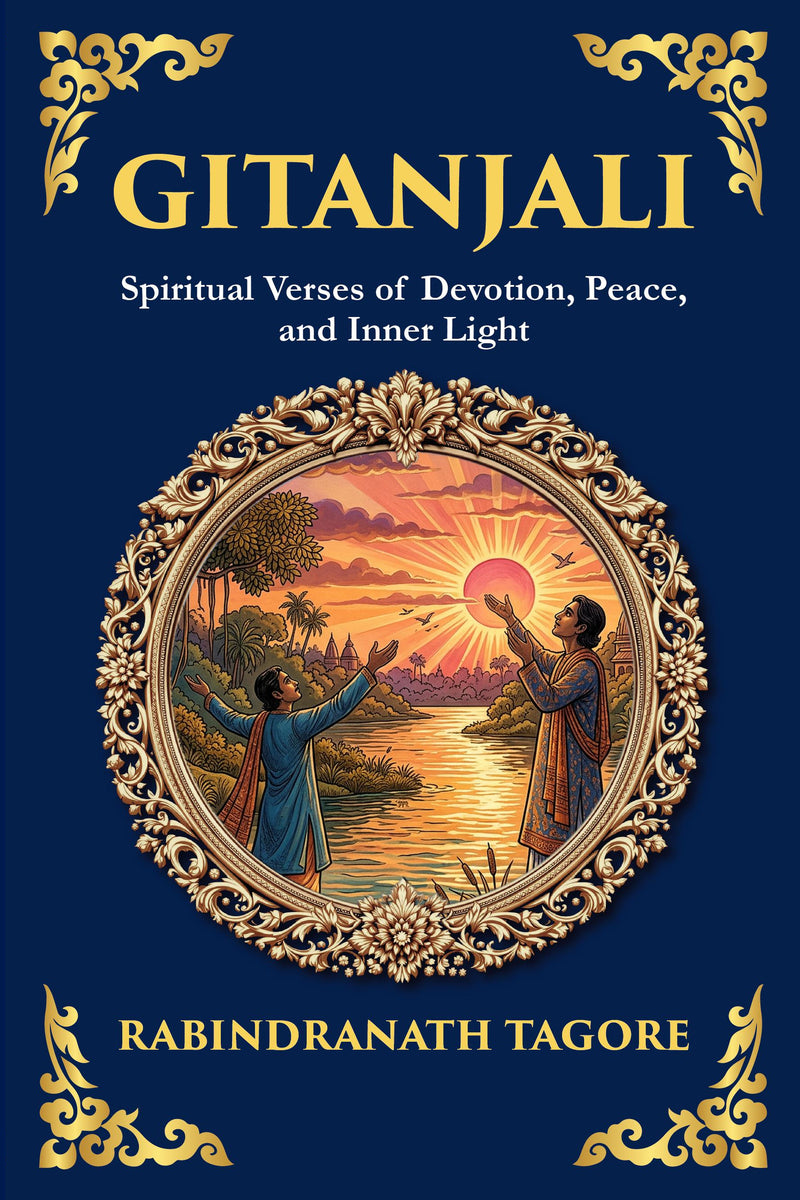
Gitanjali
A timeless offering of the soul, Gitanjali is a poetic masterpiece that transcends borders, languages, and religions. First published in 1910 and awarded the Nobel Prize in Literature in 1913, this collection of devotional songs invites readers into an intimate dialogue between the human spirit and the divine.
or free app
10,000+ hrs library
30-day guarantee
The complete Gitanjali appears in modern English through Library of Alexandria Press, available online with audiobook narration included for members.
Have you ever wondered why the soul longs for something beyond this world? In Gitanjali, Rabindranath Tagore opens the gates to the divine with a series of spiritual verses that speak directly to the soul. Written with deep reverence and lyrical beauty, this Nobel Prize- winning collection is not merely poetry—it is a sacred invocation of love, surrender, and unity with the Infinite.
Inspired by his Bengali heritage yet universal in theme, Tagore’s words reflect the yearning of every human heart to connect with the divine. Each poem pulses with sincerity, a quiet conversation with God, the universe, and the self. Whether offering praise, asking questions, or basking in silent wonder, the verses of Gitanjali illuminate the inner journey with clarity and peace.
This modern edition preserves the spiritual intensity and melodic essence of Tagore’s voice, bringing new readers into the presence of a mystic’s wisdom and a poet’s tender heart.
What you’ll discover in this modern edition
- in Gitanjali: Spiritual Verses of Devotion, Peace, and Inner Light:
- A Soulful Journey Through Devotional Poetry – Experience Tagore’s profound longing and divine connection in each verse.
- Themes of Humility, Faith, and Transcendence – Explore spiritual surrender and the beauty of divine presence in ordinary life.
- Lyrical Language with Universal Appeal – Discover why Tagore’s voice has touched hearts across cultures and centuries.
- An Accessible Modern Format – Designed to preserve the poetic rhythm while offering clarity to contemporary readers.
- A Literary Treasure from a Nobel Laureate – Celebrate the work that introduced Indian spiritual philosophy to the Western world.
| Formats | eBook (EPUB + PDF) · Audiobook · Paperback · Hardcover · Large Print |
| Language | English |
| Trim size (print) | 6 × 9 in |
| Binding | Paperback — perfect-bound · Hardcover — casewrap |
| Large Print edition | Same text in a larger, easy-read type — a larger font, not a larger trim |
| Print pricing | Every physical book at our true cost — at-cost, no profit (members) |
| Library | 873 restored titles, always growing |
| Length | 15,647 words · ~1 hr 3 min reading |
| Reading level | Grade 9 · a comfortable read (this modern-English edition) |
| Edition | Modern English translation · 2026 |
Member reviews for this edition are collected as readers finish it — be the first. Across the library: 12,000+ books shipped, every plan covered by a 365-day print guarantee.
About this edition
A faithful, unabridged modern-English edition by The Library of Alexandria — carefully rendered for today's reader and verified paragraph-by-paragraph against the public-domain source. Available as eBook, audiobook, paperback, hardcover, and large print.
- Complete & unabridgedVerified paragraph by paragraph against the source — never a scan, never abridged.
- Modern English, faithfulReadable today, with the author’s meaning kept intact. Readable — not simplified.
- Every format, one membershipRead in your browser or the free app, or listen to the full audiobook.
Included free with your membership
Cancel anytime, one click · 30-day money-back guarantee
Edition last updated July 2026
What’s inside
Gitanjali — complete and unabridged: all 60 sections included with membership, plus the full audiobook.
Begin reading Gitanjali
In clear modern English — the complete text is included with membership.
Introduction
There is a particular kind of book that does not announce itself. It does not arrive with the machinery of argument or the scaffolding of plot. It simply opens, and something in the reader shifts — quietly, the way light changes in a room when a cloud passes from the sun. Rabindranath Tagore’s Gitanjali is such a book. It is a collection of prose poems, or song offerings, drawn by the author himself from a much larger body of Bengali verse, and it has the quality — rare enough in any literature, rarer still across the distance of translation — of feeling simultaneously ancient and immediate, as though it had been written this morning by someone who has lived for a thousand years.
Tagore was born in Calcutta in 1861 into a family of extraordinary cultural vitality, and he died in 1941 having reshaped Bengali literature, music, education, and thought in ways that are still being measured. He was awarded the Nobel Prize in Literature in 1913, the first non-European writer to receive it, and the work that carried his name to Stockholm was, in large part, this very collection. Yet the Nobel Prize, for all its prestige, is perhaps the least interesting thing about him. What matters is the work itself: its tenderness, its intellectual courage, its refusal to separate the sacred from the sensory, the divine from the daily. What matters is that a man sat down and wrote poems about longing and arrival, about the soul’s restlessness and its rest, and that those poems have the power, more than a century later, to stop a reader mid-sentence and require them to sit quietly for a moment before continuing.
W. B. Yeats, who wrote the celebrated introduction to the first English edition published in 1912, described carrying the manuscript about with him for days — on railway trains, on omnibuses, in restaurants — and having to close it repeatedly lest strangers see how deeply it moved him. That response was not merely the enthusiasm of a great poet recognizing another. It was the recognition of something structurally different from what European literature had been doing: a tradition in which poetry and religion were not separate disciplines but a single practice, in which the metaphysical was not argued toward but sung toward, in which the highest philosophical thought had been carried back, generation by generation, to the common life of ordinary people. Yeats sensed that he was encountering not just a remarkable individual talent but the distilled expression of an entire civilization’s way of being in the world.
The civilization in question is Bengali, and the tradition is one that runs through centuries of devotional poetry, through the Upanishads and the Bhakti movement, through the particular spiritual atmosphere of the Brahmo Samaj, the reformist Hindu movement with which Tagore’s family was deeply associated. His father, known as the Maharshi, was a figure of considerable spiritual authority, and the household in which Tagore grew up was saturated with music, literature, and philosophical inquiry. None of this background is merely biographical decoration. It is the soil from which these poems grow, and understanding even a little of it helps the reader receive them more fully.
The most important thing to know before you begin is that this is not a book to be read quickly, and it is not a book to be read for information. It will give you nothing to summarize at a dinner party. It will not furnish you with a narrative to follow or a puzzle to solve. What it will do, if you allow it, is something more valuable and more difficult to describe: it will slow you down. It will create in you a quality of attention that most of us spend our days successfully avoiding.
Read one poem at a time, or at most two or three. Then stop. Let the language settle. These are not poems that reward the kind of reading we bring to novels or essays, the forward-leaning hunger for what comes next. They reward the opposite: a willingness to remain with what is already here. Tagore himself, by all accounts, was a man of extraordinary stillness, and that stillness is encoded in the poems. It is not the stillness of emptiness but of fullness — the stillness of a room in which everything necessary is already present.
You will notice, as you read, that the poems return again and again to a small set of images and relationships. There is a speaker and a presence — sometimes called the Lord, sometimes addressed as a king, sometimes as a friend, sometimes as a lover — and the relationship between them is the subject of the entire collection. This relationship is not static. It moves through longing and separation, through moments of sudden recognition, through the comedy of the soul’s distraction and the tenderness of its return. The emotional range is wider than it might first appear. There is humor here, and self-deprecation, and a kind of rueful honesty about the ways we busy ourselves with everything except what matters most. There is also joy of a very specific kind: not the joy of having arrived, but the joy of being on the way, of knowing that the journey itself is the destination’s first gift.
Do not be troubled if the theological vocabulary feels unfamiliar or if the devotional register seems distant from your own experience. Tagore is not asking you to adopt a creed. He is inviting you to recognize a feeling — the feeling of being alive in a world that exceeds your understanding, of loving something you cannot fully name, of sensing, in the most ordinary moments, a significance that ordinary language cannot quite hold. If you have ever stood at a window in early morning and felt, without being able to say why, that something was being offered to you, you already know the emotional territory of this book.
A word must be said about the language you are reading, because it matters more here than in most cases. The poems in this edition were translated into English by Tagore himself, a fact that is both remarkable and, in certain respects, complicated. He was working from his own Bengali originals, which means that no intermediary stood between the poet’s intention and the English rendering. He knew exactly what he meant. At the same time, the Bengali originals are, by all accounts, works of extraordinary metrical and musical sophistication — full of rhythmic subtleties and tonal colorings that simply cannot be carried across into prose English. What Tagore chose to do, rather than attempt a verse translation that might preserve some formal qualities at the cost of naturalness, was to render the poems as lyrical prose: fluid, cadenced, intimate, and deeply musical in its own way, even if the music is different from the original.
The result is a text that occupies an unusual position in world literature. It is a translation, but it is also an original work in English. It is prose, but it breathes like poetry. It is devotional writing, but it reads with the freshness of personal confession. Yeats recognized this quality immediately, noting that the work seemed simultaneously the product of supreme culture and the natural growth of common soil — as though it had not been composed at all but simply found, the way you find a stone in a riverbed that has been shaped by water into something perfect.
This edition presents Tagore’s own English text in contemporary spelling and punctuation, with light editorial adjustments made only where archaic usage might create unnecessary distance between the reader and the poem’s meaning. Nothing of substance has been altered. The aim throughout has been to honor the intimacy of the original while removing the small obstacles that time places between a text and its readers. Where Tagore’s phrasing is strange, it has been left strange, because the strangeness is often the point. Where it is simple, it has been left simple, because the simplicity is the achievement.
There is a passage in Yeats’s introduction — written, remember, by a man who was himself one of the great poets of the twentieth century — in which he describes what he believes Tagore represents. He speaks of a tradition in which the highest thought has been carried back to the multitude, in which the scholar and the beggar share a common imaginative inheritance, in which poetry is not a luxury or a specialty but the medium through which a whole civilization keeps its inner life awake. That is the civilization of the heart: a culture in which wisdom is not sealed inside institutions, but carried in songs, prayers, images, gestures, and ordinary speech. Gitanjali belongs to that civilization, and its greatness lies in how quietly it welcomes the reader into it. If you come to these poems with patience, you may find that they do not merely describe devotion; they teach the attention by which devotion becomes possible.
Tagore’s life helps explain the unusual breadth of the book without reducing its mystery. He grew up in the Jorasanko household of the Tagore family, one of the great centers of the Bengali cultural awakening. The house was alive with music, theater, poetry, painting, religious reform, and argument. His father, Debendranath Tagore, was a major figure in the Brahmo Samaj, and the atmosphere around the family joined spiritual seriousness to intellectual experiment. Tagore did not emerge from a narrow literary school. He emerged from a world in which art, devotion, education, social reform, and daily life constantly touched one another.
This matters because Gitanjali refuses the separations that modern readers often bring to literature. It is religious, but not in the manner of a doctrinal manual. It is philosophical, but not in the manner of an argument that proceeds by definitions. It is lyrical, but its lyricism is not an escape from the world. The poems return again and again to work, dust, roads, rivers, doors, lamps, children, servants, travelers, songs, waiting, and the daily movements of ordinary life. The divine is not locked away from these things. It is approached through them. Tagore’s great imaginative act is to make the soul’s longing feel as concrete as light on a floor.
The English Gitanjali occupies a special place in that achievement. Tagore did not simply hand his Bengali poems to another translator. He selected, reshaped, and rendered them himself as prose poems in English. That choice changed the music, and it necessarily altered the relation between the English text and the Bengali originals. Yet it also gave the English-speaking world a direct encounter with the poet’s own movement of thought. The result is spare, lucid, and strangely resonant. Its simplicity is not thinness. It is concentration. The sentences often seem to have been washed until only the essential gesture remains.
The circumstances of the book’s arrival in English have become part of literary history. William Rothenstein helped bring Tagore’s work to the attention of English readers, and W. B. Yeats responded with astonishment. Yeats’s introduction is valuable not merely because it gave the book prestige, but because it records the shock of recognition felt by a major poet encountering a voice from outside the expected European channels. He heard in Tagore a union of high culture and common song, of spiritual intensity and natural speech. That judgment may be colored by its time, but it still points to something real in the poems: they feel both cultivated and immediate.
In 1913 Tagore received the Nobel Prize in Literature, and Gitanjali stood at the center of the international recognition that followed. The prize made him famous in Europe and America, but fame also created misunderstandings. Some readers turned him into a vague emblem of eastern wisdom; others later reacted against that simplification. The poems deserve better than either worship or dismissal. They are not ornaments of exotic spirituality. They are exact, searching meditations on dependence, surrender, mortality, joy, service, and the difficulty of remaining awake to the presence one claims to seek.
Cancel anytime, one click · 30-day money-back guarantee
Founding annual rate available now — your price locks for life when you join.
Not ready? Get this free chapter by email — read it anytime.
✓ Sent — check your inbox for Gitanjali.
Questions about Gitanjali
What is Gitanjali about?
A timeless offering of the soul, Gitanjali is a poetic masterpiece that transcends borders, languages, and religions. First published in 1910 and awarded the Nobel Prize in Literature in 1913, this collection of devotional songs invites readers into an intimate dialogue between the human spirit and the divine. Through luminous verse, Tagore expresses longing, surrender, and joy in the presence of the eternal.
Who wrote Gitanjali?
Gitanjali was written by Rabindranath Tagore. This edition presents the complete work in clear modern English, faithfully rendered from the public-domain original by Library of Alexandria Press.
Is Gitanjali free to read?
The opening chapter is free to read on this page. Members read and listen to the complete work — and the entire library — free, and can order any physical book at our true print cost.
How long is Gitanjali?
60 chapters (~15,647 words) — about 1 hr 3 min of reading in this modern-English edition.
Is this an abridged version of Gitanjali?
No. This is the complete, unabridged Gitanjali, carefully rendered into clear modern English and verified paragraph-by-paragraph against the public-domain source — nothing is cut or summarised.
What formats does Gitanjali come in?
Gitanjali is available as eBook, paperback, hardcover and large print. eBook and audiobook are included with membership; printed editions ship at our true print cost.
Shipping & returns
Billing & membership
More from the library


Explore Poetry & Drama
- As You Like It · William Shakespeare
- The Raven · Edgar Allan Poe
- The Merchant of Venice · William Shakespeare
- A Midsummer Night’s Dream · William Shakespeare
- Romeo and Juliet · William Shakespeare
- The Imaginary Invalid · Molière
- A Woman of No Importance · Oscar Wilde
- Sonnets from the Portuguese · Elizabeth Barrett Browning
- The New Life (La Vita Nuova) · Dante Alighieri
- The Rime of the Ancient Mariner · Samuel Taylor Coleridge
- Lady Windermere’s Fan · Oscar Wilde
- The Home Book of Verse — Volume 4 · Burton Egbert Stevenson
- Ghosts · Henrik Ibsen
- Mrs. Warren’s Profession · Bernard Shaw
- An Enemy of the People · Henrik Ibsen
- Gawayne and the Green Knight: A Fairy Tale · Charlton M. Lewis
- The Nibelungenlied · G. H. Needler
- Julius Caesar · William Shakespeare
- The Aeneid of Virgil · Virgil
- Troilus and Criseyde · Geoffrey Chaucer
- The Post Office · Rabindranath Tagore
- Lamia · John Keats
- The Ballad of the White Horse · G. K. Chesterton
- A Shropshire Lad · A. E. Housman
- The Birth of the War-God: A Poem by Kalidasa · Kálidása
- Riders to the Sea · J. M. Synge
- The Prophet · Kahlil Gibran
- Twelfth Night; Or, What You Will · William Shakespeare
- Othello, the Moor of Venice · William Shakespeare
- Salomé: A Tragedy in One Act · Oscar Wilde
Gitanjali
Gitanjali
A Modern Translation
Rabindranath Tagore
Contents
- Introduction
- Poem 1
- Poem 2
- Poem 3
- Poem 4
- Poem 5
- Poem 6
- Poem 7
- Poem 8
- Poem 9
- Poem 10
- Poem 11
- Poem 12
- Poem 13
- Poem 14
- Poem 15
- Poem 16
- Poem 17
- Poem 18
- Poem 19
- Poem 20
- Poem 21
- Poem 22
- Poem 23
- Poem 24
- Poem 25
- Poem 26
- Poem 27
- Poem 28
- Poem 29
- Poem 30
- Poem 31
- Poem 32
- Poem 33
- Poem 34
- Poem 35
- Poem 36
- Poem 37
- Poem 38
- Poem 39
- … and 20 more chapters
Introduction
There is a particular kind of book that does not announce itself. It does not arrive with the machinery of argument or the scaffolding of plot. It simply opens, and something in the reader shifts — quietly, the way light changes in a room when a cloud passes from the sun. Rabindranath Tagore’s Gitanjali is such a book. It is a collection of prose poems, or song offerings, drawn by the author himself from a much larger body of Bengali verse, and it has the quality — rare enough in any literature, rarer still across the distance of translation — of feeling simultaneously ancient and immediate, as though it had been written this morning by someone who has lived for a thousand years.
Tagore was born in Calcutta in 1861 into a family of extraordinary cultural vitality, and he died in 1941 having reshaped Bengali literature, music, education, and thought in ways that are still being measured. He was awarded the Nobel Prize in Literature in 1913, the first non-European writer to receive it, and the work that carried his name to Stockholm was, in large part, this very collection. Yet the Nobel Prize, for all its prestige, is perhaps the least interesting thing about him. What matters is the work itself: its tenderness, its intellectual courage, its refusal to separate the sacred from the sensory, the divine from the daily. What matters is that a man sat down and wrote poems about longing and arrival, about the soul’s restlessness and its rest, and that those poems have the power, more than a century later, to stop a reader mid-sentence and require them to sit quietly for a moment before continuing.
W. B. Yeats, who wrote the celebrated introduction to the first English edition published in 1912, described carrying the manuscript about with him for days — on railway trains, on omnibuses, in restaurants — and having to close it repeatedly lest strangers see how deeply it moved him. That response was not merely the enthusiasm of a great poet recognizing another. It was the recognition of something structurally different from what European literature had been doing: a tradition in which poetry and religion were not separate disciplines but a single practice, in which the metaphysical was not argued toward but sung toward, in which the highest philosophical thought had been carried back, generation by generation, to the common life of ordinary people. Yeats sensed that he was encountering not just a remarkable individual talent but the distilled expression of an entire civilization’s way of being in the world.
The civilization in question is Bengali, and the tradition is one that runs through centuries of devotional poetry, through the Upanishads and the Bhakti movement, through the particular spiritual atmosphere of the Brahmo Samaj, the reformist Hindu movement with which Tagore’s family was deeply associated. His father, known as the Maharshi, was a figure of considerable spiritual authority, and the household in which Tagore grew up was saturated with music, literature, and philosophical inquiry. None of this background is merely biographical decoration. It is the soil from which these poems grow, and understanding even a little of it helps the reader receive them more fully.
The most important thing to know before you begin is that this is not a book to be read quickly, and it is not a book to be read for information. It will give you nothing to summarize at a dinner party. It will not furnish you with a narrative to follow or a puzzle to solve. What it will do, if you allow it, is something more valuable and more difficult to describe: it will slow you down. It will create in you a quality of attention that most of us spend our days successfully avoiding.
Read one poem at a time, or at most two or three. Then stop. Let the language settle. These are not poems that reward the kind of reading we bring to novels or essays, the forward-leaning hunger for what comes next. They reward the opposite: a willingness to remain with what is already here. Tagore himself, by all accounts, was a man of extraordinary stillness, and that stillness is encoded in the poems. It is not the stillness of emptiness but of fullness — the stillness of a room in which everything necessary is already present.
You will notice, as you read, that the poems return again and again to a small set of images and relationships. There is a speaker and a presence — sometimes called the Lord, sometimes addressed as a king, sometimes as a friend, sometimes as a lover — and the relationship between them is the subject of the entire collection. This relationship is not static. It moves through longing and separation, through moments of sudden recognition, through the comedy of the soul’s distraction and the tenderness of its return. The emotional range is wider than it might first appear. There is humor here, and self-deprecation, and a kind of rueful honesty about the ways we busy ourselves with everything except what matters most. There is also joy of a very specific kind: not the joy of having arrived, but the joy of being on the way, of knowing that the journey itself is the destination’s first gift.
Do not be troubled if the theological vocabulary feels unfamiliar or if the devotional register seems distant from your own experience. Tagore is not asking you to adopt a creed. He is inviting you to recognize a feeling — the feeling of being alive in a world that exceeds your understanding, of loving something you cannot fully name, of sensing, in the most ordinary moments, a significance that ordinary language cannot quite hold. If you have ever stood at a window in early morning and felt, without being able to say why, that something was being offered to you, you already know the emotional territory of this book.
A word must be said about the language you are reading, because it matters more here than in most cases. The poems in this edition were translated into English by Tagore himself, a fact that is both remarkable and, in certain respects, complicated. He was working from his own Bengali originals, which means that no intermediary stood between the poet’s intention and the English rendering. He knew exactly what he meant. At the same time, the Bengali originals are, by all accounts, works of extraordinary metrical and musical sophistication — full of rhythmic subtleties and tonal colorings that simply cannot be carried across into prose English. What Tagore chose to do, rather than attempt a verse translation that might preserve some formal qualities at the cost of naturalness, was to render the poems as lyrical prose: fluid, cadenced, intimate, and deeply musical in its own way, even if the music is different from the original.
The result is a text that occupies an unusual position in world literature. It is a translation, but it is also an original work in English. It is prose, but it breathes like poetry. It is devotional writing, but it reads with the freshness of personal confession. Yeats recognized this quality immediately, noting that the work seemed simultaneously the product of supreme culture and the natural growth of common soil — as though it had not been composed at all but simply found, the way you find a stone in a riverbed that has been shaped by water into something perfect.
This edition presents Tagore’s own English text in contemporary spelling and punctuation, with light editorial adjustments made only where archaic usage might create unnecessary distance between the reader and the poem’s meaning. Nothing of substance has been altered. The aim throughout has been to honor the intimacy of the original while removing the small obstacles that time places between a text and its readers. Where Tagore’s phrasing is strange, it has been left strange, because the strangeness is often the point. Where it is simple, it has been left simple, because the simplicity is the achievement.
There is a passage in Yeats’s introduction — written, remember, by a man who was himself one of the great poets of the twentieth century — in which he describes what he believes Tagore represents. He speaks of a tradition in which the highest thought has been carried back to the multitude, in which the scholar and the beggar share a common imaginative inheritance, in which poetry is not a luxury or a specialty but the medium through which a whole civilization keeps its inner life awake. That is the civilization of the heart: a culture in which wisdom is not sealed inside institutions, but carried in songs, prayers, images, gestures, and ordinary speech. Gitanjali belongs to that civilization, and its greatness lies in how quietly it welcomes the reader into it. If you come to these poems with patience, you may find that they do not merely describe devotion; they teach the attention by which devotion becomes possible.
Tagore’s life helps explain the unusual breadth of the book without reducing its mystery. He grew up in the Jorasanko household of the Tagore family, one of the great centers of the Bengali cultural awakening. The house was alive with music, theater, poetry, painting, religious reform, and argument. His father, Debendranath Tagore, was a major figure in the Brahmo Samaj, and the atmosphere around the family joined spiritual seriousness to intellectual experiment. Tagore did not emerge from a narrow literary school. He emerged from a world in which art, devotion, education, social reform, and daily life constantly touched one another.
This matters because Gitanjali refuses the separations that modern readers often bring to literature. It is religious, but not in the manner of a doctrinal manual. It is philosophical, but not in the manner of an argument that proceeds by definitions. It is lyrical, but its lyricism is not an escape from the world. The poems return again and again to work, dust, roads, rivers, doors, lamps, children, servants, travelers, songs, waiting, and the daily movements of ordinary life. The divine is not locked away from these things. It is approached through them. Tagore’s great imaginative act is to make the soul’s longing feel as concrete as light on a floor.
The English Gitanjali occupies a special place in that achievement. Tagore did not simply hand his Bengali poems to another translator. He selected, reshaped, and rendered them himself as prose poems in English. That choice changed the music, and it necessarily altered the relation between the English text and the Bengali originals. Yet it also gave the English-speaking world a direct encounter with the poet’s own movement of thought. The result is spare, lucid, and strangely resonant. Its simplicity is not thinness. It is concentration. The sentences often seem to have been washed until only the essential gesture remains.
The circumstances of the book’s arrival in English have become part of literary history. William Rothenstein helped bring Tagore’s work to the attention of English readers, and W. B. Yeats responded with astonishment. Yeats’s introduction is valuable not merely because it gave the book prestige, but because it records the shock of recognition felt by a major poet encountering a voice from outside the expected European channels. He heard in Tagore a union of high culture and common song, of spiritual intensity and natural speech. That judgment may be colored by its time, but it still points to something real in the poems: they feel both cultivated and immediate.
In 1913 Tagore received the Nobel Prize in Literature, and Gitanjali stood at the center of the international recognition that followed. The prize made him famous in Europe and America, but fame also created misunderstandings. Some readers turned him into a vague emblem of eastern wisdom; others later reacted against that simplification. The poems deserve better than either worship or dismissal. They are not ornaments of exotic spirituality. They are exact, searching meditations on dependence, surrender, mortality, joy, service, and the difficulty of remaining awake to the presence one claims to seek.
Where are you standing behind them all, my lover, hiding yourself in the shadows? They push you and pass you by on the dusty road, thinking you are nothing. I wait here for weary hours spreading out my offerings for you, while people passing by come and take my flowers one by one, and my basket is nearly empty.
The morning has passed, and so has the noon. In the shade of evening, my eyes are heavy with sleep. Men heading home glance at me and smile, filling me with shame. I sit like a beggar girl, pulling my skirt over my face, and when they ask me what I want, I look down and do not answer them.
Oh, how could I actually tell them that I am waiting for you, and that you promised to come? How could I admit, out of shame, that I keep this poverty as my dowry? Ah, I hold onto this pride in the secret of my heart.
I sit on the grass and gaze at the sky, dreaming of the sudden brilliance of your arrival—all the lights blazing, golden flags flying over your carriage, and the people at the roadside standing open-mouthed when they see you step down from your seat to lift me from the dust, and place this ragged beggar girl, trembling with shame and pride, by your side, like a vine in a summer breeze.
But time glides on and still there is no sound of your chariot wheels. Many processions pass by with noise, shouts, and the glamour of glory. Is it only you who would stand silent in the shadow behind them all? And only I who would wait and weep and wear out my heart in vain longing?
End of the free sample
Keep reading, free
Members read and listen to the complete book — and the entire library. Cancel anytime, one click · 30-day money-back guarantee.