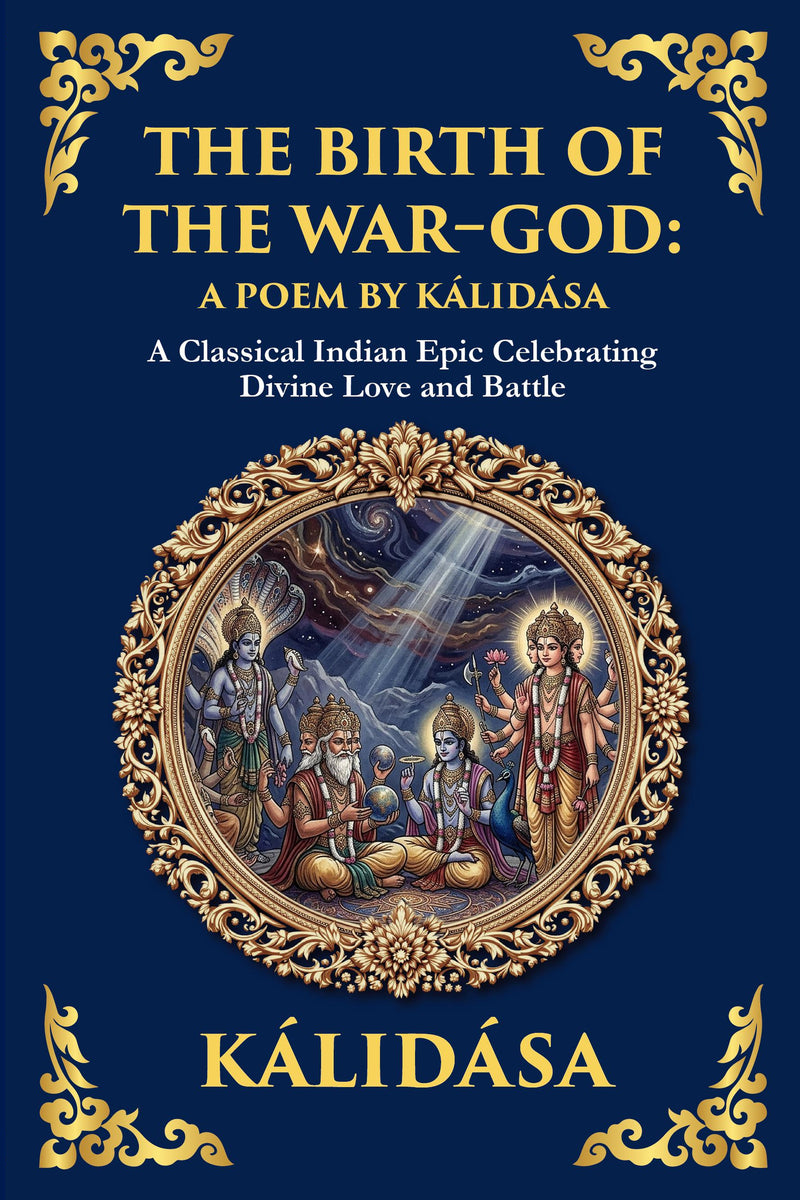
The Birth of the War-God: A Poem by Kalidasa
From one of ancient India’s greatest literary minds comes The Birth of the War-God, a poetic masterpiece that blends cosmic romance, divine destiny, and heroic action.
or free app
10,000+ hrs library
30-day guarantee
The complete The Birth of the War-God: A Poem by Kalidasa appears in modern English through Library of Alexandria Press, available online with audiobook narration included for members.
Have you ever wondered why love is the catalyst behind the greatest transformations— even among the gods? Kálidása’s The Birth of the War-God (Kumārasambhava) is a cornerstone of classical Indian poetry—a sweeping epic that tells the divine origin story of Kártikeya, born to conquer the demon Táraka and restore cosmic order. This masterful work, here presented in a beautifully rendered modern translation, balances philosophical depth with poetic grandeur.
The tale begins with a cosmic imbalance: the world plagued by the demon Táraka, invincible to all but the unborn son of Shiva. Yet Shiva has renounced the world, lost in divine meditation. It is Káma—the god of love—who dares to break Shiva’s trance by kindling desire through his flower-tipped arrows.
When Shiva’s wrath consumes Káma, the story unfolds into a saga of love reborn, penance rewarded, and war divinely ordained.
What you’ll discover in this modern edition
- A Mythic Love Story – Witness the passionate devotion of Parvati and her unwavering quest to win Shiva’s heart.
| Formats | eBook (EPUB + PDF) · Audiobook · Paperback · Hardcover · Large Print |
| Language | English |
| Trim size (print) | 6 × 9 in |
| Binding | Paperback — perfect-bound · Hardcover — casewrap |
| Large Print edition | Same text in a larger, easy-read type — a larger font, not a larger trim |
| Print pricing | Every physical book at our true cost — at-cost, no profit (members) |
| Library | 873 restored titles, always growing |
| Length | 24,238 words · ~1 hr 37 min reading |
| Reading level | Grade 10 · a comfortable read (this modern-English edition) |
| Edition | Modern English translation · 2026 |
Member reviews for this edition are collected as readers finish it — be the first. Across the library: 12,000+ books shipped, every plan covered by a 365-day print guarantee.
About this edition
A faithful, unabridged modern-English edition by The Library of Alexandria — carefully rendered for today's reader and verified paragraph-by-paragraph against the public-domain source. Available as eBook, audiobook, paperback, hardcover, and large print.
- Complete & unabridgedVerified paragraph by paragraph against the source — never a scan, never abridged.
- Modern English, faithfulReadable today, with the author’s meaning kept intact. Readable — not simplified.
- Every format, one membershipRead in your browser or the free app, or listen to the full audiobook.
Included free with your membership
Cancel anytime, one click · 30-day money-back guarantee
Edition last updated July 2026
What’s inside
The Birth of the War-God: A Poem by Kalidasa — complete and unabridged: all 8 sections included with membership, plus the full audiobook.
Begin reading The Birth of the War-God: A Poem by Kalidasa
In clear modern English — the complete text is included with membership.
Introduction
There are works of literature that arrive to us not merely as books but as inheritances—objects polished by centuries of devotion, recited in temple courtyards, copied by candlelight, memorized by students who would never set eyes on their distant author. The Birth of the War-God, known in its original Sanskrit as the Kumārasambhava, is one such inheritance. To open it is to step into a tradition of poetry that flourished in India more than fifteen hundred years ago, a tradition so refined in its sensibilities, so daring in its imagination, and so generous in its beauty that it continues to astonish readers who encounter it for the first time in any language. This poem is the crowning achievement of Kālidāsa, the writer whom posterity has crowned, without serious rival, as the supreme master of classical Sanskrit verse.
The modern reader approaching this poem deserves a few words of welcome and orientation. What you hold in your hands is an adaptation made with the contemporary reader in mind—an attempt to carry across the immense distance of time and language something of the original’s grandeur, its sensuous delight, its wit, and its spiritual seriousness. No translation can reproduce the full music of Kālidāsa’s Sanskrit, a language whose grammatical precision and acoustic richness allowed the poet to compress meaning, sound, and suggestion into a density that often defies replication. Yet the soul of the poem—its scenes of mountain landscapes and divine gardens, its portrait of love both yearning and triumphant, its meditation on the relationship between desire and discipline—survives the journey. The purpose of this introduction is to prepare you to receive it fully, to remove the small obstacles of unfamiliarity that might otherwise stand between you and your enjoyment, and to send you into the poem itself eager and unburdened.
We know remarkably little about Kālidāsa the man, and what we think we know is woven so thoroughly with legend that scholars have long since given up the hope of disentangling biography from myth. He left behind no diaries, no letters, no self-portrait in prose. What he left instead was a body of work so luminous that India has spent the better part of two millennia trying to imagine the person who could have produced it. The name itself—Kālidāsa—means “servant of Kālī,” the goddess, and one of the most beloved legends about him claims that he began life as an ignorant man, perhaps even a fool, who was transformed into a genius by the goddess’s grace. Whether or not we believe such stories, they tell us something true about the awe in which his gifts were held: only divine intervention, the legends seem to insist, could account for poetry this perfect.
Modern scholarship places Kālidāsa most plausibly in the fourth or fifth century of the common era, during or near the period of the Gupta Empire—a golden age of Indian civilization. This was a time of extraordinary cultural confidence, when the arts, the sciences, mathematics, astronomy, and literature all flourished under royal patronage and a stable, prosperous society. It is tempting, and probably correct, to see in Kālidāsa’s work the spirit of that age: an art that is at once sophisticated and serene, intricate and harmonious, deeply rooted in religious tradition yet brimming with a frankly worldly delight in beauty, love, and the pleasures of the senses. He is traditionally counted among the “nine gems” said to have adorned the court of a legendary King Vikramāditya, and though the historical reality behind that tradition is murky, the association captures the truth that Kālidāsa was a poet of the court—a writer whose audience was cultivated, learned, and intensely appreciative of literary refinement.
His surviving works are few but each is a masterpiece. He wrote plays, including the celebrated Shakuntala, which when it was first translated into European languages in the eighteenth century caused a sensation among the Romantic writers of Europe—Goethe famously praised it in rapturous terms. He wrote lyric poetry, including the Meghadūta, or “The Cloud Messenger,” a poem of exquisite longing in which an exiled spirit asks a passing cloud to carry a message of love to his distant wife. And he wrote two great narrative poems, the Raghuvamsha, which traces the dynasty of King Rāma’s ancestors, and the Kumārasambhava, the poem you are about to read. In every genre he touched, he set a standard that later poets would strive toward and rarely match. To Indian literary tradition, Kālidāsa is not simply one great poet among many; he is the measure against which greatness itself is defined. There is an old Sanskrit verse that, asked to rank the poets, places Kālidāsa first—and then, finding no one worthy of second place, leaves the rest of the list empty.
The world Kālidāsa wrote within was one in which poetry was governed by an elaborate and consciously cultivated set of aesthetic principles. Sanskrit literary theory developed a sophisticated vocabulary for discussing the effects that poetry should produce, centered on the concept of rasa—a word that literally means “juice,” “sap,” or “flavor,” but which came to mean the distilled emotional essence that a work of art evokes in a sensitive audience. A poem might be suffused with the rasa of love, of heroism, of compassion, of wonder, of the comic, or of the peaceful. The reader’s pleasure lay in tasting this essence, in having a refined emotional response awakened and elevated by the artistry of the poet. Kālidāsa was a master of rasa, and The Birth of the War-God moves with extraordinary skill among several of these flavors—the erotic and the tender, the awesome and the sublime, the meditative and the martial. Understanding that the poem is designed to make you feel, and to make you savor the feeling, is perhaps the single most useful key to enjoying it as its first audiences did.
It is also worth knowing that classical Sanskrit poetry of this kind, called kāvya, prized ornamentation in a way that can initially surprise readers accustomed to the plain styles favored in much modern writing. The poets of this tradition delighted in elaborate similes, in extended metaphors, in plays on words, in the precise observation of nature, and in the layering of meaning so that a single verse might be read in multiple ways at once. This is not decoration for its own sake; it is the very substance of the art. A great Sanskrit poet does not simply tell you that a woman is beautiful—he shows you her beauty through a cascade of comparisons drawn from the moon, the lotus, the swan, the deer, and the vine, each comparison illuminating a different facet of her grace. When you encounter such passages in this poem, the invitation is not to rush past them in search of “the plot” but to linger, as a connoisseur lingers over a fine wine, allowing each image to bloom in the mind. The reward for slow reading here is immense.
The title of the poem announces its subject plainly: it concerns the birth of a war-god. To appreciate why such a birth should be the occasion for one of the greatest poems ever written, the modern reader needs a small amount of background in the mythological world the poem inhabits—background that Kālidāsa’s original audience would have absorbed almost with their mother’s milk, but that may be unfamiliar to those coming from other cultural traditions. I will offer this background carefully, taking pains not to spoil the unfolding of the poem itself, for much of its pleasure lies in watching the great events arrive in their proper order, clothed in Kālidāsa’s incomparable language.
At the center of the poem stands the great god Shiva, one of the supreme deities of the Hindu tradition. Shiva is a figure of magnificent paradox. He is the cosmic ascetic, the lord of yogis, who sits in deep meditation upon the snowy heights of the Himalaya, withdrawn from the world, his passions mastered, his consciousness absorbed in the infinite. Ash smears his body; serpents coil about him; the crescent moon adorns his matted hair. He is the destroyer in the great triad of creation, preservation, and destruction—but his destruction is also transformation, the necessary dissolution that makes renewal possible. And yet this same austere god is also the great householder, the passionate lover, the divine husband whose union with his consort represents the fundamental creative principle of the universe. The tension between Shiva the ascetic and Shiva the lover is one of the deepest themes of Indian mythology, and it lies at the very heart of this poem.
Opposite Shiva stands the goddess, here in the form of Pārvatī, whose name means “Daughter of the Mountain.” She is the child of the Himalaya itself—for in this tradition the great mountain is not merely a place but a living, divine presence, a king among the peaks. Pārvatī is the goddess in her gentle, beautiful, devoted aspect, and her destiny is bound up with Shiva’s in ways that the poem will reveal. The love between Shiva and Pārvatī is no ordinary romance; it is a cosmic event, a union upon which the welfare of the universe itself depends. For there is a crisis among the gods, a threat that menaces the very order of the heavens, and the resolution of that crisis requires the birth of a particular child—a warrior who can be born only from the union of these two divine beings.
This child is Kumāra, also known as Kārttikeya or Skanda, the war-god whose coming the title promises. In the broader sweep of Hindu mythology, he is the radiant young general of the celestial armies, destined to lead the gods to victory against the forces that besiege them. His birth is, in the cosmic scheme, an act of salvation. And so the poem’s apparent subject—a love story, a courtship between a god and a goddess—is revealed to carry within it the gravest of stakes. The intimate and the universal are fused: the tender awakening of love between two beings becomes the hinge upon which the fate of all creation turns.
What makes Kālidāsa’s treatment of this material so extraordinary is the way he honors both registers at once. He never loses sight of the cosmic dimension, the sense that we are witnessing events of world-shaping importance. Yet he also brings to the story a psychological intimacy, a delicacy of feeling, an attentiveness to the small gestures and inward movements of the heart that makes his divine characters feel vividly, achingly alive. When Pārvatī falls in love, we feel the trembling of a real heart. When obstacles arise, we feel the genuine pain of longing and the genuine sweetness of hope. Kālidāsa understood, as the greatest writers always have, that grand themes touch us most deeply when they are embodied in particular, recognizable, human experience. His gods love and suffer and hope in ways we recognize as our own, even as they move through a landscape of pure myth.
The poem also dramatizes one of the most resonant ideas in Indian thought: the relationship between kāma, desire or love, and tapas, the heat of spiritual austerity and self-discipline. These two forces might seem opposed—the indulgence of desire against the renunciation of it—and indeed the poem contains a famous and consequential encounter between them. But Kālidāsa’s vision is more subtle than any simple opposition. He explores how desire and discipline can be woven together, how the longing of love can itself become a kind of austerity, a transformative fire, and how the highest love is not the easy gratification of appetite but a love that has been tested, purified, and earned through devotion and patient endurance. This is a poem about the dignity of desire when it is joined to discipline and directed toward a worthy end. For the modern reader, this meditation may prove one of the most surprisingly contemporary aspects of an ancient text—a reflection on how we discipline and ennoble our own deepest yearnings.
A word about the structure and the question of authorship is in order, again without spoiling the experience to come. The Kumārasambhava as it has come down to us comprises a number of cantos—self-contained chapters, each with its own movement and emphasis. Scholars have long debated how many of these cantos Kālidāsa himself composed, with a strong traditional view holding that the early cantos represent his authentic work at its finest, while certain later ones may be additions by other hands. The reader need not be troubled by these scholarly questions. What matters is that the poem offers a complete and satisfying arc, carrying us from the introduction of its great mountain setting, through the awakening and trials of love, toward the resolution that the title has promised from the beginning. Each canto rewards attention on its own terms, and the cumulative effect is one of mounting splendor.
Cancel anytime, one click · 30-day money-back guarantee
Founding annual rate available now — your price locks for life when you join.
Not ready? Get this free chapter by email — read it anytime.
✓ Sent — check your inbox for The Birth of the War-God: A Poem by Kalidasa.
Questions about The Birth of the War-God: A Poem by Kalidasa
What is The Birth of the War-God: A Poem by Kalidasa about?
From one of ancient India’s greatest literary minds comes The Birth of the War-God, a poetic masterpiece that blends cosmic romance, divine destiny, and heroic action. In this enchanting Sanskrit epic, the god of love, Káma, dares to awaken Shiva from ascetic stillness to unite him with Parvati—thus bringing forth Kártikeya, the warrior god destined to defeat evil. Steeped in rich imagery and lyrical elegance, this translation breathes new life into Kálidása’s vision of celestial passion and the birth of a divine s
Who wrote The Birth of the War-God: A Poem by Kalidasa?
The Birth of the War-God: A Poem by Kalidasa was written by Kálidása. This edition presents the complete work in clear modern English, faithfully rendered from the public-domain original by Library of Alexandria Press.
Is The Birth of the War-God: A Poem by Kalidasa free to read?
The opening chapter is free to read on this page. Members read and listen to the complete work — and the entire library — free, and can order any physical book at our true print cost.
How long is The Birth of the War-God: A Poem by Kalidasa?
8 chapters (~24,238 words) — about 1 hr 37 min of reading in this modern-English edition.
Is this an abridged version of The Birth of the War-God: A Poem by Kalidasa?
No. This is the complete, unabridged The Birth of the War-God: A Poem by Kalidasa, carefully rendered into clear modern English and verified paragraph-by-paragraph against the public-domain source — nothing is cut or summarised.
What formats does The Birth of the War-God: A Poem by Kalidasa come in?
The Birth of the War-God: A Poem by Kalidasa is available as eBook, paperback, hardcover and large print. eBook and audiobook are included with membership; printed editions ship at our true print cost.
Shipping & returns
Billing & membership
More from the library


Explore Myths & Legends
- The Red Fairy Book · Andrew Lang
- Vikram and the Vampire: Classic Hindu Tales of Adventure, Magic, and Romance · Unknown
- The Initiates of the Flame · Manly P. Hall
- Gawayne and the Green Knight: A Fairy Tale · Charlton M. Lewis
- The Nibelungenlied · G. H. Needler
- The Aeneid of Virgil · Virgil
- Fifty Famous Stories Retold · James Baldwin
- West African Folk-Tales
- Lamia · John Keats
- The Three Bears · A. E. Kennedy
- The Ballad of the White Horse · G. K. Chesterton
- The Danish History, Books I–IX · Saxo Grammaticus
- Andersen’s Fairy Tales · H. C. Andersen
- Folk-Tales of Bengal · Lal Behari Day
- Omens and Superstitions of Southern India · Edgar Thurston
- The Legend of Sleepy Hollow · Washington Irving
- The Hyborian Age · Robert E. Howard
- The Odyssey · Homer
- Grimms’ Fairy Tales · Jacob Grimm and Wilhelm Grimm
- Just So Stories · Rudyard Kipling
- Aeschylus’ Prometheus Bound and the Seven Against Thebes · Aeschylus
- The Iliad · Homer
The Birth of the War-God: A Poem by Kalidasa
The Birth of the War-God: A Poem by Kalidasa
A Classical Indian Epic Celebrating Divine Love and Battle
Kálidása
Contents
- Introduction
- Canto 1
- Canto 2
- Canto 3
- Canto 4
- Canto 5
- Canto 6
- Canto 7
Introduction
There are works of literature that arrive to us not merely as books but as inheritances—objects polished by centuries of devotion, recited in temple courtyards, copied by candlelight, memorized by students who would never set eyes on their distant author. The Birth of the War-God, known in its original Sanskrit as the Kumārasambhava, is one such inheritance. To open it is to step into a tradition of poetry that flourished in India more than fifteen hundred years ago, a tradition so refined in its sensibilities, so daring in its imagination, and so generous in its beauty that it continues to astonish readers who encounter it for the first time in any language. This poem is the crowning achievement of Kālidāsa, the writer whom posterity has crowned, without serious rival, as the supreme master of classical Sanskrit verse.
The modern reader approaching this poem deserves a few words of welcome and orientation. What you hold in your hands is an adaptation made with the contemporary reader in mind—an attempt to carry across the immense distance of time and language something of the original’s grandeur, its sensuous delight, its wit, and its spiritual seriousness. No translation can reproduce the full music of Kālidāsa’s Sanskrit, a language whose grammatical precision and acoustic richness allowed the poet to compress meaning, sound, and suggestion into a density that often defies replication. Yet the soul of the poem—its scenes of mountain landscapes and divine gardens, its portrait of love both yearning and triumphant, its meditation on the relationship between desire and discipline—survives the journey. The purpose of this introduction is to prepare you to receive it fully, to remove the small obstacles of unfamiliarity that might otherwise stand between you and your enjoyment, and to send you into the poem itself eager and unburdened.
We know remarkably little about Kālidāsa the man, and what we think we know is woven so thoroughly with legend that scholars have long since given up the hope of disentangling biography from myth. He left behind no diaries, no letters, no self-portrait in prose. What he left instead was a body of work so luminous that India has spent the better part of two millennia trying to imagine the person who could have produced it. The name itself—Kālidāsa—means “servant of Kālī,” the goddess, and one of the most beloved legends about him claims that he began life as an ignorant man, perhaps even a fool, who was transformed into a genius by the goddess’s grace. Whether or not we believe such stories, they tell us something true about the awe in which his gifts were held: only divine intervention, the legends seem to insist, could account for poetry this perfect.
Modern scholarship places Kālidāsa most plausibly in the fourth or fifth century of the common era, during or near the period of the Gupta Empire—a golden age of Indian civilization. This was a time of extraordinary cultural confidence, when the arts, the sciences, mathematics, astronomy, and literature all flourished under royal patronage and a stable, prosperous society. It is tempting, and probably correct, to see in Kālidāsa’s work the spirit of that age: an art that is at once sophisticated and serene, intricate and harmonious, deeply rooted in religious tradition yet brimming with a frankly worldly delight in beauty, love, and the pleasures of the senses. He is traditionally counted among the “nine gems” said to have adorned the court of a legendary King Vikramāditya, and though the historical reality behind that tradition is murky, the association captures the truth that Kālidāsa was a poet of the court—a writer whose audience was cultivated, learned, and intensely appreciative of literary refinement.
His surviving works are few but each is a masterpiece. He wrote plays, including the celebrated Shakuntala, which when it was first translated into European languages in the eighteenth century caused a sensation among the Romantic writers of Europe—Goethe famously praised it in rapturous terms. He wrote lyric poetry, including the Meghadūta, or “The Cloud Messenger,” a poem of exquisite longing in which an exiled spirit asks a passing cloud to carry a message of love to his distant wife. And he wrote two great narrative poems, the Raghuvamsha, which traces the dynasty of King Rāma’s ancestors, and the Kumārasambhava, the poem you are about to read. In every genre he touched, he set a standard that later poets would strive toward and rarely match. To Indian literary tradition, Kālidāsa is not simply one great poet among many; he is the measure against which greatness itself is defined. There is an old Sanskrit verse that, asked to rank the poets, places Kālidāsa first—and then, finding no one worthy of second place, leaves the rest of the list empty.
The world Kālidāsa wrote within was one in which poetry was governed by an elaborate and consciously cultivated set of aesthetic principles. Sanskrit literary theory developed a sophisticated vocabulary for discussing the effects that poetry should produce, centered on the concept of rasa—a word that literally means “juice,” “sap,” or “flavor,” but which came to mean the distilled emotional essence that a work of art evokes in a sensitive audience. A poem might be suffused with the rasa of love, of heroism, of compassion, of wonder, of the comic, or of the peaceful. The reader’s pleasure lay in tasting this essence, in having a refined emotional response awakened and elevated by the artistry of the poet. Kālidāsa was a master of rasa, and The Birth of the War-God moves with extraordinary skill among several of these flavors—the erotic and the tender, the awesome and the sublime, the meditative and the martial. Understanding that the poem is designed to make you feel, and to make you savor the feeling, is perhaps the single most useful key to enjoying it as its first audiences did.
It is also worth knowing that classical Sanskrit poetry of this kind, called kāvya, prized ornamentation in a way that can initially surprise readers accustomed to the plain styles favored in much modern writing. The poets of this tradition delighted in elaborate similes, in extended metaphors, in plays on words, in the precise observation of nature, and in the layering of meaning so that a single verse might be read in multiple ways at once. This is not decoration for its own sake; it is the very substance of the art. A great Sanskrit poet does not simply tell you that a woman is beautiful—he shows you her beauty through a cascade of comparisons drawn from the moon, the lotus, the swan, the deer, and the vine, each comparison illuminating a different facet of her grace. When you encounter such passages in this poem, the invitation is not to rush past them in search of “the plot” but to linger, as a connoisseur lingers over a fine wine, allowing each image to bloom in the mind. The reward for slow reading here is immense.
The title of the poem announces its subject plainly: it concerns the birth of a war-god. To appreciate why such a birth should be the occasion for one of the greatest poems ever written, the modern reader needs a small amount of background in the mythological world the poem inhabits—background that Kālidāsa’s original audience would have absorbed almost with their mother’s milk, but that may be unfamiliar to those coming from other cultural traditions. I will offer this background carefully, taking pains not to spoil the unfolding of the poem itself, for much of its pleasure lies in watching the great events arrive in their proper order, clothed in Kālidāsa’s incomparable language.
At the center of the poem stands the great god Shiva, one of the supreme deities of the Hindu tradition. Shiva is a figure of magnificent paradox. He is the cosmic ascetic, the lord of yogis, who sits in deep meditation upon the snowy heights of the Himalaya, withdrawn from the world, his passions mastered, his consciousness absorbed in the infinite. Ash smears his body; serpents coil about him; the crescent moon adorns his matted hair. He is the destroyer in the great triad of creation, preservation, and destruction—but his destruction is also transformation, the necessary dissolution that makes renewal possible. And yet this same austere god is also the great householder, the passionate lover, the divine husband whose union with his consort represents the fundamental creative principle of the universe. The tension between Shiva the ascetic and Shiva the lover is one of the deepest themes of Indian mythology, and it lies at the very heart of this poem.
Opposite Shiva stands the goddess, here in the form of Pārvatī, whose name means “Daughter of the Mountain.” She is the child of the Himalaya itself—for in this tradition the great mountain is not merely a place but a living, divine presence, a king among the peaks. Pārvatī is the goddess in her gentle, beautiful, devoted aspect, and her destiny is bound up with Shiva’s in ways that the poem will reveal. The love between Shiva and Pārvatī is no ordinary romance; it is a cosmic event, a union upon which the welfare of the universe itself depends. For there is a crisis among the gods, a threat that menaces the very order of the heavens, and the resolution of that crisis requires the birth of a particular child—a warrior who can be born only from the union of these two divine beings.
This child is Kumāra, also known as Kārttikeya or Skanda, the war-god whose coming the title promises. In the broader sweep of Hindu mythology, he is the radiant young general of the celestial armies, destined to lead the gods to victory against the forces that besiege them. His birth is, in the cosmic scheme, an act of salvation. And so the poem’s apparent subject—a love story, a courtship between a god and a goddess—is revealed to carry within it the gravest of stakes. The intimate and the universal are fused: the tender awakening of love between two beings becomes the hinge upon which the fate of all creation turns.
What makes Kālidāsa’s treatment of this material so extraordinary is the way he honors both registers at once. He never loses sight of the cosmic dimension, the sense that we are witnessing events of world-shaping importance. Yet he also brings to the story a psychological intimacy, a delicacy of feeling, an attentiveness to the small gestures and inward movements of the heart that makes his divine characters feel vividly, achingly alive. When Pārvatī falls in love, we feel the trembling of a real heart. When obstacles arise, we feel the genuine pain of longing and the genuine sweetness of hope. Kālidāsa understood, as the greatest writers always have, that grand themes touch us most deeply when they are embodied in particular, recognizable, human experience. His gods love and suffer and hope in ways we recognize as our own, even as they move through a landscape of pure myth.
The poem also dramatizes one of the most resonant ideas in Indian thought: the relationship between kāma, desire or love, and tapas, the heat of spiritual austerity and self-discipline. These two forces might seem opposed—the indulgence of desire against the renunciation of it—and indeed the poem contains a famous and consequential encounter between them. But Kālidāsa’s vision is more subtle than any simple opposition. He explores how desire and discipline can be woven together, how the longing of love can itself become a kind of austerity, a transformative fire, and how the highest love is not the easy gratification of appetite but a love that has been tested, purified, and earned through devotion and patient endurance. This is a poem about the dignity of desire when it is joined to discipline and directed toward a worthy end. For the modern reader, this meditation may prove one of the most surprisingly contemporary aspects of an ancient text—a reflection on how we discipline and ennoble our own deepest yearnings.
A word about the structure and the question of authorship is in order, again without spoiling the experience to come. The Kumārasambhava as it has come down to us comprises a number of cantos—self-contained chapters, each with its own movement and emphasis. Scholars have long debated how many of these cantos Kālidāsa himself composed, with a strong traditional view holding that the early cantos represent his authentic work at its finest, while certain later ones may be additions by other hands. The reader need not be troubled by these scholarly questions. What matters is that the poem offers a complete and satisfying arc, carrying us from the introduction of its great mountain setting, through the awakening and trials of love, toward the resolution that the title has promised from the beginning. Each canto rewards attention on its own terms, and the cumulative effect is one of mounting splendor.
Far to the north, the Himálaya mountains rise high
His towering peaks reach up until they pierce the sky,
Stretching across the vast land from the eastern to the western sea,
The ruler of the mountains, filled with a divine spirit.
Long ago, when Prithu reigned over the world,
The fertile earth, overflowing with gold and precious gems,
Along with the lesser hills and Mount Meru, gave up her treasures,
To adorn the Himalayas, because they loved him most;
And the earth, like a mother, shared her riches to fill
The royal mountain with medicinal herbs and shimmering minerals.
Proud king of mountains! His crown of white snow
Does not hide the beauty of the jewels beneath.
To mark one spot less brightly glorious there?
a single flaw in a hero’s reputation when he has a thousand virtues?
Often, when the reflections from the mountain’s copper peaks
flash through the clouds and color them as they drift by,
those brilliant lights outshine the colors of the sunset,
and the playful spirits of heaven welcome their time to play;
they test the magic of their gaze before the time arrives,
and dress up in their finest for the twilight dance.
The spirits love the cool shadows created
by dark clouds drifting around the mountain’s waist,
Till frightened by the storm and rain they seek
The wilderness stretches far, where determined hunters wander,
following the lion back to his gloomy den.
Even though the melting snow has rinsed away
the bright red blood of the injured prey,
the beautiful ivory tusks on the ground still reveal
where the powerful elephant was defeated and fell,
and since they are still stuck in the lion’s claws, they show
End of the free sample
Keep reading, free
Members read and listen to the complete book — and the entire library. Cancel anytime, one click · 30-day money-back guarantee.