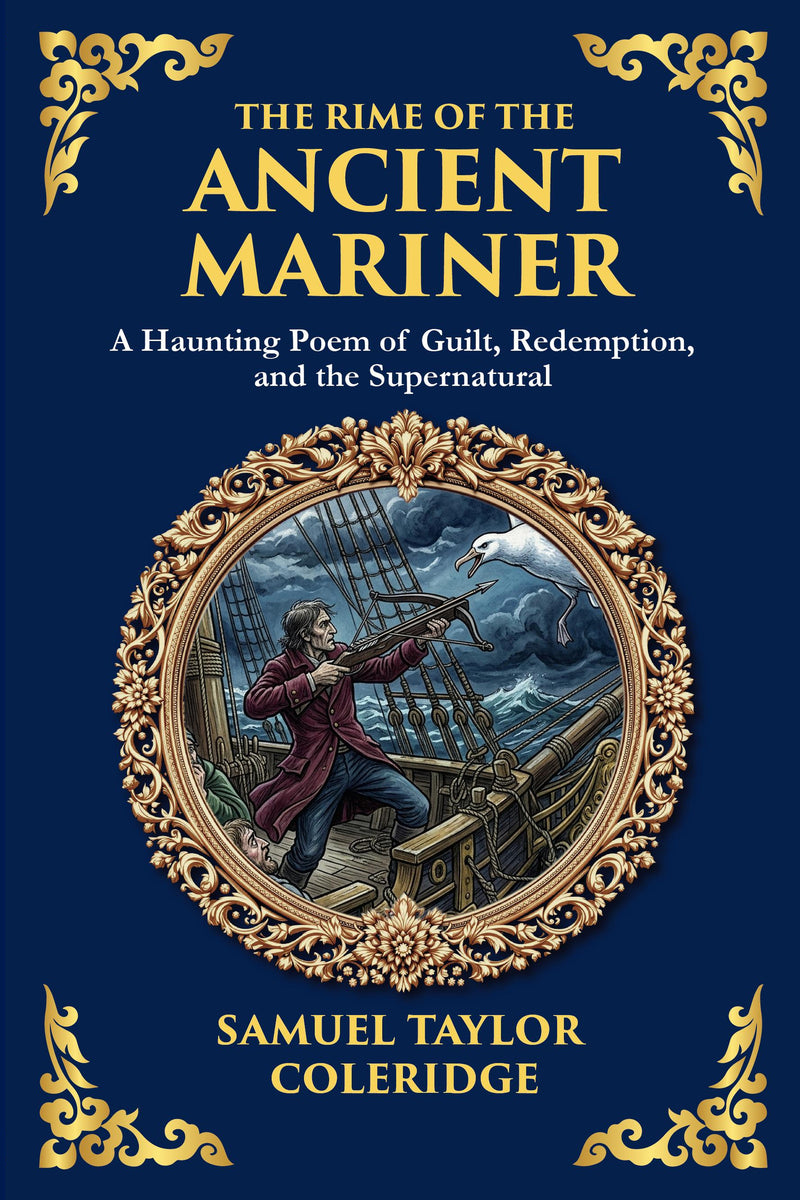
The Rime of the Ancient Mariner
A cursed sailor, a slain albatross, and a voyage through spectral seas—Samuel Taylor Coleridge’s The Rime of the Ancient Mariner is a spellbinding poetic masterpiece of penance and supernatural horror.
or free app
10,000+ hrs library
30-day guarantee
The complete The Rime of the Ancient Mariner appears in modern English through Library of Alexandria Press, available online with audiobook narration included for members.
Have you ever wondered why one man’s curse became a timeless lesson on the sanctity of life? The Rime of the Ancient Mariner is not just a poem—it is an enduring voyage into the depths of the human soul. Penned by Samuel Taylor Coleridge in the late 18th century, this foundational work of English Romanticism has captivated readers for centuries with its hypnotic rhythm, haunting imagery, and profound moral themes.
Through the unforgettable voice of the Ancient Mariner, Coleridge explores the devastating consequences of a thoughtless act: the killing of an albatross. What follows is a surreal journey across storm-tossed seas, ghost ships, deathlike stillness, and eerie resurrection—a poetic parable of nature’s retribution and the spiritual torment of a man seeking absolution. This edition presents the full original text in its majestic form, making it accessible for modern readers while preserving the beauty and intensity of Coleridge’s vision.
What you’ll discover in this modern edition
- A Visionary Tale of Guilt and Redemption – Follow the Mariner’s psychological descent and spiritual rebirth
- Poetic Supernatural Imagery – Encounter ghostly ships, spectral figures, and divine forces that shape the sailor’s fate
- A Turning Point in English Literature – Understand why this poem is heralded as the beginning of English Romantic poetry
- Lessons on the Sacredness of Life and Nature – Reflect on the poem’s message of ecological reverence and human responsibility
- A Mesmerizing Narrative Poem – Experience the pull of Coleridge’s masterful language and epic storytelling voice
| Formats | eBook (EPUB + PDF) · Audiobook · Paperback · Hardcover · Large Print |
| Language | English |
| Trim size (print) | 6 × 9 in |
| Binding | Paperback — perfect-bound · Hardcover — casewrap |
| Large Print edition | Same text in a larger, easy-read type — a larger font, not a larger trim |
| Print pricing | Every physical book at our true cost — at-cost, no profit (members) |
| Library | 873 restored titles, always growing |
| Length | 7,555 words · ~30 min reading |
| Reading level | Grade 9 · a comfortable read (this modern-English edition) |
| Edition | Modern English translation · 2026 |
Member reviews for this edition are collected as readers finish it — be the first. Across the library: 12,000+ books shipped, every plan covered by a 365-day print guarantee.
About this edition
A faithful, unabridged modern-English edition by The Library of Alexandria — carefully rendered for today's reader and verified paragraph-by-paragraph against the public-domain source. Available as eBook, audiobook, paperback, hardcover, and large print.
- Complete & unabridgedVerified paragraph by paragraph against the source — never a scan, never abridged.
- Modern English, faithfulReadable today, with the author’s meaning kept intact. Readable — not simplified.
- Every format, one membershipRead in your browser or the free app, or listen to the full audiobook.
Included free with your membership
Cancel anytime, one click · 30-day money-back guarantee
Edition last updated July 2026
What’s inside
The Rime of the Ancient Mariner — complete and unabridged: all 8 sections included with membership, plus the full audiobook.
Begin reading The Rime of the Ancient Mariner
In clear modern English — the complete text is included with membership.
Introduction
When Samuel Taylor Coleridge sat down with his friend William Wordsworth in the autumn of 1797, walking the windswept hills of Somerset and dreaming up a collection of poems that would change the course of English literature, neither man could have imagined that one of those poems would still grip readers more than two centuries later. The poem in question—a strange, hypnotic ballad about a sailor cursed by a single thoughtless act—would become not merely the centerpiece of their revolutionary collection but one of the most enduring works of imaginative literature ever composed in the English language. It is a poem that has haunted the dreams of countless readers, inspired generations of artists and writers, and embedded itself so deeply in our cultural consciousness that even those who have never read a line of it know the image of the dead bird hung about a sailor’s neck.
This modern translation has been prepared with a single purpose in mind: to remove the barriers that time has placed between Coleridge’s astonishing vision and the contemporary reader, while preserving every ounce of the eerie, spellbinding power that has made this work immortal. What follows in these pages is a story of the sea, of solitude, of an unforgivable crime and the long, terrible road toward something resembling forgiveness. It is a tale told by a man who cannot stop telling it, who seizes a stranger by the arm and holds him with a glittering eye, compelling him to listen whether he wishes to or not. By the time you reach the final lines, you may find that you, too, have been held captive—that you have become, in a sense, the listener who cannot turn away.
A Poem Born from Friendship, Walking, and the Edge of a Dream
To understand the extraordinary circumstances that gave birth to this poem, we must travel back to the closing years of the eighteenth century, to a moment when two young poets were searching for a new way to write. Coleridge was in his mid-twenties, a man of dazzling intellect and restless energy, whose conversation could hold a room spellbound for hours and whose mind ranged across philosophy, theology, science, and metaphysics with equal hunger. He had recently formed a deep and creatively intoxicating friendship with William Wordsworth, who had settled with his sister Dorothy nearby in the Quantock Hills. The three of them walked for miles through the countryside, talking endlessly, sharing ideas, and building between them the foundations of what we now call English Romanticism.
The idea for the poem emerged, as so many great ideas do, almost by accident. The two poets had conceived a plan to write a piece together to help pay for the cost of a walking tour. As they tramped across the hills one November evening, they began constructing the bones of a narrative. Wordsworth, who had been reading an account of sea voyages, suggested several crucial elements—including, famously, the central act that sets the whole supernatural machinery of the poem into motion, and the idea that the mariner should be pursued by spectral powers. But the collaboration soon revealed that the two men’s imaginations pulled in different directions. Wordsworth’s genius was rooted in the ordinary, the natural, the quiet truths of common life; Coleridge’s lay in the marvelous, the dreamlike, the uncanny. The poem belonged, it became clear, entirely to Coleridge. Wordsworth gracefully withdrew, later admitting that his contributions had been so out of tune with the rest that he felt he had only hindered its progress.
What emerged was something unprecedented. The poem became the opening work of Lyrical Ballads, the 1798 collection that Coleridge and Wordsworth published together—a slim volume that announced, almost without fanfare, a complete revolution in English poetry. The two poets had divided their labors according to a now-famous plan. Wordsworth would take the everyday world and reveal the wonder hidden within it, lending “the charm of novelty to things of every day.” Coleridge, meanwhile, would direct his efforts toward the supernatural, but would render the unbelievable so vividly and with such psychological truth that readers would willingly suspend their disbelief and surrender to the dream. This concept—the famous “willing suspension of disbelief”—was something Coleridge himself articulated years later, and there is no better demonstration of it in all of literature than the poem you now hold in your hands.
It is worth pausing on this remarkable balance, because it lies at the very heart of the poem’s enduring power. The events described are utterly fantastical. Ghostly ships, animated corpses, spirits from the deep, curses that bind a man to a living death—none of this could happen, and we know it. And yet, as we read, we believe. We believe because Coleridge anchors every impossible event in emotion that feels overwhelmingly real: the crushing weight of guilt, the agony of isolation, the desperate longing for connection, the strange and sudden grace that can arrive unbidden in the darkest hour. The supernatural framework is, in a sense, merely the vessel; what it carries is a profoundly human cargo. This is why the poem continues to resonate with readers who have no patience for ghost stories. Beneath the spectral surface lies one of the most penetrating explorations of conscience and consequence ever set to verse.
Coleridge would return to the poem repeatedly over the course of his life, revising it, polishing it, and famously adding marginal commentary—the prose glosses that run alongside the verses in many editions, offering a kind of interpretive guide written in the voice of an antique scholar. These additions, made years after the original composition, reflect Coleridge’s lifelong relationship with his own creation, his endless tinkering with a work he could never quite leave alone. The poem grew and changed, but its essential power remained constant: the story of a man who commits a casual cruelty against an innocent creature and must then endure the full, terrible weight of what he has done.
It would be a disservice to reveal the particulars of that journey here. The pleasure of this poem lies in its unfolding, in the way each stanza pulls you deeper into a world that grows stranger and more menacing with every turn. What can be said is that the poem operates on a logic that is closer to dream than to ordinary narrative. Events follow one another with the inevitability and the irrationality of nightmare. The sea itself becomes a character—vast, indifferent, and capable of both punishing horror and breathtaking beauty. And the mariner, who is both the protagonist and the narrator, occupies a position unlike any other in literature: a man condemned to relive his story endlessly, compelled to share his hard-won wisdom with those whom fate selects to hear it.
Why This Poem Still Speaks, and Why It Needed a Modern Voice
There is a question worth asking before you begin: why does a poem written more than two hundred years ago, set aboard a sailing ship in an age of wooden vessels and uncharted oceans, continue to feel so urgently relevant? Part of the answer lies in the universality of its central concerns. Guilt is not a sensation that belongs to any particular century. The experience of doing something we cannot undo, of carrying a burden that we cannot set down, of being haunted by our own actions—these are as familiar to a reader in the twenty-first century as they were to readers in the eighteenth. The poem speaks directly to that part of us that knows what it is to have done wrong and to long for absolution.
But there is another reason the poem endures, and it has become, if anything, more pressing with the passage of time. At its core, this is a work about humanity’s relationship with the natural world. The mariner’s crime is, in essence, an act of violence against nature—a casual, unthinking destruction of something innocent and beautiful, committed almost without reason. The consequences that follow can be read as nature’s response, the rebalancing of a moral order that the mariner has thoughtlessly disrupted. In an age when we have become acutely aware of the fragility of the natural world and the consequences of our own carelessness toward it, the poem reads almost as a prophecy. Coleridge could not have anticipated the environmental anxieties of our era, and yet his poem speaks to them with uncanny precision. The lesson the mariner ultimately learns—a lesson about reverence for all living things, about the interconnectedness of creation—feels less like an antique moral and more like an urgent message for our own time.
The poem is also, fundamentally, a meditation on loneliness. There is a moment at the heart of the work, which I will not spoil, in which the mariner finds himself utterly alone—alone in a way that few of us can imagine, cut off from all human companionship, surrounded by horror, abandoned even by the comfort of death. This depiction of absolute isolation is among the most powerful in all of literature. It taps into a primal human fear: the fear of being truly, irrevocably alone. And it is from the depths of this loneliness that the poem’s most transcendent moments emerge, for it is precisely when the mariner is at his lowest that the possibility of redemption begins to stir. The journey from isolation to connection, from despair to a fragile hope, gives the poem its emotional architecture and its lasting force.
So why, given the poem’s evident power, does it need a modern translation? The answer is both simple and important. Coleridge wrote in a deliberately archaic style. Even in his own day, he reached backward, imitating the language and rhythms of much older English ballads. He used words and spellings that were antique even in the late eighteenth century, employing a deliberately ancient vocabulary to lend his tale the flavor of something timeless and folkloric. This was a brilliant artistic choice, and in the original it creates an atmosphere of remoteness and antiquity that perfectly suits the supernatural subject matter. But for the contemporary reader, that same archaic language can become a thicket of obstacles. Unfamiliar words, obsolete spellings, and antiquated grammatical constructions can slow the reader down, breaking the spell that the poem works so hard to cast. A reader who must stop every few lines to puzzle over an unfamiliar term loses the momentum, the rhythm, and the immersive dread that are essential to the experience.
This modern translation has been crafted to dissolve those barriers while preserving the poem’s essence. The goal has not been to modernize away the poem’s atmosphere—far from it. The eerie tone, the relentless forward drive of the ballad meter, the vivid and often terrifying imagery, the haunting musicality of the verse: all of these have been carefully maintained. What has been adjusted is the surface accessibility, so that the contemporary reader can experience the poem the way Coleridge’s original readers did—with immediate emotional access to its terrors and wonders, undistracted by the friction of unfamiliar language. The aim is to let you feel the cold of the polar ice, the suffocating stillness of the becalmed sea, the horror of the spectral encounters, and the strange beauty of the moments of grace, all without the intervening layer of linguistic difficulty.
Reading this poem is a unique experience, unlike reading a novel or even most other poetry. It demands to be heard as much as read. The ballad form—with its strong, insistent rhythm and its recurring rhymes—was designed for recitation, for the human voice, for the communal experience of storytelling. I would encourage you, if you are able, to read at least some passages aloud. You will discover that the poem has a music that operates almost beneath the level of meaning, a hypnotic cadence that draws you forward and mirrors the relentless, inescapable nature of the mariner’s tale. The repetitions, the internal rhymes, the way certain phrases echo and return—all of these contribute to the sense that you are being held, just as the wedding guest is held, unable to break away until the story has run its course.
Cancel anytime, one click · 30-day money-back guarantee
Founding annual rate available now — your price locks for life when you join.
Not ready? Get this free chapter by email — read it anytime.
✓ Sent — check your inbox for The Rime of the Ancient Mariner.
Questions about The Rime of the Ancient Mariner
What is The Rime of the Ancient Mariner about?
A cursed sailor, a slain albatross, and a voyage through spectral seas—Samuel Taylor Coleridge’s The Rime of the Ancient Mariner is a spellbinding poetic masterpiece of penance and supernatural horror. Haunted by his past and condemned to wander the earth, the Mariner recounts his tale to a captive listener, unraveling themes of guilt, isolation, spiritual awakening, and the sacredness of all living things. First published in 1798, this lyrical epic ushered in the Romantic era of English literature and continues to
Who wrote The Rime of the Ancient Mariner?
The Rime of the Ancient Mariner was written by Samuel Taylor Coleridge. This edition presents the complete work in clear modern English, faithfully rendered from the public-domain original by Library of Alexandria Press.
Is The Rime of the Ancient Mariner free to read?
The opening chapter is free to read on this page. Members read and listen to the complete work — and the entire library — free, and can order any physical book at our true print cost.
How long is The Rime of the Ancient Mariner?
8 chapters (~7,555 words) — about 30 min of reading in this modern-English edition.
Is this an abridged version of The Rime of the Ancient Mariner?
No. This is the complete, unabridged The Rime of the Ancient Mariner, carefully rendered into clear modern English and verified paragraph-by-paragraph against the public-domain source — nothing is cut or summarised.
What formats does The Rime of the Ancient Mariner come in?
The Rime of the Ancient Mariner is available as eBook, paperback, hardcover and large print. eBook and audiobook are included with membership; printed editions ship at our true print cost.
Shipping & returns
Billing & membership
More from the library


Explore Poetry & Drama
- As You Like It · William Shakespeare
- The Raven · Edgar Allan Poe
- The Merchant of Venice · William Shakespeare
- A Midsummer Night’s Dream · William Shakespeare
- Romeo and Juliet · William Shakespeare
- The Imaginary Invalid · Molière
- A Woman of No Importance · Oscar Wilde
- Gitanjali · Rabindranath Tagore
- Sonnets from the Portuguese · Elizabeth Barrett Browning
- The New Life (La Vita Nuova) · Dante Alighieri
- Lady Windermere’s Fan · Oscar Wilde
- The Home Book of Verse — Volume 4 · Burton Egbert Stevenson
- Ghosts · Henrik Ibsen
- Mrs. Warren’s Profession · Bernard Shaw
- An Enemy of the People · Henrik Ibsen
- Gawayne and the Green Knight: A Fairy Tale · Charlton M. Lewis
- The Nibelungenlied · G. H. Needler
- Julius Caesar · William Shakespeare
- The Aeneid of Virgil · Virgil
- Troilus and Criseyde · Geoffrey Chaucer
- The Post Office · Rabindranath Tagore
- Lamia · John Keats
- The Ballad of the White Horse · G. K. Chesterton
- A Shropshire Lad · A. E. Housman
- The Birth of the War-God: A Poem by Kalidasa · Kálidása
- Riders to the Sea · J. M. Synge
- The Prophet · Kahlil Gibran
- Twelfth Night; Or, What You Will · William Shakespeare
- Othello, the Moor of Venice · William Shakespeare
- Salomé: A Tragedy in One Act · Oscar Wilde
The Rime of the Ancient Mariner
The Rime of the Ancient Mariner
A Haunting Poem of Guilt, Redemption, and the Supernatural
Samuel Taylor Coleridge
Contents
- Introduction
- Part 1
- Part 2
- Part 3
- Part 4
- Part 5
- Part 6
- Part 7
Introduction
When Samuel Taylor Coleridge sat down with his friend William Wordsworth in the autumn of 1797, walking the windswept hills of Somerset and dreaming up a collection of poems that would change the course of English literature, neither man could have imagined that one of those poems would still grip readers more than two centuries later. The poem in question—a strange, hypnotic ballad about a sailor cursed by a single thoughtless act—would become not merely the centerpiece of their revolutionary collection but one of the most enduring works of imaginative literature ever composed in the English language. It is a poem that has haunted the dreams of countless readers, inspired generations of artists and writers, and embedded itself so deeply in our cultural consciousness that even those who have never read a line of it know the image of the dead bird hung about a sailor’s neck.
This modern translation has been prepared with a single purpose in mind: to remove the barriers that time has placed between Coleridge’s astonishing vision and the contemporary reader, while preserving every ounce of the eerie, spellbinding power that has made this work immortal. What follows in these pages is a story of the sea, of solitude, of an unforgivable crime and the long, terrible road toward something resembling forgiveness. It is a tale told by a man who cannot stop telling it, who seizes a stranger by the arm and holds him with a glittering eye, compelling him to listen whether he wishes to or not. By the time you reach the final lines, you may find that you, too, have been held captive—that you have become, in a sense, the listener who cannot turn away.
A Poem Born from Friendship, Walking, and the Edge of a Dream
To understand the extraordinary circumstances that gave birth to this poem, we must travel back to the closing years of the eighteenth century, to a moment when two young poets were searching for a new way to write. Coleridge was in his mid-twenties, a man of dazzling intellect and restless energy, whose conversation could hold a room spellbound for hours and whose mind ranged across philosophy, theology, science, and metaphysics with equal hunger. He had recently formed a deep and creatively intoxicating friendship with William Wordsworth, who had settled with his sister Dorothy nearby in the Quantock Hills. The three of them walked for miles through the countryside, talking endlessly, sharing ideas, and building between them the foundations of what we now call English Romanticism.
The idea for the poem emerged, as so many great ideas do, almost by accident. The two poets had conceived a plan to write a piece together to help pay for the cost of a walking tour. As they tramped across the hills one November evening, they began constructing the bones of a narrative. Wordsworth, who had been reading an account of sea voyages, suggested several crucial elements—including, famously, the central act that sets the whole supernatural machinery of the poem into motion, and the idea that the mariner should be pursued by spectral powers. But the collaboration soon revealed that the two men’s imaginations pulled in different directions. Wordsworth’s genius was rooted in the ordinary, the natural, the quiet truths of common life; Coleridge’s lay in the marvelous, the dreamlike, the uncanny. The poem belonged, it became clear, entirely to Coleridge. Wordsworth gracefully withdrew, later admitting that his contributions had been so out of tune with the rest that he felt he had only hindered its progress.
What emerged was something unprecedented. The poem became the opening work of Lyrical Ballads, the 1798 collection that Coleridge and Wordsworth published together—a slim volume that announced, almost without fanfare, a complete revolution in English poetry. The two poets had divided their labors according to a now-famous plan. Wordsworth would take the everyday world and reveal the wonder hidden within it, lending “the charm of novelty to things of every day.” Coleridge, meanwhile, would direct his efforts toward the supernatural, but would render the unbelievable so vividly and with such psychological truth that readers would willingly suspend their disbelief and surrender to the dream. This concept—the famous “willing suspension of disbelief”—was something Coleridge himself articulated years later, and there is no better demonstration of it in all of literature than the poem you now hold in your hands.
It is worth pausing on this remarkable balance, because it lies at the very heart of the poem’s enduring power. The events described are utterly fantastical. Ghostly ships, animated corpses, spirits from the deep, curses that bind a man to a living death—none of this could happen, and we know it. And yet, as we read, we believe. We believe because Coleridge anchors every impossible event in emotion that feels overwhelmingly real: the crushing weight of guilt, the agony of isolation, the desperate longing for connection, the strange and sudden grace that can arrive unbidden in the darkest hour. The supernatural framework is, in a sense, merely the vessel; what it carries is a profoundly human cargo. This is why the poem continues to resonate with readers who have no patience for ghost stories. Beneath the spectral surface lies one of the most penetrating explorations of conscience and consequence ever set to verse.
Coleridge would return to the poem repeatedly over the course of his life, revising it, polishing it, and famously adding marginal commentary—the prose glosses that run alongside the verses in many editions, offering a kind of interpretive guide written in the voice of an antique scholar. These additions, made years after the original composition, reflect Coleridge’s lifelong relationship with his own creation, his endless tinkering with a work he could never quite leave alone. The poem grew and changed, but its essential power remained constant: the story of a man who commits a casual cruelty against an innocent creature and must then endure the full, terrible weight of what he has done.
It would be a disservice to reveal the particulars of that journey here. The pleasure of this poem lies in its unfolding, in the way each stanza pulls you deeper into a world that grows stranger and more menacing with every turn. What can be said is that the poem operates on a logic that is closer to dream than to ordinary narrative. Events follow one another with the inevitability and the irrationality of nightmare. The sea itself becomes a character—vast, indifferent, and capable of both punishing horror and breathtaking beauty. And the mariner, who is both the protagonist and the narrator, occupies a position unlike any other in literature: a man condemned to relive his story endlessly, compelled to share his hard-won wisdom with those whom fate selects to hear it.
Why This Poem Still Speaks, and Why It Needed a Modern Voice
There is a question worth asking before you begin: why does a poem written more than two hundred years ago, set aboard a sailing ship in an age of wooden vessels and uncharted oceans, continue to feel so urgently relevant? Part of the answer lies in the universality of its central concerns. Guilt is not a sensation that belongs to any particular century. The experience of doing something we cannot undo, of carrying a burden that we cannot set down, of being haunted by our own actions—these are as familiar to a reader in the twenty-first century as they were to readers in the eighteenth. The poem speaks directly to that part of us that knows what it is to have done wrong and to long for absolution.
But there is another reason the poem endures, and it has become, if anything, more pressing with the passage of time. At its core, this is a work about humanity’s relationship with the natural world. The mariner’s crime is, in essence, an act of violence against nature—a casual, unthinking destruction of something innocent and beautiful, committed almost without reason. The consequences that follow can be read as nature’s response, the rebalancing of a moral order that the mariner has thoughtlessly disrupted. In an age when we have become acutely aware of the fragility of the natural world and the consequences of our own carelessness toward it, the poem reads almost as a prophecy. Coleridge could not have anticipated the environmental anxieties of our era, and yet his poem speaks to them with uncanny precision. The lesson the mariner ultimately learns—a lesson about reverence for all living things, about the interconnectedness of creation—feels less like an antique moral and more like an urgent message for our own time.
The poem is also, fundamentally, a meditation on loneliness. There is a moment at the heart of the work, which I will not spoil, in which the mariner finds himself utterly alone—alone in a way that few of us can imagine, cut off from all human companionship, surrounded by horror, abandoned even by the comfort of death. This depiction of absolute isolation is among the most powerful in all of literature. It taps into a primal human fear: the fear of being truly, irrevocably alone. And it is from the depths of this loneliness that the poem’s most transcendent moments emerge, for it is precisely when the mariner is at his lowest that the possibility of redemption begins to stir. The journey from isolation to connection, from despair to a fragile hope, gives the poem its emotional architecture and its lasting force.
So why, given the poem’s evident power, does it need a modern translation? The answer is both simple and important. Coleridge wrote in a deliberately archaic style. Even in his own day, he reached backward, imitating the language and rhythms of much older English ballads. He used words and spellings that were antique even in the late eighteenth century, employing a deliberately ancient vocabulary to lend his tale the flavor of something timeless and folkloric. This was a brilliant artistic choice, and in the original it creates an atmosphere of remoteness and antiquity that perfectly suits the supernatural subject matter. But for the contemporary reader, that same archaic language can become a thicket of obstacles. Unfamiliar words, obsolete spellings, and antiquated grammatical constructions can slow the reader down, breaking the spell that the poem works so hard to cast. A reader who must stop every few lines to puzzle over an unfamiliar term loses the momentum, the rhythm, and the immersive dread that are essential to the experience.
This modern translation has been crafted to dissolve those barriers while preserving the poem’s essence. The goal has not been to modernize away the poem’s atmosphere—far from it. The eerie tone, the relentless forward drive of the ballad meter, the vivid and often terrifying imagery, the haunting musicality of the verse: all of these have been carefully maintained. What has been adjusted is the surface accessibility, so that the contemporary reader can experience the poem the way Coleridge’s original readers did—with immediate emotional access to its terrors and wonders, undistracted by the friction of unfamiliar language. The aim is to let you feel the cold of the polar ice, the suffocating stillness of the becalmed sea, the horror of the spectral encounters, and the strange beauty of the moments of grace, all without the intervening layer of linguistic difficulty.
Reading this poem is a unique experience, unlike reading a novel or even most other poetry. It demands to be heard as much as read. The ballad form—with its strong, insistent rhythm and its recurring rhymes—was designed for recitation, for the human voice, for the communal experience of storytelling. I would encourage you, if you are able, to read at least some passages aloud. You will discover that the poem has a music that operates almost beneath the level of meaning, a hypnotic cadence that draws you forward and mirrors the relentless, inescapable nature of the mariner’s tale. The repetitions, the internal rhymes, the way certain phrases echo and return—all of these contribute to the sense that you are being held, just as the wedding guest is held, unable to break away until the story has run its course.
An old sailor stops one of three people walking by. “Why are you stopping me, old man with the long grey beard and sparkling eyes?” the man asks. “The doors to the groom’s house are open, and I am a close relative. The guests have arrived and the feast is ready; you can already hear the joyful noise.” The sailor grips him with a bony hand and says, “There was a ship.” “Let go of me, you crazy old man!” the guest cries, and the sailor immediately drops his hand. However, the sailor holds him captive with a piercing gaze. The Wedding-Guest stands frozen, listening like a three-year-old child; the sailor has won. The Wedding-Guest sits down on a stone, unable to do anything but listen. And so the bright-eyed old sailor continued his story. The crew cheered as they left the harbor, and we happily sailed away, passing below the church, the hill, and the top of the lighthouse. The sun rose on the left, emerging from the sea! It shone brightly and then set into the ocean on the right. Every day the sun climbed higher and higher until it was directly over the mast at noon. At this point, the Wedding-Guest beat his chest in frustration because he could hear the loud sound of the bassoon. The bride has entered the hall, looking as red as a rose; the cheerful musicians walk before her, nodding their heads. The Wedding-Guest beat his chest again, yet he still cannot help but listen; and so the bright-eyed old sailor kept speaking. Then a violent storm hit, and it was powerful and cruel. It struck with wings that overtook us, chasing us toward the south. With masts leaning and the bow dipping into the waves, the ship drove fast and the wind roared loudly. We fled southward, like someone being chased by a screaming enemy who stays right in the shadow of his pursuer, leaning forward. Then both mist and snow arrived, and it became incredibly cold. Ice as tall as the masts floated by, green as emeralds. Through the snowdrifts, the icy cliffs cast a gloomy light. We saw neither people nor animals—only the ice between us. Ice was here, ice was there, and ice was everywhere. It cracked, growled, roared, and howled, sounding like noises from a fainting spell! Finally, an Albatross flew over us, appearing through the fog. As if it were a Christian soul, we welcomed it in the name of God. It ate food it had never tasted before and flew in circles around us. The ice split with a sound like thunder, and the helmsman steered us through! A favorable south wind picked up behind us, and the Albatross followed. Every day, whether for food or for fun, it came whenever the sailors called out. Whether in mist or clouds, perched on the mast or the rigging, it stayed for nine evening prayers, while the white moonlight glimmered through the white fog all night. “God save you, old sailor! Save you from the demons that plague you so! Why do you look at me like that?”—With my crossbow, I shot the ALBATROSS.
End of the free sample
Keep reading, free
Members read and listen to the complete book — and the entire library. Cancel anytime, one click · 30-day money-back guarantee.