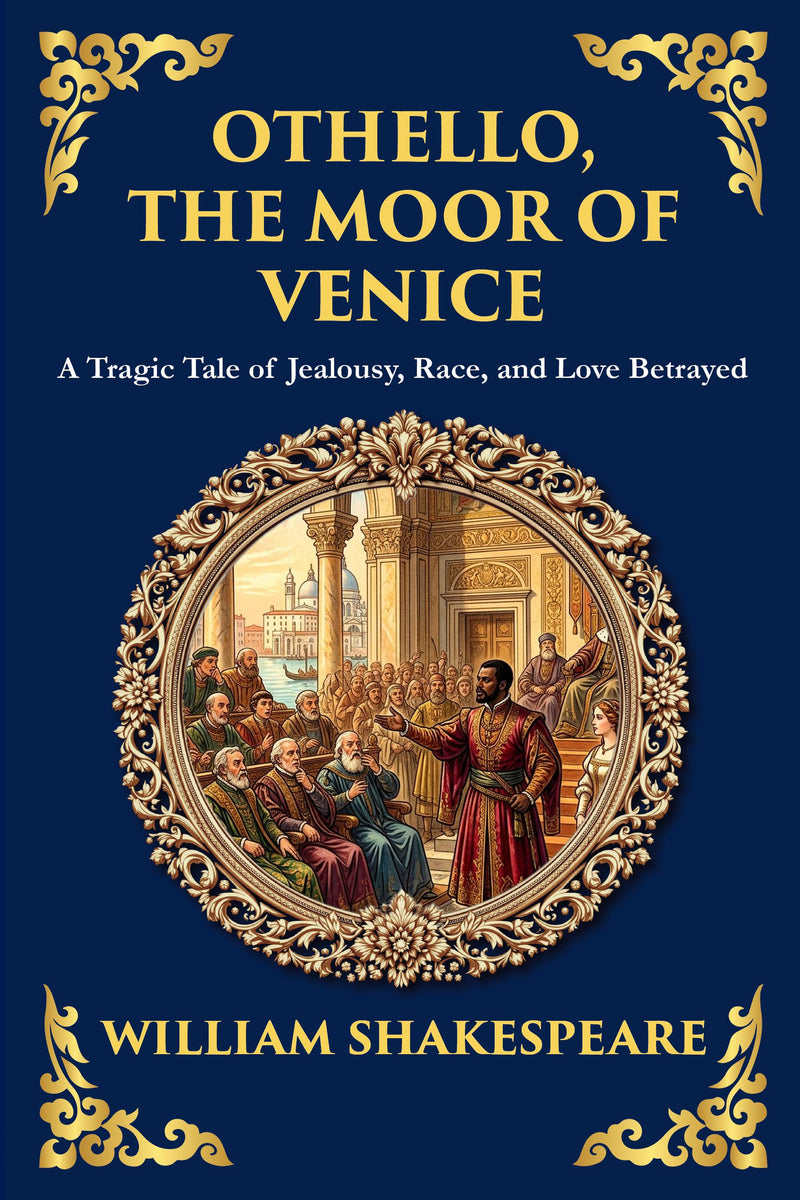
Othello, the Moor of Venice
In one of William Shakespeare’s most haunting tragedies, Othello, the Moor of Venice unravels the story of a noble general undone by a lethal combination of trust, love, and manipulation.
or free app
10,000+ hrs library
30-day guarantee
The complete Othello, the Moor of Venice appears in modern English through Library of Alexandria Press, available online with audiobook narration included for members.
Have you ever wondered why love, once doubted, can become the seed of destruction? Othello, the Moor of Venice is one of Shakespeare’s most gripping tragedies—a tale that entwines love, power, betrayal, and prejudice into an unforgettable narrative. At its center is Othello, a powerful and respected Black general in the Venetian army, whose passionate love for Desdemona is exploited by the treacherous Iago.
With masterful manipulation, Iago weaves a web of lies that poisons Othello’s heart and clouds his judgment. What begins as whispered suspicion blossoms into all-consuming jealousy, leading to one of the most devastating climaxes in dramatic history. This powerful modern edition brings Shakespeare’s original text into fresh focus—illuminating the brilliance of his psychological insight, the beauty of his verse, and the tragedy of a man undone not only by his enemy, but by his own inner fears.
What you’ll discover in this modern edition
- An Ageless Tale of Love and Betrayal – Witness how devotion is shattered by doubt and deceit.
| Formats | eBook (EPUB + PDF) · Audiobook · Paperback · Hardcover · Large Print |
| Language | English |
| Trim size (print) | 6 × 9 in |
| Binding | Paperback — perfect-bound · Hardcover — casewrap |
| Large Print edition | Same text in a larger, easy-read type — a larger font, not a larger trim |
| Print pricing | Every physical book at our true cost — at-cost, no profit (members) |
| Library | 873 restored titles, always growing |
| Length | 29,186 words · ~1 hr 57 min reading |
| Reading level | Grade 6 · an easy, flowing read (this modern-English edition) |
| Edition | Modern English translation · 2026 |
Member reviews for this edition are collected as readers finish it — be the first. Across the library: 12,000+ books shipped, every plan covered by a 365-day print guarantee.
About this edition
A faithful, unabridged modern-English edition by The Library of Alexandria — carefully rendered for today's reader and verified paragraph-by-paragraph against the public-domain source. Available as eBook, audiobook, paperback, hardcover, and large print.
- Complete & unabridgedVerified paragraph by paragraph against the source — never a scan, never abridged.
- Modern English, faithfulReadable today, with the author’s meaning kept intact. Readable — not simplified.
- Every format, one membershipRead in your browser or the free app, or listen to the full audiobook.
Included free with your membership
Cancel anytime, one click · 30-day money-back guarantee
Edition last updated July 2026
What’s inside
Othello, the Moor of Venice — complete and unabridged: all 17 sections included with membership, plus the full audiobook.
Begin reading Othello, the Moor of Venice
In clear modern English — the complete text is included with membership.
Introduction
There are tragedies that unfold like distant storms, vast and impersonal, sweeping kingdoms into ruin while we watch from a safe remove. And then there is Othello — a tragedy that happens in a bedroom, in a whisper, in the slow poisoning of one mind by another. Of all the great dramatic works to emerge from the English Renaissance, none feels quite so intimate, so terribly close, as the story of the Moor of Venice. It is a play about love and the destruction of love, about trust and the calculated betrayal of trust, about the smallness of the seed that can topple the greatest tree. To open these pages is to step into one of the most psychologically penetrating works ever written, a drama that has lost none of its power to disturb, to move, and to illuminate in the four centuries since it first held audiences breathless in a London playhouse.
This edition presents Shakespeare’s masterwork in a modern translation, carefully adapted for the contemporary reader. The intention behind such an adaptation is not to diminish the original but to remove the barriers that time has erected between the playwright’s genius and the modern eye. The English of the early seventeenth century, magnificent as it is, can feel like a locked gate to readers who have not been handed the key. Antiquated words, inverted sentences, idioms that have drifted out of common usage — these can transform what should be a thrilling, heart-pounding experience into an exercise in puzzle-solving. What this version offers is the chance to encounter the story as its first audiences did: directly, urgently, with the full emotional weight of every scene landing as it was meant to. The architecture of Shakespeare’s thought, the cunning of his villain, the agony of his hero, the radiant innocence of his heroine — all of it is here, rendered in language that flows naturally for the reader of today.
Before you begin, it is worth pausing to consider what makes this particular tragedy so singular, so enduring, and so essential. For Othello is not merely a great play. It is, in many ways, the most modern of all Shakespeare’s tragedies, the one whose central concerns press most insistently upon our own age.
What sets Othello apart from the towering tragedies that surround it in Shakespeare’s canon is its remarkable focus. Hamlet roams the corridors of philosophy and the question of action itself. King Lear expands into a cosmic howl against the cruelty of nature and the ingratitude of children. Macbeth charts the corruption of ambition across a whole bloodied kingdom. But Othello narrows its lens with almost unbearable precision. It is a domestic tragedy, a tragedy of private life, concerned not with crowns and battlefields but with marriage, reputation, and the fragile mechanics of belief between two people who love each other.
This intimacy is precisely what makes the play so devastating. We are not watching the fate of nations; we are watching the unraveling of a heart. The stakes are personal in the most piercing sense — they are the stakes of every relationship that has ever depended on trust, of every love that has ever been tested by doubt. Shakespeare understood that the destruction of something small and beautiful can be more harrowing than the collapse of empires, because it touches the part of us that knows how easily our own happiness might be poisoned, how vulnerable we are to the suggestions of those we trust, how the mind, once unsettled, can torment itself into ruin.
At the center of the play stands a man of extraordinary stature — a celebrated military commander, a figure of dignity and command, admired by the state he serves and respected by the men who follow him. He is, when we first meet him, a portrait of self-possession. He speaks with a calm authority that quiets the fury of those who would oppose him. He has won, against every expectation, the love of a woman of grace and intelligence, and their union seems to promise a happiness earned against considerable odds. This is a hero who has nothing of the brooding indecision we find in other tragic protagonists. He acts; he leads; he loves openly and without guile. And it is exactly this openness, this generous and trusting nature, that will become the instrument of his undoing.
The genius of Shakespeare’s design lies in the contrast between the hero’s nobility and the means of his destruction. He is not brought low by an external enemy he can confront, nor by a flaw of cruelty or ambition. He is brought low because he is, at heart, a man who believes in the honesty of others — and because there moves through the play one of the most chilling figures in all of literature, a man whose entire purpose is to weaponize that very trust.
To say much about how the drama proceeds would be to rob you of its terrible suspense, and that is something this introduction will scrupulously avoid. But it can be said that Othello is, among other things, a study of how reality itself can be manufactured. We watch one character construct a false world, brick by careful brick, and we watch another character come to inhabit that false world as though it were solid ground. The horror is not supernatural, as it is in Macbeth with its witches, nor metaphysical, as in Hamlet with its ghost. The horror is entirely human, entirely plausible, and therefore far more frightening. It is the horror of recognizing how little it takes to make a person doubt what they know, how a single insinuation can take root and grow until it chokes out every other thought.
The play moves with the relentless momentum of a fever. There is a quality to its pacing that distinguishes it from Shakespeare’s other works — a compression, an acceleration, that mirrors the runaway nature of the obsession at its core. Once the machinery is set in motion, events tumble forward with a sickening velocity, and the reader, like the characters, finds it almost impossible to look away. This is one of the reasons the play remains so gripping on the page: it is built like a thriller, with each scene tightening the screws, each conversation laden with a double meaning that the audience perceives even when the characters do not. We see the trap being laid. We see the victim walking toward it. And we are helpless to intervene — which is, of course, the essence of dramatic tragedy.
The villain of the piece deserves particular attention, for he is widely regarded as one of the supreme creations of the dramatic imagination. He is not a monster in any conventional sense. He moves freely among the other characters, trusted and even beloved, known to all as honest and dependable. His evil is the more terrifying for being so ordinary in its surface, so reasonable in its presentation. And one of the most fascinating and unsettling features of his character is the question of his motive. He offers reasons for his malice — several of them, in fact — but they shift and multiply and never quite cohere into a satisfying explanation. Critics and readers have argued for centuries about what truly drives him. Is it wounded ambition? Envy? A more general delight in destruction for its own sake? Shakespeare leaves the question deliberately open, and in doing so he creates something far more disturbing than a clearly motivated villain: he creates a study of malevolence that seems to exceed any rational cause, a darkness that fascinates precisely because it cannot be fully understood.
There is a peculiar intimacy in the way this character speaks to us. Through his soliloquies and asides, he takes the audience into his confidence, sharing his plans, inviting us to admire his cleverness. We become, uncomfortably, his co-conspirators, privy to schemes we wish we could prevent. This technique implicates the reader in a way few other works dare to attempt. We do not merely observe the tragedy; we are made complicit in the awful knowledge of what is coming, and that knowledge transforms our reading into a kind of agonized anticipation.
Race, Otherness, and the Outsider's Heart
It is impossible to read Othello in our own time without recognizing how astonishingly it speaks to questions we are still wrestling with today. The play’s protagonist is a Moor — a figure marked, in the eyes of the Venetian society around him, as fundamentally other. He has risen to the heights of that society through his own merit, his courage, his skill, his service to the state. He has been welcomed, honored, entrusted with command. And yet he remains, even at the summit of his achievement, an outsider — a man whose belonging is always provisional, always subject to the prejudices of those around him.
Shakespeare’s handling of this theme is remarkable for its sophistication and its humanity, particularly given the era in which the play was written. The hero is not a stereotype, not a caricature, but a fully realized human being of immense dignity and depth. The casual cruelties directed at him by certain characters — the crude language, the contemptuous assumptions, the way his very identity is used as a weapon against him — these are presented not as truths about the man but as the ugly reflexes of a prejudiced society. And the tragedy gains an additional, terrible dimension when we consider how the hero’s status as an outsider may shape his vulnerability. A man perpetually aware that he does not fully belong, a man who has had to prove himself again and again, a man who may secretly fear that his happiness is too good to be true for someone like him — such a man is uniquely susceptible to the poison that is poured into his ear.
This is one of the reasons the play resonates so powerfully with contemporary readers. It anticipates, with uncanny foresight, the psychology of marginalization — the way that those who are made to feel they do not belong can internalize the doubts of others, can be made to question their own worth, their own right to love and be loved. The hero’s tragedy is not only the result of a villain’s scheming; it is also, in part, the result of a society that never fully accepted him, that always held him at arm’s length even as it relied upon his talents. The wound was there before the villain found it. He merely knew exactly where to press.
To read the play with this understanding is to find it almost unbearably relevant. The questions it raises — about who is permitted to belong, about how prejudice operates not only through open hostility but through subtler forms of exclusion, about the corrosive effects of being perpetually regarded as an outsider — these are questions that have lost none of their urgency. Shakespeare, writing four centuries ago, in a society that knew little of the wider world and was riddled with the prejudices of its time, nevertheless created a work that interrogates those very prejudices with extraordinary moral clarity. He invites us to see the humanity of the man whom others would reduce to a category, and in doing so he challenges the assumptions of his own age and ours.
The heroine of the play deserves equal consideration, for she is one of Shakespeare’s most luminous creations. She is a woman of remarkable spirit and independence, who has defied the expectations of her family and her society to follow her own heart. There is nothing weak or passive about her; she speaks her mind with courage, defends herself with eloquence, and remains, throughout the gathering darkness, a figure of grace and constancy. The contrast between her radiant goodness and the malice arrayed against her is one of the most poignant aspects of the entire work. Her fate raises searching questions about the position of women, about the ease with which a woman’s reputation could be destroyed, about the terrible power that suspicion holds over the innocent. To watch her story unfold is to be reminded of how vulnerable virtue can be when it is unguarded against malice, and how the truest love can be undone not by any failing of its own but by the lies that surround it.
There is also a third figure in this drama worthy of mention — a woman of sharp wit and practical wisdom whose presence grows in importance as the play advances toward its climax. She is, in some ways, the most modern voice in the entire work, unillusioned about the failings of men and unafraid to speak truths that others will not. Her observations on the relationships between men and women carry a startling frankness, and her role in the final movement of the tragedy lends the play some of its most powerful and unexpected moments. Through her, Shakespeare offers a counterpoint to the deceptions and self-deceptions that drive the action, a voice of blunt reality cutting through the fog of lies.
Cancel anytime, one click · 30-day money-back guarantee
Founding annual rate available now — your price locks for life when you join.
Not ready? Get this free chapter by email — read it anytime.
✓ Sent — check your inbox for Othello, the Moor of Venice.
Questions about Othello, the Moor of Venice
What is Othello, the Moor of Venice about?
In one of William Shakespeare’s most haunting tragedies, Othello, the Moor of Venice unravels the story of a noble general undone by a lethal combination of trust, love, and manipulation. When the cunning Iago plants the seed of doubt in Othello’s heart, it blooms into a destructive force that threatens everything—his honor, his marriage, and his soul. Set against a backdrop of war, cultural tension, and fragile loyalties, Othello remains a timeless exploration of race, identity, passion, and the corrosive power of
Who wrote Othello, the Moor of Venice?
Othello, the Moor of Venice was written by William Shakespeare. This edition presents the complete work in clear modern English, faithfully rendered from the public-domain original by Library of Alexandria Press.
Is Othello, the Moor of Venice free to read?
The opening chapter is free to read on this page. Members read and listen to the complete work — and the entire library — free, and can order any physical book at our true print cost.
How long is Othello, the Moor of Venice?
17 chapters (~29,186 words) — about 1 hr 57 min of reading in this modern-English edition.
Is this an abridged version of Othello, the Moor of Venice?
No. This is the complete, unabridged Othello, the Moor of Venice, carefully rendered into clear modern English and verified paragraph-by-paragraph against the public-domain source — nothing is cut or summarised.
What formats does Othello, the Moor of Venice come in?
Othello, the Moor of Venice is available as eBook, paperback, hardcover and large print. eBook and audiobook are included with membership; printed editions ship at our true print cost.
Shipping & returns
Billing & membership
More from the library


Explore Poetry & Drama
- As You Like It · William Shakespeare
- The Raven · Edgar Allan Poe
- The Merchant of Venice · William Shakespeare
- A Midsummer Night’s Dream · William Shakespeare
- Romeo and Juliet · William Shakespeare
- The Imaginary Invalid · Molière
- A Woman of No Importance · Oscar Wilde
- Gitanjali · Rabindranath Tagore
- Sonnets from the Portuguese · Elizabeth Barrett Browning
- The New Life (La Vita Nuova) · Dante Alighieri
- The Rime of the Ancient Mariner · Samuel Taylor Coleridge
- Lady Windermere’s Fan · Oscar Wilde
- The Home Book of Verse — Volume 4 · Burton Egbert Stevenson
- Ghosts · Henrik Ibsen
- Mrs. Warren’s Profession · Bernard Shaw
- An Enemy of the People · Henrik Ibsen
- Gawayne and the Green Knight: A Fairy Tale · Charlton M. Lewis
- The Nibelungenlied · G. H. Needler
- Julius Caesar · William Shakespeare
- The Aeneid of Virgil · Virgil
- Troilus and Criseyde · Geoffrey Chaucer
- The Post Office · Rabindranath Tagore
- Lamia · John Keats
- The Ballad of the White Horse · G. K. Chesterton
- A Shropshire Lad · A. E. Housman
- The Birth of the War-God: A Poem by Kalidasa · Kálidása
- Riders to the Sea · J. M. Synge
- The Prophet · Kahlil Gibran
- Twelfth Night; Or, What You Will · William Shakespeare
- Salomé: A Tragedy in One Act · Oscar Wilde
Othello, the Moor of Venice
Othello, the Moor of Venice
A Tragic Tale of Jealousy, Race, and Betrayed Love
William Shakespeare
Contents
- Introduction
- Cast of Characters
- Act 1, Scene 1
- Act 1, Scene 2
- Act 1, Scene 3
- Act 2, Scene 1
- Act 2, Scene 2
- Act 2, Scene 3
- Act 3, Scene 1
- Act 3, Scene 2
- Act 3, Scene 3
- Act 3, Scene 4
- Act 4, Scene 1
- Act 4, Scene 2
- Act 4, Scene 3
- Act 5, Scene 1
- Act 5, Scene 2
Introduction
There are tragedies that unfold like distant storms, vast and impersonal, sweeping kingdoms into ruin while we watch from a safe remove. And then there is Othello — a tragedy that happens in a bedroom, in a whisper, in the slow poisoning of one mind by another. Of all the great dramatic works to emerge from the English Renaissance, none feels quite so intimate, so terribly close, as the story of the Moor of Venice. It is a play about love and the destruction of love, about trust and the calculated betrayal of trust, about the smallness of the seed that can topple the greatest tree. To open these pages is to step into one of the most psychologically penetrating works ever written, a drama that has lost none of its power to disturb, to move, and to illuminate in the four centuries since it first held audiences breathless in a London playhouse.
This edition presents Shakespeare’s masterwork in a modern translation, carefully adapted for the contemporary reader. The intention behind such an adaptation is not to diminish the original but to remove the barriers that time has erected between the playwright’s genius and the modern eye. The English of the early seventeenth century, magnificent as it is, can feel like a locked gate to readers who have not been handed the key. Antiquated words, inverted sentences, idioms that have drifted out of common usage — these can transform what should be a thrilling, heart-pounding experience into an exercise in puzzle-solving. What this version offers is the chance to encounter the story as its first audiences did: directly, urgently, with the full emotional weight of every scene landing as it was meant to. The architecture of Shakespeare’s thought, the cunning of his villain, the agony of his hero, the radiant innocence of his heroine — all of it is here, rendered in language that flows naturally for the reader of today.
Before you begin, it is worth pausing to consider what makes this particular tragedy so singular, so enduring, and so essential. For Othello is not merely a great play. It is, in many ways, the most modern of all Shakespeare’s tragedies, the one whose central concerns press most insistently upon our own age.
What sets Othello apart from the towering tragedies that surround it in Shakespeare’s canon is its remarkable focus. Hamlet roams the corridors of philosophy and the question of action itself. King Lear expands into a cosmic howl against the cruelty of nature and the ingratitude of children. Macbeth charts the corruption of ambition across a whole bloodied kingdom. But Othello narrows its lens with almost unbearable precision. It is a domestic tragedy, a tragedy of private life, concerned not with crowns and battlefields but with marriage, reputation, and the fragile mechanics of belief between two people who love each other.
This intimacy is precisely what makes the play so devastating. We are not watching the fate of nations; we are watching the unraveling of a heart. The stakes are personal in the most piercing sense — they are the stakes of every relationship that has ever depended on trust, of every love that has ever been tested by doubt. Shakespeare understood that the destruction of something small and beautiful can be more harrowing than the collapse of empires, because it touches the part of us that knows how easily our own happiness might be poisoned, how vulnerable we are to the suggestions of those we trust, how the mind, once unsettled, can torment itself into ruin.
At the center of the play stands a man of extraordinary stature — a celebrated military commander, a figure of dignity and command, admired by the state he serves and respected by the men who follow him. He is, when we first meet him, a portrait of self-possession. He speaks with a calm authority that quiets the fury of those who would oppose him. He has won, against every expectation, the love of a woman of grace and intelligence, and their union seems to promise a happiness earned against considerable odds. This is a hero who has nothing of the brooding indecision we find in other tragic protagonists. He acts; he leads; he loves openly and without guile. And it is exactly this openness, this generous and trusting nature, that will become the instrument of his undoing.
The genius of Shakespeare’s design lies in the contrast between the hero’s nobility and the means of his destruction. He is not brought low by an external enemy he can confront, nor by a flaw of cruelty or ambition. He is brought low because he is, at heart, a man who believes in the honesty of others — and because there moves through the play one of the most chilling figures in all of literature, a man whose entire purpose is to weaponize that very trust.
To say much about how the drama proceeds would be to rob you of its terrible suspense, and that is something this introduction will scrupulously avoid. But it can be said that Othello is, among other things, a study of how reality itself can be manufactured. We watch one character construct a false world, brick by careful brick, and we watch another character come to inhabit that false world as though it were solid ground. The horror is not supernatural, as it is in Macbeth with its witches, nor metaphysical, as in Hamlet with its ghost. The horror is entirely human, entirely plausible, and therefore far more frightening. It is the horror of recognizing how little it takes to make a person doubt what they know, how a single insinuation can take root and grow until it chokes out every other thought.
The play moves with the relentless momentum of a fever. There is a quality to its pacing that distinguishes it from Shakespeare’s other works — a compression, an acceleration, that mirrors the runaway nature of the obsession at its core. Once the machinery is set in motion, events tumble forward with a sickening velocity, and the reader, like the characters, finds it almost impossible to look away. This is one of the reasons the play remains so gripping on the page: it is built like a thriller, with each scene tightening the screws, each conversation laden with a double meaning that the audience perceives even when the characters do not. We see the trap being laid. We see the victim walking toward it. And we are helpless to intervene — which is, of course, the essence of dramatic tragedy.
The villain of the piece deserves particular attention, for he is widely regarded as one of the supreme creations of the dramatic imagination. He is not a monster in any conventional sense. He moves freely among the other characters, trusted and even beloved, known to all as honest and dependable. His evil is the more terrifying for being so ordinary in its surface, so reasonable in its presentation. And one of the most fascinating and unsettling features of his character is the question of his motive. He offers reasons for his malice — several of them, in fact — but they shift and multiply and never quite cohere into a satisfying explanation. Critics and readers have argued for centuries about what truly drives him. Is it wounded ambition? Envy? A more general delight in destruction for its own sake? Shakespeare leaves the question deliberately open, and in doing so he creates something far more disturbing than a clearly motivated villain: he creates a study of malevolence that seems to exceed any rational cause, a darkness that fascinates precisely because it cannot be fully understood.
There is a peculiar intimacy in the way this character speaks to us. Through his soliloquies and asides, he takes the audience into his confidence, sharing his plans, inviting us to admire his cleverness. We become, uncomfortably, his co-conspirators, privy to schemes we wish we could prevent. This technique implicates the reader in a way few other works dare to attempt. We do not merely observe the tragedy; we are made complicit in the awful knowledge of what is coming, and that knowledge transforms our reading into a kind of agonized anticipation.
Race, Otherness, and the Outsider's Heart
It is impossible to read Othello in our own time without recognizing how astonishingly it speaks to questions we are still wrestling with today. The play’s protagonist is a Moor — a figure marked, in the eyes of the Venetian society around him, as fundamentally other. He has risen to the heights of that society through his own merit, his courage, his skill, his service to the state. He has been welcomed, honored, entrusted with command. And yet he remains, even at the summit of his achievement, an outsider — a man whose belonging is always provisional, always subject to the prejudices of those around him.
Shakespeare’s handling of this theme is remarkable for its sophistication and its humanity, particularly given the era in which the play was written. The hero is not a stereotype, not a caricature, but a fully realized human being of immense dignity and depth. The casual cruelties directed at him by certain characters — the crude language, the contemptuous assumptions, the way his very identity is used as a weapon against him — these are presented not as truths about the man but as the ugly reflexes of a prejudiced society. And the tragedy gains an additional, terrible dimension when we consider how the hero’s status as an outsider may shape his vulnerability. A man perpetually aware that he does not fully belong, a man who has had to prove himself again and again, a man who may secretly fear that his happiness is too good to be true for someone like him — such a man is uniquely susceptible to the poison that is poured into his ear.
This is one of the reasons the play resonates so powerfully with contemporary readers. It anticipates, with uncanny foresight, the psychology of marginalization — the way that those who are made to feel they do not belong can internalize the doubts of others, can be made to question their own worth, their own right to love and be loved. The hero’s tragedy is not only the result of a villain’s scheming; it is also, in part, the result of a society that never fully accepted him, that always held him at arm’s length even as it relied upon his talents. The wound was there before the villain found it. He merely knew exactly where to press.
To read the play with this understanding is to find it almost unbearably relevant. The questions it raises — about who is permitted to belong, about how prejudice operates not only through open hostility but through subtler forms of exclusion, about the corrosive effects of being perpetually regarded as an outsider — these are questions that have lost none of their urgency. Shakespeare, writing four centuries ago, in a society that knew little of the wider world and was riddled with the prejudices of its time, nevertheless created a work that interrogates those very prejudices with extraordinary moral clarity. He invites us to see the humanity of the man whom others would reduce to a category, and in doing so he challenges the assumptions of his own age and ours.
The heroine of the play deserves equal consideration, for she is one of Shakespeare’s most luminous creations. She is a woman of remarkable spirit and independence, who has defied the expectations of her family and her society to follow her own heart. There is nothing weak or passive about her; she speaks her mind with courage, defends herself with eloquence, and remains, throughout the gathering darkness, a figure of grace and constancy. The contrast between her radiant goodness and the malice arrayed against her is one of the most poignant aspects of the entire work. Her fate raises searching questions about the position of women, about the ease with which a woman’s reputation could be destroyed, about the terrible power that suspicion holds over the innocent. To watch her story unfold is to be reminded of how vulnerable virtue can be when it is unguarded against malice, and how the truest love can be undone not by any failing of its own but by the lies that surround it.
There is also a third figure in this drama worthy of mention — a woman of sharp wit and practical wisdom whose presence grows in importance as the play advances toward its climax. She is, in some ways, the most modern voice in the entire work, unillusioned about the failings of men and unafraid to speak truths that others will not. Her observations on the relationships between men and women carry a startling frankness, and her role in the final movement of the tragedy lends the play some of its most powerful and unexpected moments. Through her, Shakespeare offers a counterpoint to the deceptions and self-deceptions that drive the action, a voice of blunt reality cutting through the fog of lies.
RODERIGO. Stop it. I find it very insulting that you, Iago—you who have spent my money as if it were your own—should know about this.
IAGO. Damn it, you won’t listen to me. If I ever dreamed of such a thing, you can hate me.
IAGO. Go ahead and despise me if I don’t. Three powerful men in the city personally begged him to make me his lieutenant; they took their hats off to him. And I swear, I know my value—I deserve no less of a position. But he, obsessed with his own pride and plans, brushes them off with pompous excuses filled with fancy military jargon. In the end, he rejects my supporters, saying, “Honestly, I’ve already chosen my officer.” And who was it? Some great mathematician, a Florentine named Michael Cassio— a man who’s practically blinded by his beautiful wife. He’s never led a squadron in the field, and he knows less about battle formations than an old maid, unless you count the textbook theories that any lawyer could explain just as well as he can. His “soldiering” is all talk and no experience. But he’s the one who got the job, while I—whose skills he saw firsthand at Rhodes, at Cyprus, and in other battles, against both Christians and heathens—must be calmed down by this accountant, this bookkeeper. He gets to be the lieutenant, and I, for God’s sake, am just the Moor’s ensign.
RODERIGO. I swear, I’d rather have been his executioner.
IAGO. Well, there’s nothing to be done. That’s the curse of employment: promotions are based on favoritism and connections, not on seniority, where the second in line would naturally follow the first. Now, you be the judge: is there any logical reason for me to love the Moor?
End of the free sample
Keep reading, free
Members read and listen to the complete book — and the entire library. Cancel anytime, one click · 30-day money-back guarantee.