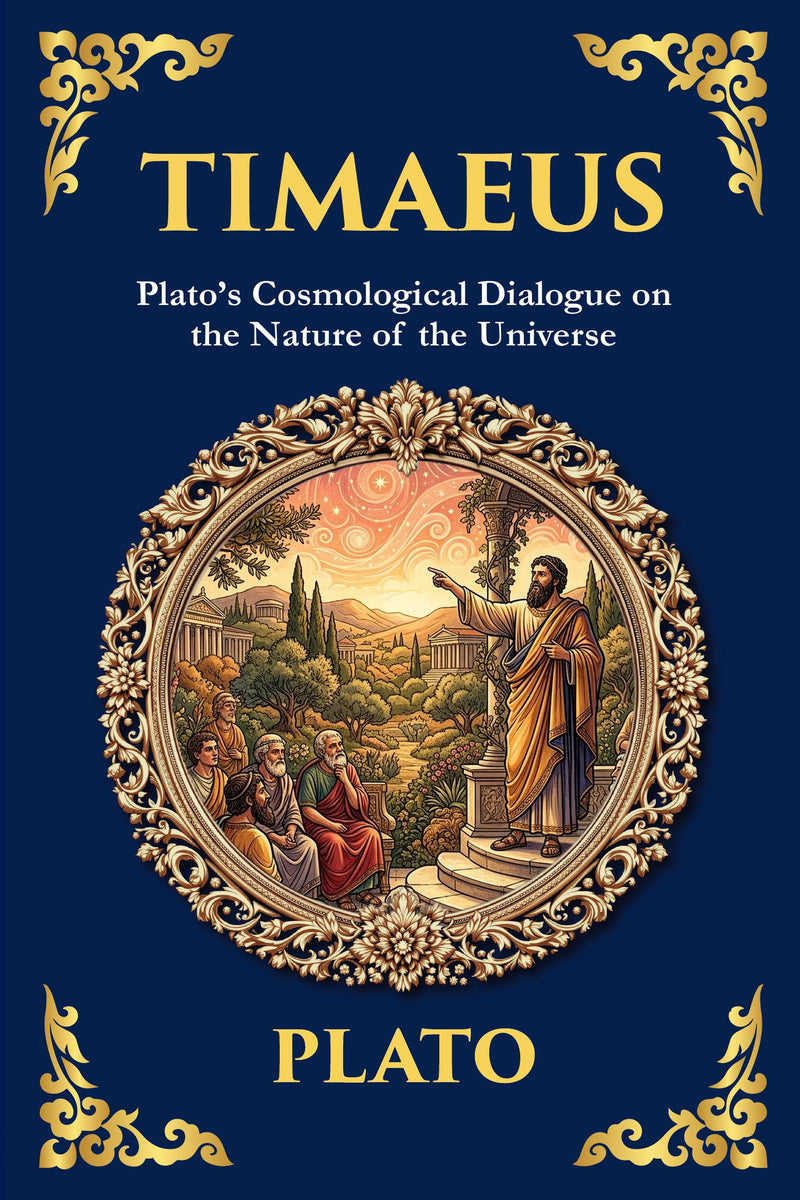
Timaeus — Large Print
Timaeus What is the origin of the cosmos? How did order arise from chaos? In Timaeus, one of the most profound and enigmatic dialogues of Plato, the philosopher imagines a conversation that reaches into the very fabric of existence.
or free app
10,000+ hrs library
30-day guarantee
The complete Timaeus appears in modern English through Library of Alexandria Press, available online with audiobook narration included for members.
Have you ever wondered why the universe exists in such harmonious order—and who designed it that way? Timaeus is one of Plato’s most influential yet mysterious works—a dazzling philosophical dialogue that dares to describe the creation and structure of the cosmos. Written in the 4th century BCE, the dialogue takes place the day after The Republic and centers on Timaeus, a learned philosopher and astronomer, who presents a detailed cosmological account of the universe’s origins, its divine rational structure, and the place of humanity within it.
In this astonishing synthesis of metaphysics and proto-science, Plato proposes that the universe was crafted by a benevolent “Demiurge,” or divine craftsman, who imposed order on primordial chaos by modeling creation on eternal, ideal Forms. The soul of the world, the elements, the stars, and even human physiology are all given roles in this majestic vision of a living, intelligent cosmos. This accessible modern translation preserves the philosophical beauty and logical depth of Plato’s original Greek, bringing fresh clarity to a dialogue that has fascinated thinkers for over two millennia.
What you’ll discover in this modern edition
- Plato’s Vision of a Created Universe Learn how a divine craftsman brought order and harmony to chaotic matter.
- The Role of Mathematics and Geometry in Nature Explore how numerical proportion and geometric forms underpin the structure of the cosmos.
- A Theory of the World Soul Understand Plato’s idea that the universe itself is a living being with a rational soul.
- Connections to Western and Eastern Thought Trace the influence of Timaeus on Neoplatonism, Christian theology, Islamic philosophy, and Renaissance science.
- A Mystical and Rational Dialogue Experience the unique blend of myth, logic, and metaphysics that makes Timaeus both poetic and profound.
| Formats | eBook (EPUB + PDF) · Audiobook · Paperback · Hardcover · Large Print |
| Language | English |
| Trim size (print) | 6 × 9 in |
| Binding | Paperback — perfect-bound · Hardcover — casewrap |
| Large Print edition | Same text in a larger, easy-read type — a larger font, not a larger trim |
| Print pricing | Every physical book at our true cost — at-cost, no profit (members) |
| Library | 873 restored titles, always growing |
| Length | 31,509 words · ~2 hr 6 min reading |
| Reading level | Grade 3 · an easy, flowing read (this modern-English edition) |
| Edition | Modern English translation · 2026 |
Member reviews for this edition are collected as readers finish it — be the first. Across the library: 12,000+ books shipped, every plan covered by a 365-day print guarantee.
About this edition
A faithful, unabridged modern-English edition by The Library of Alexandria — carefully rendered for today's reader and verified paragraph-by-paragraph against the public-domain source. Available as eBook, audiobook, paperback, hardcover, and large print.
- Complete & unabridgedVerified paragraph by paragraph against the source — never a scan, never abridged.
- Modern English, faithfulReadable today, with the author’s meaning kept intact. Readable — not simplified.
- Every format, one membershipRead in your browser or the free app, or listen to the full audiobook.
Included free with your membership
Cancel anytime, one click · 30-day money-back guarantee
Edition last updated July 2026
What’s inside
Timaeus — Large Print — complete and unabridged, included in full with membership, plus the full audiobook.
Begin reading Timaeus — Large Print
In clear modern English — the complete text is included with membership.
Introduction
There are books that describe the world, and there are books that attempt to imagine it into coherence. The dialogue you are about to read belongs decisively to the second category. Written by Plato in the fourth century before the common era, it is one of the most ambitious texts ever composed in any language: an attempt to give a unified, reasoned account of everything that exists—the heavens, the earth, the elements, the human body, the soul, time itself, and the very purpose for which the cosmos was brought into being. To open it is to step into the mind of a philosopher who refused to accept that the universe was an accident, and who labored to show that order, beauty, and intelligence lie at the heart of all things.
For more than two thousand years, this single work shaped how Western thinkers imagined the structure of reality. Long before the telescope, before the microscope, before the periodic table or the equations of physics, here was a vision of a cosmos that was rational, mathematical, and purposeful. Medieval scholars treasured it. Renaissance artists and architects drew inspiration from its proportions. Astronomers and mathematicians measured their own discoveries against its claims. It is no exaggeration to say that for a very long stretch of intellectual history, this was the book through which educated people understood the origins of the world. To read it now is to encounter the foundation upon which an enormous portion of subsequent thought was built—and to feel, perhaps for the first time, how strange and magnificent that foundation truly is.
This modern translation has been prepared with a single purpose in mind: to make that experience available to you without the barriers that have so often stood between ordinary readers and the great works of antiquity. The language here is direct, contemporary, and readable. The aim has not been to simplify Plato’s thought, which is anything but simple, but to remove the unnecessary obstacles—the archaic phrasings, the tangled syntax, the scholarly apparatus—that can turn a profound encounter into a frustrating chore. What remains is the argument itself, the imagery, the wonder, and the relentless intelligence of a writer at the height of his powers. You do not need to have studied ancient Greek philosophy to follow what unfolds in these pages. You need only curiosity, patience, and a willingness to ask the oldest and most important question a human being can ask: where did all of this come from, and why?
Plato wrote not in essays or treatises but in dialogues—dramatic conversations in which characters speak, question, object, and respond. This was a deliberate choice, and it tells us a great deal about how he understood philosophy. For Plato, thinking was not a private act performed in isolation but a living exchange between minds. Truth, in his view, emerged through dialogue, through the friction of one idea against another, through the patient work of questioning and answering. Even when, as in this work, one speaker dominates and delivers what amounts to an extended monologue, the conversational frame remains essential. We are reminded that what we are hearing is a human attempt, offered by one person to others, to make sense of an overwhelming subject.
The setting is a gathering of friends, men of learning and distinction, who have come together for conversation. The principal speaker is a figure renowned for his knowledge of astronomy and the natural world, a man from southern Italy whose name the dialogue bears. He has been invited to deliver an account of the universe—how it came to be, how it is constructed, and what place humanity occupies within it. What follows is one of the most sweeping and audacious speeches in the history of literature.
But before the great account begins, Plato does something remarkable. He establishes the spirit in which the entire work is to be received. The speaker insists, with striking humility, that what he is about to offer is not certain knowledge but a “likely account”—a plausible story, the best explanation that human reason can construct about matters that lie partly beyond human grasp. This is one of the most important things to understand before you begin reading. The dialogue does not pretend to be a final, infallible revelation. It presents itself as the most reasonable narrative available, given the limits of the human mind and the grandeur of its subject. There is a profound modesty in this, and also a kind of intellectual courage. The speaker knows he may be wrong in the details. He proceeds anyway, because the attempt to understand the whole of things is too important to abandon simply because perfect certainty is impossible.
This framing should shape how you read everything that follows. When the dialogue describes the construction of the heavens, the proportions of the soul, or the nature of the four elements, it is not delivering scientific fact in the modern sense. It is offering a vision—a carefully reasoned, mathematically structured, deeply imaginative vision of a cosmos that makes sense. Some of its specific claims have been overturned by later discovery. But its central conviction—that the universe is intelligible, that it can be grasped by reason, that beneath the chaos of appearances lies a deep order waiting to be understood—is the very conviction that made modern science possible. Every scientist who has ever assumed that nature obeys discoverable laws is, in a sense, heir to the spirit of this book.
The dialogue is also notable for what precedes the main account. It opens with a brief recollection of a previous conversation about the ideal society, and then, famously, with the introduction of an extraordinary tale about a great and ancient civilization—a story that has captured the imagination of countless readers across the centuries and that has become one of the most enduring legends in all of literature. I will not say more about it here, except to note that you should read these opening sections with care, for they set a tone of grandeur and antiquity, framing the cosmic account that follows as something handed down across vast reaches of time. There is a deliberate movement in the dialogue’s architecture from the human and political, through the legendary and historical, and finally outward to the cosmic and eternal. By the time the great account of the universe begins, you will feel that you have been prepared, almost ceremonially, for something of immense scope.
At the heart of this work lies a single, transformative idea: that the universe is the product of intelligence. The speaker imagines a divine craftsman—a maker, an artisan of cosmic scale—who looks upon an eternal model of perfection and shapes the visible world in its likeness. This figure is not a god of thunder and demand, not a being to be feared or appeased, but something closer to a supremely wise artist. He brings order out of disorder, not because he is compelled to, but because he is good, and because goodness naturally wishes to share itself and to make things as excellent as they can be. The cosmos, in this vision, is the work of a benevolent intelligence doing the best that could be done with the materials at hand.
This is one of the most influential ideas in the entire history of thought. The notion that the world is crafted, that it reflects a purpose, that its order is a sign of wisdom rather than mere chance, would echo through philosophy and theology for millennia. Readers from many different religious and philosophical traditions have found in this dialogue a kindred vision, and have drawn upon it in shaping their own accounts of creation. As you read, you may find yourself struck by how familiar some of these ideas feel, even if you have never encountered the source. That is because the source has so thoroughly saturated the intellectual atmosphere we breathe.
Yet the vision here is also distinctively philosophical and mathematical. The craftsman does not simply will the world into being. He constructs it according to ratio, proportion, and geometric harmony. The dialogue is saturated with mathematics—not as dry calculation, but as the very grammar of beauty and order. The soul of the universe is described as woven together according to musical intervals and numerical proportions. The four elements—earth, water, air, and fire—are given the shapes of geometric solids, each constructed from triangles, each capable of transforming into the others according to rules of mathematical combination. The motions of the heavenly bodies are arranged so that they trace out the harmonies of number across the sky.
This emphasis on mathematics is not incidental; it is central to everything the dialogue wants to say. For Plato, mathematics was the bridge between the changing, visible world and the eternal, perfect realm of pure forms. Numbers and geometric shapes are unchanging, exact, and universal—they exist beyond the flux of physical things, yet they govern how physical things behave. By building the cosmos out of mathematical structures, the divine craftsman ensures that the visible world participates, as fully as a material thing can, in the eternal order of truth. When you encounter the geometric construction of the elements, do not be intimidated. You do not need to follow every detail to appreciate the breathtaking ambition of the project: an attempt to derive the entire physical world, the very substance of fire and water and earth, from the pure logic of shape and number. It is one of the earliest and boldest attempts in human history to mathematize nature, and it stands as a direct ancestor of the mathematical physics that would emerge two thousand years later.
The dialogue also offers a remarkable meditation on the nature of time itself. Time, the speaker tells us, is not eternal—it came into being together with the heavens, as a “moving image of eternity.” The eternal model upon which the cosmos is patterned exists outside of time altogether, in a changeless present. But the visible world cannot share in that perfect changelessness, and so the craftsman gives it the next best thing: time, which imitates eternity by moving in a perfect, regular, numerical order through the cycles of days, months, and years. This idea—that time is a created thing, intimately bound up with the motion of the heavens, an image of something higher than itself—is among the most profound and influential passages in all of philosophy. It would be taken up, debated, and built upon by thinkers for centuries, and it continues to provoke wonder in anyone who pauses to consider what time truly is.
As the account proceeds, it descends from the largest scales to the smallest, from the structure of the cosmos as a whole to the construction of the human being. Here the dialogue becomes one of the earliest extended treatments of the human body and mind to survive from antiquity. The speaker describes the formation of the head, the senses, the organs, the circulation of fluids, the processes of nourishment and decay, and the diseases that afflict the body. He discusses the nature of sight and the mystery of perception, offering theories about how light and vision work that, while superseded by later science, reveal an extraordinary effort to explain the workings of the body in rational, mechanical terms.
But the human being, in this vision, is never merely a machine. The body exists to house the soul, and the soul is the true self. The dialogue describes the soul as having different parts or aspects, some divine and immortal, others bound up with the passions and appetites of the flesh. The highest part of the soul, the part capable of reason and contemplation, is described as a kind of inner heaven—a small image of the cosmic order, capable of aligning itself with the harmonies of the universe through the study of truth. This is one of the dialogue’s most moving and characteristic ideas: that human beings are not strangers in the cosmos but participants in its order, that by cultivating reason and turning our minds toward the eternal we bring our own inner lives into harmony with the great structure of all things. To think well, to contemplate the order of the heavens, is to heal and to perfect the soul. Philosophy, in this view, is not an abstract academic exercise but a form of cosmic alignment, a way of becoming more fully attuned to the deepest realities of existence.
Cancel anytime, one click · 30-day money-back guarantee
Founding annual rate available now — your price locks for life when you join.
Not ready? Get this free chapter by email — read it anytime.
✓ Sent — check your inbox for Timaeus — Large Print.
Questions about Timaeus — Large Print
What is Timaeus about?
Timaeus What is the origin of the cosmos? How did order arise from chaos? In Timaeus, one of the most profound and enigmatic dialogues of Plato, the philosopher imagines a conversation that reaches into the very fabric of existence.
Who wrote Timaeus?
Timaeus was written by Plato. This edition presents the complete work in clear modern English, faithfully rendered from the public-domain original by Library of Alexandria Press.
Is Timaeus free to read?
The opening chapter is free to read on this page. Members read and listen to the complete work — and the entire library — free, and can order any physical book at our true print cost.
How long is Timaeus?
2 chapters (~31,509 words) — about 2 hr 6 min of reading in this modern-English edition.
Is this an abridged version of Timaeus?
No. This is the complete, unabridged Timaeus, carefully rendered into clear modern English and verified paragraph-by-paragraph against the public-domain source — nothing is cut or summarised.
What formats does Timaeus come in?
Timaeus is available as eBook, paperback, hardcover and large print. eBook and audiobook are included with membership; printed editions ship at our true print cost.
Shipping & returns
Billing & membership
More from the library


Explore Philosophy & Ideas
- Kant's Prolegomena to Any Future Metaphysics · Immanuel Kant
- The Advancement of Learning · Francis Bacon
- The Dawn of Day · Friedrich Wilhelm Nietzsche
- Meditations · Marcus Aurelius
- The Confessions of St. Augustine · Saint Augustine
- Dialogues Concerning Natural Religion · David Hume
- Considerations on Representative Government · John Stuart Mill
- The Will to Power: An Attempted Transvaluation of All Values. Book III and IV · Friedrich Nietzsche
- Groundwork of the Metaphysics of Morals · Immanuel Kant
- The Confessions of Jean-Jacques Rousseau — Complete · Jean-Jacques Rousseau
- Democracy in America — Volume 2 · Alexis de Tocqueville
- Ecce Homo · Friedrich Wilhelm Nietzsche
- Second Treatise of Government · John Locke
- The Prince · Niccolò Machiavelli
- Thus Spake Zarathustra: A Book for All and None · Friedrich Wilhelm Nietzsche
- The Island of Doctor Moreau · H. G. Wells
- Sophist · Plato
- The Seven Lamps of Architecture · John Ruskin
- Essays — First Series · Ralph Waldo Emerson
- The Book of the Damned · Charles Fort
- The Everlasting Man · G. K. Chesterton
- The Initiates of the Flame · Manly P. Hall
- The Book of Tea · Kakuzo Okakura
- The Japanese Spirit · Yoshisaburo Okakura
- The Analysis of Mind · Bertrand Russell
- Orthodoxy · G. K. Chesterton
- Apology, Crito, and Phaedo of Socrates · Plato
- Euthyphro · Plato
- Timaeus · Plato
- Ion · Plato
Timaeus — Large Print
Timaeus — Large Print
Plato’s Dialogue on the Origin and Nature of the Universe
Plato
Contents
- Introduction
- Timaeus
Introduction
There are books that describe the world, and there are books that attempt to imagine it into coherence. The dialogue you are about to read belongs decisively to the second category. Written by Plato in the fourth century before the common era, it is one of the most ambitious texts ever composed in any language: an attempt to give a unified, reasoned account of everything that exists—the heavens, the earth, the elements, the human body, the soul, time itself, and the very purpose for which the cosmos was brought into being. To open it is to step into the mind of a philosopher who refused to accept that the universe was an accident, and who labored to show that order, beauty, and intelligence lie at the heart of all things.
For more than two thousand years, this single work shaped how Western thinkers imagined the structure of reality. Long before the telescope, before the microscope, before the periodic table or the equations of physics, here was a vision of a cosmos that was rational, mathematical, and purposeful. Medieval scholars treasured it. Renaissance artists and architects drew inspiration from its proportions. Astronomers and mathematicians measured their own discoveries against its claims. It is no exaggeration to say that for a very long stretch of intellectual history, this was the book through which educated people understood the origins of the world. To read it now is to encounter the foundation upon which an enormous portion of subsequent thought was built—and to feel, perhaps for the first time, how strange and magnificent that foundation truly is.
This modern translation has been prepared with a single purpose in mind: to make that experience available to you without the barriers that have so often stood between ordinary readers and the great works of antiquity. The language here is direct, contemporary, and readable. The aim has not been to simplify Plato’s thought, which is anything but simple, but to remove the unnecessary obstacles—the archaic phrasings, the tangled syntax, the scholarly apparatus—that can turn a profound encounter into a frustrating chore. What remains is the argument itself, the imagery, the wonder, and the relentless intelligence of a writer at the height of his powers. You do not need to have studied ancient Greek philosophy to follow what unfolds in these pages. You need only curiosity, patience, and a willingness to ask the oldest and most important question a human being can ask: where did all of this come from, and why?
Plato wrote not in essays or treatises but in dialogues—dramatic conversations in which characters speak, question, object, and respond. This was a deliberate choice, and it tells us a great deal about how he understood philosophy. For Plato, thinking was not a private act performed in isolation but a living exchange between minds. Truth, in his view, emerged through dialogue, through the friction of one idea against another, through the patient work of questioning and answering. Even when, as in this work, one speaker dominates and delivers what amounts to an extended monologue, the conversational frame remains essential. We are reminded that what we are hearing is a human attempt, offered by one person to others, to make sense of an overwhelming subject.
The setting is a gathering of friends, men of learning and distinction, who have come together for conversation. The principal speaker is a figure renowned for his knowledge of astronomy and the natural world, a man from southern Italy whose name the dialogue bears. He has been invited to deliver an account of the universe—how it came to be, how it is constructed, and what place humanity occupies within it. What follows is one of the most sweeping and audacious speeches in the history of literature.
But before the great account begins, Plato does something remarkable. He establishes the spirit in which the entire work is to be received. The speaker insists, with striking humility, that what he is about to offer is not certain knowledge but a “likely account”—a plausible story, the best explanation that human reason can construct about matters that lie partly beyond human grasp. This is one of the most important things to understand before you begin reading. The dialogue does not pretend to be a final, infallible revelation. It presents itself as the most reasonable narrative available, given the limits of the human mind and the grandeur of its subject. There is a profound modesty in this, and also a kind of intellectual courage. The speaker knows he may be wrong in the details. He proceeds anyway, because the attempt to understand the whole of things is too important to abandon simply because perfect certainty is impossible.
This framing should shape how you read everything that follows. When the dialogue describes the construction of the heavens, the proportions of the soul, or the nature of the four elements, it is not delivering scientific fact in the modern sense. It is offering a vision—a carefully reasoned, mathematically structured, deeply imaginative vision of a cosmos that makes sense. Some of its specific claims have been overturned by later discovery. But its central conviction—that the universe is intelligible, that it can be grasped by reason, that beneath the chaos of appearances lies a deep order waiting to be understood—is the very conviction that made modern science possible. Every scientist who has ever assumed that nature obeys discoverable laws is, in a sense, heir to the spirit of this book.
The dialogue is also notable for what precedes the main account. It opens with a brief recollection of a previous conversation about the ideal society, and then, famously, with the introduction of an extraordinary tale about a great and ancient civilization—a story that has captured the imagination of countless readers across the centuries and that has become one of the most enduring legends in all of literature. I will not say more about it here, except to note that you should read these opening sections with care, for they set a tone of grandeur and antiquity, framing the cosmic account that follows as something handed down across vast reaches of time. There is a deliberate movement in the dialogue’s architecture from the human and political, through the legendary and historical, and finally outward to the cosmic and eternal. By the time the great account of the universe begins, you will feel that you have been prepared, almost ceremonially, for something of immense scope.
At the heart of this work lies a single, transformative idea: that the universe is the product of intelligence. The speaker imagines a divine craftsman—a maker, an artisan of cosmic scale—who looks upon an eternal model of perfection and shapes the visible world in its likeness. This figure is not a god of thunder and demand, not a being to be feared or appeased, but something closer to a supremely wise artist. He brings order out of disorder, not because he is compelled to, but because he is good, and because goodness naturally wishes to share itself and to make things as excellent as they can be. The cosmos, in this vision, is the work of a benevolent intelligence doing the best that could be done with the materials at hand.
This is one of the most influential ideas in the entire history of thought. The notion that the world is crafted, that it reflects a purpose, that its order is a sign of wisdom rather than mere chance, would echo through philosophy and theology for millennia. Readers from many different religious and philosophical traditions have found in this dialogue a kindred vision, and have drawn upon it in shaping their own accounts of creation. As you read, you may find yourself struck by how familiar some of these ideas feel, even if you have never encountered the source. That is because the source has so thoroughly saturated the intellectual atmosphere we breathe.
Yet the vision here is also distinctively philosophical and mathematical. The craftsman does not simply will the world into being. He constructs it according to ratio, proportion, and geometric harmony. The dialogue is saturated with mathematics—not as dry calculation, but as the very grammar of beauty and order. The soul of the universe is described as woven together according to musical intervals and numerical proportions. The four elements—earth, water, air, and fire—are given the shapes of geometric solids, each constructed from triangles, each capable of transforming into the others according to rules of mathematical combination. The motions of the heavenly bodies are arranged so that they trace out the harmonies of number across the sky.
This emphasis on mathematics is not incidental; it is central to everything the dialogue wants to say. For Plato, mathematics was the bridge between the changing, visible world and the eternal, perfect realm of pure forms. Numbers and geometric shapes are unchanging, exact, and universal—they exist beyond the flux of physical things, yet they govern how physical things behave. By building the cosmos out of mathematical structures, the divine craftsman ensures that the visible world participates, as fully as a material thing can, in the eternal order of truth. When you encounter the geometric construction of the elements, do not be intimidated. You do not need to follow every detail to appreciate the breathtaking ambition of the project: an attempt to derive the entire physical world, the very substance of fire and water and earth, from the pure logic of shape and number. It is one of the earliest and boldest attempts in human history to mathematize nature, and it stands as a direct ancestor of the mathematical physics that would emerge two thousand years later.
The dialogue also offers a remarkable meditation on the nature of time itself. Time, the speaker tells us, is not eternal—it came into being together with the heavens, as a “moving image of eternity.” The eternal model upon which the cosmos is patterned exists outside of time altogether, in a changeless present. But the visible world cannot share in that perfect changelessness, and so the craftsman gives it the next best thing: time, which imitates eternity by moving in a perfect, regular, numerical order through the cycles of days, months, and years. This idea—that time is a created thing, intimately bound up with the motion of the heavens, an image of something higher than itself—is among the most profound and influential passages in all of philosophy. It would be taken up, debated, and built upon by thinkers for centuries, and it continues to provoke wonder in anyone who pauses to consider what time truly is.
As the account proceeds, it descends from the largest scales to the smallest, from the structure of the cosmos as a whole to the construction of the human being. Here the dialogue becomes one of the earliest extended treatments of the human body and mind to survive from antiquity. The speaker describes the formation of the head, the senses, the organs, the circulation of fluids, the processes of nourishment and decay, and the diseases that afflict the body. He discusses the nature of sight and the mystery of perception, offering theories about how light and vision work that, while superseded by later science, reveal an extraordinary effort to explain the workings of the body in rational, mechanical terms.
But the human being, in this vision, is never merely a machine. The body exists to house the soul, and the soul is the true self. The dialogue describes the soul as having different parts or aspects, some divine and immortal, others bound up with the passions and appetites of the flesh. The highest part of the soul, the part capable of reason and contemplation, is described as a kind of inner heaven—a small image of the cosmic order, capable of aligning itself with the harmonies of the universe through the study of truth. This is one of the dialogue’s most moving and characteristic ideas: that human beings are not strangers in the cosmos but participants in its order, that by cultivating reason and turning our minds toward the eternal we bring our own inner lives into harmony with the great structure of all things. To think well, to contemplate the order of the heavens, is to heal and to perfect the soul. Philosophy, in this view, is not an abstract academic exercise but a form of cosmic alignment, a way of becoming more fully attuned to the deepest realities of existence.
CHARACTERS: Socrates, Critias, Timaeus, Hermocrates.
SOCRATES: One, two, three; but where is the fourth person, my dear Timaeus? He was my guest yesterday, and he is supposed to be my host today.
TIMAEUS: He has fallen ill, Socrates; otherwise, he would have loved to be here with us.
SOCRATES: In that case, since he isn’t coming, you and the other two will have to take his place.
TIMAEUS: Of course, and we will do our best. Since you treated us so well yesterday, those of us who are still here would be happy to return the favor.
SOCRATES: Do you recall the specific points I asked you to discuss?
TIMAEUS: We remember some of them, and you can remind us of anything we’ve forgotten. Or better yet, if it isn’t too much trouble, could you briefly summarize everything? That way, the details will be fresher in our minds.
SOCRATES: I certainly will. The main topic of my talk yesterday was the State—specifically, how it should be organized and what kind of citizens it should have to be as perfect as possible.
TIMAEUS: Yes, Socrates; and we found your ideas on the subject very agreeable.
SOCRATES: Didn’t we start by distinguishing the farmers and the craftsmen from the group responsible for defending the State?
SOCRATES: Once we assigned every person a single job and a specific skill that matched their natural abilities, we discussed the people meant to be our soldiers. We decided they would serve as the city’s protectors against threats from both inside and outside, and that this would be their only responsibility. They were to be kind to the citizens they governed, since they were naturally friends with them, but fierce toward their enemies during battle.
End of the free sample
Keep reading, free
Members read and listen to the complete book — and the entire library. Cancel anytime, one click · 30-day money-back guarantee.