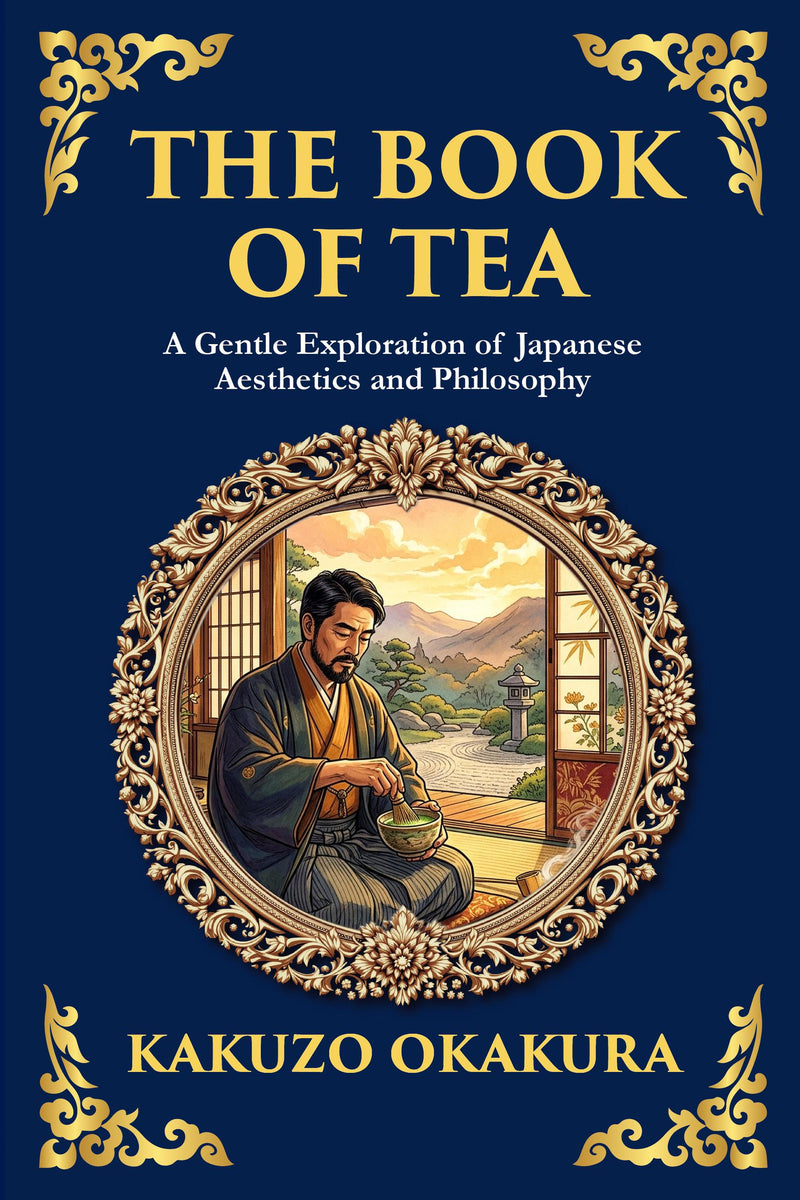
The Book of Tea
In this poetic meditation on culture and philosophy, The Book of Tea invites readers into the serene world of Japanese aesthetics—where simplicity is beauty, imperfection is cherished, and the ordinary becomes sacred.
or free app
10,000+ hrs library
30-day guarantee
The complete The Book of Tea appears in modern English through Library of Alexandria Press, available online with audiobook narration included for members.
Have you ever wondered why something as simple as tea can shape an entire way of life? The Book of Tea is a quiet masterpiece—a contemplative and graceful reflection on Japanese culture through the lens of the tea ceremony. Written in 1906 by Kakuzo Okakura, a Japanese scholar who wrote in English for a Western audience, this philosophical treatise explains the art of tea (Teaism) and how it embodies the core values of Japanese thought.
Okakura does not merely describe how tea is prepared or consumed. Instead, he draws profound connections between tea and Zen, Taoism, interior design, floral arrangement, architecture, and even political history. Through each page, readers are reminded that art and beauty lie not in the extravagant, but in the refined, imperfect, and ephemeral.
What you’ll discover in this modern edition
- A Meditative Exploration of Japanese Aesthetics – Discover the core values of harmony, respect, purity, and tranquility
- A Bridge Between Cultures – Written to explain Japanese sensibility to Western readers, making it ideal for modern global thinkers
- Insights into Taoism and Zen Philosophy – Learn how these ancient belief systems influence Japanese art and ritual
- Timeless Wisdom on Simplicity and Beauty – Understand the cultural appreciation for minimalism, silence, and transience
- The Philosophy Behind the Tea Ceremony – See how every gesture reflects deeper spiritual and ethical principles
| Formats | eBook (EPUB + PDF) · Audiobook · Paperback · Hardcover · Large Print |
| Language | English |
| Trim size (print) | 6 × 9 in |
| Binding | Paperback — perfect-bound · Hardcover — casewrap |
| Large Print edition | Same text in a larger, easy-read type — a larger font, not a larger trim |
| Print pricing | Every physical book at our true cost — at-cost, no profit (members) |
| Library | 873 restored titles, always growing |
| Length | 20,914 words · ~1 hr 24 min reading |
| Reading level | Grade 11 · a confident, adult read (this modern-English edition) |
| Edition | Modern English translation · 2026 |
Member reviews for this edition are collected as readers finish it — be the first. Across the library: 12,000+ books shipped, every plan covered by a 365-day print guarantee.
About this edition
A faithful, unabridged modern-English edition by The Library of Alexandria — carefully rendered for today's reader and verified paragraph-by-paragraph against the public-domain source. Available as eBook, audiobook, paperback, hardcover, and large print.
- Complete & unabridgedVerified paragraph by paragraph against the source — never a scan, never abridged.
- Modern English, faithfulReadable today, with the author’s meaning kept intact. Readable — not simplified.
- Every format, one membershipRead in your browser or the free app, or listen to the full audiobook.
Included free with your membership
Cancel anytime, one click · 30-day money-back guarantee
Edition last updated July 2026
What’s inside
The Book of Tea — complete and unabridged: all 8 sections included with membership, plus the full audiobook.
Begin reading The Book of Tea
In clear modern English — the complete text is included with membership.
Introduction
There are books that instruct, books that entertain, and books that quietly rearrange the furniture of the mind. Kakuzo Okakura’s slender meditation belongs unmistakably to the third category. Published in 1906 in English and written expressly for a Western audience, it disguises itself as a treatise on the drinking of a humble beverage. Within a few pages, however, the reader discovers that the cup before them is not really about tea at all. It is about how to live attentively, how to find beauty in the imperfect and the incomplete, and how an entire civilization can express its deepest convictions through the seemingly trivial gesture of boiling water and steeping leaves. To open this book is to accept an invitation into a way of seeing — gentle, unhurried, and quietly revolutionary.
What you hold in your hands is a modern translation and adaptation, prepared with care so that the contemporary reader may enter Okakura’s world without the friction of dated phrasing or unfamiliar reference. The original was composed in elegant, sometimes ornate Edwardian English, and while its music remains, certain passages once asked a great deal of patience from the reader. This edition smooths the path without smoothing away the soul. The aim has been to preserve the essential gentleness, the wit, the sly polemical edge, and above all the philosophical generosity of the work, while making it feel like a conversation that could be happening today. Okakura wrote at the turn of the twentieth century, but the questions he asks — about consumerism, about the tyranny of busyness, about the loss of beauty in modern life — are uncannily, almost eerily, the questions of our own moment.
Before you begin, it is worth knowing a little about the remarkable man who set down these words, and about the strange and urgent circumstances in which he wrote them. To understand the author is to understand why this small book carries such a large charge of feeling beneath its serene surface.
Kakuzo Okakura — also known by his pen name Tenshin — was born in 1862 in the port city of Yokohama, at the precise hinge of Japanese history. He arrived into a country that was about to transform itself more rapidly and more completely than perhaps any nation ever had. When Okakura was a child, Japan had only just emerged from more than two centuries of near-total isolation. The arrival of foreign ships and foreign demands had forced the country open, and in the decades that followed, Japan flung itself headlong into modernization. Railways, factories, Western dress, Western law, Western science — all of it poured in with astonishing speed. The old feudal order dissolved. The samurai laid down their swords. A society that had cultivated continuity for generations suddenly found itself remaking everything at once.
Okakura grew up fluent in this collision. Born to a merchant family, he learned English as a boy and absorbed Western learning at the new institutions springing up across the country. Yet he also fell deeply, passionately in love with the traditional arts of Asia — the painting, the sculpture, the architecture, the spiritual disciplines that the rushing tide of modernization threatened to sweep away as embarrassing relics of a backward past. This was the great tension of his life and the engine of his work. He was a man who could speak to the West in its own language, yet whose heart belonged to a heritage the West barely understood and often actively despised.
In his early career, Okakura became one of the most important figures in the preservation and revival of Japanese art. He helped found the Tokyo School of Fine Arts and later established his own academy when institutional politics turned against him. He traveled extensively through China and India, deepening his conviction that the arts of Asia formed a single, interconnected civilization — a belief he summarized in the famous opening line of an earlier book: “Asia is one.” Eventually his path led him to the United States, where he served as a curator at the Museum of Fine Arts in Boston, becoming a celebrated and somewhat exotic presence in the cultural salons of the American elite.
It was during these years abroad that he wrote the work before you, composing it directly in English rather than translating from Japanese. This detail matters enormously. Okakura was not writing for his countrymen, who needed no explanation of their own customs. He was writing for skeptical, self-satisfied Westerners at the height of the colonial era — people who tended to regard the East as either quaint or threatening, picturesque or barbaric, but rarely as a source of wisdom from which they might actually learn. His task, then, was an act of diplomacy disguised as an essay. He set out to make the West see itself through Eastern eyes, and to recognize, with a flush of recognition and perhaps a little shame, that its frantic material progress had left certain essential human capacities to wither.
Reading him today, we occupy a curious position. Many of the cultural barriers he wrote against have softened. Japanese aesthetics now command worldwide admiration; the language of “Zen” and “mindfulness” has entered everyday speech; the ritual he describes is no longer exotic but a familiar object of fascination. Yet in another sense his warnings have only grown sharper. We live in a world even faster, even more saturated with manufactured desire, even more allergic to stillness than the one he knew. His invitation to slow down, to attend, to find sufficiency in the small and the simple, lands with renewed force. The bridge he built between two worlds turns out to span more than geography. It spans the distance between a noisy modern life and the quieter, fuller existence he believed was still available to anyone willing to pause and pour a cup.
The central conceit of the book is so audacious that it is easy to miss how seriously Okakura means it. He proposes that the way of tea — the elaborate, codified ceremony developed in Japan over centuries — constitutes a complete philosophy of life. He even coins, half playfully and half in earnest, the term “Teaism” to place it alongside the great religions and systems of thought. This is not mere whimsy. He genuinely believes that in the act of preparing and sharing tea, the Japanese arrived at a refined expression of humanity’s relationship to beauty, to nature, to other people, and to the passing moment.
To grasp why, one has to set aside the Western assumption that tea is simply a drink. In the tradition Okakura describes, the ceremony is a carefully orchestrated experience involving architecture, gardening, flower arrangement, pottery, calligraphy, cuisine, and the subtle choreography of host and guest. The tea room itself is a deliberately humble structure — small, unadorned, even fragile — designed to strip away the clamor of the outer world and create a sanctuary of calm. Every element, from the rough texture of a hand-shaped bowl to the single flower placed in an alcove, is chosen to direct attention toward a particular quality of perception. The point is not to consume but to be present.
Underlying all of this is a cluster of ideas that the book unfolds with great delicacy. There is the principle of finding beauty in imperfection and impermanence — the recognition that a cracked bowl, a fading blossom, an asymmetrical line may move us more deeply than anything flawless or symmetrical, precisely because they remind us of the transience that gives life its poignancy. There is the embrace of emptiness and incompleteness, the radical notion that a thing left unfinished invites the imagination to complete it, and that a room left bare allows the spirit to expand. There is the cultivation of a profound humility, an attentiveness to small things, and a reverence for the natural world expressed not through grand gestures but through restraint.
Okakura traces the deep roots of these attitudes through the spiritual currents that shaped them. He shows how Taoism, with its love of the relative, the fluid, and the empty, prepared the ground; how the meditative discipline that the West knows as Zen carried these ideas into the realm of daily practice, insisting that enlightenment could be found in the most ordinary actions, that “the whole ideal of life” might be contained in the sweeping of a path or the heating of water. The tea master, in this telling, becomes a kind of artist of existence, treating life itself as the material to be shaped into something fine.
What makes the book so persuasive is that Okakura never lectures. He moves through history and legend, anecdote and aphorism, with the lightness of a man pouring tea for a friend. He tells stories of famous masters and their eccentricities, of feuds and friendships, of the great Sen no Rikyu and the dramatic, almost unbearable circumstances of his death. He digresses into the art of flowers and the psychology of the connoisseur. He pauses to skewer Western pretensions with a wit so dry it can take a moment to register. The effect is cumulative rather than systematic. By the end you do not so much understand the philosophy as feel it — feel the appeal of a life organized around presence, simplicity, and quiet attention rather than acquisition and display.
It is also a deeply moving book about the relationship between human beings and beauty. Okakura believed that the capacity to perceive beauty was not a luxury or a decoration but a fundamental measure of how alive we truly are. A culture that loses its sensitivity to the small, the subtle, the imperfect, the fleeting, he suggests, is a culture that has begun to die inwardly even as it flourishes outwardly. This is perhaps his most enduring provocation. He asks us, gently but insistently, whether all our progress has made us better at the one thing that matters most — the art of being fully present in our own lives.
A few words of guidance may enrich the experience that awaits you. First, do not approach this as a manual or a how-to guide. You will not finish it knowing how to conduct a tea ceremony, nor is that the intention. The ceremony is the vehicle, not the destination. What Okakura offers is a sensibility, a way of inclining toward the world, and the reader who relaxes into that sensibility rather than searching for practical instruction will find the most reward. Read it as you might sit in the tea room itself: slowly, attentively, with no agenda but the pleasure of the present moment.
Second, allow yourself to savor the prose. Even in this modernized form, the writing retains a poetic quality, full of imagery and rhythm and the occasional flash of paradox. Okakura was a stylist who delighted in the well-turned phrase, and many of his sentences are designed to be lingered over rather than rushed through. There are passages here worth reading aloud, worth returning to, worth keeping. The book is short — you could finish it in a single sitting — but it rewards the reader who refuses to hurry. In a sense, the very act of reading it slowly becomes a small practice of the attentiveness it celebrates. To race through a meditation on slowness would be to miss the joke and the point alike.
Third, keep in mind the historical conversation in which the book participates. Okakura is writing back against a particular set of attitudes — the casual condescension of a West that fancied itself the summit of civilization. Some of his sharpest passages take aim at this condescension, turning the tables to suggest that the supposedly refined and progressive nations of Europe and America were in fact spiritually impoverished, blind to beauties they could not be bothered to learn. There is real polemical fire beneath the serene surface, and recognizing it adds a layer of pleasure. When he observes that the average Westerner saw Japan as barbarous while it was absorbed in peaceful arts, and civilized only once it began to commit large-scale violence, he is making a point about the perverse standards by which the West judged other peoples — a point that has lost none of its bite. The gentleness of the book is real, but it is the gentleness of a master who could be cutting if he chose, and who occasionally does.
Cancel anytime, one click · 30-day money-back guarantee
Founding annual rate available now — your price locks for life when you join.
Not ready? Get this free chapter by email — read it anytime.
✓ Sent — check your inbox for The Book of Tea.
Questions about The Book of Tea
What is The Book of Tea about?
In this poetic meditation on culture and philosophy, The Book of Tea invites readers into the serene world of Japanese aesthetics—where simplicity is beauty, imperfection is cherished, and the ordinary becomes sacred. Written by scholar Kakuzo Okakura, this timeless work uses the Japanese tea ceremony as a gateway to explore the deeper meanings of art, life, and harmony. Far more than a guide to tea, this book gently bridges East and West, revealing how subtle rituals can reflect vast spiritual truths.
Who wrote The Book of Tea?
The Book of Tea was written by Kakuzo Okakura. This edition presents the complete work in clear modern English, faithfully rendered from the public-domain original by Library of Alexandria Press.
Is The Book of Tea free to read?
The opening chapter is free to read on this page. Members read and listen to the complete work — and the entire library — free, and can order any physical book at our true print cost.
How long is The Book of Tea?
8 chapters (~20,914 words) — about 1 hr 24 min of reading in this modern-English edition.
Is this an abridged version of The Book of Tea?
No. This is the complete, unabridged The Book of Tea, carefully rendered into clear modern English and verified paragraph-by-paragraph against the public-domain source — nothing is cut or summarised.
What formats does The Book of Tea come in?
The Book of Tea is available as eBook, paperback, hardcover and large print. eBook and audiobook are included with membership; printed editions ship at our true print cost.
Shipping & returns
Billing & membership
More from the library


Explore History
- The Advancement of Learning · Francis Bacon
- Democracy in America — Volume 2 · Alexis de Tocqueville
- Second Treatise of Government · John Locke
- The Prince · Niccolò Machiavelli
- Society in America, Volume 1 (of 2) · Harriet Martineau
- The Everlasting Man · G. K. Chesterton
- The Japanese Spirit · Yoshisaburo Okakura
- Give Me Liberty or Give Me Death · Patrick Henry
- Ion · Plato
- John F. Kennedy’s Inaugural Address · John F. Kennedy
- The Declaration of Independence of the United States of America · Thomas Jefferson
- On Heroes, Hero-Worship, and the Heroic in History · Thomas Carlyle
- The Communist Manifesto
- The Souls of Black Folk · W. E. B. Du Bois
- Letters on the Equality of the Sexes, and the Condition of Woman · Sarah Grimké
- The Romance of Biography (Vol. 1 of 2) · Mrs. Jameson
- The Erotic Motive in Literature · Albert Mordell
The Book of Tea
The Book of Tea
A Gentle Exploration of Japanese Aesthetics and Philosophy
Kakuzo Okakura
Contents
- Introduction
- Chapter 1
- Chapter 2
- Chapter 3
- Chapter 4
- Chapter 5
- Chapter 6
- Chapter 7
Introduction
There are books that instruct, books that entertain, and books that quietly rearrange the furniture of the mind. Kakuzo Okakura’s slender meditation belongs unmistakably to the third category. Published in 1906 in English and written expressly for a Western audience, it disguises itself as a treatise on the drinking of a humble beverage. Within a few pages, however, the reader discovers that the cup before them is not really about tea at all. It is about how to live attentively, how to find beauty in the imperfect and the incomplete, and how an entire civilization can express its deepest convictions through the seemingly trivial gesture of boiling water and steeping leaves. To open this book is to accept an invitation into a way of seeing — gentle, unhurried, and quietly revolutionary.
What you hold in your hands is a modern translation and adaptation, prepared with care so that the contemporary reader may enter Okakura’s world without the friction of dated phrasing or unfamiliar reference. The original was composed in elegant, sometimes ornate Edwardian English, and while its music remains, certain passages once asked a great deal of patience from the reader. This edition smooths the path without smoothing away the soul. The aim has been to preserve the essential gentleness, the wit, the sly polemical edge, and above all the philosophical generosity of the work, while making it feel like a conversation that could be happening today. Okakura wrote at the turn of the twentieth century, but the questions he asks — about consumerism, about the tyranny of busyness, about the loss of beauty in modern life — are uncannily, almost eerily, the questions of our own moment.
Before you begin, it is worth knowing a little about the remarkable man who set down these words, and about the strange and urgent circumstances in which he wrote them. To understand the author is to understand why this small book carries such a large charge of feeling beneath its serene surface.
Kakuzo Okakura — also known by his pen name Tenshin — was born in 1862 in the port city of Yokohama, at the precise hinge of Japanese history. He arrived into a country that was about to transform itself more rapidly and more completely than perhaps any nation ever had. When Okakura was a child, Japan had only just emerged from more than two centuries of near-total isolation. The arrival of foreign ships and foreign demands had forced the country open, and in the decades that followed, Japan flung itself headlong into modernization. Railways, factories, Western dress, Western law, Western science — all of it poured in with astonishing speed. The old feudal order dissolved. The samurai laid down their swords. A society that had cultivated continuity for generations suddenly found itself remaking everything at once.
Okakura grew up fluent in this collision. Born to a merchant family, he learned English as a boy and absorbed Western learning at the new institutions springing up across the country. Yet he also fell deeply, passionately in love with the traditional arts of Asia — the painting, the sculpture, the architecture, the spiritual disciplines that the rushing tide of modernization threatened to sweep away as embarrassing relics of a backward past. This was the great tension of his life and the engine of his work. He was a man who could speak to the West in its own language, yet whose heart belonged to a heritage the West barely understood and often actively despised.
In his early career, Okakura became one of the most important figures in the preservation and revival of Japanese art. He helped found the Tokyo School of Fine Arts and later established his own academy when institutional politics turned against him. He traveled extensively through China and India, deepening his conviction that the arts of Asia formed a single, interconnected civilization — a belief he summarized in the famous opening line of an earlier book: “Asia is one.” Eventually his path led him to the United States, where he served as a curator at the Museum of Fine Arts in Boston, becoming a celebrated and somewhat exotic presence in the cultural salons of the American elite.
It was during these years abroad that he wrote the work before you, composing it directly in English rather than translating from Japanese. This detail matters enormously. Okakura was not writing for his countrymen, who needed no explanation of their own customs. He was writing for skeptical, self-satisfied Westerners at the height of the colonial era — people who tended to regard the East as either quaint or threatening, picturesque or barbaric, but rarely as a source of wisdom from which they might actually learn. His task, then, was an act of diplomacy disguised as an essay. He set out to make the West see itself through Eastern eyes, and to recognize, with a flush of recognition and perhaps a little shame, that its frantic material progress had left certain essential human capacities to wither.
Reading him today, we occupy a curious position. Many of the cultural barriers he wrote against have softened. Japanese aesthetics now command worldwide admiration; the language of “Zen” and “mindfulness” has entered everyday speech; the ritual he describes is no longer exotic but a familiar object of fascination. Yet in another sense his warnings have only grown sharper. We live in a world even faster, even more saturated with manufactured desire, even more allergic to stillness than the one he knew. His invitation to slow down, to attend, to find sufficiency in the small and the simple, lands with renewed force. The bridge he built between two worlds turns out to span more than geography. It spans the distance between a noisy modern life and the quieter, fuller existence he believed was still available to anyone willing to pause and pour a cup.
The central conceit of the book is so audacious that it is easy to miss how seriously Okakura means it. He proposes that the way of tea — the elaborate, codified ceremony developed in Japan over centuries — constitutes a complete philosophy of life. He even coins, half playfully and half in earnest, the term “Teaism” to place it alongside the great religions and systems of thought. This is not mere whimsy. He genuinely believes that in the act of preparing and sharing tea, the Japanese arrived at a refined expression of humanity’s relationship to beauty, to nature, to other people, and to the passing moment.
To grasp why, one has to set aside the Western assumption that tea is simply a drink. In the tradition Okakura describes, the ceremony is a carefully orchestrated experience involving architecture, gardening, flower arrangement, pottery, calligraphy, cuisine, and the subtle choreography of host and guest. The tea room itself is a deliberately humble structure — small, unadorned, even fragile — designed to strip away the clamor of the outer world and create a sanctuary of calm. Every element, from the rough texture of a hand-shaped bowl to the single flower placed in an alcove, is chosen to direct attention toward a particular quality of perception. The point is not to consume but to be present.
Underlying all of this is a cluster of ideas that the book unfolds with great delicacy. There is the principle of finding beauty in imperfection and impermanence — the recognition that a cracked bowl, a fading blossom, an asymmetrical line may move us more deeply than anything flawless or symmetrical, precisely because they remind us of the transience that gives life its poignancy. There is the embrace of emptiness and incompleteness, the radical notion that a thing left unfinished invites the imagination to complete it, and that a room left bare allows the spirit to expand. There is the cultivation of a profound humility, an attentiveness to small things, and a reverence for the natural world expressed not through grand gestures but through restraint.
Okakura traces the deep roots of these attitudes through the spiritual currents that shaped them. He shows how Taoism, with its love of the relative, the fluid, and the empty, prepared the ground; how the meditative discipline that the West knows as Zen carried these ideas into the realm of daily practice, insisting that enlightenment could be found in the most ordinary actions, that “the whole ideal of life” might be contained in the sweeping of a path or the heating of water. The tea master, in this telling, becomes a kind of artist of existence, treating life itself as the material to be shaped into something fine.
What makes the book so persuasive is that Okakura never lectures. He moves through history and legend, anecdote and aphorism, with the lightness of a man pouring tea for a friend. He tells stories of famous masters and their eccentricities, of feuds and friendships, of the great Sen no Rikyu and the dramatic, almost unbearable circumstances of his death. He digresses into the art of flowers and the psychology of the connoisseur. He pauses to skewer Western pretensions with a wit so dry it can take a moment to register. The effect is cumulative rather than systematic. By the end you do not so much understand the philosophy as feel it — feel the appeal of a life organized around presence, simplicity, and quiet attention rather than acquisition and display.
It is also a deeply moving book about the relationship between human beings and beauty. Okakura believed that the capacity to perceive beauty was not a luxury or a decoration but a fundamental measure of how alive we truly are. A culture that loses its sensitivity to the small, the subtle, the imperfect, the fleeting, he suggests, is a culture that has begun to die inwardly even as it flourishes outwardly. This is perhaps his most enduring provocation. He asks us, gently but insistently, whether all our progress has made us better at the one thing that matters most — the art of being fully present in our own lives.
A few words of guidance may enrich the experience that awaits you. First, do not approach this as a manual or a how-to guide. You will not finish it knowing how to conduct a tea ceremony, nor is that the intention. The ceremony is the vehicle, not the destination. What Okakura offers is a sensibility, a way of inclining toward the world, and the reader who relaxes into that sensibility rather than searching for practical instruction will find the most reward. Read it as you might sit in the tea room itself: slowly, attentively, with no agenda but the pleasure of the present moment.
Second, allow yourself to savor the prose. Even in this modernized form, the writing retains a poetic quality, full of imagery and rhythm and the occasional flash of paradox. Okakura was a stylist who delighted in the well-turned phrase, and many of his sentences are designed to be lingered over rather than rushed through. There are passages here worth reading aloud, worth returning to, worth keeping. The book is short — you could finish it in a single sitting — but it rewards the reader who refuses to hurry. In a sense, the very act of reading it slowly becomes a small practice of the attentiveness it celebrates. To race through a meditation on slowness would be to miss the joke and the point alike.
Third, keep in mind the historical conversation in which the book participates. Okakura is writing back against a particular set of attitudes — the casual condescension of a West that fancied itself the summit of civilization. Some of his sharpest passages take aim at this condescension, turning the tables to suggest that the supposedly refined and progressive nations of Europe and America were in fact spiritually impoverished, blind to beauties they could not be bothered to learn. There is real polemical fire beneath the serene surface, and recognizing it adds a layer of pleasure. When he observes that the average Westerner saw Japan as barbarous while it was absorbed in peaceful arts, and civilized only once it began to commit large-scale violence, he is making a point about the perverse standards by which the West judged other peoples — a point that has lost none of its bite. The gentleness of the book is real, but it is the gentleness of a master who could be cutting if he chose, and who occasionally does.
Tea started as a medicine and eventually became a drink. By the eighth century in China, it became a subject of poetry and a refined pastime. In the fifteenth century, Japan elevated it into a spiritual practice centered on beauty—Teaism. Teaism is a philosophy based on finding beauty amidst the gritty realities of daily life. It teaches purity, harmony, the mystery of kindness toward others, and the romance of social structure. Essentially, it is a celebration of the imperfect, serving as a gentle attempt to achieve something meaningful within the difficult experience we call life.
The Philosophy of Tea is more than just a typical appreciation of art; it combines ethics and religion to express a complete worldview regarding humanity and nature. It is a matter of health because it promotes cleanliness. It is a matter of economics because it finds comfort in simplicity rather than in expensive or complex things. It is a form of moral geometry, as it defines our place and proportion within the universe. It embodies the true spirit of Eastern democracy by giving everyone who practices it the refined taste of an aristocrat.
Japan’s long isolation from the rest of the world encouraged deep reflection, which greatly helped Teaism grow. Our homes, habits, clothing, food, pottery, lacquerware, painting, and even our literature have all been shaped by it. No one studying Japanese culture could possibly overlook its influence. It has touched everything from the elegant rooms of the nobility to the homes of the poor. Our farmers have learned the art of flower arrangement, and even the simplest laborers show respect to the rocks and streams. In our everyday language, we say a person has “no tea” in them if they cannot appreciate the serious yet humorous side of human drama. On the other hand, we criticize the undisciplined aesthete who ignores real-world tragedies to indulge in a flood of raw emotion as someone who has “too much tea” in them.
End of the free sample
Keep reading, free
Members read and listen to the complete book — and the entire library. Cancel anytime, one click · 30-day money-back guarantee.