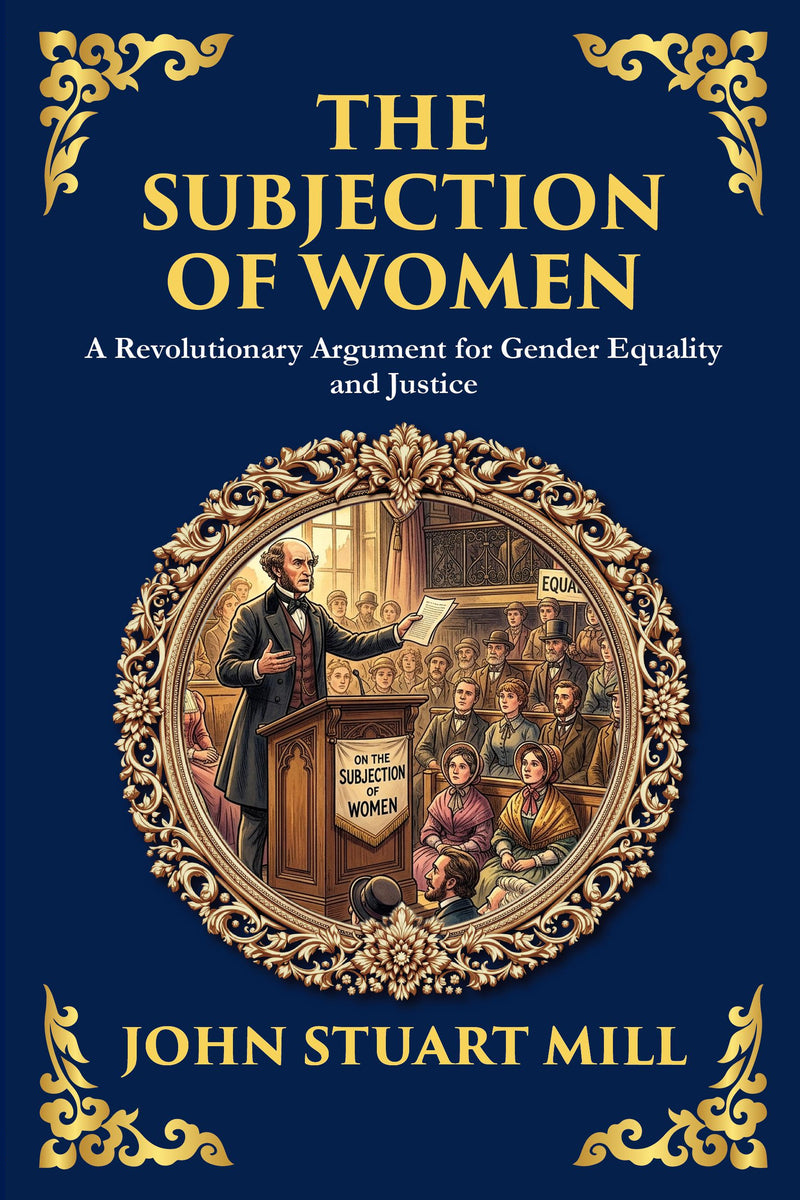
The Subjection of Women
Few works in modern political philosophy have ignited as profound a conversation as The Subjection of Women. In this groundbreaking manifesto, John Stuart Mill lays bare the unjust foundations of gender inequality, exposing the social, legal, and cultural systems that have long subordinated women.
or free app
10,000+ hrs library
30-day guarantee
The complete The Subjection of Women appears in modern English through Library of Alexandria Press, available online with audiobook narration included for members.
Have you ever wondered why freedom has too often excluded half of humanity? The Subjection of Women by John Stuart Mill is one of the earliest and most influential works of feminist philosophy—a clarion call for legal and social equality that still resonates over a century later. Written in collaboration with Harriet Taylor Mill, this revolutionary text deconstructs the assumptions behind female subordination and calls for a reexamination of gender roles, liberty, and human potential.
Mill’s argument is rooted in logic, empathy, and the liberal principles of justice and individuality. With striking clarity, he draws attention to how women’s subjugation is not a result of nature, but of systemic and historical oppression. He challenges the institution of marriage, advocates for women’s rights to education and participation in public life, and insists that society can never achieve true progress while denying half its members their full humanity.
This modern edition makes Mill’s insights more accessible than ever—bridging past and present, and reminding us how much remains at stake.
What you’ll discover in this modern edition
- A Historic Challenge to Patriarchy – Mill’s systematic breakdown of the moral and rational failures of gender inequality.
- An Enlightened Vision of Partnership – A bold rethinking of marriage as a union of equals.
- The Interplay of Freedom and Justice – How women’s liberty is essential to a just and progressive society.
- Enduring Relevance – A 19th-century work that anticipates and informs modern gender equality movements.
- A Personal and Political Testament – Written with the influence of Harriet Taylor Mill, whose intellect shaped every page.
| Formats | eBook (EPUB + PDF) · Audiobook · Paperback · Hardcover · Large Print |
| Language | English |
| Trim size (print) | 6 × 9 in |
| Binding | Paperback — perfect-bound · Hardcover — casewrap |
| Large Print edition | Same text in a larger, easy-read type — a larger font, not a larger trim |
| Print pricing | Every physical book at our true cost — at-cost, no profit (members) |
| Library | 873 restored titles, always growing |
| Length | 40,114 words · ~2 hr 40 min reading |
| Reading level | Grade 3 · an easy, flowing read (this modern-English edition) |
| Edition | Modern English translation · 2026 |
Member reviews for this edition are collected as readers finish it — be the first. Across the library: 12,000+ books shipped, every plan covered by a 365-day print guarantee.
About this edition
A faithful, unabridged modern-English edition by The Library of Alexandria — carefully rendered for today's reader and verified paragraph-by-paragraph against the public-domain source. Available as eBook, audiobook, paperback, hardcover, and large print.
- Complete & unabridgedVerified paragraph by paragraph against the source — never a scan, never abridged.
- Modern English, faithfulReadable today, with the author’s meaning kept intact. Readable — not simplified.
- Every format, one membershipRead in your browser or the free app, or listen to the full audiobook.
Included free with your membership
Cancel anytime, one click · 30-day money-back guarantee
Edition last updated July 2026
What’s inside
The Subjection of Women — complete and unabridged: all 5 sections included with membership, plus the full audiobook.
Begin reading The Subjection of Women
In clear modern English — the complete text is included with membership.
Introduction
When John Stuart Mill published The Subjection of Women in 1869, he was not writing into a vacuum of indifference—he was hurling a stone into the carefully ordered pond of Victorian respectability and watching the ripples spread outward toward every assumption his society held most dear. The book was greeted with a storm of scorn, ridicule, and outraged disbelief. Reviewers called it dangerous, absurd, unnatural. Some of his admirers turned away in embarrassment, as if a respected philosopher had suddenly lost his composure. And yet, more than a century and a half later, it is precisely this small, fierce, lucidly argued book that has endured as one of the founding documents of modern feminism, while the comfortable certainties it attacked have largely crumbled into historical curiosities. To read it today is to witness a mind of extraordinary rigor turning its full force against an injustice so deeply embedded in the fabric of daily life that almost no one around him could even see it as an injustice at all.
That is, perhaps, the most remarkable thing about this work. Mill did not merely argue that women were being treated unfairly. He argued something far more radical and far more difficult to grasp: that the entire structure of relations between men and women, accepted by nearly everyone as natural, inevitable, and ordained either by God or by biology, was in fact a relic of barbarism—a “single relic of an old world of thought and practice exploded in everything else,” as he memorably put it. The subordination of one sex to the other, he insisted, was not the product of careful reasoning or accumulated wisdom. It was the product of the simple fact that men were physically stronger, and that this raw fact of force had, over the millennia, been dressed up in the respectable clothing of law, custom, religion, and sentiment until it appeared to be the very order of nature itself.
To appreciate the courage and the originality of what Mill accomplished, you must first understand just how alone he was in saying it. John Stuart Mill was, by the time he wrote this book, one of the most celebrated thinkers in the English-speaking world. He was the author of foundational works on logic, economics, and political philosophy. He had served as a Member of Parliament. His name carried weight. He could have spent the rest of his career consolidating his reputation, polishing his legacy, and saying nothing to disturb the people who admired him. Instead, he chose to stake that reputation on a cause that his entire society regarded as eccentric at best and indecent at worst.
The Victorian world into which this book emerged was one in which a married woman had, in a very real legal sense, no separate existence. Under the doctrine of coverture, a wife’s legal identity was absorbed into her husband’s upon marriage. She could not own property in her own name. The wages she earned belonged to him. The children she bore were legally his, and in cases of separation he could deny her any access to them. She could not vote, could not attend the great universities, could not enter the professions, could not sit on a jury or hold most public offices. If her husband beat her, the law offered her almost no protection, and divorce was, for all practical purposes, beyond her reach. Mill describes this condition with a precision that still has the power to shock, comparing the legal position of the wife unflinchingly to that of a slave—and then pointing out, with devastating clarity, that in certain respects her position was even worse, for a slave at least had hours that were her own, while the wife was understood to belong to her husband at every hour of the day and night.
What makes Mill’s analysis so powerful is that he refused to treat any of this as accidental or as a mere collection of unfortunate laws that might be reformed one at a time. He saw it as a system, an interlocking architecture of subordination held in place by something far more difficult to dislodge than statutes: by feeling, by sentiment, by the deeply held conviction that this arrangement was simply how things were meant to be. And he understood, with the insight of a great psychologist, that the most effective form of domination is not the kind imposed by force but the kind that wins the willing cooperation of those it subjects. Men, he observed, did not merely want obedience from women. They wanted love. They wanted women to embrace their subordinate role, to find their fulfillment in it, to mold their very characters around the desires of the men who controlled them. The whole education of women, he argued, had been directed toward this end—toward cultivating submission, dependence, and the suppression of any will that might run counter to a man’s. This is one of the book’s most penetrating observations, and one that resonates far beyond its own century: that an oppression which has captured the minds and desires of the oppressed is the hardest of all oppressions to recognize and to overthrow.
Mill anticipated the obvious objection, the one that was thrown at him from every direction. Surely, his critics said, women themselves did not complain. Surely the relations between the sexes rested on the consent and even the contentment of women. To this Mill had an answer that cuts to the heart of how power perpetuates itself. How could anyone speak of women’s free consent, he asked, when women had been systematically denied the education, the independence, the legal standing, and the very vocabulary that would allow them to imagine and articulate an alternative? A consent extracted under conditions of total dependence is no consent at all. And besides, he noted, the silence was never as complete as men liked to believe; the complaints were there for anyone willing to listen, and they were growing louder. The very ferocity with which men defended the existing order, he suggested, betrayed an anxiety that it might not be as natural or as universally welcomed as they claimed.
Perhaps the most intellectually devastating thread running through the entire argument is Mill’s relentless assault on the appeal to “nature.” Whenever a custom is deeply entrenched and serves the interests of those in power, he observed, it is invariably defended as being in accordance with nature. The subordination of women was no exception. Women were said to be naturally suited to domestic life, naturally less capable of abstract reasoning, naturally fitted for obedience rather than command. But Mill turned this argument inside out with a single, unanswerable question: How could anyone possibly know what was natural to women, when no woman had ever been allowed to develop freely, without the relentless shaping pressure of an upbringing designed to fit her for a subordinate role? “What is now called the nature of women,” he wrote, “is an eminently artificial thing—the result of forced repression in some directions, unnatural stimulation in others.” Until women were free to become whatever their abilities and inclinations led them to become, any pronouncement about their natural limitations was nothing more than prejudice masquerading as science. We simply did not know, and could not know, what women were capable of, because we had never permitted the experiment of letting them try.
It would be a serious misreading to imagine that Mill’s book is merely a catalogue of grievances or a demand for the removal of legal disabilities. He certainly wants those disabilities removed—the right to vote, the right to own property, the right to enter the professions and the universities, the reform of the marriage laws. But his vision goes far deeper than a checklist of reforms. What he is really arguing for is a transformation in the most intimate relationship most human beings ever enter: marriage itself. And here he advances an idea that was almost unimaginable to his contemporaries—the idea of marriage as a genuine partnership of equals, a friendship between two people who choose one another freely and stand on equal footing.
Mill’s portrait of the ideal marriage is one of the most moving passages in the entire book, and it stands in deliberate, pointed contrast to the relations of dominance and submission that he saw all around him. He imagined a union of two persons of cultivated faculties, identical in opinions and purposes, between whom there exists that gradual sharing of thoughts and growing together of two natures that constitutes the deepest happiness available to human beings. In such a marriage there could be no question of one commanding and the other obeying, because there would be no commands—only the constant, mutual adjustment of two equals living a shared life. He knew this from his own experience, for his marriage to Harriet Taylor had been precisely such a partnership, and her influence on this very book was so profound that Mill always insisted the ideas in it were as much hers as his.
This brings us to one of the essential facts about the work you are about to read. The Subjection of Women did not spring from Mill’s mind alone. It was the fruit of an intellectual and emotional collaboration that lasted decades. Harriet Taylor Mill, whom John Stuart Mill married in 1851 after a long and famously controversial friendship, was herself a thinker of formidable powers, and Mill credited her, repeatedly and without reservation, as the source of much of what was best in his work on the question of women. Their daughter Helen Taylor also contributed to the ideas the book contains. So while the prose is Mill’s, the argument is in a profound sense a shared one, the product of a real partnership of the kind the book itself holds up as an ideal. There is something deeply fitting about this. A book arguing for the equality of women was itself the product of a marriage in which a woman’s mind was treated as the equal of a man’s. Mill practiced what he preached, and the book carries the authority of lived experience as well as the force of philosophical argument.
What is striking about Mill’s case for equality is that he refuses to rest it on a single foundation. He builds it up from several directions at once, and each line of argument reinforces the others. There is the argument from justice: that it is simply wrong to deny to half the human race, on the basis of an accident of birth, the freedoms and opportunities granted to the other half. There is the argument from utility, deeply rooted in Mill’s philosophical convictions: that the subordination of women is an immense waste of human talent and energy, depriving society of the contributions that half its members might make if they were free to develop and use their full capacities. Think, he urges, of the doubling of the mass of mental faculties available for the higher service of humanity that would follow from the emancipation of women—the writers, the thinkers, the leaders, the discoverers who are at present prevented from ever coming into being.
And there is the argument that, in many ways, lies closest to the moral heart of the book: the argument about what the subordination of women does to men, and to the character of human beings generally. Mill understood that an unjust power corrupts the one who wields it just as surely as it injures the one who suffers under it. To grow up as a boy with the knowledge that, simply by virtue of being male, you are the superior of every woman, including women far wiser and more capable than yourself, is to be inducted from the cradle into a habit of unearned self-regard. It teaches men to value themselves not for what they achieve but for what they are by accident of birth. It poisons the most important relationships of their lives by making genuine equality, and therefore genuine intimacy, impossible. The family, Mill argued with great force, ought to be the school in which human beings learn the virtues of freedom and equality and mutual consideration—but as long as it was founded on the principle of one person’s command and another’s obedience, it could only be a school for despotism, teaching men to expect submission and teaching women to offer it. A society that wishes to raise free and just citizens cannot do so in households organized on the principle of tyranny.
Cancel anytime, one click · 30-day money-back guarantee
Founding annual rate available now — your price locks for life when you join.
Not ready? Get this free chapter by email — read it anytime.
✓ Sent — check your inbox for The Subjection of Women.
Questions about The Subjection of Women
What is The Subjection of Women about?
Few works in modern political philosophy have ignited as profound a conversation as The Subjection of Women. In this groundbreaking manifesto, John Stuart Mill lays bare the unjust foundations of gender inequality, exposing the social, legal, and cultural systems that have long subordinated women. With unwavering logic and moral conviction, Mill dismantles the belief that women are inherently inferior to men and instead argues for complete equality—not only in law, but in love, work, and society.
Who wrote The Subjection of Women?
The Subjection of Women was written by John Stuart Mill. This edition presents the complete work in clear modern English, faithfully rendered from the public-domain original by Library of Alexandria Press.
Is The Subjection of Women free to read?
The opening chapter is free to read on this page. Members read and listen to the complete work — and the entire library — free, and can order any physical book at our true print cost.
How long is The Subjection of Women?
5 chapters (~40,114 words) — about 2 hr 40 min of reading in this modern-English edition.
Is this an abridged version of The Subjection of Women?
No. This is the complete, unabridged The Subjection of Women, carefully rendered into clear modern English and verified paragraph-by-paragraph against the public-domain source — nothing is cut or summarised.
What formats does The Subjection of Women come in?
The Subjection of Women is available as eBook, paperback, hardcover and large print. eBook and audiobook are included with membership; printed editions ship at our true print cost.
Shipping & returns
Billing & membership
More from the library


Explore Philosophy & Ideas
- Kant's Prolegomena to Any Future Metaphysics · Immanuel Kant
- The Advancement of Learning · Francis Bacon
- The Dawn of Day · Friedrich Wilhelm Nietzsche
- Meditations · Marcus Aurelius
- The Confessions of St. Augustine · Saint Augustine
- Dialogues Concerning Natural Religion · David Hume
- Considerations on Representative Government · John Stuart Mill
- The Will to Power: An Attempted Transvaluation of All Values. Book III and IV · Friedrich Nietzsche
- Groundwork of the Metaphysics of Morals · Immanuel Kant
- The Confessions of Jean-Jacques Rousseau — Complete · Jean-Jacques Rousseau
- Democracy in America — Volume 2 · Alexis de Tocqueville
- Ecce Homo · Friedrich Wilhelm Nietzsche
- Second Treatise of Government · John Locke
- The Prince · Niccolò Machiavelli
- Thus Spake Zarathustra: A Book for All and None · Friedrich Wilhelm Nietzsche
- The Island of Doctor Moreau · H. G. Wells
- Sophist · Plato
- The Seven Lamps of Architecture · John Ruskin
- Essays — First Series · Ralph Waldo Emerson
- The Book of the Damned · Charles Fort
- The Everlasting Man · G. K. Chesterton
- The Initiates of the Flame · Manly P. Hall
- The Book of Tea · Kakuzo Okakura
- The Japanese Spirit · Yoshisaburo Okakura
- The Analysis of Mind · Bertrand Russell
- Orthodoxy · G. K. Chesterton
- Apology, Crito, and Phaedo of Socrates · Plato
- Euthyphro · Plato
- Timaeus · Plato
- Ion · Plato
The Subjection of Women
The Subjection of Women
A Revolutionary Argument for Gender Equality and Justice
John Stuart Mill
Contents
- Introduction
- Chapter 1
- Chapter 2
- Chapter 3
- Chapter 4
Introduction
When John Stuart Mill published The Subjection of Women in 1869, he was not writing into a vacuum of indifference—he was hurling a stone into the carefully ordered pond of Victorian respectability and watching the ripples spread outward toward every assumption his society held most dear. The book was greeted with a storm of scorn, ridicule, and outraged disbelief. Reviewers called it dangerous, absurd, unnatural. Some of his admirers turned away in embarrassment, as if a respected philosopher had suddenly lost his composure. And yet, more than a century and a half later, it is precisely this small, fierce, lucidly argued book that has endured as one of the founding documents of modern feminism, while the comfortable certainties it attacked have largely crumbled into historical curiosities. To read it today is to witness a mind of extraordinary rigor turning its full force against an injustice so deeply embedded in the fabric of daily life that almost no one around him could even see it as an injustice at all.
That is, perhaps, the most remarkable thing about this work. Mill did not merely argue that women were being treated unfairly. He argued something far more radical and far more difficult to grasp: that the entire structure of relations between men and women, accepted by nearly everyone as natural, inevitable, and ordained either by God or by biology, was in fact a relic of barbarism—a “single relic of an old world of thought and practice exploded in everything else,” as he memorably put it. The subordination of one sex to the other, he insisted, was not the product of careful reasoning or accumulated wisdom. It was the product of the simple fact that men were physically stronger, and that this raw fact of force had, over the millennia, been dressed up in the respectable clothing of law, custom, religion, and sentiment until it appeared to be the very order of nature itself.
To appreciate the courage and the originality of what Mill accomplished, you must first understand just how alone he was in saying it. John Stuart Mill was, by the time he wrote this book, one of the most celebrated thinkers in the English-speaking world. He was the author of foundational works on logic, economics, and political philosophy. He had served as a Member of Parliament. His name carried weight. He could have spent the rest of his career consolidating his reputation, polishing his legacy, and saying nothing to disturb the people who admired him. Instead, he chose to stake that reputation on a cause that his entire society regarded as eccentric at best and indecent at worst.
The Victorian world into which this book emerged was one in which a married woman had, in a very real legal sense, no separate existence. Under the doctrine of coverture, a wife’s legal identity was absorbed into her husband’s upon marriage. She could not own property in her own name. The wages she earned belonged to him. The children she bore were legally his, and in cases of separation he could deny her any access to them. She could not vote, could not attend the great universities, could not enter the professions, could not sit on a jury or hold most public offices. If her husband beat her, the law offered her almost no protection, and divorce was, for all practical purposes, beyond her reach. Mill describes this condition with a precision that still has the power to shock, comparing the legal position of the wife unflinchingly to that of a slave—and then pointing out, with devastating clarity, that in certain respects her position was even worse, for a slave at least had hours that were her own, while the wife was understood to belong to her husband at every hour of the day and night.
What makes Mill’s analysis so powerful is that he refused to treat any of this as accidental or as a mere collection of unfortunate laws that might be reformed one at a time. He saw it as a system, an interlocking architecture of subordination held in place by something far more difficult to dislodge than statutes: by feeling, by sentiment, by the deeply held conviction that this arrangement was simply how things were meant to be. And he understood, with the insight of a great psychologist, that the most effective form of domination is not the kind imposed by force but the kind that wins the willing cooperation of those it subjects. Men, he observed, did not merely want obedience from women. They wanted love. They wanted women to embrace their subordinate role, to find their fulfillment in it, to mold their very characters around the desires of the men who controlled them. The whole education of women, he argued, had been directed toward this end—toward cultivating submission, dependence, and the suppression of any will that might run counter to a man’s. This is one of the book’s most penetrating observations, and one that resonates far beyond its own century: that an oppression which has captured the minds and desires of the oppressed is the hardest of all oppressions to recognize and to overthrow.
Mill anticipated the obvious objection, the one that was thrown at him from every direction. Surely, his critics said, women themselves did not complain. Surely the relations between the sexes rested on the consent and even the contentment of women. To this Mill had an answer that cuts to the heart of how power perpetuates itself. How could anyone speak of women’s free consent, he asked, when women had been systematically denied the education, the independence, the legal standing, and the very vocabulary that would allow them to imagine and articulate an alternative? A consent extracted under conditions of total dependence is no consent at all. And besides, he noted, the silence was never as complete as men liked to believe; the complaints were there for anyone willing to listen, and they were growing louder. The very ferocity with which men defended the existing order, he suggested, betrayed an anxiety that it might not be as natural or as universally welcomed as they claimed.
Perhaps the most intellectually devastating thread running through the entire argument is Mill’s relentless assault on the appeal to “nature.” Whenever a custom is deeply entrenched and serves the interests of those in power, he observed, it is invariably defended as being in accordance with nature. The subordination of women was no exception. Women were said to be naturally suited to domestic life, naturally less capable of abstract reasoning, naturally fitted for obedience rather than command. But Mill turned this argument inside out with a single, unanswerable question: How could anyone possibly know what was natural to women, when no woman had ever been allowed to develop freely, without the relentless shaping pressure of an upbringing designed to fit her for a subordinate role? “What is now called the nature of women,” he wrote, “is an eminently artificial thing—the result of forced repression in some directions, unnatural stimulation in others.” Until women were free to become whatever their abilities and inclinations led them to become, any pronouncement about their natural limitations was nothing more than prejudice masquerading as science. We simply did not know, and could not know, what women were capable of, because we had never permitted the experiment of letting them try.
It would be a serious misreading to imagine that Mill’s book is merely a catalogue of grievances or a demand for the removal of legal disabilities. He certainly wants those disabilities removed—the right to vote, the right to own property, the right to enter the professions and the universities, the reform of the marriage laws. But his vision goes far deeper than a checklist of reforms. What he is really arguing for is a transformation in the most intimate relationship most human beings ever enter: marriage itself. And here he advances an idea that was almost unimaginable to his contemporaries—the idea of marriage as a genuine partnership of equals, a friendship between two people who choose one another freely and stand on equal footing.
Mill’s portrait of the ideal marriage is one of the most moving passages in the entire book, and it stands in deliberate, pointed contrast to the relations of dominance and submission that he saw all around him. He imagined a union of two persons of cultivated faculties, identical in opinions and purposes, between whom there exists that gradual sharing of thoughts and growing together of two natures that constitutes the deepest happiness available to human beings. In such a marriage there could be no question of one commanding and the other obeying, because there would be no commands—only the constant, mutual adjustment of two equals living a shared life. He knew this from his own experience, for his marriage to Harriet Taylor had been precisely such a partnership, and her influence on this very book was so profound that Mill always insisted the ideas in it were as much hers as his.
This brings us to one of the essential facts about the work you are about to read. The Subjection of Women did not spring from Mill’s mind alone. It was the fruit of an intellectual and emotional collaboration that lasted decades. Harriet Taylor Mill, whom John Stuart Mill married in 1851 after a long and famously controversial friendship, was herself a thinker of formidable powers, and Mill credited her, repeatedly and without reservation, as the source of much of what was best in his work on the question of women. Their daughter Helen Taylor also contributed to the ideas the book contains. So while the prose is Mill’s, the argument is in a profound sense a shared one, the product of a real partnership of the kind the book itself holds up as an ideal. There is something deeply fitting about this. A book arguing for the equality of women was itself the product of a marriage in which a woman’s mind was treated as the equal of a man’s. Mill practiced what he preached, and the book carries the authority of lived experience as well as the force of philosophical argument.
What is striking about Mill’s case for equality is that he refuses to rest it on a single foundation. He builds it up from several directions at once, and each line of argument reinforces the others. There is the argument from justice: that it is simply wrong to deny to half the human race, on the basis of an accident of birth, the freedoms and opportunities granted to the other half. There is the argument from utility, deeply rooted in Mill’s philosophical convictions: that the subordination of women is an immense waste of human talent and energy, depriving society of the contributions that half its members might make if they were free to develop and use their full capacities. Think, he urges, of the doubling of the mass of mental faculties available for the higher service of humanity that would follow from the emancipation of women—the writers, the thinkers, the leaders, the discoverers who are at present prevented from ever coming into being.
And there is the argument that, in many ways, lies closest to the moral heart of the book: the argument about what the subordination of women does to men, and to the character of human beings generally. Mill understood that an unjust power corrupts the one who wields it just as surely as it injures the one who suffers under it. To grow up as a boy with the knowledge that, simply by virtue of being male, you are the superior of every woman, including women far wiser and more capable than yourself, is to be inducted from the cradle into a habit of unearned self-regard. It teaches men to value themselves not for what they achieve but for what they are by accident of birth. It poisons the most important relationships of their lives by making genuine equality, and therefore genuine intimacy, impossible. The family, Mill argued with great force, ought to be the school in which human beings learn the virtues of freedom and equality and mutual consideration—but as long as it was founded on the principle of one person’s command and another’s obedience, it could only be a school for despotism, teaching men to expect submission and teaching women to offer it. A society that wishes to raise free and just citizens cannot do so in households organized on the principle of tyranny.
The goal of this essay is to explain as clearly as I can the reasons for a belief I have held since I first began forming opinions on social and political issues. Rather than fading or changing, this conviction has only grown stronger as I have aged and thought more deeply about it. My belief is that the principle governing current social relations between the sexes—the legal subordination of one sex to the other—is fundamentally wrong and is now one of the main obstacles to human progress. It should be replaced by a principle of total equality, where neither side has special power or privilege, and neither side faces legal disadvantages.
The very words I must use to describe this task show how difficult it is. However, it would be a mistake to assume that this difficulty stems from a lack of clear or logical evidence for my conviction. Instead, the difficulty is the same as in any case where one must fight against deeply held emotions. When an opinion is rooted in feeling, it often becomes more stable, not less, when faced with overwhelming logical arguments. If a belief were based on logic, a better argument could shake it; but when it is based solely on emotion, the more it loses in a logical debate, the more its supporters believe their feelings must be based on some deeper truth that logic simply cannot reach. As long as that feeling persists, they will keep inventing new arguments to patch up the holes in their old ones. There are so many reasons why the emotions surrounding this subject are among the most intense and deeply rooted of all those that protect old customs and institutions. Therefore, we shouldn’t be surprised that these beliefs have been less affected by modern social and spiritual progress than others. Nor should we assume that the barbaric customs men cling to the longest are any less barbaric than the ones they abandoned sooner.
End of the free sample
Keep reading, free
Members read and listen to the complete book — and the entire library. Cancel anytime, one click · 30-day money-back guarantee.