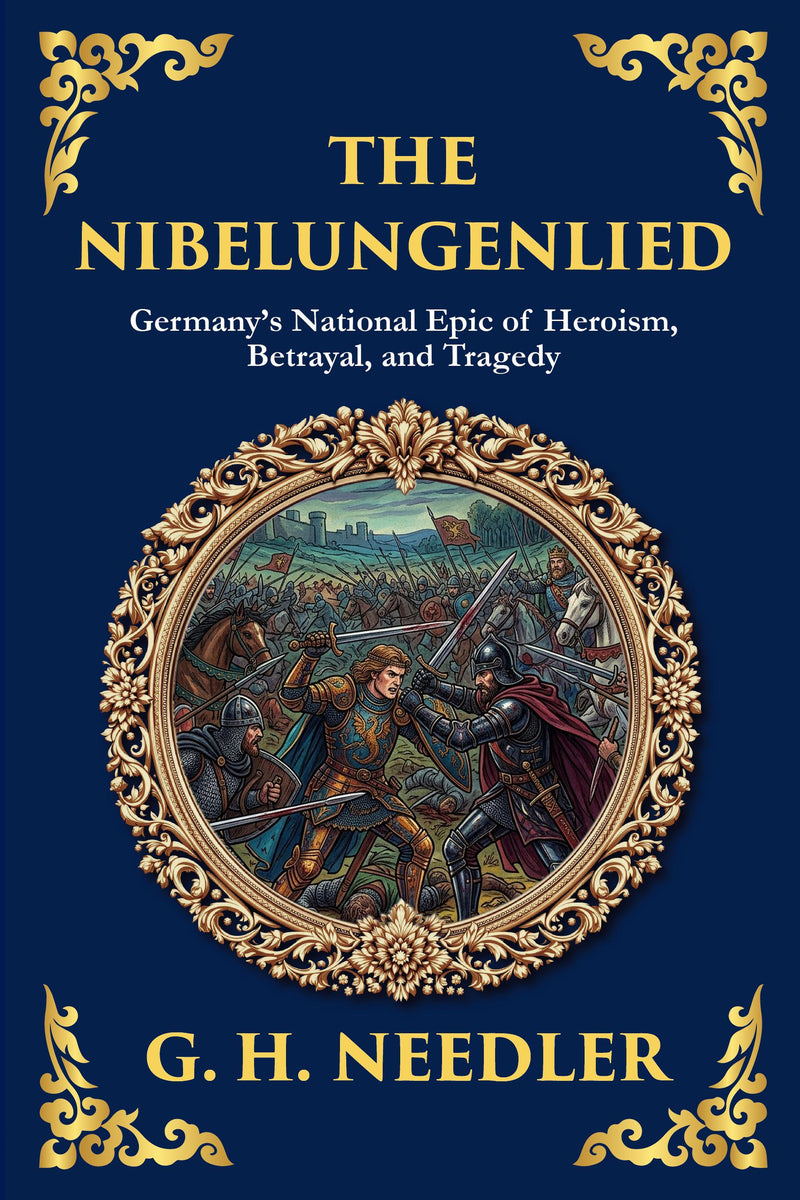
The Nibelungenlied — Large Print
from The Nibelungenlied In this monumental epic of medieval Germany, heroism is glorious, loyalty is sacred—and betrayal cuts the deepest.
or free app
10,000+ hrs library
30-day guarantee
The complete The Nibelungenlied appears in modern English through Library of Alexandria Press, available online with audiobook narration included for members.
Have you ever wondered why legends of love and vengeance still haunt us today? The Nibelungenlied: Germany’s National Epic of Heroism, Betrayal, and Tragedy is one of the great poems of the European Middle Ages. Composed around the 13th century, this saga tells of mighty deeds and human frailties—the kind of narrative that shaped the moral imagination of generations.
In this translation by G. H. Needler, the pulse of the original text lives on: majestic, brutal, heartbreaking. This edition brings forward the epic’s fullest power: battles that thunder, betrayals that devastate, characters whose loyalty and flaws alike define their fates. From Siegfried’s fearless journey to Kriemhild’s relentless grief, it is a story of heroic heights and tragic depths.
What you’ll discover in this modern edition
- A Hero’s Journey and Its Price – Witness how Siegfried’s triumphs come at costs that his kingdom and enemies alike cannot ignore.
- Loyalty, Love, and Treachery – Explore the bonds of marriage, brotherhood, and kinship—and how easily they fracture under ambition and jealousy.
- The Role of Fate and Honor – Honor is pursued, betrayed, and avenged, even as fate looms in every sword stroke and promise broken.
- Rich Character Portraits – From the noble Kriemhild to the treacherous Hagen; from royal Gunther to the doomed dragon-slayer Siegfried.
- A Translation that Resonates Now – Clear, powerful, and respectful of the poem’s original cadence—perfect for readers new to Germanic myth or lovers of epic poetry alike.
| Formats | eBook (EPUB + PDF) · Audiobook · Paperback · Hardcover · Large Print |
| Language | English |
| Trim size (print) | 6 × 9 in |
| Binding | Paperback — perfect-bound · Hardcover — casewrap |
| Large Print edition | Same text in a larger, easy-read type — a larger font, not a larger trim |
| Print pricing | Every physical book at our true cost — at-cost, no profit (members) |
| Library | 873 restored titles, always growing |
| Length | 108,817 words · ~7 hr 15 min reading |
| Reading level | Grade 7 · an easy, flowing read (this modern-English edition) |
| Edition | Modern English translation · 2026 |
Member reviews for this edition are collected as readers finish it — be the first. Across the library: 12,000+ books shipped, every plan covered by a 365-day print guarantee.
About this edition
A faithful, unabridged modern-English edition by The Library of Alexandria — carefully rendered for today's reader and verified paragraph-by-paragraph against the public-domain source. Available as eBook, audiobook, paperback, hardcover, and large print.
- Complete & unabridgedVerified paragraph by paragraph against the source — never a scan, never abridged.
- Modern English, faithfulReadable today, with the author’s meaning kept intact. Readable — not simplified.
- Every format, one membershipRead in your browser or the free app, or listen to the full audiobook.
Included free with your membership
Cancel anytime, one click · 30-day money-back guarantee
Edition last updated July 2026
What’s inside
The Nibelungenlied — Large Print — complete and unabridged: all 41 sections included with membership, plus the full audiobook.
Begin reading The Nibelungenlied — Large Print
In clear modern English — the complete text is included with membership.
Introduction
There are stories that belong to a single author, and there are stories that belong to a people. The work you are about to read is unmistakably the latter. It rose out of the collective memory of the medieval German-speaking world, gathering momentum across centuries of oral recitation before an unknown poet finally set it down in writing around the year 1200. By then its heroes had already lived a long life in song and legend, their names whispered around hearths and chanted in feasting halls from the Rhine to the Danube. When the anonymous master finally committed the tale to parchment, he was not inventing so much as crystallizing—drawing together the scattered threads of a tradition older than any cathedral then standing in Europe and weaving them into a single, sustained, and devastating narrative.
To open these pages is therefore to step into a current that has been flowing for more than a thousand years. The poem we now call the great national epic of Germany emerged from a culture that prized memory above written record, that understood honor as the most precious of all possessions, and that knew, with a clear-eyed and almost terrible certainty, that the things human beings desire most—love, glory, treasure, vengeance—are precisely the things that destroy them. This is a poem about magnificence and about ruin, and it refuses to pretend that the two can be separated.
The roots of this story reach down into the turbulent soil of the European Dark Ages, into the centuries when the Roman world was collapsing and the migrating peoples of the north were carving out kingdoms from the wreckage. Behind the courtly splendor that the medieval poet lavished upon his tale lie genuine historical catastrophes, dimly remembered and transfigured by generations of retelling. The Burgundians were a real people whose kingdom was indeed shattered in the fifth century. The figure of the great king of the Huns whose name echoes through these pages corresponds to one of the most fearsome names in all of European history. Yet by the time these memories had passed through the alchemy of legend, they had been transformed utterly. Dates dissolved, geography compressed, and historical figures who never could have met were drawn together into a single luminous drama, as though the entire age of migrations had been gathered into one tremendous chord.
This is how legend works upon history. It does not preserve facts; it preserves meaning. The poem does not care that its events span impossible distances of time and place. What it cares about is the inner logic of fate—the way one proud word leads to another, the way a single act of deception sets in motion a chain of consequences that no power on earth can halt. The unknown poet who shaped the final form of the work inherited a body of material steeped in the heroic ethos of an older, harsher Germanic world, and he overlaid it with the manners, the costumes, and the chivalric ideals of his own high medieval moment. The result is a curious and powerful double vision. On the surface we find knights and ladies, tournaments and courtly ceremony, the polished etiquette of the twelfth-century aristocracy. But underneath, never far below, lies something far more ancient and far more pitiless: the archaic code of blood and loyalty, the absolute obligation of vengeance, the conviction that a person’s word, once given, binds them past all reason and all mercy.
That tension between the courtly surface and the savage depths is one of the secrets of the poem’s enduring power. The characters speak in the refined language of chivalry, but they act according to the older imperatives of the heroic age. They are caught, in a sense, between two worlds—and so the tragedy that unfolds feels both intimately human and vast as myth.
The manuscript tradition itself testifies to how beloved this work became. It survives in numerous copies, more than thirty in various states of completeness, which by the standards of medieval literature marks it as an extraordinary popular success. Different versions disagree on details, on the spelling of names, even on certain episodes, because the poem continued to live and breathe in the hands of those who copied it. It was not a fixed and frozen artifact but a living tradition, and the very multiplicity of its forms reminds us that we are dealing with something closer to a national possession than to a private composition. For centuries afterward the work fell into a strange obscurity, half-forgotten as tastes changed and the medieval world receded. Then, in the great age of Romantic rediscovery, scholars and poets unearthed it again and recognized in it the foundational epic of German literature—a counterpart, in their eyes, to what the Iliad had been for the Greeks. From that rediscovery flowed an immense cultural afterlife, inspiring operas, paintings, scholarly debates, and reinterpretations beyond counting. But all of those later echoes are merely echoes. The poem itself remains, waiting, as fresh and as terrible as it was eight centuries ago.
About the poet himself we know essentially nothing. He left no name, no signature, no claim of authorship. This anonymity is fitting, for it underscores the communal character of the work. The poet was less an originator than a supreme craftsman of inherited materials, a voice through which an entire tradition found its final and most eloquent expression. He composed in a distinctive stanza form, a four-line strophe with a particular rhythm and a weighted final line that lends each verse a sense of closure and gravity, almost like the tolling of a bell. In the original Middle High German, this measured, stately movement gives the poem its peculiar music—a forward march that never hurries, that lets each scene unfold with deliberate ceremony even as it carries the reader inexorably toward catastrophe.
The Hands That Carry It to You: G. H. Needler's Achievement
To bring such a work across the gulf of eight centuries and into modern English is no small undertaking, and the translation you hold represents a labor of genuine devotion. G. H. Needler, a scholar steeped in Germanic philology, set himself the demanding task of rendering the medieval poem in a form that would be both faithful to the original and genuinely readable for an English-speaking audience. His was not the only attempt to bring this epic into English, but it has earned a lasting place among the translations precisely because of the choices he made—choices that deserve a word of explanation, since they shape every page of what follows.
The central challenge facing any translator of this poem is the stanza. The original is written in those four-line strophes, each with its own internal rhythm and rhyme, and the question of how to handle them in English admits no easy answer. A translator might abandon verse altogether and render the whole in flowing prose, sacrificing the music for the sake of clarity. Or a translator might attempt to reproduce the verse form, accepting that English and Middle High German do not move in quite the same way and that something must inevitably be lost or transformed in the passage between them. Needler chose the harder and braver path. He elected to preserve the stanza, to carry the poem across in verse that honors the shape and movement of the original, so that the modern reader might experience not merely the events of the tale but something of its formal grandeur, its ceremonial pacing, the way it builds and falls in measured units.
This was a decision of real consequence. To translate verse into verse is to commit oneself to a thousand small compromises, balancing meaning against meter, fidelity against grace, the demands of the line against the demands of sense. Needler understood that a translation is not a transparent window but an act of interpretation, and he aimed always to keep the reader in touch with the essential character of the poem—its dignity, its restraint, its slow accumulation of dread. The result is a rendering that feels neither slavishly literal nor freely modernized, but rather like a true bridge: a structure built with care to carry living readers across to a distant and unfamiliar shore, while letting them feel the weight and texture of what they cross toward.
In approaching Needler’s version, the contemporary reader should understand what kind of experience awaits. This is not a breathless, fast-paced adventure of the sort modern publishing often favors. It is a stately, deliberate, processional kind of storytelling, and it asks of the reader a corresponding patience and attentiveness. The poem moves through its scenes with ceremony. It pauses to describe the arming of warriors, the welcoming of guests, the giving of gifts, the assembling of companies for a journey. These passages are not idle ornamentation. In the world the poem depicts, such ceremonies are the very substance of social life; they are how relationships are established and honored, how status is asserted and recognized, how the bonds of loyalty and obligation are made visible. To skim past them impatiently is to miss the texture of the world and, more importantly, to miss the way the poem uses these moments of splendor to heighten, by contrast, the horror of what is to come.
For the rhythm of this work is the rhythm of approaching doom. The early portions glow with light and magnificence—courts and feasts, marriages and triumphs, the dazzling display of heroic prowess. But a careful reader will sense, even amid the brightness, a shadow gathering. The poet is a master of foreboding. Again and again he allows his narrative voice to glance forward, to hint darkly at the sorrows that lie ahead, to remind us that joy in this world is purchased at a fearful price and that the brilliant gatherings we are witnessing carry within them the seeds of their own destruction. This technique of anticipation, of letting the reader know that catastrophe is coming long before it arrives, is one of the most distinctive features of the poem and one of its greatest sources of power. It transforms the entire reading experience into something like the watching of a slow, magnificent, and inevitable fall. We are not surprised by the tragedy; we are made to dread it, to feel it approaching, to understand that the very virtues and passions we admire in the characters are the things that will undo them.
I will say nothing here of the particulars of that tragedy, for the poem deserves to unfold its great movements in its own time and on its own terms, and the experience of discovering how its destinies work themselves out is among the deepest pleasures it offers. But I can speak of its themes, for these are timeless, and understanding them will only deepen the reader’s engagement.
The Eternal Themes of Loyalty, Honor, and Fate
At the heart of this epic stands the question of loyalty—what it demands, what it costs, and what happens when loyalties collide. The world of the poem is a world held together by sworn bonds: the loyalty of vassal to lord, of kinsman to kinsman, of guest to host, of companion to companion. These bonds are sacred and absolute. To honor them is the highest of virtues; to violate them is the deepest of crimes. But the poem’s terrible insight is that these various loyalties can come into irreconcilable conflict, that a person may be bound by sacred obligation to two opposing duties at once, and that no matter which they choose, they must commit a betrayal. Some of the most harrowing moments in all of literature arise from exactly such impossible situations, where good and honorable people are driven to monstrous deeds not because they are wicked but because they are trapped within a code that allows them no innocent path. The poem does not flinch from this. It looks unblinkingly at the way the very structures meant to hold society together can become engines of its destruction.
Closely bound to loyalty is the theme of honor—and the related, darker theme of vengeance. In the world of the poem, honor is not a private feeling but a public reality, something visible and measurable, something that can be increased or diminished by the actions and words of others. An insult is not merely hurtful; it is a kind of damage that must be repaired, and the repair often demands blood. The logic of vengeance, once set in motion, possesses a fearful momentum. One wrong calls for another, and that for another, and so on, each act of retribution generating fresh grievance, until the original cause is almost lost in the accumulating weight of slaughter. The poem traces this logic with merciless clarity. It understands that vengeance, however justified it may seem to those who pursue it, is ultimately insatiable, that it consumes the avenger as surely as the avenged, and that there is no point at which the scales can finally be balanced and the killing brought to an end. In this, the poem speaks across the centuries to our own age, which is no stranger to cycles of retaliation that nobody seems able to stop.
Cancel anytime, one click · 30-day money-back guarantee
Founding annual rate available now — your price locks for life when you join.
Not ready? Get this free chapter by email — read it anytime.
✓ Sent — check your inbox for The Nibelungenlied — Large Print.
Questions about The Nibelungenlied — Large Print
What is The Nibelungenlied about?
from The Nibelungenlied In this monumental epic of medieval Germany, heroism is glorious, loyalty is sacred—and betrayal cuts the deepest. The Nibelungenlied weaves together the rise of Siegfried, the marriage of King Gunther and Kriemhild, the tragic vengeance that tears families apart, and the doomed pride that leads kingdoms to ruin. Featuring dragons slain, treachery made manifest, and love turned lethal, this is legend in its richest form.
Who wrote The Nibelungenlied?
The Nibelungenlied was written by G. H. Needler. This edition presents the complete work in clear modern English, faithfully rendered from the public-domain original by Library of Alexandria Press.
Is The Nibelungenlied free to read?
The opening chapter is free to read on this page. Members read and listen to the complete work — and the entire library — free, and can order any physical book at our true print cost.
How long is The Nibelungenlied?
41 chapters (~108,817 words) — about 7 hr 15 min of reading in this modern-English edition.
Is this an abridged version of The Nibelungenlied?
No. This is the complete, unabridged The Nibelungenlied, carefully rendered into clear modern English and verified paragraph-by-paragraph against the public-domain source — nothing is cut or summarised.
What formats does The Nibelungenlied come in?
The Nibelungenlied is available as eBook, paperback, hardcover and large print. eBook and audiobook are included with membership; printed editions ship at our true print cost.
Shipping & returns
Billing & membership
More from the library


Explore Myths & Legends
- The Red Fairy Book · Andrew Lang
- Vikram and the Vampire: Classic Hindu Tales of Adventure, Magic, and Romance · Unknown
- The Initiates of the Flame · Manly P. Hall
- Gawayne and the Green Knight: A Fairy Tale · Charlton M. Lewis
- The Nibelungenlied · G. H. Needler
- The Aeneid of Virgil · Virgil
- Fifty Famous Stories Retold · James Baldwin
- West African Folk-Tales
- Lamia · John Keats
- The Three Bears · A. E. Kennedy
- The Ballad of the White Horse · G. K. Chesterton
- The Danish History, Books I–IX · Saxo Grammaticus
- Andersen’s Fairy Tales · H. C. Andersen
- Folk-Tales of Bengal · Lal Behari Day
- The Birth of the War-God: A Poem by Kalidasa · Kálidása
- Omens and Superstitions of Southern India · Edgar Thurston
- The Legend of Sleepy Hollow · Washington Irving
- The Hyborian Age · Robert E. Howard
- The Odyssey · Homer
- Grimms’ Fairy Tales · Jacob Grimm and Wilhelm Grimm
- Just So Stories · Rudyard Kipling
- Aeschylus’ Prometheus Bound and the Seven Against Thebes · Aeschylus
- The Iliad · Homer
The Nibelungenlied — Large Print
The Nibelungenlied — Large Print
Germany’s National Epic of Heroism, Betrayal, and Tragedy
G. H. Needler
Contents
- Introduction
- Source Introduction
- Chapter 1
- Chapter 2
- Chapter 3
- Chapter 4
- Chapter 5
- Chapter 6
- Chapter 7
- Chapter 8
- Chapter 9
- Chapter 10
- Chapter 11
- Chapter 12
- Chapter 13
- Chapter 14
- Chapter 15
- Chapter 16
- Chapter 17
- Chapter 18
- Chapter 19
- Chapter 20
- Chapter 21
- Chapter 22
- Chapter 23
- Chapter 24
- Chapter 25
- Chapter 26
- Chapter 27
- Chapter 28
- Chapter 29
- Chapter 30
- Chapter 31
- Chapter 32
- Chapter 33
- Chapter 34
- Chapter 35
- Chapter 36
- Chapter 37
- Chapter 38
- … and 1 more chapters
Introduction
There are stories that belong to a single author, and there are stories that belong to a people. The work you are about to read is unmistakably the latter. It rose out of the collective memory of the medieval German-speaking world, gathering momentum across centuries of oral recitation before an unknown poet finally set it down in writing around the year 1200. By then its heroes had already lived a long life in song and legend, their names whispered around hearths and chanted in feasting halls from the Rhine to the Danube. When the anonymous master finally committed the tale to parchment, he was not inventing so much as crystallizing—drawing together the scattered threads of a tradition older than any cathedral then standing in Europe and weaving them into a single, sustained, and devastating narrative.
To open these pages is therefore to step into a current that has been flowing for more than a thousand years. The poem we now call the great national epic of Germany emerged from a culture that prized memory above written record, that understood honor as the most precious of all possessions, and that knew, with a clear-eyed and almost terrible certainty, that the things human beings desire most—love, glory, treasure, vengeance—are precisely the things that destroy them. This is a poem about magnificence and about ruin, and it refuses to pretend that the two can be separated.
The roots of this story reach down into the turbulent soil of the European Dark Ages, into the centuries when the Roman world was collapsing and the migrating peoples of the north were carving out kingdoms from the wreckage. Behind the courtly splendor that the medieval poet lavished upon his tale lie genuine historical catastrophes, dimly remembered and transfigured by generations of retelling. The Burgundians were a real people whose kingdom was indeed shattered in the fifth century. The figure of the great king of the Huns whose name echoes through these pages corresponds to one of the most fearsome names in all of European history. Yet by the time these memories had passed through the alchemy of legend, they had been transformed utterly. Dates dissolved, geography compressed, and historical figures who never could have met were drawn together into a single luminous drama, as though the entire age of migrations had been gathered into one tremendous chord.
This is how legend works upon history. It does not preserve facts; it preserves meaning. The poem does not care that its events span impossible distances of time and place. What it cares about is the inner logic of fate—the way one proud word leads to another, the way a single act of deception sets in motion a chain of consequences that no power on earth can halt. The unknown poet who shaped the final form of the work inherited a body of material steeped in the heroic ethos of an older, harsher Germanic world, and he overlaid it with the manners, the costumes, and the chivalric ideals of his own high medieval moment. The result is a curious and powerful double vision. On the surface we find knights and ladies, tournaments and courtly ceremony, the polished etiquette of the twelfth-century aristocracy. But underneath, never far below, lies something far more ancient and far more pitiless: the archaic code of blood and loyalty, the absolute obligation of vengeance, the conviction that a person’s word, once given, binds them past all reason and all mercy.
That tension between the courtly surface and the savage depths is one of the secrets of the poem’s enduring power. The characters speak in the refined language of chivalry, but they act according to the older imperatives of the heroic age. They are caught, in a sense, between two worlds—and so the tragedy that unfolds feels both intimately human and vast as myth.
The manuscript tradition itself testifies to how beloved this work became. It survives in numerous copies, more than thirty in various states of completeness, which by the standards of medieval literature marks it as an extraordinary popular success. Different versions disagree on details, on the spelling of names, even on certain episodes, because the poem continued to live and breathe in the hands of those who copied it. It was not a fixed and frozen artifact but a living tradition, and the very multiplicity of its forms reminds us that we are dealing with something closer to a national possession than to a private composition. For centuries afterward the work fell into a strange obscurity, half-forgotten as tastes changed and the medieval world receded. Then, in the great age of Romantic rediscovery, scholars and poets unearthed it again and recognized in it the foundational epic of German literature—a counterpart, in their eyes, to what the Iliad had been for the Greeks. From that rediscovery flowed an immense cultural afterlife, inspiring operas, paintings, scholarly debates, and reinterpretations beyond counting. But all of those later echoes are merely echoes. The poem itself remains, waiting, as fresh and as terrible as it was eight centuries ago.
About the poet himself we know essentially nothing. He left no name, no signature, no claim of authorship. This anonymity is fitting, for it underscores the communal character of the work. The poet was less an originator than a supreme craftsman of inherited materials, a voice through which an entire tradition found its final and most eloquent expression. He composed in a distinctive stanza form, a four-line strophe with a particular rhythm and a weighted final line that lends each verse a sense of closure and gravity, almost like the tolling of a bell. In the original Middle High German, this measured, stately movement gives the poem its peculiar music—a forward march that never hurries, that lets each scene unfold with deliberate ceremony even as it carries the reader inexorably toward catastrophe.
The Hands That Carry It to You: G. H. Needler's Achievement
To bring such a work across the gulf of eight centuries and into modern English is no small undertaking, and the translation you hold represents a labor of genuine devotion. G. H. Needler, a scholar steeped in Germanic philology, set himself the demanding task of rendering the medieval poem in a form that would be both faithful to the original and genuinely readable for an English-speaking audience. His was not the only attempt to bring this epic into English, but it has earned a lasting place among the translations precisely because of the choices he made—choices that deserve a word of explanation, since they shape every page of what follows.
The central challenge facing any translator of this poem is the stanza. The original is written in those four-line strophes, each with its own internal rhythm and rhyme, and the question of how to handle them in English admits no easy answer. A translator might abandon verse altogether and render the whole in flowing prose, sacrificing the music for the sake of clarity. Or a translator might attempt to reproduce the verse form, accepting that English and Middle High German do not move in quite the same way and that something must inevitably be lost or transformed in the passage between them. Needler chose the harder and braver path. He elected to preserve the stanza, to carry the poem across in verse that honors the shape and movement of the original, so that the modern reader might experience not merely the events of the tale but something of its formal grandeur, its ceremonial pacing, the way it builds and falls in measured units.
This was a decision of real consequence. To translate verse into verse is to commit oneself to a thousand small compromises, balancing meaning against meter, fidelity against grace, the demands of the line against the demands of sense. Needler understood that a translation is not a transparent window but an act of interpretation, and he aimed always to keep the reader in touch with the essential character of the poem—its dignity, its restraint, its slow accumulation of dread. The result is a rendering that feels neither slavishly literal nor freely modernized, but rather like a true bridge: a structure built with care to carry living readers across to a distant and unfamiliar shore, while letting them feel the weight and texture of what they cross toward.
In approaching Needler’s version, the contemporary reader should understand what kind of experience awaits. This is not a breathless, fast-paced adventure of the sort modern publishing often favors. It is a stately, deliberate, processional kind of storytelling, and it asks of the reader a corresponding patience and attentiveness. The poem moves through its scenes with ceremony. It pauses to describe the arming of warriors, the welcoming of guests, the giving of gifts, the assembling of companies for a journey. These passages are not idle ornamentation. In the world the poem depicts, such ceremonies are the very substance of social life; they are how relationships are established and honored, how status is asserted and recognized, how the bonds of loyalty and obligation are made visible. To skim past them impatiently is to miss the texture of the world and, more importantly, to miss the way the poem uses these moments of splendor to heighten, by contrast, the horror of what is to come.
For the rhythm of this work is the rhythm of approaching doom. The early portions glow with light and magnificence—courts and feasts, marriages and triumphs, the dazzling display of heroic prowess. But a careful reader will sense, even amid the brightness, a shadow gathering. The poet is a master of foreboding. Again and again he allows his narrative voice to glance forward, to hint darkly at the sorrows that lie ahead, to remind us that joy in this world is purchased at a fearful price and that the brilliant gatherings we are witnessing carry within them the seeds of their own destruction. This technique of anticipation, of letting the reader know that catastrophe is coming long before it arrives, is one of the most distinctive features of the poem and one of its greatest sources of power. It transforms the entire reading experience into something like the watching of a slow, magnificent, and inevitable fall. We are not surprised by the tragedy; we are made to dread it, to feel it approaching, to understand that the very virtues and passions we admire in the characters are the things that will undo them.
I will say nothing here of the particulars of that tragedy, for the poem deserves to unfold its great movements in its own time and on its own terms, and the experience of discovering how its destinies work themselves out is among the deepest pleasures it offers. But I can speak of its themes, for these are timeless, and understanding them will only deepen the reader’s engagement.
The Eternal Themes of Loyalty, Honor, and Fate
At the heart of this epic stands the question of loyalty—what it demands, what it costs, and what happens when loyalties collide. The world of the poem is a world held together by sworn bonds: the loyalty of vassal to lord, of kinsman to kinsman, of guest to host, of companion to companion. These bonds are sacred and absolute. To honor them is the highest of virtues; to violate them is the deepest of crimes. But the poem’s terrible insight is that these various loyalties can come into irreconcilable conflict, that a person may be bound by sacred obligation to two opposing duties at once, and that no matter which they choose, they must commit a betrayal. Some of the most harrowing moments in all of literature arise from exactly such impossible situations, where good and honorable people are driven to monstrous deeds not because they are wicked but because they are trapped within a code that allows them no innocent path. The poem does not flinch from this. It looks unblinkingly at the way the very structures meant to hold society together can become engines of its destruction.
Closely bound to loyalty is the theme of honor—and the related, darker theme of vengeance. In the world of the poem, honor is not a private feeling but a public reality, something visible and measurable, something that can be increased or diminished by the actions and words of others. An insult is not merely hurtful; it is a kind of damage that must be repaired, and the repair often demands blood. The logic of vengeance, once set in motion, possesses a fearful momentum. One wrong calls for another, and that for another, and so on, each act of retribution generating fresh grievance, until the original cause is almost lost in the accumulating weight of slaughter. The poem traces this logic with merciless clarity. It understands that vengeance, however justified it may seem to those who pursue it, is ultimately insatiable, that it consumes the avenger as surely as the avenged, and that there is no point at which the scales can finally be balanced and the killing brought to an end. In this, the poem speaks across the centuries to our own age, which is no stranger to cycles of retaliation that nobody seems able to stop.
All Aryan peoples experienced a heroic age, and the feats from that time became the foundation for later legends. For the Germans, this was the era known as the Migration Period, roughly the two hundred years between 400 and 600 AD. By the end of this time, they had settled in the regions they generally still occupy today. During these two centuries, the positions of the various Germanic tribes shifted constantly. Driven partly by a natural desire to wander and partly by pressure from hostile foreign groups, they moved across Europe with incredible speed. They were often fighting each other or were pushed around by the Romans to the west and south, and by the Huns to the east. In this brutal struggle for survival and the search for a permanent home, some tribes vanished completely. Throughout these changing fortunes, people performed deeds that became etched in the collective memory; massive victories and terrible disasters turned into stories and songs. We only need to remember names like Ermanric and Theodoric to see how influential the Germanic peoples were in European history during the Migration Period. During this time, a sense of national identity was born, and the earliest seeds of a national literature were planted. Germanic sagas are based almost entirely on the events of these two centuries, the fifth and sixth. While we have some glimpses of the Germans from the few centuries before that, none of the historical figures from those earlier times survived in the national legends.
However, these history-based sagas were usually mixed with ancient Germanic myths passed down from prehistoric times. The Nibelungen saga is a prime example of this blend of myth and history, and over time, it evolved into the great national epic, the Nibelungenlied.
End of the free sample
Keep reading, free
Members read and listen to the complete book — and the entire library. Cancel anytime, one click · 30-day money-back guarantee.