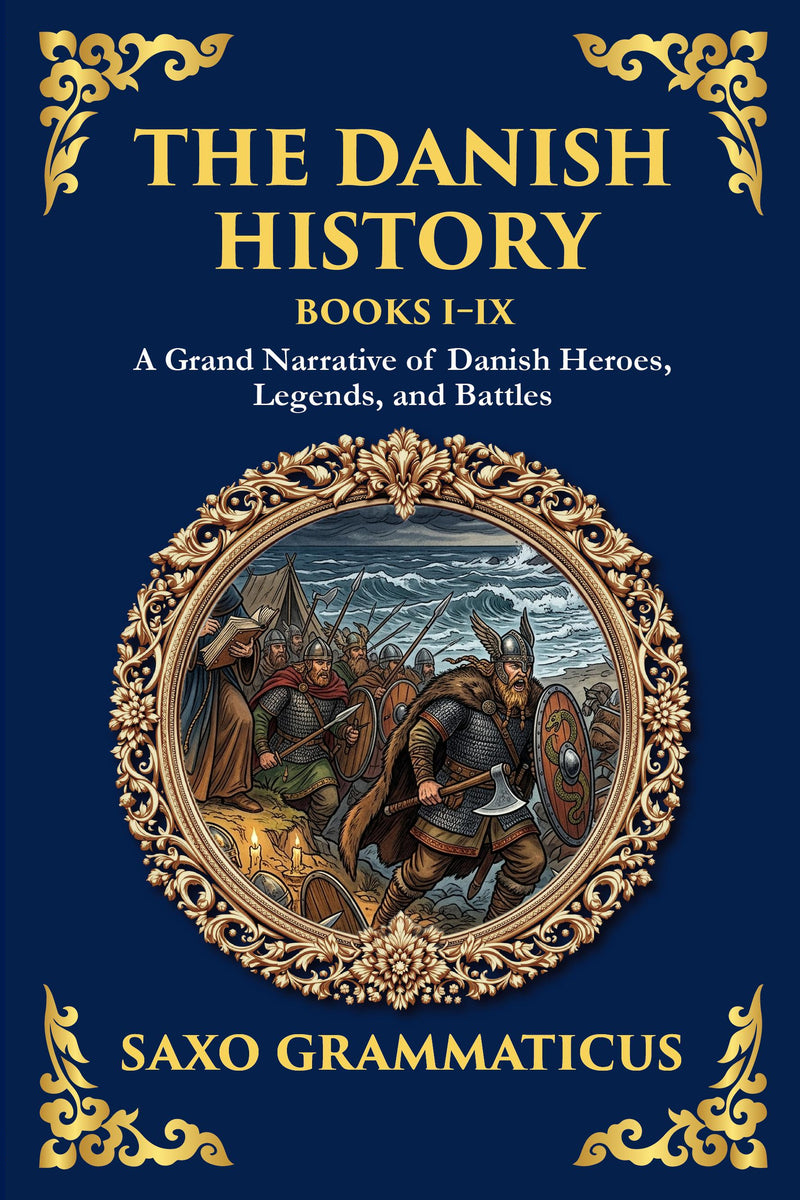
The Danish History, Books I–IX
Travel back to the mists of myth and history, where kings carved empires from chaos and warriors etched their names in legend.
or free app
10,000+ hrs library
30-day guarantee
The complete The Danish History, Books I–IX appears in modern English through Library of Alexandria Press, available online with audiobook narration included for members.
Have you ever wondered why legends outlive the kings who inspired them? Saxo Grammaticus’s The Danish History, Books I–IX is not just a chronicle—it is a saga of greatness, tragedy, and the forging of a kingdom from myth and blood. Written in the 12th century, these first nine books form the mythical and legendary core of Denmark’s past, blending historical truth with rich imagination.
From the primordial tales of the first Danish kings to the legendary exploits of heroes like Amleth (the inspiration for Shakespeare’s Hamlet), Saxo brings to life a vibrant tapestry of courage, treachery, and the eternal struggle between power and honor. Through poetic prose and vivid battle scenes, this epic account immortalizes the noble lineage of Danish royalty and the cultural identity of a people shaped by war and wisdom.
What you’ll discover in this modern edition
- The Foundations of Danish Myth and Heroism – Meet the earliest kings and champions whose deeds defined a nation.
| Formats | eBook (EPUB + PDF) · Audiobook · Paperback · Hardcover · Large Print |
| Language | English |
| Trim size (print) | 6 × 9 in |
| Binding | Paperback — perfect-bound · Hardcover — casewrap |
| Large Print edition | Same text in a larger, easy-read type — a larger font, not a larger trim |
| Print pricing | Every physical book at our true cost — at-cost, no profit (members) |
| Library | 873 restored titles, always growing |
| Length | 129,174 words · ~8 hr 37 min reading |
| Reading level | Grade 3 · an easy, flowing read (this modern-English edition) |
| Edition | Modern English translation · 2026 |
Member reviews for this edition are collected as readers finish it — be the first. Across the library: 12,000+ books shipped, every plan covered by a 365-day print guarantee.
About this edition
A faithful, unabridged modern-English edition by The Library of Alexandria — carefully rendered for today's reader and verified paragraph-by-paragraph against the public-domain source. Available as eBook, audiobook, paperback, hardcover, and large print.
- Complete & unabridgedVerified paragraph by paragraph against the source — never a scan, never abridged.
- Modern English, faithfulReadable today, with the author’s meaning kept intact. Readable — not simplified.
- Every format, one membershipRead in your browser or the free app, or listen to the full audiobook.
Included free with your membership
Cancel anytime, one click · 30-day money-back guarantee
Edition last updated July 2026
What’s inside
The Danish History, Books I–IX — complete and unabridged: all 11 sections included with membership, plus the full audiobook.
Begin reading The Danish History, Books I–IX
In clear modern English — the complete text is included with membership.
Introduction
There are books that record history, and there are books that create it. Saxo Grammaticus’s Gesta Danorum—known in English as The Danish History—belongs firmly to the second category. Written in the late twelfth and early thirteenth centuries, this monumental work set out to give the Danes what the Romans had in Livy and Virgil, what the Greeks had in Homer: a grand narrative of origins, a treasury of heroes, a foundation myth shimmering with the gold of legend and the blood of battle. The first nine books, gathered in this volume, form the most extraordinary part of that achievement. They plunge us into a world before reliable record, where kings descend from gods, where giants walk among men, where the dead rise to give counsel and the line between the mortal and the marvelous dissolves entirely.
To open these pages is to step into the deep imaginative past of Scandinavia. Here you will meet warriors whose names have echoed through a thousand years of European storytelling, sometimes under disguises that may surprise you. You will encounter a melancholy prince feigning madness to survive a murderous uncle—a story that would, centuries later and through winding paths of transmission, give the world its most famous tragedy. You will witness berserker rage and quiet cunning, oaths sworn in mead-halls and broken on battlefields, the ceaseless churn of ambition and revenge that drives men to glory and to ruin. This is not a tidy chronicle. It is a teeming, vivid, often violent panorama of a people imagining themselves into being.
Saxo Grammaticus stands at one of the great hinges of cultural history, and understanding his position illuminates everything that follows in these books. He wrote in Latin, the learned international language of medieval Christendom, with a style so polished and elaborate that admirers later granted him the surname Grammaticus—“the lettered” or “the grammarian.” His prose was modeled on the silver-age Latin of writers like Valerius Maximus and the poet Martianus Capella, dense with rhetorical flourish, studded with verse passages of considerable difficulty. He was, by any measure, a sophisticated man of his era, working under the patronage of Absalon, the powerful warrior-archbishop of Lund who served as both spiritual leader and political architect of a Denmark consolidating itself into a Christian kingdom of growing ambition.
Yet the material Saxo poured into this elegant classical mold came from an entirely different source: the oral traditions of pagan Scandinavia, the sagas and songs and heroic lays carried down through generations by memory and performance. He drew on Icelandic informants, on old Danish poems, on the accumulated lore of a Norse world whose gods were Odin and Thor, whose values were forged in feud and fellowship, whose imagination filled the northern darkness with monsters and marvels. The tension between these two worlds—the Christian Latin scholar and the heathen heroic past he sought to preserve and ennoble—gives The Danish History its peculiar and unforgettable flavor.
This was a man writing to dignify his nation. Absalon and the Danish court of King Valdemar wanted a history that could stand proudly beside the chronicles of Rome and the legends of Troy. Saxo answered the call magnificently. He reached back beyond the dawn of recorded events into the realm of pure legend, beginning with a mythic founder named Dan from whom the Danes supposedly took their name, and then carrying the story forward through generations of kings, each with their triumphs and tragedies, their wars and their words. The first nine books cover this legendary and semi-legendary span, the deep prehistory before the Christian era brought firmer ground beneath the chronicler’s feet. It is precisely this stretch—the most fabulous, the most mythological, the richest in story—that you now hold.
We know surprisingly little about Saxo the man himself. He was likely born around 1150 and seems to have been the son of a soldier; he describes his father and grandfather as having borne arms in the service of Valdemar. He was probably a cleric attached to the cathedral at Lund, working in some secretarial or scholarly capacity for Archbishop Absalon, who appears to have commissioned the great work and may have died before its completion. Saxo himself probably finished his labors around 1208 and died perhaps a decade or two later. These bare facts are almost all we have. The man dissolves into his work, which is perhaps fitting, for the work is so vast and so consuming that it seems to have absorbed his entire creative life.
What we can say with confidence is that Saxo was an artist as much as a historian, in the medieval sense where the two roles freely overlapped. He shaped his material, heightened its drama, gave speeches to his characters, and arranged his episodes for maximum effect. He was not interested in history as we understand it today—the careful sifting of evidence, the cautious distinction between fact and fiction. For Saxo, a story that revealed a moral truth or displayed an admirable virtue was worth telling regardless of whether it had literally happened. He wrote within a tradition where the past served the present, where the deeds of ancestors offered models of conduct and warnings against folly, where the purpose of remembering was instruction and inspiration as much as record.
This is crucial to grasp before you begin. If you approach these books expecting reliable accounts of actual events, you will be perpetually frustrated and will misunderstand what you are reading. But if you approach them as you would Homer or the Norse sagas or the legends of King Arthur—as a magnificent body of traditional story, lovingly gathered and artfully retold—you will find treasures beyond counting. The historical Denmark may have looked nothing like the kingdom Saxo describes in these early books. But the imaginative Denmark, the Denmark of the collective heroic memory, lives in these pages with a vitality that mere fact could never match.
The modern reader should also know something of how this text has traveled to reach us. Saxo’s Latin was difficult even for his contemporaries, and his work was nearly lost; for centuries it survived in fragments and in a single early printed edition before scholars pieced together a fuller picture. The translation tradition that brings it into English—most influentially the labors of Oliver Elton in the nineteenth century, building on earlier scholarship—made these stories accessible to readers who could never wade through the original. This present edition continues that work of bringing Saxo across the centuries, adapting the language and presentation for contemporary readers while preserving the essential character of the narrative. Some of the difficulty of the original is necessarily smoothed; some of the strangeness, happily, remains. The aim throughout is to let you experience the sweep and grandeur of the story without the barriers that have kept it locked away from general readers for too long.
A Landscape of Heroes, Gods, and Monsters
What awaits you in these nine books defies easy summary, because Saxo’s canvas is so crowded and his ambition so total. But a few features of this strange and wonderful country deserve mention, so that you may navigate it with pleasure rather than confusion.
First, understand that the world of these early books is one in which the supernatural is simply part of reality. Giants are not metaphors; they stride across the landscape and wrestle with heroes. Sorcerers cast genuine spells, shape-shifters change their forms, the dead are summoned from their barrows to deliver prophecies and curses. The god Odin appears repeatedly, sometimes as a one-eyed old man dispensing wisdom or weapons, sometimes meddling in human affairs with the capricious authority of a deity who has not yet been demoted to the rank of a mere character in fiction. Saxo, as a Christian writer, treats these pagan gods with a certain wary distance—he sometimes rationalizes them as cunning sorcerers who deceived a credulous people into worshipping them—but he cannot help conveying their power and presence. The result is a world saturated with wonder, where the boundary between the natural and the marvelous is gloriously porous.
Second, this is a heroic world, and the values that govern it are heroic values. Courage in battle, loyalty to one’s lord, the keeping of oaths, the taking of vengeance, the winning of fame that outlasts death—these are the principles by which Saxo’s characters live and die. The warrior who flinches is despised; the man who endures wounds and hardship without complaint is exalted. There is a fierce, sometimes brutal ethic at work here, one that can seem alien to modern sensibilities. Bloodshed is constant. Vengeance is not merely permitted but demanded. The weak are often crushed, and the strong are celebrated for their strength even when it serves cruelty. Yet within this harsh framework there is also room for cunning, for poetry, for love, for loyalty so profound that men will die for it without hesitation. The heroes of these books are not simple; they contain multitudes, and their struggles speak to something deep and enduring in the human condition.
Third, prepare yourself for the famous and the obscure to stand side by side. Some of the figures who march through these pages will be utterly unknown to you—local Danish kings whose names survive nowhere else, petty chieftains and forgotten warriors whose deeds Saxo preserved from oblivion. But others will ring with sudden recognition. The tale of Amleth, the prince who feigns idiocy to escape the suspicion of the uncle who murdered his father and seized his throne and his mother, is the direct ancestor of Shakespeare’s Hamlet. When you read it here, in its raw and original form, you will see the bones of the great tragedy laid bare, and you will be struck by both the similarities and the profound differences. Shakespeare transformed the story utterly, but the seed was planted by Saxo, who preserved a tale that had likely circulated in oral tradition for generations before he wrote it down. To read this is to touch the headwaters of one of the deepest streams in our literary heritage.
You will also encounter heroes whose legends spread far beyond Denmark. There are figures connected to the broader web of Germanic and Norse heroic tradition, characters who appear in other forms in the Icelandic sagas, in the Old English poetry, in the songs sung across the medieval North. Saxo gives them a distinctly Danish coloring, but the threads of a shared heroic culture run through everything. Reading these books is like discovering a great hidden chamber in a building you thought you knew—you find that the legends you encountered elsewhere have roots and relatives you never suspected.
A word about structure and pacing will serve you well. Saxo does not write like a modern novelist. His narrative moves in episodes, sometimes lingering at length on a single dramatic confrontation, sometimes racing through generations in a few sentences. Kings succeed kings; wars give way to wars; characters appear, perform their deeds, and vanish. This episodic quality is part of the work’s nature, inherited from the oral traditions that fed it. Do not expect a single continuous plot building to a climax. Instead, expect a procession—a great pageant of figures and events, unified by the ongoing story of the Danish kingdom and the recurring themes of valor, treachery, ambition, and fate. Some readers find it helpful to treat the books as a collection of linked tales rather than a single seamless narrative. Read for the individual episodes, savor the great set-pieces, and let the larger movement carry you forward at its own stately pace.
You should also be prepared for the verse. Saxo interrupts his prose at intervals with passages of poetry—speeches, laments, boasts, exchanges between characters rendered in verse. In the original Latin these are often dazzlingly complex; in translation they retain a heightened, formal quality that sets them apart from the surrounding narration. These verse passages often mark moments of high emotion or significance: a hero’s defiant words before death, a lament for the fallen, an exchange of taunts before battle. They slow the pace deliberately, inviting reflection, and they preserve something of the bardic, performed quality of the original traditions. When you reach them, slow down with them. They are meant to be the emotional and rhetorical peaks of the narrative.
Cancel anytime, one click · 30-day money-back guarantee
Founding annual rate available now — your price locks for life when you join.
Not ready? Get this free chapter by email — read it anytime.
✓ Sent — check your inbox for The Danish History, Books I–IX.
Questions about The Danish History, Books I–IX
What is The Danish History, Books I–IX about?
Travel back to the mists of myth and history, where kings carved empires from chaos and warriors etched their names in legend. In The Danish History, Books I–IX, Saxo Grammaticus recounts the heroic origins of Denmark with poetic grandeur, celebrating the valor, wisdom, and folly of its ancient rulers. These early books are a sweeping saga of noble conquests, deadly feuds, and legendary deeds that laid the foundation of a nation.
Who wrote The Danish History, Books I–IX?
The Danish History, Books I–IX was written by Saxo Grammaticus. This edition presents the complete work in clear modern English, faithfully rendered from the public-domain original by Library of Alexandria Press.
Is The Danish History, Books I–IX free to read?
The opening chapter is free to read on this page. Members read and listen to the complete work — and the entire library — free, and can order any physical book at our true print cost.
How long is The Danish History, Books I–IX?
11 chapters (~129,174 words) — about 8 hr 37 min of reading in this modern-English edition.
Is this an abridged version of The Danish History, Books I–IX?
No. This is the complete, unabridged The Danish History, Books I–IX, carefully rendered into clear modern English and verified paragraph-by-paragraph against the public-domain source — nothing is cut or summarised.
What formats does The Danish History, Books I–IX come in?
The Danish History, Books I–IX is available as eBook, paperback, hardcover and large print. eBook and audiobook are included with membership; printed editions ship at our true print cost.
Shipping & returns
Billing & membership
More from the library


Explore Myths & Legends
- The Red Fairy Book · Andrew Lang
- Vikram and the Vampire: Classic Hindu Tales of Adventure, Magic, and Romance · Unknown
- The Initiates of the Flame · Manly P. Hall
- Gawayne and the Green Knight: A Fairy Tale · Charlton M. Lewis
- The Nibelungenlied · G. H. Needler
- The Aeneid of Virgil · Virgil
- Fifty Famous Stories Retold · James Baldwin
- West African Folk-Tales
- Lamia · John Keats
- The Three Bears · A. E. Kennedy
- The Ballad of the White Horse · G. K. Chesterton
- Andersen’s Fairy Tales · H. C. Andersen
- Folk-Tales of Bengal · Lal Behari Day
- The Birth of the War-God: A Poem by Kalidasa · Kálidása
- Omens and Superstitions of Southern India · Edgar Thurston
- The Legend of Sleepy Hollow · Washington Irving
- The Hyborian Age · Robert E. Howard
- The Odyssey · Homer
- Grimms’ Fairy Tales · Jacob Grimm and Wilhelm Grimm
- Just So Stories · Rudyard Kipling
- Aeschylus’ Prometheus Bound and the Seven Against Thebes · Aeschylus
- The Iliad · Homer
The Danish History, Books I–IX
The Danish History, Books I–IX
An Epic Tale of Danish Heroes, Legends, and Battles
Saxo Grammaticus
Contents
- Introduction
- Preface by the Author
- Book 1
- Book 2
- Book 3
- Book 4
- Book 5
- Book 6
- Book 7
- Book 8
- Book 9
Introduction
There are books that record history, and there are books that create it. Saxo Grammaticus’s Gesta Danorum—known in English as The Danish History—belongs firmly to the second category. Written in the late twelfth and early thirteenth centuries, this monumental work set out to give the Danes what the Romans had in Livy and Virgil, what the Greeks had in Homer: a grand narrative of origins, a treasury of heroes, a foundation myth shimmering with the gold of legend and the blood of battle. The first nine books, gathered in this volume, form the most extraordinary part of that achievement. They plunge us into a world before reliable record, where kings descend from gods, where giants walk among men, where the dead rise to give counsel and the line between the mortal and the marvelous dissolves entirely.
To open these pages is to step into the deep imaginative past of Scandinavia. Here you will meet warriors whose names have echoed through a thousand years of European storytelling, sometimes under disguises that may surprise you. You will encounter a melancholy prince feigning madness to survive a murderous uncle—a story that would, centuries later and through winding paths of transmission, give the world its most famous tragedy. You will witness berserker rage and quiet cunning, oaths sworn in mead-halls and broken on battlefields, the ceaseless churn of ambition and revenge that drives men to glory and to ruin. This is not a tidy chronicle. It is a teeming, vivid, often violent panorama of a people imagining themselves into being.
Saxo Grammaticus stands at one of the great hinges of cultural history, and understanding his position illuminates everything that follows in these books. He wrote in Latin, the learned international language of medieval Christendom, with a style so polished and elaborate that admirers later granted him the surname Grammaticus—“the lettered” or “the grammarian.” His prose was modeled on the silver-age Latin of writers like Valerius Maximus and the poet Martianus Capella, dense with rhetorical flourish, studded with verse passages of considerable difficulty. He was, by any measure, a sophisticated man of his era, working under the patronage of Absalon, the powerful warrior-archbishop of Lund who served as both spiritual leader and political architect of a Denmark consolidating itself into a Christian kingdom of growing ambition.
Yet the material Saxo poured into this elegant classical mold came from an entirely different source: the oral traditions of pagan Scandinavia, the sagas and songs and heroic lays carried down through generations by memory and performance. He drew on Icelandic informants, on old Danish poems, on the accumulated lore of a Norse world whose gods were Odin and Thor, whose values were forged in feud and fellowship, whose imagination filled the northern darkness with monsters and marvels. The tension between these two worlds—the Christian Latin scholar and the heathen heroic past he sought to preserve and ennoble—gives The Danish History its peculiar and unforgettable flavor.
This was a man writing to dignify his nation. Absalon and the Danish court of King Valdemar wanted a history that could stand proudly beside the chronicles of Rome and the legends of Troy. Saxo answered the call magnificently. He reached back beyond the dawn of recorded events into the realm of pure legend, beginning with a mythic founder named Dan from whom the Danes supposedly took their name, and then carrying the story forward through generations of kings, each with their triumphs and tragedies, their wars and their words. The first nine books cover this legendary and semi-legendary span, the deep prehistory before the Christian era brought firmer ground beneath the chronicler’s feet. It is precisely this stretch—the most fabulous, the most mythological, the richest in story—that you now hold.
We know surprisingly little about Saxo the man himself. He was likely born around 1150 and seems to have been the son of a soldier; he describes his father and grandfather as having borne arms in the service of Valdemar. He was probably a cleric attached to the cathedral at Lund, working in some secretarial or scholarly capacity for Archbishop Absalon, who appears to have commissioned the great work and may have died before its completion. Saxo himself probably finished his labors around 1208 and died perhaps a decade or two later. These bare facts are almost all we have. The man dissolves into his work, which is perhaps fitting, for the work is so vast and so consuming that it seems to have absorbed his entire creative life.
What we can say with confidence is that Saxo was an artist as much as a historian, in the medieval sense where the two roles freely overlapped. He shaped his material, heightened its drama, gave speeches to his characters, and arranged his episodes for maximum effect. He was not interested in history as we understand it today—the careful sifting of evidence, the cautious distinction between fact and fiction. For Saxo, a story that revealed a moral truth or displayed an admirable virtue was worth telling regardless of whether it had literally happened. He wrote within a tradition where the past served the present, where the deeds of ancestors offered models of conduct and warnings against folly, where the purpose of remembering was instruction and inspiration as much as record.
This is crucial to grasp before you begin. If you approach these books expecting reliable accounts of actual events, you will be perpetually frustrated and will misunderstand what you are reading. But if you approach them as you would Homer or the Norse sagas or the legends of King Arthur—as a magnificent body of traditional story, lovingly gathered and artfully retold—you will find treasures beyond counting. The historical Denmark may have looked nothing like the kingdom Saxo describes in these early books. But the imaginative Denmark, the Denmark of the collective heroic memory, lives in these pages with a vitality that mere fact could never match.
The modern reader should also know something of how this text has traveled to reach us. Saxo’s Latin was difficult even for his contemporaries, and his work was nearly lost; for centuries it survived in fragments and in a single early printed edition before scholars pieced together a fuller picture. The translation tradition that brings it into English—most influentially the labors of Oliver Elton in the nineteenth century, building on earlier scholarship—made these stories accessible to readers who could never wade through the original. This present edition continues that work of bringing Saxo across the centuries, adapting the language and presentation for contemporary readers while preserving the essential character of the narrative. Some of the difficulty of the original is necessarily smoothed; some of the strangeness, happily, remains. The aim throughout is to let you experience the sweep and grandeur of the story without the barriers that have kept it locked away from general readers for too long.
A Landscape of Heroes, Gods, and Monsters
What awaits you in these nine books defies easy summary, because Saxo’s canvas is so crowded and his ambition so total. But a few features of this strange and wonderful country deserve mention, so that you may navigate it with pleasure rather than confusion.
First, understand that the world of these early books is one in which the supernatural is simply part of reality. Giants are not metaphors; they stride across the landscape and wrestle with heroes. Sorcerers cast genuine spells, shape-shifters change their forms, the dead are summoned from their barrows to deliver prophecies and curses. The god Odin appears repeatedly, sometimes as a one-eyed old man dispensing wisdom or weapons, sometimes meddling in human affairs with the capricious authority of a deity who has not yet been demoted to the rank of a mere character in fiction. Saxo, as a Christian writer, treats these pagan gods with a certain wary distance—he sometimes rationalizes them as cunning sorcerers who deceived a credulous people into worshipping them—but he cannot help conveying their power and presence. The result is a world saturated with wonder, where the boundary between the natural and the marvelous is gloriously porous.
Second, this is a heroic world, and the values that govern it are heroic values. Courage in battle, loyalty to one’s lord, the keeping of oaths, the taking of vengeance, the winning of fame that outlasts death—these are the principles by which Saxo’s characters live and die. The warrior who flinches is despised; the man who endures wounds and hardship without complaint is exalted. There is a fierce, sometimes brutal ethic at work here, one that can seem alien to modern sensibilities. Bloodshed is constant. Vengeance is not merely permitted but demanded. The weak are often crushed, and the strong are celebrated for their strength even when it serves cruelty. Yet within this harsh framework there is also room for cunning, for poetry, for love, for loyalty so profound that men will die for it without hesitation. The heroes of these books are not simple; they contain multitudes, and their struggles speak to something deep and enduring in the human condition.
Third, prepare yourself for the famous and the obscure to stand side by side. Some of the figures who march through these pages will be utterly unknown to you—local Danish kings whose names survive nowhere else, petty chieftains and forgotten warriors whose deeds Saxo preserved from oblivion. But others will ring with sudden recognition. The tale of Amleth, the prince who feigns idiocy to escape the suspicion of the uncle who murdered his father and seized his throne and his mother, is the direct ancestor of Shakespeare’s Hamlet. When you read it here, in its raw and original form, you will see the bones of the great tragedy laid bare, and you will be struck by both the similarities and the profound differences. Shakespeare transformed the story utterly, but the seed was planted by Saxo, who preserved a tale that had likely circulated in oral tradition for generations before he wrote it down. To read this is to touch the headwaters of one of the deepest streams in our literary heritage.
You will also encounter heroes whose legends spread far beyond Denmark. There are figures connected to the broader web of Germanic and Norse heroic tradition, characters who appear in other forms in the Icelandic sagas, in the Old English poetry, in the songs sung across the medieval North. Saxo gives them a distinctly Danish coloring, but the threads of a shared heroic culture run through everything. Reading these books is like discovering a great hidden chamber in a building you thought you knew—you find that the legends you encountered elsewhere have roots and relatives you never suspected.
A word about structure and pacing will serve you well. Saxo does not write like a modern novelist. His narrative moves in episodes, sometimes lingering at length on a single dramatic confrontation, sometimes racing through generations in a few sentences. Kings succeed kings; wars give way to wars; characters appear, perform their deeds, and vanish. This episodic quality is part of the work’s nature, inherited from the oral traditions that fed it. Do not expect a single continuous plot building to a climax. Instead, expect a procession—a great pageant of figures and events, unified by the ongoing story of the Danish kingdom and the recurring themes of valor, treachery, ambition, and fate. Some readers find it helpful to treat the books as a collection of linked tales rather than a single seamless narrative. Read for the individual episodes, savor the great set-pieces, and let the larger movement carry you forward at its own stately pace.
You should also be prepared for the verse. Saxo interrupts his prose at intervals with passages of poetry—speeches, laments, boasts, exchanges between characters rendered in verse. In the original Latin these are often dazzlingly complex; in translation they retain a heightened, formal quality that sets them apart from the surrounding narration. These verse passages often mark moments of high emotion or significance: a hero’s defiant words before death, a lament for the fallen, an exchange of taunts before battle. They slow the pace deliberately, inviting reflection, and they preserve something of the bardic, performed quality of the original traditions. When you reach them, slow down with them. They are meant to be the emotional and rhetorical peaks of the narrative.
Dan and Angul, the ancestors of the Danes, were the sons of Humble. They were the leaders and founders of our people. (However, Dudo, the historian of Normandy, believes the Danes descended from and were named after the Danai.) Although these two men became rulers of the land because their people wanted them to, and gained supreme power through their own incredible bravery and the consent of their citizens, they did not use the title of king. At that time, the title of king was not commonly used by any authority among our people.
According to tradition, Angul—the ancestor of the Anglian race—gave his own name to the region he ruled. This was an easy way to make his fame last forever. Later, when his descendants took over Britain, they replaced the island’s original name with a new title based on their own homeland. This act was well-regarded by the ancients. This is noted by Bede, a significant church writer and native of England, who made it his mission to record the achievements of his country in his sacred writings; he believed it was a religious duty to both glorify the deeds of his land and chronicle the history of the Church.
Ancient records state that the lineages of our kings flowed in a glorious line from Dan, like streams from a single spring. Grytha, a woman highly respected among the Teutons, bore him two sons: HUMBLE and LOTHER.
When the ancients chose a king, they used to stand on stones planted in the ground while announcing their votes, symbolizing that the decision would be as permanent as the stones. Through this ceremony, Humble was elected king after his father died, gaining the support of his people. However, due to a cruel twist of fate, he went from being a king to a commoner. Lother captured him in war, and Humble bought his life by giving up his crown; those were the only terms offered to him after his defeat. Forced by his brother’s injustice to surrender his power, he taught humanity that while a palace has more luxury than a cottage, it offers less safety. He accepted this wrong so calmly that he seemed to view the loss of his title as a blessing; I believe he understood the true nature of a king’s burden. Lother, however, was as unbearable as a king as he had been as a soldier, beginning his reign with arrogance and crime. He believed it was right to strip the most prominent citizens of their lives or property, clearing the land of loyal people because he viewed everyone of equal birth as a rival for the throne. He was soon punished for his wickedness, meeting his end during a rebellion by the very people who had once given him the kingdom and now took his life.
End of the free sample
Keep reading, free
Members read and listen to the complete book — and the entire library. Cancel anytime, one click · 30-day money-back guarantee.