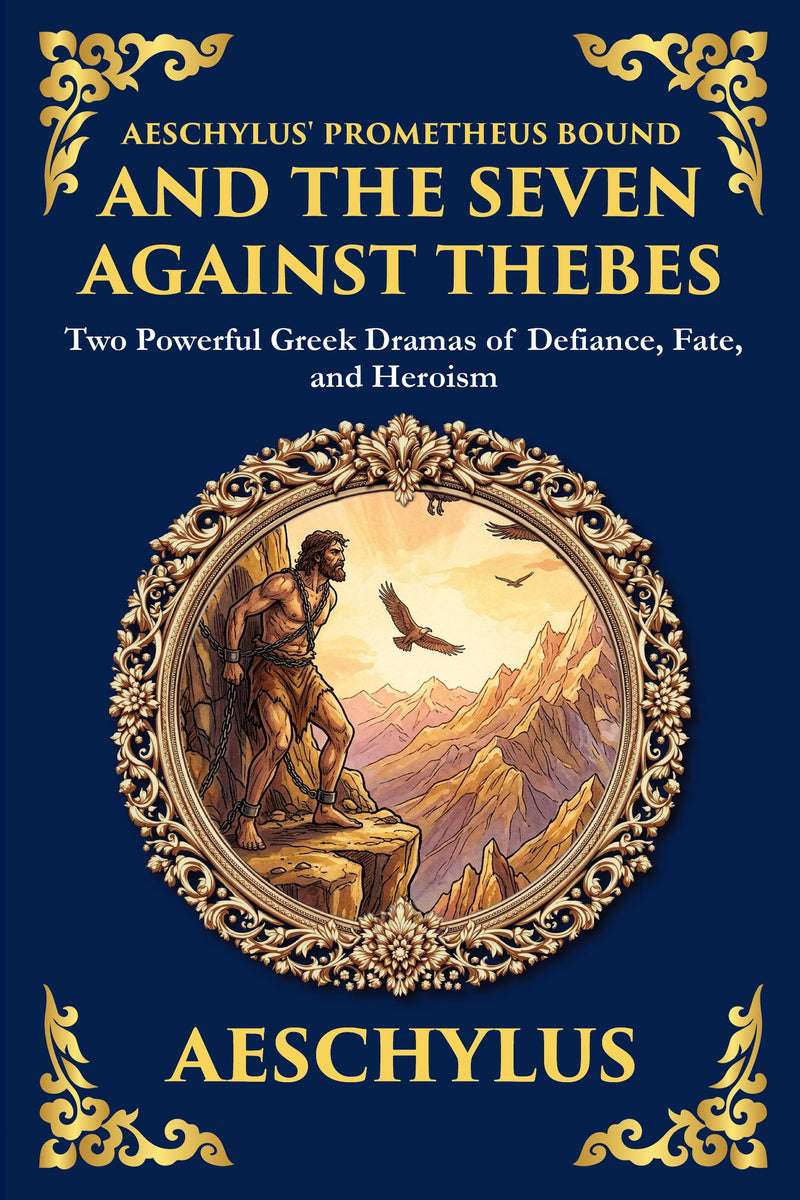
Aeschylus’ Prometheus Bound and the Seven Against Thebes
Prometheus Bound Bound by chains. Driven by prophecy. Defiant to the end. In Prometheus Bound and The Seven Against Thebes, Aeschylus crafts two unforgettable portraits of resistance against tyranny and the inescapable grip of fate.
or free app
10,000+ hrs library
30-day guarantee
The complete Aeschylus’ Prometheus Bound and the Seven Against Thebes appears in modern English through Library of Alexandria Press, available online with audiobook narration included for members.
Have you ever wondered why defying fate often comes at the greatest cost? In this definitive volume, two of Aeschylus’ most enduring tragedies—Prometheus Bound and The Seven Against Thebes—are presented in a modern, accessible translation that brings the thunder of Greek drama to life. Both plays illuminate the eternal conflict between free will and divine will, courage and consequence, individual action and inherited doom.
In Prometheus Bound, we encounter the chained Titan whose crime—giving fire and knowledge to mankind—has earned Zeus’s eternal wrath. Yet Prometheus does not regret his defiance. With thunderous monologues and divine visitations, the play explores themes of resistance, justice, and the human condition.
The Seven Against Thebes unfolds a brutal siege on the city of Thebes, as the sons of Oedipus —Eteocles and Polynices—face off in a doomed battle. The tragedy plunges deep into questions of loyalty, fate, and family legacy. With powerful choruses and prophetic terror, it is one of the most visceral war dramas in the ancient world.
Together, these two masterpieces form a dual portrait of rebellion—one cosmic, the other political—delivering a potent reflection on hubris, honor, and destiny.
What you’ll discover in this modern edition
- The Tragic Brilliance of Aeschylus – Experience the poetic grandeur and timeless intensity of one of Greece’s greatest tragedians.
- Themes of Power, Rebellion, and Fate – Explore the struggle between gods and mortals, brothers and cities.
- Two Complete and Modern Translations – Faithfully rendered for the contemporary reader without losing the resonance of the original Greek.
- Essential Readings for Classical Enthusiasts – A cornerstone of world literature for anyone passionate about drama, mythology, and philosophy.
| Formats | eBook (EPUB + PDF) · Audiobook · Paperback · Hardcover · Large Print |
| Language | English |
| Trim size (print) | 6 × 9 in |
| Binding | Paperback — perfect-bound · Hardcover — casewrap |
| Large Print edition | Same text in a larger, easy-read type — a larger font, not a larger trim |
| Print pricing | Every physical book at our true cost — at-cost, no profit (members) |
| Library | 873 restored titles, always growing |
| Length | 20,550 words · ~1 hr 22 min reading |
| Reading level | Grade 5 · an easy, flowing read (this modern-English edition) |
| Edition | Modern English translation · 2026 |
Member reviews for this edition are collected as readers finish it — be the first. Across the library: 12,000+ books shipped, every plan covered by a 365-day print guarantee.
About this edition
A faithful, unabridged modern-English edition by The Library of Alexandria — carefully rendered for today's reader and verified paragraph-by-paragraph against the public-domain source. Available as eBook, audiobook, paperback, hardcover, and large print.
- Complete & unabridgedVerified paragraph by paragraph against the source — never a scan, never abridged.
- Modern English, faithfulReadable today, with the author’s meaning kept intact. Readable — not simplified.
- Every format, one membershipRead in your browser or the free app, or listen to the full audiobook.
Included free with your membership
Cancel anytime, one click · 30-day money-back guarantee
Edition last updated July 2026
What’s inside
Aeschylus’ Prometheus Bound and the Seven Against Thebes — complete and unabridged: all 8 sections included with membership, plus the full audiobook.
Begin reading Aeschylus’ Prometheus Bound and the Seven Against Thebes
In clear modern English — the complete text is included with membership.
Introduction
There are voices in the ancient world that still arrive to us charged with a strange and undiminished electricity. They speak across more than two and a half thousand years, and yet, when we lean in to listen, we discover that they are speaking to us — about the things that frighten us, the things we cannot control, the courage it takes to stand against forces larger than ourselves, and the bitter intimacy of suffering that no fortune seems able to escape. Among these voices, none rings out with greater grandeur, greater solemnity, or greater terror than that of Aeschylus, the earliest of the three great tragedians of Athens, and arguably the boldest. To open the pages of his work is to step into a theater of cosmic proportions, where gods clash with Titans, where cities tremble on the brink of ruin, and where individual human beings — frail, proud, defiant — are pressed against the iron limits of destiny.
The two dramas gathered in this volume, Prometheus Bound and Seven Against Thebes, represent two of the most powerful and contrasting visions in the surviving body of Aeschylus’s work. The first lifts its eyes to the heavens, staging a confrontation between a rebellious immortal and the new tyrant of the universe. The second plants its feet firmly upon the earth, in the dust and clamor of a besieged city, where brothers are fated to meet at the gates with swords drawn. One is a tragedy of the sky; the other a tragedy of the soil. One concerns the suffering of a being who cannot die; the other concerns the doom that gathers around a single mortal family. Together, they offer a remarkable portrait of the Aeschylean imagination at its most ambitious — an imagination that was never content to dramatize a quarrel or a household crisis, but always reached for the largest questions a human being can ask. What is justice? What is fate? Can the individual will resist the order of the cosmos? And what does it mean to endure?
This modern translation has been prepared with the contemporary reader firmly in mind. The aim throughout has been to preserve the towering dignity and the dark grandeur of Aeschylus’s language while making it accessible, readable, and emotionally direct. The ancient Greek of these plays is dense, allusive, and often deliberately archaic even by the standards of fifth-century Athens; Aeschylus was famous in antiquity for the weight and difficulty of his vocabulary, for compound words that seem to strain under their own significance, and for a style that the comic poet Aristophanes once compared to a great roaring river. To carry that force into modern English without burying the reader under footnotes and obscurities requires careful judgment. What you hold has been adapted so that the lines move with clarity and momentum, so that the choral songs sing rather than stall, and so that the great speeches retain their thunder. Nothing essential has been lost, but much that would only baffle a modern reader has been gently smoothed away. The result, we hope, is a reading experience that feels alive rather than embalmed — a chance to encounter these masterpieces not as museum pieces but as living drama.
To read Aeschylus well, it helps to know something of the world that made him, and of the revolution in art that he himself helped to create. He was born around 525 BCE in Eleusis, a town near Athens famous for its mysterious religious rites, and he lived through one of the most consequential periods in all of human history. This was the age of the Persian Wars, when the small, quarrelsome city-states of Greece faced annihilation at the hands of the largest empire the world had then known. Aeschylus did not merely live through these wars; he fought in them. He stood in the ranks at the Battle of Marathon in 490 BCE, where his brother was killed, and very probably at Salamis a decade later, the great naval clash that turned the tide of the conflict. So thoroughly did he identify himself with the soldier rather than the artist that, according to tradition, the epitaph composed for his tomb — possibly by his own hand — mentioned only his service at Marathon and said nothing whatsoever of his plays. Imagine a man who wrote some of the greatest dramas ever conceived, and who wished to be remembered above all as one who had defended his homeland with a spear.
This biographical detail is not a mere curiosity. It tells us something fundamental about the spirit that animates his work. Aeschylus had stared down extinction, both his own and his city’s. He knew, in his body and not merely in his mind, what it meant to face overwhelming force, to gamble everything on courage, and to live in a world where the gods seemed to weigh the fates of nations on their scales. The grandeur of his imagination, the seriousness with which he treats questions of justice and divine order, the recurring theme of the catastrophe that befalls overweening pride — all of this springs from a sensibility forged in an era of existential struggle. When his characters speak of doom and deliverance, of fate and the will of Zeus, they speak with the authority of a man who had seen empires fall and cities saved.
Aeschylus did not invent tragedy, but he transformed it almost beyond recognition. Before him, Greek tragic performance was a relatively simple affair: a single actor exchanging lines with a chorus, which sang and danced and carried much of the dramatic weight. It was Aeschylus, ancient tradition tells us, who introduced a second actor onto the stage, and in doing so opened up the possibility of genuine dramatic conflict — of one character confronting another, of dialogue that crackles with opposition and tension. This innovation may sound technical, but it was nothing less than the birth of drama as we understand it. By placing two speaking figures in opposition, Aeschylus made it possible to stage not just a story but a struggle, not just a lament but a debate. The entire subsequent history of Western theater, from Sophocles and Euripides through Shakespeare and down to the playwrights of our own day, descends from this fertile moment.
He was also, by all accounts, a master of spectacle. Ancient sources describe his productions as visually overwhelming, full of striking costumes, imposing masks, and stage effects designed to inspire awe and even fear. There is a famous, probably exaggerated story that a chorus of terrifying Furies in one of his plays so frightened the audience that children fainted and pregnant women miscarried. Whether or not we believe the tale, it captures something true about his theatrical instincts: Aeschylus wanted his audience to feel the presence of the sacred and the terrible. He was not interested in polite entertainment. He wanted to shake his viewers to the core, to make them confront the vast and often merciless powers that govern existence.
He competed in the dramatic festivals of Athens, the great civic-religious occasions at which playwrights presented their works in competition before the assembled citizenry, and he won first prize many times over the course of his long career. He wrote, by ancient count, somewhere between seventy and ninety plays, of which only seven survive complete. This is a heartbreaking loss, and it should color the way we read what remains: each surviving play is a precious fragment of a much vaster achievement, a single surviving column from a temple whose full dimensions we can only imagine. The two works in this volume are among that small band of survivors, and they have endured for good reason. They speak with a power that the passage of millennia has not exhausted.
It is worth noting, too, that scholars have long debated whether Prometheus Bound is entirely the work of Aeschylus himself. Certain features of its language and staging have led some to wonder whether it was completed or revised by another hand, perhaps a member of his school or even his own son, who was also a dramatist. The reader need not be troubled by these scholarly disputes; the play has been transmitted to us under Aeschylus’s name, it bears the unmistakable stamp of his cosmic ambition, and it stands as one of the most influential dramas ever written, regardless of the precise circumstances of its composition. What matters is the experience it offers — and that experience is unforgettable.
The genius of pairing these two plays lies in the way they illuminate one another. They are, in a sense, two answers to the same set of questions, approached from opposite directions. Both are fundamentally concerned with the confrontation between an individual will and a power that seems destined to crush it. Both ask what it means to stand firm in the face of overwhelming opposition. Both meditate on suffering — its causes, its endurance, and its meaning. But the worlds they construct, and the kinds of defiance they portray, could scarcely be more different.
Prometheus Bound takes us to the very edge of the known world, to a barren and windswept place at the ends of the earth, where the newly enthroned ruler of the gods exacts a terrible punishment upon one who has defied him. Prometheus — whose name means “forethought” — is one of the great enduring figures of the Western imagination, a being who, out of love and pity for struggling humanity, committed an act of profound rebellion against the supreme power of the cosmos. For this, he is condemned to a suffering as immense as it is unjust, and the play unfolds as a sustained meditation on what it means to suffer for one’s convictions, to refuse to bend, and to know more than one’s tormentor yet remain in chains.
What makes this drama so extraordinary, and so unlike anything else in ancient literature, is its sheer audacity. Here is a play whose protagonist is not a mortal hero but an immortal being, and whose antagonist is the king of the gods himself. The conflict is not between human beings, or between a human and the divine order, but within the divine order — a clash of two cosmic principles. The figure of Prometheus has resonated through the centuries with astonishing force. He became, for the Romantic poets of the early nineteenth century, the very emblem of revolutionary defiance, of the noble rebel who suffers for the sake of others and refuses to submit to tyranny. Shelley wrote an entire lyrical drama in response to him; Byron addressed him in verse; the figure haunts Goethe and countless others. Even the subtitle of Mary Shelley’s Frankenstein — The Modern Prometheus — testifies to the enduring power of this myth, with its profound questions about knowledge, transgression, and the consequences of giving humanity gifts it may not be ready to use.
Yet it would be a mistake to read the play simply as a celebration of rebellion. Aeschylus was too profound a thinker for such simplicity. The drama holds in tension two competing claims: the sympathy we feel for the suffering rebel and the recognition that order, even harsh order, has its own necessity. Prometheus is defiant, but he is also bound; he is wise, but his wisdom has not saved him; he knows secrets that could topple his tormentor, but his refusal to bend keeps him pinned to the rock. The play does not resolve these tensions easily, and that is precisely its greatness. It invites us to sit with the discomfort of a universe in which justice and power do not always align, in which the one who acts out of love may be punished by the one who holds the throne, and in which endurance itself becomes a kind of victory. The reader who comes to this play expecting a simple parable of good against evil will find instead something far richer and more disturbing: a portrait of the moral universe at one of its most fraught and uncertain moments.
Seven Against Thebes offers an entirely different theater of action and a different kind of hero. Where Prometheus Bound gazes outward and upward to the cosmic and the eternal, this play turns inward and downward to the human and the immediate — to a single city under siege, a single royal house weighed down by an inherited curse, and a single man who must rise to defend his people. This is a war play, and it conveys with extraordinary vividness the atmosphere of a city awaiting assault: the fear that ripples through the population, the desperate prayers offered up to the gods, the grim resolve of the defenders, and the terrible weight of decision that falls upon the leader who must hold the city together.
Cancel anytime, one click · 30-day money-back guarantee
Founding annual rate available now — your price locks for life when you join.
Not ready? Get this free chapter by email — read it anytime.
✓ Sent — check your inbox for Aeschylus’ Prometheus Bound and the Seven Against Thebes.
Questions about Aeschylus’ Prometheus Bound and the Seven Against Thebes
What is Aeschylus’ Prometheus Bound and the Seven Against Thebes about?
Prometheus Bound Bound by chains. Driven by prophecy. Defiant to the end.
Who wrote Aeschylus’ Prometheus Bound and the Seven Against Thebes?
Aeschylus’ Prometheus Bound and the Seven Against Thebes was written by Aeschylus. This edition presents the complete work in clear modern English, faithfully rendered from the public-domain original by Library of Alexandria Press.
Is Aeschylus’ Prometheus Bound and the Seven Against Thebes free to read?
The opening chapter is free to read on this page. Members read and listen to the complete work — and the entire library — free, and can order any physical book at our true print cost.
How long is Aeschylus’ Prometheus Bound and the Seven Against Thebes?
8 chapters (~20,550 words) — about 1 hr 22 min of reading in this modern-English edition.
Is this an abridged version of Aeschylus’ Prometheus Bound and the Seven Against Thebes?
No. This is the complete, unabridged Aeschylus’ Prometheus Bound and the Seven Against Thebes, carefully rendered into clear modern English and verified paragraph-by-paragraph against the public-domain source — nothing is cut or summarised.
What formats does Aeschylus’ Prometheus Bound and the Seven Against Thebes come in?
Aeschylus’ Prometheus Bound and the Seven Against Thebes is available as eBook, paperback, hardcover and large print. eBook and audiobook are included with membership; printed editions ship at our true print cost.
Shipping & returns
Billing & membership
More from the library


Explore Myths & Legends
- The Red Fairy Book · Andrew Lang
- Vikram and the Vampire: Classic Hindu Tales of Adventure, Magic, and Romance · Unknown
- The Initiates of the Flame · Manly P. Hall
- Gawayne and the Green Knight: A Fairy Tale · Charlton M. Lewis
- The Nibelungenlied · G. H. Needler
- The Aeneid of Virgil · Virgil
- Fifty Famous Stories Retold · James Baldwin
- West African Folk-Tales
- Lamia · John Keats
- The Three Bears · A. E. Kennedy
- The Ballad of the White Horse · G. K. Chesterton
- The Danish History, Books I–IX · Saxo Grammaticus
- Andersen’s Fairy Tales · H. C. Andersen
- Folk-Tales of Bengal · Lal Behari Day
- The Birth of the War-God: A Poem by Kalidasa · Kálidása
- Omens and Superstitions of Southern India · Edgar Thurston
- The Legend of Sleepy Hollow · Washington Irving
- The Hyborian Age · Robert E. Howard
- The Odyssey · Homer
- Grimms’ Fairy Tales · Jacob Grimm and Wilhelm Grimm
- Just So Stories · Rudyard Kipling
- The Iliad · Homer
Aeschylus’ Prometheus Bound and the Seven Against Thebes
Aeschylus’ Prometheus Bound and the Seven Against Thebes
Two Powerful Greek Dramas of Defiance, Fate, and Heroism
Aeschylus
Contents
- Introduction
- Chapter 1
- Chapter 2
- Chapter 3
- Chapter 4
- Chapter 5
- Chapter 6
- Chapter 7
Introduction
There are voices in the ancient world that still arrive to us charged with a strange and undiminished electricity. They speak across more than two and a half thousand years, and yet, when we lean in to listen, we discover that they are speaking to us — about the things that frighten us, the things we cannot control, the courage it takes to stand against forces larger than ourselves, and the bitter intimacy of suffering that no fortune seems able to escape. Among these voices, none rings out with greater grandeur, greater solemnity, or greater terror than that of Aeschylus, the earliest of the three great tragedians of Athens, and arguably the boldest. To open the pages of his work is to step into a theater of cosmic proportions, where gods clash with Titans, where cities tremble on the brink of ruin, and where individual human beings — frail, proud, defiant — are pressed against the iron limits of destiny.
The two dramas gathered in this volume, Prometheus Bound and Seven Against Thebes, represent two of the most powerful and contrasting visions in the surviving body of Aeschylus’s work. The first lifts its eyes to the heavens, staging a confrontation between a rebellious immortal and the new tyrant of the universe. The second plants its feet firmly upon the earth, in the dust and clamor of a besieged city, where brothers are fated to meet at the gates with swords drawn. One is a tragedy of the sky; the other a tragedy of the soil. One concerns the suffering of a being who cannot die; the other concerns the doom that gathers around a single mortal family. Together, they offer a remarkable portrait of the Aeschylean imagination at its most ambitious — an imagination that was never content to dramatize a quarrel or a household crisis, but always reached for the largest questions a human being can ask. What is justice? What is fate? Can the individual will resist the order of the cosmos? And what does it mean to endure?
This modern translation has been prepared with the contemporary reader firmly in mind. The aim throughout has been to preserve the towering dignity and the dark grandeur of Aeschylus’s language while making it accessible, readable, and emotionally direct. The ancient Greek of these plays is dense, allusive, and often deliberately archaic even by the standards of fifth-century Athens; Aeschylus was famous in antiquity for the weight and difficulty of his vocabulary, for compound words that seem to strain under their own significance, and for a style that the comic poet Aristophanes once compared to a great roaring river. To carry that force into modern English without burying the reader under footnotes and obscurities requires careful judgment. What you hold has been adapted so that the lines move with clarity and momentum, so that the choral songs sing rather than stall, and so that the great speeches retain their thunder. Nothing essential has been lost, but much that would only baffle a modern reader has been gently smoothed away. The result, we hope, is a reading experience that feels alive rather than embalmed — a chance to encounter these masterpieces not as museum pieces but as living drama.
To read Aeschylus well, it helps to know something of the world that made him, and of the revolution in art that he himself helped to create. He was born around 525 BCE in Eleusis, a town near Athens famous for its mysterious religious rites, and he lived through one of the most consequential periods in all of human history. This was the age of the Persian Wars, when the small, quarrelsome city-states of Greece faced annihilation at the hands of the largest empire the world had then known. Aeschylus did not merely live through these wars; he fought in them. He stood in the ranks at the Battle of Marathon in 490 BCE, where his brother was killed, and very probably at Salamis a decade later, the great naval clash that turned the tide of the conflict. So thoroughly did he identify himself with the soldier rather than the artist that, according to tradition, the epitaph composed for his tomb — possibly by his own hand — mentioned only his service at Marathon and said nothing whatsoever of his plays. Imagine a man who wrote some of the greatest dramas ever conceived, and who wished to be remembered above all as one who had defended his homeland with a spear.
This biographical detail is not a mere curiosity. It tells us something fundamental about the spirit that animates his work. Aeschylus had stared down extinction, both his own and his city’s. He knew, in his body and not merely in his mind, what it meant to face overwhelming force, to gamble everything on courage, and to live in a world where the gods seemed to weigh the fates of nations on their scales. The grandeur of his imagination, the seriousness with which he treats questions of justice and divine order, the recurring theme of the catastrophe that befalls overweening pride — all of this springs from a sensibility forged in an era of existential struggle. When his characters speak of doom and deliverance, of fate and the will of Zeus, they speak with the authority of a man who had seen empires fall and cities saved.
Aeschylus did not invent tragedy, but he transformed it almost beyond recognition. Before him, Greek tragic performance was a relatively simple affair: a single actor exchanging lines with a chorus, which sang and danced and carried much of the dramatic weight. It was Aeschylus, ancient tradition tells us, who introduced a second actor onto the stage, and in doing so opened up the possibility of genuine dramatic conflict — of one character confronting another, of dialogue that crackles with opposition and tension. This innovation may sound technical, but it was nothing less than the birth of drama as we understand it. By placing two speaking figures in opposition, Aeschylus made it possible to stage not just a story but a struggle, not just a lament but a debate. The entire subsequent history of Western theater, from Sophocles and Euripides through Shakespeare and down to the playwrights of our own day, descends from this fertile moment.
He was also, by all accounts, a master of spectacle. Ancient sources describe his productions as visually overwhelming, full of striking costumes, imposing masks, and stage effects designed to inspire awe and even fear. There is a famous, probably exaggerated story that a chorus of terrifying Furies in one of his plays so frightened the audience that children fainted and pregnant women miscarried. Whether or not we believe the tale, it captures something true about his theatrical instincts: Aeschylus wanted his audience to feel the presence of the sacred and the terrible. He was not interested in polite entertainment. He wanted to shake his viewers to the core, to make them confront the vast and often merciless powers that govern existence.
He competed in the dramatic festivals of Athens, the great civic-religious occasions at which playwrights presented their works in competition before the assembled citizenry, and he won first prize many times over the course of his long career. He wrote, by ancient count, somewhere between seventy and ninety plays, of which only seven survive complete. This is a heartbreaking loss, and it should color the way we read what remains: each surviving play is a precious fragment of a much vaster achievement, a single surviving column from a temple whose full dimensions we can only imagine. The two works in this volume are among that small band of survivors, and they have endured for good reason. They speak with a power that the passage of millennia has not exhausted.
It is worth noting, too, that scholars have long debated whether Prometheus Bound is entirely the work of Aeschylus himself. Certain features of its language and staging have led some to wonder whether it was completed or revised by another hand, perhaps a member of his school or even his own son, who was also a dramatist. The reader need not be troubled by these scholarly disputes; the play has been transmitted to us under Aeschylus’s name, it bears the unmistakable stamp of his cosmic ambition, and it stands as one of the most influential dramas ever written, regardless of the precise circumstances of its composition. What matters is the experience it offers — and that experience is unforgettable.
The genius of pairing these two plays lies in the way they illuminate one another. They are, in a sense, two answers to the same set of questions, approached from opposite directions. Both are fundamentally concerned with the confrontation between an individual will and a power that seems destined to crush it. Both ask what it means to stand firm in the face of overwhelming opposition. Both meditate on suffering — its causes, its endurance, and its meaning. But the worlds they construct, and the kinds of defiance they portray, could scarcely be more different.
Prometheus Bound takes us to the very edge of the known world, to a barren and windswept place at the ends of the earth, where the newly enthroned ruler of the gods exacts a terrible punishment upon one who has defied him. Prometheus — whose name means “forethought” — is one of the great enduring figures of the Western imagination, a being who, out of love and pity for struggling humanity, committed an act of profound rebellion against the supreme power of the cosmos. For this, he is condemned to a suffering as immense as it is unjust, and the play unfolds as a sustained meditation on what it means to suffer for one’s convictions, to refuse to bend, and to know more than one’s tormentor yet remain in chains.
What makes this drama so extraordinary, and so unlike anything else in ancient literature, is its sheer audacity. Here is a play whose protagonist is not a mortal hero but an immortal being, and whose antagonist is the king of the gods himself. The conflict is not between human beings, or between a human and the divine order, but within the divine order — a clash of two cosmic principles. The figure of Prometheus has resonated through the centuries with astonishing force. He became, for the Romantic poets of the early nineteenth century, the very emblem of revolutionary defiance, of the noble rebel who suffers for the sake of others and refuses to submit to tyranny. Shelley wrote an entire lyrical drama in response to him; Byron addressed him in verse; the figure haunts Goethe and countless others. Even the subtitle of Mary Shelley’s Frankenstein — The Modern Prometheus — testifies to the enduring power of this myth, with its profound questions about knowledge, transgression, and the consequences of giving humanity gifts it may not be ready to use.
Yet it would be a mistake to read the play simply as a celebration of rebellion. Aeschylus was too profound a thinker for such simplicity. The drama holds in tension two competing claims: the sympathy we feel for the suffering rebel and the recognition that order, even harsh order, has its own necessity. Prometheus is defiant, but he is also bound; he is wise, but his wisdom has not saved him; he knows secrets that could topple his tormentor, but his refusal to bend keeps him pinned to the rock. The play does not resolve these tensions easily, and that is precisely its greatness. It invites us to sit with the discomfort of a universe in which justice and power do not always align, in which the one who acts out of love may be punished by the one who holds the throne, and in which endurance itself becomes a kind of victory. The reader who comes to this play expecting a simple parable of good against evil will find instead something far richer and more disturbing: a portrait of the moral universe at one of its most fraught and uncertain moments.
Seven Against Thebes offers an entirely different theater of action and a different kind of hero. Where Prometheus Bound gazes outward and upward to the cosmic and the eternal, this play turns inward and downward to the human and the immediate — to a single city under siege, a single royal house weighed down by an inherited curse, and a single man who must rise to defend his people. This is a war play, and it conveys with extraordinary vividness the atmosphere of a city awaiting assault: the fear that ripples through the population, the desperate prayers offered up to the gods, the grim resolve of the defenders, and the terrible weight of decision that falls upon the leader who must hold the city together.
Strength. Force. Vulcan. Prometheus. Chorus of Nymphs, Daughters of Ocean. Io, Daughter of Inachus. Mercury.
St. We have come to the far edge of the earth — a remote Scythian wilderness, a trackless desert. Vulcan, it falls to you to carry out the orders your Father has laid down: chain this reckless criminal to the high, jagged rocks in unbreakable adamantine fetters. He stole your treasure — the bright fire that powers every human craft — and handed it to mortals. For that offense he must pay the gods their due, so that he learns to accept Jupiter’s rule and give up his obsession with doing good for mankind.
Vul. Strength and Force, as far as you two are concerned, Jupiter’s command is now fulfilled and there is nothing more standing in the way. But I cannot bring myself to shackle a fellow god by force to this wind-battered cliff. And yet I have no choice but to steel myself for it, because defying the Father’s orders is a dangerous thing. High-minded son of wise-counseling Themis — against my will I must rivet you, against your will, in unbreakable chains to this desolate rock. Here you will see no human face and hear no human voice. The blazing sun will slowly scorch you and wither the freshness of your skin. You will be glad when night, robed in stars, draws her veil over the light, and glad again when the sun melts the morning frost — but the agony of your present torment will gnaw at you without end, because no one yet born will set you free. This is what your goodwill toward humanity has earned you. You are a god, yet you did not bow before the anger of the gods — you gave mortals gifts beyond what was right. For that you will stand guard on this joyless rock, upright, sleepless, never bending a knee, pouring out laments and useless groans, because Jupiter’s heart is not easily moved, and every ruler who has newly come to power is harsh.
End of the free sample
Keep reading, free
Members read and listen to the complete book — and the entire library. Cancel anytime, one click · 30-day money-back guarantee.