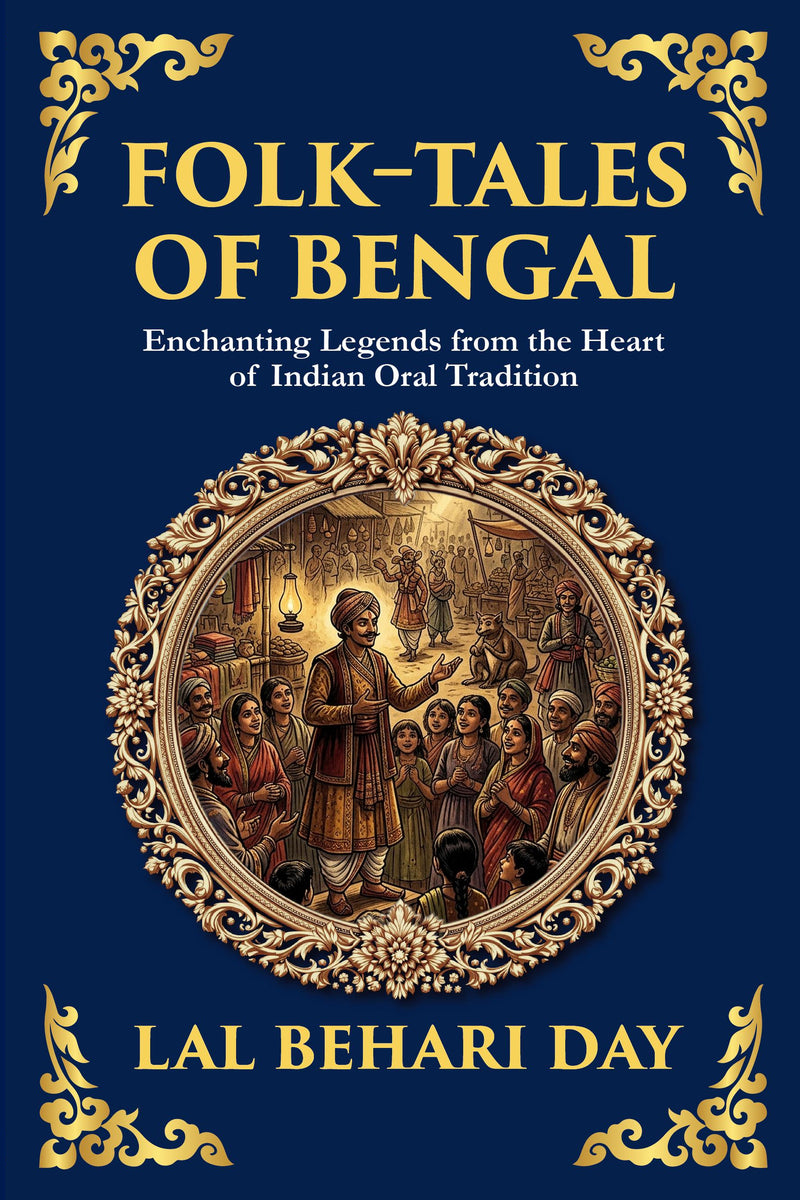
Folk-Tales of Bengal
Told by the firesides of Bengal and passed down through generations, these folk-tales are more than just stories—they are windows into the soul of a culture.
or free app
10,000+ hrs library
30-day guarantee
The complete Folk-Tales of Bengal appears in modern English through Library of Alexandria Press, available online with audiobook narration included for members.
Have you ever wondered why ancient tales still echo in the hearts of modern readers? In Folk-Tales of Bengal, author and scholar Lal Behari Day captures the living essence of Bengali folklore—stories told by village storytellers, passed from elder to child, and woven into the daily rhythm of life. First published in 1883, this groundbreaking collection is among the earliest efforts to preserve the oral traditions of India in English, bringing together tales of magic, humor, bravery, and wisdom.
Each story carries the voice of a people—their fears, their hopes, their reverence for nature, and their moral compass. These are not mere fantasies, but living cultural artifacts that offer insight into how generations of Bengalis viewed the world, understood justice, and celebrated life’s mysteries.
What you’ll discover in this modern edition
- Timeless Fables from the Villages of Bengal Dive into stories of cunning foxes, haunted trees, shape-shifting snakes, heroic peasants, and divine intervention.
| Formats | eBook (EPUB + PDF) · Audiobook · Paperback · Hardcover · Large Print |
| Language | English |
| Trim size (print) | 6 × 9 in |
| Binding | Paperback — perfect-bound · Hardcover — casewrap |
| Large Print edition | Same text in a larger, easy-read type — a larger font, not a larger trim |
| Print pricing | Every physical book at our true cost — at-cost, no profit (members) |
| Library | 873 restored titles, always growing |
| Length | 65,691 words · ~4 hr 23 min reading |
| Reading level | Grade 6 · an easy, flowing read (this modern-English edition) |
| Edition | Modern English translation · 2026 |
Member reviews for this edition are collected as readers finish it — be the first. Across the library: 12,000+ books shipped, every plan covered by a 365-day print guarantee.
About this edition
A faithful, unabridged modern-English edition by The Library of Alexandria — carefully rendered for today's reader and verified paragraph-by-paragraph against the public-domain source. Available as eBook, audiobook, paperback, hardcover, and large print.
- Complete & unabridgedVerified paragraph by paragraph against the source — never a scan, never abridged.
- Modern English, faithfulReadable today, with the author’s meaning kept intact. Readable — not simplified.
- Every format, one membershipRead in your browser or the free app, or listen to the full audiobook.
Included free with your membership
Cancel anytime, one click · 30-day money-back guarantee
Edition last updated July 2026
What’s inside
Folk-Tales of Bengal — complete and unabridged: all 24 sections included with membership, plus the full audiobook.
Begin reading Folk-Tales of Bengal
In clear modern English — the complete text is included with membership.
Introduction
When a young Bengali clergyman named Lal Behari Day set out to capture the stories that had filled the evenings of his childhood, he was performing an act of quiet rescue. These were tales that had never lived on paper. They had been carried instead on the breath of grandmothers and aunts, of village storytellers and family servants, passed from one generation to the next in the flickering light of oil lamps, in the warm dark after the evening meal, in the long pauses of rural Bengal where time moved slowly and a good story was among the richest entertainments a family could share. By the time Day undertook to write them down in the late nineteenth century, he understood something that gives this collection its enduring poignancy: a whole world of imagination was beginning to fade, and unless someone caught these stories before they slipped away entirely, they might be lost to the very people who had created them.
The result is a treasury of wonder—a gathering of princes and demons, of clever wives and foolish husbands, of talking birds and magical jewels, of fortunes won and lost and won again. To open these pages is to be welcomed into a circle of listeners who have gathered countless times before you, across centuries you cannot count, to hear the same beloved tales told once more. What follows is meant to enrich that experience: to set the stage, to introduce the storyteller and the world that shaped him, and to offer a few thoughts on how to read these stories so that they reveal their full delight. The tales themselves will not be spoiled here; that pleasure is reserved entirely for you.
Lal Behari Day was born in 1824 in the village of Sonapalashi, in the Burdwan district of Bengal, into a Hindu family of modest means. His was a childhood steeped in the very oral culture he would later preserve. The Bengal of his youth was a land of rivers and rice paddies, of monsoon rains and dry-season dust, of villages knit together by custom and faith and the rhythms of agricultural life. In such a setting, before the spread of printed books and formal schooling reached deep into rural homes, the spoken story was the great vessel of memory and meaning. Children learned of right and wrong, of cleverness and folly, of the dangers of greed and the rewards of patience, not from textbooks but from the lips of the women and old men who knew the tales by heart.
Day’s life took an unusual turn that would shape the entire character of this book. As a boy he was sent to Calcutta, where he came under the influence of the Scottish missionary and educator Alexander Duff. There he received a thorough English education, eventually converting to Christianity and entering the ministry himself. This was no small thing in the Bengal of that era; it marked him as a man who moved between two worlds. He was steeped in the indigenous culture of his birth—its language, its folklore, its rhythms of speech and feeling—yet he was also fluent in the literary traditions and intellectual habits of England. He read Shakespeare and the Bible; he absorbed the methods of European scholarship; he wrote in English with grace and precision.
This dual inheritance proved to be precisely the right preparation for the task he eventually undertook. A man wholly inside the village culture might never have thought to write its stories down—why preserve what everyone already knows? A man wholly outside it might have collected the tales as curiosities, flattening them into specimens for foreign examination. Day was uniquely positioned to do something better. He could hear these stories with the loving familiarity of a son of Bengal and render them with the literary skill of a trained English writer, all while understanding why they mattered and why they were worth saving.
The immediate occasion for the book was a request from an Englishman, Captain R. C. Temple, who was gathering folklore from across India and who wished to see the oral traditions of Bengal represented. Day agreed, but he set himself a particular discipline. He did not invent or embellish freely. Instead, he sought out the genuine article. In his own account of the project, he tells us that he gathered these tales chiefly from the memory of an old Bengali woman who had been a member of his household—a woman who, like so many keepers of folklore throughout history, carried in her mind a living library that existed nowhere on paper. He supplemented her store with stories recalled from his own boyhood and with others gathered from various sources, always taking care to reproduce the substance and spirit of the tales as they were actually told.
This care is what lifts the collection above mere antiquarian curiosity. Day was not constructing an artificial folklore; he was transcribing a real one. He understood that the value of these tales lay not in any single clever twist but in their authenticity, in the way they captured the imagination of a whole people. When he published the collection in 1883, he was offering the world a genuine window into the inner life of rural Bengal—its hopes, its fears, its humor, its sense of justice, and its boundless appetite for wonder.
It is worth pausing to appreciate how rare such a window is. For most of human history, the great mass of ordinary people left almost no written record of their inner lives. Kings and priests and merchants kept accounts and chronicles; the poor and the rural and the unlettered did not. Their thoughts, their entertainments, their moral imaginations survive, when they survive at all, only in fragments—and folktales are among the richest of those fragments. They are the literature of those who did not write. To read them is to hear voices that would otherwise be silent: the voices of the grandmothers and the village women, the farmers and the wanderers, who shaped these narratives over generations to delight their children and to make sense of their world.
Day went on to write other works, including a celebrated novel of Bengali village life, but it is this collection of folktales for which he is best remembered today, and rightly so. In setting down these stories with such fidelity and such evident love, he performed a service not only for the scholars of his own day but for every reader since who has wished to know the heart of Bengal. He died in 1892, but the world he preserved lives on in these pages, as vivid and as charming as it was on the evenings when he first heard the tales told.
What awaits the reader who steps into this collection? A landscape both familiar and strange—familiar because the great patterns of folktale run through all human cultures, strange because the particular flavor of Bengal infuses every page. Here you will find the recurring figures that storytellers everywhere have loved: the youngest child who succeeds where the elder ones fail, the suffering innocent who is finally vindicated, the trickster who outwits the powerful, the fool whose foolishness lands him, against all odds, on his feet. These are the deep grammar of human storytelling, and they will feel like old friends.
Yet they arrive dressed in the unmistakable garments of Bengal. The kings rule over Indian kingdoms; the merchants sail down Bengali rivers; the holy men and ascetics walk the roads of a Hindu world; the demons and ogres are the rakshasas of Indian myth, with their particular appetites and powers. The food, the festivals, the family structures, the gods invoked and the customs observed—all of these root the stories firmly in their soil. A reader from outside Bengal will encounter much that is delightfully unfamiliar, and part of the pleasure of the collection is precisely this immersion in a richly detailed cultural world. Names, foods, articles of clothing, social roles, and religious practices appear throughout, and rather than stumbling over them, the reader is encouraged to let them wash over the imagination as the original listeners would have, taking them as the natural furniture of a world both magical and real.
A particular feature of these tales deserves special mention, because it gives the collection much of its charm and even its sweetness. Bengali folktales of this domestic kind were largely the province of women—grandmothers and mothers and aunts telling stories to children. As a consequence, the texture of the tales is intimate and homely in the best sense. The grand adventures of princes are interwoven with the small details of household life: the cooking of rice, the grinding of spices, the quarrels and reconciliations of co-wives, the anxieties of a mother for her child, the cleverness of a wife who must manage a difficult husband or a dangerous situation. The female characters in these stories are frequently the ones with the real intelligence and resourcefulness, even when the formal hero is a man. The tales reflect a woman’s view of the world—its dangers and its consolations, its injustices and its small triumphs—and this perspective lends them a warmth and a psychological truthfulness that the reader will find quietly affecting.
There is humor here too, and plenty of it. The Bengali storytelling tradition has a fine appreciation for absurdity, for the foolish man who misunderstands everything, for the comic reversal that punctures pretension. Some of these tales are meant simply to make children laugh, and they still succeed. Others carry a sting of social satire, gently mocking the greedy, the vain, the hypocritically pious. The reader who comes expecting only solemn fairy magic will be pleasantly surprised by how often these stories twinkle with mischief.
And yet beneath the entertainment runs a current of genuine wisdom. Folktales are, among other things, a culture’s way of teaching itself how to live. They reward kindness and punish cruelty; they celebrate cleverness but warn against cunning that crosses into wickedness; they show that the meek may inherit good fortune and that the proud may stumble. These are not heavy-handed moral lectures—the Bengali storytellers were far too skilled for that—but the moral vision is present nonetheless, woven so deeply into the fabric of the narratives that it never feels imposed. The child who heard these stories absorbed a whole ethical sensibility without ever being lectured. The adult reader today can still feel that sensibility at work, shaping the satisfying arcs of the tales toward justice and reconciliation.
The structure of the tales themselves rewards attention. Oral storytelling has its own conventions, quite different from those of the written novel. Repetition is one of the most striking. Events happen in threes; phrases recur like refrains; characters perform the same action again and again with small variations. To a reader accustomed to the economy of modern prose, this may at first seem redundant—but it is nothing of the sort. Repetition was the storyteller’s tool, the device that built suspense in a live performance, that let the listener anticipate and savor the coming variation, that gave the tale its hypnotic rhythm. When you read these stories, it is worth reading some of them aloud, or at least hearing them in your mind’s ear, for they were composed for the ear, not the eye. The cadences, the formulas, the rhythmic repetitions all come alive when you let them sound.
You will notice, too, that the logic of these tales is the logic of dream rather than the logic of waking life. Transformations occur without explanation; the dead are restored; animals speak; impossible tasks are accomplished by magical means. Folktales do not pretend to plausibility, and to demand it of them is to misunderstand them entirely. They operate by a different set of rules—the rules of wish and fear, of justice imagined rather than observed, of the deep symbolic currents that run beneath the surface of the conscious mind. The fearsome ogress, the helpful animal, the magic object that solves an impossible problem—these are not failures of realism but the very substance of the form. They speak to something older and deeper in us than realism can reach.
Cancel anytime, one click · 30-day money-back guarantee
Founding annual rate available now — your price locks for life when you join.
Not ready? Get this free chapter by email — read it anytime.
✓ Sent — check your inbox for Folk-Tales of Bengal.
Questions about Folk-Tales of Bengal
What is Folk-Tales of Bengal about?
Told by the firesides of Bengal and passed down through generations, these folk-tales are more than just stories—they are windows into the soul of a culture. In Folk-Tales of Bengal, Lal Behari Day preserves the myths, morals, and magic of India’s rich oral tradition. Talking animals, clever tricksters, noble kings, mischievous ghosts, and wise sages populate this unforgettable collection, where each tale brims with wonder, wit, and wisdom.
Who wrote Folk-Tales of Bengal?
Folk-Tales of Bengal was written by Lal Behari Day. This edition presents the complete work in clear modern English, faithfully rendered from the public-domain original by Library of Alexandria Press.
Is Folk-Tales of Bengal free to read?
The opening chapter is free to read on this page. Members read and listen to the complete work — and the entire library — free, and can order any physical book at our true print cost.
How long is Folk-Tales of Bengal?
24 chapters (~65,691 words) — about 4 hr 23 min of reading in this modern-English edition.
Is this an abridged version of Folk-Tales of Bengal?
No. This is the complete, unabridged Folk-Tales of Bengal, carefully rendered into clear modern English and verified paragraph-by-paragraph against the public-domain source — nothing is cut or summarised.
What formats does Folk-Tales of Bengal come in?
Folk-Tales of Bengal is available as eBook, paperback, hardcover and large print. eBook and audiobook are included with membership; printed editions ship at our true print cost.
Shipping & returns
Billing & membership
More from the library


Explore Myths & Legends
- The Red Fairy Book · Andrew Lang
- Vikram and the Vampire: Classic Hindu Tales of Adventure, Magic, and Romance · Unknown
- The Initiates of the Flame · Manly P. Hall
- Gawayne and the Green Knight: A Fairy Tale · Charlton M. Lewis
- The Nibelungenlied · G. H. Needler
- The Aeneid of Virgil · Virgil
- Fifty Famous Stories Retold · James Baldwin
- West African Folk-Tales
- Lamia · John Keats
- The Three Bears · A. E. Kennedy
- The Ballad of the White Horse · G. K. Chesterton
- The Danish History, Books I–IX · Saxo Grammaticus
- Andersen’s Fairy Tales · H. C. Andersen
- The Birth of the War-God: A Poem by Kalidasa · Kálidása
- Omens and Superstitions of Southern India · Edgar Thurston
- The Legend of Sleepy Hollow · Washington Irving
- The Hyborian Age · Robert E. Howard
- The Odyssey · Homer
- Grimms’ Fairy Tales · Jacob Grimm and Wilhelm Grimm
- Just So Stories · Rudyard Kipling
- Aeschylus’ Prometheus Bound and the Seven Against Thebes · Aeschylus
- The Iliad · Homer
Folk-Tales of Bengal
Folk-Tales of Bengal
Captivating Stories from the Core of Indian Oral Tradition
Lal Behari Day
Contents
- Introduction
- Preface by the Author
- Chapter 1
- Chapter 2
- Chapter 3
- Chapter 4
- Chapter 5
- Chapter 6
- Chapter 7
- Chapter 8
- Chapter 9
- Chapter 10
- Chapter 11
- Chapter 12
- Chapter 13
- Chapter 14
- Chapter 15
- Chapter 16
- Chapter 17
- Chapter 18
- Chapter 19
- Chapter 20
- Chapter 21
- Chapter 22
Introduction
When a young Bengali clergyman named Lal Behari Day set out to capture the stories that had filled the evenings of his childhood, he was performing an act of quiet rescue. These were tales that had never lived on paper. They had been carried instead on the breath of grandmothers and aunts, of village storytellers and family servants, passed from one generation to the next in the flickering light of oil lamps, in the warm dark after the evening meal, in the long pauses of rural Bengal where time moved slowly and a good story was among the richest entertainments a family could share. By the time Day undertook to write them down in the late nineteenth century, he understood something that gives this collection its enduring poignancy: a whole world of imagination was beginning to fade, and unless someone caught these stories before they slipped away entirely, they might be lost to the very people who had created them.
The result is a treasury of wonder—a gathering of princes and demons, of clever wives and foolish husbands, of talking birds and magical jewels, of fortunes won and lost and won again. To open these pages is to be welcomed into a circle of listeners who have gathered countless times before you, across centuries you cannot count, to hear the same beloved tales told once more. What follows is meant to enrich that experience: to set the stage, to introduce the storyteller and the world that shaped him, and to offer a few thoughts on how to read these stories so that they reveal their full delight. The tales themselves will not be spoiled here; that pleasure is reserved entirely for you.
Lal Behari Day was born in 1824 in the village of Sonapalashi, in the Burdwan district of Bengal, into a Hindu family of modest means. His was a childhood steeped in the very oral culture he would later preserve. The Bengal of his youth was a land of rivers and rice paddies, of monsoon rains and dry-season dust, of villages knit together by custom and faith and the rhythms of agricultural life. In such a setting, before the spread of printed books and formal schooling reached deep into rural homes, the spoken story was the great vessel of memory and meaning. Children learned of right and wrong, of cleverness and folly, of the dangers of greed and the rewards of patience, not from textbooks but from the lips of the women and old men who knew the tales by heart.
Day’s life took an unusual turn that would shape the entire character of this book. As a boy he was sent to Calcutta, where he came under the influence of the Scottish missionary and educator Alexander Duff. There he received a thorough English education, eventually converting to Christianity and entering the ministry himself. This was no small thing in the Bengal of that era; it marked him as a man who moved between two worlds. He was steeped in the indigenous culture of his birth—its language, its folklore, its rhythms of speech and feeling—yet he was also fluent in the literary traditions and intellectual habits of England. He read Shakespeare and the Bible; he absorbed the methods of European scholarship; he wrote in English with grace and precision.
This dual inheritance proved to be precisely the right preparation for the task he eventually undertook. A man wholly inside the village culture might never have thought to write its stories down—why preserve what everyone already knows? A man wholly outside it might have collected the tales as curiosities, flattening them into specimens for foreign examination. Day was uniquely positioned to do something better. He could hear these stories with the loving familiarity of a son of Bengal and render them with the literary skill of a trained English writer, all while understanding why they mattered and why they were worth saving.
The immediate occasion for the book was a request from an Englishman, Captain R. C. Temple, who was gathering folklore from across India and who wished to see the oral traditions of Bengal represented. Day agreed, but he set himself a particular discipline. He did not invent or embellish freely. Instead, he sought out the genuine article. In his own account of the project, he tells us that he gathered these tales chiefly from the memory of an old Bengali woman who had been a member of his household—a woman who, like so many keepers of folklore throughout history, carried in her mind a living library that existed nowhere on paper. He supplemented her store with stories recalled from his own boyhood and with others gathered from various sources, always taking care to reproduce the substance and spirit of the tales as they were actually told.
This care is what lifts the collection above mere antiquarian curiosity. Day was not constructing an artificial folklore; he was transcribing a real one. He understood that the value of these tales lay not in any single clever twist but in their authenticity, in the way they captured the imagination of a whole people. When he published the collection in 1883, he was offering the world a genuine window into the inner life of rural Bengal—its hopes, its fears, its humor, its sense of justice, and its boundless appetite for wonder.
It is worth pausing to appreciate how rare such a window is. For most of human history, the great mass of ordinary people left almost no written record of their inner lives. Kings and priests and merchants kept accounts and chronicles; the poor and the rural and the unlettered did not. Their thoughts, their entertainments, their moral imaginations survive, when they survive at all, only in fragments—and folktales are among the richest of those fragments. They are the literature of those who did not write. To read them is to hear voices that would otherwise be silent: the voices of the grandmothers and the village women, the farmers and the wanderers, who shaped these narratives over generations to delight their children and to make sense of their world.
Day went on to write other works, including a celebrated novel of Bengali village life, but it is this collection of folktales for which he is best remembered today, and rightly so. In setting down these stories with such fidelity and such evident love, he performed a service not only for the scholars of his own day but for every reader since who has wished to know the heart of Bengal. He died in 1892, but the world he preserved lives on in these pages, as vivid and as charming as it was on the evenings when he first heard the tales told.
What awaits the reader who steps into this collection? A landscape both familiar and strange—familiar because the great patterns of folktale run through all human cultures, strange because the particular flavor of Bengal infuses every page. Here you will find the recurring figures that storytellers everywhere have loved: the youngest child who succeeds where the elder ones fail, the suffering innocent who is finally vindicated, the trickster who outwits the powerful, the fool whose foolishness lands him, against all odds, on his feet. These are the deep grammar of human storytelling, and they will feel like old friends.
Yet they arrive dressed in the unmistakable garments of Bengal. The kings rule over Indian kingdoms; the merchants sail down Bengali rivers; the holy men and ascetics walk the roads of a Hindu world; the demons and ogres are the rakshasas of Indian myth, with their particular appetites and powers. The food, the festivals, the family structures, the gods invoked and the customs observed—all of these root the stories firmly in their soil. A reader from outside Bengal will encounter much that is delightfully unfamiliar, and part of the pleasure of the collection is precisely this immersion in a richly detailed cultural world. Names, foods, articles of clothing, social roles, and religious practices appear throughout, and rather than stumbling over them, the reader is encouraged to let them wash over the imagination as the original listeners would have, taking them as the natural furniture of a world both magical and real.
A particular feature of these tales deserves special mention, because it gives the collection much of its charm and even its sweetness. Bengali folktales of this domestic kind were largely the province of women—grandmothers and mothers and aunts telling stories to children. As a consequence, the texture of the tales is intimate and homely in the best sense. The grand adventures of princes are interwoven with the small details of household life: the cooking of rice, the grinding of spices, the quarrels and reconciliations of co-wives, the anxieties of a mother for her child, the cleverness of a wife who must manage a difficult husband or a dangerous situation. The female characters in these stories are frequently the ones with the real intelligence and resourcefulness, even when the formal hero is a man. The tales reflect a woman’s view of the world—its dangers and its consolations, its injustices and its small triumphs—and this perspective lends them a warmth and a psychological truthfulness that the reader will find quietly affecting.
There is humor here too, and plenty of it. The Bengali storytelling tradition has a fine appreciation for absurdity, for the foolish man who misunderstands everything, for the comic reversal that punctures pretension. Some of these tales are meant simply to make children laugh, and they still succeed. Others carry a sting of social satire, gently mocking the greedy, the vain, the hypocritically pious. The reader who comes expecting only solemn fairy magic will be pleasantly surprised by how often these stories twinkle with mischief.
And yet beneath the entertainment runs a current of genuine wisdom. Folktales are, among other things, a culture’s way of teaching itself how to live. They reward kindness and punish cruelty; they celebrate cleverness but warn against cunning that crosses into wickedness; they show that the meek may inherit good fortune and that the proud may stumble. These are not heavy-handed moral lectures—the Bengali storytellers were far too skilled for that—but the moral vision is present nonetheless, woven so deeply into the fabric of the narratives that it never feels imposed. The child who heard these stories absorbed a whole ethical sensibility without ever being lectured. The adult reader today can still feel that sensibility at work, shaping the satisfying arcs of the tales toward justice and reconciliation.
The structure of the tales themselves rewards attention. Oral storytelling has its own conventions, quite different from those of the written novel. Repetition is one of the most striking. Events happen in threes; phrases recur like refrains; characters perform the same action again and again with small variations. To a reader accustomed to the economy of modern prose, this may at first seem redundant—but it is nothing of the sort. Repetition was the storyteller’s tool, the device that built suspense in a live performance, that let the listener anticipate and savor the coming variation, that gave the tale its hypnotic rhythm. When you read these stories, it is worth reading some of them aloud, or at least hearing them in your mind’s ear, for they were composed for the ear, not the eye. The cadences, the formulas, the rhythmic repetitions all come alive when you let them sound.
You will notice, too, that the logic of these tales is the logic of dream rather than the logic of waking life. Transformations occur without explanation; the dead are restored; animals speak; impossible tasks are accomplished by magical means. Folktales do not pretend to plausibility, and to demand it of them is to misunderstand them entirely. They operate by a different set of rules—the rules of wish and fear, of justice imagined rather than observed, of the deep symbolic currents that run beneath the surface of the conscious mind. The fearsome ogress, the helpful animal, the magic object that solves an impossible problem—these are not failures of realism but the very substance of the form. They speak to something older and deeper in us than realism can reach.
There was once a king who had two queens, Duo and Suo, but neither of them had any children. One day, a Faquir came to the palace gates begging for food. Queen Suo went to the door with a handful of rice. The beggar asked if she had any children. When she told him she did not, the holy man refused to take the rice, as the hands of a woman without children were considered spiritually unclean. He offered her a medicine to cure her infertility. Since she wanted it, he gave it to her with these instructions: “Take this remedy and swallow it with the juice of a pomegranate flower. If you do this, you will eventually have a son. He will be incredibly handsome, with skin the color of a pomegranate flower, and you shall name him Dalim Kumar. Because enemies will try to kill your son, I should tell you that the boy’s life will be tied to a large boal fish living in the pond in front of the palace. Inside the fish’s heart is a small wooden box, and inside that box is a gold necklace; that necklace is your son’s life. Farewell.”
About a month later, rumors began to spread through the palace that Queen Suo was expecting a baby. The king was overjoyed. He imagined a future heir to the throne and a long line of powerful kings continuing his dynasty for generations to come, which made him happier than he had ever been. The traditional ceremonies for such an occasion were held with great splendor, and the people loudly cheered, excited for the birth of a prince. In due time, Queen Suo gave birth to a son of extraordinary beauty. When the king first saw the infant’s face, his heart leaped with joy. The celebration of the child’s first eating of rice was held with immense pomp, and the entire kingdom was filled with happiness.
End of the free sample
Keep reading, free
Members read and listen to the complete book — and the entire library. Cancel anytime, one click · 30-day money-back guarantee.