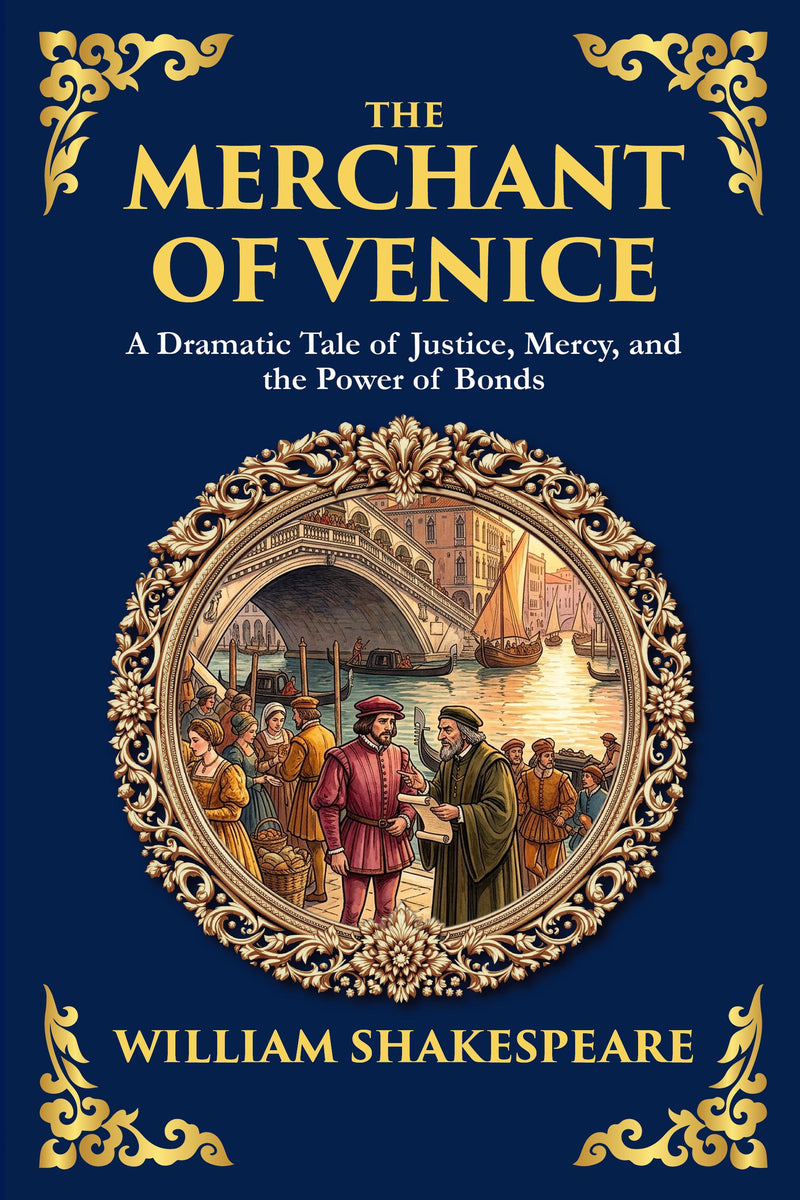
The Merchant of Venice — Large Print
Set in the vibrant world of Renaissance Venice, The Merchant of Venice is one of Shakespeare’s most captivating and controversial plays.
or free app
10,000+ hrs library
30-day guarantee
The complete The Merchant of Venice appears in modern English through Library of Alexandria Press, available online with audiobook narration included for members.
Have you ever wondered why mercy is more powerful than revenge? The Merchant of Venice is a complex and powerful drama where love and law collide, and every promise has its price. In this unforgettable tale, Shakespeare explores the tension between justice and compassion, friendship and greed, and societal expectations and human dignity.
Antonio, a merchant of Venice, borrows money from Shylock to help his dear friend woo the intelligent and wealthy Portia. But when Antonio’s ships are lost at sea, Shylock demands repayment—a literal pound of flesh. What follows is one of the most dramatic courtroom scenes in all of literature.
This modern edition brings Shakespeare’s rich language and profound ideas to life with clarity and emotional resonance. It invites readers to grapple with questions of morality, discrimination, loyalty, and the nature of mercy.
What you’ll discover in this modern edition
- A Story of Legal and Emotional High Stakes – Witness the conflict between Shylock and Antonio unfold with tension and grace.
| Formats | eBook (EPUB + PDF) · Audiobook · Paperback · Hardcover · Large Print |
| Language | English |
| Trim size (print) | 6 × 9 in |
| Binding | Paperback — perfect-bound · Hardcover — casewrap |
| Large Print edition | Same text in a larger, easy-read type — a larger font, not a larger trim |
| Print pricing | Every physical book at our true cost — at-cost, no profit (members) |
| Library | 873 restored titles, always growing |
| Length | 23,713 words · ~1 hr 35 min reading |
| Reading level | Grade 7 · an easy, flowing read (this modern-English edition) |
| Edition | Modern English translation · 2026 |
Member reviews for this edition are collected as readers finish it — be the first. Across the library: 12,000+ books shipped, every plan covered by a 365-day print guarantee.
About this edition
A faithful, unabridged modern-English edition by The Library of Alexandria — carefully rendered for today's reader and verified paragraph-by-paragraph against the public-domain source. Available as eBook, audiobook, paperback, hardcover, and large print.
- Complete & unabridgedVerified paragraph by paragraph against the source — never a scan, never abridged.
- Modern English, faithfulReadable today, with the author’s meaning kept intact. Readable — not simplified.
- Every format, one membershipRead in your browser or the free app, or listen to the full audiobook.
Included free with your membership
Cancel anytime, one click · 30-day money-back guarantee
Edition last updated July 2026
What’s inside
The Merchant of Venice — Large Print — complete and unabridged: all 21 sections included with membership, plus the full audiobook.
Begin reading The Merchant of Venice — Large Print
In clear modern English — the complete text is included with membership.
Introduction
There are works of literature that arrive in our hands already wrapped in the weight of centuries, their reputations preceding them, their famous lines half-remembered from classrooms and quotations and the casual borrowings of everyday speech. The Merchant of Venice is one such work. Few readers come to it entirely fresh; most carry some impression, however vague, of a courtroom, a pound of flesh, a moneylender, a woman disguised as a man delivering a stirring speech about the quality of mercy. And yet, for all its familiarity, this play remains one of the most surprising, unsettling, and rewarding pieces in the entire canon of Western literature. It refuses to sit comfortably in any single category. It is a comedy that contains tragedy. It is a romance shadowed by cruelty. It is a celebration of friendship and love that also asks hard questions about prejudice, money, and the limits of the law. To open this book is to step into a world that gleams with wit and warmth on its surface while pulling, always, at the deeper currents beneath.
This edition presents the play in a modern translation, carefully adapted so that the contemporary reader may move through Shakespeare’s story without stumbling over the thickets of archaic vocabulary, inverted syntax, and dated idiom that so often turn first encounters into frustrations. The aim here is not to replace Shakespeare but to open a clear door into his theater. The intent, the drama, the emotional force, and the moral complexity of the original have been preserved; what has been smoothed away is the linguistic distance that can make Elizabethan English feel like a foreign country. Think of this version as a companion who walks beside you through Venice and Belmont, translating not only the words but the spirit, so that you may experience the play as its first audiences did: with immediacy, with laughter, with suspense, and with the occasional sharp intake of breath when the comedy turns dangerous.
Before you begin, it is worth pausing to consider what you are about to read, where it came from, and why it has held the imaginations of audiences for more than four hundred years. The pages that follow will set the scene without spoiling it, prepare you without prescribing how you must feel, and offer a few keys that may unlock the richest possible reading experience.
A World of Merchants, Money, and Magnificent Cities
To understand The Merchant of Venice, it helps first to understand the city that gives it its name. In Shakespeare’s time, Venice was not merely a place on a map; it was an idea, a symbol, a shimmering image in the European imagination. It was the great trading hub of the Mediterranean, a republic grown fabulously wealthy on the movement of goods between East and West. Ships departed its harbors laden with spices, silks, jewels, and a thousand other luxuries, and returned bearing the fortunes that built its palaces and filled its coffers. To the English audiences who first saw this play performed, Venice represented the very pinnacle of commercial sophistication—a cosmopolitan, multicultural city where money flowed freely, where men of every nation came to do business, and where the law was famous for its impartiality and its strict enforcement of contracts.
This last point matters enormously, for the subtitle of this edition rightly identifies “the power of contracts” as one of the play’s central concerns. Venice prided itself on being a city where a bond was a bond, where the rule of law applied equally to citizen and foreigner alike, because its entire prosperity depended on the trust that such consistency created. Merchants from across the world would only bring their trade to a city where they could be certain their agreements would be honored. And so, when a contract is signed in this play—a strange, dark, and seemingly reckless contract—the entire weight of Venetian law and Venetian commercial honor stands behind it. The drama that unfolds is not simply a matter of personal conflict; it is a collision between human feeling and the impersonal, unbending machinery of legal obligation. This is what gives the play its peculiar power and its enduring relevance. We still live in a world governed by contracts, by the binding force of agreements made on paper, by the question of whether the letter of the law should ever yield to its spirit, or to simple human compassion.
Against the worldly bustle of Venice, Shakespeare sets a second location: Belmont, the home of a wealthy and beautiful heiress. If Venice is the realm of commerce, calculation, and law, Belmont is the realm of music, romance, and fortune of a different kind. The play moves back and forth between these two worlds, and much of its richness comes from the contrast and conversation between them. In Venice, men bargain over ducats; in Belmont, suitors gamble their futures on a riddle of golden, silver, and leaden caskets. In Venice, the question is what a man owes; in Belmont, the question is what a woman is worth, and how love is to be won and proven. The genius of the play lies in how these two worlds are made to bear upon one another, how the troubles of one reach into the joys of the other, and how characters move between them carrying their loyalties, their loves, and their burdens.
It is also impossible to introduce this play honestly without acknowledging the figure who stands at its troubled heart: a Jewish moneylender named Shylock. Here we must tread carefully, for this character has been the subject of more debate, more controversy, and more divergent interpretation than perhaps any other in Shakespeare’s works. In the original era of the play’s composition, Jews had been formally expelled from England for centuries, and the small number who remained lived under suspicion and disguise. The stereotypes that surrounded them were ugly and pervasive, and there is no use pretending that The Merchant of Venice is entirely free of the prejudices of its age. The character of Shylock was created within a culture that held deep and unjust hostilities, and some of the play’s elements undeniably reflect those attitudes.
And yet—and this is the remarkable thing, the thing that has kept generations of scholars, actors, and audiences returning to argue and wrestle with the text—Shakespeare did something extraordinary. He gave this character a voice. He gave him grievances. He gave him a wound that bleeds in full view of the audience. He allowed him to stand on a stage and demand, in words of searing power, to be recognized as a human being who feels, suffers, and bleeds exactly as his persecutors do. Whether Shakespeare intended sympathy or merely complexity, the result is a character who cannot be reduced to a simple villain. Modern readers will find themselves caught in a difficult and productive tension: appalled by certain aspects of the portrayal, yet moved by the humanity that breaks through it. This discomfort is not a flaw in your reading; it is part of what the play does to those who engage with it seriously. Approach Shylock not as a settled question but as an open one, and you will discover one of the most psychologically rich and morally challenging figures ever written for the stage.
It is precisely because the play does not offer easy answers that it has remained so vital. A simpler work would have aged into irrelevance, a museum piece to be admired and forgotten. Instead, The Merchant of Venice continues to provoke, to disturb, and to demand that each new generation think hard about justice, about mercy, about the difference between the law and what is right, and about the terrible cost of treating any human being as less than fully human. As you read, you will find that the play asks more of you than it answers, and that this is exactly its gift.
The Genius of Shakespeare and the Architecture of the Drama
William Shakespeare wrote this play in the late 1590s, during one of the most extraordinarily fertile periods of his career. By this point he was already an established and successful playwright, the principal dramatist of a thriving London theater company, a man whose works packed the open-air playhouses on the south bank of the Thames with audiences drawn from every rank of society—from groundlings who paid a penny to stand in the yard to wealthy patrons in the covered galleries above. To write for such a crowd required a particular kind of genius: the ability to please the educated and the unlettered at once, to layer crude jokes beneath profound philosophy, to deliver spectacle and suspense while also exploring the deepest questions of the human condition. Shakespeare possessed this genius in a measure no other writer before or since has matched, and The Merchant of Venice is one of its most polished demonstrations.
Consider, first, the play’s masterful construction. Shakespeare weaves together at least three distinct plot threads—a tale of devoted friendship and a perilous financial bargain, a romance pursued through a test of caskets, and a subplot of elopement and disguise—and braids them so tightly that each illuminates the others. A modern reader, freed by this translation from the obstacles of antique language, will be able to appreciate just how skillfully these threads are managed. Nothing is wasted. A casual remark in one scene becomes crucial three acts later. A bargain made lightly returns with deadly seriousness. A ring given as a token of love becomes the engine of an entire comic resolution. This is the work of a dramatist at the height of his craft, building suspense with the precision of a master watchmaker and timing each revelation for maximum effect.
Consider, too, the play’s extraordinary range of tone. Within a single work, Shakespeare gives us tender love scenes bathed in moonlight and music, gut-wrenching confrontations charged with hatred and fear, broad clownish comedy, sparkling verbal wit, and a courtroom drama as tense as any thriller ever written. The famous trial scene, which forms the climax of the play, is a marvel of dramatic engineering—a sequence in which the stakes could not be higher, in which the audience’s sympathies are pulled in multiple directions at once, and in which the resolution arrives through a turn so clever and so morally charged that it has been studied by lawyers and philosophers for centuries. You will know it when you reach it. The air in the room seems to change. And the speech delivered there about the nature of mercy—about how it falls like gentle rain, how it blesses both the one who gives and the one who receives, how it is mightier than the scepter of any king—stands among the most beautiful and frequently quoted passages in all of English literature. In this modern rendering, its meaning rings out with clarity, so that you may feel its full force rather than puzzling over its phrasing.
One of the great pleasures awaiting you in these pages is Shakespeare’s gift for character. The people who populate this play are not types or mouthpieces; they are vivid, contradictory, fully realized human beings. There is the title merchant himself, a man of mysterious melancholy whose generosity to his friends knows no bounds and whose fate hangs by a thread for much of the action. There is a young man, charming and somewhat reckless, who borrows beyond his means in pursuit of love, and whose journey forces us to ask what we owe to those who help us and what love demands in return. There is, above all, one of Shakespeare’s most brilliant and resourceful heroines—a woman of intelligence, courage, and wit who outmaneuvers every man in the play and who, in disguise, achieves what none of them can. To watch her operate is one of the chief delights of the text. She is funny, she is formidable, she is tender, and she is shrewd, and her presence transforms the play from a story about men’s affairs into something far richer and more surprising.
A word here about the modern translation you hold, and about how best to read it. Shakespeare wrote largely in verse—in the rhythmic, elevated language of blank verse and rhymed couplets—interspersed with prose for his comic and lower-status characters. The original language is glorious, but it is also, for many contemporary readers, genuinely difficult. Words have shifted their meanings over four centuries; references that were obvious to an Elizabethan audience are obscure to us; the dense wordplay and rapid puns can fly past before we grasp them. This edition has been prepared to remove those barriers while honoring the music and meaning of the original. Where Shakespeare’s metaphors remain vivid, they are kept. Where his jokes still land, they are preserved. But the syntax has been clarified, the vocabulary modernized, and the meaning made transparent, so that nothing stands between you and the living drama.
Cancel anytime, one click · 30-day money-back guarantee
Founding annual rate available now — your price locks for life when you join.
Not ready? Get this free chapter by email — read it anytime.
✓ Sent — check your inbox for The Merchant of Venice — Large Print.
Questions about The Merchant of Venice — Large Print
What is The Merchant of Venice about?
Set in the vibrant world of Renaissance Venice, The Merchant of Venice is one of Shakespeare’s most captivating and controversial plays. At the heart of the drama is the iconic and enigmatic character Shylock, a Jewish moneylender who demands a pound of flesh as collateral for a loan. When the time comes to collect his bond, a courtroom battle ensues that tests the limits of justice, vengeance, love, and forgiveness.
Who wrote The Merchant of Venice?
The Merchant of Venice was written by William Shakespeare. This edition presents the complete work in clear modern English, faithfully rendered from the public-domain original by Library of Alexandria Press.
Is The Merchant of Venice free to read?
The opening chapter is free to read on this page. Members read and listen to the complete work — and the entire library — free, and can order any physical book at our true print cost.
How long is The Merchant of Venice?
21 chapters (~23,713 words) — about 1 hr 35 min of reading in this modern-English edition.
Is this an abridged version of The Merchant of Venice?
No. This is the complete, unabridged The Merchant of Venice, carefully rendered into clear modern English and verified paragraph-by-paragraph against the public-domain source — nothing is cut or summarised.
What formats does The Merchant of Venice come in?
The Merchant of Venice is available as eBook, paperback, hardcover and large print. eBook and audiobook are included with membership; printed editions ship at our true print cost.
Shipping & returns
Billing & membership
More from the library


Explore Poetry & Drama
- As You Like It · William Shakespeare
- The Raven · Edgar Allan Poe
- The Merchant of Venice · William Shakespeare
- A Midsummer Night’s Dream · William Shakespeare
- Romeo and Juliet · William Shakespeare
- The Imaginary Invalid · Molière
- A Woman of No Importance · Oscar Wilde
- Gitanjali · Rabindranath Tagore
- Sonnets from the Portuguese · Elizabeth Barrett Browning
- The New Life (La Vita Nuova) · Dante Alighieri
- The Rime of the Ancient Mariner · Samuel Taylor Coleridge
- Lady Windermere’s Fan · Oscar Wilde
- The Home Book of Verse — Volume 4 · Burton Egbert Stevenson
- Ghosts · Henrik Ibsen
- Mrs. Warren’s Profession · Bernard Shaw
- An Enemy of the People · Henrik Ibsen
- Gawayne and the Green Knight: A Fairy Tale · Charlton M. Lewis
- The Nibelungenlied · G. H. Needler
- Julius Caesar · William Shakespeare
- The Aeneid of Virgil · Virgil
- Troilus and Criseyde · Geoffrey Chaucer
- The Post Office · Rabindranath Tagore
- Lamia · John Keats
- The Ballad of the White Horse · G. K. Chesterton
- A Shropshire Lad · A. E. Housman
- The Birth of the War-God: A Poem by Kalidasa · Kálidása
- Riders to the Sea · J. M. Synge
- The Prophet · Kahlil Gibran
- Twelfth Night; Or, What You Will · William Shakespeare
- Othello, the Moor of Venice · William Shakespeare
The Merchant of Venice — Large Print
The Merchant of Venice — Large Print
A Dramatic Story of Justice, Mercy, and the Power of Contracts
William Shakespeare
Contents
- Introduction
- Act 1, Scene 1
- Act 1, Scene 2
- Act 1, Scene 3
- Act 2, Scene 1
- Act 2, Scene 2
- Act 2, Scene 3
- Act 2, Scene 4
- Act 2, Scene 5
- Act 2, Scene 6
- Act 2, Scene 7
- Act 2, Scene 8
- Act 2, Scene 9
- Act 3, Scene 1
- Act 3, Scene 2
- Act 3, Scene 3
- Act 3, Scene 4
- Act 3, Scene 5
- Act 4, Scene 1
- Act 4, Scene 2
- Act 5, Scene 1
Introduction
There are works of literature that arrive in our hands already wrapped in the weight of centuries, their reputations preceding them, their famous lines half-remembered from classrooms and quotations and the casual borrowings of everyday speech. The Merchant of Venice is one such work. Few readers come to it entirely fresh; most carry some impression, however vague, of a courtroom, a pound of flesh, a moneylender, a woman disguised as a man delivering a stirring speech about the quality of mercy. And yet, for all its familiarity, this play remains one of the most surprising, unsettling, and rewarding pieces in the entire canon of Western literature. It refuses to sit comfortably in any single category. It is a comedy that contains tragedy. It is a romance shadowed by cruelty. It is a celebration of friendship and love that also asks hard questions about prejudice, money, and the limits of the law. To open this book is to step into a world that gleams with wit and warmth on its surface while pulling, always, at the deeper currents beneath.
This edition presents the play in a modern translation, carefully adapted so that the contemporary reader may move through Shakespeare’s story without stumbling over the thickets of archaic vocabulary, inverted syntax, and dated idiom that so often turn first encounters into frustrations. The aim here is not to replace Shakespeare but to open a clear door into his theater. The intent, the drama, the emotional force, and the moral complexity of the original have been preserved; what has been smoothed away is the linguistic distance that can make Elizabethan English feel like a foreign country. Think of this version as a companion who walks beside you through Venice and Belmont, translating not only the words but the spirit, so that you may experience the play as its first audiences did: with immediacy, with laughter, with suspense, and with the occasional sharp intake of breath when the comedy turns dangerous.
Before you begin, it is worth pausing to consider what you are about to read, where it came from, and why it has held the imaginations of audiences for more than four hundred years. The pages that follow will set the scene without spoiling it, prepare you without prescribing how you must feel, and offer a few keys that may unlock the richest possible reading experience.
A World of Merchants, Money, and Magnificent Cities
To understand The Merchant of Venice, it helps first to understand the city that gives it its name. In Shakespeare’s time, Venice was not merely a place on a map; it was an idea, a symbol, a shimmering image in the European imagination. It was the great trading hub of the Mediterranean, a republic grown fabulously wealthy on the movement of goods between East and West. Ships departed its harbors laden with spices, silks, jewels, and a thousand other luxuries, and returned bearing the fortunes that built its palaces and filled its coffers. To the English audiences who first saw this play performed, Venice represented the very pinnacle of commercial sophistication—a cosmopolitan, multicultural city where money flowed freely, where men of every nation came to do business, and where the law was famous for its impartiality and its strict enforcement of contracts.
This last point matters enormously, for the subtitle of this edition rightly identifies “the power of contracts” as one of the play’s central concerns. Venice prided itself on being a city where a bond was a bond, where the rule of law applied equally to citizen and foreigner alike, because its entire prosperity depended on the trust that such consistency created. Merchants from across the world would only bring their trade to a city where they could be certain their agreements would be honored. And so, when a contract is signed in this play—a strange, dark, and seemingly reckless contract—the entire weight of Venetian law and Venetian commercial honor stands behind it. The drama that unfolds is not simply a matter of personal conflict; it is a collision between human feeling and the impersonal, unbending machinery of legal obligation. This is what gives the play its peculiar power and its enduring relevance. We still live in a world governed by contracts, by the binding force of agreements made on paper, by the question of whether the letter of the law should ever yield to its spirit, or to simple human compassion.
Against the worldly bustle of Venice, Shakespeare sets a second location: Belmont, the home of a wealthy and beautiful heiress. If Venice is the realm of commerce, calculation, and law, Belmont is the realm of music, romance, and fortune of a different kind. The play moves back and forth between these two worlds, and much of its richness comes from the contrast and conversation between them. In Venice, men bargain over ducats; in Belmont, suitors gamble their futures on a riddle of golden, silver, and leaden caskets. In Venice, the question is what a man owes; in Belmont, the question is what a woman is worth, and how love is to be won and proven. The genius of the play lies in how these two worlds are made to bear upon one another, how the troubles of one reach into the joys of the other, and how characters move between them carrying their loyalties, their loves, and their burdens.
It is also impossible to introduce this play honestly without acknowledging the figure who stands at its troubled heart: a Jewish moneylender named Shylock. Here we must tread carefully, for this character has been the subject of more debate, more controversy, and more divergent interpretation than perhaps any other in Shakespeare’s works. In the original era of the play’s composition, Jews had been formally expelled from England for centuries, and the small number who remained lived under suspicion and disguise. The stereotypes that surrounded them were ugly and pervasive, and there is no use pretending that The Merchant of Venice is entirely free of the prejudices of its age. The character of Shylock was created within a culture that held deep and unjust hostilities, and some of the play’s elements undeniably reflect those attitudes.
And yet—and this is the remarkable thing, the thing that has kept generations of scholars, actors, and audiences returning to argue and wrestle with the text—Shakespeare did something extraordinary. He gave this character a voice. He gave him grievances. He gave him a wound that bleeds in full view of the audience. He allowed him to stand on a stage and demand, in words of searing power, to be recognized as a human being who feels, suffers, and bleeds exactly as his persecutors do. Whether Shakespeare intended sympathy or merely complexity, the result is a character who cannot be reduced to a simple villain. Modern readers will find themselves caught in a difficult and productive tension: appalled by certain aspects of the portrayal, yet moved by the humanity that breaks through it. This discomfort is not a flaw in your reading; it is part of what the play does to those who engage with it seriously. Approach Shylock not as a settled question but as an open one, and you will discover one of the most psychologically rich and morally challenging figures ever written for the stage.
It is precisely because the play does not offer easy answers that it has remained so vital. A simpler work would have aged into irrelevance, a museum piece to be admired and forgotten. Instead, The Merchant of Venice continues to provoke, to disturb, and to demand that each new generation think hard about justice, about mercy, about the difference between the law and what is right, and about the terrible cost of treating any human being as less than fully human. As you read, you will find that the play asks more of you than it answers, and that this is exactly its gift.
The Genius of Shakespeare and the Architecture of the Drama
William Shakespeare wrote this play in the late 1590s, during one of the most extraordinarily fertile periods of his career. By this point he was already an established and successful playwright, the principal dramatist of a thriving London theater company, a man whose works packed the open-air playhouses on the south bank of the Thames with audiences drawn from every rank of society—from groundlings who paid a penny to stand in the yard to wealthy patrons in the covered galleries above. To write for such a crowd required a particular kind of genius: the ability to please the educated and the unlettered at once, to layer crude jokes beneath profound philosophy, to deliver spectacle and suspense while also exploring the deepest questions of the human condition. Shakespeare possessed this genius in a measure no other writer before or since has matched, and The Merchant of Venice is one of its most polished demonstrations.
Consider, first, the play’s masterful construction. Shakespeare weaves together at least three distinct plot threads—a tale of devoted friendship and a perilous financial bargain, a romance pursued through a test of caskets, and a subplot of elopement and disguise—and braids them so tightly that each illuminates the others. A modern reader, freed by this translation from the obstacles of antique language, will be able to appreciate just how skillfully these threads are managed. Nothing is wasted. A casual remark in one scene becomes crucial three acts later. A bargain made lightly returns with deadly seriousness. A ring given as a token of love becomes the engine of an entire comic resolution. This is the work of a dramatist at the height of his craft, building suspense with the precision of a master watchmaker and timing each revelation for maximum effect.
Consider, too, the play’s extraordinary range of tone. Within a single work, Shakespeare gives us tender love scenes bathed in moonlight and music, gut-wrenching confrontations charged with hatred and fear, broad clownish comedy, sparkling verbal wit, and a courtroom drama as tense as any thriller ever written. The famous trial scene, which forms the climax of the play, is a marvel of dramatic engineering—a sequence in which the stakes could not be higher, in which the audience’s sympathies are pulled in multiple directions at once, and in which the resolution arrives through a turn so clever and so morally charged that it has been studied by lawyers and philosophers for centuries. You will know it when you reach it. The air in the room seems to change. And the speech delivered there about the nature of mercy—about how it falls like gentle rain, how it blesses both the one who gives and the one who receives, how it is mightier than the scepter of any king—stands among the most beautiful and frequently quoted passages in all of English literature. In this modern rendering, its meaning rings out with clarity, so that you may feel its full force rather than puzzling over its phrasing.
One of the great pleasures awaiting you in these pages is Shakespeare’s gift for character. The people who populate this play are not types or mouthpieces; they are vivid, contradictory, fully realized human beings. There is the title merchant himself, a man of mysterious melancholy whose generosity to his friends knows no bounds and whose fate hangs by a thread for much of the action. There is a young man, charming and somewhat reckless, who borrows beyond his means in pursuit of love, and whose journey forces us to ask what we owe to those who help us and what love demands in return. There is, above all, one of Shakespeare’s most brilliant and resourceful heroines—a woman of intelligence, courage, and wit who outmaneuvers every man in the play and who, in disguise, achieves what none of them can. To watch her operate is one of the chief delights of the text. She is funny, she is formidable, she is tender, and she is shrewd, and her presence transforms the play from a story about men’s affairs into something far richer and more surprising.
A word here about the modern translation you hold, and about how best to read it. Shakespeare wrote largely in verse—in the rhythmic, elevated language of blank verse and rhymed couplets—interspersed with prose for his comic and lower-status characters. The original language is glorious, but it is also, for many contemporary readers, genuinely difficult. Words have shifted their meanings over four centuries; references that were obvious to an Elizabethan audience are obscure to us; the dense wordplay and rapid puns can fly past before we grasp them. This edition has been prepared to remove those barriers while honoring the music and meaning of the original. Where Shakespeare’s metaphors remain vivid, they are kept. Where his jokes still land, they are preserved. But the syntax has been clarified, the vocabulary modernized, and the meaning made transparent, so that nothing stands between you and the living drama.
ANTONIO. To be honest, I don’t know why I feel so sad. It exhausts me; you say it exhausts you too. But I have yet to figure out how I caught this feeling, where it came from, or what it is actually made of. This sadness makes me feel so foolish that I barely recognize myself.
SALARINO. Your mind is drifting across the ocean, where your large merchant ships sail with full canvases. They look like noblemen or wealthy citizens of the city gliding over the waves, or like grand parades of the sea. They tower over the smaller trading boats, which seem to bow and show respect as the great ships fly past them with their woven sails.
SOLANIO. Believe me, sir, if I had invested my money in ships, most of my thoughts would be out at sea with my hopes. I would constantly be pulling at the grass to see which way the wind was blowing, and staring at maps to find ports, piers, and harbors. Without a doubt, anything that made me fear for my shipments would make me miserable.
how much damage a strong wind could do at sea.
Every time I watched the sand run through an hourglass,
I would think of shallow waters and sandbanks,
and picture my expensive ship, the Andrew, running aground,
tilting her tall masts down lower than her hull
to kiss her own burial. If I went to church
I would immediately think of dangerous rocks
that, by just grazing the side of my ship,
would scatter all her spices into the current,
and, in a word, one moment worth a fortune
and the next worth nothing. If I had the thought
to dwell on this, could I really lack the thought
that such a thing happening would make me sad?
ANTONIO. Believe me, I’m not. I’m actually grateful for my situation. My shipments aren’t all on one ship, nor are they all headed to one place; my entire fortune doesn’t depend on this single year. Therefore, my business isn’t making me sad.
End of the free sample
Keep reading, free
Members read and listen to the complete book — and the entire library. Cancel anytime, one click · 30-day money-back guarantee.