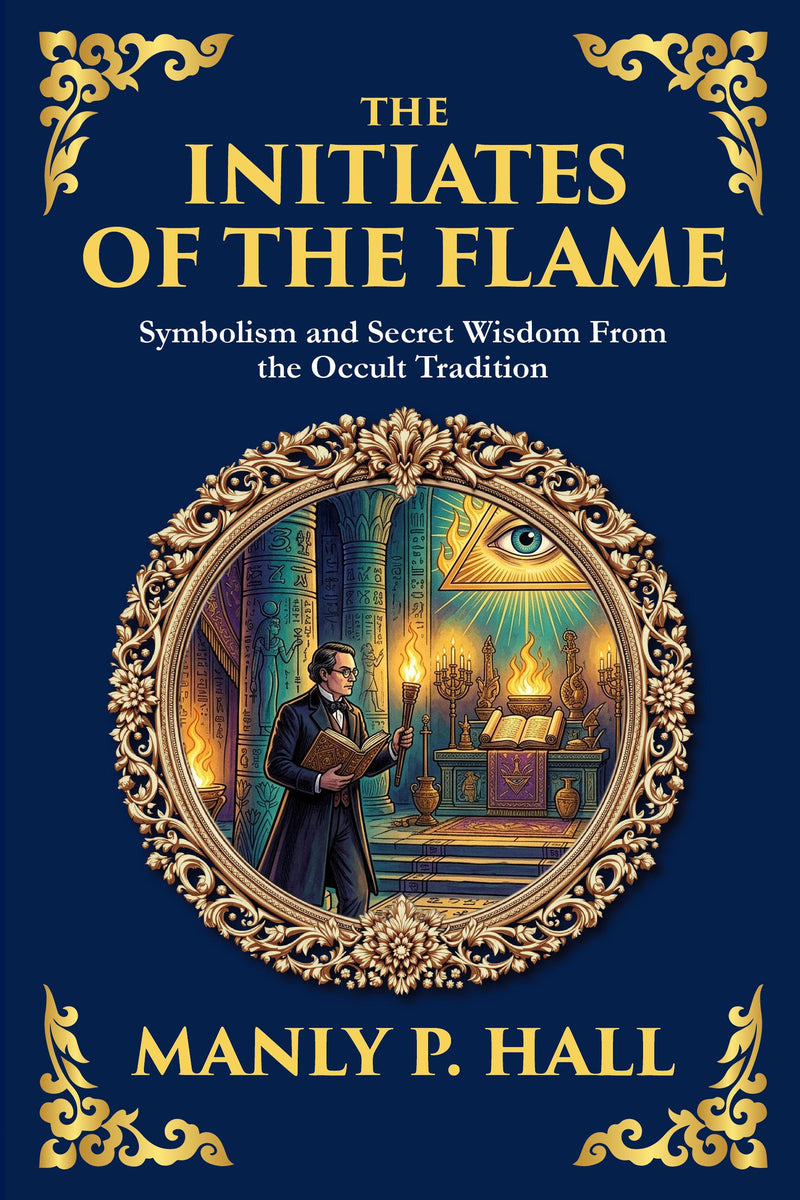
The Initiates of the Flame — Large Print
Step beyond the veil of the material world into the ancient mysteries that have shaped the spiritual evolution of humanity.
or free app
10,000+ hrs library
30-day guarantee
The complete The Initiates of the Flame appears in modern English through Library of Alexandria Press, available online with audiobook narration included for members.
Have you ever wondered why the same sacred symbols appear in every age and culture? The Initiates of the Flame is a timeless exploration of the sacred fire that has burned at the heart of mystery traditions for millennia. Written by esoteric philosopher Manly P. Hall when he was just 21 years old, this foundational work invites readers into the ancient wisdom teachings hidden beneath religious symbolism, ritual, and myth.
Hall leads us through the deeper meaning of fire as a spiritual principle, the symbol of the eternal soul, and the transformative agent of inner alchemy. By tracing the journey of the initiate —from ignorance to illumination—he illuminates how secret orders have preserved the sacred flame through time: in Egyptian temples, Zoroastrian fire altars, Masonic lodges, and early Christian sacraments. Through poetic prose and metaphysical insight, Hall constructs a spiritual blueprint for seekers of truth—those ready to walk the path of awakening and service.
What you’ll discover in this modern edition
- The Symbolism of the Flame Understand the fire as a divine symbol of life, spirit, and purification found in all esoteric traditions.
- Mystery Schools of the Ages Explore teachings from the ancient Egyptians, Persian Magi, Knights Templar, Masons, and Rosicrucians.
- The Path of Initiation Follow the allegorical ascent of the soul—from material darkness to divine light and truth.
- The Sacred Architecture of the Inner World Learn how the temples of old reflect the structure of the human spirit and the cosmos.
- Manly P. Hall’s Visionary Voice Access the original work of one of the 20th century’s most important occult thinkers— crafted with insight, reverence, and poetic intensity.
| Formats | eBook (EPUB + PDF) · Audiobook · Paperback · Hardcover · Large Print |
| Language | English |
| Trim size (print) | 6 × 9 in |
| Binding | Paperback — perfect-bound · Hardcover — casewrap |
| Large Print edition | Same text in a larger, easy-read type — a larger font, not a larger trim |
| Print pricing | Every physical book at our true cost — at-cost, no profit (members) |
| Library | 873 restored titles, always growing |
| Length | 15,704 words · ~1 hr 3 min reading |
| Reading level | Grade 12 · a confident, adult read (this modern-English edition) |
| Edition | Modern English translation · 2026 |
Member reviews for this edition are collected as readers finish it — be the first. Across the library: 12,000+ books shipped, every plan covered by a 365-day print guarantee.
About this edition
A faithful, unabridged modern-English edition by The Library of Alexandria — carefully rendered for today's reader and verified paragraph-by-paragraph against the public-domain source. Available as eBook, audiobook, paperback, hardcover, and large print.
- Complete & unabridgedVerified paragraph by paragraph against the source — never a scan, never abridged.
- Modern English, faithfulReadable today, with the author’s meaning kept intact. Readable — not simplified.
- Every format, one membershipRead in your browser or the free app, or listen to the full audiobook.
Included free with your membership
Cancel anytime, one click · 30-day money-back guarantee
Edition last updated July 2026
What’s inside
The Initiates of the Flame — Large Print — complete and unabridged: all 10 sections included with membership, plus the full audiobook.
Begin reading The Initiates of the Flame — Large Print
In clear modern English — the complete text is included with membership.
Introduction
There are certain books that arrive not as conclusions but as invitations. They do not seek to settle the great questions of existence with the heavy hand of dogma; instead they open doors, light lamps, and gesture toward corridors the reader has perhaps always sensed but never dared to walk. The Initiates of the Flame belongs unmistakably to this rare and luminous category. It is a slender work, but slenderness here is no measure of its weight. Within its pages burns a quiet fire — the same fire, the author would argue, that has been tended in secret across the ages by philosophers, priests, alchemists, mystics, and those nameless seekers who have understood that wisdom is not a possession to be owned but a flame to be kept alive.
To approach this book well, it helps to understand something of the extraordinary young man who wrote it. Manly Palmer Hall was born in 1901 in Peterborough, Ontario, and by the time he composed this early work he was barely past the threshold of adulthood. This fact alone deserves a moment’s pause. Hall was not a graybeard professor crowning a lifetime of scholarship; he was a young man of remarkable precocity, possessed of an intellect and a sensitivity that allowed him to absorb and synthesize the vast inheritance of the world’s mystical traditions with a fluency that astonished his contemporaries. He would go on, in 1928, to publish the monumental encyclopedia of symbolic philosophy that secured his reputation — a book so ambitious in scope that it remains a touchstone for students of the esoteric to this day. But before that great labor, there were these earlier, more intimate writings, of which the present volume is among the most beloved.
What strikes the modern reader first about Hall is the sincerity of his purpose. He was not a charlatan trading in mystery for profit, nor a sensationalist dressing up superstition in robes of profundity. He was, rather, a genuine devotee of the search for meaning — a man who believed, deeply and unwaveringly, that beneath the surface of religion, science, and art there flowed a single underground river of perennial truth. He saw the world’s spiritual traditions not as competitors but as dialects of one universal language, each expressing in its own symbols and stories the same fundamental insights about the nature of the soul, the structure of the cosmos, and the destiny of the human spirit. This conviction, sometimes called the perennial philosophy, animates everything he wrote, and it animates this book with particular brightness.
Hall lived in an era hungry for precisely this kind of synthesis. The early decades of the twentieth century were a period of tremendous spiritual restlessness in the Western world. The certainties of the old religious orthodoxies had been shaken by the advance of science, by the trauma of war, and by the dizzying acceleration of modern life. Many thoughtful people found themselves caught between a faith they could no longer accept literally and a materialism that left the soul starving. Into this gap stepped a host of teachers, movements, and societies — some genuine, some less so — promising access to ancient wisdom that could reconcile the heart with the head, the seen with the unseen. Hall emerged from this milieu, but he was never content to be merely a product of it. He sought to clarify rather than to mystify, to illuminate rather than to obscure. Where lesser figures cultivated an air of impenetrable secrecy, Hall labored to make the symbols speak, to translate the hidden language of the initiates into terms a sincere reader might actually grasp and use.
That word — initiate — sits at the very heart of this work, and it deserves careful attention before we proceed. In ordinary speech we use it loosely, as when we say a person is initiated into a club or a profession. But in the tradition from which Hall drew, initiation meant something far more profound and far more demanding. It referred to a transformation of the whole being, a passage from one mode of consciousness to another, a kind of inner death and rebirth through which the seeker was remade. The ancient mystery schools of Egypt, Greece, and the Near East were said to guard such initiations jealously, admitting only those who had proven themselves ready through long preparation, ethical discipline, and the cultivation of inner perception. The candidate who emerged from these rites was held to have crossed a threshold invisible to the uninitiated — to have awakened a faculty of understanding that the ordinary person possessed only in dormant, unrealized form.
The “flame” of the title is the central symbol around which all of this revolves, and it is worth dwelling on, for Hall has chosen it with great care. Fire has fascinated humanity since the first spark was struck in the darkness of prehistory. It warms and it consumes; it gives life and it destroys; it illuminates and it transforms. Across virtually every culture and every age, fire has served as a symbol of the divine spark within the human being — that mysterious inner light which distinguishes us from the merely mechanical, which yearns toward truth, which refuses to be extinguished even in the darkest circumstances. To be an initiate of the flame, in Hall’s vision, is to be one who has discovered, tended, and ultimately become one with this inner fire — the spiritual essence that the alchemists symbolized, that the mystics adored, and that the great teachers of every tradition pointed toward by a thousand different names.
It would be a disservice to the reader to summarize the contents of these pages in advance, for much of the pleasure and the power of this work lies in the unfolding — in the way Hall leads us, image by image and idea by idea, toward insights that arrive with the quiet force of recognition rather than the blunt impact of assertion. But it is fair, and indeed helpful, to describe the kind of journey on which the author is about to take us, so that the reader may set out properly equipped.
This is, in the deepest sense, a book about symbols and what they conceal and reveal. Hall belonged to a tradition that held the symbol to be a uniquely powerful vehicle of truth — more powerful, in certain respects, than plain prose could ever be. A philosophical argument addresses the reasoning mind alone, but a symbol speaks simultaneously to the intellect, the imagination, and the intuition. It can carry layers of meaning that no single sentence could contain, and it can communicate across the centuries and across the barriers of language and culture in a way that doctrine cannot. The serpent and the staff, the rose and the cross, the sun and the moon, the temple and the tomb — these and countless other images recur throughout the world’s sacred traditions not by coincidence, Hall would insist, but because they encode genuine knowledge about the inner life and the structure of reality. To learn to read these symbols is to gain access to a kind of wisdom that has been deliberately preserved in pictorial and allegorical form precisely so that it might survive the rise and fall of empires and the corruption of literal-minded interpretation.
Throughout these pages, then, the reader will encounter the great symbolic vocabulary of the Western esoteric tradition — and beyond it, glimpses of the East as well, for Hall ranged widely in his sympathies. He draws upon the mythologies of antiquity, upon the imagery of alchemy with its strange crucibles and its talk of transmuting base metal into gold, upon the architecture of sacred buildings, upon the figures of legendary teachers and heroes, and upon the natural world itself, which the ancient mind read as a vast book of divine correspondences. The reader who comes to this material for the first time may find some of it unfamiliar, even bewildering. This is to be expected, and it should not discourage. Hall is asking us to learn a new way of seeing, and like any new literacy, it requires patience. The symbols that seem opaque on first encounter will begin, with reflection, to glow with significance.
It is important to be clear about what this book is and is not. It is not a manual of technique, promising to make the reader an adept through the mechanical application of formulas. It is not a work of historical scholarship in the academic sense, marshaling footnotes and weighing evidence. And it is emphatically not a system of belief demanding the reader’s assent. Hall was offering something gentler and, in its way, more respectful of the reader’s freedom: an interpretation, a way of understanding the spiritual heritage of humanity that finds in it not a museum of dead curiosities but a living guide to the cultivation of the soul. He invites us to consider that the old myths and symbols might be saying something true — true not necessarily as literal history, but true as descriptions of inner experience, true as maps of the territory of consciousness through which every serious seeker must eventually pass.
What gives the work its enduring appeal is the warmth and idealism of its underlying vision. Hall believed, with a conviction that shines through every page, that the human being is a spiritual creature of immense and largely unrealized potential. He believed that the purpose of life is growth — the patient, disciplined, often difficult unfolding of the divine spark within us toward its full flowering. And he believed that this unfolding is not a private affair but a service to the whole, that the true initiate becomes a source of light and help to others, a steward of wisdom rather than a hoarder of secrets. There is nothing mean or grasping in his outlook; it is generous, expansive, and animated throughout by a genuine love of the good, the true, and the beautiful. In an age that often seems cynical about such ideals, the unembarrassed nobility of Hall’s vision can come as a refreshment to the spirit.
This particular edition has been prepared as a modern translation and adaptation for the contemporary reader, and a word about what that means is in order. The original text, like much writing of its period and its genre, employed a style and a vocabulary that can present obstacles to readers today. Sentence constructions were more ornate, certain terms have shifted in meaning or fallen out of use, and references that would have been familiar to Hall’s first audience may now require a moment’s orientation. The aim of this adaptation has been to clear away such obstacles without diminishing the substance or the spirit of the work — to let Hall’s ideas come through with the clarity they deserve, so that the modern reader may engage with the genuine content of his thought rather than wrestling with the surface of his prose. Nothing essential has been sacrificed; rather, the intent has been to honor the author by making his teaching as accessible as possible to the very seekers he most wished to reach. The result, it is hoped, preserves the dignity and the depth of the original while removing the friction that might otherwise stand between the reader and the rich rewards these pages offer.
A practical suggestion may also be welcome here. This is not a book to be rushed. It is short enough that one could race through it in a single sitting, but to do so would be to miss much of its value. Hall’s writing rewards a slower, more meditative kind of reading — the kind in which one pauses at the close of a passage to let its meaning settle, in which one returns to a striking image and turns it over in the mind, in which one allows the text to provoke one’s own reflections rather than passively consuming its conclusions. The symbols he discusses are meant to be lived with, not merely noted. Some readers find it valuable to keep a notebook at hand, recording the thoughts and questions that arise. Others prefer simply to read a few pages at a time, allowing the material to work upon them gradually. There is no single correct method, but the general principle holds: this is a book to be savored, contemplated, and revisited, not devoured and discarded.
Cancel anytime, one click · 30-day money-back guarantee
Founding annual rate available now — your price locks for life when you join.
Not ready? Get this free chapter by email — read it anytime.
✓ Sent — check your inbox for The Initiates of the Flame — Large Print.
Questions about The Initiates of the Flame — Large Print
What is The Initiates of the Flame about?
Step beyond the veil of the material world into the ancient mysteries that have shaped the spiritual evolution of humanity. The Initiates of the Flame is Manly P. Hall’s early masterpiece— an initiation text in itself—unlocking the esoteric symbols, sacred fires, and timeless truths passed down through mystical orders across the ages. From the rites of Egypt to the fires of Zoroaster, from the Christian mysteries to the secret teachings of the Knights Templar and Rosicrucians, Hall connects spiritual seekers to the
Who wrote The Initiates of the Flame?
The Initiates of the Flame was written by Manly P. Hall. This edition presents the complete work in clear modern English, faithfully rendered from the public-domain original by Library of Alexandria Press.
Is The Initiates of the Flame free to read?
The opening chapter is free to read on this page. Members read and listen to the complete work — and the entire library — free, and can order any physical book at our true print cost.
How long is The Initiates of the Flame?
10 chapters (~15,704 words) — about 1 hr 3 min of reading in this modern-English edition.
Is this an abridged version of The Initiates of the Flame?
No. This is the complete, unabridged The Initiates of the Flame, carefully rendered into clear modern English and verified paragraph-by-paragraph against the public-domain source — nothing is cut or summarised.
What formats does The Initiates of the Flame come in?
The Initiates of the Flame is available as eBook, paperback, hardcover and large print. eBook and audiobook are included with membership; printed editions ship at our true print cost.
Shipping & returns
Billing & membership
More from the library


Explore Myths & Legends
- The Red Fairy Book · Andrew Lang
- Vikram and the Vampire: Classic Hindu Tales of Adventure, Magic, and Romance · Unknown
- The Initiates of the Flame · Manly P. Hall
- Gawayne and the Green Knight: A Fairy Tale · Charlton M. Lewis
- The Nibelungenlied · G. H. Needler
- The Aeneid of Virgil · Virgil
- Fifty Famous Stories Retold · James Baldwin
- West African Folk-Tales
- Lamia · John Keats
- The Three Bears · A. E. Kennedy
- The Ballad of the White Horse · G. K. Chesterton
- The Danish History, Books I–IX · Saxo Grammaticus
- Andersen’s Fairy Tales · H. C. Andersen
- Folk-Tales of Bengal · Lal Behari Day
- The Birth of the War-God: A Poem by Kalidasa · Kálidása
- Omens and Superstitions of Southern India · Edgar Thurston
- The Legend of Sleepy Hollow · Washington Irving
- The Hyborian Age · Robert E. Howard
- The Odyssey · Homer
- Grimms’ Fairy Tales · Jacob Grimm and Wilhelm Grimm
- Just So Stories · Rudyard Kipling
- Aeschylus’ Prometheus Bound and the Seven Against Thebes · Aeschylus
- The Iliad · Homer
The Initiates of the Flame — Large Print
The Initiates of the Flame — Large Print
Symbolism and Secret Wisdom From the Occult Tradition
Manly P. Hall
Contents
- Introduction
- Preface by the Author
- Foreword the greatest of mystery schools
- Chapter 1
- Chapter 2
- Chapter 3
- Chapter 4
- Chapter 5
- Chapter 6
- Chapter 7
Introduction
There are certain books that arrive not as conclusions but as invitations. They do not seek to settle the great questions of existence with the heavy hand of dogma; instead they open doors, light lamps, and gesture toward corridors the reader has perhaps always sensed but never dared to walk. The Initiates of the Flame belongs unmistakably to this rare and luminous category. It is a slender work, but slenderness here is no measure of its weight. Within its pages burns a quiet fire — the same fire, the author would argue, that has been tended in secret across the ages by philosophers, priests, alchemists, mystics, and those nameless seekers who have understood that wisdom is not a possession to be owned but a flame to be kept alive.
To approach this book well, it helps to understand something of the extraordinary young man who wrote it. Manly Palmer Hall was born in 1901 in Peterborough, Ontario, and by the time he composed this early work he was barely past the threshold of adulthood. This fact alone deserves a moment’s pause. Hall was not a graybeard professor crowning a lifetime of scholarship; he was a young man of remarkable precocity, possessed of an intellect and a sensitivity that allowed him to absorb and synthesize the vast inheritance of the world’s mystical traditions with a fluency that astonished his contemporaries. He would go on, in 1928, to publish the monumental encyclopedia of symbolic philosophy that secured his reputation — a book so ambitious in scope that it remains a touchstone for students of the esoteric to this day. But before that great labor, there were these earlier, more intimate writings, of which the present volume is among the most beloved.
What strikes the modern reader first about Hall is the sincerity of his purpose. He was not a charlatan trading in mystery for profit, nor a sensationalist dressing up superstition in robes of profundity. He was, rather, a genuine devotee of the search for meaning — a man who believed, deeply and unwaveringly, that beneath the surface of religion, science, and art there flowed a single underground river of perennial truth. He saw the world’s spiritual traditions not as competitors but as dialects of one universal language, each expressing in its own symbols and stories the same fundamental insights about the nature of the soul, the structure of the cosmos, and the destiny of the human spirit. This conviction, sometimes called the perennial philosophy, animates everything he wrote, and it animates this book with particular brightness.
Hall lived in an era hungry for precisely this kind of synthesis. The early decades of the twentieth century were a period of tremendous spiritual restlessness in the Western world. The certainties of the old religious orthodoxies had been shaken by the advance of science, by the trauma of war, and by the dizzying acceleration of modern life. Many thoughtful people found themselves caught between a faith they could no longer accept literally and a materialism that left the soul starving. Into this gap stepped a host of teachers, movements, and societies — some genuine, some less so — promising access to ancient wisdom that could reconcile the heart with the head, the seen with the unseen. Hall emerged from this milieu, but he was never content to be merely a product of it. He sought to clarify rather than to mystify, to illuminate rather than to obscure. Where lesser figures cultivated an air of impenetrable secrecy, Hall labored to make the symbols speak, to translate the hidden language of the initiates into terms a sincere reader might actually grasp and use.
That word — initiate — sits at the very heart of this work, and it deserves careful attention before we proceed. In ordinary speech we use it loosely, as when we say a person is initiated into a club or a profession. But in the tradition from which Hall drew, initiation meant something far more profound and far more demanding. It referred to a transformation of the whole being, a passage from one mode of consciousness to another, a kind of inner death and rebirth through which the seeker was remade. The ancient mystery schools of Egypt, Greece, and the Near East were said to guard such initiations jealously, admitting only those who had proven themselves ready through long preparation, ethical discipline, and the cultivation of inner perception. The candidate who emerged from these rites was held to have crossed a threshold invisible to the uninitiated — to have awakened a faculty of understanding that the ordinary person possessed only in dormant, unrealized form.
The “flame” of the title is the central symbol around which all of this revolves, and it is worth dwelling on, for Hall has chosen it with great care. Fire has fascinated humanity since the first spark was struck in the darkness of prehistory. It warms and it consumes; it gives life and it destroys; it illuminates and it transforms. Across virtually every culture and every age, fire has served as a symbol of the divine spark within the human being — that mysterious inner light which distinguishes us from the merely mechanical, which yearns toward truth, which refuses to be extinguished even in the darkest circumstances. To be an initiate of the flame, in Hall’s vision, is to be one who has discovered, tended, and ultimately become one with this inner fire — the spiritual essence that the alchemists symbolized, that the mystics adored, and that the great teachers of every tradition pointed toward by a thousand different names.
It would be a disservice to the reader to summarize the contents of these pages in advance, for much of the pleasure and the power of this work lies in the unfolding — in the way Hall leads us, image by image and idea by idea, toward insights that arrive with the quiet force of recognition rather than the blunt impact of assertion. But it is fair, and indeed helpful, to describe the kind of journey on which the author is about to take us, so that the reader may set out properly equipped.
This is, in the deepest sense, a book about symbols and what they conceal and reveal. Hall belonged to a tradition that held the symbol to be a uniquely powerful vehicle of truth — more powerful, in certain respects, than plain prose could ever be. A philosophical argument addresses the reasoning mind alone, but a symbol speaks simultaneously to the intellect, the imagination, and the intuition. It can carry layers of meaning that no single sentence could contain, and it can communicate across the centuries and across the barriers of language and culture in a way that doctrine cannot. The serpent and the staff, the rose and the cross, the sun and the moon, the temple and the tomb — these and countless other images recur throughout the world’s sacred traditions not by coincidence, Hall would insist, but because they encode genuine knowledge about the inner life and the structure of reality. To learn to read these symbols is to gain access to a kind of wisdom that has been deliberately preserved in pictorial and allegorical form precisely so that it might survive the rise and fall of empires and the corruption of literal-minded interpretation.
Throughout these pages, then, the reader will encounter the great symbolic vocabulary of the Western esoteric tradition — and beyond it, glimpses of the East as well, for Hall ranged widely in his sympathies. He draws upon the mythologies of antiquity, upon the imagery of alchemy with its strange crucibles and its talk of transmuting base metal into gold, upon the architecture of sacred buildings, upon the figures of legendary teachers and heroes, and upon the natural world itself, which the ancient mind read as a vast book of divine correspondences. The reader who comes to this material for the first time may find some of it unfamiliar, even bewildering. This is to be expected, and it should not discourage. Hall is asking us to learn a new way of seeing, and like any new literacy, it requires patience. The symbols that seem opaque on first encounter will begin, with reflection, to glow with significance.
It is important to be clear about what this book is and is not. It is not a manual of technique, promising to make the reader an adept through the mechanical application of formulas. It is not a work of historical scholarship in the academic sense, marshaling footnotes and weighing evidence. And it is emphatically not a system of belief demanding the reader’s assent. Hall was offering something gentler and, in its way, more respectful of the reader’s freedom: an interpretation, a way of understanding the spiritual heritage of humanity that finds in it not a museum of dead curiosities but a living guide to the cultivation of the soul. He invites us to consider that the old myths and symbols might be saying something true — true not necessarily as literal history, but true as descriptions of inner experience, true as maps of the territory of consciousness through which every serious seeker must eventually pass.
What gives the work its enduring appeal is the warmth and idealism of its underlying vision. Hall believed, with a conviction that shines through every page, that the human being is a spiritual creature of immense and largely unrealized potential. He believed that the purpose of life is growth — the patient, disciplined, often difficult unfolding of the divine spark within us toward its full flowering. And he believed that this unfolding is not a private affair but a service to the whole, that the true initiate becomes a source of light and help to others, a steward of wisdom rather than a hoarder of secrets. There is nothing mean or grasping in his outlook; it is generous, expansive, and animated throughout by a genuine love of the good, the true, and the beautiful. In an age that often seems cynical about such ideals, the unembarrassed nobility of Hall’s vision can come as a refreshment to the spirit.
This particular edition has been prepared as a modern translation and adaptation for the contemporary reader, and a word about what that means is in order. The original text, like much writing of its period and its genre, employed a style and a vocabulary that can present obstacles to readers today. Sentence constructions were more ornate, certain terms have shifted in meaning or fallen out of use, and references that would have been familiar to Hall’s first audience may now require a moment’s orientation. The aim of this adaptation has been to clear away such obstacles without diminishing the substance or the spirit of the work — to let Hall’s ideas come through with the clarity they deserve, so that the modern reader may engage with the genuine content of his thought rather than wrestling with the surface of his prose. Nothing essential has been sacrificed; rather, the intent has been to honor the author by making his teaching as accessible as possible to the very seekers he most wished to reach. The result, it is hoped, preserves the dignity and the depth of the original while removing the friction that might otherwise stand between the reader and the rich rewards these pages offer.
A practical suggestion may also be welcome here. This is not a book to be rushed. It is short enough that one could race through it in a single sitting, but to do so would be to miss much of its value. Hall’s writing rewards a slower, more meditative kind of reading — the kind in which one pauses at the close of a passage to let its meaning settle, in which one returns to a striking image and turns it over in the mind, in which one allows the text to provoke one’s own reflections rather than passively consuming its conclusions. The symbols he discusses are meant to be lived with, not merely noted. Some readers find it valuable to keep a notebook at hand, recording the thoughts and questions that arise. Others prefer simply to read a few pages at a time, allowing the material to work upon them gradually. There is no single correct method, but the general principle holds: this is a book to be savored, contemplated, and revisited, not devoured and discarded.
For as long as recorded history exists, fire has played a vital role in human religious rituals. Almost every religion features sacred altar fires, which priests and vestal virgins protected more fiercely than their own lives. The Bible contains numerous mentions of the sacred fires used by the ancient Israelites as a way of showing devotion. The Altar of Burnt Offerings is as old as humanity itself, dating back to when the first man emerged from the mists of ancient Lemuria and first beheld the sun, the universe’s great Fire Spirit. For centuries, the followers of the Persian initiate Zoroaster have used fire to honor the great Fire God, Ormuzd, whom they believe created the universe.
Understand that the flame burning inside you and lighting your path is the same eternal lamp used by the ancients. Just as their lamps were fueled by the purest oil, your spiritual flame must be nourished by a life of purity and selflessness.
There are two groups of people whose history is deeply tied to the Wisdom Teachings. They represent the doctrines of fire and water, the two opposing forces of nature. Those who follow the path of the heart or faith use water and are known as the Sons of Seth. Meanwhile, those who follow the path of the mind and action are the Children of Cain, who was the son of Samael, the Spirit of Fire. Today, we find this second group among alchemists, hermetic philosophers, Rosicrucians, and Freemasons.
We should realize that we are the cube-shaped altar where the sacred fire burns. For centuries, the Initiate of fire has nurtured and protected this spiritual flame inside, just as the ancient priests kept a constant watch over the altar fires in the temple of Vesta.
End of the free sample
Keep reading, free
Members read and listen to the complete book — and the entire library. Cancel anytime, one click · 30-day money-back guarantee.