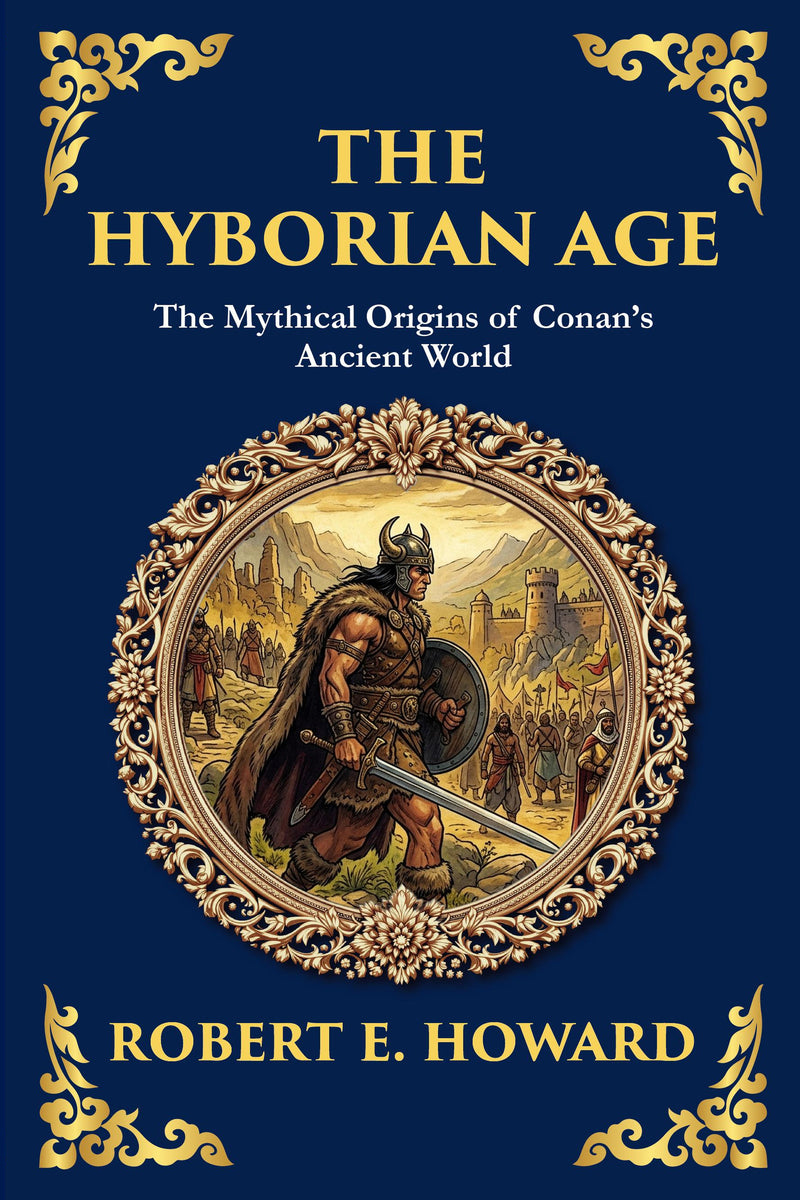
The Hyborian Age — Large Print
Enter the shadowed mists of forgotten time with The Hyborian Age, Robert E. Howard’s sweeping prelude to the legendary tales of Conan the Barbarian.
or free app
10,000+ hrs library
30-day guarantee
The complete The Hyborian Age appears in modern English through Library of Alexandria Press, available online with audiobook narration included for members.
Have you ever wondered why Conan’s world feels as real as legend—and as timeless as myth? Before Conan drew his sword in battle, Robert E. Howard forged the very world in which he would fight. The Hyborian Age is not a narrative tale—it is an epic pseudo-historical essay that breathes life into an imaginary past so vivid, it rivals the grandeur of real-world mythology.
In this foundational work, Howard traces the rise and fall of empires, the shifting of continents, and the turbulent evolution of humanity after the fall of Atlantis. With vivid names like Aquilonia, Stygia, and Cimmeria, he charts the geopolitical landscape that would give rise to Conan’s legendary adventures. Far more than background lore, The Hyborian Age is a masterclass in worldbuilding.
It combines the sweep of ancient history with the mythic resonance of epic fantasy, anchoring sword and sorcery in a realm that feels both distant and disturbingly familiar.
What you’ll discover in this modern edition
- The Origin of the Hyborian World – From Atlantis’s fall to the dawn of Conan’s era, follow the timeline that shapes Howard’s entire mythos
| Formats | eBook (EPUB + PDF) · Audiobook · Paperback · Hardcover · Large Print |
| Language | English |
| Trim size (print) | 6 × 9 in |
| Binding | Paperback — perfect-bound · Hardcover — casewrap |
| Large Print edition | Same text in a larger, easy-read type — a larger font, not a larger trim |
| Print pricing | Every physical book at our true cost — at-cost, no profit (members) |
| Library | 873 restored titles, always growing |
| Length | 11,926 words · ~48 min reading |
| Reading level | Grade 5 · an easy, flowing read (this modern-English edition) |
| Edition | Modern English translation · 2026 |
Member reviews for this edition are collected as readers finish it — be the first. Across the library: 12,000+ books shipped, every plan covered by a 365-day print guarantee.
About this edition
A faithful, unabridged modern-English edition by The Library of Alexandria — carefully rendered for today's reader and verified paragraph-by-paragraph against the public-domain source. Available as eBook, audiobook, paperback, hardcover, and large print.
- Complete & unabridgedVerified paragraph by paragraph against the source — never a scan, never abridged.
- Modern English, faithfulReadable today, with the author’s meaning kept intact. Readable — not simplified.
- Every format, one membershipRead in your browser or the free app, or listen to the full audiobook.
Included free with your membership
Cancel anytime, one click · 30-day money-back guarantee
Edition last updated July 2026
What’s inside
The Hyborian Age — Large Print — complete and unabridged, included in full with membership, plus the full audiobook.
Begin reading The Hyborian Age — Large Print
In clear modern English — the complete text is included with membership.
Introduction
When Robert E. Howard sat down to write the strange, dense little essay that would become known as The Hyborian Age, he was not composing a story at all. He was building a world. More precisely, he was building the scaffolding of a world — the deep historical bedrock upon which one of the most enduring characters in all of popular fiction would walk, fight, scheme, conquer, and ultimately become a king. What you hold in your hands is not a tale of swords clashing under crimson skies, nor a single hero’s quest across haunted ruins. It is something rarer and, in its own way, more astonishing: a complete pseudo-history of a vanished epoch, conjured whole from the imagination of a young man writing in a small Texas town during the early years of the Great Depression.
This is the secret architecture behind the legend of Conan the Cimmerian. It is the map beneath the map, the chronicle that explains why the nations of that fictional world bear the names they do, why certain peoples hate one another with such ancient ferocity, and how an entire civilization rose from the ashes of catastrophe only to slide, inexorably, back toward darkness. For decades, readers encountered Conan first and the Hyborian Age second — discovering, often with delight, that the barbarian’s adventures were set against a backdrop of immense and carefully imagined depth. This volume invites you to approach the matter from the other direction. Here is the foundation. Here is the long, slow breathing of continents and the migration of tribes across thousands of years. To read it is to peer over Howard’s shoulder as he labors at the most ambitious act of literary cartography of his career.
A Writer Inventing the Ground Beneath His Hero's Feet
To understand why this essay exists at all, one must first understand the peculiar habits of mind that defined its author. Robert Ervin Howard, born in 1906 in Peaster, Texas, and raised across a series of dusty oil-boom towns, was a man possessed by history. Not the dry recitation of dates and treaties found in schoolbooks, but history as a living, surging, violent force — a river of blood and ambition carrying peoples from one age into the next. He devoured accounts of the fall of Rome, the wanderings of the Picts and Celts, the conquests of Genghis Khan, the rise and ruin of empires both real and half-legendary. He read of Atlantis and lost continents, of the great folk-migrations that reshaped the ancient world, and he felt, with the particular intensity of a born storyteller, that beneath the recorded past lay vast unrecorded ages waiting to be imagined.
When Howard created Conan in 1932, he faced a problem that confronts every author of heroic fantasy: where, exactly, does the hero live? Many writers would have invented a single kingdom, perhaps a neighboring rival or two, and left it at that. Howard’s solution was characteristically grand. Rather than scatter his stories across an inconsistent patchwork of made-up places, he decided to invent an entire era of prehistory — a gap in the timeline of our own real world, situated after the sinking of Atlantis and before the dawn of recorded antiquity. In this conception, the Hyborian Age was not some parallel dimension or distant planet. It was Earth, our Earth, in a forgotten epoch whose memory has been utterly erased by the slow grinding of geological catastrophe and the rise of the seas.
This was a brilliant stroke, and The Hyborian Age is the document in which Howard worked it all out. He wrote the essay around 1932, partly to clarify his own thinking and partly to share with friends and fellow writers the logic of the world he was building. In it, he traces the fortunes of his imagined nations across thousands of years — their origins, their conquests, their golden ages, and their dooms. He gives us Aquilonia, mightiest of the Hyborian kingdoms; Cimmeria, the bleak northern land of Conan’s birth; Stygia with its serpent-haunted sorcery; the desert kingdoms and the snowbound Nordheim; the dark forests where the Picts await their long-deferred revenge. He explains how these peoples descended from earlier races, how their languages and bloodlines mingled and clashed, and how the very names by which we know our own ancient civilizations — the Persians, the Egyptians, the Celts, the Slavs — might be the distant, distorted echoes of these vanished Hyborian peoples.
What makes the essay remarkable is its sheer commitment. Howard does not merely sketch a few highlights. He follows the logic of migration and conquest with the patience of a true chronicler, watching cultures bloom and rot over enormous spans of time. He understood something that the best world-builders have always understood: that a fictional world feels real not because of its surface detail, but because of its depth — the sense that things happened before the story began, that the ruins the hero stumbles upon were once palaces, that the hatred between two peoples has roots stretching back beyond living memory. Every kingdom in the Conan stories carries the weight of this invented history, even when the history itself is never mentioned. That is the quiet magic of the thing. The stories breathe because the world behind them was given lungs.
It is worth pausing to appreciate how unusual this was for its time. In the early 1930s, the genre we now call fantasy barely existed as a recognizable category. The pulp magazines that published Howard’s work — Weird Tales chief among them — trafficked in horror, adventure, and the fantastic, but the notion of a fully realized “secondary world” with its own consistent geography and chronology was almost unheard of. J.R.R. Tolkien was, at roughly the same moment, privately constructing the languages and legends of Middle-earth, but The Hobbit would not appear until 1937 and The Lord of the Rings not until the 1950s. Howard, working in isolation in rural Texas, with none of Tolkien’s academic resources and writing at breakneck speed to pay his bills, arrived independently at the same fundamental insight: that a hero’s adventures gain immeasurable power when they unfold against a backdrop that the author has imagined down to its bones. The Hyborian Age is one of the founding documents of modern fantasy world-building, and it deserves to be recognized as such.
There is also a melancholy beauty to Howard’s vision that distinguishes it from the work of many who followed him. Tolkien’s Middle-earth, for all its tragedies, ultimately bends toward hope and the eventual triumph of good. Howard’s worldview was darker, more cyclical, more pagan. In the Hyborian Age, civilizations are not permanent achievements but temporary holding actions against an encroaching barbarism that always, eventually, wins. Empires rise only to grow soft, decadent, and corrupt; then the hardy barbarians at their borders sweep in to destroy them, found new kingdoms of their own, and begin the slow slide toward the same decay. This is history as a wheel, turning eternally, and there is something both bleak and bracing in Howard’s refusal to imagine any final victory. “Barbarism is the natural state of mankind,” Conan himself declares in one of the stories. “Civilization is unnatural. It is a whim of circumstance. And barbarism must always ultimately triumph.” The Hyborian Age is, in a sense, the long historical argument that makes good on that claim. You can watch the wheel turn across its pages — watch kingdoms born of conquest mature into glittering powers and then, centuries on, crumble before the next wave of hungry invaders.
On This Modern Translation and How Best to Read It
A word now about the volume you are about to read, and about what it means that this is described as a modern translation adapted for the contemporary reader. The original essay was, frankly, a difficult text. Howard wrote it quickly and for a small audience, and it shows the marks of its hasty composition. It is dense with proper nouns, packed with sentences that march through millennia in a single breath, and structured more like a textbook than a story. Names pile upon names; tribes splinter and merge; the reader can easily lose track of which people are descended from which, and who is conquering whom in any given paragraph. For the dedicated scholar of Howard’s work, these difficulties are part of the pleasure — a puzzle to be unraveled. But for the general reader coming fresh to this material, the original can feel forbidding, even bewildering.
The aim of this adaptation is to preserve everything that makes Howard’s vision powerful while smoothing the path for the contemporary reader. The archaic constructions and the more impenetrable thickets of nineteenth-century pulp prose have been clarified. The flow has been eased so that the great sweep of Howard’s imagined history can be followed without constant backtracking. Yet the essential character of the work — its grandeur, its grim poetry, its sense of vast time and remorseless change — has been carefully retained. This is not a watering-down. It is a clearing of the windows so that the magnificent landscape beyond can be seen plainly. Where Howard’s original voice rings out with particular force, that voice has been honored. The goal throughout has been to let a modern reader experience the thrill of this material as Howard’s first readers must have experienced it: the dizzying realization that an entire world, complete and consistent, has been laid out before them.
Now, how should you approach the reading? A few suggestions may enhance your experience considerably.
First, resist the urge to memorize. When you encounter a passage describing, say, the descent of the Hyborian peoples from the northern lands of the Hyperboreans, or the splintering of the Lemurian remnants into the slave-races of the east, do not feel obligated to fix every name and lineage in your mind. The essay rewards a more relaxed, almost musical reading. Let the names wash over you — Acheron, Valusia, Koth, Zamora, Vendhya — and absorb the rhythm of rise and fall, migration and conquest, that gives the whole its shape. You are not studying for an examination. You are listening to a bard recite the deep history of a world that never was, and the pleasure is in the cadence as much as in the content.
Second, allow yourself to feel the geography. Howard had a strong spatial imagination, and his Hyborian world maps loosely onto our own — the Western Ocean roughly where the Atlantic lies, the great kingdoms occupying lands we might recognize as Europe and the Near East, the dark continent to the south evoking Africa, the mysterious eastern realms suggesting Asia. As you read of armies marching south, of peoples driven westward by invaders from the steppes, of kingdoms hemmed in by mountains or sprawling along great rivers, try to hold a sense of the land in your mind. The drama of the Hyborian Age is fundamentally a drama of place — of who holds what ground, and for how long, and at what cost.
Third, and perhaps most importantly, read this with the Conan stories in view, whether you have already met the Cimmerian or are about to. For those who know the tales, this essay will function as a kind of revelation, illuminating the hidden connections between adventures that may have seemed unrelated. You will understand at last why the Picts loom as such a persistent menace, why Stygia is a land of dread, why Aquilonia represents the pinnacle of Hyborian civilization and thus the great prize toward which so much ambition flows. For those who have not yet read the stories, this volume offers a tantalizing foretaste — a glimpse of the immense canvas across which the adventures will play out. Either way, the essay enriches the fiction, and the fiction brings the essay to life. They are two halves of a single grand design.
It is also worth remembering, as you read, the conditions under which this world was born. Howard wrote in an era and a region far removed from our own. Some of his assumptions about race, conquest, and the movement of peoples reflect the intellectual currents of the early twentieth century — currents that have since been thoroughly challenged and, in many respects, discredited. The pseudo-historical framework Howard employed, in which distinct “races” carry distinct destinies and bloodlines determine character, was a common feature of the popular fiction and even the popular science of his day. The modern reader will recognize these elements as artifacts of their time rather than as endorsements of any contemporary worldview. They are part of the historical texture of the work, and they are best understood as such: the imaginative furniture of a particular author writing in a particular moment, repurposed here for the wholly fictional ends of his invented chronicle. To read Howard with both appreciation and discernment is to do him the honor of taking him seriously as an artist of his time, neither excusing nor anachronistically condemning, but understanding.
Cancel anytime, one click · 30-day money-back guarantee
Founding annual rate available now — your price locks for life when you join.
Not ready? Get this free chapter by email — read it anytime.
✓ Sent — check your inbox for The Hyborian Age — Large Print.
Questions about The Hyborian Age — Large Print
What is The Hyborian Age about?
Enter the shadowed mists of forgotten time with The Hyborian Age, Robert E. Howard’s sweeping prelude to the legendary tales of Conan the Barbarian. This is not merely a fantasy—it is a meticulously imagined prehistory, laying the foundation for one of the most iconic fictional universes ever created. With the rigor of an ancient chronicle and the fire of a mythmaker, Howard maps the rise and fall of empires, the migrations of tribes, and the birth of civilizations long lost to history.
Who wrote The Hyborian Age?
The Hyborian Age was written by Robert E. Howard. This edition presents the complete work in clear modern English, faithfully rendered from the public-domain original by Library of Alexandria Press.
Is The Hyborian Age free to read?
The opening chapter is free to read on this page. Members read and listen to the complete work — and the entire library — free, and can order any physical book at our true print cost.
How long is The Hyborian Age?
2 chapters (~11,926 words) — about 48 min of reading in this modern-English edition.
Is this an abridged version of The Hyborian Age?
No. This is the complete, unabridged The Hyborian Age, carefully rendered into clear modern English and verified paragraph-by-paragraph against the public-domain source — nothing is cut or summarised.
What formats does The Hyborian Age come in?
The Hyborian Age is available as eBook, paperback, hardcover and large print. eBook and audiobook are included with membership; printed editions ship at our true print cost.
Shipping & returns
Billing & membership
More from the library


Explore Myths & Legends
- The Red Fairy Book · Andrew Lang
- Vikram and the Vampire: Classic Hindu Tales of Adventure, Magic, and Romance · Unknown
- The Initiates of the Flame · Manly P. Hall
- Gawayne and the Green Knight: A Fairy Tale · Charlton M. Lewis
- The Nibelungenlied · G. H. Needler
- The Aeneid of Virgil · Virgil
- Fifty Famous Stories Retold · James Baldwin
- West African Folk-Tales
- Lamia · John Keats
- The Three Bears · A. E. Kennedy
- The Ballad of the White Horse · G. K. Chesterton
- The Danish History, Books I–IX · Saxo Grammaticus
- Andersen’s Fairy Tales · H. C. Andersen
- Folk-Tales of Bengal · Lal Behari Day
- The Birth of the War-God: A Poem by Kalidasa · Kálidása
- Omens and Superstitions of Southern India · Edgar Thurston
- The Legend of Sleepy Hollow · Washington Irving
- The Hyborian Age · Robert E. Howard
- The Odyssey · Homer
- Grimms’ Fairy Tales · Jacob Grimm and Wilhelm Grimm
- Just So Stories · Rudyard Kipling
- Aeschylus’ Prometheus Bound and the Seven Against Thebes · Aeschylus
- The Iliad · Homer
The Hyborian Age — Large Print
The Hyborian Age — Large Print
The Mythical Origins of Conan’s Ancient World
Robert E. Howard
Contents
- Introduction
- The Hyborian Age
Introduction
When Robert E. Howard sat down to write the strange, dense little essay that would become known as The Hyborian Age, he was not composing a story at all. He was building a world. More precisely, he was building the scaffolding of a world — the deep historical bedrock upon which one of the most enduring characters in all of popular fiction would walk, fight, scheme, conquer, and ultimately become a king. What you hold in your hands is not a tale of swords clashing under crimson skies, nor a single hero’s quest across haunted ruins. It is something rarer and, in its own way, more astonishing: a complete pseudo-history of a vanished epoch, conjured whole from the imagination of a young man writing in a small Texas town during the early years of the Great Depression.
This is the secret architecture behind the legend of Conan the Cimmerian. It is the map beneath the map, the chronicle that explains why the nations of that fictional world bear the names they do, why certain peoples hate one another with such ancient ferocity, and how an entire civilization rose from the ashes of catastrophe only to slide, inexorably, back toward darkness. For decades, readers encountered Conan first and the Hyborian Age second — discovering, often with delight, that the barbarian’s adventures were set against a backdrop of immense and carefully imagined depth. This volume invites you to approach the matter from the other direction. Here is the foundation. Here is the long, slow breathing of continents and the migration of tribes across thousands of years. To read it is to peer over Howard’s shoulder as he labors at the most ambitious act of literary cartography of his career.
A Writer Inventing the Ground Beneath His Hero's Feet
To understand why this essay exists at all, one must first understand the peculiar habits of mind that defined its author. Robert Ervin Howard, born in 1906 in Peaster, Texas, and raised across a series of dusty oil-boom towns, was a man possessed by history. Not the dry recitation of dates and treaties found in schoolbooks, but history as a living, surging, violent force — a river of blood and ambition carrying peoples from one age into the next. He devoured accounts of the fall of Rome, the wanderings of the Picts and Celts, the conquests of Genghis Khan, the rise and ruin of empires both real and half-legendary. He read of Atlantis and lost continents, of the great folk-migrations that reshaped the ancient world, and he felt, with the particular intensity of a born storyteller, that beneath the recorded past lay vast unrecorded ages waiting to be imagined.
When Howard created Conan in 1932, he faced a problem that confronts every author of heroic fantasy: where, exactly, does the hero live? Many writers would have invented a single kingdom, perhaps a neighboring rival or two, and left it at that. Howard’s solution was characteristically grand. Rather than scatter his stories across an inconsistent patchwork of made-up places, he decided to invent an entire era of prehistory — a gap in the timeline of our own real world, situated after the sinking of Atlantis and before the dawn of recorded antiquity. In this conception, the Hyborian Age was not some parallel dimension or distant planet. It was Earth, our Earth, in a forgotten epoch whose memory has been utterly erased by the slow grinding of geological catastrophe and the rise of the seas.
This was a brilliant stroke, and The Hyborian Age is the document in which Howard worked it all out. He wrote the essay around 1932, partly to clarify his own thinking and partly to share with friends and fellow writers the logic of the world he was building. In it, he traces the fortunes of his imagined nations across thousands of years — their origins, their conquests, their golden ages, and their dooms. He gives us Aquilonia, mightiest of the Hyborian kingdoms; Cimmeria, the bleak northern land of Conan’s birth; Stygia with its serpent-haunted sorcery; the desert kingdoms and the snowbound Nordheim; the dark forests where the Picts await their long-deferred revenge. He explains how these peoples descended from earlier races, how their languages and bloodlines mingled and clashed, and how the very names by which we know our own ancient civilizations — the Persians, the Egyptians, the Celts, the Slavs — might be the distant, distorted echoes of these vanished Hyborian peoples.
What makes the essay remarkable is its sheer commitment. Howard does not merely sketch a few highlights. He follows the logic of migration and conquest with the patience of a true chronicler, watching cultures bloom and rot over enormous spans of time. He understood something that the best world-builders have always understood: that a fictional world feels real not because of its surface detail, but because of its depth — the sense that things happened before the story began, that the ruins the hero stumbles upon were once palaces, that the hatred between two peoples has roots stretching back beyond living memory. Every kingdom in the Conan stories carries the weight of this invented history, even when the history itself is never mentioned. That is the quiet magic of the thing. The stories breathe because the world behind them was given lungs.
It is worth pausing to appreciate how unusual this was for its time. In the early 1930s, the genre we now call fantasy barely existed as a recognizable category. The pulp magazines that published Howard’s work — Weird Tales chief among them — trafficked in horror, adventure, and the fantastic, but the notion of a fully realized “secondary world” with its own consistent geography and chronology was almost unheard of. J.R.R. Tolkien was, at roughly the same moment, privately constructing the languages and legends of Middle-earth, but The Hobbit would not appear until 1937 and The Lord of the Rings not until the 1950s. Howard, working in isolation in rural Texas, with none of Tolkien’s academic resources and writing at breakneck speed to pay his bills, arrived independently at the same fundamental insight: that a hero’s adventures gain immeasurable power when they unfold against a backdrop that the author has imagined down to its bones. The Hyborian Age is one of the founding documents of modern fantasy world-building, and it deserves to be recognized as such.
There is also a melancholy beauty to Howard’s vision that distinguishes it from the work of many who followed him. Tolkien’s Middle-earth, for all its tragedies, ultimately bends toward hope and the eventual triumph of good. Howard’s worldview was darker, more cyclical, more pagan. In the Hyborian Age, civilizations are not permanent achievements but temporary holding actions against an encroaching barbarism that always, eventually, wins. Empires rise only to grow soft, decadent, and corrupt; then the hardy barbarians at their borders sweep in to destroy them, found new kingdoms of their own, and begin the slow slide toward the same decay. This is history as a wheel, turning eternally, and there is something both bleak and bracing in Howard’s refusal to imagine any final victory. “Barbarism is the natural state of mankind,” Conan himself declares in one of the stories. “Civilization is unnatural. It is a whim of circumstance. And barbarism must always ultimately triumph.” The Hyborian Age is, in a sense, the long historical argument that makes good on that claim. You can watch the wheel turn across its pages — watch kingdoms born of conquest mature into glittering powers and then, centuries on, crumble before the next wave of hungry invaders.
On This Modern Translation and How Best to Read It
A word now about the volume you are about to read, and about what it means that this is described as a modern translation adapted for the contemporary reader. The original essay was, frankly, a difficult text. Howard wrote it quickly and for a small audience, and it shows the marks of its hasty composition. It is dense with proper nouns, packed with sentences that march through millennia in a single breath, and structured more like a textbook than a story. Names pile upon names; tribes splinter and merge; the reader can easily lose track of which people are descended from which, and who is conquering whom in any given paragraph. For the dedicated scholar of Howard’s work, these difficulties are part of the pleasure — a puzzle to be unraveled. But for the general reader coming fresh to this material, the original can feel forbidding, even bewildering.
The aim of this adaptation is to preserve everything that makes Howard’s vision powerful while smoothing the path for the contemporary reader. The archaic constructions and the more impenetrable thickets of nineteenth-century pulp prose have been clarified. The flow has been eased so that the great sweep of Howard’s imagined history can be followed without constant backtracking. Yet the essential character of the work — its grandeur, its grim poetry, its sense of vast time and remorseless change — has been carefully retained. This is not a watering-down. It is a clearing of the windows so that the magnificent landscape beyond can be seen plainly. Where Howard’s original voice rings out with particular force, that voice has been honored. The goal throughout has been to let a modern reader experience the thrill of this material as Howard’s first readers must have experienced it: the dizzying realization that an entire world, complete and consistent, has been laid out before them.
Now, how should you approach the reading? A few suggestions may enhance your experience considerably.
First, resist the urge to memorize. When you encounter a passage describing, say, the descent of the Hyborian peoples from the northern lands of the Hyperboreans, or the splintering of the Lemurian remnants into the slave-races of the east, do not feel obligated to fix every name and lineage in your mind. The essay rewards a more relaxed, almost musical reading. Let the names wash over you — Acheron, Valusia, Koth, Zamora, Vendhya — and absorb the rhythm of rise and fall, migration and conquest, that gives the whole its shape. You are not studying for an examination. You are listening to a bard recite the deep history of a world that never was, and the pleasure is in the cadence as much as in the content.
Second, allow yourself to feel the geography. Howard had a strong spatial imagination, and his Hyborian world maps loosely onto our own — the Western Ocean roughly where the Atlantic lies, the great kingdoms occupying lands we might recognize as Europe and the Near East, the dark continent to the south evoking Africa, the mysterious eastern realms suggesting Asia. As you read of armies marching south, of peoples driven westward by invaders from the steppes, of kingdoms hemmed in by mountains or sprawling along great rivers, try to hold a sense of the land in your mind. The drama of the Hyborian Age is fundamentally a drama of place — of who holds what ground, and for how long, and at what cost.
Third, and perhaps most importantly, read this with the Conan stories in view, whether you have already met the Cimmerian or are about to. For those who know the tales, this essay will function as a kind of revelation, illuminating the hidden connections between adventures that may have seemed unrelated. You will understand at last why the Picts loom as such a persistent menace, why Stygia is a land of dread, why Aquilonia represents the pinnacle of Hyborian civilization and thus the great prize toward which so much ambition flows. For those who have not yet read the stories, this volume offers a tantalizing foretaste — a glimpse of the immense canvas across which the adventures will play out. Either way, the essay enriches the fiction, and the fiction brings the essay to life. They are two halves of a single grand design.
It is also worth remembering, as you read, the conditions under which this world was born. Howard wrote in an era and a region far removed from our own. Some of his assumptions about race, conquest, and the movement of peoples reflect the intellectual currents of the early twentieth century — currents that have since been thoroughly challenged and, in many respects, discredited. The pseudo-historical framework Howard employed, in which distinct “races” carry distinct destinies and bloodlines determine character, was a common feature of the popular fiction and even the popular science of his day. The modern reader will recognize these elements as artifacts of their time rather than as endorsements of any contemporary worldview. They are part of the historical texture of the work, and they are best understood as such: the imaginative furniture of a particular author writing in a particular moment, repurposed here for the wholly fictional ends of his invented chronicle. To read Howard with both appreciation and discernment is to do him the honor of taking him seriously as an artist of his time, neither excusing nor anachronistically condemning, but understanding.
Very little is known about the era the Nemedian chroniclers call the Pre-Cataclysmic Age, except for its final period, which is shrouded in legend. Recorded history begins as the Pre-Cataclysmic civilization declined. This civilization was led by the kingdoms of Kamelia, Valusia, Verulia, Grondar, Thule, and Commoria. Because these people spoke a similar language, they likely shared a common origin. There were other civilized kingdoms as well, but they were inhabited by different and apparently older races.
The barbarians of that era included the Picts, who lived on islands far out in the western ocean; the Atlanteans, who lived on a small continent between the Pictish Islands and the main Thurian Continent; and the Lemurians, who lived on a chain of large islands in the eastern hemisphere.
Huge regions of land remained unexplored. Although the civilized kingdoms were massive, they occupied only a small part of the planet. Valusia was the westernmost kingdom of the Thurian Continent, and Grondar was the easternmost. East of Grondar—whose people were less sophisticated than those in the other kingdoms—lay a wild, barren stretch of desert. Scattered clans and primitive tribes lived in the mountains, the jungles, and the less dry parts of the desert. Far to the south, there was a mysterious civilization that was unrelated to Thurian culture and seemed to be pre-human. Another human race lived on the far eastern shores of the continent; they were mysterious non-Thurians who occasionally contacted the Lemurians. They apparently came from a shadowy, nameless continent located somewhere east of the Lemurian Islands.
End of the free sample
Keep reading, free
Members read and listen to the complete book — and the entire library. Cancel anytime, one click · 30-day money-back guarantee.