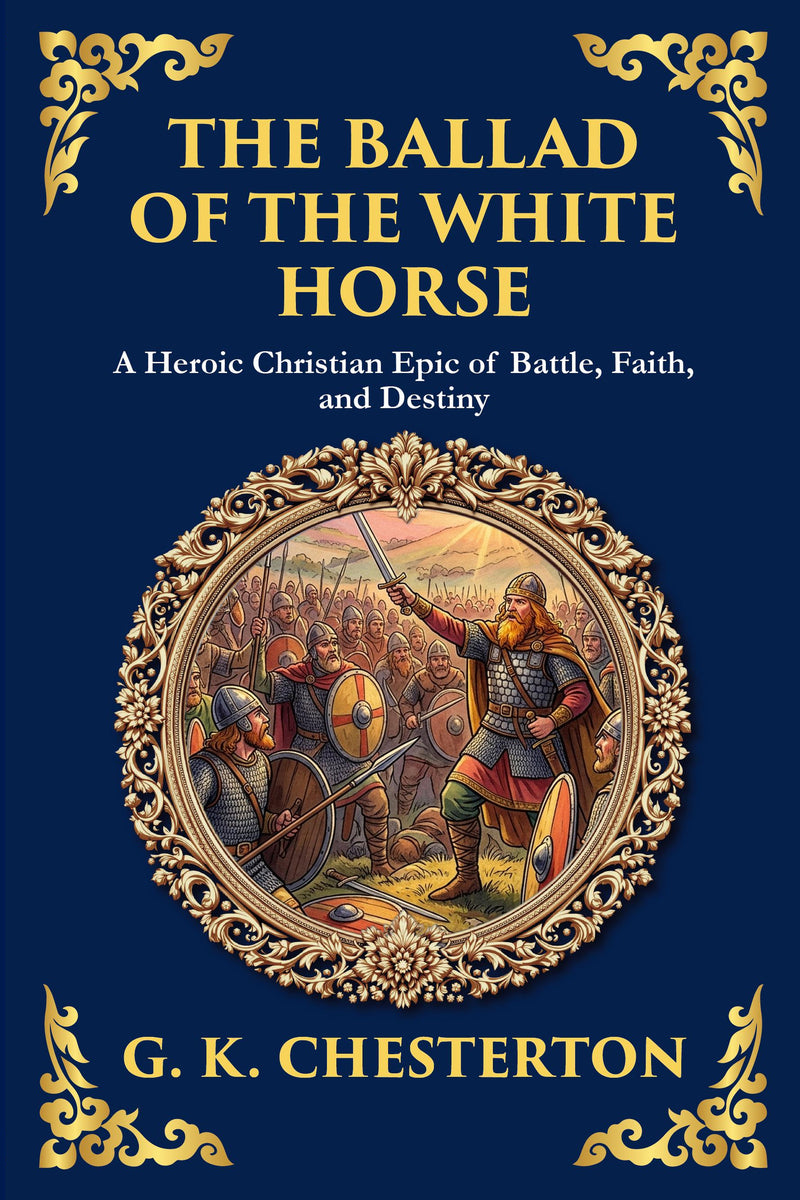
The Ballad of the White Horse — Large Print
The Ballad of the White Horse is G. K. Chesterton’s stirring poetic retelling of one of England’s oldest and most legendary battles.
or free app
10,000+ hrs library
30-day guarantee
The complete The Ballad of the White Horse appears in modern English through Library of Alexandria Press, available online with audiobook narration included for members.
Have you ever wondered why true heroism is often forged in the shadow of defeat? In The Ballad of the White Horse, G. K. Chesterton offers a soaring poetic chronicle of King Alfred the Great’s legendary defense of Christian England against pagan Viking invaders. Written in 1911, Chesterton’s work fuses literary elegance, spiritual depth, and mythic grandeur into a singularly powerful epic that speaks to the soul.
Set against the backdrop of the 9th-century Battle of Ethandun, the poem follows the burdened yet unyielding King Alfred as he unites scattered Christian forces to face overwhelming darkness. But more than a tale of swords and shields, Chesterton’s ballad is a meditation on divine purpose, the endurance of belief, and the mysterious ways in which grace works through struggle. Laced with philosophical reflections, theological undertones, and symbolic imagery, The Ballad of the White Horse is as much a spiritual journey as it is a historic recounting.
What you’ll discover in this modern edition
- A Legendary Battle Reimagined in Lyrical Verse Experience the story of King Alfred’s resistance against the Norse invaders told through beautifully structured poetry.
| Formats | eBook (EPUB + PDF) · Audiobook · Paperback · Hardcover · Large Print |
| Language | English |
| Trim size (print) | 6 × 9 in |
| Binding | Paperback — perfect-bound · Hardcover — casewrap |
| Large Print edition | Same text in a larger, easy-read type — a larger font, not a larger trim |
| Print pricing | Every physical book at our true cost — at-cost, no profit (members) |
| Library | 873 restored titles, always growing |
| Length | 21,028 words · ~1 hr 24 min reading |
| Reading level | Grade 10 · a comfortable read (this modern-English edition) |
| Edition | Modern English translation · 2026 |
Member reviews for this edition are collected as readers finish it — be the first. Across the library: 12,000+ books shipped, every plan covered by a 365-day print guarantee.
About this edition
A faithful, unabridged modern-English edition by The Library of Alexandria — carefully rendered for today's reader and verified paragraph-by-paragraph against the public-domain source. Available as eBook, audiobook, paperback, hardcover, and large print.
- Complete & unabridgedVerified paragraph by paragraph against the source — never a scan, never abridged.
- Modern English, faithfulReadable today, with the author’s meaning kept intact. Readable — not simplified.
- Every format, one membershipRead in your browser or the free app, or listen to the full audiobook.
Included free with your membership
Cancel anytime, one click · 30-day money-back guarantee
Edition last updated July 2026
What’s inside
The Ballad of the White Horse — Large Print — complete and unabridged: all 10 sections included with membership, plus the full audiobook.
Begin reading The Ballad of the White Horse — Large Print
In clear modern English — the complete text is included with membership.
Introduction
There are certain books that seem to arrive in the world already carrying the weight of centuries, as though they had been waiting patiently for the right hand to write them down. The Ballad of the White Horse is one of these. When G. K. Chesterton published it in 1911, he was already among the most celebrated and prolific writers of his age — a journalist, essayist, novelist, and apologist whose wit could puncture pomposity in a single sentence and whose paradoxes danced across the pages of newspapers and books alike. Yet for all his vast and varied output, it was this long narrative poem, this thundering verse epic about a half-legendary English king, that he poured his deepest convictions into. It is a work that stands somewhat apart from the rest of his career: not the playful Chesterton of the Father Brown mysteries, nor the sparring debater of his essays, but a Chesterton transformed into something closer to a bard — a singer of ancient songs who believed, with his whole heart, that those songs still mattered.
The figure at the center of this epic is King Alfred the Great, the ninth-century monarch of Wessex who, against staggering odds, held back the tide of Danish invasion that threatened to engulf the whole of England. Alfred is one of the few English kings to bear the title “the Great,” and he earned it not merely through battle but through learning, law, and a fierce devotion to preserving the fragile flame of civilization in a dark and violent age. But Chesterton was not writing a history book. He warns the reader of this himself, with characteristic frankness, in his prefatory note. He had no intention of reconstructing the precise events of Alfred’s reign, nor of settling scholarly disputes about what really happened in those distant centuries. Instead, he sought to capture something that he believed history alone could never quite hold: the meaning of Alfred, the spirit of the man as he lived in the imagination of the people, the legend that had grown around him like ivy around a ruined tower.
This distinction is crucial, and it shapes everything about how the poem ought to be read. Chesterton was reaching back not to documents and dates but to ballads and folk memory — to the old tradition of storytelling in which a hero is not a collection of verified facts but a vessel for the hopes and fears and faith of a whole people. The white horse of the title is itself a real thing: a vast prehistoric figure carved into the chalk hillside of Berkshire, the Uffington White Horse, whose origins are lost in the mists of antiquity. For centuries, local custom required that the horse be “scoured” — that the grass and weeds be cleared away so that the white chalk beneath would shine again. If the scouring stopped, the horse would vanish back into the green hillside, swallowed by neglect. Chesterton seized upon this image with the instinct of a poet who knows when he has found his governing metaphor. The white horse becomes a symbol of all the things in civilization that do not maintain themselves, that must be tended and renewed by each generation lest they fade and disappear forever. It is a poem about the labor of keeping good things alive.
To read this work well, then, is to enter into a particular frame of mind. You are not picking up a textbook or even a conventional novel. You are sitting down at a fire, in a manner of speaking, to hear a tale told in the old style — a tale full of swords and visions, of kings disguised among the common folk, of impossible courage and the strange logic of faith. The verse rolls forward with a galloping, insistent rhythm, full of alliteration and repetition and the hammering music that the old bards used to keep their listeners spellbound. Chesterton wrote it to be spoken aloud, and many readers find that they understand it best when they let the lines fall upon the ear rather than merely upon the eye. There is no shame in reading a stanza twice, or in murmuring it under your breath. The poem rewards that kind of attention. It was built for it.
The World of the Poem and the Faith Behind It
The historical moment that Chesterton chose for his story is one of genuine crisis. In the late ninth century, the Danish raiders — the Vikings, the heathen men of the north — had swept across the kingdoms of England with terrifying speed. Northumbria had fallen. Mercia had fallen. East Anglia had fallen. One by one the old Christian kingdoms collapsed before the invaders, and it seemed only a matter of time before Wessex, the last holdout, would follow them into ruin. Alfred himself was driven into hiding, reduced to a fugitive sheltering in the marshes, his cause apparently lost and his crown all but meaningless. It is from this lowest of low points — this moment of near-total defeat — that the poem draws its central drama. For Chesterton, there could be no more fitting backdrop. He believed that the truest test of faith comes not in the hour of triumph but in the hour when everything seems hopeless, when reason itself counsels surrender and only some deeper, stranger conviction can keep a man standing.
This is where the poem reveals its real subject. Beneath the swords and the shields, beneath the marches and the battles, The Ballad of the White Horse is a meditation on Christian hope set against pagan despair. Chesterton understood the conflict between Alfred and the Danes not merely as a clash of armies or even of cultures, but as a clash of two fundamentally different ways of seeing the world. The pagan north, as he portrays it, was magnificent in its way — fierce, brave, possessed of a wild and sorrowful poetry of its own. But it was also a creed of doom. The Norse gods themselves were fated to die; the whole vast machinery of that mythology pointed toward a final darkness, a twilight in which courage was admirable precisely because it was useless. The pagan hero fought knowing that all his fighting would ultimately come to nothing, that the wolf would swallow the sun and the world would end in ice and fire. There is grandeur in that vision, and Chesterton does not pretend otherwise. He gives the Danish chieftains some of the most beautiful and haunting passages in the entire poem.
But against this, he sets the Christian vision that Alfred embodies — a vision that is, in a sense, the very opposite. The Christian, in Chesterton’s telling, fights not because victory is assured but because hope is a duty even in the face of probable defeat. There is a famous and astonishing moment in the poem, which I will not spoil here, in which a heavenly figure appears to Alfred at his darkest hour and offers him not a promise of victory but something far stranger and more demanding. The whole spiritual genius of the work is concentrated in that exchange. Where the pagan finds a melancholy comfort in the inevitability of doom, the Christian is called to a harder and higher thing: to act, to strive, to fight on, without the guarantee of success, sustained only by a hope that has no rational ground except faith itself. This is the paradox at the molten core of the poem, and it is pure Chesterton — the man who built his entire philosophy out of the apparent contradictions that, properly understood, turn out to be the deepest truths.
It is worth dwelling on this because it explains why the poem has meant so much to so many readers across the decades. The Ballad of the White Horse was beloved by soldiers in the trenches of the First World War, who found in its lines a strange consolation amid the mud and slaughter. It was quoted in the dark days of the Second World War, when Britain stood alone against the threat of conquest, and the image of a small embattled people refusing to surrender against impossible odds suddenly seemed less like ancient legend and more like present reality. Winston Churchill is said to have drawn upon it; ordinary readers found their own courage steadied by it. The poem has a way of speaking to people in their hours of need, precisely because it was written about an hour of need and because its message is not the cheap optimism that everything will turn out fine, but the far tougher and more bracing conviction that one must do right regardless of how things turn out. That is a message for every age, and perhaps especially for ages that feel besieged.
Readers should also be aware of the way Chesterton handles his three great companion-figures who join Alfred in his struggle. Without revealing the events that befall them, it can be said that Chesterton designed them with deliberate symbolic weight, each representing one of the strands of European civilization that came together under the banner of Christendom — the Roman, the Celtic, and the Germanic peoples, woven into a single fellowship by their shared faith and common cause. In this, the poem becomes something larger than a tale of England alone. It becomes a kind of myth of Christian Europe itself, of how disparate and quarreling peoples were bound together into a civilization, and of how that civilization must be defended and renewed by each generation that inherits it. The scouring of the white horse, you begin to see, is not only about a chalk carving on a hillside. It is about everything worth preserving, everything that decays the moment we stop caring for it.
This modern translation and adaptation has been prepared with the contemporary reader firmly in mind. Chesterton’s language, for all its power, was written more than a century ago, and it carries the cadences and vocabulary of its time — along with a wealth of allusions to history, geography, and Christian tradition that would have been second nature to his original audience but that may give a present-day reader pause. The aim of this edition is to smooth the path without flattening the landscape: to preserve the thunderous music and the spiritual intensity that make the poem what it is, while ensuring that nothing essential is lost in obscurity. The reader who comes to these pages should expect to be challenged, certainly, for great poetry always asks something of us. But the reader should never feel abandoned or lost in a thicket of forgotten references. The goal throughout has been to let Chesterton’s voice ring out clearly across the gulf of years, so that his fire can warm a new generation as it warmed those who came before.
How to Read This Epic and What to Carry Away
A few words of guidance may help the first-time reader to get the most from what follows. The poem is divided into several books, each with its own movement and mood, building from the depths of despair through the gathering of allies and the long approach to a climactic confrontation, and on to a conclusion that reaches far beyond the ninth century into reflections on time, memory, and the endless task of defending civilization against the forces that would tear it down. It is best not to rush. Chesterton wrote in long, surging waves of verse, and the experience he intended is closer to listening to a great piece of music than to skimming a piece of prose. Allow yourself to be carried along by the rhythm. Do not worry, on a first reading, about catching every historical reference or untangling every symbolic thread. The poem works first on the level of feeling, of sound and image and emotion, and only afterward on the level of intellect. Many readers find that they are moved by passages they do not fully understand, and that understanding comes later, on reflection or rereading. This is exactly as it should be. The poem is generous; it gives more each time you return to it.
It also helps to remember that this is, fundamentally, a heroic poem — an epic in the oldest and grandest sense. It belongs to the same family as the ancient sagas and the old battle-songs, the tales of warriors and last stands and the testing of men’s souls under pressure. There is a great deal of action in these pages: marches and ambushes, councils of war, the clash of armies, individual feats of courage and folly. Chesterton was a large man with a large appetite for romance and adventure, and he wrote his battle scenes with relish. But interwoven with all this action is a constant undercurrent of reflection, of meaning, of the deeper questions that the action serves to dramatize. The genius of the work lies in the way it never lets either element overwhelm the other. The fighting is never merely fighting; it always carries spiritual weight. And the philosophy is never merely abstract; it is always embodied in living characters facing real and terrible choices. This marriage of the heroic and the contemplative is what gives the poem its peculiar and enduring power.
Cancel anytime, one click · 30-day money-back guarantee
Founding annual rate available now — your price locks for life when you join.
Not ready? Get this free chapter by email — read it anytime.
✓ Sent — check your inbox for The Ballad of the White Horse — Large Print.
Questions about The Ballad of the White Horse — Large Print
What is The Ballad of the White Horse about?
The Ballad of the White Horse is G. K. Chesterton’s stirring poetic retelling of one of England’s oldest and most legendary battles. Blending myth, faith, and history, Chesterton recounts the story of King Alfred the Great’s stand against the invading Danes in a lyrical masterpiece that is both profoundly spiritual and deeply heroic. Written in rhythmic, sweeping verse, this epic ballad captures the eternal struggle between light and darkness, courage and despair, Christian hope and pagan fate.
Who wrote The Ballad of the White Horse?
The Ballad of the White Horse was written by G. K. Chesterton. This edition presents the complete work in clear modern English, faithfully rendered from the public-domain original by Library of Alexandria Press.
Is The Ballad of the White Horse free to read?
The opening chapter is free to read on this page. Members read and listen to the complete work — and the entire library — free, and can order any physical book at our true print cost.
How long is The Ballad of the White Horse?
10 chapters (~21,028 words) — about 1 hr 24 min of reading in this modern-English edition.
Is this an abridged version of The Ballad of the White Horse?
No. This is the complete, unabridged The Ballad of the White Horse, carefully rendered into clear modern English and verified paragraph-by-paragraph against the public-domain source — nothing is cut or summarised.
What formats does The Ballad of the White Horse come in?
The Ballad of the White Horse is available as eBook, paperback, hardcover and large print. eBook and audiobook are included with membership; printed editions ship at our true print cost.
Shipping & returns
Billing & membership
More from the library


Explore Myths & Legends
- The Red Fairy Book · Andrew Lang
- Vikram and the Vampire: Classic Hindu Tales of Adventure, Magic, and Romance · Unknown
- The Initiates of the Flame · Manly P. Hall
- Gawayne and the Green Knight: A Fairy Tale · Charlton M. Lewis
- The Nibelungenlied · G. H. Needler
- The Aeneid of Virgil · Virgil
- Fifty Famous Stories Retold · James Baldwin
- West African Folk-Tales
- Lamia · John Keats
- The Three Bears · A. E. Kennedy
- The Ballad of the White Horse · G. K. Chesterton
- The Danish History, Books I–IX · Saxo Grammaticus
- Andersen’s Fairy Tales · H. C. Andersen
- Folk-Tales of Bengal · Lal Behari Day
- The Birth of the War-God: A Poem by Kalidasa · Kálidása
- Omens and Superstitions of Southern India · Edgar Thurston
- The Legend of Sleepy Hollow · Washington Irving
- The Hyborian Age · Robert E. Howard
- The Odyssey · Homer
- Grimms’ Fairy Tales · Jacob Grimm and Wilhelm Grimm
- Just So Stories · Rudyard Kipling
- Aeschylus’ Prometheus Bound and the Seven Against Thebes · Aeschylus
- The Iliad · Homer
The Ballad of the White Horse — Large Print
The Ballad of the White Horse — Large Print
A Heroic Christian Epic of Battle, Faith, and Destiny
G. K. Chesterton
Contents
- Introduction
- Preface by the Author
- Book 1
- Book 2
- Book 3
- Book 4
- Book 5
- Book 6
- Book 7
- Book 8
Introduction
There are certain books that seem to arrive in the world already carrying the weight of centuries, as though they had been waiting patiently for the right hand to write them down. The Ballad of the White Horse is one of these. When G. K. Chesterton published it in 1911, he was already among the most celebrated and prolific writers of his age — a journalist, essayist, novelist, and apologist whose wit could puncture pomposity in a single sentence and whose paradoxes danced across the pages of newspapers and books alike. Yet for all his vast and varied output, it was this long narrative poem, this thundering verse epic about a half-legendary English king, that he poured his deepest convictions into. It is a work that stands somewhat apart from the rest of his career: not the playful Chesterton of the Father Brown mysteries, nor the sparring debater of his essays, but a Chesterton transformed into something closer to a bard — a singer of ancient songs who believed, with his whole heart, that those songs still mattered.
The figure at the center of this epic is King Alfred the Great, the ninth-century monarch of Wessex who, against staggering odds, held back the tide of Danish invasion that threatened to engulf the whole of England. Alfred is one of the few English kings to bear the title “the Great,” and he earned it not merely through battle but through learning, law, and a fierce devotion to preserving the fragile flame of civilization in a dark and violent age. But Chesterton was not writing a history book. He warns the reader of this himself, with characteristic frankness, in his prefatory note. He had no intention of reconstructing the precise events of Alfred’s reign, nor of settling scholarly disputes about what really happened in those distant centuries. Instead, he sought to capture something that he believed history alone could never quite hold: the meaning of Alfred, the spirit of the man as he lived in the imagination of the people, the legend that had grown around him like ivy around a ruined tower.
This distinction is crucial, and it shapes everything about how the poem ought to be read. Chesterton was reaching back not to documents and dates but to ballads and folk memory — to the old tradition of storytelling in which a hero is not a collection of verified facts but a vessel for the hopes and fears and faith of a whole people. The white horse of the title is itself a real thing: a vast prehistoric figure carved into the chalk hillside of Berkshire, the Uffington White Horse, whose origins are lost in the mists of antiquity. For centuries, local custom required that the horse be “scoured” — that the grass and weeds be cleared away so that the white chalk beneath would shine again. If the scouring stopped, the horse would vanish back into the green hillside, swallowed by neglect. Chesterton seized upon this image with the instinct of a poet who knows when he has found his governing metaphor. The white horse becomes a symbol of all the things in civilization that do not maintain themselves, that must be tended and renewed by each generation lest they fade and disappear forever. It is a poem about the labor of keeping good things alive.
To read this work well, then, is to enter into a particular frame of mind. You are not picking up a textbook or even a conventional novel. You are sitting down at a fire, in a manner of speaking, to hear a tale told in the old style — a tale full of swords and visions, of kings disguised among the common folk, of impossible courage and the strange logic of faith. The verse rolls forward with a galloping, insistent rhythm, full of alliteration and repetition and the hammering music that the old bards used to keep their listeners spellbound. Chesterton wrote it to be spoken aloud, and many readers find that they understand it best when they let the lines fall upon the ear rather than merely upon the eye. There is no shame in reading a stanza twice, or in murmuring it under your breath. The poem rewards that kind of attention. It was built for it.
The World of the Poem and the Faith Behind It
The historical moment that Chesterton chose for his story is one of genuine crisis. In the late ninth century, the Danish raiders — the Vikings, the heathen men of the north — had swept across the kingdoms of England with terrifying speed. Northumbria had fallen. Mercia had fallen. East Anglia had fallen. One by one the old Christian kingdoms collapsed before the invaders, and it seemed only a matter of time before Wessex, the last holdout, would follow them into ruin. Alfred himself was driven into hiding, reduced to a fugitive sheltering in the marshes, his cause apparently lost and his crown all but meaningless. It is from this lowest of low points — this moment of near-total defeat — that the poem draws its central drama. For Chesterton, there could be no more fitting backdrop. He believed that the truest test of faith comes not in the hour of triumph but in the hour when everything seems hopeless, when reason itself counsels surrender and only some deeper, stranger conviction can keep a man standing.
This is where the poem reveals its real subject. Beneath the swords and the shields, beneath the marches and the battles, The Ballad of the White Horse is a meditation on Christian hope set against pagan despair. Chesterton understood the conflict between Alfred and the Danes not merely as a clash of armies or even of cultures, but as a clash of two fundamentally different ways of seeing the world. The pagan north, as he portrays it, was magnificent in its way — fierce, brave, possessed of a wild and sorrowful poetry of its own. But it was also a creed of doom. The Norse gods themselves were fated to die; the whole vast machinery of that mythology pointed toward a final darkness, a twilight in which courage was admirable precisely because it was useless. The pagan hero fought knowing that all his fighting would ultimately come to nothing, that the wolf would swallow the sun and the world would end in ice and fire. There is grandeur in that vision, and Chesterton does not pretend otherwise. He gives the Danish chieftains some of the most beautiful and haunting passages in the entire poem.
But against this, he sets the Christian vision that Alfred embodies — a vision that is, in a sense, the very opposite. The Christian, in Chesterton’s telling, fights not because victory is assured but because hope is a duty even in the face of probable defeat. There is a famous and astonishing moment in the poem, which I will not spoil here, in which a heavenly figure appears to Alfred at his darkest hour and offers him not a promise of victory but something far stranger and more demanding. The whole spiritual genius of the work is concentrated in that exchange. Where the pagan finds a melancholy comfort in the inevitability of doom, the Christian is called to a harder and higher thing: to act, to strive, to fight on, without the guarantee of success, sustained only by a hope that has no rational ground except faith itself. This is the paradox at the molten core of the poem, and it is pure Chesterton — the man who built his entire philosophy out of the apparent contradictions that, properly understood, turn out to be the deepest truths.
It is worth dwelling on this because it explains why the poem has meant so much to so many readers across the decades. The Ballad of the White Horse was beloved by soldiers in the trenches of the First World War, who found in its lines a strange consolation amid the mud and slaughter. It was quoted in the dark days of the Second World War, when Britain stood alone against the threat of conquest, and the image of a small embattled people refusing to surrender against impossible odds suddenly seemed less like ancient legend and more like present reality. Winston Churchill is said to have drawn upon it; ordinary readers found their own courage steadied by it. The poem has a way of speaking to people in their hours of need, precisely because it was written about an hour of need and because its message is not the cheap optimism that everything will turn out fine, but the far tougher and more bracing conviction that one must do right regardless of how things turn out. That is a message for every age, and perhaps especially for ages that feel besieged.
Readers should also be aware of the way Chesterton handles his three great companion-figures who join Alfred in his struggle. Without revealing the events that befall them, it can be said that Chesterton designed them with deliberate symbolic weight, each representing one of the strands of European civilization that came together under the banner of Christendom — the Roman, the Celtic, and the Germanic peoples, woven into a single fellowship by their shared faith and common cause. In this, the poem becomes something larger than a tale of England alone. It becomes a kind of myth of Christian Europe itself, of how disparate and quarreling peoples were bound together into a civilization, and of how that civilization must be defended and renewed by each generation that inherits it. The scouring of the white horse, you begin to see, is not only about a chalk carving on a hillside. It is about everything worth preserving, everything that decays the moment we stop caring for it.
This modern translation and adaptation has been prepared with the contemporary reader firmly in mind. Chesterton’s language, for all its power, was written more than a century ago, and it carries the cadences and vocabulary of its time — along with a wealth of allusions to history, geography, and Christian tradition that would have been second nature to his original audience but that may give a present-day reader pause. The aim of this edition is to smooth the path without flattening the landscape: to preserve the thunderous music and the spiritual intensity that make the poem what it is, while ensuring that nothing essential is lost in obscurity. The reader who comes to these pages should expect to be challenged, certainly, for great poetry always asks something of us. But the reader should never feel abandoned or lost in a thicket of forgotten references. The goal throughout has been to let Chesterton’s voice ring out clearly across the gulf of years, so that his fire can warm a new generation as it warmed those who came before.
How to Read This Epic and What to Carry Away
A few words of guidance may help the first-time reader to get the most from what follows. The poem is divided into several books, each with its own movement and mood, building from the depths of despair through the gathering of allies and the long approach to a climactic confrontation, and on to a conclusion that reaches far beyond the ninth century into reflections on time, memory, and the endless task of defending civilization against the forces that would tear it down. It is best not to rush. Chesterton wrote in long, surging waves of verse, and the experience he intended is closer to listening to a great piece of music than to skimming a piece of prose. Allow yourself to be carried along by the rhythm. Do not worry, on a first reading, about catching every historical reference or untangling every symbolic thread. The poem works first on the level of feeling, of sound and image and emotion, and only afterward on the level of intellect. Many readers find that they are moved by passages they do not fully understand, and that understanding comes later, on reflection or rereading. This is exactly as it should be. The poem is generous; it gives more each time you return to it.
It also helps to remember that this is, fundamentally, a heroic poem — an epic in the oldest and grandest sense. It belongs to the same family as the ancient sagas and the old battle-songs, the tales of warriors and last stands and the testing of men’s souls under pressure. There is a great deal of action in these pages: marches and ambushes, councils of war, the clash of armies, individual feats of courage and folly. Chesterton was a large man with a large appetite for romance and adventure, and he wrote his battle scenes with relish. But interwoven with all this action is a constant undercurrent of reflection, of meaning, of the deeper questions that the action serves to dramatize. The genius of the work lies in the way it never lets either element overwhelm the other. The fighting is never merely fighting; it always carries spiritual weight. And the philosophy is never merely abstract; it is always embodied in living characters facing real and terrible choices. This marriage of the heroic and the contemplative is what gives the poem its peculiar and enduring power.
Before the gods who created the gods saw their own sunrise fade, the White Horse of the White Horse Vale was carved into the grass. Before those creator gods had drunk their fill at dawn, the White Horse of the White Horse Vale stood white upon the hill. For ages and ages on British land, through eons of time, there was peace and war in the western hills, and the White Horse watched it all. The White Horse knew England when there was no one else to know it; he saw the first oar bend, and he saw the heavens fall and the world end. My God, how long ago that was. The end of the world happened long ago, and today we live as children of a second birth, like a strange people left on earth after a day of judgment. The world ended long ago, when the boundaries of the earth broke open, when Rome sank into a wasteland of slaves, and the sun drowned in the sea. When Caesar’s sun fell from the sky, anyone listening closely could only hear the nations plunging into the night. The ends of the earth marched in by the light of torches and beacons. The roads leading to Rome were filled with faces that drifted like foam, like faces in a dream. Men rode out from the eastern lands, across wide rivers and burning plains, past trees that looked like giant flowers and tiger-striped skies colored by tropical rain. They came from where India’s shimmering peaks rise around the highest mountain, where ancient eagles, vast as archangels, gather to drink the sunlight. And men broke out of the northern lands, enormous and lonely places where a spell hangs over life and desire, where rain turns to silver dust and the sea becomes a great green stone. A murky Shape that moves through mirrors of ice and night has frightened all the animals and birds, just as death or a shock of evil words turns a man’s hair white. The cries of the palm trees and purple moons, or the screams of frost and foam, swirled around a central place, and the noise of race after race echoed around Rome. Death came for the Emperor and darkness fell upon the Pope; meanwhile, Alfred, hiding in the deep grass, strengthened his heart with hope. A sea-people, more blind than the ocean, attacked his land from all sides. But Alfred stood against them, gripping the earth and grasping the air, staggering and struggling to stay on his feet. He pushed them back with spears and shovels, with desperate ditches and walls. Enemies leaned against his shield and roared at him as he stumbled, and no help arrived. With a broken sword, he defeated them near the sea. For one hour of breathless peace, surrounded by a roar that wouldn’t stop, he wore his golden crown and fleece and created laws under a tree.
End of the free sample
Keep reading, free
Members read and listen to the complete book — and the entire library. Cancel anytime, one click · 30-day money-back guarantee.