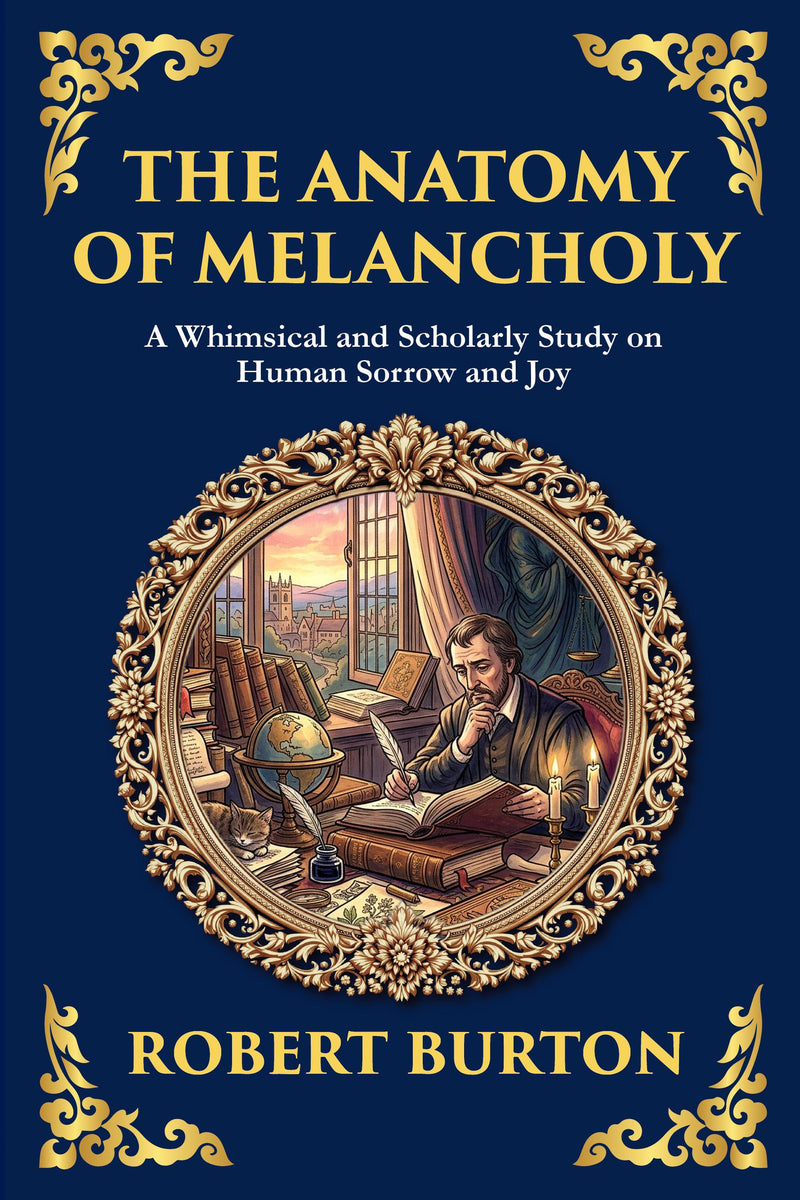
The Anatomy of Melancholy
What if the cure to sadness lies not in avoiding it—but in understanding it fully? First published in 1621, The Anatomy of Melancholy remains one of literature’s most unique and enduring explorations of the human condition.
or free app
10,000+ hrs library
30-day guarantee
The complete The Anatomy of Melancholy appears in modern English through Library of Alexandria Press, available online with audiobook narration included for members.
Have you ever wondered why we feel melancholy—and why we secretly enjoy it? The Anatomy of Melancholy by Robert Burton is a literary wonder unlike any other—a whimsical, sprawling, and erudite journey through the many shades of sadness, humor, obsession, joy, and the workings of the human mind. Originally written under the pseudonym "Democritus Junior," this massive and charmingly chaotic book reads like a conversation between a Renaissance scholar, a philosopher, a physician, and a jester.
In this modern edition, Burton’s dazzling intellect and satirical flair are preserved for the contemporary reader, unlocking a treasury of insight into what it means to be human. Through layers of quotations, anecdotes, digressions, and classical allusions, The Anatomy of Melancholy offers an astonishingly thorough (and at times hilariously absurd) look at everything from love and religion to madness, diet, and dreams.
What you’ll discover in this modern edition
- A Scholarly Exploration of Emotion – Burton investigates the causes and cures of melancholy with razor-sharp wit and Renaissance curiosity
| Formats | eBook (EPUB + PDF) · Audiobook · Paperback · Hardcover · Large Print |
| Language | English |
| Trim size (print) | 6 × 9 in |
| Binding | Paperback — perfect-bound · Hardcover — casewrap |
| Large Print edition | Same text in a larger, easy-read type — a larger font, not a larger trim |
| Print pricing | Every physical book at our true cost — at-cost, no profit (members) |
| Library | 873 restored titles, always growing |
| Length | 453,363 words · ~30 hr 13 min reading |
| Reading level | Grade 3 · an easy, flowing read (this modern-English edition) |
| Edition | Modern English translation · 2026 |
Member reviews for this edition are collected as readers finish it — be the first. Across the library: 12,000+ books shipped, every plan covered by a 365-day print guarantee.
About this edition
A faithful, unabridged modern-English edition by The Library of Alexandria — carefully rendered for today's reader and verified paragraph-by-paragraph against the public-domain source. Available as eBook, audiobook, paperback, hardcover, and large print.
- Complete & unabridgedVerified paragraph by paragraph against the source — never a scan, never abridged.
- Modern English, faithfulReadable today, with the author’s meaning kept intact. Readable — not simplified.
- Every format, one membershipRead in your browser or the free app, or listen to the full audiobook.
Included free with your membership
Cancel anytime, one click · 30-day money-back guarantee
Edition last updated July 2026
What’s inside
The Anatomy of Melancholy — complete and unabridged: all 5 sections included with membership, plus the full audiobook.
Begin reading The Anatomy of Melancholy
In clear modern English — the complete text is included with membership.
Introduction
There are books that we read, and there are books that read us. Robert Burton’s masterpiece belongs firmly to the second category. Open it at any page and you may find yourself startled by a flash of recognition, as though some long-dead scholar in a drafty seventeenth-century study had somehow anticipated the precise contours of your own restless mind. This is the strange and enduring magic of a work that has refused to die for four centuries, that has been loved by poets and philosophers, physicians and insomniacs, and that continues to speak with uncanny directness to anyone who has ever lain awake at night wondering why happiness feels so slippery and sorrow so stubbornly persistent.
What you hold in your hands is a modern rendering of one of the most extraordinary and idiosyncratic books ever produced in the English language. First published in 1621 by a quiet Oxford clergyman and scholar who spent most of his life within the walls of Christ Church college, the original was a sprawling, ever-expanding encyclopedia of human emotion, dressed in the scholarly costume of a medical treatise. Burton called himself “Democritus Junior,” after the ancient laughing philosopher who reportedly retreated from the world to study the causes of human folly. The pose was deliberate. Burton wanted us to understand from the outset that he was both a serious investigator of the human condition and a man fully aware of the absurdity of the whole enterprise—including his own.
This adaptation aims to preserve everything that makes the work beloved while removing the considerable barriers that have, for too long, kept it locked away from the general reader. The original is famous, even notorious, for its density. Burton wrote in a thicket of Latin quotations, obscure classical references, archaic medical theories, and digressions that spiral off into yet further digressions. To read it in its original form is a rewarding but genuinely demanding undertaking, often requiring a dictionary in one hand and a classical encyclopedia in the other. What follows is something different: a translation not merely from old English into new, but from the dense academic style of the early modern scholar into prose that a contemporary reader can move through with pleasure, while retaining the voice, the wit, the warmth, and the wild associative energy that make the original unforgettable.
A Book About Sadness That Is Anything but Sad
The first thing any new reader should understand is that this is, despite its weighty title and its formidable reputation, one of the most genuinely entertaining books you will ever encounter. The word “melancholy” in Burton’s day did not mean simply sadness in our narrow modern sense. It was an enormous and elastic concept, encompassing what we might today call depression and anxiety, but also obsession, lovesickness, religious despair, hypochondria, boredom, irritability, eccentricity, and a hundred other states of mind. To Burton, melancholy was nothing less than the universal human condition—the price we pay for being thinking, feeling creatures rather than contented beasts. “I write of melancholy,” he announces, “by being busy to avoid melancholy.” In other words, the cure for the disease was the very act of describing it.
This is the paradox at the heart of the book and the reason it remains so alive. Burton set out to catalog every variety of human suffering, and in doing so produced a work bursting with energy, humor, and an almost manic delight in the sheer variety of human experience. He is endlessly curious, endlessly digressive, and endlessly generous in his sympathy. He has read everything—or appears to have—and he cannot resist sharing it all with us. A discussion of the causes of sadness might wander, within a single page, through ancient Greek medicine, a story about a lovesick king, a recipe involving herbs and minerals, a complaint about bad weather, a meditation on the stars, and a sly joke at the expense of pompous physicians. The effect is dizzying and delightful, like wandering through the mind of the most learned, most companionable, and most slightly unhinged friend you have ever had.
Modern readers sometimes approach old books expecting solemnity, distance, formality. Burton offers none of these. He is intimate, confessional, frequently funny, and disarmingly honest about his own struggles. He admits that he writes about melancholy because he suffers from it himself. He confesses to his own laziness, his own bookishness, his own retreat from the world. He pokes fun at scholars, at lovers, at the rich, at the ambitious, at the superstitious—and never spares himself in the process. There is a profound humility in this. Burton does not stand above his subject like a doctor lecturing patients. He stands among us, one fellow sufferer addressing another, offering not a cure exactly, but companionship, understanding, and the consoling knowledge that we are not alone.
It is worth dwelling on just how revolutionary this honesty was, and remains. In an age when emotional suffering was often dismissed as weakness, moral failing, or demonic affliction, Burton insisted on treating it as a legitimate object of serious study—and, crucially, as something universal. “All the world is melancholy,” he writes, “or mad, dotes, and every member of it.” Far from being a counsel of despair, this is strangely liberating. If everyone is, in some measure, touched by melancholy, then there is no shame in it. It becomes simply part of what it means to be human, as natural as breathing, and therefore something we can examine, understand, laugh at, and perhaps, with care and effort, learn to live with.
The modern relevance of all this scarcely needs spelling out. We live in an age that talks endlessly about mental health, about anxiety and depression, about burnout and loneliness, about the difficulty of finding contentment in a world of infinite distraction. We have therapists and pharmaceuticals and self-help books beyond counting. And yet the fundamental questions Burton wrestled with remain stubbornly unanswered. Why are we sad? Where does happiness come from, and why is it so hard to hold onto? How should we live in order to suffer less? Burton does not pretend to have definitive answers, but his attempt to grapple with these questions—exhaustive, humane, frequently brilliant—has lost none of its power to illuminate. Reading him, you will find yourself nodding in recognition again and again, marveling that a man writing four hundred years ago could understand the modern mind so well.
To appreciate this book fully, it helps to know a little about the curious figure who wrote it. Robert Burton was born in 1577 in Leicestershire, England, into a respectable gentry family. He went up to Oxford as a young man and, in a sense, never really left. He became a scholar of Christ Church, took holy orders, and lived out his days in the cloistered world of the university, surrounded by books, occupied with his studies, holding minor church positions, and venturing rarely beyond the familiar streets of Oxford and the surrounding countryside. By most external measures, his was an uneventful life. He did not travel widely, fight in wars, hold high office, or achieve fame in his own time beyond a small circle. He was, by his own account, a shy and bookish man, more comfortable among manuscripts than among people.
And yet within this quiet, circumscribed existence, Burton built one of the most expansive interior worlds in the history of literature. Unable or unwilling to roam the physical world, he traveled instead through the vast libraries of Oxford, reading omnivorously across every field of knowledge then available: medicine, theology, astronomy, philosophy, history, poetry, geography, natural science, and the accumulated wisdom and folly of the ancient world. Everything he read, he absorbed and recorded, and all of it found its way into his book. In a famous and often-quoted passage, he describes himself as a kind of armchair traveler, content to journey through the cosmos and across the ages from the safety of his study: “I have lived a silent, sedentary, solitary, private life... in the University, as long almost as Xenocrates in Athens, to learn wisdom as he did, penned up most part in my study.”
There is something deeply touching, and deeply modern, about this self-portrait. Burton was, in essence, a man who experienced the world primarily through reading and reflection—who lived more vividly in his mind than in his daily surroundings. Many of us today, who spend our hours scrolling through screens, consuming information about distant places and events we will never directly encounter, may recognize in Burton a kindred spirit: the perennial figure of the watcher rather than the actor, the one who understands the world through study rather than through living it. And like many such people, Burton was intimately acquainted with the particular sorrows of the contemplative life—the loneliness, the restlessness, the sense that one is somehow standing apart from the full feast of existence.
It was, perhaps, precisely this temperament that made him the ideal anatomist of melancholy. He knew the territory from the inside. He was not a detached physician observing a disease in others, but a sufferer mapping his own affliction with the desperate thoroughness of a man trying to understand and master what tormented him. The result is a work of extraordinary personal investment, however disguised it may be beneath its mountains of learning and its scholarly apparatus. Behind every quotation, every classification, every digression, we sense a real human being trying to make sense of his own pain and the pain of the world around him.
Burton published the book in 1621 and then, remarkably, spent the rest of his life expanding and revising it. New editions appeared in 1624, 1628, 1632, 1638, and—after his death—in 1651, each one larger than the last, swollen with fresh reading, new examples, additional digressions. He could not stop adding to it. The book became his life’s work in the most literal sense: a vast, ever-growing reflection of a mind in perpetual motion. There is a poignant legend that Burton died in 1640 on or very near the date he had himself predicted through astrological calculation—a story that, true or not, captures something essential about a man so fascinated by fate, fortune, and the mysterious forces that shape human destiny. He was buried in Christ Church Cathedral, where his monument bears an epitaph he is said to have composed himself, declaring that melancholy gave him both life and death: a fittingly paradoxical farewell from a man who made paradox his lifelong study.
A word of guidance is in order, for this is not a book that should be approached like an ordinary work of nonfiction, to be read dutifully from cover to cover in pursuit of a single argument. To read it that way would be to misunderstand its nature and to miss much of its pleasure. The original is organized, ostensibly, with great formal precision—divided into partitions, sections, members, and subsections, each carefully labeled and arranged according to an elaborate scheme that Burton even illustrated with branching diagrams. He moves systematically from the definition and causes of melancholy, through its symptoms, to its cures, treating along the way three great special cases that fascinated him most: the melancholy that arises from love, and the melancholy that arises from religion.
But do not be deceived by this scaffolding of apparent orderliness. The true spirit of the book is anything but orderly. Burton is constitutionally incapable of staying on topic. Begin reading any section and you will soon find yourself swept away on a tide of association, carried from the announced subject into stories, anecdotes, complaints, jokes, lists, and meditations that may have only the most tenuous connection to where you started. This is not a flaw; it is the entire point. The book mirrors the wandering, restless, associative nature of the melancholy mind itself. To read it is to experience something of what it is like to think, in all its glorious disorder.
Cancel anytime, one click · 30-day money-back guarantee
Founding annual rate available now — your price locks for life when you join.
Not ready? Get this free chapter by email — read it anytime.
✓ Sent — check your inbox for The Anatomy of Melancholy.
Questions about The Anatomy of Melancholy
What is The Anatomy of Melancholy about?
What if the cure to sadness lies not in avoiding it—but in understanding it fully? First published in 1621, The Anatomy of Melancholy remains one of literature’s most unique and enduring explorations of the human condition. Part philosophy, part satire, part medical manual, Robert Burton’s singular work dives headfirst into sorrow, joy, madness, and everything in between.
Who wrote The Anatomy of Melancholy?
The Anatomy of Melancholy was written by Robert Burton. This edition presents the complete work in clear modern English, faithfully rendered from the public-domain original by Library of Alexandria Press.
Is The Anatomy of Melancholy free to read?
The opening chapter is free to read on this page. Members read and listen to the complete work — and the entire library — free, and can order any physical book at our true print cost.
How long is The Anatomy of Melancholy?
5 chapters (~453,363 words) — about 30 hr 13 min of reading in this modern-English edition.
Is this an abridged version of The Anatomy of Melancholy?
No. This is the complete, unabridged The Anatomy of Melancholy, carefully rendered into clear modern English and verified paragraph-by-paragraph against the public-domain source — nothing is cut or summarised.
What formats does The Anatomy of Melancholy come in?
The Anatomy of Melancholy is available as eBook. eBook and audiobook are included with membership; printed editions ship at our true print cost.
Shipping & returns
Billing & membership
More from the library


Explore Philosophy & Ideas
- Kant's Prolegomena to Any Future Metaphysics · Immanuel Kant
- The Advancement of Learning · Francis Bacon
- The Dawn of Day · Friedrich Wilhelm Nietzsche
- Meditations · Marcus Aurelius
- The Confessions of St. Augustine · Saint Augustine
- Dialogues Concerning Natural Religion · David Hume
- Considerations on Representative Government · John Stuart Mill
- The Will to Power: An Attempted Transvaluation of All Values. Book III and IV · Friedrich Nietzsche
- Groundwork of the Metaphysics of Morals · Immanuel Kant
- The Confessions of Jean-Jacques Rousseau — Complete · Jean-Jacques Rousseau
- Democracy in America — Volume 2 · Alexis de Tocqueville
- Ecce Homo · Friedrich Wilhelm Nietzsche
- Second Treatise of Government · John Locke
- The Prince · Niccolò Machiavelli
- Thus Spake Zarathustra: A Book for All and None · Friedrich Wilhelm Nietzsche
- The Island of Doctor Moreau · H. G. Wells
- Sophist · Plato
- The Seven Lamps of Architecture · John Ruskin
- Essays — First Series · Ralph Waldo Emerson
- The Book of the Damned · Charles Fort
- The Everlasting Man · G. K. Chesterton
- The Initiates of the Flame · Manly P. Hall
- The Book of Tea · Kakuzo Okakura
- The Japanese Spirit · Yoshisaburo Okakura
- The Analysis of Mind · Bertrand Russell
- Orthodoxy · G. K. Chesterton
- Apology, Crito, and Phaedo of Socrates · Plato
- Euthyphro · Plato
- Timaeus · Plato
- Ion · Plato
The Anatomy of Melancholy
The Anatomy of Melancholy
A Quirky and Academic Look at Human Sadness and Happiness
Robert Burton
Contents
- Introduction
- Chapter 1
- Chapter 2
- Chapter 3
- Chapter 4
Introduction
There are books that we read, and there are books that read us. Robert Burton’s masterpiece belongs firmly to the second category. Open it at any page and you may find yourself startled by a flash of recognition, as though some long-dead scholar in a drafty seventeenth-century study had somehow anticipated the precise contours of your own restless mind. This is the strange and enduring magic of a work that has refused to die for four centuries, that has been loved by poets and philosophers, physicians and insomniacs, and that continues to speak with uncanny directness to anyone who has ever lain awake at night wondering why happiness feels so slippery and sorrow so stubbornly persistent.
What you hold in your hands is a modern rendering of one of the most extraordinary and idiosyncratic books ever produced in the English language. First published in 1621 by a quiet Oxford clergyman and scholar who spent most of his life within the walls of Christ Church college, the original was a sprawling, ever-expanding encyclopedia of human emotion, dressed in the scholarly costume of a medical treatise. Burton called himself “Democritus Junior,” after the ancient laughing philosopher who reportedly retreated from the world to study the causes of human folly. The pose was deliberate. Burton wanted us to understand from the outset that he was both a serious investigator of the human condition and a man fully aware of the absurdity of the whole enterprise—including his own.
This adaptation aims to preserve everything that makes the work beloved while removing the considerable barriers that have, for too long, kept it locked away from the general reader. The original is famous, even notorious, for its density. Burton wrote in a thicket of Latin quotations, obscure classical references, archaic medical theories, and digressions that spiral off into yet further digressions. To read it in its original form is a rewarding but genuinely demanding undertaking, often requiring a dictionary in one hand and a classical encyclopedia in the other. What follows is something different: a translation not merely from old English into new, but from the dense academic style of the early modern scholar into prose that a contemporary reader can move through with pleasure, while retaining the voice, the wit, the warmth, and the wild associative energy that make the original unforgettable.
A Book About Sadness That Is Anything but Sad
The first thing any new reader should understand is that this is, despite its weighty title and its formidable reputation, one of the most genuinely entertaining books you will ever encounter. The word “melancholy” in Burton’s day did not mean simply sadness in our narrow modern sense. It was an enormous and elastic concept, encompassing what we might today call depression and anxiety, but also obsession, lovesickness, religious despair, hypochondria, boredom, irritability, eccentricity, and a hundred other states of mind. To Burton, melancholy was nothing less than the universal human condition—the price we pay for being thinking, feeling creatures rather than contented beasts. “I write of melancholy,” he announces, “by being busy to avoid melancholy.” In other words, the cure for the disease was the very act of describing it.
This is the paradox at the heart of the book and the reason it remains so alive. Burton set out to catalog every variety of human suffering, and in doing so produced a work bursting with energy, humor, and an almost manic delight in the sheer variety of human experience. He is endlessly curious, endlessly digressive, and endlessly generous in his sympathy. He has read everything—or appears to have—and he cannot resist sharing it all with us. A discussion of the causes of sadness might wander, within a single page, through ancient Greek medicine, a story about a lovesick king, a recipe involving herbs and minerals, a complaint about bad weather, a meditation on the stars, and a sly joke at the expense of pompous physicians. The effect is dizzying and delightful, like wandering through the mind of the most learned, most companionable, and most slightly unhinged friend you have ever had.
Modern readers sometimes approach old books expecting solemnity, distance, formality. Burton offers none of these. He is intimate, confessional, frequently funny, and disarmingly honest about his own struggles. He admits that he writes about melancholy because he suffers from it himself. He confesses to his own laziness, his own bookishness, his own retreat from the world. He pokes fun at scholars, at lovers, at the rich, at the ambitious, at the superstitious—and never spares himself in the process. There is a profound humility in this. Burton does not stand above his subject like a doctor lecturing patients. He stands among us, one fellow sufferer addressing another, offering not a cure exactly, but companionship, understanding, and the consoling knowledge that we are not alone.
It is worth dwelling on just how revolutionary this honesty was, and remains. In an age when emotional suffering was often dismissed as weakness, moral failing, or demonic affliction, Burton insisted on treating it as a legitimate object of serious study—and, crucially, as something universal. “All the world is melancholy,” he writes, “or mad, dotes, and every member of it.” Far from being a counsel of despair, this is strangely liberating. If everyone is, in some measure, touched by melancholy, then there is no shame in it. It becomes simply part of what it means to be human, as natural as breathing, and therefore something we can examine, understand, laugh at, and perhaps, with care and effort, learn to live with.
The modern relevance of all this scarcely needs spelling out. We live in an age that talks endlessly about mental health, about anxiety and depression, about burnout and loneliness, about the difficulty of finding contentment in a world of infinite distraction. We have therapists and pharmaceuticals and self-help books beyond counting. And yet the fundamental questions Burton wrestled with remain stubbornly unanswered. Why are we sad? Where does happiness come from, and why is it so hard to hold onto? How should we live in order to suffer less? Burton does not pretend to have definitive answers, but his attempt to grapple with these questions—exhaustive, humane, frequently brilliant—has lost none of its power to illuminate. Reading him, you will find yourself nodding in recognition again and again, marveling that a man writing four hundred years ago could understand the modern mind so well.
To appreciate this book fully, it helps to know a little about the curious figure who wrote it. Robert Burton was born in 1577 in Leicestershire, England, into a respectable gentry family. He went up to Oxford as a young man and, in a sense, never really left. He became a scholar of Christ Church, took holy orders, and lived out his days in the cloistered world of the university, surrounded by books, occupied with his studies, holding minor church positions, and venturing rarely beyond the familiar streets of Oxford and the surrounding countryside. By most external measures, his was an uneventful life. He did not travel widely, fight in wars, hold high office, or achieve fame in his own time beyond a small circle. He was, by his own account, a shy and bookish man, more comfortable among manuscripts than among people.
And yet within this quiet, circumscribed existence, Burton built one of the most expansive interior worlds in the history of literature. Unable or unwilling to roam the physical world, he traveled instead through the vast libraries of Oxford, reading omnivorously across every field of knowledge then available: medicine, theology, astronomy, philosophy, history, poetry, geography, natural science, and the accumulated wisdom and folly of the ancient world. Everything he read, he absorbed and recorded, and all of it found its way into his book. In a famous and often-quoted passage, he describes himself as a kind of armchair traveler, content to journey through the cosmos and across the ages from the safety of his study: “I have lived a silent, sedentary, solitary, private life... in the University, as long almost as Xenocrates in Athens, to learn wisdom as he did, penned up most part in my study.”
There is something deeply touching, and deeply modern, about this self-portrait. Burton was, in essence, a man who experienced the world primarily through reading and reflection—who lived more vividly in his mind than in his daily surroundings. Many of us today, who spend our hours scrolling through screens, consuming information about distant places and events we will never directly encounter, may recognize in Burton a kindred spirit: the perennial figure of the watcher rather than the actor, the one who understands the world through study rather than through living it. And like many such people, Burton was intimately acquainted with the particular sorrows of the contemplative life—the loneliness, the restlessness, the sense that one is somehow standing apart from the full feast of existence.
It was, perhaps, precisely this temperament that made him the ideal anatomist of melancholy. He knew the territory from the inside. He was not a detached physician observing a disease in others, but a sufferer mapping his own affliction with the desperate thoroughness of a man trying to understand and master what tormented him. The result is a work of extraordinary personal investment, however disguised it may be beneath its mountains of learning and its scholarly apparatus. Behind every quotation, every classification, every digression, we sense a real human being trying to make sense of his own pain and the pain of the world around him.
Burton published the book in 1621 and then, remarkably, spent the rest of his life expanding and revising it. New editions appeared in 1624, 1628, 1632, 1638, and—after his death—in 1651, each one larger than the last, swollen with fresh reading, new examples, additional digressions. He could not stop adding to it. The book became his life’s work in the most literal sense: a vast, ever-growing reflection of a mind in perpetual motion. There is a poignant legend that Burton died in 1640 on or very near the date he had himself predicted through astrological calculation—a story that, true or not, captures something essential about a man so fascinated by fate, fortune, and the mysterious forces that shape human destiny. He was buried in Christ Church Cathedral, where his monument bears an epitaph he is said to have composed himself, declaring that melancholy gave him both life and death: a fittingly paradoxical farewell from a man who made paradox his lifelong study.
A word of guidance is in order, for this is not a book that should be approached like an ordinary work of nonfiction, to be read dutifully from cover to cover in pursuit of a single argument. To read it that way would be to misunderstand its nature and to miss much of its pleasure. The original is organized, ostensibly, with great formal precision—divided into partitions, sections, members, and subsections, each carefully labeled and arranged according to an elaborate scheme that Burton even illustrated with branching diagrams. He moves systematically from the definition and causes of melancholy, through its symptoms, to its cures, treating along the way three great special cases that fascinated him most: the melancholy that arises from love, and the melancholy that arises from religion.
But do not be deceived by this scaffolding of apparent orderliness. The true spirit of the book is anything but orderly. Burton is constitutionally incapable of staying on topic. Begin reading any section and you will soon find yourself swept away on a tide of association, carried from the announced subject into stories, anecdotes, complaints, jokes, lists, and meditations that may have only the most tenuous connection to where you started. This is not a flaw; it is the entire point. The book mirrors the wandering, restless, associative nature of the melancholy mind itself. To read it is to experience something of what it is like to think, in all its glorious disorder.
Go forth, O book; I dare not say how lucky you are,
Unless the dawn of a new day makes you happy.
Go wherever you wish, across whatever shores,
And let the spirit of your master guide you.
Go among the charming Graces, and greet the mystic.
Any lover of the arts, if you happen to be my reader,
whether you live in the country, in the city, or dwell in royal palaces,
be humble, stay calm, and keep your peace.
If a nobleman or perhaps some great hero happens to glance at this,
present yourself as a gentle soul, so they may enjoy reading further.
There is something that nobility and heroes desire,
and perhaps these pages can appeal to them more gracefully.
If someone like a grumpy Cato or a stern Senator
should also happen to want to look at this book,
or if they are a high official, treat them with respect;
but if not, ignore them; eagles do not hunt flies.
Their fleeting time is too precious to waste on such trifles,
I don’t desire such people; my reader will be an equal to me.
If a serious matron happens to pick up this book,
or if a noble lady or a countess reads it:
some parts may displease them, while others might be enjoyed;
just don’t force it on them, but let the pages be open.
But if a famous young woman considers your writings
worthy of her touch, or if she becomes absorbed in your pages:
be flexible with her, and remember that some pages
are better suited to her eyes than others.
wants to look at these plays, agree to it and share them gladly.
I wish that my own [companion]—since he loves such things—would now...
Now, the master of the house should be observed.
Whether he be a stranger to me or a known Roman,
End of the free sample
Keep reading, free
Members read and listen to the complete book — and the entire library. Cancel anytime, one click · 30-day money-back guarantee.