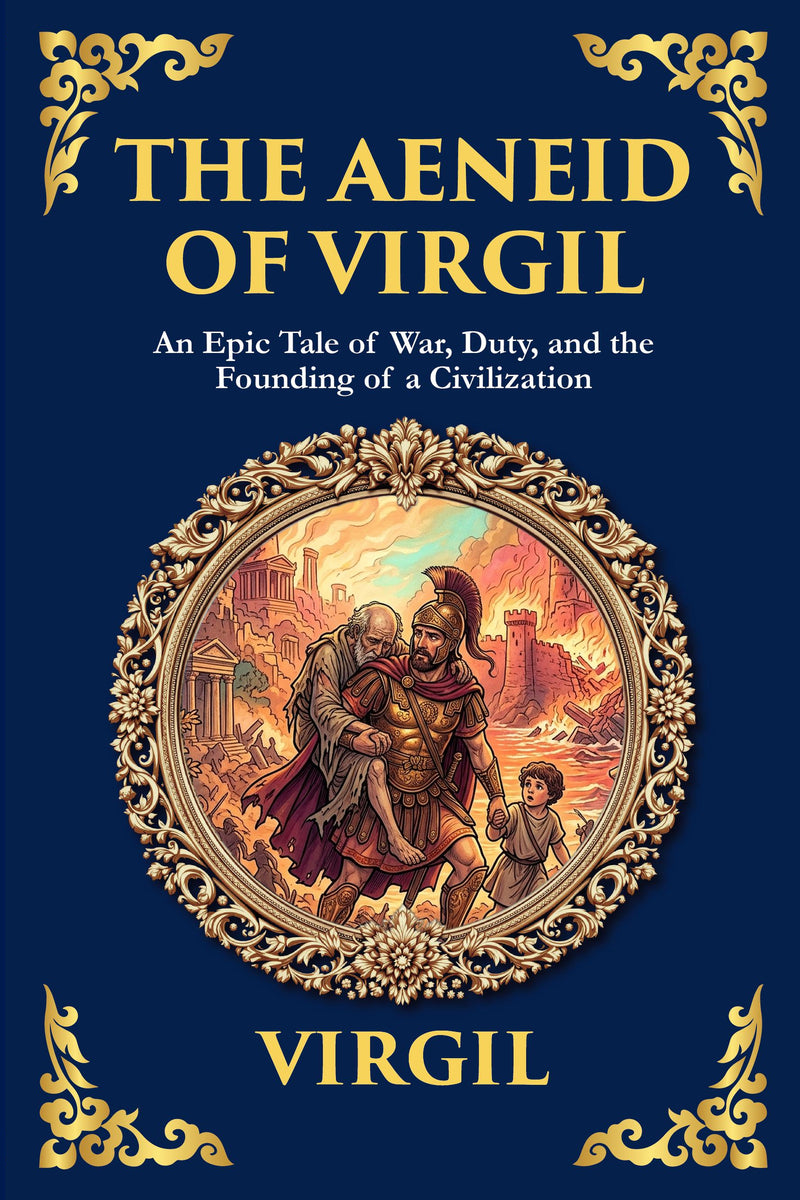
The Aeneid of Virgil — Large Print
Aeneas is no ordinary hero—he carries the destiny of a civilization. In The Aeneid, Virgil weaves a majestic tale of a Trojan warrior’s perilous journey to fulfill a divine mission.
or free app
10,000+ hrs library
30-day guarantee
The complete The Aeneid of Virgil appears in modern English through Library of Alexandria Press, available online with audiobook narration included for members.
Have you ever wondered why the founding of a civilization begins with heartbreak, exile, and fire? The Aeneid of Virgil is one of the greatest epics in world literature—a sweeping story of loss, duty, and divine destiny. Written during the reign of Augustus, this Latin masterpiece chronicles the heroic odyssey of Aeneas, a Trojan prince chosen by the gods to establish the roots of what would become the Roman Empire.
As Aeneas flees the ashes of Troy, he embarks on a divinely ordained mission to find a new homeland. Along the way, he faces thunderous storms, love and betrayal, spectral prophecies, and epic clashes with foes—culminating in the fierce war that determines the fate of Latium and the birth of Rome. But even more compelling is the inner conflict that rages within Aeneas: the human cost of greatness, and the painful sacrifice of personal happiness for a greater good.
This modern rendering captures the fire and clarity of Virgil’s poetry while making its profound themes resonate for contemporary readers. More than a myth, The Aeneid is a mirror to empire, leadership, and legacy.
What you’ll discover in this modern edition
- A Hero Torn Between Heart and Duty Experience the powerful inner struggle of Aeneas as he weighs personal desire against divine mission.
- A Visionary Tale of Nation-Building See how Rome’s mythical foundation is shaped through war, leadership, and prophetic fate.
- Myth, History, and Political Commentary Interwoven Uncover how Virgil uses legend to reflect the ambitions and anxieties of Augustan Rome.
- An Accessible Yet Faithful Translation Engaging for first-time readers, illuminating for scholars—this version balances literary beauty and clarity.
- A Masterpiece of Poetic Craft and Narrative Scope Appreciate the elegance of Virgil’s verse and the epic scale of his vision.
| Formats | eBook (EPUB + PDF) · Audiobook · Paperback · Hardcover · Large Print |
| Language | English |
| Trim size (print) | 6 × 9 in |
| Binding | Paperback — perfect-bound · Hardcover — casewrap |
| Large Print edition | Same text in a larger, easy-read type — a larger font, not a larger trim |
| Print pricing | Every physical book at our true cost — at-cost, no profit (members) |
| Library | 873 restored titles, always growing |
| Length | 101,639 words · ~6 hr 47 min reading |
| Reading level | Grade 3 · an easy, flowing read (this modern-English edition) |
| Edition | Modern English translation · 2026 |
Member reviews for this edition are collected as readers finish it — be the first. Across the library: 12,000+ books shipped, every plan covered by a 365-day print guarantee.
About this edition
A faithful, unabridged modern-English edition by The Library of Alexandria — carefully rendered for today's reader and verified paragraph-by-paragraph against the public-domain source. Available as eBook, audiobook, paperback, hardcover, and large print.
- Complete & unabridgedVerified paragraph by paragraph against the source — never a scan, never abridged.
- Modern English, faithfulReadable today, with the author’s meaning kept intact. Readable — not simplified.
- Every format, one membershipRead in your browser or the free app, or listen to the full audiobook.
Included free with your membership
Cancel anytime, one click · 30-day money-back guarantee
Edition last updated July 2026
What’s inside
The Aeneid of Virgil — Large Print — complete and unabridged: all 13 sections included with membership, plus the full audiobook.
Begin reading The Aeneid of Virgil — Large Print
In clear modern English — the complete text is included with membership.
Introduction
There are stories that entertain us for an evening, and there are stories that have shaped the way an entire civilization understands itself. The poem you are about to read belongs unmistakably to the second kind. For more than two thousand years, it has been copied, recited, memorized, mourned over, argued about, and loved. It has been quoted by emperors and by exiles, studied by schoolchildren and by philosophers, carried into battle and into monasteries. Few works of human imagination can claim such a continuous and living presence across the centuries. To open this book is to step into one of the longest conversations in Western culture — a conversation about what it means to belong somewhere, to lose everything, to carry a burden you did not choose, and to build something lasting out of grief and determination.
Yet for all its grandeur, this is at heart a deeply human poem. Beneath the gods and the battles, the prophecies and the founding of nations, it is the story of a man trying to do the right thing in an impossible world. It is about a refugee searching for a home, a leader weighed down by responsibility, a son honoring his father, a lover torn between desire and duty. It is about the price of greatness and the cost of survival. These are not ancient concerns alone; they are the concerns of every age, including our own. That is why this poem has never stopped speaking to readers, and why this modern adaptation has been prepared with such care — to remove the barriers of archaic language and unfamiliar reference, and to let the timeless power of the story reach you directly, as fresh and urgent as it was when it was first composed.
To understand why this poem matters, it helps to know something of the man who wrote it and the moment in which he wrote. Publius Vergilius Maro — known to us as Virgil — was born in the year 70 BCE near the northern Italian town of Mantua, the son of a modest landowning family. He grew up in the countryside, and a love of rural life, of fields and seasons and the quiet dignity of farming, never left him; it breathes through everything he wrote. He received an excellent education in rhetoric and philosophy, but he was by temperament shy, reserved, and physically frail, more comfortable with study and reflection than with the noise of public life. From these unpromising beginnings emerged the poet who would become the voice of an empire.
The world into which Virgil came of age was one of staggering turmoil. The Roman Republic, which had governed for centuries through a system of elected magistrates and a powerful Senate, was tearing itself apart in a series of brutal civil wars. Virgil lived through the assassination of Julius Caesar, the chaos and bloodshed that followed, and the long, vicious struggle for power that finally ended when Caesar’s adopted heir, Octavian, defeated his last rival and emerged as the undisputed master of the Roman world. In 27 BCE, Octavian took the name Augustus and became, in all but title, the first emperor of Rome. After decades of slaughter, exhausted Romans found themselves at peace — but it was a peace purchased at the cost of the old liberties, and many wondered what, exactly, their suffering had been for.
It was in this atmosphere of relief mingled with uncertainty that Virgil undertook his greatest work. He had already established himself as the leading poet of his generation with two earlier masterpieces — a collection of pastoral poems and a long meditation on farming and the natural world — and he enjoyed the patronage and friendship of the most powerful men in Rome, including Augustus himself. The new ruler wanted something more than military victories and grand buildings; he wanted to give Rome a sense of meaning, a story that would explain who the Romans were, where they had come from, and what destiny they were called to fulfill. Virgil set out to provide exactly that. He devoted the last eleven years of his life, from about 29 BCE until his death in 19 BCE, to a single epic poem that would do for Rome what the great epics of Homer had done for Greece.
The labor consumed him. Virgil was a perfectionist who wrote slowly and revised obsessively; it is said that he produced only a few lines a day, polishing each one as a mother bear was thought to lick her cubs into shape. As he neared the end, he planned to spend three more years refining the work before releasing it. But on a journey to Greece he fell ill, and returning to Italy he died at Brindisi in the autumn of 19 BCE, his great poem still, in his own exacting judgment, unfinished. According to the most famous tradition, he asked on his deathbed that the manuscript be burned rather than published in its imperfect state. Augustus himself intervened and overruled the request, ordering the poem preserved and published with only the lightest editing. We owe its survival to that imperial command. Had Virgil’s wishes been honored, the Western world would be immeasurably poorer.
It is worth pausing on this fact, because it tells us something essential about the work. This is not a hastily assembled adventure tale but the considered, lifelong labor of a man who believed poetry could carry the deepest truths about human existence and the destiny of nations. Every episode was weighed, every image chosen, every echo and parallel deliberately placed. When you encounter a moment that strikes you as unbearably moving or strangely resonant, you can be confident it was meant to strike you so. Virgil composed for readers who would return to his poem again and again across a lifetime, finding new depths each time. He composed, in other words, for exactly the kind of attentive reading that you are about to give him.
The poem was an instant and overwhelming success. Even before its publication, word had spread that Virgil was creating something extraordinary; the poet Propertius declared that a work greater than Homer’s was being born. Once released, it became the central text of Roman education, the poem every educated person knew by heart. It remained at the heart of Western learning through the fall of Rome, through the medieval centuries, through the Renaissance, and into the modern age. The great Italian poet Dante chose Virgil himself as his guide through the underworld in the Divine Comedy, calling him “my master and my author.” Saint Augustine confessed that he had wept as a boy over the fate of one of the poem’s characters. For close to two millennia, no work apart from the Bible has exerted a comparable influence on the imagination of the West.
A Story of War, Duty, and the Birth of a Civilization
The subtitle of this volume names the three great themes that run through the poem like rivers through a landscape: war, duty, and the birth of a civilization. Each deserves a few words, for understanding what the poem is about — in the deepest sense — will enormously enrich your reading without spoiling a single surprise of plot.
The story begins in the aftermath of the most famous war in all of legend: the fall of Troy. The Greeks have at last destroyed the great city, and from its smoking ruins a band of survivors escapes, led by a Trojan prince who has been told by the gods that he is destined to found a new nation in a distant land. This is the premise on which everything rests. The hero is not setting out to conquer or to win glory for himself; he is fleeing a catastrophe and carrying with him the broken remnants of his people, charged with a mission he barely understands and often wishes he could refuse. The poem follows his long, storm-tossed journey across the Mediterranean and the trials that await him when he finally reaches the shores where his destiny lies. The first half of the poem unfolds as a great voyage of wandering and survival; the second half brings conflict and struggle on the land that has been promised. Beyond this broad shape, I will say nothing of the particulars, for the unfolding of events is among the chief pleasures awaiting you.
War, then, frames the entire poem — both the war that destroys the old world at the beginning and the war that must be fought to establish the new one at the end. But Virgil’s treatment of war is far from celebratory. Having lived through decades of civil bloodshed, he knew the cost of violence intimately, and the poem is shot through with grief for the slain on both sides. He gives us the terror and chaos of a city’s fall, the waste of young lives, the anguish of mothers and fathers who outlive their children. Even in moments of triumph, there is sorrow. This is one of the qualities that sets the poem apart from many tales of heroic combat: it never lets us forget that every victory is built on suffering, that the founding of something great demands a terrible price, and that the price is paid by ordinary people whose names history will not remember. Virgil mourns even as he commemorates.
The second great theme is duty — and here we touch the very heart of the poem. The hero is defined above all by a quality the Romans called pietas, a word for which English has no precise equivalent. It means something far richer than our “piety.” It encompasses devotion to the gods, loyalty to one’s family, faithfulness to one’s homeland, and the steady fulfillment of obligation even when every personal desire pulls in the opposite direction. The hero is repeatedly described by an epithet meaning “dutiful” or “devoted,” and his great struggle throughout the poem is to subordinate his own longings — for rest, for love, for peace, for the dead past — to the demands of a destiny larger than himself. This is not always an easy thing to admire. There are moments when his self-control seems cold, when his obedience to fate seems almost inhuman, when we ache for him to choose the path of the heart. Virgil knew this, and he built that tension into the poem deliberately. The greatness of the hero lies precisely in the cost of his duty, in the things he must give up and the pain he must endure to fulfill it. He is not a man who feels nothing; he is a man who feels everything and chooses duty anyway.
This made the hero a profoundly Roman figure, for the Romans prized self-discipline and devotion to the state above almost every other virtue. But it also makes him a deeply modern one. We live in an age that often celebrates the pursuit of personal happiness above all else, and there is something bracing, even challenging, in encountering a hero whose greatness consists in surrendering his happiness for the sake of others. The poem asks us to consider what we owe to our families, our communities, and the generations that will come after us. It asks whether there are things worth more than our own contentment. These are not comfortable questions, and the poem does not answer them glibly. Its hero suffers for his choices, and so do those around him. But in his weary, unglamorous persistence — in his willingness to keep going when every reason to stop presses upon him — there is a kind of heroism that the modern world badly needs to remember.
The third theme, the birth of a civilization, gives the poem its sweep and its sense of cosmic purpose. This is not merely the story of one man’s journey but of the founding of a people who will, in the long unfolding of time, build the greatest empire the ancient world had ever seen. Throughout the poem, Virgil opens windows onto the future, allowing his characters glimpses of the centuries to come — the rise of Rome, its conquests, its heroes, and ultimately the golden age that Virgil’s own contemporaries believed Augustus was bringing to fulfillment. The small band of refugees we follow are, in a sense, the seed from which an entire world will grow. This gives even the smallest episodes a tremendous weight; every choice, every loss, every act of endurance is part of a vast pattern stretching across hundreds of years. The poem makes us feel the immense distances of history, the way present struggles echo into a future the strugglers themselves will never see.
Cancel anytime, one click · 30-day money-back guarantee
Founding annual rate available now — your price locks for life when you join.
Not ready? Get this free chapter by email — read it anytime.
✓ Sent — check your inbox for The Aeneid of Virgil — Large Print.
Questions about The Aeneid of Virgil — Large Print
What is The Aeneid of Virgil about?
Aeneas is no ordinary hero—he carries the destiny of a civilization. In The Aeneid, Virgil weaves a majestic tale of a Trojan warrior’s perilous journey to fulfill a divine mission. Through tempestuous seas, heart-wrenching losses, and brutal warfare, Aeneas is tested not only in battle, but in spirit.
Who wrote The Aeneid of Virgil?
The Aeneid of Virgil was written by Virgil. This edition presents the complete work in clear modern English, faithfully rendered from the public-domain original by Library of Alexandria Press.
Is The Aeneid of Virgil free to read?
The opening chapter is free to read on this page. Members read and listen to the complete work — and the entire library — free, and can order any physical book at our true print cost.
How long is The Aeneid of Virgil?
13 chapters (~101,639 words) — about 6 hr 47 min of reading in this modern-English edition.
Is this an abridged version of The Aeneid of Virgil?
No. This is the complete, unabridged The Aeneid of Virgil, carefully rendered into clear modern English and verified paragraph-by-paragraph against the public-domain source — nothing is cut or summarised.
What formats does The Aeneid of Virgil come in?
The Aeneid of Virgil is available as eBook, paperback, hardcover and large print. eBook and audiobook are included with membership; printed editions ship at our true print cost.
Shipping & returns
Billing & membership
More from the library


Explore Myths & Legends
- The Red Fairy Book · Andrew Lang
- Vikram and the Vampire: Classic Hindu Tales of Adventure, Magic, and Romance · Unknown
- The Initiates of the Flame · Manly P. Hall
- Gawayne and the Green Knight: A Fairy Tale · Charlton M. Lewis
- The Nibelungenlied · G. H. Needler
- The Aeneid of Virgil · Virgil
- Fifty Famous Stories Retold · James Baldwin
- West African Folk-Tales
- Lamia · John Keats
- The Three Bears · A. E. Kennedy
- The Ballad of the White Horse · G. K. Chesterton
- The Danish History, Books I–IX · Saxo Grammaticus
- Andersen’s Fairy Tales · H. C. Andersen
- Folk-Tales of Bengal · Lal Behari Day
- The Birth of the War-God: A Poem by Kalidasa · Kálidása
- Omens and Superstitions of Southern India · Edgar Thurston
- The Legend of Sleepy Hollow · Washington Irving
- The Hyborian Age · Robert E. Howard
- The Odyssey · Homer
- Grimms’ Fairy Tales · Jacob Grimm and Wilhelm Grimm
- Just So Stories · Rudyard Kipling
- Aeschylus’ Prometheus Bound and the Seven Against Thebes · Aeschylus
- The Iliad · Homer
The Aeneid of Virgil — Large Print
The Aeneid of Virgil — Large Print
An Epic Story of War, Duty, and the Birth of a Civilization
Virgil
Contents
- Introduction
- Book 1
- Book 2
- Book 3
- Book 4
- Book 5
- Book 6
- Book 7
- Book 8
- Book 9
- Book 10
- Book 11
- Book 12
Introduction
There are stories that entertain us for an evening, and there are stories that have shaped the way an entire civilization understands itself. The poem you are about to read belongs unmistakably to the second kind. For more than two thousand years, it has been copied, recited, memorized, mourned over, argued about, and loved. It has been quoted by emperors and by exiles, studied by schoolchildren and by philosophers, carried into battle and into monasteries. Few works of human imagination can claim such a continuous and living presence across the centuries. To open this book is to step into one of the longest conversations in Western culture — a conversation about what it means to belong somewhere, to lose everything, to carry a burden you did not choose, and to build something lasting out of grief and determination.
Yet for all its grandeur, this is at heart a deeply human poem. Beneath the gods and the battles, the prophecies and the founding of nations, it is the story of a man trying to do the right thing in an impossible world. It is about a refugee searching for a home, a leader weighed down by responsibility, a son honoring his father, a lover torn between desire and duty. It is about the price of greatness and the cost of survival. These are not ancient concerns alone; they are the concerns of every age, including our own. That is why this poem has never stopped speaking to readers, and why this modern adaptation has been prepared with such care — to remove the barriers of archaic language and unfamiliar reference, and to let the timeless power of the story reach you directly, as fresh and urgent as it was when it was first composed.
To understand why this poem matters, it helps to know something of the man who wrote it and the moment in which he wrote. Publius Vergilius Maro — known to us as Virgil — was born in the year 70 BCE near the northern Italian town of Mantua, the son of a modest landowning family. He grew up in the countryside, and a love of rural life, of fields and seasons and the quiet dignity of farming, never left him; it breathes through everything he wrote. He received an excellent education in rhetoric and philosophy, but he was by temperament shy, reserved, and physically frail, more comfortable with study and reflection than with the noise of public life. From these unpromising beginnings emerged the poet who would become the voice of an empire.
The world into which Virgil came of age was one of staggering turmoil. The Roman Republic, which had governed for centuries through a system of elected magistrates and a powerful Senate, was tearing itself apart in a series of brutal civil wars. Virgil lived through the assassination of Julius Caesar, the chaos and bloodshed that followed, and the long, vicious struggle for power that finally ended when Caesar’s adopted heir, Octavian, defeated his last rival and emerged as the undisputed master of the Roman world. In 27 BCE, Octavian took the name Augustus and became, in all but title, the first emperor of Rome. After decades of slaughter, exhausted Romans found themselves at peace — but it was a peace purchased at the cost of the old liberties, and many wondered what, exactly, their suffering had been for.
It was in this atmosphere of relief mingled with uncertainty that Virgil undertook his greatest work. He had already established himself as the leading poet of his generation with two earlier masterpieces — a collection of pastoral poems and a long meditation on farming and the natural world — and he enjoyed the patronage and friendship of the most powerful men in Rome, including Augustus himself. The new ruler wanted something more than military victories and grand buildings; he wanted to give Rome a sense of meaning, a story that would explain who the Romans were, where they had come from, and what destiny they were called to fulfill. Virgil set out to provide exactly that. He devoted the last eleven years of his life, from about 29 BCE until his death in 19 BCE, to a single epic poem that would do for Rome what the great epics of Homer had done for Greece.
The labor consumed him. Virgil was a perfectionist who wrote slowly and revised obsessively; it is said that he produced only a few lines a day, polishing each one as a mother bear was thought to lick her cubs into shape. As he neared the end, he planned to spend three more years refining the work before releasing it. But on a journey to Greece he fell ill, and returning to Italy he died at Brindisi in the autumn of 19 BCE, his great poem still, in his own exacting judgment, unfinished. According to the most famous tradition, he asked on his deathbed that the manuscript be burned rather than published in its imperfect state. Augustus himself intervened and overruled the request, ordering the poem preserved and published with only the lightest editing. We owe its survival to that imperial command. Had Virgil’s wishes been honored, the Western world would be immeasurably poorer.
It is worth pausing on this fact, because it tells us something essential about the work. This is not a hastily assembled adventure tale but the considered, lifelong labor of a man who believed poetry could carry the deepest truths about human existence and the destiny of nations. Every episode was weighed, every image chosen, every echo and parallel deliberately placed. When you encounter a moment that strikes you as unbearably moving or strangely resonant, you can be confident it was meant to strike you so. Virgil composed for readers who would return to his poem again and again across a lifetime, finding new depths each time. He composed, in other words, for exactly the kind of attentive reading that you are about to give him.
The poem was an instant and overwhelming success. Even before its publication, word had spread that Virgil was creating something extraordinary; the poet Propertius declared that a work greater than Homer’s was being born. Once released, it became the central text of Roman education, the poem every educated person knew by heart. It remained at the heart of Western learning through the fall of Rome, through the medieval centuries, through the Renaissance, and into the modern age. The great Italian poet Dante chose Virgil himself as his guide through the underworld in the Divine Comedy, calling him “my master and my author.” Saint Augustine confessed that he had wept as a boy over the fate of one of the poem’s characters. For close to two millennia, no work apart from the Bible has exerted a comparable influence on the imagination of the West.
A Story of War, Duty, and the Birth of a Civilization
The subtitle of this volume names the three great themes that run through the poem like rivers through a landscape: war, duty, and the birth of a civilization. Each deserves a few words, for understanding what the poem is about — in the deepest sense — will enormously enrich your reading without spoiling a single surprise of plot.
The story begins in the aftermath of the most famous war in all of legend: the fall of Troy. The Greeks have at last destroyed the great city, and from its smoking ruins a band of survivors escapes, led by a Trojan prince who has been told by the gods that he is destined to found a new nation in a distant land. This is the premise on which everything rests. The hero is not setting out to conquer or to win glory for himself; he is fleeing a catastrophe and carrying with him the broken remnants of his people, charged with a mission he barely understands and often wishes he could refuse. The poem follows his long, storm-tossed journey across the Mediterranean and the trials that await him when he finally reaches the shores where his destiny lies. The first half of the poem unfolds as a great voyage of wandering and survival; the second half brings conflict and struggle on the land that has been promised. Beyond this broad shape, I will say nothing of the particulars, for the unfolding of events is among the chief pleasures awaiting you.
War, then, frames the entire poem — both the war that destroys the old world at the beginning and the war that must be fought to establish the new one at the end. But Virgil’s treatment of war is far from celebratory. Having lived through decades of civil bloodshed, he knew the cost of violence intimately, and the poem is shot through with grief for the slain on both sides. He gives us the terror and chaos of a city’s fall, the waste of young lives, the anguish of mothers and fathers who outlive their children. Even in moments of triumph, there is sorrow. This is one of the qualities that sets the poem apart from many tales of heroic combat: it never lets us forget that every victory is built on suffering, that the founding of something great demands a terrible price, and that the price is paid by ordinary people whose names history will not remember. Virgil mourns even as he commemorates.
The second great theme is duty — and here we touch the very heart of the poem. The hero is defined above all by a quality the Romans called pietas, a word for which English has no precise equivalent. It means something far richer than our “piety.” It encompasses devotion to the gods, loyalty to one’s family, faithfulness to one’s homeland, and the steady fulfillment of obligation even when every personal desire pulls in the opposite direction. The hero is repeatedly described by an epithet meaning “dutiful” or “devoted,” and his great struggle throughout the poem is to subordinate his own longings — for rest, for love, for peace, for the dead past — to the demands of a destiny larger than himself. This is not always an easy thing to admire. There are moments when his self-control seems cold, when his obedience to fate seems almost inhuman, when we ache for him to choose the path of the heart. Virgil knew this, and he built that tension into the poem deliberately. The greatness of the hero lies precisely in the cost of his duty, in the things he must give up and the pain he must endure to fulfill it. He is not a man who feels nothing; he is a man who feels everything and chooses duty anyway.
This made the hero a profoundly Roman figure, for the Romans prized self-discipline and devotion to the state above almost every other virtue. But it also makes him a deeply modern one. We live in an age that often celebrates the pursuit of personal happiness above all else, and there is something bracing, even challenging, in encountering a hero whose greatness consists in surrendering his happiness for the sake of others. The poem asks us to consider what we owe to our families, our communities, and the generations that will come after us. It asks whether there are things worth more than our own contentment. These are not comfortable questions, and the poem does not answer them glibly. Its hero suffers for his choices, and so do those around him. But in his weary, unglamorous persistence — in his willingness to keep going when every reason to stop presses upon him — there is a kind of heroism that the modern world badly needs to remember.
The third theme, the birth of a civilization, gives the poem its sweep and its sense of cosmic purpose. This is not merely the story of one man’s journey but of the founding of a people who will, in the long unfolding of time, build the greatest empire the ancient world had ever seen. Throughout the poem, Virgil opens windows onto the future, allowing his characters glimpses of the centuries to come — the rise of Rome, its conquests, its heroes, and ultimately the golden age that Virgil’s own contemporaries believed Augustus was bringing to fulfillment. The small band of refugees we follow are, in a sense, the seed from which an entire world will grow. This gives even the smallest episodes a tremendous weight; every choice, every loss, every act of endurance is part of a vast pattern stretching across hundreds of years. The poem makes us feel the immense distances of history, the way present struggles echo into a future the strugglers themselves will never see.
I sing of war and of the man who, long ago, was forced by fate to leave the shores of Troy and travel to Italy and the coast of Lavinium. He was driven across land and sea by the fury of the heavens because of the relentless anger of the cruel goddess Juno. He suffered greatly in battle before he could finally establish a city and bring his gods to Latium. From this man came the Latin people, the rulers of Alba, and the great city of Rome.
Muse, tell me why the Queen of Heaven would force a man so virtuous to endure so many hardships and face so many struggles. What offense did he commit, or what grudge did she hold? Is anger truly so intense among the gods?
Long ago, settlers from Tyre built a city called Carthage, located far from Italy and the mouth of the Tiber River. It was a wealthy city and a powerful military force. They say that Juno loved this place more than any other land, even more than Samos. Her armor and her chariot were kept there. Even now, if fate allows, the goddess hopes to make Carthage the ruler of all nations. However, she had heard that a lineage was descending from the people of Troy who would one day destroy her Tyrian fortress. This group would become a dominant people, masters of the land and brutal in war, the conquerors of Libya; that was how destiny was written. Fearing this, the daughter of Saturn remembered the old war she had fought at Troy for her beloved Argos. The fire of her anger and the bitterness of her resentment had never faded. Deep in her soul, she still carried the memory of Paris’s judgment, the insult to her beauty, her hatred for the Trojan race, and the memory of the kidnapped Ganymede. Fueled by these feelings, she tossed the Trojan survivors—those who had escaped the Greek army and the ruthless Achilles—across the ocean, keeping them far from Latium. For many years, they wandered the seas, driven by fate. Such was the struggle required to found the Roman people.
End of the free sample
Keep reading, free
Members read and listen to the complete book — and the entire library. Cancel anytime, one click · 30-day money-back guarantee.