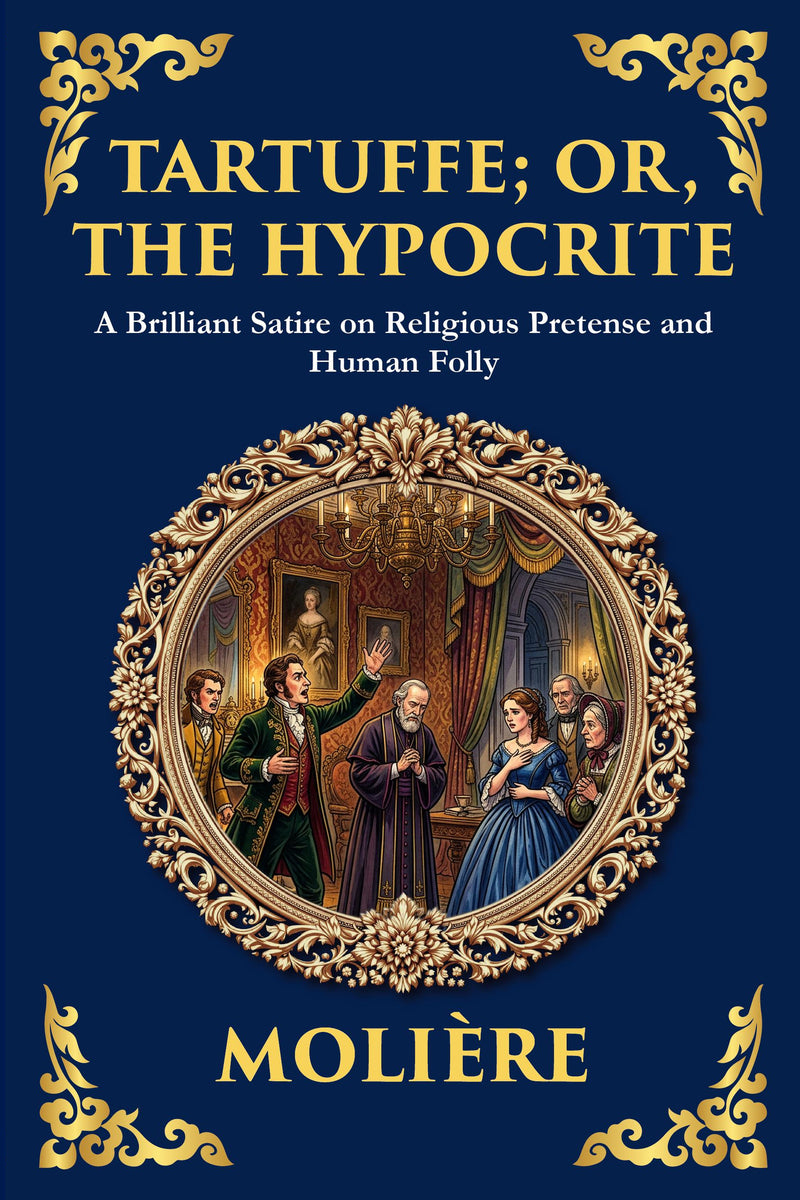
Tartuffe; Or, The Hypocrite
A master of deception. A family on the brink. A comedy that reveals the darkest truths. In Tartuffe, Molière skewers religious hypocrisy and blind devotion with razor-sharp wit and unforgettable characters.
or free app
10,000+ hrs library
30-day guarantee
The complete Tartuffe; Or, The Hypocrite appears in modern English through Library of Alexandria Press, available online with audiobook narration included for members.
Have you ever wondered why some of the most dangerous lies are told in the name of virtue? In Tartuffe; Or, The Hypocrite, Molière unveils a world where trust is manipulated, piety is feigned, and folly rules the day. First performed in 1664—and immediately censored by the powerful religious elite—Tartuffe stands as one of the most daring theatrical works in literary history.
A satire so sharp it was banned for offending the powerful, yet so clever that it became a timeless classic. The play follows the wealthy but naïve Orgon, who invites Tartuffe—a seemingly devout and humble man—into his home. Blinded by Tartuffe’s facade of holiness, Orgon ignores the warnings of his family, granting this manipulative stranger control over his wealth, household, and even his daughter’s hand in marriage.
As the deception grows, so does the absurdity—until the illusion shatters in a climax both hilarious and profound. This modern edition brings Molière’s sharp language and social insight into vivid clarity, making his 17th-century masterpiece accessible and compelling for contemporary readers. Tartuffe is more than a farce—it’s a brilliant mirror held up to those who exploit faith for personal gain.
What you’ll discover in this modern edition
- A Timeless Comedy of Deception and Delusion – Experience one of the greatest theatrical satires ever written.
- A Scathing Attack on Hypocrisy – Unmask the dangers of religious manipulation and false virtue.
- A Modern, Accessible Translation – Faithfully adapted to preserve Molière’s wit and rhythm for today’s audience.
- Laughter with a Purpose – A hilarious tale that exposes serious truths about morality, power, and trust.
| Formats | eBook (EPUB + PDF) · Audiobook · Paperback · Hardcover · Large Print |
| Language | English |
| Trim size (print) | 6 × 9 in |
| Binding | Paperback — perfect-bound · Hardcover — casewrap |
| Large Print edition | Same text in a larger, easy-read type — a larger font, not a larger trim |
| Print pricing | Every physical book at our true cost — at-cost, no profit (members) |
| Library | 873 restored titles, always growing |
| Length | 15,712 words · ~1 hr 3 min reading |
| Reading level | Grade 7 · an easy, flowing read (this modern-English edition) |
| Edition | Modern English translation · 2026 |
Member reviews for this edition are collected as readers finish it — be the first. Across the library: 12,000+ books shipped, every plan covered by a 365-day print guarantee.
About this edition
A faithful, unabridged modern-English edition by The Library of Alexandria — carefully rendered for today's reader and verified paragraph-by-paragraph against the public-domain source. Available as eBook, audiobook, paperback, hardcover, and large print.
- Complete & unabridgedVerified paragraph by paragraph against the source — never a scan, never abridged.
- Modern English, faithfulReadable today, with the author’s meaning kept intact. Readable — not simplified.
- Every format, one membershipRead in your browser or the free app, or listen to the full audiobook.
Included free with your membership
Cancel anytime, one click · 30-day money-back guarantee
Edition last updated July 2026
What’s inside
Tartuffe; Or, The Hypocrite — complete and unabridged: all 33 sections included with membership, plus the full audiobook.
Begin reading Tartuffe; Or, The Hypocrite
In clear modern English — the complete text is included with membership.
Introduction
Few plays in the history of theater have ignited such fierce controversy, endured such determined suppression, and emerged so gloriously triumphant as the work you are about to read. When Molière first presented this comedy to the court of Louis XIV in 1664, he could scarcely have anticipated the storm it would unleash. Within days, powerful factions had mobilized against it. Religious authorities denounced it from their pulpits. The Archbishop of Paris threatened excommunication to anyone who dared to perform, watch, or even read it. For five long years, the playwright fought to bring his creation before the public, revising, defending, petitioning, and refusing to abandon what he believed to be a work of genuine moral purpose. That a single comedy could provoke such an extraordinary reaction tells us something essential about its power. It struck a nerve. It exposed something that many people would have much preferred to keep hidden.
The reason for this furor was not, as the play’s enemies claimed, an attack on religion or piety. Molière was no enemy of faith. What he targeted with surgical precision was something far more dangerous and far more universal: the abuse of sacred things for selfish ends, the cynical performance of virtue as a means of acquiring power, wealth, and control over others. The figure at the center of this drama is one of literature’s most unforgettable creations, a man who has draped himself in the language and gestures of holiness while pursuing the basest of human appetites. He is a fraud of monumental proportions, yet he is also disturbingly persuasive, and the household he infiltrates falls under his spell with a completeness that is both comic and terrifying to behold.
What makes this satire so enduring is precisely that it does not concern itself merely with one corrupt era or one particular brand of religious cant. The phenomenon Molière exposes is timeless. In every age and in every society, there have been those who recognize that the appearance of goodness can be more profitable than goodness itself, who understand that a reputation for piety opens doors that honest dealing keeps closed. Such people learn to mimic the outward signs of virtue while their hearts remain entirely devoted to their own advancement. They speak the right words, adopt the right postures, and cultivate the right associations, all while pursuing ends that would horrify their admirers if those ends were ever exposed. The play asks a question that has lost none of its urgency: how do we tell the genuine from the counterfeit? How do we distinguish authentic devotion from its skillful imitation, when the imitation has been so carefully crafted to resemble the real thing?
This is a comedy of deception, but it is also a comedy of self-deception. The figures who are most thoroughly taken in by the central impostor are not stupid people, nor are they wicked. They are, in many cases, well-meaning individuals who have allowed their better instincts to be exploited. They want to believe in goodness, and that very desire becomes the instrument of their undoing. There is a profound psychological truth at work here that elevates the play far above simple farce. Molière understood that we are most vulnerable to manipulation not through our vices but through our virtues, that the wish to do right can blind us to the manipulations of those who exploit that wish. The household that admits this dangerous guest does so out of a misguided form of generosity, and watching the consequences unfold is to witness a kind of slow-motion catastrophe in which the audience can see the disaster approaching long before the characters can.
The structure of the comedy is itself a masterclass in dramatic craftsmanship. Molière withholds the appearance of his title character with extraordinary patience. For two entire acts, we hear about this man, we observe the violent disagreements he provokes among the members of a single family, we form an increasingly vivid picture of his influence, but we do not actually meet him. By the time he finally steps onto the stage, our anticipation has been wound to an almost unbearable pitch. This delay is not an accident or a flaw; it is a deliberate and brilliant technique. By the time the impostor appears, we already understand exactly how he operates, because we have seen his effect upon the household so clearly that his actual presence becomes a kind of confirmation. The man we have imagined is given flesh, and the reality proves every bit as repellent and fascinating as the reports had suggested.
To appreciate fully the achievement of this play, it helps to understand something of the man who wrote it and the world in which he worked. Molière, whose real name was Jean-Baptiste Poquelin, was the son of a prosperous upholsterer who held an official position in the royal household. By all conventional expectations, the young man should have inherited his father’s comfortable trade and lived a respectable, unremarkable life. Instead, he turned his back on security and chose the precarious, often disreputable existence of an actor and theatrical manager. In the seventeenth century, this was no minor rebellion. Actors occupied a marginal position in society, frequently condemned by the Church and denied the ordinary sacraments. To choose this life was to choose the company of vagabonds and outcasts, to accept a measure of social stigma that would follow a person to the grave and even beyond it.
For years, Molière and his troupe struggled in the provinces, traveling from town to town, performing in tennis courts and makeshift theaters, learning their craft through endless practice and the unforgiving education of audiences who would not pay for mediocrity. These years of hardship and apprenticeship gave Molière an intimate knowledge of human nature and a profound understanding of what made people laugh, what moved them, what held their attention. He absorbed the traditions of the Italian commedia dell’arte, with its stock characters and improvised comedy, and he combined these popular elements with the classical learning he had acquired in his education. When at last he won the favor of the king and established himself in Paris, he brought with him this rich and varied inheritance, fusing high and low, refined wit and broad physical comedy, into something entirely his own.
It is important to remember that Molière wrote his plays not as a detached literary author working in isolation but as a working man of the theater, an actor who performed in his own productions and a manager responsible for the livelihood of his company. He knew his actors intimately, wrote roles to suit their particular gifts, and tested his comedies against the immediate response of living audiences. This practical, hands-on relationship with the stage permeates everything he wrote. His plays are not closet dramas meant only to be read; they are scripts for performance, alive with the rhythms of speech, the possibilities of gesture, and the dynamics of human interaction. Even on the page, one can sense the theatrical energy crackling through every scene, the careful orchestration of entrances and exits, the building of tension and the explosive release of laughter.
The age in which Molière wrote was one of remarkable cultural brilliance, the golden age of French classicism under the reign of Louis XIV. The Sun King had gathered around him the most gifted artists, writers, and thinkers of his realm, and the court at Versailles became a stage upon which the drama of power was performed with elaborate ceremony. It was an era obsessed with appearances, with manners, with the careful calibration of social conduct. In such a world, the gap between what people seemed to be and what they actually were became a subject of endless fascination, and no writer explored that gap more incisively than Molière. His great comedies hold up a mirror to the society around him, reflecting its pretensions, its hypocrisies, and its follies with a clarity that proved deeply uncomfortable to many of his contemporaries.
The king himself, however, recognized and protected Molière’s genius. The relationship between the playwright and his royal patron was one of the most consequential artistic alliances of the period. When the enemies of this particular play mounted their campaign of suppression, it was ultimately the support of Louis XIV that allowed the work to survive. The king understood, perhaps better than the offended clergy, that satire directed against hypocrisy was not the same as satire directed against faith. He grasped that Molière’s target was the false believer, not the true one, the manipulator who exploited religion rather than religion itself. This royal protection was no small thing, for without it the play might well have been lost to history, suppressed and forgotten, its author hounded into silence.
Molière’s comic method deserves particular attention, because it is the engine that drives this play and all his greatest works. His characters are frequently defined by a single dominant trait, an obsession or a folly that has come to govern their entire being. There is something almost monstrous about the way these obsessions take over a personality, crowding out reason, distorting judgment, and leading the afflicted person into ever more absurd and self-destructive behavior. Yet Molière never reduces his characters to mere abstractions or simple targets of ridicule. They remain recognizably human, and their follies are exaggerated versions of weaknesses that we recognize in ourselves and in those around us. The comedy arises precisely from this recognition, from the uncomfortable awareness that we are laughing at exaggerated portraits of failings to which we ourselves are not immune.
This particular play features one of the most remarkable examples of such a comic obsession, not in the impostor himself, who is fully aware of his own fraudulence, but in the man who falls so completely under his spell. Here is a figure whose infatuation with his counterfeit holy man reaches such heights of absurdity that he is willing to sacrifice everything and everyone he ought to hold dear. His blindness is comic, but it is also frightening, because it shows how thoroughly a person can be led astray when they surrender their own judgment to another. The dynamic between the deceiver and the deceived forms the central engine of the drama, and Molière extracts from it both uproarious comedy and a chilling meditation on the dangers of credulity.
This edition presents the work in a modern translation, adapted for the contemporary reader, and a word about what this means may help you to approach the text with appropriate expectations and an open mind. Molière wrote in French, and much of his original was composed in rhymed verse, a form that lent the dialogue a particular music and elegance. Any translation must make difficult choices about how to convey the spirit and meaning of the original in another language, and a modern adaptation goes further still, seeking to render the comedy accessible and immediate to readers who live in a very different world from that of seventeenth-century France. The aim is not to dilute or simplify Molière’s genius but to remove the barriers of archaic language and obscure reference that might otherwise stand between the modern reader and the full enjoyment of this remarkable work.
What you will discover, I think, is that the essential power of the play translates across the centuries with astonishing ease. The reason for this is simple: the human types that Molière portrayed have not disappeared. We still know the smooth-talking manipulator who exploits the trust of others. We still encounter the gullible enthusiast who falls for an obvious fraud. We still recognize the clear-sighted observer whose warnings go unheeded, the family torn apart by a dangerous outside influence, the servant whose plain common sense cuts through the pretensions of her supposed betters. These figures populate our own lives, our own news headlines, our own experience of the world. The con artist who poses as a guru, the charlatan who builds an empire on false promises, the charismatic figure who persuades intelligent people to abandon their own judgment, these are not relics of a vanished age but permanent features of human society.
Cancel anytime, one click · 30-day money-back guarantee
Founding annual rate available now — your price locks for life when you join.
Not ready? Get this free chapter by email — read it anytime.
✓ Sent — check your inbox for Tartuffe; Or, The Hypocrite.
Questions about Tartuffe; Or, The Hypocrite
What is Tartuffe; Or, The Hypocrite about?
A master of deception. A family on the brink. A comedy that reveals the darkest truths.
Who wrote Tartuffe; Or, The Hypocrite?
Tartuffe; Or, The Hypocrite was written by Molière. This edition presents the complete work in clear modern English, faithfully rendered from the public-domain original by Library of Alexandria Press.
Is Tartuffe; Or, The Hypocrite free to read?
The opening chapter is free to read on this page. Members read and listen to the complete work — and the entire library — free, and can order any physical book at our true print cost.
How long is Tartuffe; Or, The Hypocrite?
33 chapters (~15,712 words) — about 1 hr 3 min of reading in this modern-English edition.
Is this an abridged version of Tartuffe; Or, The Hypocrite?
No. This is the complete, unabridged Tartuffe; Or, The Hypocrite, carefully rendered into clear modern English and verified paragraph-by-paragraph against the public-domain source — nothing is cut or summarised.
What formats does Tartuffe; Or, The Hypocrite come in?
Tartuffe; Or, The Hypocrite is available as eBook, paperback, hardcover and large print. eBook and audiobook are included with membership; printed editions ship at our true print cost.
Shipping & returns
Billing & membership
More from the library


Explore Poetry & Drama
- As You Like It · William Shakespeare
- The Raven · Edgar Allan Poe
- The Merchant of Venice · William Shakespeare
- A Midsummer Night’s Dream · William Shakespeare
- Romeo and Juliet · William Shakespeare
- The Imaginary Invalid · Molière
- A Woman of No Importance · Oscar Wilde
- Gitanjali · Rabindranath Tagore
- Sonnets from the Portuguese · Elizabeth Barrett Browning
- The New Life (La Vita Nuova) · Dante Alighieri
- The Rime of the Ancient Mariner · Samuel Taylor Coleridge
- Lady Windermere’s Fan · Oscar Wilde
- The Home Book of Verse — Volume 4 · Burton Egbert Stevenson
- Ghosts · Henrik Ibsen
- Mrs. Warren’s Profession · Bernard Shaw
- An Enemy of the People · Henrik Ibsen
- Gawayne and the Green Knight: A Fairy Tale · Charlton M. Lewis
- The Nibelungenlied · G. H. Needler
- Julius Caesar · William Shakespeare
- The Aeneid of Virgil · Virgil
- Troilus and Criseyde · Geoffrey Chaucer
- The Post Office · Rabindranath Tagore
- Lamia · John Keats
- The Ballad of the White Horse · G. K. Chesterton
- A Shropshire Lad · A. E. Housman
- The Birth of the War-God: A Poem by Kalidasa · Kálidása
- Riders to the Sea · J. M. Synge
- The Prophet · Kahlil Gibran
- Twelfth Night; Or, What You Will · William Shakespeare
- Othello, the Moor of Venice · William Shakespeare
Tartuffe; Or, The Hypocrite
Tartuffe; Or, The Hypocrite
A Brilliant Satire on Religious Pretense and Human Folly
Molière
Contents
- Introduction
- Cast of Characters
- Act 1, Scene 1
- Act 1, Scene 2
- Act 1, Scene 3
- Act 1, Scene 4
- Act 1, Scene 5
- Act 2, Scene 1
- Act 2, Scene 2
- Act 2, Scene 3
- Act 2, Scene 4
- Act 3, Scene 1
- Act 3, Scene 2
- Act 3, Scene 3
- Act 3, Scene 4
- Act 3, Scene 5
- Act 3, Scene 6
- Act 3, Scene 7
- Act 4, Scene 1
- Act 4, Scene 2
- Act 4, Scene 3
- Act 4, Scene 4
- Act 4, Scene 5
- Act 4, Scene 6
- Act 4, Scene 7
- Act 4, Scene 8
- Act 5, Scene 1
- Act 5, Scene 2
- Act 5, Scene 3
- Act 5, Scene 4
- Act 5, Scene 5
- Act 5, Scene 6
- Act 5, Scene 7
Introduction
Few plays in the history of theater have ignited such fierce controversy, endured such determined suppression, and emerged so gloriously triumphant as the work you are about to read. When Molière first presented this comedy to the court of Louis XIV in 1664, he could scarcely have anticipated the storm it would unleash. Within days, powerful factions had mobilized against it. Religious authorities denounced it from their pulpits. The Archbishop of Paris threatened excommunication to anyone who dared to perform, watch, or even read it. For five long years, the playwright fought to bring his creation before the public, revising, defending, petitioning, and refusing to abandon what he believed to be a work of genuine moral purpose. That a single comedy could provoke such an extraordinary reaction tells us something essential about its power. It struck a nerve. It exposed something that many people would have much preferred to keep hidden.
The reason for this furor was not, as the play’s enemies claimed, an attack on religion or piety. Molière was no enemy of faith. What he targeted with surgical precision was something far more dangerous and far more universal: the abuse of sacred things for selfish ends, the cynical performance of virtue as a means of acquiring power, wealth, and control over others. The figure at the center of this drama is one of literature’s most unforgettable creations, a man who has draped himself in the language and gestures of holiness while pursuing the basest of human appetites. He is a fraud of monumental proportions, yet he is also disturbingly persuasive, and the household he infiltrates falls under his spell with a completeness that is both comic and terrifying to behold.
What makes this satire so enduring is precisely that it does not concern itself merely with one corrupt era or one particular brand of religious cant. The phenomenon Molière exposes is timeless. In every age and in every society, there have been those who recognize that the appearance of goodness can be more profitable than goodness itself, who understand that a reputation for piety opens doors that honest dealing keeps closed. Such people learn to mimic the outward signs of virtue while their hearts remain entirely devoted to their own advancement. They speak the right words, adopt the right postures, and cultivate the right associations, all while pursuing ends that would horrify their admirers if those ends were ever exposed. The play asks a question that has lost none of its urgency: how do we tell the genuine from the counterfeit? How do we distinguish authentic devotion from its skillful imitation, when the imitation has been so carefully crafted to resemble the real thing?
This is a comedy of deception, but it is also a comedy of self-deception. The figures who are most thoroughly taken in by the central impostor are not stupid people, nor are they wicked. They are, in many cases, well-meaning individuals who have allowed their better instincts to be exploited. They want to believe in goodness, and that very desire becomes the instrument of their undoing. There is a profound psychological truth at work here that elevates the play far above simple farce. Molière understood that we are most vulnerable to manipulation not through our vices but through our virtues, that the wish to do right can blind us to the manipulations of those who exploit that wish. The household that admits this dangerous guest does so out of a misguided form of generosity, and watching the consequences unfold is to witness a kind of slow-motion catastrophe in which the audience can see the disaster approaching long before the characters can.
The structure of the comedy is itself a masterclass in dramatic craftsmanship. Molière withholds the appearance of his title character with extraordinary patience. For two entire acts, we hear about this man, we observe the violent disagreements he provokes among the members of a single family, we form an increasingly vivid picture of his influence, but we do not actually meet him. By the time he finally steps onto the stage, our anticipation has been wound to an almost unbearable pitch. This delay is not an accident or a flaw; it is a deliberate and brilliant technique. By the time the impostor appears, we already understand exactly how he operates, because we have seen his effect upon the household so clearly that his actual presence becomes a kind of confirmation. The man we have imagined is given flesh, and the reality proves every bit as repellent and fascinating as the reports had suggested.
To appreciate fully the achievement of this play, it helps to understand something of the man who wrote it and the world in which he worked. Molière, whose real name was Jean-Baptiste Poquelin, was the son of a prosperous upholsterer who held an official position in the royal household. By all conventional expectations, the young man should have inherited his father’s comfortable trade and lived a respectable, unremarkable life. Instead, he turned his back on security and chose the precarious, often disreputable existence of an actor and theatrical manager. In the seventeenth century, this was no minor rebellion. Actors occupied a marginal position in society, frequently condemned by the Church and denied the ordinary sacraments. To choose this life was to choose the company of vagabonds and outcasts, to accept a measure of social stigma that would follow a person to the grave and even beyond it.
For years, Molière and his troupe struggled in the provinces, traveling from town to town, performing in tennis courts and makeshift theaters, learning their craft through endless practice and the unforgiving education of audiences who would not pay for mediocrity. These years of hardship and apprenticeship gave Molière an intimate knowledge of human nature and a profound understanding of what made people laugh, what moved them, what held their attention. He absorbed the traditions of the Italian commedia dell’arte, with its stock characters and improvised comedy, and he combined these popular elements with the classical learning he had acquired in his education. When at last he won the favor of the king and established himself in Paris, he brought with him this rich and varied inheritance, fusing high and low, refined wit and broad physical comedy, into something entirely his own.
It is important to remember that Molière wrote his plays not as a detached literary author working in isolation but as a working man of the theater, an actor who performed in his own productions and a manager responsible for the livelihood of his company. He knew his actors intimately, wrote roles to suit their particular gifts, and tested his comedies against the immediate response of living audiences. This practical, hands-on relationship with the stage permeates everything he wrote. His plays are not closet dramas meant only to be read; they are scripts for performance, alive with the rhythms of speech, the possibilities of gesture, and the dynamics of human interaction. Even on the page, one can sense the theatrical energy crackling through every scene, the careful orchestration of entrances and exits, the building of tension and the explosive release of laughter.
The age in which Molière wrote was one of remarkable cultural brilliance, the golden age of French classicism under the reign of Louis XIV. The Sun King had gathered around him the most gifted artists, writers, and thinkers of his realm, and the court at Versailles became a stage upon which the drama of power was performed with elaborate ceremony. It was an era obsessed with appearances, with manners, with the careful calibration of social conduct. In such a world, the gap between what people seemed to be and what they actually were became a subject of endless fascination, and no writer explored that gap more incisively than Molière. His great comedies hold up a mirror to the society around him, reflecting its pretensions, its hypocrisies, and its follies with a clarity that proved deeply uncomfortable to many of his contemporaries.
The king himself, however, recognized and protected Molière’s genius. The relationship between the playwright and his royal patron was one of the most consequential artistic alliances of the period. When the enemies of this particular play mounted their campaign of suppression, it was ultimately the support of Louis XIV that allowed the work to survive. The king understood, perhaps better than the offended clergy, that satire directed against hypocrisy was not the same as satire directed against faith. He grasped that Molière’s target was the false believer, not the true one, the manipulator who exploited religion rather than religion itself. This royal protection was no small thing, for without it the play might well have been lost to history, suppressed and forgotten, its author hounded into silence.
Molière’s comic method deserves particular attention, because it is the engine that drives this play and all his greatest works. His characters are frequently defined by a single dominant trait, an obsession or a folly that has come to govern their entire being. There is something almost monstrous about the way these obsessions take over a personality, crowding out reason, distorting judgment, and leading the afflicted person into ever more absurd and self-destructive behavior. Yet Molière never reduces his characters to mere abstractions or simple targets of ridicule. They remain recognizably human, and their follies are exaggerated versions of weaknesses that we recognize in ourselves and in those around us. The comedy arises precisely from this recognition, from the uncomfortable awareness that we are laughing at exaggerated portraits of failings to which we ourselves are not immune.
This particular play features one of the most remarkable examples of such a comic obsession, not in the impostor himself, who is fully aware of his own fraudulence, but in the man who falls so completely under his spell. Here is a figure whose infatuation with his counterfeit holy man reaches such heights of absurdity that he is willing to sacrifice everything and everyone he ought to hold dear. His blindness is comic, but it is also frightening, because it shows how thoroughly a person can be led astray when they surrender their own judgment to another. The dynamic between the deceiver and the deceived forms the central engine of the drama, and Molière extracts from it both uproarious comedy and a chilling meditation on the dangers of credulity.
This edition presents the work in a modern translation, adapted for the contemporary reader, and a word about what this means may help you to approach the text with appropriate expectations and an open mind. Molière wrote in French, and much of his original was composed in rhymed verse, a form that lent the dialogue a particular music and elegance. Any translation must make difficult choices about how to convey the spirit and meaning of the original in another language, and a modern adaptation goes further still, seeking to render the comedy accessible and immediate to readers who live in a very different world from that of seventeenth-century France. The aim is not to dilute or simplify Molière’s genius but to remove the barriers of archaic language and obscure reference that might otherwise stand between the modern reader and the full enjoyment of this remarkable work.
What you will discover, I think, is that the essential power of the play translates across the centuries with astonishing ease. The reason for this is simple: the human types that Molière portrayed have not disappeared. We still know the smooth-talking manipulator who exploits the trust of others. We still encounter the gullible enthusiast who falls for an obvious fraud. We still recognize the clear-sighted observer whose warnings go unheeded, the family torn apart by a dangerous outside influence, the servant whose plain common sense cuts through the pretensions of her supposed betters. These figures populate our own lives, our own news headlines, our own experience of the world. The con artist who poses as a guru, the charlatan who builds an empire on false promises, the charismatic figure who persuades intelligent people to abandon their own judgment, these are not relics of a vanished age but permanent features of human society.
Madame Pernelle and her servant Flipote, Elmire, Mariane, Dorine, Damis, Cleante
Mme. Pernelle: Let’s go, Flipote, let’s go. I can’t stand this place.
Elmire: I can’t keep up; you’re walking too fast.
Mme. Pernelle: Stop it, my dear, just stop; don’t come any further.
Elmire: I insist on doing what my duty requires.
But mother, why are you leaving in such a hurry?
Mme. Pernelle. I just can’t stand how this house is run...
Oh yes, I’m leaving this house completely dissatisfied
Because all my wise advice has been ignored...
Nobody respects me, and everyone just shouts,
Honestly, this place is a haven for idiots!
Mme. Pernelle. You, my dear, are a bold girl,
Always sticking your nose in everything to give your opinion.
Mme. Pernelle. And you, grandson, are a complete fool.
As your grandmother, I’m officially declaring it:
That you’ll end up as a useless waste of space,
Mme. Pernelle. And his sister! You act so discreet,
But still waters run deep—and usually dirty,
And your sneakiness honestly disgusts me.
Mme. Pernelle. Daughter, my opinions might annoy you,
But your behavior in everything is just wrong.
You should be setting an example for your family;
Their late mother was much better at that.
You spend too much money, and it hurts me, I think,
To see you strutting around dressed like a princess.
A woman who only wants to please her husband,
Dear daughter, doesn’t need to primp and preen so much.
Mme. Pernelle. As for you and your brother,
I would tell you to leave this house immediately.
You never stop preaching your rules and slogans,
Things that decent people would never actually do.
I’m being blunt, but that’s just who I am;
End of the free sample
Keep reading, free
Members read and listen to the complete book — and the entire library. Cancel anytime, one click · 30-day money-back guarantee.