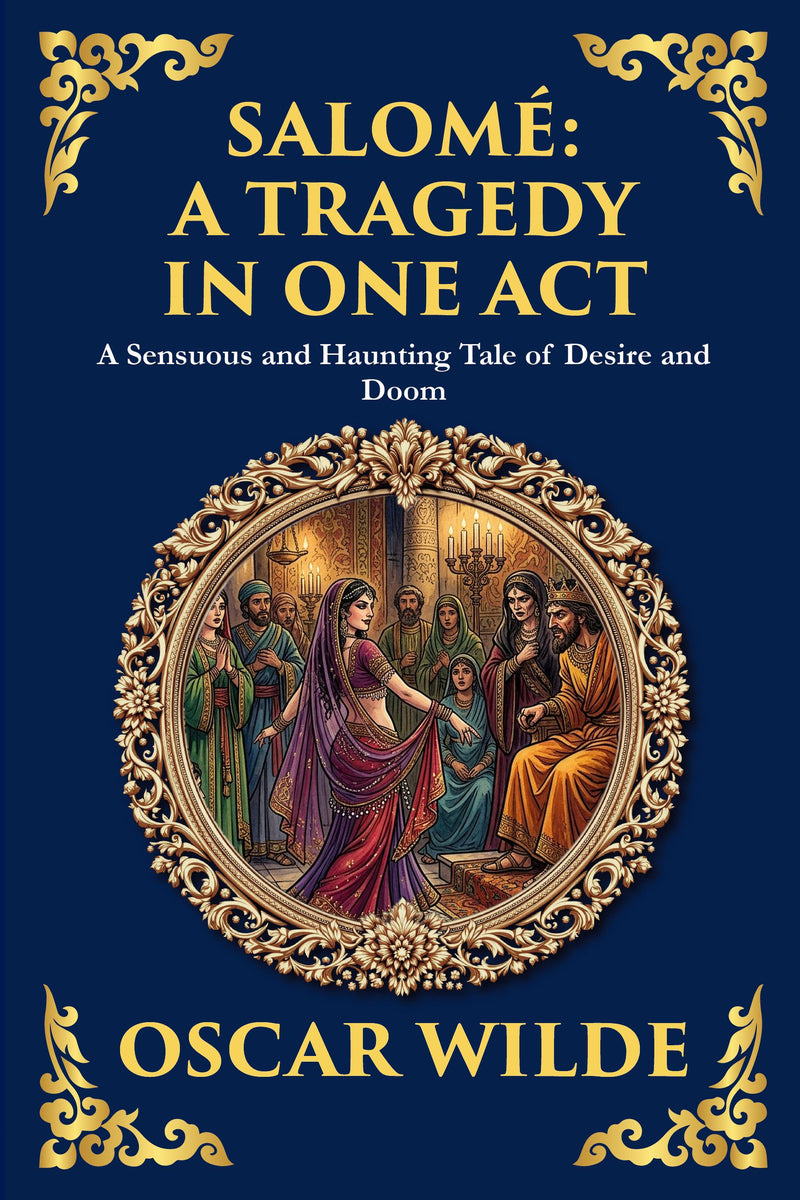
Salomé: A Tragedy in One Act — Large Print
Wickedly beautiful, poetically hypnotic, and disturbingly tragic—Salomé is Oscar Wilde’s most haunting drama, where beauty becomes a curse and desire turns deadly.
or free app
10,000+ hrs library
30-day guarantee
The complete Salomé: A Tragedy in One Act appears in modern English through Library of Alexandria Press, available online with audiobook narration included for members.
Have you ever wondered why desire, once unleashed, can become its own form of destruction? Oscar Wilde’s Salomé is a singular theatrical experience—an exquisite one-act tragedy that blends biblical legend with sensual poetry, Eastern mysticism, and the dark undercurrents of fin- de-siècle decadence. Written originally in French and banned from the English stage in its time, Salomé tells the story of Herod’s stepdaughter who, enthralled by her lust for the prophet Iokanaan (John the Baptist), spirals into a seductive madness that culminates in one of literature’s most iconic and macabre finales.
This modern edition restores Wilde’s original language in a clean, accessible format that preserves the rhythmic intensity and rich imagery of the play. From the moon-drenched terrace of Herod’s palace to the shocking final tableau, Salomé is a descent into obsession, gendered power, and the lethal nature of unrestrained desire.
What you’ll discover in this modern edition
- A Masterpiece of Symbolist Theater – Explore Wilde’s poetic treatment of passion, madness, and mortality through surreal, evocative dialogue.
- A Dark Reimagining of a Biblical Tale – Witness the transformation of Salomé from historical footnote to mythic archetype.
- Themes of Gender, Power, and Objectification – Examine the interplay of control, lust, and voice in a world where women are seen but silenced.
- An Accessible Modern Edition – Designed for today’s readers and performers, this version retains Wilde’s rhythm and beauty while enhancing readability.
- A Timeless Tragedy of Beauty and Death – For readers of drama, poetry, mythology, and literary erotica, this is a text that both stuns and endures.
| Formats | eBook (EPUB + PDF) · Audiobook · Paperback · Hardcover · Large Print |
| Language | English |
| Trim size (print) | 6 × 9 in |
| Binding | Paperback — perfect-bound · Hardcover — casewrap |
| Large Print edition | Same text in a larger, easy-read type — a larger font, not a larger trim |
| Print pricing | Every physical book at our true cost — at-cost, no profit (members) |
| Library | 873 restored titles, always growing |
| Length | 13,931 words · ~56 min reading |
| Reading level | Grade 4 · an easy, flowing read (this modern-English edition) |
| Edition | Modern English translation · 2026 |
Member reviews for this edition are collected as readers finish it — be the first. Across the library: 12,000+ books shipped, every plan covered by a 365-day print guarantee.
About this edition
A faithful, unabridged modern-English edition by The Library of Alexandria — carefully rendered for today's reader and verified paragraph-by-paragraph against the public-domain source. Available as eBook, audiobook, paperback, hardcover, and large print.
- Complete & unabridgedVerified paragraph by paragraph against the source — never a scan, never abridged.
- Modern English, faithfulReadable today, with the author’s meaning kept intact. Readable — not simplified.
- Every format, one membershipRead in your browser or the free app, or listen to the full audiobook.
Included free with your membership
Cancel anytime, one click · 30-day money-back guarantee
Edition last updated July 2026
What’s inside
Salomé: A Tragedy in One Act — Large Print — complete and unabridged: all 5 sections included with membership, plus the full audiobook.
Begin reading Salomé: A Tragedy in One Act — Large Print
In clear modern English — the complete text is included with membership.
Introduction
There are works of art that arrive into the world quietly, gathering admirers over decades, and there are others that detonate on contact—scandalizing, electrifying, and refusing ever to be ignored. Oscar Wilde’s Salomé belongs emphatically to the second category. Conceived in French by an Irishman at the height of his powers, banned from the English stage before it could even be performed, illustrated by an artist whose drawings became as notorious as the play itself, and ultimately woven into the tragic biography of its author, Salomé has never had an ordinary existence. It is a work that seems to vibrate with a strange, feverish life of its own, a single act of poetry and menace that compresses obsession, beauty, and destruction into the span of a single moonlit night.
To open this play is to step into a world unlike any other in Wilde’s catalogue. Readers who know him chiefly through the glittering drawing-room comedies—The Importance of Being Earnest, Lady Windermere’s Fan, An Ideal Husband—may be startled to discover here a writer working in an entirely different register. Gone are the epigrams traded across teacups, the impeccable wit, the gentle social satire. In their place is something darker, more incantatory, and far more dangerous. This is Wilde the aesthete, Wilde the poet of decadence, Wilde reaching toward the sublime and the terrifying with both hands. The result is a small masterpiece of mood and atmosphere, a tragedy that lingers in the imagination long after the final, devastating line has been spoken.
This modern translation has been prepared with the contemporary reader firmly in mind. The play’s complex origins—written first in French, then rendered into English—have meant that English-speaking readers have long encountered Salomé through a veil of slightly archaic phrasing. The intention here is to honor the original’s haunting cadences and ritualistic repetitions while ensuring that nothing stands between you and the raw power of the drama. The aim is not to simplify Wilde but to clarify him, to let his strange music ring as clearly for a reader today as it did for those first daring audiences who dared to seek the play out. What you hold is meant to be read with pleasure and ease, yet without sacrificing the incantatory beauty that makes this work so unforgettable.
A Forbidden Play and Its Astonishing Origins
The story of how Salomé came to be written is nearly as dramatic as the play itself. In the early 1890s, Wilde was at the dazzling summit of his fame. London adored him; his plays packed theatres; his conversation was legendary; his every public appearance was an event. And yet, restless and ambitious, he longed to produce something that would establish him not merely as a celebrated wit but as a serious artist, a poet capable of the highest flights of literary creation. He chose to write Salomé in French—a remarkable decision for a man whose native language was English and whose mastery of it was the foundation of his reputation.
Why French? Wilde offered various explanations, but the deepest reason seems to have been aesthetic. He was steeped in the French Symbolist movement, in the writings of authors like Maurice Maeterlinck and Stéphane Mallarmé, whose work prized suggestion over statement, atmosphere over action, and the musical properties of language above all. French gave Wilde a certain distance from his usual instruments, a fresh medium in which he could pursue effects he could not have achieved in his everyday tongue. The repetitions, the chiming refrains, the slow accumulation of imagery—all of these owe a debt to the Symbolist aesthetic, and writing in French allowed Wilde to channel that influence directly.
The play was completed and intended for the London stage, with the legendary actress Sarah Bernhardt herself preparing to take the title role. Rehearsals were actually underway when disaster struck. The Lord Chamberlain’s office, which then exercised censorship over British theatre, refused to license the production. The reason was an obscure but absolute law forbidding the depiction of biblical characters on stage—a rule originally intended to prevent the irreverent treatment of sacred subjects. Wilde was furious. He threatened, in a fit of pique, to renounce his British citizenship and become French. The play was published in its original French in 1893, and an English translation appeared in 1894, but Salomé would not be performed in England in Wilde’s lifetime. Its first public performances took place abroad, in Paris and elsewhere, while in England it remained a forbidden, almost mythical text—a book read in private, passed among admirers, whispered about.
This history of suppression has shaped the play’s reputation ever since. Salomé became something more than a piece of literature; it became a symbol of artistic freedom pitted against the forces of censorship and convention. The very prohibition that kept it from the stage lent it an aura of the dangerous and the illicit, an aura that has never entirely faded. To read it today is to participate, in some small way, in that long tradition of seeking out the forbidden, of insisting that art has the right to explore the darkest corners of human experience.
The English edition was further transformed by the contribution of Aubrey Beardsley, the brilliant young illustrator whose black-and-white drawings accompanied the text. Beardsley’s images—sinuous, erotic, grotesque, and utterly modern—became inseparable from the play in the public imagination. They were as shocking as the drama they illustrated, sometimes more so, and they helped to fix Salomé in the cultural memory as the quintessential work of the decadent 1890s, that brief, brilliant, doomed moment in which beauty and decay were pursued with equal fervor. Though this edition presents the play in a modern translation suited to today’s reader, it is worth keeping Beardsley’s vision in mind as you read—the febrile elegance of his line is a perfect visual counterpart to Wilde’s prose.
The subject of the play—the dance, the demand, the fatal reward—comes from an ancient source, a story embedded in the Gospels and told for centuries by painters, poets, and preachers. But Wilde did something radical with this familiar material. In the traditional accounts, the young princess is little more than an instrument, a pawn manipulated by her scheming mother. Wilde inverted this entirely. In his hands, the princess becomes the central consciousness of the drama, a figure of overwhelming will and desire, the engine that drives the tragedy forward. This reimagining transformed an old tale into something startlingly new, a study of obsession and the terrible logic of unfulfilled longing. Wilde was not the only artist of his era to be fascinated by this figure—she haunted the paintings of Gustave Moreau and the imaginations of countless writers—but his version remains the most psychologically daring and the most enduringly powerful.
It is worth pausing on the particular genius of Wilde’s approach to language in this work. He builds his effects through repetition, through the obsessive return of certain images—the moon, white as a dead woman; the great black wings; the comparison of a beloved object to silver, to ivory, to roses, to pomegranates. These repeated phrases function almost like the recurring motifs of a piece of music, accumulating force and resonance with each return. Characters echo one another, restating and varying the same images, creating an atmosphere of incantation, of ritual, of a spell being slowly woven. This is not the brisk, witty dialogue of Wilde’s comedies; it is a kind of poetry, a verbal architecture designed to induce a state of heightened, almost hypnotic attention. Reading the play, one feels the slow tightening of an inexorable mechanism, the gradual gathering of an atmosphere so charged that catastrophe seems inevitable long before it arrives.
Desire, Doom, and the Beauty of the Terrible
At its heart, Salomé is a meditation on desire—desire in its most absolute and destructive form. Nearly every character in the play wants something or someone with a hunger that overrides reason, prudence, and self-preservation. There is the desire of the young Syrian captain, gazing helplessly at the princess; the desire of the Tetrarch, whose appetites are restless and unquenchable; and above all the desire of the princess herself, which, once awakened, becomes a force of nature, a will that cannot be deflected or denied. Wilde presents desire not as something tender or romantic but as something closer to a possession, a kind of madness that seizes its victims and drives them toward ruin.
This is what gives the play its peculiar intensity, its quality of fever-dream. The characters do not behave reasonably because they are past reason. They are in the grip of forces larger than themselves, and the drama unfolds with the awful inevitability of a nightmare from which one cannot wake. Wilde understood something profound about the nature of obsessive longing—that it feeds on resistance, that it grows monstrous when frustrated, that it can transform love into something indistinguishable from hatred and the wish to possess into the wish to destroy. The princess’s pursuit of the object of her desire is at once a love story and a horror story, and the line between the two dissolves entirely as the play moves toward its climax.
The setting amplifies all of this. The action takes place on a great terrace outside a banqueting hall, beneath a moon that is itself a kind of character, watched and described and interpreted by everyone who looks upon it. The moon shifts and changes throughout the play, reflecting the emotional weather of the drama—now pale and virginal, now red as blood, now hidden behind clouds. This single, looming presence in the sky gives the play a cosmic dimension, suggesting that the human passions unfolding below are somehow mirrored in the heavens, that the universe itself is implicated in the tragedy. The terrace becomes a stage in the fullest sense, a liminal space between the lighted hall and the dark night, between civilization and the wilderness, between the seen and the unseen.
There is also a powerful religious dimension to the play, though Wilde handles it with a complexity that resists easy interpretation. The figure of the prophet—the holy man whose voice rises from the cistern where he is imprisoned, denouncing the sins of the court—introduces a note of stern, otherworldly authority into the sensuous and corrupt atmosphere of the palace. His words seem to come from another realm entirely, a realm of judgment and prophecy and absolute moral certainty, and their collision with the world of appetite and intrigue generates much of the play’s electric tension. Wilde, who was himself fascinated by religion throughout his life and who converted to Catholicism on his deathbed, was deeply attuned to the strange intersections of the sacred and the profane, the holy and the carnal. Salomé is, among other things, a work about what happens when the spiritual and the sensual meet—and the meeting, in this play, is anything but peaceful.
The famous dance that occurs near the play’s climax has become one of the most celebrated moments in all of theatre, the inspiration for operas, ballets, films, and countless works of visual art. Wilde’s stage direction for this dance is brief, almost laconic, leaving the precise nature of the performance to the imagination of the director and the reader. This restraint is itself a stroke of genius. The dance is the pivot on which the entire tragedy turns, the moment at which desire is offered and a terrible price is named, and by refusing to over-describe it, Wilde allows it to remain forever mysterious, forever charged with possibility. It is a void at the center of the play into which each reader and each audience pours their own imagining. The composer Richard Strauss, who would later transform Wilde’s play into one of the most powerful operas ever written, understood the magnetic force of this scene and gave it music of unparalleled lushness and menace. But on the page, in Wilde’s spare words, the dance retains an even greater power precisely because it is left to the imagination.
Cancel anytime, one click · 30-day money-back guarantee
Founding annual rate available now — your price locks for life when you join.
Not ready? Get this free chapter by email — read it anytime.
✓ Sent — check your inbox for Salomé: A Tragedy in One Act — Large Print.
Questions about Salomé: A Tragedy in One Act — Large Print
What is Salomé: A Tragedy in One Act about?
Wickedly beautiful, poetically hypnotic, and disturbingly tragic—Salomé is Oscar Wilde’s most haunting drama, where beauty becomes a curse and desire turns deadly. In this one-act tragedy, the infamous biblical tale is reimagined with decadent symbolism and dark sensuality. Salomé, the stepdaughter of King Herod, dances not for art, but for the head of a prophet—driven by lust, rejection, and revenge.
Who wrote Salomé: A Tragedy in One Act?
Salomé: A Tragedy in One Act was written by Oscar Wilde. This edition presents the complete work in clear modern English, faithfully rendered from the public-domain original by Library of Alexandria Press.
Is Salomé: A Tragedy in One Act free to read?
The opening chapter is free to read on this page. Members read and listen to the complete work — and the entire library — free, and can order any physical book at our true print cost.
How long is Salomé: A Tragedy in One Act?
5 chapters (~13,931 words) — about 56 min of reading in this modern-English edition.
Is this an abridged version of Salomé: A Tragedy in One Act?
No. This is the complete, unabridged Salomé: A Tragedy in One Act, carefully rendered into clear modern English and verified paragraph-by-paragraph against the public-domain source — nothing is cut or summarised.
What formats does Salomé: A Tragedy in One Act come in?
Salomé: A Tragedy in One Act is available as eBook, paperback, hardcover and large print. eBook and audiobook are included with membership; printed editions ship at our true print cost.
Shipping & returns
Billing & membership
More from the library


Explore Poetry & Drama
- As You Like It · William Shakespeare
- The Raven · Edgar Allan Poe
- The Merchant of Venice · William Shakespeare
- A Midsummer Night’s Dream · William Shakespeare
- Romeo and Juliet · William Shakespeare
- The Imaginary Invalid · Molière
- A Woman of No Importance · Oscar Wilde
- Gitanjali · Rabindranath Tagore
- Sonnets from the Portuguese · Elizabeth Barrett Browning
- The New Life (La Vita Nuova) · Dante Alighieri
- The Rime of the Ancient Mariner · Samuel Taylor Coleridge
- Lady Windermere’s Fan · Oscar Wilde
- The Home Book of Verse — Volume 4 · Burton Egbert Stevenson
- Ghosts · Henrik Ibsen
- Mrs. Warren’s Profession · Bernard Shaw
- An Enemy of the People · Henrik Ibsen
- Gawayne and the Green Knight: A Fairy Tale · Charlton M. Lewis
- The Nibelungenlied · G. H. Needler
- Julius Caesar · William Shakespeare
- The Aeneid of Virgil · Virgil
- Troilus and Criseyde · Geoffrey Chaucer
- The Post Office · Rabindranath Tagore
- Lamia · John Keats
- The Ballad of the White Horse · G. K. Chesterton
- A Shropshire Lad · A. E. Housman
- The Birth of the War-God: A Poem by Kalidasa · Kálidása
- Riders to the Sea · J. M. Synge
- The Prophet · Kahlil Gibran
- Twelfth Night; Or, What You Will · William Shakespeare
- Othello, the Moor of Venice · William Shakespeare
Salomé: A Tragedy in One Act — Large Print
Salomé: A Tragedy in One Act — Large Print
A Sensuous and Haunting Tale of Desire and Doom
Oscar Wilde
Contents
- Introduction
- Chapter 1
- Chapter 2
- Chapter 3
- Chapter 4
Introduction
There are works of art that arrive into the world quietly, gathering admirers over decades, and there are others that detonate on contact—scandalizing, electrifying, and refusing ever to be ignored. Oscar Wilde’s Salomé belongs emphatically to the second category. Conceived in French by an Irishman at the height of his powers, banned from the English stage before it could even be performed, illustrated by an artist whose drawings became as notorious as the play itself, and ultimately woven into the tragic biography of its author, Salomé has never had an ordinary existence. It is a work that seems to vibrate with a strange, feverish life of its own, a single act of poetry and menace that compresses obsession, beauty, and destruction into the span of a single moonlit night.
To open this play is to step into a world unlike any other in Wilde’s catalogue. Readers who know him chiefly through the glittering drawing-room comedies—The Importance of Being Earnest, Lady Windermere’s Fan, An Ideal Husband—may be startled to discover here a writer working in an entirely different register. Gone are the epigrams traded across teacups, the impeccable wit, the gentle social satire. In their place is something darker, more incantatory, and far more dangerous. This is Wilde the aesthete, Wilde the poet of decadence, Wilde reaching toward the sublime and the terrifying with both hands. The result is a small masterpiece of mood and atmosphere, a tragedy that lingers in the imagination long after the final, devastating line has been spoken.
This modern translation has been prepared with the contemporary reader firmly in mind. The play’s complex origins—written first in French, then rendered into English—have meant that English-speaking readers have long encountered Salomé through a veil of slightly archaic phrasing. The intention here is to honor the original’s haunting cadences and ritualistic repetitions while ensuring that nothing stands between you and the raw power of the drama. The aim is not to simplify Wilde but to clarify him, to let his strange music ring as clearly for a reader today as it did for those first daring audiences who dared to seek the play out. What you hold is meant to be read with pleasure and ease, yet without sacrificing the incantatory beauty that makes this work so unforgettable.
A Forbidden Play and Its Astonishing Origins
The story of how Salomé came to be written is nearly as dramatic as the play itself. In the early 1890s, Wilde was at the dazzling summit of his fame. London adored him; his plays packed theatres; his conversation was legendary; his every public appearance was an event. And yet, restless and ambitious, he longed to produce something that would establish him not merely as a celebrated wit but as a serious artist, a poet capable of the highest flights of literary creation. He chose to write Salomé in French—a remarkable decision for a man whose native language was English and whose mastery of it was the foundation of his reputation.
Why French? Wilde offered various explanations, but the deepest reason seems to have been aesthetic. He was steeped in the French Symbolist movement, in the writings of authors like Maurice Maeterlinck and Stéphane Mallarmé, whose work prized suggestion over statement, atmosphere over action, and the musical properties of language above all. French gave Wilde a certain distance from his usual instruments, a fresh medium in which he could pursue effects he could not have achieved in his everyday tongue. The repetitions, the chiming refrains, the slow accumulation of imagery—all of these owe a debt to the Symbolist aesthetic, and writing in French allowed Wilde to channel that influence directly.
The play was completed and intended for the London stage, with the legendary actress Sarah Bernhardt herself preparing to take the title role. Rehearsals were actually underway when disaster struck. The Lord Chamberlain’s office, which then exercised censorship over British theatre, refused to license the production. The reason was an obscure but absolute law forbidding the depiction of biblical characters on stage—a rule originally intended to prevent the irreverent treatment of sacred subjects. Wilde was furious. He threatened, in a fit of pique, to renounce his British citizenship and become French. The play was published in its original French in 1893, and an English translation appeared in 1894, but Salomé would not be performed in England in Wilde’s lifetime. Its first public performances took place abroad, in Paris and elsewhere, while in England it remained a forbidden, almost mythical text—a book read in private, passed among admirers, whispered about.
This history of suppression has shaped the play’s reputation ever since. Salomé became something more than a piece of literature; it became a symbol of artistic freedom pitted against the forces of censorship and convention. The very prohibition that kept it from the stage lent it an aura of the dangerous and the illicit, an aura that has never entirely faded. To read it today is to participate, in some small way, in that long tradition of seeking out the forbidden, of insisting that art has the right to explore the darkest corners of human experience.
The English edition was further transformed by the contribution of Aubrey Beardsley, the brilliant young illustrator whose black-and-white drawings accompanied the text. Beardsley’s images—sinuous, erotic, grotesque, and utterly modern—became inseparable from the play in the public imagination. They were as shocking as the drama they illustrated, sometimes more so, and they helped to fix Salomé in the cultural memory as the quintessential work of the decadent 1890s, that brief, brilliant, doomed moment in which beauty and decay were pursued with equal fervor. Though this edition presents the play in a modern translation suited to today’s reader, it is worth keeping Beardsley’s vision in mind as you read—the febrile elegance of his line is a perfect visual counterpart to Wilde’s prose.
The subject of the play—the dance, the demand, the fatal reward—comes from an ancient source, a story embedded in the Gospels and told for centuries by painters, poets, and preachers. But Wilde did something radical with this familiar material. In the traditional accounts, the young princess is little more than an instrument, a pawn manipulated by her scheming mother. Wilde inverted this entirely. In his hands, the princess becomes the central consciousness of the drama, a figure of overwhelming will and desire, the engine that drives the tragedy forward. This reimagining transformed an old tale into something startlingly new, a study of obsession and the terrible logic of unfulfilled longing. Wilde was not the only artist of his era to be fascinated by this figure—she haunted the paintings of Gustave Moreau and the imaginations of countless writers—but his version remains the most psychologically daring and the most enduringly powerful.
It is worth pausing on the particular genius of Wilde’s approach to language in this work. He builds his effects through repetition, through the obsessive return of certain images—the moon, white as a dead woman; the great black wings; the comparison of a beloved object to silver, to ivory, to roses, to pomegranates. These repeated phrases function almost like the recurring motifs of a piece of music, accumulating force and resonance with each return. Characters echo one another, restating and varying the same images, creating an atmosphere of incantation, of ritual, of a spell being slowly woven. This is not the brisk, witty dialogue of Wilde’s comedies; it is a kind of poetry, a verbal architecture designed to induce a state of heightened, almost hypnotic attention. Reading the play, one feels the slow tightening of an inexorable mechanism, the gradual gathering of an atmosphere so charged that catastrophe seems inevitable long before it arrives.
Desire, Doom, and the Beauty of the Terrible
At its heart, Salomé is a meditation on desire—desire in its most absolute and destructive form. Nearly every character in the play wants something or someone with a hunger that overrides reason, prudence, and self-preservation. There is the desire of the young Syrian captain, gazing helplessly at the princess; the desire of the Tetrarch, whose appetites are restless and unquenchable; and above all the desire of the princess herself, which, once awakened, becomes a force of nature, a will that cannot be deflected or denied. Wilde presents desire not as something tender or romantic but as something closer to a possession, a kind of madness that seizes its victims and drives them toward ruin.
This is what gives the play its peculiar intensity, its quality of fever-dream. The characters do not behave reasonably because they are past reason. They are in the grip of forces larger than themselves, and the drama unfolds with the awful inevitability of a nightmare from which one cannot wake. Wilde understood something profound about the nature of obsessive longing—that it feeds on resistance, that it grows monstrous when frustrated, that it can transform love into something indistinguishable from hatred and the wish to possess into the wish to destroy. The princess’s pursuit of the object of her desire is at once a love story and a horror story, and the line between the two dissolves entirely as the play moves toward its climax.
The setting amplifies all of this. The action takes place on a great terrace outside a banqueting hall, beneath a moon that is itself a kind of character, watched and described and interpreted by everyone who looks upon it. The moon shifts and changes throughout the play, reflecting the emotional weather of the drama—now pale and virginal, now red as blood, now hidden behind clouds. This single, looming presence in the sky gives the play a cosmic dimension, suggesting that the human passions unfolding below are somehow mirrored in the heavens, that the universe itself is implicated in the tragedy. The terrace becomes a stage in the fullest sense, a liminal space between the lighted hall and the dark night, between civilization and the wilderness, between the seen and the unseen.
There is also a powerful religious dimension to the play, though Wilde handles it with a complexity that resists easy interpretation. The figure of the prophet—the holy man whose voice rises from the cistern where he is imprisoned, denouncing the sins of the court—introduces a note of stern, otherworldly authority into the sensuous and corrupt atmosphere of the palace. His words seem to come from another realm entirely, a realm of judgment and prophecy and absolute moral certainty, and their collision with the world of appetite and intrigue generates much of the play’s electric tension. Wilde, who was himself fascinated by religion throughout his life and who converted to Catholicism on his deathbed, was deeply attuned to the strange intersections of the sacred and the profane, the holy and the carnal. Salomé is, among other things, a work about what happens when the spiritual and the sensual meet—and the meeting, in this play, is anything but peaceful.
The famous dance that occurs near the play’s climax has become one of the most celebrated moments in all of theatre, the inspiration for operas, ballets, films, and countless works of visual art. Wilde’s stage direction for this dance is brief, almost laconic, leaving the precise nature of the performance to the imagination of the director and the reader. This restraint is itself a stroke of genius. The dance is the pivot on which the entire tragedy turns, the moment at which desire is offered and a terrible price is named, and by refusing to over-describe it, Wilde allows it to remain forever mysterious, forever charged with possibility. It is a void at the center of the play into which each reader and each audience pours their own imagining. The composer Richard Strauss, who would later transform Wilde’s play into one of the most powerful operas ever written, understood the magnetic force of this scene and gave it music of unparalleled lushness and menace. But on the page, in Wilde’s spare words, the dance retains an even greater power precisely because it is left to the imagination.
Herod antipas, tetrarch of judea. Jokanaan, the prophet. The young syrian, captain of the guard. Tigellinus, a young roman. A cappadocian. A nubian. First soldier. Second soldier. The page of herodias. Jews, nazarenes, etc. A slave. Naaman, the executioner. Herodias, wife of the tetrarch. Salomé, daughter of herodias. Salomé’s slaves.
Sir, I noticed a review of “Salomé” published in your paper last week. Naturally, the opinions of English critics regarding a work I wrote in French are of little to no interest to me. I am writing simply to ask you to let me correct a mistake made in that review.
It is, and always will be, a source of pride and pleasure for me that the greatest tragic actress alive saw such beauty in my play that she wanted to produce it, play the lead role, bring the glamour of her personality to the poem, and bring the music of her flute-like voice to my prose. I look forward with delight to seeing Mme. Bernhardt perform my play in Paris, a vibrant center of art where religious dramas are often staged. However, my play was not written specifically for this great actress. I have never written a play for any particular actor or actress, nor will I ever do so. That is the work of a literary craftsman, not an artist.
When Lord Alfred Douglas translated “Salomé” into English, the illustrator Aubrey Beardsley shared some of the public criticism directed at Wilde. It is interesting that Beardsley found inspiration for his finest work in a play he never admired and by a writer he genuinely disliked. The themes of the play suited his style perfectly; there was perhaps no better material for his unique, linear art, which lacks traditional depth and texture. The funny caricatures of Wilde found in the Frontispiece, “Enter Herodias,” and “The Eyes of Herod” are the only realistic elements in these exquisite designs. The colophon is a true masterpiece and a witty critique of the play itself.
End of the free sample
Keep reading, free
Members read and listen to the complete book — and the entire library. Cancel anytime, one click · 30-day money-back guarantee.