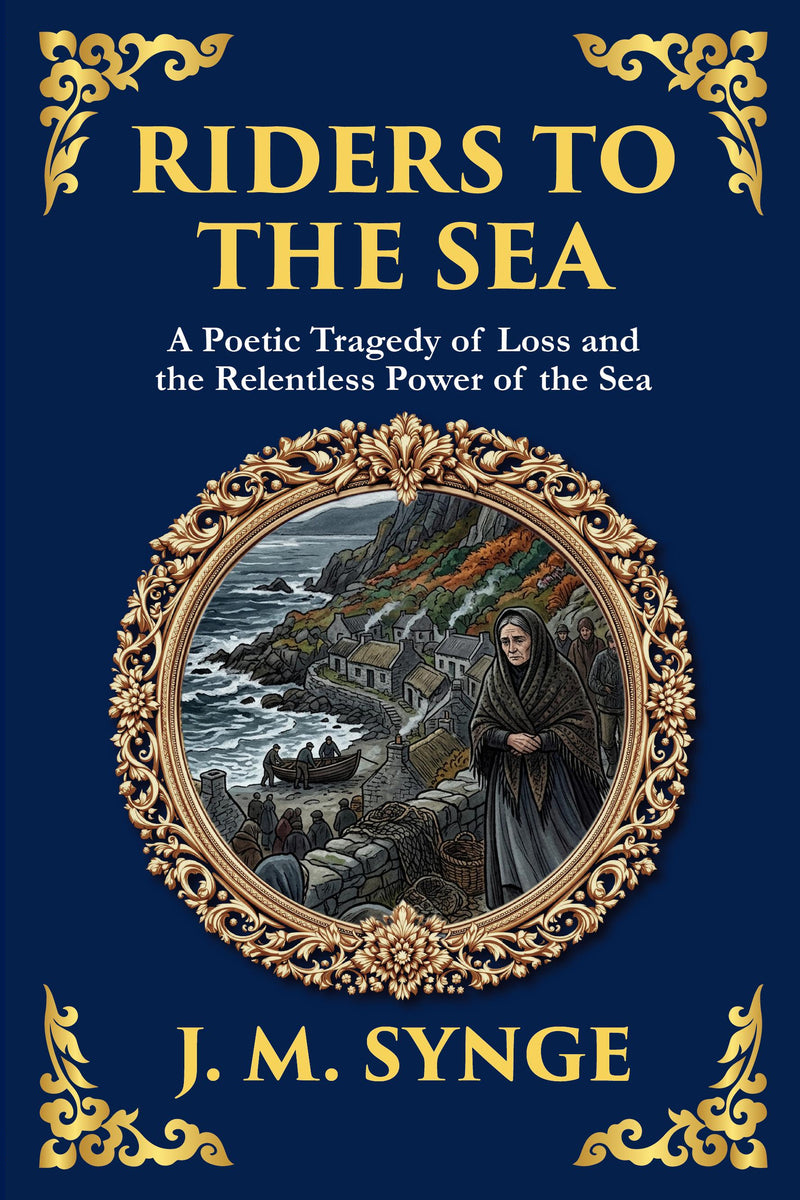
Riders to the Sea — Large Print
Riders to the Sea is a harrowing one-act masterpiece by Irish playwright J. M. Synge that distills the raw essence of human suffering, nature's indifference, and the quiet strength of maternal grief.
or free app
10,000+ hrs library
30-day guarantee
The complete Riders to the Sea appears in modern English through Library of Alexandria Press, available online with audiobook narration included for members.
Have you ever wondered why nature shows no mercy to those who love most deeply? Riders to the Sea is a haunting portrayal of a family's struggle against the unforgiving forces of nature. In just a single act, J. M. Synge captures a world of sorrow, resilience, and fatalism on the rugged western coast of Ireland.
Maurya, an elderly mother, has already seen five of her six sons claimed by the treacherous sea. When her last remaining son, Bartley, prepares to make a dangerous journey by boat, she is struck by an overwhelming sense of foreboding. Despite her pleas, Bartley departs—and the sea once again delivers its verdict.
Through poetic language steeped in the cadences of Irish dialect, Synge brings to life a world where faith clashes with fatalism, where grief becomes ritual, and where the ocean serves as both provider and destroyer.
What you’ll discover in this modern edition
- A Lyrical Exploration of Grief and Resilience – Witness the power of maternal love in the face of relentless loss.
| Formats | eBook (EPUB + PDF) · Audiobook · Paperback · Hardcover · Large Print |
| Language | English |
| Trim size (print) | 6 × 9 in |
| Binding | Paperback — perfect-bound · Hardcover — casewrap |
| Large Print edition | Same text in a larger, easy-read type — a larger font, not a larger trim |
| Print pricing | Every physical book at our true cost — at-cost, no profit (members) |
| Library | 873 restored titles, always growing |
| Length | 7,624 words · ~30 min reading |
| Reading level | Grade 8 · an easy, flowing read (this modern-English edition) |
| Edition | Modern English translation · 2026 |
Member reviews for this edition are collected as readers finish it — be the first. Across the library: 12,000+ books shipped, every plan covered by a 365-day print guarantee.
About this edition
A faithful, unabridged modern-English edition by The Library of Alexandria — carefully rendered for today's reader and verified paragraph-by-paragraph against the public-domain source. Available as eBook, audiobook, paperback, hardcover, and large print.
- Complete & unabridgedVerified paragraph by paragraph against the source — never a scan, never abridged.
- Modern English, faithfulReadable today, with the author’s meaning kept intact. Readable — not simplified.
- Every format, one membershipRead in your browser or the free app, or listen to the full audiobook.
Included free with your membership
Cancel anytime, one click · 30-day money-back guarantee
Edition last updated July 2026
What’s inside
Riders to the Sea — Large Print — complete and unabridged, included in full with membership, plus the full audiobook.
Begin reading Riders to the Sea — Large Print
In clear modern English — the complete text is included with membership.
Introduction
There are works of literature that announce themselves with grand gestures, demanding the reader surrender weeks of their life. And then there are works that achieve the opposite: a concentration so intense, a focus so unwavering, that they seem to compress an entire universe of human feeling into the space of a single hour. Riders to the Sea belongs firmly to this second, rarer category. It is among the shortest plays ever to earn a permanent place in the canon of world drama, and yet readers and audiences for well over a century have found themselves shaken by it in ways that far longer and more elaborate works never manage. To open this play is to step into something that feels less like a story and more like a ritual, a brief and devastating communion with the oldest griefs that human beings have ever known.
This edition presents J. M. Synge’s masterpiece in a modern adaptation, prepared with the contemporary reader in mind. That phrase deserves a moment of explanation, because it touches on something essential about how this play has been received and how it should be approached. Synge wrote in a language unlike any other in English literature, a rhythmic, image-laden speech that he developed by listening intently to the people of the Aran Islands and the rural west of Ireland. It is gorgeous, but it can also be unfamiliar, and for some readers the original idiom presents a barrier between themselves and the emotional core of the work. The aim of a modern adaptation is not to flatten or simplify what Synge achieved, but to keep its doors open, to ensure that the play’s overwhelming power reaches across the distance of more than a hundred years. The hope is that the reader who finishes this book will want to seek out the original cadences as well, having first felt the full weight of what the play has to say.
Before we go further, a word about what follows in these pages and what does not. This introduction will not reveal the events of the play. Riders to the Sea is so compact that to describe its incidents would be to rob you of the experience of encountering them as Synge intended, in their proper order and at their proper pace. Part of the play’s terrible beauty lies in the way it withholds and reveals, in the slow accumulation of dread and the way small domestic details take on enormous significance. To know in advance what happens would be to dull the edge of a knife that Synge sharpened with extraordinary care. Instead, what this introduction offers is context: the world from which the play emerged, the man who wrote it, the ideas and forces that give it shape, and some thoughts on how to read it so that its full effect can land upon you. Consider this a preparation of the ground, so that when the curtain rises in your imagination, you will be ready to receive what comes.
John Millington Synge was born in 1871 near Dublin into a comfortable Protestant family, the kind of background that might have led him toward a quiet, conventional life. For a time it seemed it might. He was a sickly child, often kept from school, and he developed an early and abiding love of nature and music. He trained as a musician, studying the violin, and for several years he drifted through Europe, living in Paris and elsewhere, trying to find a literary voice while composing criticism and minor verse that gave little indication of the greatness to come. He was, by most accounts, a young man searching for something he could not quite name, possessed of talent but without a subject worthy of it.
The turning point came through a now-famous meeting in Paris with the poet W. B. Yeats. Yeats, who was then deeply engaged in the project of building a distinctly Irish national literature, gave Synge a piece of advice that would change the course of his life and the course of Irish drama. He told Synge to leave Paris, to give up writing about subjects he only half understood, and to go to the Aran Islands, to live among the people there and to express a life that had never found its way into literature. The Aran Islands sit off the western coast of Ireland in Galway Bay, three small, windswept, rocky outcrops in the Atlantic where, at the turn of the twentieth century, people still lived in a manner that had changed little for centuries. They spoke Irish, fished from small boats called curraghs, eked out a living from soil they had to build up by hand from sand and seaweed, and existed in a state of constant, intimate proximity to the ocean that both sustained them and killed them.
Synge took the advice. Beginning in 1898, he made a series of visits to the islands, staying for weeks at a time, learning the language, listening to the stories and the speech of the people, and absorbing the texture of a way of life that struck him with the force of revelation. He kept detailed notebooks, later published as The Aran Islands, that record his observations with a clear and unsentimental eye. What he found there was not the picturesque rural idyll that romantic visitors sometimes sought, but something far harder and more profound: a community living at the very edge of existence, where death by drowning was not an occasional tragedy but a recurring fact of life, woven into the rhythm of the seasons and the expectations of every family. The men went out on the sea because they had to, and the sea took them with terrible regularity, and the women who remained behind carried the weight of that knowledge in their bones.
It was from this experience that Riders to the Sea was born. The play, first performed in 1904, draws directly on incidents Synge witnessed or heard about during his time on the islands, including the way bodies of the drowned might wash ashore far from where they were lost, identified by some small detail of clothing. But Synge did not write a documentary or a piece of social commentary. He took the raw material of island life and shaped it into something that transcends its particular setting, a work that uses the specific to reach the universal. The result is a play that is unmistakably rooted in a real place and a real people, and at the same time speaks to anyone who has ever loved someone and feared losing them, anyone who has ever stood helpless before forces too large to resist.
Synge’s career was tragically brief. He died in 1909, not yet thirty-eight years old, of cancer, leaving behind a small body of work that nonetheless secured his reputation as one of the most important dramatists of the modern era. He was a central figure in the Irish Literary Revival and one of the founding voices of the Abbey Theatre in Dublin, the institution that would become the home of modern Irish drama. His later play The Playboy of the Western World caused riots when it was first staged, so provocative did some audiences find its portrait of Irish peasant life. But Riders to the Sea provoked no riots. It provoked something else entirely: a kind of stunned silence, the recognition that they were in the presence of a work that touched the deepest and most sacred regions of human feeling. It has been called the most perfect one-act tragedy in the English language, and many who encounter it for the first time find that the praise, far from being excessive, hardly seems sufficient.
The Sea, the Mother, and the Shape of Sorrow
To understand what makes Riders to the Sea so extraordinary, it helps to think about its central presence, which is not a character in the conventional sense at all but the sea itself. The ocean dominates this play the way fate dominates ancient Greek tragedy. It is never seen on stage, yet it is felt in every line, a vast and indifferent power that surrounds the small community and shapes every aspect of their existence. The islanders depend on the sea for their survival, for their food and their connection to the wider world, and yet the same sea is the great devourer, the thing that takes their men and gives back only their broken bodies, or sometimes nothing at all. This terrible doubleness, the sea as both giver and taker of life, lies at the heart of the play’s vision.
What Synge does with this material is to elevate it to the level of myth. The play has the structure and feel of ancient tragedy, and this is no accident. Synge was steeped in classical literature, and Riders to the Sea deliberately echoes the great Greek dramas, with their sense of inexorable fate, their compression of time, their use of a central suffering figure who comes to embody the grief of a whole people. The play observes something very close to the classical unities of time, place, and action: it unfolds in a single setting, over a short span, around a single line of events. There are no subplots, no comic relief, no diversions of any kind. Everything is directed toward a single overwhelming emotional climax, and this concentration is precisely what gives the play its power. Nothing is wasted, nothing distracts, and the effect is like watching a wave gather itself far out at sea and then come crashing down with all its accumulated force.
At the center of this drama stands a woman, an old mother who has spent her life on these islands and who has already given much to the sea. She is one of the great figures of modern drama, a character of immense dignity and almost unbearable suffering. Through her, Synge explores the particular grief of women in this world, the women who do not go out on the boats but who wait, who watch, who keen over the dead, who hold the family together through loss after loss. There is a deeply feminine wisdom in the play, an understanding that the women bear a burden the men do not, the burden of survival, of remembering, of continuing to live in a world that has taken so much. The play’s emotional architecture is built around her, around what she knows and what she fears and what she finally comes to accept, and it is impossible to read the work without being drawn into her consciousness, into the long perspective of someone who has seen too much sorrow to be surprised by any of it.
This brings us to one of the most striking qualities of Riders to the Sea, which is its movement toward a kind of acceptance, even a kind of peace, in the face of devastation. This is not a play of rage against the dying of the light, not a story of struggle and defiance. It is something stranger and, in the end, more profound: a meditation on the limits of human endurance and the strange consolation that comes when there is nothing left to fear, when the worst has happened and can happen no more. There is grief in this play, grief of an intensity that few works of literature ever reach, but there is also something beyond grief, a quality almost of transcendence, as the human spirit, having been stripped of everything, arrives at a place of terrible calm. Synge does not offer false comfort. He does not pretend that loss can be redeemed or that suffering has a tidy meaning. But he does suggest that there is dignity in endurance, and that even in the midst of the most complete desolation, the human capacity to feel and to speak and to mark the passing of those we love remains a kind of triumph.
The religious dimension of the play deserves attention as well. The islanders are Catholic, and the rituals and language of their faith run through the play, mingling with older, more pagan attitudes toward the sea and toward death. There is a constant interplay between Christian hope, with its promise of salvation and reunion, and a more ancient fatalism that sees the sea as an implacable god demanding its sacrifices. Synge does not resolve this tension, and he does not need to. Instead he lets both elements coexist, as they did in the lives of the people he observed, creating a spiritual texture that feels both very old and very honest. The prayers and the keening, the holy water and the lament, all blend together in a vision of human beings trying to make sense of a universe that offers them very little explanation for their suffering.
Cancel anytime, one click · 30-day money-back guarantee
Founding annual rate available now — your price locks for life when you join.
Not ready? Get this free chapter by email — read it anytime.
✓ Sent — check your inbox for Riders to the Sea — Large Print.
Questions about Riders to the Sea — Large Print
What is Riders to the Sea about?
Riders to the Sea is a harrowing one-act masterpiece by Irish playwright J. M. Synge that distills the raw essence of human suffering, nature's indifference, and the quiet strength of maternal grief. Set on the desolate Aran Islands, the play captures the sorrow of a mother who has lost nearly all her sons to the sea—and must now face the inevitable loss of the last. Told in lyrical, poetic prose that echoes the rhythms of Irish speech and folklore, this timeless work is a meditation on fate, resilience, and the cr
Who wrote Riders to the Sea?
Riders to the Sea was written by J. M. Synge. This edition presents the complete work in clear modern English, faithfully rendered from the public-domain original by Library of Alexandria Press.
Is Riders to the Sea free to read?
The opening chapter is free to read on this page. Members read and listen to the complete work — and the entire library — free, and can order any physical book at our true print cost.
How long is Riders to the Sea?
2 chapters (~7,624 words) — about 30 min of reading in this modern-English edition.
Is this an abridged version of Riders to the Sea?
No. This is the complete, unabridged Riders to the Sea, carefully rendered into clear modern English and verified paragraph-by-paragraph against the public-domain source — nothing is cut or summarised.
What formats does Riders to the Sea come in?
Riders to the Sea is available as eBook, paperback, hardcover and large print. eBook and audiobook are included with membership; printed editions ship at our true print cost.
Shipping & returns
Billing & membership
More from the library


Explore Poetry & Drama
- As You Like It · William Shakespeare
- The Raven · Edgar Allan Poe
- The Merchant of Venice · William Shakespeare
- A Midsummer Night’s Dream · William Shakespeare
- Romeo and Juliet · William Shakespeare
- The Imaginary Invalid · Molière
- A Woman of No Importance · Oscar Wilde
- Gitanjali · Rabindranath Tagore
- Sonnets from the Portuguese · Elizabeth Barrett Browning
- The New Life (La Vita Nuova) · Dante Alighieri
- The Rime of the Ancient Mariner · Samuel Taylor Coleridge
- Lady Windermere’s Fan · Oscar Wilde
- The Home Book of Verse — Volume 4 · Burton Egbert Stevenson
- Ghosts · Henrik Ibsen
- Mrs. Warren’s Profession · Bernard Shaw
- An Enemy of the People · Henrik Ibsen
- Gawayne and the Green Knight: A Fairy Tale · Charlton M. Lewis
- The Nibelungenlied · G. H. Needler
- Julius Caesar · William Shakespeare
- The Aeneid of Virgil · Virgil
- Troilus and Criseyde · Geoffrey Chaucer
- The Post Office · Rabindranath Tagore
- Lamia · John Keats
- The Ballad of the White Horse · G. K. Chesterton
- A Shropshire Lad · A. E. Housman
- The Birth of the War-God: A Poem by Kalidasa · Kálidása
- Riders to the Sea · J. M. Synge
- The Prophet · Kahlil Gibran
- Twelfth Night; Or, What You Will · William Shakespeare
- Othello, the Moor of Venice · William Shakespeare
Riders to the Sea — Large Print
Riders to the Sea — Large Print
A Poetic Tragedy of Loss and the Relentless Power of the Sea
J. M. Synge
Contents
- Introduction
- Riders to the Sea
Introduction
There are works of literature that announce themselves with grand gestures, demanding the reader surrender weeks of their life. And then there are works that achieve the opposite: a concentration so intense, a focus so unwavering, that they seem to compress an entire universe of human feeling into the space of a single hour. Riders to the Sea belongs firmly to this second, rarer category. It is among the shortest plays ever to earn a permanent place in the canon of world drama, and yet readers and audiences for well over a century have found themselves shaken by it in ways that far longer and more elaborate works never manage. To open this play is to step into something that feels less like a story and more like a ritual, a brief and devastating communion with the oldest griefs that human beings have ever known.
This edition presents J. M. Synge’s masterpiece in a modern adaptation, prepared with the contemporary reader in mind. That phrase deserves a moment of explanation, because it touches on something essential about how this play has been received and how it should be approached. Synge wrote in a language unlike any other in English literature, a rhythmic, image-laden speech that he developed by listening intently to the people of the Aran Islands and the rural west of Ireland. It is gorgeous, but it can also be unfamiliar, and for some readers the original idiom presents a barrier between themselves and the emotional core of the work. The aim of a modern adaptation is not to flatten or simplify what Synge achieved, but to keep its doors open, to ensure that the play’s overwhelming power reaches across the distance of more than a hundred years. The hope is that the reader who finishes this book will want to seek out the original cadences as well, having first felt the full weight of what the play has to say.
Before we go further, a word about what follows in these pages and what does not. This introduction will not reveal the events of the play. Riders to the Sea is so compact that to describe its incidents would be to rob you of the experience of encountering them as Synge intended, in their proper order and at their proper pace. Part of the play’s terrible beauty lies in the way it withholds and reveals, in the slow accumulation of dread and the way small domestic details take on enormous significance. To know in advance what happens would be to dull the edge of a knife that Synge sharpened with extraordinary care. Instead, what this introduction offers is context: the world from which the play emerged, the man who wrote it, the ideas and forces that give it shape, and some thoughts on how to read it so that its full effect can land upon you. Consider this a preparation of the ground, so that when the curtain rises in your imagination, you will be ready to receive what comes.
John Millington Synge was born in 1871 near Dublin into a comfortable Protestant family, the kind of background that might have led him toward a quiet, conventional life. For a time it seemed it might. He was a sickly child, often kept from school, and he developed an early and abiding love of nature and music. He trained as a musician, studying the violin, and for several years he drifted through Europe, living in Paris and elsewhere, trying to find a literary voice while composing criticism and minor verse that gave little indication of the greatness to come. He was, by most accounts, a young man searching for something he could not quite name, possessed of talent but without a subject worthy of it.
The turning point came through a now-famous meeting in Paris with the poet W. B. Yeats. Yeats, who was then deeply engaged in the project of building a distinctly Irish national literature, gave Synge a piece of advice that would change the course of his life and the course of Irish drama. He told Synge to leave Paris, to give up writing about subjects he only half understood, and to go to the Aran Islands, to live among the people there and to express a life that had never found its way into literature. The Aran Islands sit off the western coast of Ireland in Galway Bay, three small, windswept, rocky outcrops in the Atlantic where, at the turn of the twentieth century, people still lived in a manner that had changed little for centuries. They spoke Irish, fished from small boats called curraghs, eked out a living from soil they had to build up by hand from sand and seaweed, and existed in a state of constant, intimate proximity to the ocean that both sustained them and killed them.
Synge took the advice. Beginning in 1898, he made a series of visits to the islands, staying for weeks at a time, learning the language, listening to the stories and the speech of the people, and absorbing the texture of a way of life that struck him with the force of revelation. He kept detailed notebooks, later published as The Aran Islands, that record his observations with a clear and unsentimental eye. What he found there was not the picturesque rural idyll that romantic visitors sometimes sought, but something far harder and more profound: a community living at the very edge of existence, where death by drowning was not an occasional tragedy but a recurring fact of life, woven into the rhythm of the seasons and the expectations of every family. The men went out on the sea because they had to, and the sea took them with terrible regularity, and the women who remained behind carried the weight of that knowledge in their bones.
It was from this experience that Riders to the Sea was born. The play, first performed in 1904, draws directly on incidents Synge witnessed or heard about during his time on the islands, including the way bodies of the drowned might wash ashore far from where they were lost, identified by some small detail of clothing. But Synge did not write a documentary or a piece of social commentary. He took the raw material of island life and shaped it into something that transcends its particular setting, a work that uses the specific to reach the universal. The result is a play that is unmistakably rooted in a real place and a real people, and at the same time speaks to anyone who has ever loved someone and feared losing them, anyone who has ever stood helpless before forces too large to resist.
Synge’s career was tragically brief. He died in 1909, not yet thirty-eight years old, of cancer, leaving behind a small body of work that nonetheless secured his reputation as one of the most important dramatists of the modern era. He was a central figure in the Irish Literary Revival and one of the founding voices of the Abbey Theatre in Dublin, the institution that would become the home of modern Irish drama. His later play The Playboy of the Western World caused riots when it was first staged, so provocative did some audiences find its portrait of Irish peasant life. But Riders to the Sea provoked no riots. It provoked something else entirely: a kind of stunned silence, the recognition that they were in the presence of a work that touched the deepest and most sacred regions of human feeling. It has been called the most perfect one-act tragedy in the English language, and many who encounter it for the first time find that the praise, far from being excessive, hardly seems sufficient.
The Sea, the Mother, and the Shape of Sorrow
To understand what makes Riders to the Sea so extraordinary, it helps to think about its central presence, which is not a character in the conventional sense at all but the sea itself. The ocean dominates this play the way fate dominates ancient Greek tragedy. It is never seen on stage, yet it is felt in every line, a vast and indifferent power that surrounds the small community and shapes every aspect of their existence. The islanders depend on the sea for their survival, for their food and their connection to the wider world, and yet the same sea is the great devourer, the thing that takes their men and gives back only their broken bodies, or sometimes nothing at all. This terrible doubleness, the sea as both giver and taker of life, lies at the heart of the play’s vision.
What Synge does with this material is to elevate it to the level of myth. The play has the structure and feel of ancient tragedy, and this is no accident. Synge was steeped in classical literature, and Riders to the Sea deliberately echoes the great Greek dramas, with their sense of inexorable fate, their compression of time, their use of a central suffering figure who comes to embody the grief of a whole people. The play observes something very close to the classical unities of time, place, and action: it unfolds in a single setting, over a short span, around a single line of events. There are no subplots, no comic relief, no diversions of any kind. Everything is directed toward a single overwhelming emotional climax, and this concentration is precisely what gives the play its power. Nothing is wasted, nothing distracts, and the effect is like watching a wave gather itself far out at sea and then come crashing down with all its accumulated force.
At the center of this drama stands a woman, an old mother who has spent her life on these islands and who has already given much to the sea. She is one of the great figures of modern drama, a character of immense dignity and almost unbearable suffering. Through her, Synge explores the particular grief of women in this world, the women who do not go out on the boats but who wait, who watch, who keen over the dead, who hold the family together through loss after loss. There is a deeply feminine wisdom in the play, an understanding that the women bear a burden the men do not, the burden of survival, of remembering, of continuing to live in a world that has taken so much. The play’s emotional architecture is built around her, around what she knows and what she fears and what she finally comes to accept, and it is impossible to read the work without being drawn into her consciousness, into the long perspective of someone who has seen too much sorrow to be surprised by any of it.
This brings us to one of the most striking qualities of Riders to the Sea, which is its movement toward a kind of acceptance, even a kind of peace, in the face of devastation. This is not a play of rage against the dying of the light, not a story of struggle and defiance. It is something stranger and, in the end, more profound: a meditation on the limits of human endurance and the strange consolation that comes when there is nothing left to fear, when the worst has happened and can happen no more. There is grief in this play, grief of an intensity that few works of literature ever reach, but there is also something beyond grief, a quality almost of transcendence, as the human spirit, having been stripped of everything, arrives at a place of terrible calm. Synge does not offer false comfort. He does not pretend that loss can be redeemed or that suffering has a tidy meaning. But he does suggest that there is dignity in endurance, and that even in the midst of the most complete desolation, the human capacity to feel and to speak and to mark the passing of those we love remains a kind of triumph.
The religious dimension of the play deserves attention as well. The islanders are Catholic, and the rituals and language of their faith run through the play, mingling with older, more pagan attitudes toward the sea and toward death. There is a constant interplay between Christian hope, with its promise of salvation and reunion, and a more ancient fatalism that sees the sea as an implacable god demanding its sacrifices. Synge does not resolve this tension, and he does not need to. Instead he lets both elements coexist, as they did in the lives of the people he observed, creating a spiritual texture that feels both very old and very honest. The prayers and the keening, the holy water and the lament, all blend together in a vision of human beings trying to make sense of a universe that offers them very little explanation for their suffering.
MAURYA (an old woman) — Honor Lavelle BARTLEY (her son) — W. G. Fay CATHLEEN (her daughter) — Sarah Allgood NORA (a younger daughter) — Emma Vernon MEN AND WOMEN
(A cottage kitchen containing fishing nets, waterproof gear, a spinning wheel, and some new wooden boards leaning against the wall. Cathleen, a woman of about twenty, finishes kneading dough and places it in the oven by the fire; she then wipes her hands and begins to spin. Nora, a younger girl, peeks through the door.)
CATHLEEN. She’s resting, poor soul, and might be asleep if she can manage it.
[Nora enters quietly and pulls a bundle from beneath her shawl.]
CATHLEEN. (Spinning the wheel quickly) What do you have there?
NORA. The young priest just brought these. They are a shirt and a plain stocking taken from a drowned man in Donegal.
[Cathleen abruptly stops the wheel and leans forward to listen.]
NORA. We need to find out if these belong to Michael; Mother will be down by the shore looking for them soon.
CATHLEEN. Why would they be Michael’s, Nora? Why would he have traveled all the way to the far north?
NORA. The young priest says he has seen this happen before. He told me, “If these are Michael’s, you can tell your mother that he received a proper burial by the grace of God. But if they aren’t his, don’t let anyone mention it, because the grief and crying will kill her.”
[A gust of wind blows open the door that Nora had left halfway closed.]
CATHLEEN. [Looking out anxiously] Did you ask him if he would stop Bartley from taking the horses to the Galway fair today?
NORA. He said, “I won’t stop him, but don’t be afraid. Your mother prays half the night, and Almighty God will not leave her with no living son.”
End of the free sample
Keep reading, free
Members read and listen to the complete book — and the entire library. Cancel anytime, one click · 30-day money-back guarantee.