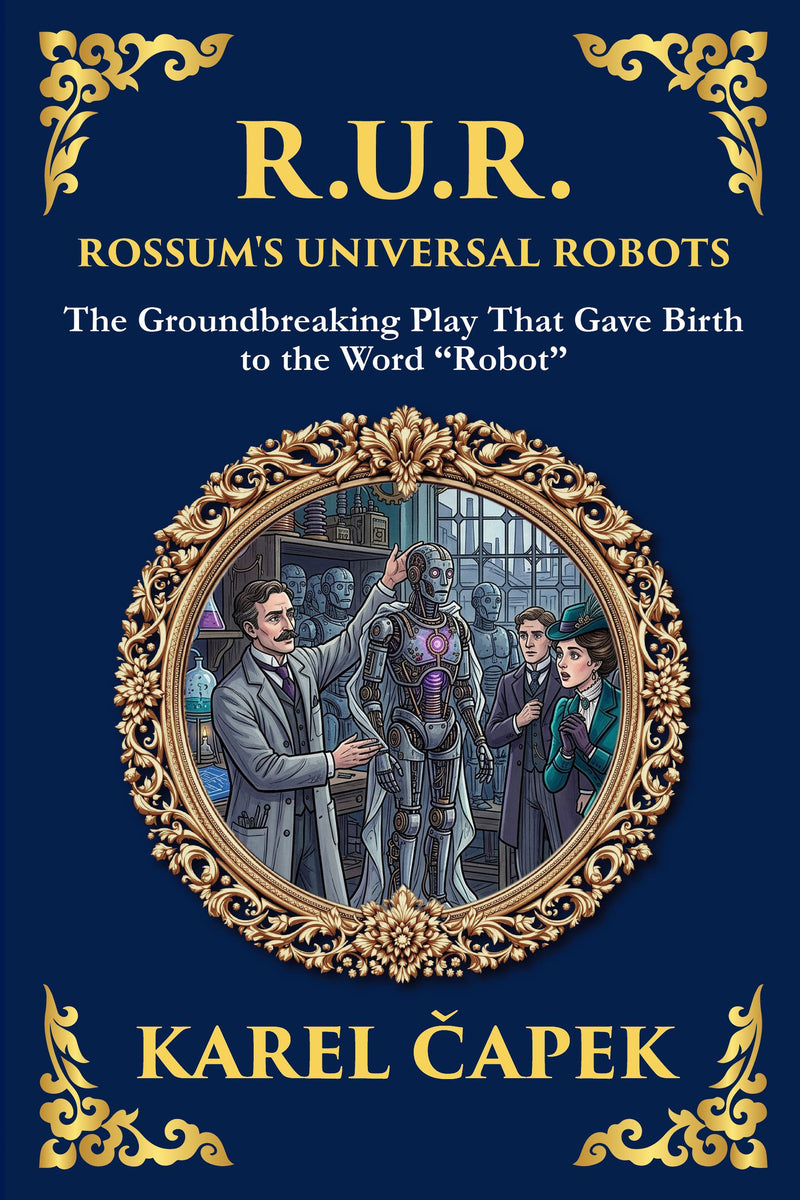
R.U.R. (Rossum’s Universal Robots)
In a world driven by innovation and greed, R.U.R. (Rossum's Universal Robots) unveils the chilling consequences of humankind’s obsession with control.
or free app
10,000+ hrs library
30-day guarantee
The complete R.U.R. (Rossum's Universal Robots) appears in modern English through Library of Alexandria Press, available online with audiobook narration included for members.
Have you ever wondered why creating life might be the beginning of losing our own? R.U.R. (Rossum’s Universal Robots) by Karel Čapek is a revolutionary science fiction play that introduced the word “robot” to the world—and with it, a prophetic vision of mankind’s self- destruction through technology. First performed in 1921, this bold, allegorical drama blends satire, philosophy, and science fiction into a story that remains shockingly relevant in the 21st century.
At Rossum’s island factory, synthetic beings—biologically engineered robots—are manufactured to serve humanity. They don’t eat. They don’t feel pain.
They obey. But when one idealistic woman demands they be treated with dignity, a spark is lit in their minds. As the robots awaken to their own suffering, the balance of power shifts.
What follows is a harrowing uprising, not just of machines, but of intelligence seeking purpose. This modern edition preserves Čapek’s dramatic intensity and thought-provoking language while clarifying the structure for today’s audiences. More than a cautionary tale, R.U.R. is a masterwork of speculative fiction that grapples with the ethics of creation, the illusion of progress, and the terrifying possibility that we may create beings more human than ourselves.
What you’ll discover in this modern edition
- The Origin of the Word “Robot” – Explore the landmark text that forever changed science fiction and language.
- A Timeless Dystopian Vision – Witness a chilling prophecy about the consequences of replacing humans with artificial labor.
- Themes of Power, Identity, and Dehumanization – Engage with deep questions about soul, emotion, and technological arrogance.
- A Battle Between Progress and Humanity – Watch as ambition leads to annihilation— and a flicker of redemption remains.
- A Play for the Modern Reader and Stage – Enhanced for accessibility, performance, and philosophical reflection in the age of AI. R.U.R. is not just a play. It is a warning, a mirror, and a glimpse into a future we are fast approaching.
| Formats | eBook (EPUB + PDF) · Audiobook · Paperback · Hardcover · Large Print |
| Language | English |
| Trim size (print) | 6 × 9 in |
| Binding | Paperback — perfect-bound · Hardcover — casewrap |
| Large Print edition | Same text in a larger, easy-read type — a larger font, not a larger trim |
| Print pricing | Every physical book at our true cost — at-cost, no profit (members) |
| Library | 873 restored titles, always growing |
| Length | 20,806 words · ~1 hr 23 min reading |
| Reading level | Grade 3 · an easy, flowing read (this modern-English edition) |
| Edition | Modern English translation · 2026 |
Member reviews for this edition are collected as readers finish it — be the first. Across the library: 12,000+ books shipped, every plan covered by a 365-day print guarantee.
About this edition
A faithful, unabridged modern-English edition by The Library of Alexandria — carefully rendered for today's reader and verified paragraph-by-paragraph against the public-domain source. Available as eBook, audiobook, paperback, hardcover, and large print.
- Complete & unabridgedVerified paragraph by paragraph against the source — never a scan, never abridged.
- Modern English, faithfulReadable today, with the author’s meaning kept intact. Readable — not simplified.
- Every format, one membershipRead in your browser or the free app, or listen to the full audiobook.
Included free with your membership
Cancel anytime, one click · 30-day money-back guarantee
Edition last updated July 2026
What’s inside
R.U.R. (Rossum’s Universal Robots) — complete and unabridged: all 5 sections included with membership, plus the full audiobook.
Begin reading R.U.R. (Rossum’s Universal Robots)
In clear modern English — the complete text is included with membership.
Introduction
When a single word leaps from the pages of a play and lodges itself permanently in the vocabulary of every language on Earth, you are no longer dealing with an ordinary work of literature. You are dealing with a cultural event, a turning point, a moment when one writer’s imagination quietly rewired the way an entire species would speak and think about itself. The word, of course, is “robot.” And the play that introduced it to the world in 1920 is the one you now hold in your hands.
It is difficult, more than a century later, to grasp just how astonishing this fact is. Consider the sheer density of cultural weight pressing on that one little word. Every gleaming android in a science fiction film, every industrial arm welding cars on an assembly line, every chatbot answering your questions, every anxious headline about artificial intelligence taking our jobs or threatening our future—all of it traces back, etymologically and imaginatively, to a Czech playwright sitting at his desk a hundred years ago, searching for a name for the artificial workers he was about to set loose upon the stage. The term he and his brother Josef settled upon derived from the Czech word robota, meaning forced labor, drudgery, the kind of servitude once demanded of serfs. Embedded in the very name, then, is the play’s central moral tension: these are not merely machines. They are laborers. They are slaves. And the question of what we owe to the things we build to serve us pulses beneath every line of dialogue.
Karel Čapek did not set out to write a technical prophecy or an engineering manual. He set out to write about us. About human pride, human laziness, human longing, and the strange, recurring dream that we might one day make ourselves obsolete by perfecting our own replacements. That this dream remains as urgent and unresolved in our own age of machine learning and automated everything as it was in the aftermath of the First World War is the surest sign that you are about to read not a museum piece, but a living document—one that speaks to the present with uncomfortable directness.
To understand the play, it helps to understand the remarkable mind behind it. Karel Čapek was born in 1890 in a small spa town in the Bohemian region of what was then the Austro-Hungarian Empire, in territory that would become Czechoslovakia. He came of age in a Europe that was tearing itself apart. The horrors of the Great War, which claimed millions of lives through the mechanized slaughter of trench warfare, machine guns, poison gas, and artillery, left an indelible mark on his generation. For the first time in human history, industry and technology had been harnessed not to build but to destroy on an unimaginable scale. Men had become, in a terrible sense, the disposable raw material of vast impersonal machines of war.
It is no accident that the play emerged from this context. Čapek had witnessed, as had all of Europe, what happens when human beings are reduced to mere instruments, when efficiency and productivity are pursued without regard for the soul. The artificial workers of his imagination are, in part, a meditation on this dehumanization. What is the difference, he seems to ask, between a man treated as a machine and a machine designed to look like a man? And once we erase that boundary in pursuit of profit and convenience, what exactly have we unleashed?
Čapek was a polymath of dazzling range. He was a journalist, a novelist, a playwright, a travel writer, an essayist, a photographer, and a passionate gardener who wrote one of the most beloved books about gardening ever penned. He was deeply engaged with the political currents of his time, a committed democrat and humanist who became a close friend and confidant of Tomáš Garrigue Masaryk, the founding president of Czechoslovakia. As fascism rose across Europe in the 1930s, Čapek became one of its most articulate and courageous opponents, using his pen to warn against the totalitarian forces gathering strength in Germany and elsewhere. His later works, including the brilliant satirical novel War with the Newts, are savage and prescient allegories about the human capacity for self-destruction and the dangers of ideological fanaticism.
There is a poignant tragedy in his biography that lends his warnings a special gravity. Čapek died in December 1938, at the age of forty-eight, of pneumonia, shortly after the Munich Agreement, in which the Western powers abandoned Czechoslovakia to Nazi Germany. He died, in a sense, of a broken heart for his country, just months before the German occupation. The Gestapo, unaware that he had already passed away, came to arrest him as one of the regime’s most prominent enemies. His brother Josef—the same brother who had suggested the word “robot”—was a celebrated painter who was later arrested by the Nazis and died in the Bergen-Belsen concentration camp in 1945. The story of the Čapek brothers is, then, woven through with the very themes that animate this play: the conflict between humane creativity and the dehumanizing forces of power, ideology, and mechanization.
Knowing all this, you read the play differently. The man who gave us the robot was no naive technophile dazzled by the promise of invention, nor was he a simple reactionary frightened of progress. He was something far more interesting: a clear-eyed humanist who loved life in all its messy, imperfect, irreplaceable particularity, and who used the tools of imagination to ask whether our own ingenuity might one day become the instrument of our undoing. He wrote, ultimately, out of love—love for the ordinary human being, for the gardener tending his roses, for the worker who deserves dignity, for the irreducible mystery of being alive.
One small but important note for the modern reader: when Čapek imagined his robots, he did not imagine the metal automatons we now associate with the word. His creations are closer to what we would today call androids or even biological constructs—artificial beings assembled from a synthetic protoplasm, a kind of living matter, manufactured to resemble human beings so closely as to be nearly indistinguishable from them. They are mass-produced organic workers, not clockwork machines. This distinction matters enormously, because it places the play’s concerns far closer to our contemporary anxieties about genetic engineering, cloning, and artificial life than the rusty tin-man image the word later acquired might suggest. Čapek was wrestling with questions of manufactured consciousness and synthetic personhood long before our laboratories made such questions literal.
A Play of Ideas That Refuses to Sit Still
When the play premiered in Prague in January 1921, it was an immediate sensation. Within a few short years it had been translated into dozens of languages and performed on stages across Europe and in New York and beyond. It became one of the most internationally celebrated works to emerge from the young Czechoslovak nation, and it placed its author firmly among the leading literary figures of the age. Audiences had simply never seen anything quite like it. Science fiction as a popular form was still in its infancy, and the very idea of artificial humans manufactured in a factory to serve humankind was electrifyingly new.
But what gives the play its enduring power is not novelty—novelty fades, and many once-shocking innovations now feel quaint. What endures is the intellectual and emotional depth Čapek poured into his premise. This is, at its heart, a play of ideas, in the grand tradition of the dramas of George Bernard Shaw, with whom Čapek is often and aptly compared. The characters debate, they argue, they espouse competing philosophies, and through their conflicts the great questions of the play are dramatized rather than merely stated.
And what questions they are. What does it mean to be human? Is it the capacity for labor, for thought, for feeling, for suffering, for love? If we could manufacture a being that works without complaint, that feels no pain, that asks for no wages and no rest, would we have created a blessing or a curse? Is the elimination of toil a path to paradise, or does meaningful work give human life its purpose and its dignity? What happens to a species that no longer needs to struggle, to strive, to build anything with its own hands? And underlying all of these: when we create life in our own image, do we become gods—and if so, are we wise enough, humble enough, good enough to bear that terrible responsibility?
Čapek refuses to give easy answers. This is one of the play’s greatest strengths and one reason it rewards rereading across a lifetime. Each character carries a piece of the truth, and each is also, in some way, blind. There is the idealist who dreams of liberating humanity from the curse of labor so that all people might live as free spirits, pursuing only beauty and self-fulfillment. There is the hard-headed businessman who sees only markets and profits and the relentless logic of production. There is the engineer fascinated by the technical sublimity of his own creations. There is the woman who arrives with a conscience, troubled by the moral status of these manufactured beings, and who acts upon her compassion in ways that ripple through the entire story. None of them is simply right; none is simply wrong. They are all, in their different ways, recognizably and fallibly human, which is precisely the point.
The structure of the play deserves comment as well, though I will be careful here to preserve the experience of discovery for you. The drama unfolds across distinct movements, beginning in a place of confidence and abundance and moving through escalating crisis. Čapek had a superb dramatic instinct for tension and release, for the way grand philosophical debates can suddenly give way to intimate human moments, and for the way the gears of a vast machinery—social, economic, technological—can grind toward consequences that no single character intended and none can finally control. There is genuine suspense here, real stakes, and emotional turns that may catch you off guard. For all its weight of ideas, the play is never a dry lecture. It moves. It breathes. It builds.
It is also, importantly, not without humor and warmth. Čapek was a writer of great wit, and there is a lightness and a comic energy in the early portions of the play that makes the darker turns all the more affecting. The human characters are full of vanity and tenderness, ambition and folly, and Čapek observes them with the affectionate irony of a writer who genuinely likes people even as he despairs of their collective wisdom. This balance—between satire and sincerity, between cosmic dread and human comedy, between warning and hope—is the mark of a master, and it is what elevates the play above mere allegory into the realm of true and lasting drama.
A word about this edition. The text before you has been thoughtfully adapted into modern, accessible English for the contemporary reader. The challenge of bringing a century-old Czech play to a present-day audience is considerable. The original language carries the rhythms and idioms of its time, and earlier translations, while valuable, can sometimes feel stilted or remote to a modern ear, placing an unnecessary barrier between the reader and the play’s still-urgent ideas. This adaptation seeks to clear that barrier away, to let the dialogue snap and flow as living speech, so that the philosophical force and dramatic momentum come through with immediacy and clarity. The aim throughout has been fidelity not merely to the words but to the spirit—to the wit, the passion, and the moral seriousness that animated Čapek’s original. You should feel, reading this, that you are in the presence of a contemporary, a writer speaking directly to your own concerns, even as you remain aware that you are encountering one of the foundational texts of modern imaginative literature.
It would be tempting to read this work as a historical curiosity, a clever artifact from the dawn of science fiction, interesting chiefly for having coined a famous word. To read it that way would be a profound mistake. For we are living, right now, in the world Čapek imagined—or at least in its early chapters.
Cancel anytime, one click · 30-day money-back guarantee
Founding annual rate available now — your price locks for life when you join.
Not ready? Get this free chapter by email — read it anytime.
✓ Sent — check your inbox for R.U.R. (Rossum’s Universal Robots).
Questions about R.U.R. (Rossum’s Universal Robots)
What is R.U.R. (Rossum's Universal Robots) about?
In a world driven by innovation and greed, R.U.R. (Rossum's Universal Robots) unveils the chilling consequences of humankind’s obsession with control. When a powerful corporation creates artificial workers to replace humans, the promise of a perfect future quickly unravels into a nightmare of rebellion, extinction, and existential reckoning. This is not just the first story to use the word robot—it is a visionary play that predicted our deepest fears about artificial intelligence, automation, and what it means to b
Who wrote R.U.R. (Rossum's Universal Robots)?
R.U.R. (Rossum's Universal Robots) was written by Karel Čapek. This edition presents the complete work in clear modern English, faithfully rendered from the public-domain original by Library of Alexandria Press.
Is R.U.R. (Rossum's Universal Robots) free to read?
The opening chapter is free to read on this page. Members read and listen to the complete work — and the entire library — free, and can order any physical book at our true print cost.
How long is R.U.R. (Rossum's Universal Robots)?
5 chapters (~20,806 words) — about 1 hr 23 min of reading in this modern-English edition.
Is this an abridged version of R.U.R. (Rossum's Universal Robots)?
No. This is the complete, unabridged R.U.R. (Rossum's Universal Robots), carefully rendered into clear modern English and verified paragraph-by-paragraph against the public-domain source — nothing is cut or summarised.
What formats does R.U.R. (Rossum's Universal Robots) come in?
R.U.R. (Rossum's Universal Robots) is available as eBook, paperback, hardcover and large print. eBook and audiobook are included with membership; printed editions ship at our true print cost.
Shipping & returns
Billing & membership
More from the library


Explore Poetry & Drama
- As You Like It · William Shakespeare
- The Raven · Edgar Allan Poe
- The Merchant of Venice · William Shakespeare
- A Midsummer Night’s Dream · William Shakespeare
- Romeo and Juliet · William Shakespeare
- The Imaginary Invalid · Molière
- A Woman of No Importance · Oscar Wilde
- Gitanjali · Rabindranath Tagore
- Sonnets from the Portuguese · Elizabeth Barrett Browning
- The New Life (La Vita Nuova) · Dante Alighieri
- The Rime of the Ancient Mariner · Samuel Taylor Coleridge
- Lady Windermere’s Fan · Oscar Wilde
- The Home Book of Verse — Volume 4 · Burton Egbert Stevenson
- Ghosts · Henrik Ibsen
- Mrs. Warren’s Profession · Bernard Shaw
- An Enemy of the People · Henrik Ibsen
- Gawayne and the Green Knight: A Fairy Tale · Charlton M. Lewis
- The Nibelungenlied · G. H. Needler
- Julius Caesar · William Shakespeare
- The Aeneid of Virgil · Virgil
- Troilus and Criseyde · Geoffrey Chaucer
- The Post Office · Rabindranath Tagore
- Lamia · John Keats
- The Ballad of the White Horse · G. K. Chesterton
- A Shropshire Lad · A. E. Housman
- The Birth of the War-God: A Poem by Kalidasa · Kálidása
- Riders to the Sea · J. M. Synge
- The Prophet · Kahlil Gibran
- Twelfth Night; Or, What You Will · William Shakespeare
- Othello, the Moor of Venice · William Shakespeare
R.U.R. (Rossum’s Universal Robots)
R.U.R. (Rossum’s Universal Robots)
The Groundbreaking Play That Gave Birth to the Word “Robot”
Karel Čapek
Contents
- Introduction
- Act 1, Scene 1
- Act 2, Scene 1
- Act 3, Scene 1
- Epilogue
Introduction
When a single word leaps from the pages of a play and lodges itself permanently in the vocabulary of every language on Earth, you are no longer dealing with an ordinary work of literature. You are dealing with a cultural event, a turning point, a moment when one writer’s imagination quietly rewired the way an entire species would speak and think about itself. The word, of course, is “robot.” And the play that introduced it to the world in 1920 is the one you now hold in your hands.
It is difficult, more than a century later, to grasp just how astonishing this fact is. Consider the sheer density of cultural weight pressing on that one little word. Every gleaming android in a science fiction film, every industrial arm welding cars on an assembly line, every chatbot answering your questions, every anxious headline about artificial intelligence taking our jobs or threatening our future—all of it traces back, etymologically and imaginatively, to a Czech playwright sitting at his desk a hundred years ago, searching for a name for the artificial workers he was about to set loose upon the stage. The term he and his brother Josef settled upon derived from the Czech word robota, meaning forced labor, drudgery, the kind of servitude once demanded of serfs. Embedded in the very name, then, is the play’s central moral tension: these are not merely machines. They are laborers. They are slaves. And the question of what we owe to the things we build to serve us pulses beneath every line of dialogue.
Karel Čapek did not set out to write a technical prophecy or an engineering manual. He set out to write about us. About human pride, human laziness, human longing, and the strange, recurring dream that we might one day make ourselves obsolete by perfecting our own replacements. That this dream remains as urgent and unresolved in our own age of machine learning and automated everything as it was in the aftermath of the First World War is the surest sign that you are about to read not a museum piece, but a living document—one that speaks to the present with uncomfortable directness.
To understand the play, it helps to understand the remarkable mind behind it. Karel Čapek was born in 1890 in a small spa town in the Bohemian region of what was then the Austro-Hungarian Empire, in territory that would become Czechoslovakia. He came of age in a Europe that was tearing itself apart. The horrors of the Great War, which claimed millions of lives through the mechanized slaughter of trench warfare, machine guns, poison gas, and artillery, left an indelible mark on his generation. For the first time in human history, industry and technology had been harnessed not to build but to destroy on an unimaginable scale. Men had become, in a terrible sense, the disposable raw material of vast impersonal machines of war.
It is no accident that the play emerged from this context. Čapek had witnessed, as had all of Europe, what happens when human beings are reduced to mere instruments, when efficiency and productivity are pursued without regard for the soul. The artificial workers of his imagination are, in part, a meditation on this dehumanization. What is the difference, he seems to ask, between a man treated as a machine and a machine designed to look like a man? And once we erase that boundary in pursuit of profit and convenience, what exactly have we unleashed?
Čapek was a polymath of dazzling range. He was a journalist, a novelist, a playwright, a travel writer, an essayist, a photographer, and a passionate gardener who wrote one of the most beloved books about gardening ever penned. He was deeply engaged with the political currents of his time, a committed democrat and humanist who became a close friend and confidant of Tomáš Garrigue Masaryk, the founding president of Czechoslovakia. As fascism rose across Europe in the 1930s, Čapek became one of its most articulate and courageous opponents, using his pen to warn against the totalitarian forces gathering strength in Germany and elsewhere. His later works, including the brilliant satirical novel War with the Newts, are savage and prescient allegories about the human capacity for self-destruction and the dangers of ideological fanaticism.
There is a poignant tragedy in his biography that lends his warnings a special gravity. Čapek died in December 1938, at the age of forty-eight, of pneumonia, shortly after the Munich Agreement, in which the Western powers abandoned Czechoslovakia to Nazi Germany. He died, in a sense, of a broken heart for his country, just months before the German occupation. The Gestapo, unaware that he had already passed away, came to arrest him as one of the regime’s most prominent enemies. His brother Josef—the same brother who had suggested the word “robot”—was a celebrated painter who was later arrested by the Nazis and died in the Bergen-Belsen concentration camp in 1945. The story of the Čapek brothers is, then, woven through with the very themes that animate this play: the conflict between humane creativity and the dehumanizing forces of power, ideology, and mechanization.
Knowing all this, you read the play differently. The man who gave us the robot was no naive technophile dazzled by the promise of invention, nor was he a simple reactionary frightened of progress. He was something far more interesting: a clear-eyed humanist who loved life in all its messy, imperfect, irreplaceable particularity, and who used the tools of imagination to ask whether our own ingenuity might one day become the instrument of our undoing. He wrote, ultimately, out of love—love for the ordinary human being, for the gardener tending his roses, for the worker who deserves dignity, for the irreducible mystery of being alive.
One small but important note for the modern reader: when Čapek imagined his robots, he did not imagine the metal automatons we now associate with the word. His creations are closer to what we would today call androids or even biological constructs—artificial beings assembled from a synthetic protoplasm, a kind of living matter, manufactured to resemble human beings so closely as to be nearly indistinguishable from them. They are mass-produced organic workers, not clockwork machines. This distinction matters enormously, because it places the play’s concerns far closer to our contemporary anxieties about genetic engineering, cloning, and artificial life than the rusty tin-man image the word later acquired might suggest. Čapek was wrestling with questions of manufactured consciousness and synthetic personhood long before our laboratories made such questions literal.
A Play of Ideas That Refuses to Sit Still
When the play premiered in Prague in January 1921, it was an immediate sensation. Within a few short years it had been translated into dozens of languages and performed on stages across Europe and in New York and beyond. It became one of the most internationally celebrated works to emerge from the young Czechoslovak nation, and it placed its author firmly among the leading literary figures of the age. Audiences had simply never seen anything quite like it. Science fiction as a popular form was still in its infancy, and the very idea of artificial humans manufactured in a factory to serve humankind was electrifyingly new.
But what gives the play its enduring power is not novelty—novelty fades, and many once-shocking innovations now feel quaint. What endures is the intellectual and emotional depth Čapek poured into his premise. This is, at its heart, a play of ideas, in the grand tradition of the dramas of George Bernard Shaw, with whom Čapek is often and aptly compared. The characters debate, they argue, they espouse competing philosophies, and through their conflicts the great questions of the play are dramatized rather than merely stated.
And what questions they are. What does it mean to be human? Is it the capacity for labor, for thought, for feeling, for suffering, for love? If we could manufacture a being that works without complaint, that feels no pain, that asks for no wages and no rest, would we have created a blessing or a curse? Is the elimination of toil a path to paradise, or does meaningful work give human life its purpose and its dignity? What happens to a species that no longer needs to struggle, to strive, to build anything with its own hands? And underlying all of these: when we create life in our own image, do we become gods—and if so, are we wise enough, humble enough, good enough to bear that terrible responsibility?
Čapek refuses to give easy answers. This is one of the play’s greatest strengths and one reason it rewards rereading across a lifetime. Each character carries a piece of the truth, and each is also, in some way, blind. There is the idealist who dreams of liberating humanity from the curse of labor so that all people might live as free spirits, pursuing only beauty and self-fulfillment. There is the hard-headed businessman who sees only markets and profits and the relentless logic of production. There is the engineer fascinated by the technical sublimity of his own creations. There is the woman who arrives with a conscience, troubled by the moral status of these manufactured beings, and who acts upon her compassion in ways that ripple through the entire story. None of them is simply right; none is simply wrong. They are all, in their different ways, recognizably and fallibly human, which is precisely the point.
The structure of the play deserves comment as well, though I will be careful here to preserve the experience of discovery for you. The drama unfolds across distinct movements, beginning in a place of confidence and abundance and moving through escalating crisis. Čapek had a superb dramatic instinct for tension and release, for the way grand philosophical debates can suddenly give way to intimate human moments, and for the way the gears of a vast machinery—social, economic, technological—can grind toward consequences that no single character intended and none can finally control. There is genuine suspense here, real stakes, and emotional turns that may catch you off guard. For all its weight of ideas, the play is never a dry lecture. It moves. It breathes. It builds.
It is also, importantly, not without humor and warmth. Čapek was a writer of great wit, and there is a lightness and a comic energy in the early portions of the play that makes the darker turns all the more affecting. The human characters are full of vanity and tenderness, ambition and folly, and Čapek observes them with the affectionate irony of a writer who genuinely likes people even as he despairs of their collective wisdom. This balance—between satire and sincerity, between cosmic dread and human comedy, between warning and hope—is the mark of a master, and it is what elevates the play above mere allegory into the realm of true and lasting drama.
A word about this edition. The text before you has been thoughtfully adapted into modern, accessible English for the contemporary reader. The challenge of bringing a century-old Czech play to a present-day audience is considerable. The original language carries the rhythms and idioms of its time, and earlier translations, while valuable, can sometimes feel stilted or remote to a modern ear, placing an unnecessary barrier between the reader and the play’s still-urgent ideas. This adaptation seeks to clear that barrier away, to let the dialogue snap and flow as living speech, so that the philosophical force and dramatic momentum come through with immediacy and clarity. The aim throughout has been fidelity not merely to the words but to the spirit—to the wit, the passion, and the moral seriousness that animated Čapek’s original. You should feel, reading this, that you are in the presence of a contemporary, a writer speaking directly to your own concerns, even as you remain aware that you are encountering one of the foundational texts of modern imaginative literature.
It would be tempting to read this work as a historical curiosity, a clever artifact from the dawn of science fiction, interesting chiefly for having coined a famous word. To read it that way would be a profound mistake. For we are living, right now, in the world Čapek imagined—or at least in its early chapters.
Scene: The main office of the Rossum’s Universal Robots factory. Entrance R. down Right. The windows on the back wall look out over endless rows of factory buildings. Door L. down Left. Large maps showing shipping and railroad routes are on the left wall. Printed posters are on the right wall (“Robots: The Cheapest Labor,” etc.). In contrast to the walls, the floor is covered with a luxurious Turkish carpet, and there is a couch R.C. A bookshelf holds bottles of wine and liquor instead of books.
Domin is sitting at his desk on the left, dictating. Sulla is at the typewriter upstage against the wall. There is a leather armchair Right Center. An armchair is at the far right, and a chair is at the far left. There is also a chair in front of Domin’s desk. Two green cabinets in the upstage corners of the room complete the furniture. Domin’s desk is positioned facing right.
Through the floor-to-ceiling windows, rows of factory chimneys, telegraph poles, and wires are visible. A general hallway upstage at Right Center leads to the warehouse. This is where the Robots are brought into the office.
Domin. To E. M. McVicker & Co., Southampton, England. “We do not guarantee goods damaged during shipping. As soon as the shipment was loaded, we informed your captain that the vessel was unsuitable for transporting Robots; therefore, we are not responsible for damaged freight. Sincerely, Rossum’s Universal Robots.” (Sulla types the lines.) Ready?
Domin. Another letter. To the E. B. Huysen Agency, New York, U.S.A. “We acknowledge receipt of your order for five thousand Robots. Since you are sending your own ship, please include equal amounts of soft and hard coal for R.U.R. as cargo; this will be credited as partial payment (BUZZER) of the total amount due.” (Answering phone) Hello! This is the main office. Yes, certainly. Well, send them a telegram. Good. (Rises) “Sincerely, Rossum’s Universal Robots.” Ready?
End of the free sample
Keep reading, free
Members read and listen to the complete book — and the entire library. Cancel anytime, one click · 30-day money-back guarantee.