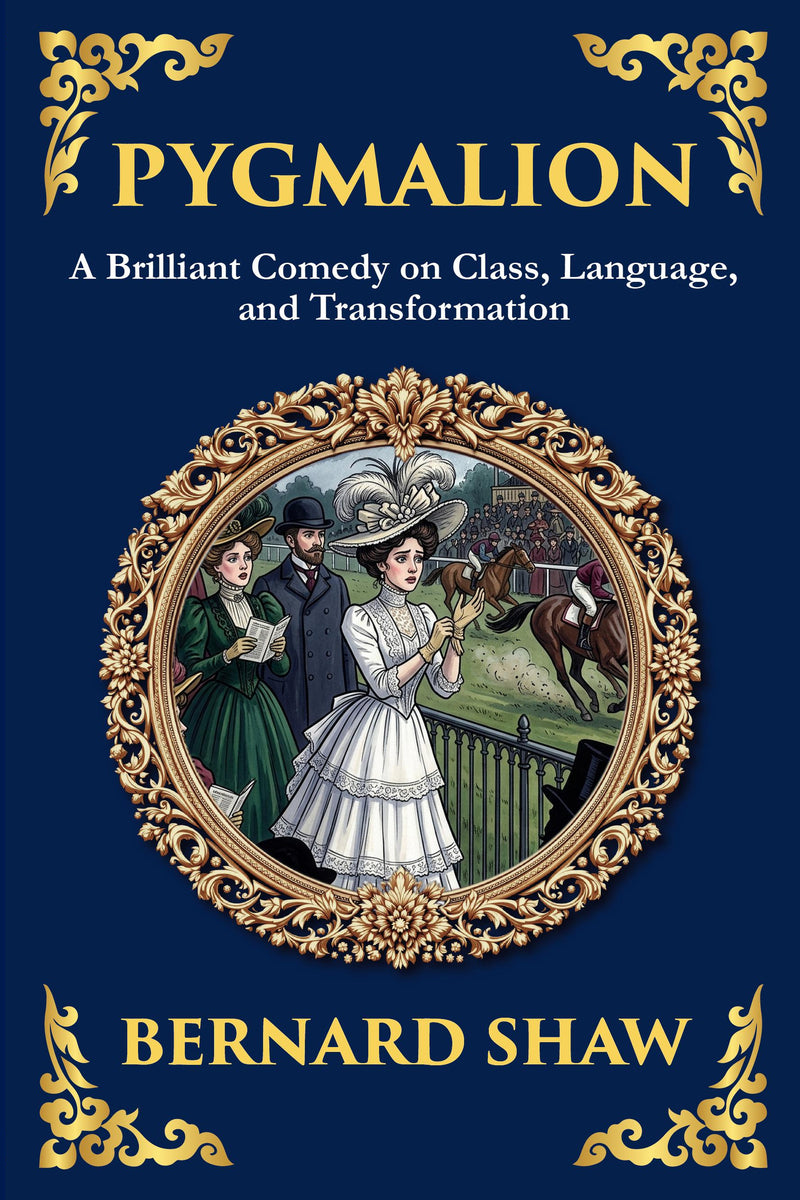
Pygmalion — Large Print
Step into the witty and provocative world of Pygmalion, where class, identity, and transformation collide in one of Bernard Shaw’s most enduring plays.
or free app
10,000+ hrs library
30-day guarantee
The complete Pygmalion appears in modern English through Library of Alexandria Press, available online with audiobook narration included for members.
Have you ever wondered why the way we speak can shape the way we are seen—and even who we become? In Pygmalion, Bernard Shaw delivers a brilliant and biting social comedy that explores the transformative power of language—and the rigid structures of class that language often upholds. At the heart of this play is Eliza Doolittle, a spirited young flower girl who dreams of something more.
When the arrogant Professor Higgins boasts that he can turn her into a duchess simply by refining her speech, Eliza takes the challenge—and so begins one of literature’s most famous makeovers. But what starts as a phonetic experiment soon unravels into something much more complicated. As Eliza asserts her independence and questions the terms of her transformation, Shaw turns a simple premise into a sharp critique of classism, sexism, and social hypocrisy.
What you’ll discover in this modern edition
- A Sharp Satire of Class and Privilege – Shaw skewers the British class system with humor and precision.
- A Heroine Who Defies Expectations – Eliza Doolittle evolves from subject to self- determined woman in a story of agency and empowerment.
- A Timeless Exploration of Identity – What defines us: how we speak, how we act, or how we are perceived?
- Hilarious and Thought-Provoking Dialogue – Shaw’s wit sparkles through every line, blending comedy with commentary.
- A Play That Continues to Inspire – Adapted into the beloved musical My Fair Lady, Pygmalion remains a cultural cornerstone on both stage and screen.
| Formats | eBook (EPUB + PDF) · Audiobook · Paperback · Hardcover · Large Print |
| Language | English |
| Trim size (print) | 6 × 9 in |
| Binding | Paperback — perfect-bound · Hardcover — casewrap |
| Large Print edition | Same text in a larger, easy-read type — a larger font, not a larger trim |
| Print pricing | Every physical book at our true cost — at-cost, no profit (members) |
| Library | 873 restored titles, always growing |
| Length | 35,292 words · ~2 hr 21 min reading |
| Reading level | Grade 3 · an easy, flowing read (this modern-English edition) |
| Edition | Modern English translation · 2026 |
Member reviews for this edition are collected as readers finish it — be the first. Across the library: 12,000+ books shipped, every plan covered by a 365-day print guarantee.
About this edition
A faithful, unabridged modern-English edition by The Library of Alexandria — carefully rendered for today's reader and verified paragraph-by-paragraph against the public-domain source. Available as eBook, audiobook, paperback, hardcover, and large print.
- Complete & unabridgedVerified paragraph by paragraph against the source — never a scan, never abridged.
- Modern English, faithfulReadable today, with the author’s meaning kept intact. Readable — not simplified.
- Every format, one membershipRead in your browser or the free app, or listen to the full audiobook.
Included free with your membership
Cancel anytime, one click · 30-day money-back guarantee
Edition last updated July 2026
What’s inside
Pygmalion — Large Print — complete and unabridged: all 7 sections included with membership, plus the full audiobook.
Begin reading Pygmalion — Large Print
In clear modern English — the complete text is included with membership.
Introduction
There are few plays in the English language as quietly revolutionary as the one you are about to read. On its glittering surface, it appears to be a witty drawing-room comedy—a sparkling battle of wits between a brilliant, boorish professor and the spirited flower girl he resolves to transform. But beneath that polished exterior lies one of the most subversive examinations of social inequality ever committed to the stage. Bernard Shaw did not simply write a story about teaching someone to speak. He wrote a savage, hilarious, and ultimately tender indictment of how we judge one another, of the arbitrary markers we mistake for character, and of the strange and uncomfortable question of what we owe to those whose lives we presume to improve.
To open this book is to step into the foggy, gaslit streets of Edwardian London at the precise moment when the old certainties of the British class system were beginning to crack. It is a world in which a person’s destiny could be read in the consonants they dropped and the vowels they flattened, where an accent functioned as both a prison and a passport. Shaw understood this world intimately, and he attacked its absurdities with a weapon far more dangerous than outrage: laughter. The genius of what follows is that it makes you laugh at the very moment it is teaching you to think, and it teaches you to think at the very moment you believe you are simply being entertained.
This modern edition has been carefully prepared for the contemporary reader, with the goal of preserving every ounce of Shaw’s wit, intelligence, and moral force while ensuring that nothing in the language or staging conventions of a bygone era stands between you and the brilliance of his ideas. What has not changed—what could never change—is the electric crackle of the dialogue, the vividness of the characters, and the audacity of a writer who believed that the theater should not merely amuse its audience but provoke, challenge, and ultimately transform them. Just as the play itself is a story of transformation, so too is the experience of reading it: you will not finish it quite the same person who began it.
A Playwright Who Made Mischief His Mission
To understand the play, it helps to understand the singular figure who created it. Bernard Shaw—who famously dropped his first name, George, in adult life, preferring simply “Bernard Shaw” or the initials “G.B.S.”—was perhaps the most quotable, most contrarian, and most relentlessly provocative public intellectual of his age. Born in Dublin in 1856 into a family of declining respectability, he grew up acutely aware of the gap between social pretension and economic reality. His father’s failures and the family’s precarious gentility gave the young Shaw an early, intimate education in the great theme that would animate so much of his work: the absurdity of a system in which appearances mattered more than substance, and in which the right manners and the right speech could open doors that talent and virtue alone could not.
Shaw was, by his own cheerful admission, an outsider and an agitator. He arrived in London in his early twenties an awkward, impoverished, self-conscious young man, and he set about reinventing himself with a thoroughness that no character in any of his plays ever quite matched. He educated himself in the reading rooms of the British Museum, devouring economics, philosophy, music, and politics. He became a committed socialist, a founding member of the Fabian Society, and a tireless lecturer on street corners and in public halls, honing the rhetorical gifts that would later make his dialogue crackle with such intelligence. He was a music and theater critic of formidable wit, a vegetarian, a teetotaler, and a man who delighted in puncturing the comfortable assumptions of polite society at every available opportunity.
What makes Shaw so essential—and what makes the play in your hands so enduring—is that he refused to separate his art from his ideas. He believed passionately that drama could be a vehicle for serious thought, that a play could ask its audience to reconsider the foundations of their world even as it kept them laughing in their seats. This was no easy balance to strike, and lesser writers who attempted it produced lectures dressed up as entertainment. Shaw, by contrast, possessed a comic genius so natural and so abundant that his philosophy never weighed his plays down. His characters argue, scheme, and bicker with such vitality that we forget we are being instructed at all. He smuggled his radicalism into the West End theater under the cover of comedy, and audiences cheerfully paid to be challenged by the very ideas that, stated baldly from a soapbox, they might have walked past in the street.
By the time he wrote this play, first staged in 1913, Shaw was already a celebrated and controversial figure. He would go on to win the Nobel Prize in Literature in 1925, an honor he accepted with characteristic ambivalence, and he remains the only person ever to have won both a Nobel Prize and an Academy Award—the latter for his work on the screen adaptation of this very play. He lived to the remarkable age of ninety-four, writing and provoking almost until the end, and he left behind a body of work that includes some of the most performed and beloved plays in the English language. Yet of all his many creations, it is this one that has most thoroughly entered the bloodstream of popular culture, inspiring stage musicals, films, and countless imitations and variations across more than a century.
It is worth pausing on that fact, because it illuminates something important about the nature of Shaw’s achievement. The play has been so frequently adapted, so often sweetened and softened for popular consumption, that many people believe they know its story even if they have never read a word of the original. They carry in their minds a version smoothed over by sentiment, simplified into a familiar romance. Part of the pleasure—and the surprise—of encountering Shaw’s actual text is discovering how much sharper, stranger, and more uncompromising it is than its many descendants. Shaw himself was fiercely protective of his intentions and grew increasingly irritated as audiences and adaptors tried to bend his work toward conventional happy endings. He had something more difficult and more honest in mind, and reading the play as he wrote it allows you to recover that original vision in all its bracing intelligence.
The title of this play points us toward an ancient story, and understanding that story enriches everything that follows. In Greek and Roman mythology, Pygmalion was a sculptor who carved a statue of a woman so beautiful and so perfect that he fell in love with his own creation. In the most famous version of the tale, told by the Roman poet Ovid in his Metamorphoses, Pygmalion prays to the goddess of love, and his prayer is answered: the statue comes to life, and the sculptor marries the woman he has made. It is a fantasy of creation and possession, of the artist who shapes a being according to his own desire and then claims her as his reward.
Shaw, ever the contrarian, took this ancient myth and turned it on its head. He was intrigued by the premise—the idea of one person transforming another, of shaping a human being as an artist shapes raw material—but he was deeply suspicious of the mythological conclusion. For Shaw, the most interesting question was not whether the creator could fall in love with his creation, but what happened when the creation turned out to be a living human being with a will, a mind, and a soul of her own. What happens when the statue does not merely come to life but begins to think for herself? What happens when she resents her maker, demands her independence, and refuses to be the trophy that the myth says she ought to become?
This is the brilliant inversion at the heart of the play. Shaw takes the comforting old fable of the artist and his creation and exposes the troubling assumptions buried within it. He asks us to consider the ethics of transformation, the responsibilities that come with the power to reshape another person, and the rights of the person being reshaped. The professor who undertakes to transform a poor flower girl into something resembling a fine lady is, in a sense, a modern Pygmalion. But Shaw refuses to let him—or us—off easily. The “statue” he creates is no passive object of his genius; she is a vivid, intelligent, fiercely proud human being, and the drama of the play arises precisely from her refusal to remain the thing her creator intended her to be.
There is something deeply modern, even feminist, in this reworking, and it is one of the reasons the play continues to feel so alive. Long before such concerns became commonplace, Shaw was interrogating the dynamics of power, ownership, and gender that the original myth took for granted. He was asking what it means to “improve” another person, and whether the improver has any right to expect gratitude, devotion, or compliance in return. He was probing the uncomfortable space between mentorship and manipulation, between generosity and control. And he was doing all of this while writing a comedy so funny and so fast-moving that audiences hardly noticed the philosophical depth charges he was setting off beneath their feet.
The myth also provides a key to one of the play’s central preoccupations: the relationship between the surface and the substance of a person. A statue, after all, is all surface—beautiful, perhaps, but empty. The question Shaw poses is whether the transformation his characters undertake is merely a matter of surface, of polished manners and corrected speech, or whether it touches something deeper. Can a person truly be remade from the outside in? Or does genuine transformation require something more, something that no amount of training or instruction can supply? These are the questions that linger long after the final page, and they are questions that the mythological framework brings into sharp and resonant focus.
Language, Class, and the Architecture of a Society
If there is one idea that the play insists upon above all others, it is the extraordinary power of language to determine human destiny. Shaw was fascinated by phonetics—the study of the sounds of speech—and he counted among his friends and influences some of the leading phoneticians of his day. He saw, with a clarity that few of his contemporaries shared, that in the rigidly stratified society of Edwardian Britain, the way a person spoke was the single most decisive marker of their social standing. An accent was not merely a quirk of regional or class background; it was a sentence, in both senses of the word—a structure of grammar and a verdict of fate.
In the world of the play, a person’s vowels could disqualify them from employment, from respectable society, from the simple dignity of being taken seriously. The flower girl who sells her wares in the street is condemned not by any failing of intelligence or character but by the sounds that come out of her mouth. Shaw understood that this was both monstrous and absurd, and he set out to dramatize it with all the force of his comic and intellectual gifts. The premise of the play—that a phonetics expert could, through rigorous training, pass off a poor girl as a duchess simply by changing the way she speaks—is at once a delicious comic conceit and a devastating piece of social criticism. For if a person’s entire standing in the world can be altered by something as superficial as pronunciation, then what does that say about the foundations of the social order itself?
Shaw’s point is radical and unmistakable: the distinctions of class that his society treated as natural, permanent, and almost sacred were in fact arbitrary, learned, and entirely changeable. The difference between a lady and a flower girl, he suggests, is not a difference of essence but a difference of treatment. It is a matter of how a person is spoken to, how they are dressed, how they are perceived and addressed by others. This was a profoundly threatening idea to a society that liked to believe its hierarchies were rooted in something deeper than habit and prejudice. And Shaw drives it home not through argument but through demonstration, allowing us to watch the transformation unfold and to draw our own unsettling conclusions.
Cancel anytime, one click · 30-day money-back guarantee
Founding annual rate available now — your price locks for life when you join.
Not ready? Get this free chapter by email — read it anytime.
✓ Sent — check your inbox for Pygmalion — Large Print.
Questions about Pygmalion — Large Print
What is Pygmalion about?
Step into the witty and provocative world of Pygmalion, where class, identity, and transformation collide in one of Bernard Shaw’s most enduring plays. When Professor Henry Higgins wagers he can transform Eliza Doolittle—a Cockney flower girl—into a refined lady through the power of speech, he sets off a social experiment neither fully understands. But as Eliza blossoms beyond even his expectations, the line between student and teacher, creation and creator, begins to blur.
Who wrote Pygmalion?
Pygmalion was written by Bernard Shaw. This edition presents the complete work in clear modern English, faithfully rendered from the public-domain original by Library of Alexandria Press.
Is Pygmalion free to read?
The opening chapter is free to read on this page. Members read and listen to the complete work — and the entire library — free, and can order any physical book at our true print cost.
How long is Pygmalion?
7 chapters (~35,292 words) — about 2 hr 21 min of reading in this modern-English edition.
Is this an abridged version of Pygmalion?
No. This is the complete, unabridged Pygmalion, carefully rendered into clear modern English and verified paragraph-by-paragraph against the public-domain source — nothing is cut or summarised.
What formats does Pygmalion come in?
Pygmalion is available as eBook, paperback, hardcover and large print. eBook and audiobook are included with membership; printed editions ship at our true print cost.
Shipping & returns
Billing & membership
More from the library


Explore Poetry & Drama
- As You Like It · William Shakespeare
- The Raven · Edgar Allan Poe
- The Merchant of Venice · William Shakespeare
- A Midsummer Night’s Dream · William Shakespeare
- Romeo and Juliet · William Shakespeare
- The Imaginary Invalid · Molière
- A Woman of No Importance · Oscar Wilde
- Gitanjali · Rabindranath Tagore
- Sonnets from the Portuguese · Elizabeth Barrett Browning
- The New Life (La Vita Nuova) · Dante Alighieri
- The Rime of the Ancient Mariner · Samuel Taylor Coleridge
- Lady Windermere’s Fan · Oscar Wilde
- The Home Book of Verse — Volume 4 · Burton Egbert Stevenson
- Ghosts · Henrik Ibsen
- Mrs. Warren’s Profession · Bernard Shaw
- An Enemy of the People · Henrik Ibsen
- Gawayne and the Green Knight: A Fairy Tale · Charlton M. Lewis
- The Nibelungenlied · G. H. Needler
- Julius Caesar · William Shakespeare
- The Aeneid of Virgil · Virgil
- Troilus and Criseyde · Geoffrey Chaucer
- The Post Office · Rabindranath Tagore
- Lamia · John Keats
- The Ballad of the White Horse · G. K. Chesterton
- A Shropshire Lad · A. E. Housman
- The Birth of the War-God: A Poem by Kalidasa · Kálidása
- Riders to the Sea · J. M. Synge
- The Prophet · Kahlil Gibran
- Twelfth Night; Or, What You Will · William Shakespeare
- Othello, the Moor of Venice · William Shakespeare
Pygmalion — Large Print
Pygmalion — Large Print
A Brilliant Comedy on Class, Language, and Transformation
Bernard Shaw
Contents
- Introduction
- Preface to Pygmalion
- Act 1, Scene 1
- Act 2, Scene 1
- Act 3, Scene 1
- Act 4, Scene 1
- Act 5, Scene 1
Introduction
There are few plays in the English language as quietly revolutionary as the one you are about to read. On its glittering surface, it appears to be a witty drawing-room comedy—a sparkling battle of wits between a brilliant, boorish professor and the spirited flower girl he resolves to transform. But beneath that polished exterior lies one of the most subversive examinations of social inequality ever committed to the stage. Bernard Shaw did not simply write a story about teaching someone to speak. He wrote a savage, hilarious, and ultimately tender indictment of how we judge one another, of the arbitrary markers we mistake for character, and of the strange and uncomfortable question of what we owe to those whose lives we presume to improve.
To open this book is to step into the foggy, gaslit streets of Edwardian London at the precise moment when the old certainties of the British class system were beginning to crack. It is a world in which a person’s destiny could be read in the consonants they dropped and the vowels they flattened, where an accent functioned as both a prison and a passport. Shaw understood this world intimately, and he attacked its absurdities with a weapon far more dangerous than outrage: laughter. The genius of what follows is that it makes you laugh at the very moment it is teaching you to think, and it teaches you to think at the very moment you believe you are simply being entertained.
This modern edition has been carefully prepared for the contemporary reader, with the goal of preserving every ounce of Shaw’s wit, intelligence, and moral force while ensuring that nothing in the language or staging conventions of a bygone era stands between you and the brilliance of his ideas. What has not changed—what could never change—is the electric crackle of the dialogue, the vividness of the characters, and the audacity of a writer who believed that the theater should not merely amuse its audience but provoke, challenge, and ultimately transform them. Just as the play itself is a story of transformation, so too is the experience of reading it: you will not finish it quite the same person who began it.
A Playwright Who Made Mischief His Mission
To understand the play, it helps to understand the singular figure who created it. Bernard Shaw—who famously dropped his first name, George, in adult life, preferring simply “Bernard Shaw” or the initials “G.B.S.”—was perhaps the most quotable, most contrarian, and most relentlessly provocative public intellectual of his age. Born in Dublin in 1856 into a family of declining respectability, he grew up acutely aware of the gap between social pretension and economic reality. His father’s failures and the family’s precarious gentility gave the young Shaw an early, intimate education in the great theme that would animate so much of his work: the absurdity of a system in which appearances mattered more than substance, and in which the right manners and the right speech could open doors that talent and virtue alone could not.
Shaw was, by his own cheerful admission, an outsider and an agitator. He arrived in London in his early twenties an awkward, impoverished, self-conscious young man, and he set about reinventing himself with a thoroughness that no character in any of his plays ever quite matched. He educated himself in the reading rooms of the British Museum, devouring economics, philosophy, music, and politics. He became a committed socialist, a founding member of the Fabian Society, and a tireless lecturer on street corners and in public halls, honing the rhetorical gifts that would later make his dialogue crackle with such intelligence. He was a music and theater critic of formidable wit, a vegetarian, a teetotaler, and a man who delighted in puncturing the comfortable assumptions of polite society at every available opportunity.
What makes Shaw so essential—and what makes the play in your hands so enduring—is that he refused to separate his art from his ideas. He believed passionately that drama could be a vehicle for serious thought, that a play could ask its audience to reconsider the foundations of their world even as it kept them laughing in their seats. This was no easy balance to strike, and lesser writers who attempted it produced lectures dressed up as entertainment. Shaw, by contrast, possessed a comic genius so natural and so abundant that his philosophy never weighed his plays down. His characters argue, scheme, and bicker with such vitality that we forget we are being instructed at all. He smuggled his radicalism into the West End theater under the cover of comedy, and audiences cheerfully paid to be challenged by the very ideas that, stated baldly from a soapbox, they might have walked past in the street.
By the time he wrote this play, first staged in 1913, Shaw was already a celebrated and controversial figure. He would go on to win the Nobel Prize in Literature in 1925, an honor he accepted with characteristic ambivalence, and he remains the only person ever to have won both a Nobel Prize and an Academy Award—the latter for his work on the screen adaptation of this very play. He lived to the remarkable age of ninety-four, writing and provoking almost until the end, and he left behind a body of work that includes some of the most performed and beloved plays in the English language. Yet of all his many creations, it is this one that has most thoroughly entered the bloodstream of popular culture, inspiring stage musicals, films, and countless imitations and variations across more than a century.
It is worth pausing on that fact, because it illuminates something important about the nature of Shaw’s achievement. The play has been so frequently adapted, so often sweetened and softened for popular consumption, that many people believe they know its story even if they have never read a word of the original. They carry in their minds a version smoothed over by sentiment, simplified into a familiar romance. Part of the pleasure—and the surprise—of encountering Shaw’s actual text is discovering how much sharper, stranger, and more uncompromising it is than its many descendants. Shaw himself was fiercely protective of his intentions and grew increasingly irritated as audiences and adaptors tried to bend his work toward conventional happy endings. He had something more difficult and more honest in mind, and reading the play as he wrote it allows you to recover that original vision in all its bracing intelligence.
The title of this play points us toward an ancient story, and understanding that story enriches everything that follows. In Greek and Roman mythology, Pygmalion was a sculptor who carved a statue of a woman so beautiful and so perfect that he fell in love with his own creation. In the most famous version of the tale, told by the Roman poet Ovid in his Metamorphoses, Pygmalion prays to the goddess of love, and his prayer is answered: the statue comes to life, and the sculptor marries the woman he has made. It is a fantasy of creation and possession, of the artist who shapes a being according to his own desire and then claims her as his reward.
Shaw, ever the contrarian, took this ancient myth and turned it on its head. He was intrigued by the premise—the idea of one person transforming another, of shaping a human being as an artist shapes raw material—but he was deeply suspicious of the mythological conclusion. For Shaw, the most interesting question was not whether the creator could fall in love with his creation, but what happened when the creation turned out to be a living human being with a will, a mind, and a soul of her own. What happens when the statue does not merely come to life but begins to think for herself? What happens when she resents her maker, demands her independence, and refuses to be the trophy that the myth says she ought to become?
This is the brilliant inversion at the heart of the play. Shaw takes the comforting old fable of the artist and his creation and exposes the troubling assumptions buried within it. He asks us to consider the ethics of transformation, the responsibilities that come with the power to reshape another person, and the rights of the person being reshaped. The professor who undertakes to transform a poor flower girl into something resembling a fine lady is, in a sense, a modern Pygmalion. But Shaw refuses to let him—or us—off easily. The “statue” he creates is no passive object of his genius; she is a vivid, intelligent, fiercely proud human being, and the drama of the play arises precisely from her refusal to remain the thing her creator intended her to be.
There is something deeply modern, even feminist, in this reworking, and it is one of the reasons the play continues to feel so alive. Long before such concerns became commonplace, Shaw was interrogating the dynamics of power, ownership, and gender that the original myth took for granted. He was asking what it means to “improve” another person, and whether the improver has any right to expect gratitude, devotion, or compliance in return. He was probing the uncomfortable space between mentorship and manipulation, between generosity and control. And he was doing all of this while writing a comedy so funny and so fast-moving that audiences hardly noticed the philosophical depth charges he was setting off beneath their feet.
The myth also provides a key to one of the play’s central preoccupations: the relationship between the surface and the substance of a person. A statue, after all, is all surface—beautiful, perhaps, but empty. The question Shaw poses is whether the transformation his characters undertake is merely a matter of surface, of polished manners and corrected speech, or whether it touches something deeper. Can a person truly be remade from the outside in? Or does genuine transformation require something more, something that no amount of training or instruction can supply? These are the questions that linger long after the final page, and they are questions that the mythological framework brings into sharp and resonant focus.
Language, Class, and the Architecture of a Society
If there is one idea that the play insists upon above all others, it is the extraordinary power of language to determine human destiny. Shaw was fascinated by phonetics—the study of the sounds of speech—and he counted among his friends and influences some of the leading phoneticians of his day. He saw, with a clarity that few of his contemporaries shared, that in the rigidly stratified society of Edwardian Britain, the way a person spoke was the single most decisive marker of their social standing. An accent was not merely a quirk of regional or class background; it was a sentence, in both senses of the word—a structure of grammar and a verdict of fate.
In the world of the play, a person’s vowels could disqualify them from employment, from respectable society, from the simple dignity of being taken seriously. The flower girl who sells her wares in the street is condemned not by any failing of intelligence or character but by the sounds that come out of her mouth. Shaw understood that this was both monstrous and absurd, and he set out to dramatize it with all the force of his comic and intellectual gifts. The premise of the play—that a phonetics expert could, through rigorous training, pass off a poor girl as a duchess simply by changing the way she speaks—is at once a delicious comic conceit and a devastating piece of social criticism. For if a person’s entire standing in the world can be altered by something as superficial as pronunciation, then what does that say about the foundations of the social order itself?
Shaw’s point is radical and unmistakable: the distinctions of class that his society treated as natural, permanent, and almost sacred were in fact arbitrary, learned, and entirely changeable. The difference between a lady and a flower girl, he suggests, is not a difference of essence but a difference of treatment. It is a matter of how a person is spoken to, how they are dressed, how they are perceived and addressed by others. This was a profoundly threatening idea to a society that liked to believe its hierarchies were rooted in something deeper than habit and prejudice. And Shaw drives it home not through argument but through demonstration, allowing us to watch the transformation unfold and to draw our own unsettling conclusions.
Covent Garden at 11: p.m. Heavy summer rain is pouring down. Taxi whistles are blowing frantically in every direction. Pedestrians are rushing for cover in the market and under the porch of St. Paul’s Church, where several people are already gathered, including a woman and her daughter in evening gowns. They are all staring gloomily at the rain, except for one man with his back to the group, who seems completely absorbed in a notebook he is busily writing in.
The church clock strikes the first quarter.
THE DAUGHTER [standing between the central pillars, close to the one on her left] I’m freezing. What is Freddy doing? He’s been gone for twenty minutes.
THE MOTHER [to her daughter’s right] Not that long. But he should have found us a cab by now.
A BYSTANDER [to the lady’s right] He won’t find a cab until half-past eleven, ma’am, when they come back after dropping off the theater crowds.
THE MOTHER. But we need a cab. We can’t just stand here until half-past eleven. This is awful.
THE BYSTANDER. Well, it ain’t my fault, ma’am.
THE DAUGHTER. If Freddy had any common sense, he would have grabbed one at the theater door.
THE MOTHER. What could he have done, poor boy?
THE DAUGHTER. Other people got cabs. Why couldn’t he?
Freddy rushes in from the rain from the Southampton Street side, stepping between them as he closes a dripping umbrella. He is a twenty-year-old man in evening dress, and his ankles are soaked.
FREDDY. There isn’t one to be had for love or money.
THE MOTHER. Oh, Freddy, there must be one. You couldn’t have tried everywhere.
THE DAUGHTER. This is ridiculous. Do you expect us to go find one ourselves?
End of the free sample
Keep reading, free
Members read and listen to the complete book — and the entire library. Cancel anytime, one click · 30-day money-back guarantee.