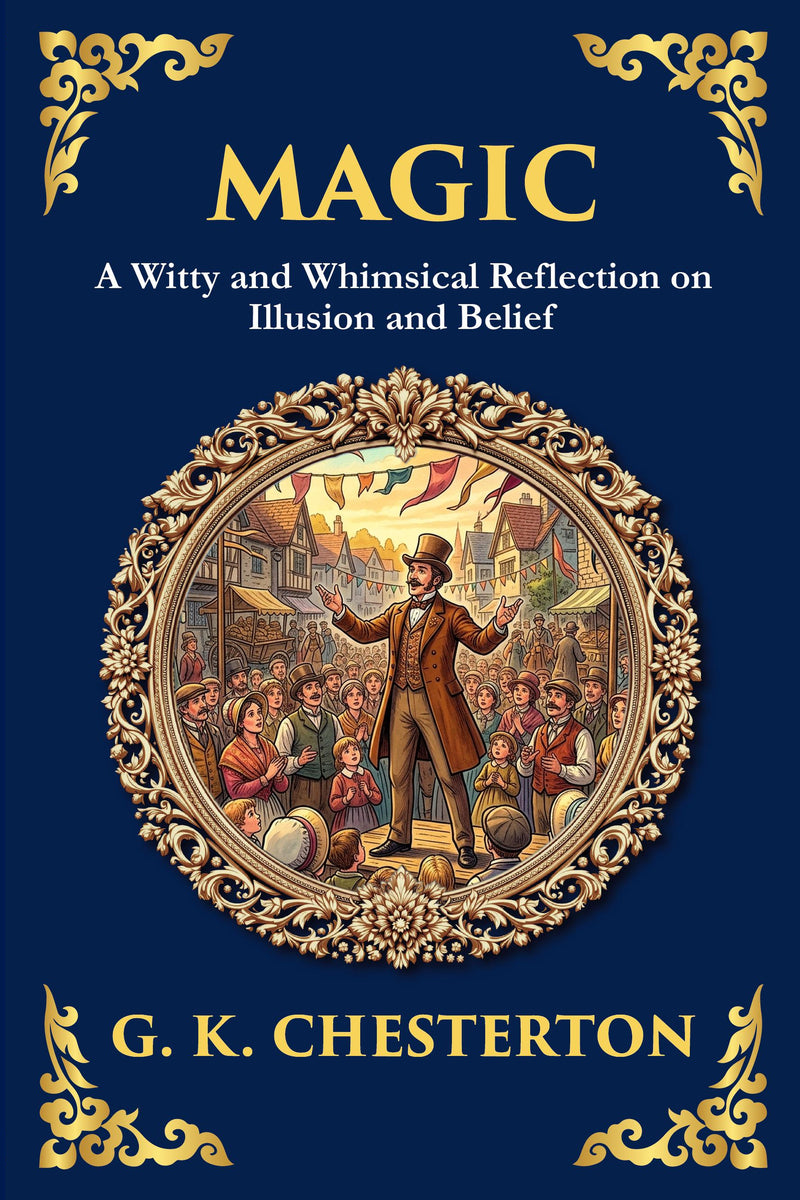
Magic
In this brilliant and thought-provoking play, G. K. Chesterton blends wit, humor, and philosophical insight to examine the tension between skepticism and faith, illusion and truth.
or free app
10,000+ hrs library
30-day guarantee
The complete Magic appears in modern English through Library of Alexandria Press, available online with audiobook narration included for members.
Have you ever wondered why a simple magic trick can open a doorway to profound philosophical reflection? Magic by G. K. Chesterton is a clever and enchanting play that invites readers to step into a world where wit and wonder collide. Written in 1913, this theatrical masterpiece offers more than entertainment; it’s a sparkling meditation on reason, faith, skepticism, and the mysteries that underpin human existence.
Set in the drawing room of an English country house, the story follows a visiting conjurer whose illusions unsettle the intellectual and spiritual certainties of those around him. As humor and debate swirl, Chesterton crafts a narrative that’s part comedy, part parable, and entirely timeless. This slim yet profound play highlights his genius for blending lighthearted storytelling with deep philosophical insight.
What you’ll discover in this modern edition
- A Masterpiece of Wit and Wisdom – Chesterton’s trademark humor softens but never diminishes his bold exploration of truth and belief.
- An Engaging Theatrical Experience – Enjoy a lively and memorable play that’s as entertaining to read as it is to perform.
- A Philosophical Debate on Illusion – Delve into questions of reason, faith, and perception through sharp dialogue and clever scenarios.
- A Glimpse into Edwardian Culture and Thought – Explore Chesterton’s keen observations on society, belief, and skepticism.
- Timeless Themes for Modern Readers – Whether you’re drawn to its humor or its depth, Magic remains strikingly relevant.
| Formats | eBook (EPUB + PDF) · Audiobook · Paperback · Hardcover · Large Print |
| Language | English |
| Trim size (print) | 6 × 9 in |
| Binding | Paperback — perfect-bound · Hardcover — casewrap |
| Large Print edition | Same text in a larger, easy-read type — a larger font, not a larger trim |
| Print pricing | Every physical book at our true cost — at-cost, no profit (members) |
| Library | 873 restored titles, always growing |
| Length | 16,204 words · ~1 hr 5 min reading |
| Reading level | Grade 4 · an easy, flowing read (this modern-English edition) |
| Edition | Modern English translation · 2026 |
Member reviews for this edition are collected as readers finish it — be the first. Across the library: 12,000+ books shipped, every plan covered by a 365-day print guarantee.
About this edition
A faithful, unabridged modern-English edition by The Library of Alexandria — carefully rendered for today's reader and verified paragraph-by-paragraph against the public-domain source. Available as eBook, audiobook, paperback, hardcover, and large print.
- Complete & unabridgedVerified paragraph by paragraph against the source — never a scan, never abridged.
- Modern English, faithfulReadable today, with the author’s meaning kept intact. Readable — not simplified.
- Every format, one membershipRead in your browser or the free app, or listen to the full audiobook.
Included free with your membership
Cancel anytime, one click · 30-day money-back guarantee
Edition last updated July 2026
What’s inside
Magic — complete and unabridged: all 4 sections included with membership, plus the full audiobook.
Begin reading Magic
In clear modern English — the complete text is included with membership.
Introduction
There are writers who argue, and there are writers who enchant, and then there is the rare creature who manages to do both at once, slipping a philosophical argument into your pocket while you are too busy laughing to notice. Gilbert Keith Chesterton belonged firmly to this last and most delightful category. He was a man of enormous physical bulk and even more enormous intellectual appetite, a journalist who wrote on everything, a debater who treated argument as a form of friendship, and a thinker who insisted, against the whole grain of his clever age, that wonder was not childish but the very thing that made adults worth talking to. When such a man turned his hand to the stage, the result was not a tidy little drawing-room comedy but something stranger, sharper, and more haunting — a play that begins with a parlor trick and ends by tapping its finger gently but firmly on the locked door of the unknown.
This work occupies a peculiar and rather glorious place in his enormous body of work. It was his first produced play, written when he was already famous for his essays, his criticism, his Father Brown stories, and his blazing public arguments with the leading minds of the day. He came to the theater late and almost by accident, and he came to it as a man who had spent years thinking about exactly the questions that the play would dramatize: What do we actually believe? What do we only pretend to believe? And what happens to a confident, modern, sensible person when something occurs that their confident, modern, sensible worldview cannot explain away? The play is short — it can be read in a single sitting, and was meant to be performed in a single evening — but it carries a weight far beyond its modest length. It is the work of a heavyweight thinker who has decided, with characteristic mischief, to do his heaviest thinking in the lightest possible costume.
What follows is an attempt to prepare you for the experience without spoiling it, to hand you a lantern before you step into a room that is deliberately kept half in shadow. There will be no betrayal of the story’s turns here, for the pleasure of this particular drama lies precisely in not knowing where the floor will give way beneath you. Instead, let us consider the man who wrote it, the strange and serious game he is playing with you, and the reasons this small play has refused to fade in the more than a century since it was first performed before a startled and delighted audience.
To understand why this play feels the way it does, it helps to understand the extraordinary mind that produced it. Chesterton was born in 1874 in London, into a comfortable middle-class family, and he came of age in a period drunk on its own progress. The late Victorian and Edwardian world was a world of railways and electric light, of confident science and confident skepticism, a world in which a great many intelligent people had quietly concluded that the universe was a machine, that miracles were superstition, that religion was a charming relic, and that the educated modern person had finally grown up and put away childish things. It was an age that prided itself on having explained the mystery out of life.
Chesterton spent his entire career arguing, with tremendous good humor and even greater stubbornness, that this was exactly backwards. He believed that the modern world had not grown up but had instead fallen asleep — that it had explained so much that it had forgotten how astonishing it was that there was anything to explain at all. His great gift, the thing that runs like a bright thread through everything he wrote, was the capacity to make the familiar strange again. He could look at a lamppost, a piece of cheese, a fairy tale, or a railway timetable and suddenly make you see the dizzying miracle of its existence. He famously argued that the man who said “the sun rises every morning because of natural law” had merely fallen into a habit, while the child who clapped and cried “do it again!” had seen the truth: that the sun rising is a perpetual, deliberate, almost theatrical wonder.
This is the temperament you must bring into the theater with you. The play before you is not a casual entertainment dashed off by a busy man. It is a deliberate ambush, set by someone who had thought longer and harder than almost anyone of his generation about the precise question it asks. Chesterton had watched the spiritualist crazes of his time, the séances and the table-rappings, the eager believers and the smug debunkers, and he had concluded that both sides were missing something. The believers were often gullible; the debunkers were often blind. What fascinated him was the curious psychology of certainty itself — the way people cling to their explanations not because the explanations are proven but because the alternative is too unsettling to bear.
He was also, it must be said, one of the funniest serious men who ever lived. His humor was never decoration; it was a tool, a way of getting past the reader’s defenses. A solemn argument can be resisted, dismissed, filed away. A joke gets in under the door. Chesterton used wit the way a good doctor uses a sugar coating on a difficult medicine, and the play is full of this technique. Its characters are sharply, often hilariously drawn — the bluff skeptic, the earnest idealist, the worldly clergyman, the bewildered patriarch — and much of the early dialogue crackles with the kind of exchange that makes you grin in recognition. But the laughter is doing work. It is lowering your guard, drawing you in, settling you comfortably into your chair — so that when the temperature in the room begins to change, you have nowhere to hide.
It is worth pausing on the fact that this was a man who, just a few years before writing for the stage, had published a defense of his entire view of life that argued passionately for the necessity of mystery, the danger of pure rationalism, and the strange truth that the maddest people are often the most relentlessly logical. He observed that the madman is not the man who has lost his reason but the man who has lost everything except his reason — who has constructed a perfectly tight, perfectly sane-sounding explanation that happens to leave out the whole of reality. The play turns this insight into living drama. It places before us people who pride themselves on being reasonable, and then it shows us what reason looks like when it is asked to do something it cannot do: account for the inexplicable.
This modern adaptation has been prepared with the aim of letting that timeless quality shine through without the friction of period idiom standing between you and the wit. Chesterton’s original dialogue, brilliant as it is, was written for an Edwardian ear, full of the rhythms and references of its moment. The intention here is not to flatten his voice — that would be a crime against one of the great prose stylists in the English language — but to clear away the small obstacles that might otherwise slow a contemporary reader, so that the speed and surprise of his argument can land with the force he intended. The paradoxes are all his. The mischief is all his. What this edition offers is a clearer pane of glass through which to watch him work.
At the heart of this play lies an argument, but it is not the sort of argument that can be settled by anyone shouting louder. It is the oldest quarrel there is, the one between the disenchanted and the enchanted, between those who believe the world is exactly what it appears to be and those who suspect it is hiding something. Chesterton sets this quarrel inside a single house over the course of a single evening, and he populates that house with a small, carefully chosen cast of people who each represent a different way of facing the unexplained.
The brilliance of his structure is that he refuses to give anyone an easy victory. The skeptic in this play is not a fool. He is intelligent, articulate, and in many ways admirable, and his demand for evidence is the demand of a reasonable man. The believer is not a saint of pure faith but a complicated, modern, slightly tangled soul whose belief is mixed with sentiment and confusion. The figure of the conjurer — the man who performs the magic, or appears to — is the most fascinating of all, because he occupies the dangerous middle ground. He is a professional of illusion. His entire livelihood depends on the fact that what looks like magic is really skill and deception. He knows, better than anyone in the room, how easily people are fooled. And precisely because he knows this, he becomes the most reliable witness to the moment when fooling stops and something else begins.
This is the trap Chesterton has built, and it is a beautiful one. We tend to assume that the person most likely to believe in the supernatural is the credulous innocent, and the person least likely is the hardened cynic. The play scrambles this assumption thoroughly. It suggests that real wonder, when it comes, comes most powerfully to the people who thought they were immune to it. The man who has spent his life manufacturing fake miracles is in some ways the only person properly equipped to recognize a real one — and to be properly terrified by it.
Because that, ultimately, is the great theme: not magic as spectacle, but belief as a moral and psychological condition. The play asks what it does to a person to be confronted with proof of something they have spent their whole life denying. It asks whether we actually want our skepticism to be vindicated, or whether we secretly hope it will be shattered. It asks why the supernatural, when it draws near, so often inspires not joy but dread. And underneath all of this it asks a question that has only grown more urgent in the century since: in a world that has decided it knows how everything works, what becomes of the part of us that still longs for the world to be more than a machine?
Chesterton was acutely aware that the disenchantment of his age came at a cost. He saw that when people stop believing in genuine wonder, they do not stop believing in nothing — they start believing in anything, or in the next confident explanation handed to them, or in their own infallible reason. He was not, it must be stressed, arguing for gullibility. He had no patience for the cheap mysticism and fashionable occultism of his day, which he regarded as a sort of spiritual junk food. His position was both more subtle and more bracing: that the universe is genuinely mysterious, that this mystery is good news rather than bad, and that the truly humble response to existence is to keep the door of wonder open while refusing to be deceived by every charlatan who knocks at it.
The play dramatizes this balance with remarkable economy. In the space of a short evening, it walks its characters — and us — right up to the edge of the inexplicable and forces them to decide what they will do there. Some retreat into denial. Some collapse into superstition. The play watches them with affection and with a kind of merciless clarity, never letting any of them off the hook, never letting us off the hook either. For the audience is not a passive observer here. We, too, are being asked the central question. We, too, are watching the parlor trick and wondering, against our better judgment, whether it might be more than a trick. And we, too, must reckon with our own reaction — with the strange way that the human heart leaps at the possibility of the impossible and then, almost in the same instant, flinches away from it in fear.
There is a particular pleasure in watching a great essayist write dialogue, because the form forces him to do something his essays never had to do: to give his opponents their full and living voice. In an essay, Chesterton could argue against the materialist and the skeptic and always have the last word. On the stage, he must let them speak for themselves, embody them, make them flesh and breath and wit. And he does so with surprising generosity. The skeptical, scientific characters in this play are not straw men. Their arguments are real arguments, and they are given real force. This is what makes the play more than propaganda. It is a genuine drama of ideas, in which the ideas are alive precisely because they are at war, and in which the outcome is left, in the most important sense, for you to decide.
Cancel anytime, one click · 30-day money-back guarantee
Founding annual rate available now — your price locks for life when you join.
Not ready? Get this free chapter by email — read it anytime.
✓ Sent — check your inbox for Magic.
Questions about Magic
What is Magic about?
In this brilliant and thought-provoking play, G. K. Chesterton blends wit, humor, and philosophical insight to examine the tension between skepticism and faith, illusion and truth. Magic tells the story of a mysterious conjurer whose tricks spark debates that go beyond sleight of hand, challenging characters—and readers—to see beyond appearances. Playful, profound, and deeply entertaining, Chesterton’s work invites us to consider whether the real magic lies not in tricks, but in the mysteries of life itself.
Who wrote Magic?
Magic was written by G. K. Chesterton. This edition presents the complete work in clear modern English, faithfully rendered from the public-domain original by Library of Alexandria Press.
Is Magic free to read?
The opening chapter is free to read on this page. Members read and listen to the complete work — and the entire library — free, and can order any physical book at our true print cost.
How long is Magic?
4 chapters (~16,204 words) — about 1 hr 5 min of reading in this modern-English edition.
Is this an abridged version of Magic?
No. This is the complete, unabridged Magic, carefully rendered into clear modern English and verified paragraph-by-paragraph against the public-domain source — nothing is cut or summarised.
What formats does Magic come in?
Magic is available as eBook, paperback, hardcover and large print. eBook and audiobook are included with membership; printed editions ship at our true print cost.
Shipping & returns
Billing & membership
More from the library


Explore Poetry & Drama
- As You Like It · William Shakespeare
- The Raven · Edgar Allan Poe
- The Merchant of Venice · William Shakespeare
- A Midsummer Night’s Dream · William Shakespeare
- Romeo and Juliet · William Shakespeare
- The Imaginary Invalid · Molière
- A Woman of No Importance · Oscar Wilde
- Gitanjali · Rabindranath Tagore
- Sonnets from the Portuguese · Elizabeth Barrett Browning
- The New Life (La Vita Nuova) · Dante Alighieri
- The Rime of the Ancient Mariner · Samuel Taylor Coleridge
- Lady Windermere’s Fan · Oscar Wilde
- The Home Book of Verse — Volume 4 · Burton Egbert Stevenson
- Ghosts · Henrik Ibsen
- Mrs. Warren’s Profession · Bernard Shaw
- An Enemy of the People · Henrik Ibsen
- Gawayne and the Green Knight: A Fairy Tale · Charlton M. Lewis
- The Nibelungenlied · G. H. Needler
- Julius Caesar · William Shakespeare
- The Aeneid of Virgil · Virgil
- Troilus and Criseyde · Geoffrey Chaucer
- The Post Office · Rabindranath Tagore
- Lamia · John Keats
- The Ballad of the White Horse · G. K. Chesterton
- A Shropshire Lad · A. E. Housman
- The Birth of the War-God: A Poem by Kalidasa · Kálidása
- Riders to the Sea · J. M. Synge
- The Prophet · Kahlil Gibran
- Twelfth Night; Or, What You Will · William Shakespeare
- Othello, the Moor of Venice · William Shakespeare
Magic
Magic
A Witty and Whimsical Reflection on Illusion and Belief
G. K. Chesterton
Contents
- Introduction
- Chapter 1
- Chapter 2
- Chapter 3
Introduction
There are writers who argue, and there are writers who enchant, and then there is the rare creature who manages to do both at once, slipping a philosophical argument into your pocket while you are too busy laughing to notice. Gilbert Keith Chesterton belonged firmly to this last and most delightful category. He was a man of enormous physical bulk and even more enormous intellectual appetite, a journalist who wrote on everything, a debater who treated argument as a form of friendship, and a thinker who insisted, against the whole grain of his clever age, that wonder was not childish but the very thing that made adults worth talking to. When such a man turned his hand to the stage, the result was not a tidy little drawing-room comedy but something stranger, sharper, and more haunting — a play that begins with a parlor trick and ends by tapping its finger gently but firmly on the locked door of the unknown.
This work occupies a peculiar and rather glorious place in his enormous body of work. It was his first produced play, written when he was already famous for his essays, his criticism, his Father Brown stories, and his blazing public arguments with the leading minds of the day. He came to the theater late and almost by accident, and he came to it as a man who had spent years thinking about exactly the questions that the play would dramatize: What do we actually believe? What do we only pretend to believe? And what happens to a confident, modern, sensible person when something occurs that their confident, modern, sensible worldview cannot explain away? The play is short — it can be read in a single sitting, and was meant to be performed in a single evening — but it carries a weight far beyond its modest length. It is the work of a heavyweight thinker who has decided, with characteristic mischief, to do his heaviest thinking in the lightest possible costume.
What follows is an attempt to prepare you for the experience without spoiling it, to hand you a lantern before you step into a room that is deliberately kept half in shadow. There will be no betrayal of the story’s turns here, for the pleasure of this particular drama lies precisely in not knowing where the floor will give way beneath you. Instead, let us consider the man who wrote it, the strange and serious game he is playing with you, and the reasons this small play has refused to fade in the more than a century since it was first performed before a startled and delighted audience.
To understand why this play feels the way it does, it helps to understand the extraordinary mind that produced it. Chesterton was born in 1874 in London, into a comfortable middle-class family, and he came of age in a period drunk on its own progress. The late Victorian and Edwardian world was a world of railways and electric light, of confident science and confident skepticism, a world in which a great many intelligent people had quietly concluded that the universe was a machine, that miracles were superstition, that religion was a charming relic, and that the educated modern person had finally grown up and put away childish things. It was an age that prided itself on having explained the mystery out of life.
Chesterton spent his entire career arguing, with tremendous good humor and even greater stubbornness, that this was exactly backwards. He believed that the modern world had not grown up but had instead fallen asleep — that it had explained so much that it had forgotten how astonishing it was that there was anything to explain at all. His great gift, the thing that runs like a bright thread through everything he wrote, was the capacity to make the familiar strange again. He could look at a lamppost, a piece of cheese, a fairy tale, or a railway timetable and suddenly make you see the dizzying miracle of its existence. He famously argued that the man who said “the sun rises every morning because of natural law” had merely fallen into a habit, while the child who clapped and cried “do it again!” had seen the truth: that the sun rising is a perpetual, deliberate, almost theatrical wonder.
This is the temperament you must bring into the theater with you. The play before you is not a casual entertainment dashed off by a busy man. It is a deliberate ambush, set by someone who had thought longer and harder than almost anyone of his generation about the precise question it asks. Chesterton had watched the spiritualist crazes of his time, the séances and the table-rappings, the eager believers and the smug debunkers, and he had concluded that both sides were missing something. The believers were often gullible; the debunkers were often blind. What fascinated him was the curious psychology of certainty itself — the way people cling to their explanations not because the explanations are proven but because the alternative is too unsettling to bear.
He was also, it must be said, one of the funniest serious men who ever lived. His humor was never decoration; it was a tool, a way of getting past the reader’s defenses. A solemn argument can be resisted, dismissed, filed away. A joke gets in under the door. Chesterton used wit the way a good doctor uses a sugar coating on a difficult medicine, and the play is full of this technique. Its characters are sharply, often hilariously drawn — the bluff skeptic, the earnest idealist, the worldly clergyman, the bewildered patriarch — and much of the early dialogue crackles with the kind of exchange that makes you grin in recognition. But the laughter is doing work. It is lowering your guard, drawing you in, settling you comfortably into your chair — so that when the temperature in the room begins to change, you have nowhere to hide.
It is worth pausing on the fact that this was a man who, just a few years before writing for the stage, had published a defense of his entire view of life that argued passionately for the necessity of mystery, the danger of pure rationalism, and the strange truth that the maddest people are often the most relentlessly logical. He observed that the madman is not the man who has lost his reason but the man who has lost everything except his reason — who has constructed a perfectly tight, perfectly sane-sounding explanation that happens to leave out the whole of reality. The play turns this insight into living drama. It places before us people who pride themselves on being reasonable, and then it shows us what reason looks like when it is asked to do something it cannot do: account for the inexplicable.
This modern adaptation has been prepared with the aim of letting that timeless quality shine through without the friction of period idiom standing between you and the wit. Chesterton’s original dialogue, brilliant as it is, was written for an Edwardian ear, full of the rhythms and references of its moment. The intention here is not to flatten his voice — that would be a crime against one of the great prose stylists in the English language — but to clear away the small obstacles that might otherwise slow a contemporary reader, so that the speed and surprise of his argument can land with the force he intended. The paradoxes are all his. The mischief is all his. What this edition offers is a clearer pane of glass through which to watch him work.
At the heart of this play lies an argument, but it is not the sort of argument that can be settled by anyone shouting louder. It is the oldest quarrel there is, the one between the disenchanted and the enchanted, between those who believe the world is exactly what it appears to be and those who suspect it is hiding something. Chesterton sets this quarrel inside a single house over the course of a single evening, and he populates that house with a small, carefully chosen cast of people who each represent a different way of facing the unexplained.
The brilliance of his structure is that he refuses to give anyone an easy victory. The skeptic in this play is not a fool. He is intelligent, articulate, and in many ways admirable, and his demand for evidence is the demand of a reasonable man. The believer is not a saint of pure faith but a complicated, modern, slightly tangled soul whose belief is mixed with sentiment and confusion. The figure of the conjurer — the man who performs the magic, or appears to — is the most fascinating of all, because he occupies the dangerous middle ground. He is a professional of illusion. His entire livelihood depends on the fact that what looks like magic is really skill and deception. He knows, better than anyone in the room, how easily people are fooled. And precisely because he knows this, he becomes the most reliable witness to the moment when fooling stops and something else begins.
This is the trap Chesterton has built, and it is a beautiful one. We tend to assume that the person most likely to believe in the supernatural is the credulous innocent, and the person least likely is the hardened cynic. The play scrambles this assumption thoroughly. It suggests that real wonder, when it comes, comes most powerfully to the people who thought they were immune to it. The man who has spent his life manufacturing fake miracles is in some ways the only person properly equipped to recognize a real one — and to be properly terrified by it.
Because that, ultimately, is the great theme: not magic as spectacle, but belief as a moral and psychological condition. The play asks what it does to a person to be confronted with proof of something they have spent their whole life denying. It asks whether we actually want our skepticism to be vindicated, or whether we secretly hope it will be shattered. It asks why the supernatural, when it draws near, so often inspires not joy but dread. And underneath all of this it asks a question that has only grown more urgent in the century since: in a world that has decided it knows how everything works, what becomes of the part of us that still longs for the world to be more than a machine?
Chesterton was acutely aware that the disenchantment of his age came at a cost. He saw that when people stop believing in genuine wonder, they do not stop believing in nothing — they start believing in anything, or in the next confident explanation handed to them, or in their own infallible reason. He was not, it must be stressed, arguing for gullibility. He had no patience for the cheap mysticism and fashionable occultism of his day, which he regarded as a sort of spiritual junk food. His position was both more subtle and more bracing: that the universe is genuinely mysterious, that this mystery is good news rather than bad, and that the truly humble response to existence is to keep the door of wonder open while refusing to be deceived by every charlatan who knocks at it.
The play dramatizes this balance with remarkable economy. In the space of a short evening, it walks its characters — and us — right up to the edge of the inexplicable and forces them to decide what they will do there. Some retreat into denial. Some collapse into superstition. The play watches them with affection and with a kind of merciless clarity, never letting any of them off the hook, never letting us off the hook either. For the audience is not a passive observer here. We, too, are being asked the central question. We, too, are watching the parlor trick and wondering, against our better judgment, whether it might be more than a trick. And we, too, must reckon with our own reaction — with the strange way that the human heart leaps at the possibility of the impossible and then, almost in the same instant, flinches away from it in fear.
There is a particular pleasure in watching a great essayist write dialogue, because the form forces him to do something his essays never had to do: to give his opponents their full and living voice. In an essay, Chesterton could argue against the materialist and the skeptic and always have the last word. On the stage, he must let them speak for themselves, embody them, make them flesh and breath and wit. And he does so with surprising generosity. The skeptical, scientific characters in this play are not straw men. Their arguments are real arguments, and they are given real force. This is what makes the play more than propaganda. It is a genuine drama of ideas, in which the ideas are alive precisely because they are at war, and in which the outcome is left, in the most important sense, for you to decide.
Scene: A grove of thin young trees during a misty, rainy twilight; patches of woodland flowers are visible on the ground between the trunks.
The Stranger appears, wearing a cloak and a pointed hood. His outfit could be from any era, and the conical hood is pulled so far down that his face is barely visible.
A woman’s voice is heard in the distance, half-singing and half-chanting words that cannot be understood. The cloaked figure looks up and listens with interest. As the singing gets closer, Patricia Carleon enters. She is slight with dark features and a dreamy look. Although her clothes are artistic, her hair is a bit messy. She is holding a broken branch from a flowering tree. She doesn’t notice the stranger, and although he watches her curiously, he doesn’t make a sound. Suddenly, she notices him and jumps back.
Stranger. Ah! Who am I? [He begins muttering to himself, using his staff to mark patterns on the ground.]
Patricia. What are you? What are you talking about?
Stranger. It is the language of the fairies, daughter of Eve.
Patricia. I never imagined fairies looked like you. You’re actually taller than I am.
Stranger. We can be whatever size we choose. But elves shrink rather than grow when they want to mingle with humans.
Patricia. You mean they are more powerful beings than we are.
Stranger. Daughter of men, if you want to see a fairy as he truly is, imagine his head above all the stars and his feet on the ocean floor. Old women have taught you that fairies are too small to be seen. But I tell you they are too powerful to be seen. They are the ancient gods, and compared to them, giants were like pygmies. They are the Elemental Spirits, and any one of them is larger than the world. Yet you look for them in acorns and on toadstools, and then you wonder why you never find them.
End of the free sample
Keep reading, free
Members read and listen to the complete book — and the entire library. Cancel anytime, one click · 30-day money-back guarantee.