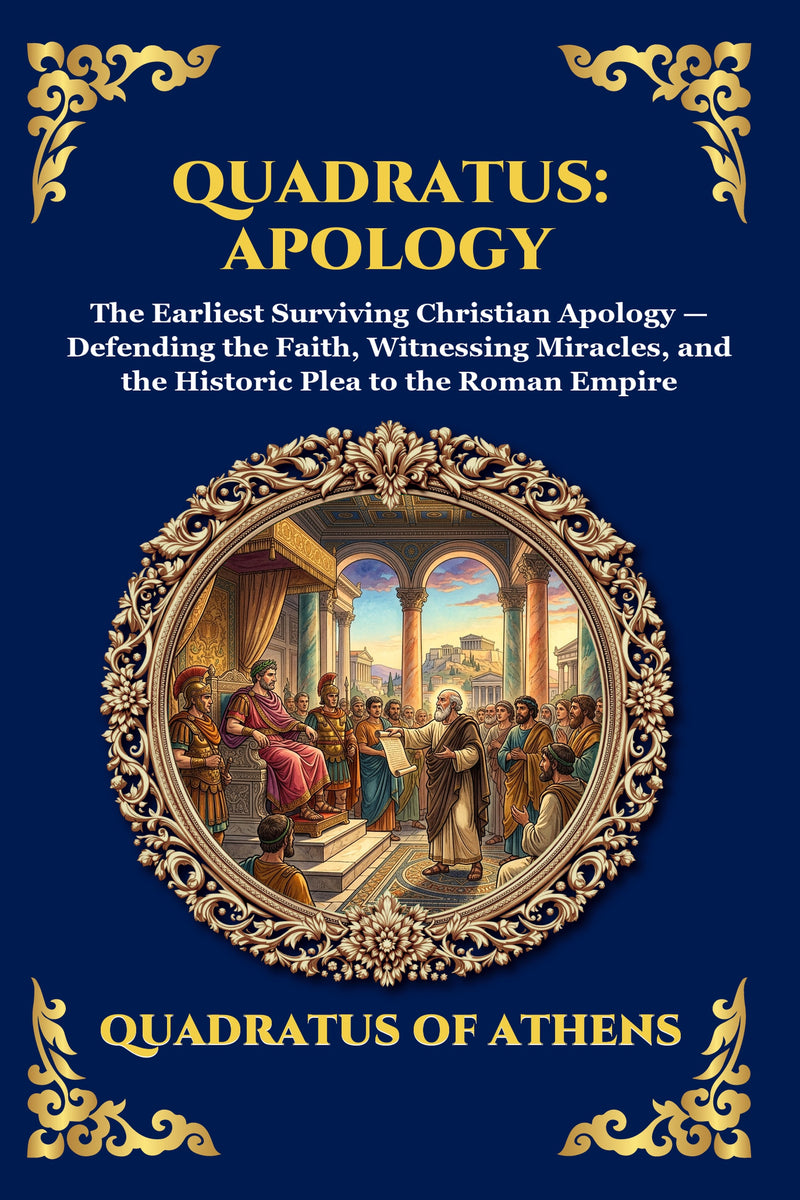
Quadratus: Apology — Large Print
In 125 AD, Quadratus, Bishop of Athens, presented a bold defense of Christianity to Emperor Hadrian, seeking protection for his persecuted community. This earliest known Christian apology, largely lost to history, survives in fragments that reveal a reasoned argument for faith amidst hostility.
or free app
10,000+ hrs library
30-day guarantee
This complete modern-English translation of Quadratus: Apology presents the surviving fragments from c. 125 AD, readable online with audiobook narration included for members.
Large Print Edition. The complete, unabridged text set in a larger, easy-on-the-eyes typeface for comfortable reading.
Have you ever wondered why the earliest Christians felt compelled to defend their faith to the Roman Emperor, or what evidence they used to prove their beliefs to a hostile world?
The Apology of Quadratus provides a compelling modern exploration of the earliest known Christian apology. Written around 125 AD by Quadratus, Bishop of Athens, and presented to Emperor Hadrian, this historic document was crafted during a time of intense vulnerability for the early church. Seeking to protect his flock from mob violence and unjust persecution, Quadratus took a bold stand, offering a reasoned and powerful defense of the Christian way of life.
Though only a profound fragment of this monumental work survives today—preserved through the writings of the ancient historian Eusebius—its impact is immeasurable. Quadratus did not rely on philosophical abstraction or mere theological theory; instead, he pointed to the undeniable, historical reality of Christ's miracles. He famously noted that those healed and raised from the dead survived long into his own era as living, undeniable proof of the divine, challenging the emperor to look at the facts of history rather than the rumors of the mob.
What You Will Discover in This Modern Translation:
The First Defense of the Faith Explore the historical context of the very first written apology, understanding how early believers argued for their legal and spiritual right to exist in a pagan empire.
The Witnesses of Miracles Read the striking testimony that points to the actual survivors of Jesus's miracles, emphasizing the historical, grounded nature of early Christian claims.
The Reign of Emperor Hadrian Gain a deeper understanding of the political and cultural landscape of the Roman Empire during the early second century, and the unique challenges faced by the church in Athens.
A Window into Early Christian Apologetics Discover the foundational arguments that paved the way for future defenders of the faith, establishing a tradition of intellectual and historical defense that would span centuries.
Whether you are exploring this work for its immense historical value, its theological significance, or its inspiring testament to the courage of the early church, The Apology of Quadratus offers wisdom and inspiration that remain vital today.
Step into a story of unparalleled bravery and discover the timeless legacy of Quadratus of Athens. Begin your journey today.
| Formats | eBook (EPUB + PDF) · Audiobook · Paperback · Hardcover · Large Print |
| Language | English |
| Trim size (print) | 6 × 9 in |
| Binding | Paperback — perfect-bound · Hardcover — casewrap |
| Large Print edition | Same text in a larger, easy-read type — a larger font, not a larger trim |
| Print pricing | Every physical book at our true cost — at-cost, no profit (members) |
| Library | 873 restored titles, always growing |
| Composed | c. 125 AD |
| Original language | Greek |
| Source tradition | Patristic quotations, primarily Eusebius |
| Translation basis | Public-domain scholarly translation, rendered in clear modern English |
| Length | 3,590 words · ~14 min reading |
| Edition | Modern English translation · 2026 |
Member reviews for this edition are collected as readers finish it — be the first. Across the library: 12,000+ books shipped, every plan covered by a 365-day print guarantee.
About this edition
The complete, unabridged text in clear modern English — faithful to the original, never simplified. Every paragraph is checked against the source, so nothing is cut, summarised, or paraphrased away. It reads cleanly for today while keeping the original meaning intact.
Preserved primarily through quotations in Eusebius's Ecclesiastical History and other patristic sources. This edition draws from the standard public-domain scholarly collections of apostolic fathers and renders the fragments in clear modern English.
- Complete & unabridgedVerified paragraph by paragraph against the source — never a scan, never abridged.
- Modern English, faithfulReadable today, with the author’s meaning kept intact. Readable — not simplified.
- Every format, one membershipRead in your browser or the free app, or listen to the full audiobook.
Included free with your membership
Cancel anytime, one click · 30-day money-back guarantee
Edition last updated June 2026
What’s inside
Quadratus: Apology — Large Print — complete and unabridged, included in full with membership, plus the full audiobook.
Begin reading Quadratus: Apology — Large Print
In clear modern English — the complete text is included with membership.
Introduction
Imagine holding in your hands the oldest surviving piece of Christian apologetic writing in existence. Not a fragment recovered from a desert cave, not a quotation preserved in amber by some later scholar's footnote, but an actual plea — urgent, reasoned, and deeply personal — addressed directly to the most powerful man on earth. That is precisely what you are about to read. The document before you is small in physical size, a mere handful of sentences as we have it today, and yet its historical and theological weight is almost impossible to overstate. It is a letter that crossed the threshold between a persecuted minority faith and the Roman imperial court, written at a moment when Christianity was still young enough that people who had personally witnessed the miracles of Jesus were, according to its author, still alive and walking among ordinary citizens.
The author is a man named Quadratus, and almost everything about him is wrapped in the tantalizing mist of early church history. We know his name. We know he was a Christian. We know he wrote an apology — in the ancient sense of the word, meaning a formal defense rather than an expression of regret — addressed to the Emperor Hadrian, who ruled the Roman Empire from 117 to 138 CE. And we know, because the great church historian Eusebius of Caesarea preserved a fragment of this text in his monumental Ecclesiastical History, that the apology contained at least one extraordinary claim: that some of the people healed and raised from the dead by Jesus were still living in Quadratus's own time, available as living witnesses to the truth of what the Christians proclaimed. Beyond these facts, the historical record grows thin, contested, and wonderfully open to interpretation.
But thinness of the record does not mean poverty of significance. If anything, the scarcity of what we know about Quadratus makes what we do know more luminous, more charged with meaning. Every surviving word becomes precious. Every contextual detail that historians and scholars have labored to reconstruct over centuries becomes a window into a world that was, in many ways, as turbulent, as pluralistic, and as religiously anxious as our own. The Roman Empire of the early second century was a vast, multiethnic, multilingual civilization that had absorbed dozens of religious traditions and was perpetually negotiating the boundaries between toleration and suppression, between civic religion and personal belief, between the demands of the state and the convictions of the conscience.
Christianity, in this world, was a newcomer — suspect, misunderstood, and frequently the target of popular hostility and official suspicion. The followers of Jesus were accused of atheism because they refused to honor the traditional gods. They were accused of cannibalism because of misunderstandings about the Eucharist. They were accused of immorality because their love feasts were held in private. They were accused of disloyalty because they would not sacrifice to the imperial genius. Into this atmosphere of suspicion and danger, Quadratus stepped forward with a pen and a courage that is easy to underestimate from the comfortable distance of two millennia. He wrote to the emperor not in desperation or in anger, but in the measured, confident tones of a man who believed that reason and evidence were on his side — and who believed that the emperor, if properly informed, would recognize the injustice being done to his community.
This introduction aims to do several things. It aims to place Quadratus and his work in their proper historical context, to explain why this document matters not just as a curiosity of church history but as a living artifact of one of the most consequential moments in Western civilization. It aims to explore what we know — and what we can reasonably infer — about the man himself, about the emperor to whom he wrote, and about the community he was defending. And it aims to prepare you, the reader, to encounter the text itself with the full appreciation it deserves: not as a dry relic, but as a human voice speaking across nearly nineteen centuries with a clarity and a passion that can still move us today.
There is something almost cinematic about the situation Quadratus found himself in. The Roman Empire was at the height of its power and geographical extent. Hadrian, the emperor he addressed, was one of the most intellectually sophisticated rulers Rome ever produced — a man who loved Greek culture, who wrote poetry, who traveled ceaselessly through his empire, who built the Pantheon in Rome and a magnificent villa at Tivoli, and who was genuinely curious about the diverse peoples and beliefs he encountered. He was not, by any account, a reflexive persecutor. And yet Christians in his empire continued to suffer. Local magistrates applied old laws. Mob violence flared. The simple fact of bearing the name 'Christian' could be enough to bring a person before a court.
Quadratus understood that the problem was, at its root, a problem of information and perception. The emperor and his advisors did not truly know what Christians believed or how they lived. They were operating on rumors, on caricatures, on the hostile testimony of enemies. If someone could simply explain, clearly and calmly, who the Christians actually were and what they actually taught — if someone could demonstrate that they were not criminals, not subversives, not enemies of civilization, but in fact its best and most virtuous citizens — then perhaps justice could be done. This is the wager that Quadratus made. It is a wager that subsequent apologists — Justin Martyr, Athenagoras, Tertullian, Origen — would make again and again in the centuries that followed. But Quadratus made it first. He pioneered a genre that would shape the intellectual history of Christianity for generations.
To read his apology, even in its fragmentary state, is to witness the birth of a tradition. And traditions, like people, are best understood by attending carefully to their beginnings.
The World That Shaped a Voice
To understand Quadratus, you must first understand the world he inhabited — a world so different from our own in its surface details and yet so recognizable in its deeper dynamics that reading about it can feel like looking into a distorting mirror that nevertheless shows you something true about your own reflection.
The early second century CE was a period of relative stability in the Roman Empire, at least compared to the chaos that had preceded and would follow it. The so-called Five Good Emperors — Nerva, Trajan, Hadrian, Antoninus Pius, and Marcus Aurelius — presided over what Edward Gibbon famously called the period in which 'the condition of the human race was most happy and prosperous.' This is, of course, a romanticized assessment that ignores the experiences of slaves, conquered peoples, and religious minorities. But it captures something real about the era's administrative competence, its cultural vitality, and its relative freedom from the worst kinds of political terror.
Hadrian, the emperor to whom Quadratus wrote, came to power in 117 CE following the death of Trajan. He was a complex and contradictory figure. He pulled back from some of Trajan's aggressive military expansionism, consolidating rather than extending the empire's borders — hence the famous wall in Britain that still bears his name. He was deeply philhellenic, spending enormous energy and resources on beautifying Athens and other Greek cities. He was a patron of the arts and a practitioner of them. He was also capable of great cruelty: he suppressed the Bar Kokhba revolt in Judea with devastating thoroughness, killing hundreds of thousands of Jews and renaming Jerusalem as Aelia Capitolina, a Roman city from which Jews were forbidden. The man Quadratus addressed was capable of both enlightened curiosity and brutal repression — which is precisely what made writing to him both possible and necessary.
The legal situation of Christians under Hadrian was defined largely by a rescript — an official imperial response to a legal inquiry — that Hadrian had issued to Minucius Fundanus, the proconsul of Asia. This document, preserved by Eusebius and sometimes appended to early apologies, instructed Roman officials not to act on anonymous accusations against Christians and to ensure that any charges were properly substantiated before punishment was administered. It was not a declaration of tolerance, still less of approval. But it was a check on the worst kinds of mob-driven persecution. It suggested that Hadrian was at least somewhat open to the idea that Christians deserved the same procedural protections as other subjects of the empire.
Into this opening — this crack of possibility — Quadratus inserted his apology. The timing was deliberate. The scholarly consensus places the composition of the text sometime during Hadrian's reign, with many scholars suggesting it was presented to the emperor during one of his travels through Asia Minor or during a visit to Athens, where Quadratus may have been a church leader. Eusebius, writing in the early fourth century, identifies Quadratus as a disciple of the apostles — meaning not that he knew Jesus personally, but that he had learned from those who had. This places him in the second generation of Christian leadership, a figure of considerable authority and antiquity even by the standards of his own time.
The city of Athens, if that is indeed where the apology was presented, adds another layer of resonance to the document. Athens was the intellectual capital of the ancient world, the city of Socrates and Plato, of the Areopagus where Paul had famously preached decades earlier. It was a city that prided itself on philosophical sophistication and the free exchange of ideas. It was also a city with a powerful civic religion, a dense web of temples and festivals and priestly offices that bound together the social fabric. For a Christian to stand up in Athens and defend his faith was to engage with the deepest currents of classical civilization — to claim, implicitly, that the Christian message was not a barbarian superstition but a rational and defensible account of reality.
This is what makes the apologetic tradition so fascinating and so important. The apologists were not simply defending themselves against persecution, though they were certainly doing that. They were also engaging in a profound act of cultural translation, arguing that Christianity could be understood in terms that educated Greeks and Romans would recognize and respect. They drew on the vocabulary of philosophy, on concepts like logos and virtue and providence, on the rhetorical conventions of the educated elite. They were building bridges between two worlds, and in doing so they were helping to create the synthesis of Jewish, Greek, and Roman elements that would become the foundation of Western Christian civilization.
Quadratus stands at the very beginning of this process. He was, as far as we know, the first person to attempt it in writing at this level — addressing not a local magistrate or a hostile crowd, but the emperor himself, the symbolic and actual center of the known world. The audacity of this act deserves to be savored. He was a member of a community that was widely despised, legally vulnerable, and socially marginal. And he wrote to the most powerful man alive and said, in effect: you are making a mistake. We deserve better. Here is why.
The social world of early Christianity is also crucial background for reading this text. The Christians of the early second century were not yet the dominant cultural force they would become. They were a scattered network of communities, meeting in private homes, bound together by shared scriptures, shared rituals, and shared identity. They came from diverse backgrounds — Jewish and Gentile, slave and free, educated and illiterate, urban and rural. They were united by their conviction that Jesus of Nazareth had been raised from the dead and that this event had changed everything: the nature of God's relationship with humanity, the meaning of history, the hope for the future.
Cancel anytime, one click · 30-day money-back guarantee
Founding annual rate available now — your price locks for life when you join.
Not ready? Get this free chapter by email — read it anytime.
✓ Sent — check your inbox for Quadratus: Apology — Large Print.
Questions about Quadratus: Apology — Large Print
What survives of Quadratus's Apology?
Only fragments of Quadratus's Apology survive, primarily preserved through quotations by later church historians like Eusebius. The most substantial fragment discusses Christ's miracles and their lasting effects on those who witnessed them.
Why was Quadratus's Apology written?
Quadratus wrote his Apology around 125 AD as a defense of Christianity presented to Emperor Hadrian, seeking to counter persecution and misconceptions about Christian beliefs through reasoned argument and historical testimony.
Is Quadratus's Apology considered authentic early Christian literature?
Scholars generally accept the authenticity of the surviving fragments of Quadratus's Apology as genuine early Christian apologetic literature, representing the earliest known formal defense of Christianity to Roman imperial authority.
Shipping & returns
Billing & membership
More from the library


Explore Early Church Writings
- Didascalia · Attributed to early Christian c...
- Martyrdom of Perpetua and Felicitas · Attributed to Vibia Perpetua
- Martyrdom of Pionius
- Apostolic Canons · Attributed to Clement of Rome
- Polycarp to the Philippians · Attributed to Polycarp of Smyrna
- Ignatius of Antioch: Seven Letters · Attributed to Ignatius of Antioch
- Epistle of Peter to James · Attributed to the Apostle Peter
- 1–4 Maccabees · Various Jewish authors
- Apostolic Fathers · Various early Christian authors
- Letter of Lentulus
- Apostolic Tradition · Attributed to Hippolytus of Rome
- Hegesippus: Memoirs · Attributed to Hegesippus
- Quadratus: Apology · Attributed to Quadratus of Athens
- Martyrdom of Polycarp · Attributed to the Church of Smyrna
- Letter to Diognetus
- Book of the Rolls · Attributed to Clement
- Book of the Bee · Attributed to Solomon of Akhlat
- Martyrdom of Matthew · Attributed to Pseudo-Abdias
- Martyrdom of Andrew · Attributed to various early Chr...
- Martyrdom of Paul · Attributed to early Christian a...
- Martyrdom of Peter · Attributed to Leucius Charinus
- Preaching of Paul · Attributed to the Apostle Paul
- On the Eucharist B · Attributed to St. Ambrose of Milan
- On the Eucharist A · Attributed to St. Ambrose of Milan
- On the Baptism B · Attributed to St. Augustine
- On the Baptism A · Attributed to Tertullian of Car...
- On the Anointing · Various early Christian theolog...
- Letter of Clement to James · Attributed to Clement of Rome
- Clementine Homilies · Attributed to Clement of Rome
- Clementine Recognitions · Attributed to Clement of Rome
Quadratus: Apology — Large Print
Quadratus: Apology — Large Print
Attributed to Quadratus of Athens
Contents
- Introduction
- Chapter 1
Introduction
Imagine holding in your hands the oldest surviving piece of Christian apologetic writing in existence. Not a fragment recovered from a desert cave, not a quotation preserved in amber by some later scholar's footnote, but an actual plea — urgent, reasoned, and deeply personal — addressed directly to the most powerful man on earth. That is precisely what you are about to read. The document before you is small in physical size, a mere handful of sentences as we have it today, and yet its historical and theological weight is almost impossible to overstate. It is a letter that crossed the threshold between a persecuted minority faith and the Roman imperial court, written at a moment when Christianity was still young enough that people who had personally witnessed the miracles of Jesus were, according to its author, still alive and walking among ordinary citizens.
The author is a man named Quadratus, and almost everything about him is wrapped in the tantalizing mist of early church history. We know his name. We know he was a Christian. We know he wrote an apology — in the ancient sense of the word, meaning a formal defense rather than an expression of regret — addressed to the Emperor Hadrian, who ruled the Roman Empire from 117 to 138 CE. And we know, because the great church historian Eusebius of Caesarea preserved a fragment of this text in his monumental Ecclesiastical History, that the apology contained at least one extraordinary claim: that some of the people healed and raised from the dead by Jesus were still living in Quadratus's own time, available as living witnesses to the truth of what the Christians proclaimed. Beyond these facts, the historical record grows thin, contested, and wonderfully open to interpretation.
But thinness of the record does not mean poverty of significance. If anything, the scarcity of what we know about Quadratus makes what we do know more luminous, more charged with meaning. Every surviving word becomes precious. Every contextual detail that historians and scholars have labored to reconstruct over centuries becomes a window into a world that was, in many ways, as turbulent, as pluralistic, and as religiously anxious as our own. The Roman Empire of the early second century was a vast, multiethnic, multilingual civilization that had absorbed dozens of religious traditions and was perpetually negotiating the boundaries between toleration and suppression, between civic religion and personal belief, between the demands of the state and the convictions of the conscience.
Christianity, in this world, was a newcomer — suspect, misunderstood, and frequently the target of popular hostility and official suspicion. The followers of Jesus were accused of atheism because they refused to honor the traditional gods. They were accused of cannibalism because of misunderstandings about the Eucharist. They were accused of immorality because their love feasts were held in private. They were accused of disloyalty because they would not sacrifice to the imperial genius. Into this atmosphere of suspicion and danger, Quadratus stepped forward with a pen and a courage that is easy to underestimate from the comfortable distance of two millennia. He wrote to the emperor not in desperation or in anger, but in the measured, confident tones of a man who believed that reason and evidence were on his side — and who believed that the emperor, if properly informed, would recognize the injustice being done to his community.
This introduction aims to do several things. It aims to place Quadratus and his work in their proper historical context, to explain why this document matters not just as a curiosity of church history but as a living artifact of one of the most consequential moments in Western civilization. It aims to explore what we know — and what we can reasonably infer — about the man himself, about the emperor to whom he wrote, and about the community he was defending. And it aims to prepare you, the reader, to encounter the text itself with the full appreciation it deserves: not as a dry relic, but as a human voice speaking across nearly nineteen centuries with a clarity and a passion that can still move us today.
There is something almost cinematic about the situation Quadratus found himself in. The Roman Empire was at the height of its power and geographical extent. Hadrian, the emperor he addressed, was one of the most intellectually sophisticated rulers Rome ever produced — a man who loved Greek culture, who wrote poetry, who traveled ceaselessly through his empire, who built the Pantheon in Rome and a magnificent villa at Tivoli, and who was genuinely curious about the diverse peoples and beliefs he encountered. He was not, by any account, a reflexive persecutor. And yet Christians in his empire continued to suffer. Local magistrates applied old laws. Mob violence flared. The simple fact of bearing the name 'Christian' could be enough to bring a person before a court.
Quadratus understood that the problem was, at its root, a problem of information and perception. The emperor and his advisors did not truly know what Christians believed or how they lived. They were operating on rumors, on caricatures, on the hostile testimony of enemies. If someone could simply explain, clearly and calmly, who the Christians actually were and what they actually taught — if someone could demonstrate that they were not criminals, not subversives, not enemies of civilization, but in fact its best and most virtuous citizens — then perhaps justice could be done. This is the wager that Quadratus made. It is a wager that subsequent apologists — Justin Martyr, Athenagoras, Tertullian, Origen — would make again and again in the centuries that followed. But Quadratus made it first. He pioneered a genre that would shape the intellectual history of Christianity for generations.
To read his apology, even in its fragmentary state, is to witness the birth of a tradition. And traditions, like people, are best understood by attending carefully to their beginnings.
The World That Shaped a Voice
To understand Quadratus, you must first understand the world he inhabited — a world so different from our own in its surface details and yet so recognizable in its deeper dynamics that reading about it can feel like looking into a distorting mirror that nevertheless shows you something true about your own reflection.
The early second century CE was a period of relative stability in the Roman Empire, at least compared to the chaos that had preceded and would follow it. The so-called Five Good Emperors — Nerva, Trajan, Hadrian, Antoninus Pius, and Marcus Aurelius — presided over what Edward Gibbon famously called the period in which 'the condition of the human race was most happy and prosperous.' This is, of course, a romanticized assessment that ignores the experiences of slaves, conquered peoples, and religious minorities. But it captures something real about the era's administrative competence, its cultural vitality, and its relative freedom from the worst kinds of political terror.
Hadrian, the emperor to whom Quadratus wrote, came to power in 117 CE following the death of Trajan. He was a complex and contradictory figure. He pulled back from some of Trajan's aggressive military expansionism, consolidating rather than extending the empire's borders — hence the famous wall in Britain that still bears his name. He was deeply philhellenic, spending enormous energy and resources on beautifying Athens and other Greek cities. He was a patron of the arts and a practitioner of them. He was also capable of great cruelty: he suppressed the Bar Kokhba revolt in Judea with devastating thoroughness, killing hundreds of thousands of Jews and renaming Jerusalem as Aelia Capitolina, a Roman city from which Jews were forbidden. The man Quadratus addressed was capable of both enlightened curiosity and brutal repression — which is precisely what made writing to him both possible and necessary.
The legal situation of Christians under Hadrian was defined largely by a rescript — an official imperial response to a legal inquiry — that Hadrian had issued to Minucius Fundanus, the proconsul of Asia. This document, preserved by Eusebius and sometimes appended to early apologies, instructed Roman officials not to act on anonymous accusations against Christians and to ensure that any charges were properly substantiated before punishment was administered. It was not a declaration of tolerance, still less of approval. But it was a check on the worst kinds of mob-driven persecution. It suggested that Hadrian was at least somewhat open to the idea that Christians deserved the same procedural protections as other subjects of the empire.
Into this opening — this crack of possibility — Quadratus inserted his apology. The timing was deliberate. The scholarly consensus places the composition of the text sometime during Hadrian's reign, with many scholars suggesting it was presented to the emperor during one of his travels through Asia Minor or during a visit to Athens, where Quadratus may have been a church leader. Eusebius, writing in the early fourth century, identifies Quadratus as a disciple of the apostles — meaning not that he knew Jesus personally, but that he had learned from those who had. This places him in the second generation of Christian leadership, a figure of considerable authority and antiquity even by the standards of his own time.
The city of Athens, if that is indeed where the apology was presented, adds another layer of resonance to the document. Athens was the intellectual capital of the ancient world, the city of Socrates and Plato, of the Areopagus where Paul had famously preached decades earlier. It was a city that prided itself on philosophical sophistication and the free exchange of ideas. It was also a city with a powerful civic religion, a dense web of temples and festivals and priestly offices that bound together the social fabric. For a Christian to stand up in Athens and defend his faith was to engage with the deepest currents of classical civilization — to claim, implicitly, that the Christian message was not a barbarian superstition but a rational and defensible account of reality.
This is what makes the apologetic tradition so fascinating and so important. The apologists were not simply defending themselves against persecution, though they were certainly doing that. They were also engaging in a profound act of cultural translation, arguing that Christianity could be understood in terms that educated Greeks and Romans would recognize and respect. They drew on the vocabulary of philosophy, on concepts like logos and virtue and providence, on the rhetorical conventions of the educated elite. They were building bridges between two worlds, and in doing so they were helping to create the synthesis of Jewish, Greek, and Roman elements that would become the foundation of Western Christian civilization.
Quadratus stands at the very beginning of this process. He was, as far as we know, the first person to attempt it in writing at this level — addressing not a local magistrate or a hostile crowd, but the emperor himself, the symbolic and actual center of the known world. The audacity of this act deserves to be savored. He was a member of a community that was widely despised, legally vulnerable, and socially marginal. And he wrote to the most powerful man alive and said, in effect: you are making a mistake. We deserve better. Here is why.
The social world of early Christianity is also crucial background for reading this text. The Christians of the early second century were not yet the dominant cultural force they would become. They were a scattered network of communities, meeting in private homes, bound together by shared scriptures, shared rituals, and shared identity. They came from diverse backgrounds — Jewish and Gentile, slave and free, educated and illiterate, urban and rural. They were united by their conviction that Jesus of Nazareth had been raised from the dead and that this event had changed everything: the nature of God's relationship with humanity, the meaning of history, the hope for the future.
From the Apology for the Christian Religion.
Our Savior's miracles were always there to see: for they were real, consisting of the people who had been healed of their sicknesses and raised from the dead; who were not only seen while they were being healed and raised, but were always around afterward. Nor did they stay only during the Savior's time on earth, but also for a long time after He left; and, in fact, some of them have survived even to our own times.
End of the free sample
Keep reading, free
Members read and listen to the complete book — and the entire library. Cancel anytime, one click · 30-day money-back guarantee.