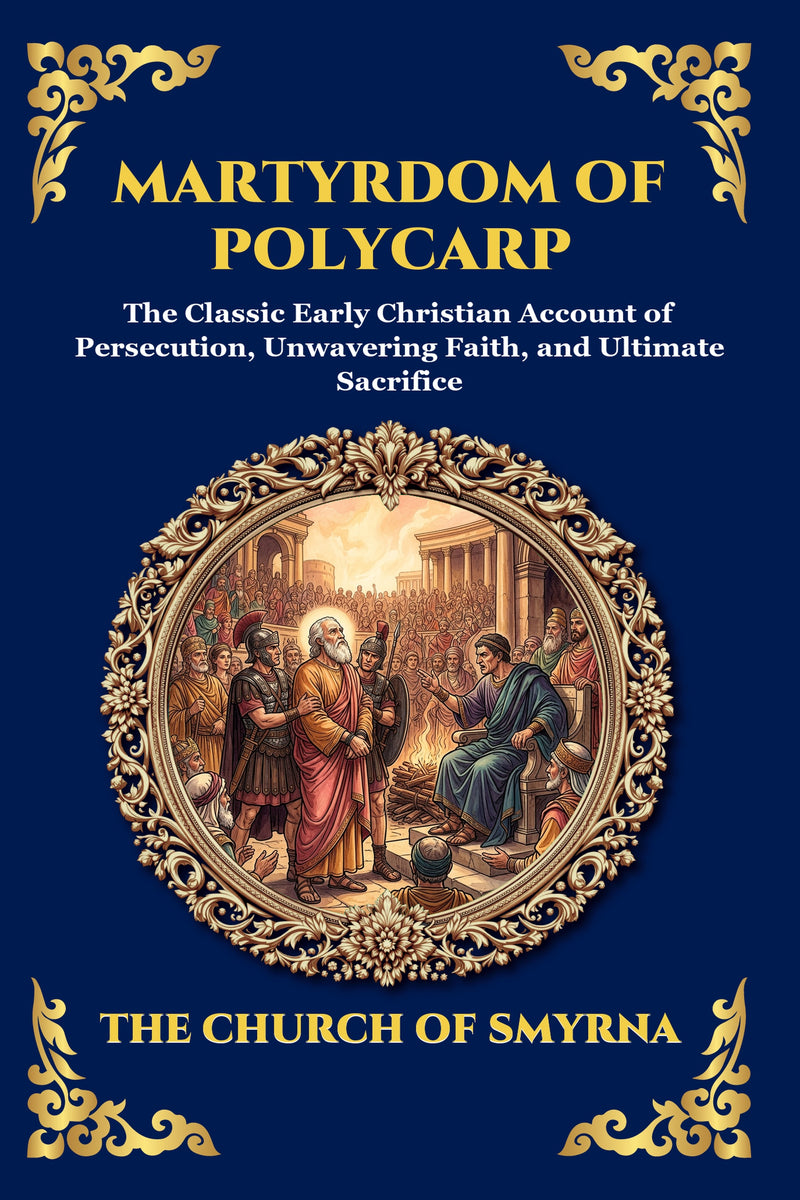
Martyrdom of Polycarp
The Martyrdom of Polycarp delivers the earliest surviving account of a Christian martyr outside the New Testament, capturing the arrest, trial, and execution of a revered bishop. This second-century letter from the Church of Smyrna explores spiritual endurance and the theology of suffering, inspiring believers for generations.
or free app
10,000+ hrs library
30-day guarantee
The Martyrdom of Polycarp provides Library of Alexandria Press members with a complete modern-English translation of the earliest surviving Christian martyrdom account outside the New Testament, readable online with audiobook included.
The flames refused to consume the aged bishop as he stood bound to the stake, prompting his executioners to pierce him with a dagger instead. The Martyrdom of Polycarp provides a compelling modern translation of the earliest surviving account of a Christian martyr outside the New Testament.
The Martyrdom of Polycarp provides a compelling modern translation of the earliest surviving account of a Christian martyr outside the New Testament. Written as a circular letter by the Church of Smyrna in the second century, this deeply emotional text details the arrest, trial, and execution of Polycarp, a revered bishop and a direct disciple of John the Apostle.
Far more than a simple historical chronicle, The Martyrdom of Polycarp delves into profound themes of spiritual endurance, the theology of suffering, and the ultimate triumph of heavenly loyalty over earthly tyranny. It captures the sheer brutality of Roman persecution while illuminating the miraculous peace that accompanied the early saints in their final moments.
What You Will Discover in This Modern Translation
- The Arrest and Trial of a Saint: Follow the dramatic sequence of events as Polycarp is hunted down, arrested, and brought before the Roman proconsul, refusing to yield to threats of wild beasts or fire.
- The Power of Unwavering Faith: Explore the incredible steadfastness of an eighty-six-year-old leader whose peaceful defiance in the face of death baffled his executioners and inspired a nascent religious movement.
- Miracles Amidst the Flames: Read the astonishing eyewitness accounts of the execution, including the legendary moment when the fire supposedly arched around him like a ship's sail, refusing to consume his body.
- A Foundational Historical Document: Gain a deeper understanding of the Apostolic Fathers, the culture of the Roman Empire, and the origins of the veneration of martyrs in early Christian history.
Whether you are exploring this work for its immense historical value, its theological significance, or its raw, inspiring narrative of courage, The Martyrdom of Polycarp offers wisdom and inspiration that remain intensely powerful today.
Step into a story of unparalleled bravery and discover the timeless legacy of Polycarp. Begin your journey today.
| Formats | eBook (EPUB + PDF) · Audiobook · Paperback · Hardcover · Large Print |
| Language | English |
| Trim size (print) | 6 × 9 in |
| Binding | Paperback — perfect-bound · Hardcover — casewrap |
| Large Print edition | Same text in a larger, easy-read type — a larger font, not a larger trim |
| Print pricing | Every physical book at our true cost — at-cost, no profit (members) |
| Library | 873 restored titles, always growing |
| Composed | 2nd century AD |
| Original language | Greek |
| Source tradition | Greek manuscript tradition with early Latin versions |
| Translation basis | Public-domain scholarly translation, rendered in clear modern English |
| Length | 3,591 words · ~14 min reading |
| Reading level | Grade 13 · rich, literary prose (this modern-English edition) |
| Edition | Modern English translation · 2026 |
Member reviews for this edition are collected as readers finish it — be the first. Across the library: 12,000+ books shipped, every plan covered by a 365-day print guarantee.
About this edition
The complete, unabridged text in clear modern English — faithful to the original, never simplified. Every paragraph is checked against the source, so nothing is cut, summarised, or paraphrased away. It reads cleanly for today while keeping the original meaning intact.
The text survives in multiple Greek manuscripts and early Latin translations. This edition derives from the standard public-domain scholarly translation and renders it in clear modern English.
- Complete & unabridgedVerified paragraph by paragraph against the source — never a scan, never abridged.
- Modern English, faithfulReadable today, with the author’s meaning kept intact. Readable — not simplified.
- Every format, one membershipRead in your browser or the free app, or listen to the full audiobook.
Included free with your membership
Cancel anytime, one click · 30-day money-back guarantee
Edition last updated June 2026
What’s inside
Martyrdom of Polycarp — complete and unabridged: all 9 sections included with membership, plus the full audiobook.
Begin reading Martyrdom of Polycarp
In clear modern English — the complete text is included with membership.
Chapter 1
The church of God sojourning at Smyrna, to the church of God sojourning at Philomelium, and to all the brotherhoods of the holy and universal Church sojourning in every place: may mercy, peace, and love from God the Father and our Lord Jesus Christ be multiplied to you.
We write to you, brothers, an account of what befell those who suffered martyrdom, and especially the blessed Polycarp, who brought the persecution to a close by setting his seal upon it through his own martyrdom.
For nearly all the foregoing events came to pass so that the Lord might show us once more an example of martyrdom conformable to the Gospel. He lingered so that he might be delivered up, even as the Lord was, so that we too might be imitators of him — looking not only to what concerns ourselves, but also to what concerns our neighbors. For it is the mark of true and steadfast love to desire not only one's own salvation, but the salvation of all the brothers as well.
Blessed and noble, therefore, are all the martyrdoms that have taken place according to the will of God. For who could fail to admire their nobility, their patient endurance, and their loyalty to the Master? When they were so torn by lashes that the inner workings of their flesh were visible, even to the veins and arteries within, they endured patiently, so that the very bystanders were moved to pity and wept — while the martyrs themselves reached such a pitch of bravery that not one of them uttered a cry or a groan. They showed us all that at that hour the martyrs of Christ, while being tortured, were absent from the flesh — or rather, that the Lord was standing by and conversing with them.
Fixing their minds on the grace of Christ, they despised the tortures of this world, purchasing with the cost of one hour a release from eternal punishment. They found the fire of their inhuman torturers cold, for they set before their eyes the escape from the eternal fire that is never quenched; and with the eyes of their heart they gazed upon the good things reserved for those who endure patiently — things which no ear has heard, no eye has seen, and which have not entered into the heart of man, but were shown by the Lord to them, for they were no longer men but angels already.
And likewise those condemned to the wild beasts endured fearful punishments, being made to lie on sharp shells and subjected to other forms of manifold torture, so that the devil might, if possible, by the persistence of the punishment bring them to a denial — for he tried many wiles against them. But thanks be to God, for He truly prevailed against all.
The right noble Germanicus encouraged their timidity through the constancy that was in him, and he fought with the wild beasts in a remarkable way. When the proconsul wished to prevail upon him and urged him to have pity on his youth, he used force and dragged the wild beast toward him, desiring all the more speedily to obtain release from their unrighteous and lawless life.
After this, the whole multitude, marveling at the bravery of the God-beloved and God-fearing Christians, raised a cry: "Away with the atheists! Let search be made for Polycarp!"
Chapter 2
But one man, Quintus by name, a Phrygian newly arrived from Phrygia, turned coward when he saw the wild beasts. He was the one who had pressed himself and some others to come forward of their own free will. The proconsul, by much urging, persuaded this man to swear the oath and offer incense. For this reason, brothers, we do not praise those who deliver themselves up, since the Gospel does not teach us to do so.
Now the glorious Polycarp, when he first heard of it, was far from dismayed and wished to remain in the city; but the greater part persuaded him to withdraw. So he withdrew to a farm not far from the city, and there he stayed with a few companions, doing nothing else night and day but praying for all people and for the churches throughout the world, for this was his constant habit.
While he was praying, three days before his arrest, he fell into a trance and saw his pillow burning with fire. He turned and said to those who were with him: "It must be that I shall be burned alive."
As those searching for him persisted, he departed to another farm; and immediately those in search of him arrived there. Not finding him, they seized two slave boys, one of whom confessed under torture. It was impossible for him to remain hidden, since the very people who betrayed him were members of his own household.
The captain of the police, who happened to bear the very name Herod, was eager to bring him into the stadium, so that Polycarp might fulfill his appointed lot by becoming a partaker with Christ, while his betrayers underwent the punishment of Judas himself.
Taking the boy with them, on the Friday about suppertime, the officers and horsemen went out with their usual arms, hastening as if against a robber. Coming up in force late in the evening, they found the man himself lying in bed in an upper room of a small cottage. He could have slipped away to another place, but he would not, saying, "The will of God be done."
When he heard that they had arrived, he went down and spoke with them, while the bystanders marveled at his age and his composure, and wondered that there should be such eagerness for the arrest of so old a man. He immediately gave orders that a table should be set for them to eat and drink as much as they wished at that hour. He then asked them to grant him an hour to pray undisturbed, and when they agreed, he stood up and prayed — so filled was he with the grace of God that for two hours he could not stop, and those who heard him were amazed, and many repented that they had come against so venerable an old man.
When at last he brought his prayer to an end, having remembered all who had ever come his way — small and great, high and low — and the whole universal Church throughout the world, the hour of departure came. They seated him on a donkey and brought him into the city, it being a great Sabbath day.
Chapter 3
He was met by Herod the captain of police and his father Nicetes, who removed him to their carriage and tried to prevail upon him, sitting beside him and saying, "Why, what harm is there in saying 'Caesar is Lord' and offering incense, and saving yourself?" — with more to this effect. But at first he gave them no answer. When they persisted, he said, "I am not going to do what you counsel me."
They, failing to persuade him, uttered threatening words and made him dismount in haste, so that he bruised his shin as he got down from the carriage. Without even turning around, he went on his way promptly and with speed, as if nothing had happened to him, and was led to the stadium, where the tumult was so great that no man's voice could be heard.
As Polycarp entered the stadium, a voice came to him from heaven: "Be strong, Polycarp, and play the man." No one saw the speaker, but those of our people who were present heard the voice.
When he was brought forward, there was a great tumult, for the crowd had heard that Polycarp had been arrested. The proconsul asked whether he was the man, and when he confessed that he was, the proconsul tried to persuade him to deny the faith, saying, "Have respect for your age," and other such things as it is their custom to say: "Swear by the genius of Caesar; repent and say, 'Away with the atheists.'"
Then Polycarp, with solemn countenance, looked upon the whole multitude of lawless heathen in the stadium, waved his hand toward them, and groaning, looked up to heaven and said, "Away with the atheists."
When the magistrate pressed him harder and said, "Swear the oath, and I will release you; revile the Christ," Polycarp said, "Eighty-six years I have been his servant, and he has done me no wrong. How then can I blaspheme my King who saved me?"
But when the proconsul persisted and said, "Swear by the genius of Caesar," Polycarp answered, "If you imagine that I will swear by the genius of Caesar, as you say, and pretend not to know who I am, then hear me plainly: I am a Christian. But if you wish to learn the teaching of Christianity, set a day and give me a hearing."
Chapter 4
The proconsul said, "Persuade the people." But Polycarp said, "I would have considered you worthy of a reasoned reply, for we have been taught to give to rulers and authorities appointed by God such honor as does us no harm, and that is only fitting. But as for these people, I do not consider them worthy of my defending myself before them."
The proconsul then said, "I have wild beasts here, and I will throw you to them unless you repent." But Polycarp said, "Call for them. We are not permitted to change from better to worse, but it is a noble thing to change from wickedness to righteousness."
Then the proconsul said to him again, "If you despise the wild beasts, I will have you consumed by fire, unless you repent." But Polycarp said, "You threaten a fire that burns for a season and is quenched after a little while, for you do not know the fire of the coming judgment and eternal punishment, which is reserved for the ungodly. But why do you delay? Come, do what you will."
Saying these things and more besides, he was filled with courage and joy, and his face shone with grace, so that not only did he show no dismay at what was said to him, but on the contrary the proconsul was astounded and sent his own herald to proclaim three times in the midst of the stadium, "Polycarp has confessed himself to be a Christian."
When the herald made this proclamation, the whole multitude, both Gentiles and Jews who lived in Smyrna, cried out with uncontrollable fury and at the top of their voices, "This is the teacher of Asia, the father of the Christians, the destroyer of our gods, who teaches crowds not to sacrifice or worship." Shouting these things, they called out to the Asiarch Philip to release a lion upon Polycarp. But he said it was not lawful for him to do so, since he had already brought the games to a close. Then they agreed with one voice to demand that Polycarp be burned alive.
For it was necessary that the vision shown to him concerning his pillow should be fulfilled — when he saw it on fire while he was praying, and turning around he said prophetically to the faithful who were with him, "I must be burned alive."
These things happened with such speed, faster than words can tell — the crowds immediately gathering timber and brushwood from the workshops and baths, with the Jews in particular assisting in this with their customary zeal.
When the pile was ready, Polycarp took off all his outer garments and loosened his belt, and tried also to remove his shoes, though he was not in the habit of doing this himself, because all the faithful always competed eagerly to be the first to touch his flesh. For he had been treated with every honor on account of his holy life, even before his hair turned gray.
Chapter 5
The materials prepared for the pyre were immediately placed around him, and when they were about to nail him to the stake as well, he said, "Leave me as I am, for He who has granted me to endure the fire will also grant me to remain at the pyre unmoved, without the security you seek from the nails."
So they did not nail him, but tied him instead.
Then he placed his hands behind him and was bound to the stake — like a noble ram chosen from a great flock for an offering, a burnt sacrifice made ready and acceptable to God — and looking up to heaven he said:
"O Lord God Almighty, Father of your beloved and blessed Son Jesus Christ, through whom we have received the knowledge of you, the God of angels and powers and of all creation and of the whole race of the righteous who live in your presence:
I bless you that you have granted me this day and this hour, that I might receive a place among the number of the martyrs in the cup of Christ, for the resurrection to eternal life of both soul and body in the incorruptibility of the Holy Spirit. May I be received among them in your presence this day, as a rich and acceptable sacrifice, as you prepared and revealed beforehand, and have now accomplished — you who are the faithful and true God.
Cancel anytime, one click · 30-day money-back guarantee
Founding annual rate available now — your price locks for life when you join.
Not ready? Get this free chapter by email — read it anytime.
✓ Sent — check your inbox for Martyrdom of Polycarp.
Questions about Martyrdom of Polycarp
Who wrote the Martyrdom of Polycarp?
The Martyrdom of Polycarp was written as a circular letter by the Church of Smyrna around 155-160 AD, describing the death of their bishop Polycarp during Roman persecution under Emperor Antoninus Pius.
Why isn't the Martyrdom of Polycarp in the Bible?
The Martyrdom of Polycarp was written after the apostolic period and describes events from the mid-2nd century. It was excluded from the biblical canon as it was a historical account rather than apostolic teaching or scripture.
What does the Martyrdom of Polycarp contain?
The Martyrdom of Polycarp details the arrest, trial, and execution of Bishop Polycarp of Smyrna, including his famous declaration of 86 years serving Christ and his refusal to renounce his faith before Roman authorities.
Is Martyrdom of Polycarp free to read?
The opening of the text is free to read below. Members read and listen to the complete work — and the entire Lost & Forbidden Library — free.
What is Martyrdom of Polycarp?
Have you ever wondered why early Christians were so willing to face death rather than renounce their faith, or what historical accounts inspired generations of believers to stand firm in the face of absolute terror?
How long is Martyrdom of Polycarp?
9 chapters (~3,615 words) in this restored edition.
Shipping & returns
Billing & membership
More from the library


Explore The Lost & Forbidden Library
- 1 Enoch · Attributed to Enoch
- 1–4 Maccabees · Various Jewish authors
- 2 Baruch · Attributed to Baruch
- 2 Enoch · Attributed to Enoch
- 2 Esdras · Attributed to the prophet Ezra
- 3 Baruch · Attributed to Baruch ben Neriah
- 4 Baruch · Attributed to Baruch ben Neriah
- A Valentinian Exposition · Attributed to a follower of Val...
- Acta Archelai · Attributed to Hegemonius
- Acts of Andrew · Anonymous (Early Christian Apoc...
- Acts of Andrew and Matthias in the City of the Cannibals · Attributed to early Christian a...
- Acts of Barnabas · Attributed to John Mark
- Acts of Bartholomew
- Acts of John · Anonymous (Early Christian Apoc...
- Acts of Matthias · Anonymous early Christian writers
- Acts of Paul · Attributed to an unknown early ...
- Acts of Paul and Thecla · Attributed to Onesiphorus
- Acts of Peter
- Acts of Peter and Andrew · Attributed to various early Chr...
- Acts of Peter and Paul · Attributed to Leucius Charinus
- Acts of Peter and Simon · Attributed to Leucius Charinus
- Acts of Peter and the Twelve Apostles · Attributed to early Christian a...
- Acts of Philip · Anonymous (Early Christian Apoc...
- Acts of Pilate (Gospel of Nicodemus) · Attributed to various early Chr...
- Acts of Saturninus
- Acts of Thaddaeus · Attributed to Thaddaeus the Apo...
- Acts of Thomas
- Acts of Titus · Anonymous early Christian writer
- Acts of Xanthippe, Polyxena, and Rebecca
- Allogenes · Anonymous (Early Gnostic Mystic)
Martyrdom of Polycarp
The Martyrdom of Polycarp
The Letter of the Church of Smyrna — The Faithful Witness of the Aged Bishop: His Arrest and His Words Before the Proconsul, the Fire That Arched About Him Without Consuming, and the Recovery of His Bones More Precious Than Gold
Library of Alexandria Press
The Martyrdom of Polycarp
© Copyright 2026 Library of Alexandria Press. All rights reserved.
Published by Library of Alexandria Press
Printed in the United States of America
It is not legal to copy, share, or send any part of this document in either digital or printed form without written permission from the publisher, except short quotes in a book review.
Table of Contents
Introduction
Chapter 1
Chapter 2
Chapter 3
Chapter 4
Chapter 5
Chapter 6
Chapter 7
Chapter 8
Introduction
There are moments in history so charged with meaning, so concentrated in their moral and spiritual intensity, that they refuse to stay in the past. They reach forward across centuries, grab hold of the present, and demand to be reckoned with. The story you are about to read is one of those moments. It is the account of an old man — a bishop, a shepherd of souls, a man who had known the apostles personally — who was given every opportunity to save his life and chose instead to give it away. It is a story about what happens when the machinery of empire meets something it cannot crush: a faith so quietly certain of itself that it renders all threats absurd.
The document you hold is among the oldest surviving accounts of Christian martyrdom outside the New Testament itself. Scholars date it to somewhere around 155 to 160 CE, placing it in the reign of the Roman emperor Antoninus Pius, a period often romanticized as one of relative stability and enlightened governance. And yet, in the provincial city of Smyrna — a prosperous port on the western coast of what is now Turkey — the crowd in the arena was screaming for blood, the proconsul was pressing an elderly bishop to renounce his faith, and a fire was being prepared. What emerged from that day was not simply a death. It was a template, a theology, and a piece of literature that would shape Christian identity for the next two millennia.
To read this text today is to encounter something simultaneously ancient and startlingly immediate. The questions it raises — about loyalty and conscience, about the nature of courage, about what a human being owes to the state versus what they owe to their deepest convictions — are not questions that history has resolved. They are questions that every generation must answer for itself. The early Christians who witnessed these events, and who carefully preserved and circulated this account, understood that they were doing something more than recording history. They were transmitting a way of being in the world, a grammar of faithfulness under pressure, that they believed their communities would need again and again.
This introduction is an attempt to give you the fullest possible context for what you are about to read — not to explain away its power or reduce it to a series of historical footnotes, but to place it in the world from which it came so that its meaning can land with full force. Understanding who Polycarp was, what the Roman world expected of its subjects, and how this particular document came to be written and preserved will not diminish the text. It will, if anything, make the central drama more astonishing, not less.
Polycarp was bishop of Smyrna, one of the most important Christian communities in the ancient world. He was, by the time of his death, an extraordinarily old man — the text itself tells us he had served Christ for eighty-six years, a detail that has fascinated readers ever since, since it implies he may have been a Christian from birth or earliest childhood. What is historically significant, and what the early church never tired of emphasizing, is that Polycarp belonged to a generation that had direct personal contact with the apostles. He is said to have been a disciple of the apostle John, the same John traditionally associated with the Gospel and the letters that bear his name. This placed Polycarp at a unique intersection: he was a living link between the apostolic generation and the rapidly expanding, increasingly threatened church of the mid-second century.
We know something of Polycarp beyond this account of his death. His letter to the Philippians survives, a warm and theologically rich document that reveals a pastor deeply concerned with the practical ethics of Christian community life — with humility, with the care of widows and orphans, with the dangers of greed and false teaching. The letter shows a man formed by the Pauline tradition, saturated in the language of the New Testament, and possessed of a gentle but firm authority. The great church father Irenaeus of Lyon, who as a boy had heard Polycarp preach, later recalled the bishop's manner, his voice, his stories about John and the other eyewitnesses to Jesus. These memories were treasured precisely because they represented an unbroken chain of testimony, a living tradition that connected the mid-second century church to its origins.
Polycarp also appears in a famous episode involving Anicetus, the bishop of Rome, with whom he traveled to discuss the date of Easter — a controversy that was already dividing Eastern and Western Christian practice. The two men disagreed but parted in peace, a detail that tells us something important about the character of both men and about the nature of early Christian authority, which was collegial and relational rather than strictly hierarchical. Polycarp was not simply a local figure. He was a churchman of international standing, respected across the Mediterranean world, whose voice carried weight precisely because of his age, his connections, and his evident holiness.
It is against this backdrop that his arrest, trial, and execution must be understood. This was not the death of an obscure provincial troublemaker. This was the death of one of the most prominent Christian leaders in the Roman world, a man whose loss was felt immediately and deeply across multiple communities. The account that was written to commemorate his death was addressed to other churches and was clearly intended for wide circulation. It was, from the beginning, a public document with a public purpose.
The world into which this document was born was one in which the relationship between Christianity and the Roman Empire was deeply unstable. Rome was, in many ways, a remarkably tolerant society when it came to religion. The empire encompassed dozens of cultures and hundreds of local deities, and Roman policy was generally to accommodate local religious practice as long as it did not threaten public order or, crucially, as long as its adherents were willing to participate in the civic religious rituals that expressed loyalty to Rome and to the emperor. This is where Christians found themselves in an impossible position.
Roman religion was not primarily about private belief or inner conviction. It was about public ritual, about sacrifice and ceremony that bound the community together and expressed its relationship to the divine powers that protected it. To refuse to participate in these rituals was not simply a matter of personal conscience — it was a political act, a statement of non-belonging, a rejection of the social contract. Christians, like Jews before them, refused to sacrifice to the Roman gods or to acknowledge the divine status of the emperor. Unlike Jews, however, Christians did not have the protection of being an ancient, recognized national religion. They were a new movement, of suspicious origin, spreading rapidly across social classes and ethnic boundaries, and their refusal to participate in civic religion made them easy targets for accusations of atheism — a charge that, in the ancient world, carried connotations not of intellectual skepticism but of dangerous antisocial behavior.
The legal situation of Christians in the second century was ambiguous and inconsistent. There was no empire-wide law mandating the persecution of Christians, but there was a general understanding, formalized in correspondence between the emperor Trajan and Pliny the Younger at the beginning of the century, that Christians who were denounced and refused to recant should be executed. The key elements of this policy were, first, that Christians should not be actively sought out by the authorities, and second, that those who were brought forward and who denied being Christian — and proved it by sacrificing to the gods — should be released. This meant that the fate of any individual Christian depended enormously on local circumstances: on the mood of the crowd, the temperament of the local magistrate, the presence or absence of particular enemies willing to make a formal accusation.
Smyrna in the mid-second century was a prosperous and culturally vibrant city, intensely proud of its Greek heritage and deeply invested in its relationship with Rome. It had been one of the first cities in the province of Asia to build a temple to Rome, and it cultivated its status as a center of the imperial cult with considerable enthusiasm. The games and festivals associated with this cult were major civic events, occasions for the display of Roman power and provincial loyalty, and they were also occasions at which the presence of religious dissenters could become suddenly and dangerously visible. It was in this context — the heightened emotions of public spectacle, the crowd's appetite for entertainment and its resentment of those who stood apart — that the events described in this account unfolded.
The account itself is remarkable not only for what it describes but for how it describes it. The authors — for this is clearly a communal document, written on behalf of the church at Smyrna to other churches — are doing something theologically sophisticated. They are not simply recording events. They are interpreting them, framing them through the lens of the Passion of Jesus, drawing explicit and careful parallels between the death of their bishop and the death of their Lord. This is not naive or accidental. It reflects a fully developed theology of martyrdom that was emerging in the second century church, a theology that understood the martyr's death as a participation in Christ's own self-offering, a witness — the Greek word martys means simply 'witness' — that was complete and final and irreversible.
This theological framing shapes every aspect of the narrative. The pacing, the details that are selected and emphasized, the way certain events are described in language that echoes the Gospel accounts — all of this is deliberate. The authors want their readers to see Polycarp's death not as a tragedy or a defeat but as a victory, a completion, a kind of second baptism that the tradition would come to call the 'baptism of blood.' Understanding this interpretive framework is essential for reading the text honestly. It does not mean that the events described did not happen — most scholars accept that the account preserves genuine historical memory — but it does mean that the account is making an argument as much as it is telling a story.
A World on Fire
To fully appreciate what unfolds in the pages ahead, it helps to sit for a moment inside the texture of daily life in a second-century Roman city, to feel the particular pressures that shaped the experience of early Christians in ways that are genuinely difficult for modern readers to imagine. We live in societies where, at least in principle, freedom of conscience is a legal right and where religious identity is understood as a private matter. The ancient world operated on almost exactly opposite assumptions. Religion was public, communal, and inseparable from political loyalty. The gods were not merely objects of personal devotion; they were the protectors of the city, the guarantors of its prosperity, the powers whose favor had to be maintained through collective ritual. To opt out of this system was not simply eccentric — it was threatening, because it implied that you did not share in the community's most fundamental obligations and therefore could not be fully trusted.
For Christians, this created a daily experience of navigating a world saturated with religious practices they could not participate in. The meat sold in the market had often been sacrificed at a temple. Social gatherings frequently involved libations to the gods. The calendar was structured around religious festivals. The coins in your pocket bore the image of an emperor who was, officially, divine. Simply existing in a Roman city meant constant negotiation with a religious environment that was, from a Christian perspective, comprehensively pagan. Most Christians most of the time found ways to manage this tension quietly, to live as good neighbors and loyal subjects while maintaining their own worship and their own community life. But the tension was always there, and it could erupt into crisis with very little warning.
What triggered persecution was usually some combination of local resentment, public accusation, and official response. The Christians in Smyrna had, in the period leading up to Polycarp's arrest, already seen members of their community brought into the arena. The account we are about to read begins not with Polycarp but with these earlier martyrs, and the contrast it draws between their example and that of one man who apostatized under pressure is sharp and instructive. The authors are not interested in simple triumphalism. They know that the pressure to recant was enormous, that the human desire to survive is powerful, and that not everyone who faced the arena emerged with their faith intact. The account is honest about this in ways that make it more, not less, trustworthy.
The Roman arena was one of the most psychologically sophisticated instruments of social control ever devised. It was not simply a place of execution; it was a theater of power, a space in which the authority of Rome and the will of the crowd were made visible and visceral. The crowd's appetite for spectacle, their ability to demand death or grant mercy, their participation in the ritual humiliation of those who had defied the social order — all of this was carefully managed and deeply meaningful. For Christians to be thrown to the beasts or burned alive in this space was not simply to be killed. It was to be publicly destroyed, to have your community's claims to truth and dignity ridiculed before thousands of witnesses. The courage required to face this was not merely physical. It was the courage to maintain, in the most exposed and humiliating circumstances imaginable, that you were not what Rome said you were, that your identity was grounded in something the arena could not touch.
Polycarp's response to his situation, when it comes, is shaped by decades of formation in precisely this kind of courage. The man we meet in the central drama of this account is not someone who has stumbled unprepared into a crisis. He is someone who has spent a lifetime thinking about what faithfulness means, who has watched others face similar moments, who carries within him the memories of the apostles and the stories of the Lord's own passion. When the authorities come for him, his reaction is not panic or calculation. It is something much quieter and more unsettling: a kind of serene readiness, as if he has been expecting this moment and has already, in some deep interior sense, already passed through it.
This quality of spiritual preparedness is one of the things that made the early martyrs so disturbing to Roman observers. The Roman world had its own traditions of noble death — the philosopher who drinks hemlock calmly, the soldier who falls on his sword rather than surrender — but these were deaths that affirmed Roman values of dignity, self-mastery, and honor. The Christian martyrs were doing something different. They were dying not to preserve their dignity but to surrender it, not to demonstrate self-mastery but to express dependence on a power they believed was greater than Rome. And they were dying not as isolated individuals performing a personal moral drama but as members of a community, their deaths witnessed and interpreted and preserved by that community, their courage understood as a gift not just to themselves but to all who would hear of it.
The community that produced and circulated this account was engaged in a project of collective memory-making that was also, simultaneously, a project of identity formation. To read and hear this story was to be reminded of who you were, what you belonged to, what might be asked of you. It was to be given, in narrative form, a model of how to face the worst that the world could do. This is why the account was copied and recopied, why it was read aloud in churches across the Mediterranean world, why it survived when countless other documents from the same period did not. It was not preserved because it was historically interesting. It was preserved because it was spiritually necessary.
The theology of martyrdom that this account both reflects and helped to shape had profound consequences for the development of Christianity. It established the martyr as the supreme exemplar of Christian faithfulness, the person whose witness was most complete and most unambiguous. It created a cult of the martyrs — a veneration of their memory, their relics, their anniversaries — that would become one of the most distinctive features of early Christian practice and that would eventually develop into the elaborate tradition of saints' veneration that characterizes Catholic and Orthodox Christianity to this day. The account you are about to read contains some of the earliest evidence for practices that would become central to this tradition: the gathering of the martyr's bones, the annual commemoration of the date of death, the understanding of the martyr as an intercessor whose prayers carry special weight.
These practices were not, as later Protestant critics sometimes charged, corruptions of a purer original Christianity. They grew organically from the experience of communities under pressure, communities that needed to honor their dead, to maintain connection with those who had gone before, and to find in the stories of their courage a resource for their own. The martyr's death was not understood as a loss but as a kind of ongoing presence, a continued witness that the community kept alive through memory and ritual. To read this account in its original context was to participate in that ongoing witness, to add your own hearing and your own response to the long chain of reception that stretched back to the arena in Smyrna.
How to Read This Text
There is a particular kind of attention that ancient texts reward, and it is worth pausing to describe it before you enter the narrative itself. Modern readers are accustomed to a certain kind of historical document — the eyewitness report, the journalistic account, the memoir — in which the goal is to convey events as they happened, with the author's interpretive presence kept as invisible as possible. Ancient historiography worked differently. The authors of this account would not have understood the distinction between 'what happened' and 'what it meant,' because for them, meaning was not something added to events after the fact. Meaning was woven into events from the beginning, visible to those with eyes trained to see it. Their job as authors was not to strip away interpretation and deliver bare facts but to make the meaning of events legible to their audience.
This is why the account is so densely allusive, so full of echoes of scripture and of the Gospel passion narratives in particular. When you read descriptions of Polycarp that remind you of Jesus — the betrayal by someone close to him, the manner of his arrest, the questions put to him by the authorities, the crowd's response, the details of his death — you are not supposed to think that the authors are being sloppy or conflationary. You are supposed to recognize that they are making a theological argument in narrative form: that what happened to Polycarp was not a coincidence or an imitation but a participation, a real sharing in the pattern of Christ's own self-giving. The literary and the theological are inseparable here, and to read the text well is to hold both dimensions simultaneously.
At the same time, it would be a mistake to treat the account as pure theology with no historical content. The specific details it contains — the names of individuals, the description of the arena, the legal procedures followed, the behavior of the crowd, the physical circumstances of the execution — are the kinds of details that are difficult to invent convincingly and that align well with what we know from other sources about Roman legal practice and the geography of Smyrna. Scholars have debated the historicity of various elements, and there are genuine questions about some of the more miraculous details. But the broad outline of events — the arrest, the trial, the execution of an elderly Christian bishop in the arena at Smyrna during the mid-second century — is accepted by virtually all serious historians as historical.
What this means for the reader is that you can engage with the text on multiple levels simultaneously. You can read it as history, as the preserved memory of real events that shaped the early church. You can read it as theology, as a carefully constructed argument about the meaning of martyrdom and its relationship to the death of Christ. You can read it as literature, attending to its narrative structure, its use of dramatic irony, its management of pace and detail. And you can read it as a spiritual document, as a text that has formed and sustained Christian communities across twenty centuries and that still has the power to challenge and disturb and inspire.
One of the most striking things about this account, and one that becomes more apparent the more closely you read it, is its emotional restraint. This is not a text that wallows in suffering or that uses graphic description to manipulate its readers' emotions. The violence is present, but it is described with a kind of matter-of-fact brevity that is, paradoxically, more affecting than elaborate description would be. The authors are not interested in sensationalism. They are interested in witness. The distinction matters enormously. Sensationalism puts the audience's emotional response at the center; witness puts the truth of what happened at the center and trusts the audience to respond appropriately. This text trusts its readers, and that trust is part of what makes it so powerful.
The central figure himself is presented with similar restraint. Polycarp is not portrayed as superhuman or as someone who has transcended ordinary human feeling. He is an old man who is frightened enough that those around him urge him to flee, who prays with such intensity in the days before his arrest that those who hear him are moved to tears, who in the arena speaks with a directness and a dignity that clearly surprises and unsettles those who expected him to break. He is, in other words, recognizably human — and his courage is therefore recognizably available, not the exclusive property of saints and heroes but something that ordinary human beings, formed by faith and community, can find within themselves when the moment demands it.
This is perhaps the deepest reason why this account has endured. It is not a story about an exceptional individual performing an exceptional feat. It is a story about what a human life formed by faith looks like when it reaches its ultimate test — and about the community that surrounds such a life, that witnesses its end, that preserves its memory, and that draws from it the courage to go on. The church at Smyrna did not collapse after Polycarp's death. It survived, and it sent this account to other churches, and those churches read it and were strengthened, and some of their members, when their own moment of testing came, remembered what they had heard and found that it was enough.
As you begin to read, you are joining that long chain of witnesses. You are taking your place in the company of all those who have read these words before you — in Greek manuscripts copied by hand in ancient monasteries, in Latin translations read aloud to medieval congregations, in modern editions studied by scholars and believers and curious seekers of every kind. The text has traveled a long way to reach you, and it has survived because each generation that encountered it found something in it worth passing on. What you will find in it is something only you can discover. But the invitation is genuine, and it is ancient, and it is still open.
The pages ahead are not long. This is a short document, as ancient texts go — you could read it in a single sitting. But its brevity is deceptive. There is more packed into these pages than many books ten times their length manage to contain. Read slowly. Pay attention to the details. Notice what the authors choose to emphasize and what they pass over quickly. Listen for the echoes of scripture and ask yourself why they are placed where they are. And above all, allow yourself to be present to the central drama — to the moment when an old man stands before the power of empire and is asked to make a choice, and makes it, and in making it becomes something that the empire, for all its power, could not prevent him from becoming: a witness, permanent and unassailable, to the truth as he understood it.
What follows is one of the most important documents in the history of Christianity, and one of the most compelling human stories to survive from the ancient world. It deserves your full attention, and it will repay it generously. Turn the page, and enter the world of Smyrna in the second century — a world of danger and courage, of community and sacrifice, of a faith being tested in fire and emerging, somehow, more itself than ever.
The Martyrdom of Polycarp
Chapter 1
The church of God sojourning at Smyrna, to the church of God sojourning at Philomelium, and to all the brotherhoods of the holy and universal Church sojourning in every place: may mercy, peace, and love from God the Father and our Lord Jesus Christ be multiplied to you.
We write to you, brothers, an account of what befell those who suffered martyrdom, and especially the blessed Polycarp, who brought the persecution to a close by setting his seal upon it through his own martyrdom.
For nearly all the foregoing events came to pass so that the Lord might show us once more an example of martyrdom conformable to the Gospel. He lingered so that he might be delivered up, even as the Lord was, so that we too might be imitators of him — looking not only to what concerns ourselves, but also to what concerns our neighbors. For it is the mark of true and steadfast love to desire not only one's own salvation, but the salvation of all the brothers as well.
Blessed and noble, therefore, are all the martyrdoms that have taken place according to the will of God. For who could fail to admire their nobility, their patient endurance, and their loyalty to the Master? When they were so torn by lashes that the inner workings of their flesh were visible, even to the veins and arteries within, they endured patiently, so that the very bystanders were moved to pity and wept — while the martyrs themselves reached such a pitch of bravery that not one of them uttered a cry or a groan. They showed us all that at that hour the martyrs of Christ, while being tortured, were absent from the flesh — or rather, that the Lord was standing by and conversing with them.
Fixing their minds on the grace of Christ, they despised the tortures of this world, purchasing with the cost of one hour a release from eternal punishment. They found the fire of their inhuman torturers cold, for they set before their eyes the escape from the eternal fire that is never quenched; and with the eyes of their heart they gazed upon the good things reserved for those who endure patiently — things which no ear has heard, no eye has seen, and which have not entered into the heart of man, but were shown by the Lord to them, for they were no longer men but angels already.
And likewise those condemned to the wild beasts endured fearful punishments, being made to lie on sharp shells and subjected to other forms of manifold torture, so that the devil might, if possible, by the persistence of the punishment bring them to a denial — for he tried many wiles against them. But thanks be to God, for He truly prevailed against all.
The right noble Germanicus encouraged their timidity through the constancy that was in him, and he fought with the wild beasts in a remarkable way. When the proconsul wished to prevail upon him and urged him to have pity on his youth, he used force and dragged the wild beast toward him, desiring all the more speedily to obtain release from their unrighteous and lawless life.
After this, the whole multitude, marveling at the bravery of the God-beloved and God-fearing Christians, raised a cry: "Away with the atheists! Let search be made for Polycarp!"
End of the free sample
Keep reading, free
Members read and listen to the complete book — and the entire library. Cancel anytime, one click · 30-day money-back guarantee.