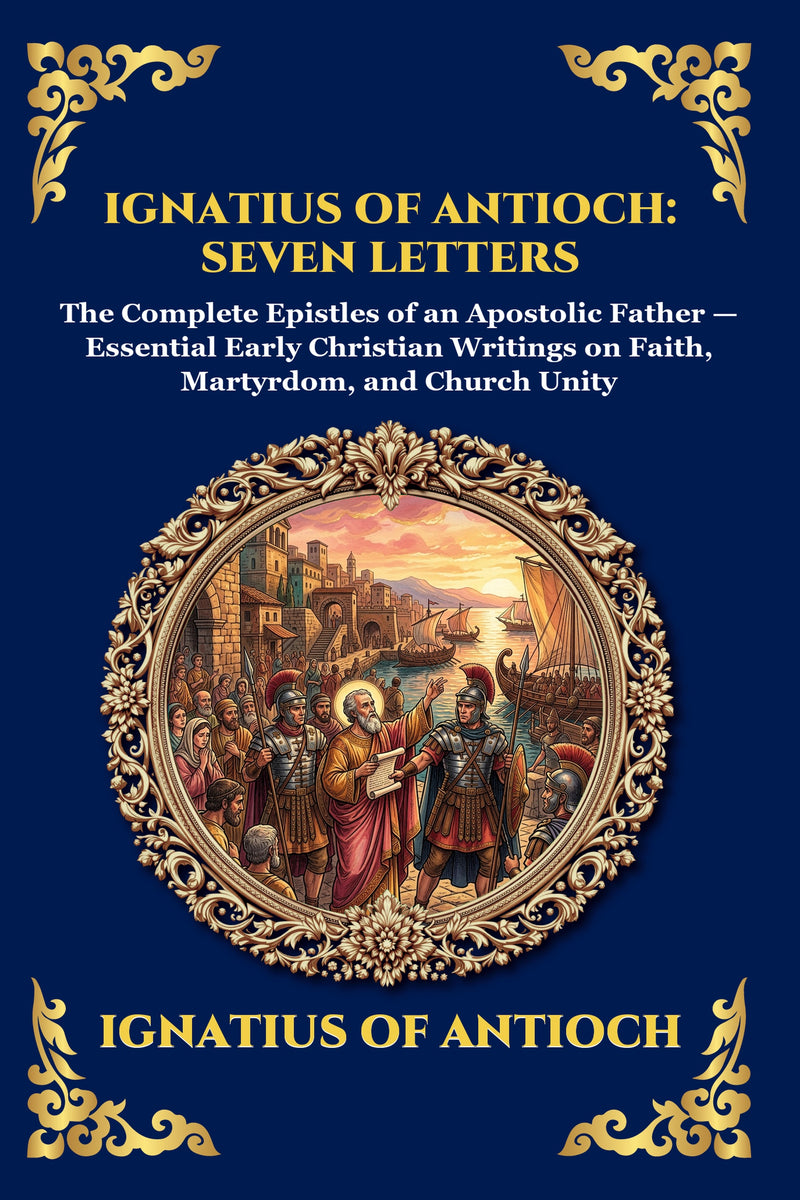
Ignatius of Antioch: Seven Letters
As he journeyed to his execution, Ignatius of Antioch penned seven letters urging early Christians to hold fast against division and heresy. These texts, foundational to Christian literature, capture the unwavering conviction of a leader facing death for his faith.
or free app
10,000+ hrs library
30-day guarantee
A complete modern-English translation of Ignatius of Antioch: Seven Letters (c. 108-110 AD), quoted by Polycarp, offers online reading plus audiobook narration for members.
Ignatius of Antioch: Seven Letters represents some of Christianity's earliest surviving correspondence outside the New Testament, penned around 108-110 CE by a bishop en route to Roman martyrdom.
In Ignatius of Antioch: Seven Letters, readers are invited to witness the raw, unfiltered passion of a man walking willingly toward his own execution. Written in the early second century as Ignatius was transported from Antioch to Rome to be thrown to the wild beasts, these seven epistles—addressed to various early congregations and a fellow bishop—serve as foundational pillars of Christian literature.
Far more than historical artifacts, these letters are the vibrant, urgent final words of a devoted leader pleading with his flock to remain unified against division and heresy. Ignatius's writings provide crucial insights into the evolving structure of the early church, the role of leadership, the nature of communal worship, and the intense desire for martyrdom as a means of perfect discipleship. This complete collection brings to life the fervent spirit of a man who saw his impending death not as a tragedy, but as the ultimate victory and birth into true life.
What You Will Discover in This Complete Collection
- The Epistle to the Ephesians — A profound call for harmony, unity, and adherence to shared faith in the face of false teachings.
- The Epistle to the Magnesians — Timely warnings against returning to old legalistic practices and a defense of early Christian worship.
- The Epistle to the Trallians — An urgent plea to remain obedient to church leadership and to guard against the poison of early heresies.
- The Epistle to the Romans — Ignatius’s famous and shocking request that the Roman church not intervene to save him from martyrdom.
- The Epistle to the Philadelphians — Encouragement to maintain the unity of the Spirit and avoid those who cause schisms.
- The Epistle to the Smyrnaeans — A robust defense of the physical reality of the incarnation and resurrection against early Docetist claims.
- The Epistle to Polycarp — Personal, pastoral advice to a fellow young bishop on how to lead with grace, endurance, and wisdom.
Step into the ancient world and experience the unwavering courage of one of history’s most dedicated spiritual leaders. These seven letters offer timeless lessons on leadership, the power of a unified community, and the ultimate cost of conviction. Begin your journey into the foundations of early faith today.
| Formats | eBook (EPUB + PDF) · Audiobook · Paperback · Hardcover · Large Print |
| Language | English |
| Trim size (print) | 6 × 9 in |
| Binding | Paperback — perfect-bound · Hardcover — casewrap |
| Large Print edition | Same text in a larger, easy-read type — a larger font, not a larger trim |
| Print pricing | Every physical book at our true cost — at-cost, no profit (members) |
| Library | 873 restored titles, always growing |
| Composed | c. 108-110 AD |
| Original language | Greek |
| Source tradition | Greek manuscripts and medieval Latin translations |
| Translation basis | Public-domain scholarly translation, rendered in clear modern English |
| Length | 23,587 words · ~1 hr 34 min reading |
| Reading level | Grade 10 · a confident, adult read (this modern-English edition) |
| Edition | Modern English translation · 2026 |
Member reviews for this edition are collected as readers finish it — be the first. Across the library: 12,000+ books shipped, every plan covered by a 365-day print guarantee.
About this edition
The complete, unabridged text in clear modern English — faithful to the original, never simplified. Every paragraph is checked against the source, so nothing is cut, summarised, or paraphrased away. It reads cleanly for today while keeping the original meaning intact.
The Seven Letters survive through Greek manuscripts and later Latin translations, preserved in medieval manuscript collections. This edition derives from the standard public-domain scholarly translation and renders it in clear modern English.
- Complete & unabridgedVerified paragraph by paragraph against the source — never a scan, never abridged.
- Modern English, faithfulReadable today, with the author’s meaning kept intact. Readable — not simplified.
- Every format, one membershipRead in your browser or the free app, or listen to the full audiobook.
Included free with your membership
Cancel anytime, one click · 30-day money-back guarantee
Edition last updated June 2026
What’s inside
Ignatius of Antioch: Seven Letters — complete and unabridged: all 91 sections included with membership, plus the full audiobook.
Begin reading Ignatius of Antioch: Seven Letters
In clear modern English — the complete text is included with membership.
Chapter I
Having obtained good proof that your mind is fixed in God as upon an immovable rock, I loudly glorify His name that I have been counted worthy to behold your blameless face — may I ever enjoy that blessing in God! I entreat you, by the grace with which you are clothed, to press forward in your course and to exhort all people so that they may be saved. Maintain your position with all care, both in flesh and spirit. Make it your concern to preserve unity, than which nothing is better. Bear with all, even as the Lord bears with you. Support all in love, as indeed you do. Give yourself to prayer without ceasing. Ask for greater understanding beyond what you already have. Be watchful, keeping a spirit that never sleeps. Speak to each person individually, as God gives you ability. Bear the infirmities of all, as a perfect athlete in the Christian life — even as the Lord of all does. For the Scripture says, "He himself took our infirmities and bore our sicknesses." Where the labor is great, the gain is all the greater.
Chapter II
If you love the good disciples, no thanks are due to you for that; but rather seek by gentleness to win over the more troublesome ones. Not every wound is healed with the same remedy. Calm violent outbreaks of disease with soothing treatment. Be in all things wise as a serpent and harmless as a dove. For this purpose you are made of both soul and body, both fleshly and spiritual, so that you may correct the evils that present themselves visibly before you; and as for those that are not seen, pray that they may be revealed to you, so that you may lack nothing but may abound in every gift. The times call upon you to pray. For as the wind aids the pilot of a ship, and as a harbor is a welcome refuge for a vessel tossed by storms, so too is prayer for you, that you may attain to God. Be sober as an athlete of God, whose prize is immortality and eternal life — of which you are already persuaded. In all things may my soul be given for yours, and my chains also, which you have held dear.
Chapter III
Do not let those who seem trustworthy but teach strange doctrines unsettle you. Stand firm as an anvil under the hammer. A noble athlete expects to be struck, and yet wins. Above all, we must bear everything for God's sake, so that he may bear with us and bring us into his kingdom. Grow ever more diligent; run your race with increasing energy; weigh the times carefully. While you are here, be a conqueror — for here is the course, and there are the crowns. Look for Christ, the Son of God, who existed before time yet appeared within time; who was invisible by nature yet visible in the flesh; who was beyond all touch and handling, having no body, yet for our sakes became one who could be touched and handled in the body; who as God was beyond all suffering, yet for our sakes as man became capable of suffering — and who in every possible way suffered for us.
Chapter IV
Do not neglect the widows. After the Lord, be their protector and friend. Let nothing be done without your consent, and do nothing yourself without the approval of God — which indeed you do not, since you stand firm. Meet together as frequently as possible, and seek out each person by name. Do not look down on male or female slaves, but do not let them become conceited either. Rather, let them serve all the more willingly, for the glory of God, so that they may obtain from God a better freedom. They should not desire to be set free at the congregation's expense, lest they be found slaves to their own desires.
Chapter V
Flee from evil practices, but speak about them openly in public. Tell my sisters to love the Lord and to be content with their husbands in both body and spirit. In the same way, urge my brothers, in the name of Jesus Christ, to love their wives as the Lord loves the Church. If anyone is able to remain in a state of chastity, to the honor of the Lord of the flesh, let him do so — but without boasting. If he begins to boast, he is lost; and if he considers himself greater than the bishop, he is ruined. It is fitting that both men and women who marry should form their union with the bishop's approval, so that their marriage may be according to God and not driven by their own desires. Let all things be done to the honor of God.
Chapter VI
Pay attention to your bishop, so that God may pay attention to you. I would give my life for those who are submissive to the bishop, to the presbyters, and to the deacons, and may my portion be with them in God. Labor together with one another; strive together; run together; suffer together; sleep together; and wake together, as stewards, companions, and servants of God. Please the One under whom you fight and from whom you receive your wages. Let none of you be found a deserter. Let your baptism stand as your armor; your faith as your helmet; your love as your spear; your patience as your full panoply. Let your works be the charge assigned to you, so that you may receive a most worthy recompense for them. Be patient with one another, then, in gentleness, as God is with you. May I have joy of you forever.
Chapter VII
Since I have been informed that the church at Antioch in Syria is now at peace, thanks to your prayers, I am all the more encouraged, and I rest without anxiety in God — trusting that through suffering I may attain to God, and that through your prayers I may be found a true disciple of Christ. It is fitting, Polycarp, most blessed in God, to convene a solemn council and to choose someone you greatly love and know to be a person of energy and action, who may be appointed as a messenger of God. Honor him with this commission: let him go into Syria and there glorify your ever-active love to the praise of Christ. A Christian has no authority over himself, but must always be ready for the service of God. This work belongs both to God and to you, when you have brought it to completion for his glory. I trust that through grace you are prepared for every good work pertaining to God. Knowing your energetic love of the truth, I have urged you on through this brief letter.
Chapter VIII
Since I have not been able to write to all the Churches — I must sail suddenly from Troas to Neapolis, as the emperor's will requires — I ask you, as one who knows the purpose of God, to write to the neighboring Churches so that they may do the same: those who are able sending messengers in person, and the others sending letters through the delegates you dispatch. In this way you will be honored for a work that will be remembered forever, as indeed you deserve to be. I greet everyone by name, and especially the wife of Epitropus, together with her whole household and children. I greet Attalus, my beloved. I greet the one who will be found worthy to go from you to Syria. Grace be with him always, and with Polycarp who sends him. I pray for your joy forever in our God, Jesus Christ, through whom remain in the unity and under the protection of God. I greet Alce, my dearly beloved. Amen. Grace be with you. Farewell in the Lord.
Chapter I
I give glory to God — even Jesus Christ — who has granted you such wisdom. For I have observed that you are perfected in an immovable faith, as though you were nailed to the cross of our Lord Jesus Christ, both in the flesh and in the spirit, and are established in love through the blood of Christ. You are fully persuaded, in very truth, concerning our Lord Jesus Christ: that He is the Son of God, the firstborn of all creation, God the Word, the only-begotten Son; that He was of the seed of David according to the flesh, born of the Virgin Mary; that He was baptized by John, so that all righteousness might be fulfilled by Him; that He lived a life of holiness without sin; and that He was truly, under Pontius Pilate and Herod the tetrarch, nailed to the cross for us in His flesh. It is from Him that we also derive our being, through His divinely blessed passion, so that He might raise up a standard for all ages through His resurrection, for all His holy and faithful followers, whether among Jews or Gentiles, in the one body of His Church.
Chapter II
He suffered all these things for our sakes, that we might be saved. He suffered truly, and just as truly raised himself up — not, as certain unbelievers claim, that he only seemed to suffer, just as they themselves only seem to be Christians. As they believe, so shall it happen to them: they will be stripped of their bodies and become nothing but evil spirits.
He suffered all these things for us — really, not merely in appearance — and just as really he rose again. But some unbelievers, ashamed of the formation of man, of the cross, and of death itself, claim that he only appeared to take a body from the Virgin and only appeared to suffer. In doing so they forget the one who said, "The Word was made flesh," and again, "Destroy this temple, and in three days I will raise it up," and once more, "If I am lifted up from the earth, I will draw all men to myself." The Word did indeed dwell in flesh, for "Wisdom built herself a house." The Word raised up his own temple on the third day after it had been destroyed by the Jews who fought against Christ. And when his flesh was lifted up, after the manner of the bronze serpent in the wilderness, the Word drew all men to himself for their eternal salvation.
Chapter III
After His resurrection, He was still possessed of flesh, and I believe He is so now. When He came to those who were with Peter, He said to them, "Lay hold, handle Me, and see that I am not an incorporeal spirit." And immediately they touched Him and believed, being convinced both by His flesh and spirit. For this cause also they despised death, and were found its conquerors. And after His resurrection He ate and drank with them, as one possessed of flesh, although spiritually He was united to the Father.
I know that He was possessed of a body not only in His birth and crucifixion, but also after His resurrection, and I believe He is so now. When He came to those who were with Peter, He said to them, "Lay hold, handle Me, and see that I am not an incorporeal spirit." "For a spirit has not flesh and bones, as you see Me have." And He said to Thomas, "Reach your finger here into the print of the nails, and reach your hand and thrust it into My side." And immediately they believed that He was Christ. Therefore Thomas also said to Him, "My Lord and my God." And on this account they despised death — to say nothing of indignities and stripes, which would be to say too little. Nor was this all; for after He had shown Himself to them, demonstrating that He had truly risen and not merely in appearance, He both ate and drank with them during forty full days. And so He was received up in their sight, in the flesh, to Him who had sent Him — in that same flesh to come again, accompanied by glory and power. For the holy scriptures declare, "This same Jesus, who is taken up from you into heaven, shall so come in like manner as you have seen Him go into heaven." But if anyone says He will come at the end of the world without a body, how shall those who pierced Him see Him, and recognizing Him, mourn for themselves? For incorporeal beings have neither form nor figure, nor the outward aspect of a creature possessed of shape, because their nature is in itself simple.
Chapter IV
I give you these instructions, beloved, knowing that you hold the same convictions I do. But I warn you in advance against those beasts in human form — people you must not only refuse to receive, but flee from entirely if at all possible. Pray to God for them, that they may somehow be brought to repentance, though that will be very difficult. Yet Jesus Christ, who is our true life, has the power to bring it about.
For if what our Lord did was done only in appearance, then my own chains are only an appearance as well. And why have I given myself over to death, to fire, to the sword, to the wild beasts? The truth is this: whoever is close to the sword is close to God; whoever is among the wild beasts is in the company of God — provided it is in the name of Jesus Christ. I endure all these things not in appearance only but in reality, so that I may suffer together with Him, while He who became a perfect man strengthens me inwardly — for of myself I have no such ability.
Cancel anytime, one click · 30-day money-back guarantee
Founding annual rate available now — your price locks for life when you join.
Not ready? Get this free chapter by email — read it anytime.
✓ Sent — check your inbox for Ignatius of Antioch: Seven Letters.
Questions about Ignatius of Antioch: Seven Letters
Are Ignatius's Seven Letters considered authentic by scholars?
Most scholars accept the authenticity of Ignatius's Seven Letters, distinguishing them from later pseudepigraphic letters attributed to him. These seven are consistently cited by early Church Fathers and show linguistic consistency with early second-century Greek.
Why aren't Ignatius's letters in the New Testament canon?
Ignatius's Seven Letters were written after the apostolic period and were never considered for New Testament inclusion. They belong to the Apostolic Fathers collection, representing important early Christian writings that informed Church doctrine but weren't deemed apostolic scripture.
What do Ignatius's Seven Letters actually contain?
The Seven Letters address early Christian communities, emphasizing unity under episcopal authority, warnings against Docetism and Judaizing tendencies, and Ignatius's own anticipation of martyrdom. They provide crucial insight into early Church structure and theological development.
Is Ignatius of Antioch: Seven Letters free to read?
The opening of the text is free to read below. Members read and listen to the complete work — and the entire Lost & Forbidden Library — free.
What is Ignatius of Antioch: Seven Letters?
Have you ever wondered why the earliest Christians were willing to sacrifice everything, even their lives, for their beliefs?
How long is Ignatius of Antioch: Seven Letters?
90 chapters (~23,760 words) in this restored edition.
Shipping & returns
Billing & membership
More from the library


Explore The Lost & Forbidden Library
- 1 Enoch · Attributed to Enoch
- 1–4 Maccabees · Various Jewish authors
- 2 Baruch · Attributed to Baruch
- 2 Enoch · Attributed to Enoch
- 2 Esdras · Attributed to the prophet Ezra
- 3 Baruch · Attributed to Baruch ben Neriah
- 4 Baruch · Attributed to Baruch ben Neriah
- A Valentinian Exposition · Attributed to a follower of Val...
- Acta Archelai · Attributed to Hegemonius
- Acts of Andrew · Anonymous (Early Christian Apoc...
- Acts of Andrew and Matthias in the City of the Cannibals · Attributed to early Christian a...
- Acts of Barnabas · Attributed to John Mark
- Acts of Bartholomew
- Acts of John · Anonymous (Early Christian Apoc...
- Acts of Matthias · Anonymous early Christian writers
- Acts of Paul · Attributed to an unknown early ...
- Acts of Paul and Thecla · Attributed to Onesiphorus
- Acts of Peter
- Acts of Peter and Andrew · Attributed to various early Chr...
- Acts of Peter and Paul · Attributed to Leucius Charinus
- Acts of Peter and Simon · Attributed to Leucius Charinus
- Acts of Peter and the Twelve Apostles · Attributed to early Christian a...
- Acts of Philip · Anonymous (Early Christian Apoc...
- Acts of Pilate (Gospel of Nicodemus) · Attributed to various early Chr...
- Acts of Saturninus
- Acts of Thaddaeus · Attributed to Thaddaeus the Apo...
- Acts of Thomas
- Acts of Titus · Anonymous early Christian writer
- Acts of Xanthippe, Polyxena, and Rebecca
- Allogenes · Anonymous (Early Gnostic Mystic)
Ignatius of Antioch: Seven Letters
Ignatius of Antioch: Seven Letters
The Complete Epistles of an Apostolic Father — Essential Early Christian Writings on Faith, Martyrdom, and Church Unity
Library of Alexandria Press
Ignatius of Antioch: Seven Letters
© Copyright 2026 Library of Alexandria Press. All rights reserved.
Published by Library of Alexandria Press
Printed in the United States of America
It is not legal to copy, share, or send any part of this document in either digital or printed form without written permission from the publisher, except short quotes in a book review.
Table of Contents
Introduction
Chapter I
Chapter II
Chapter III
Chapter IV
Chapter V
Chapter VI
Chapter VII
Chapter VIII
Chapter I
Chapter II
Chapter III
Chapter IV
Chapter V
Chapter VI
Chapter VII
Chapter VIII
Chapter IX
Chapter X
Chapter XI
Chapter XII
Chapter I
Chapter II
Chapter III
Chapter IV
Chapter V
Chapter VI
Chapter VII
Chapter VIII
Chapter IX
Chapter X
Chapter XI
Chapter I
Chapter II
Chapter III
Chapter IV
Chapter V
Chapter VI
Chapter VII
Chapter VIII
Chapter IX
Chapter X
Chapter I
Chapter II
Chapter III
Chapter IV
Chapter V
Chapter VI
Chapter VII
Chapter VIII
Chapter IX
Chapter X
Chapter XI
Chapter XII
Chapter XIII
Chapter I
Chapter II
Chapter III
Chapter IV
Chapter V
Chapter VI
Chapter VII
Chapter VIII
Chapter IX
Chapter X
Chapter XI
Chapter XII
Chapter XIII
Chapter XIV
Chapter XV
Chapter I
Chapter II
Chapter III
Chapter IV
Chapter V
Chapter VI
Chapter VII
Chapter VIII
Chapter IX
Chapter X
Chapter XI
Chapter XII
Chapter XIII
Chapter XIV
Chapter XV
Chapter XVI
Chapter XVII
Chapter XVIII
Chapter XIX
Chapter XX
Chapter XXI
Introduction
Sometime around the year 107 CE, a man was led in chains across the breadth of the Roman Empire. He traveled from Antioch in Syria — one of the great cosmopolitan cities of the ancient world, a place where Greek culture, Roman power, and Jewish tradition had long mingled and collided — westward through Asia Minor, across the Aegean, and ultimately to Rome itself. His name was Ignatius. He was the bishop of the Christian community in Antioch, and he was being transported to the imperial capital to be executed. According to later tradition, he would die in the arena, torn apart by wild beasts for the entertainment of the Roman crowd. He knew this. He had been told. And yet, in one of the most startling paradoxes in all of early Christian literature, he did not want to be saved.
Along the way, Ignatius wrote letters. Seven of them survive, addressed to six different Christian communities and to one individual bishop named Polycarp of Smyrna. These letters are among the most extraordinary documents to emerge from the earliest centuries of the Christian movement. They are intimate and urgent, theologically dense and emotionally raw, politically shrewd and spiritually ecstatic. They were written by a man who believed he was about to die, who wanted to die, and who used the occasion of his death march to address some of the most pressing questions facing the young, fragile, and fractious communities of believers scattered across the Roman world.
To read these letters today is to step into a world that is at once utterly foreign and strangely familiar. The Roman Empire is still very much alive. The emperor Trajan is at the height of his power. Christianity is not yet a century old as a distinct movement, and it is still finding its shape — defining its boundaries, establishing its hierarchies, working out what it actually believes about the man it worships as Lord. The letters of Ignatius land us right in the middle of this process, at a moment of extraordinary creative tension, before the great councils and creeds had settled the questions that would come to define orthodox Christianity for the next two millennia.
What makes Ignatius so remarkable is not merely his historical position, though that position is genuinely significant. He is one of only a handful of voices we can hear from this pivotal transitional period, the generation after the apostles, the men and women who had to figure out what the church was supposed to be without the direct guidance of those who had known Jesus personally. What makes him remarkable is the quality of his voice itself — its passion, its intelligence, its vulnerability, and its strangeness. He is not a systematic theologian. He is not writing a treatise. He is a man in chains, writing to communities he loves and fears for, pouring out his heart in letters that veer between pastoral tenderness and ferocious urgency, between soaring mystical language and very practical institutional concerns.
The seven letters have been read continuously since they were written. They circulated widely in the ancient church and were treated as authoritative by figures as important as Polycarp himself, Irenaeus of Lyon, Origen, and Eusebius of Caesarea. They have been quoted, debated, and commented upon by theologians in every subsequent century. They have also been the subject of one of the most sustained and sometimes bitter scholarly controversies in the history of early Christian studies — a controversy about which letters are genuinely his, in what form, and what they actually mean. To understand why these texts matter so much, and why they have generated such fierce debate, it helps to understand something of the world that produced them and the man who wrote them.
Ignatius describes himself as the bishop of Syria, the leader of the Christian community in Antioch. Antioch was no ordinary city. It was the third largest city in the Roman Empire, after Rome and Alexandria, a major commercial and administrative hub, and a place of profound religious diversity. It was in Antioch, according to the Acts of the Apostles, that followers of Jesus were first called 'Christians.' The community there had deep roots and a complex history, shaped by the tensions between Jewish and Gentile believers that had already generated some of the most important theological controversies of the apostolic generation. Paul had confronted Peter there. The community had navigated the destruction of Jerusalem in 70 CE and the catastrophic consequences of that event for Jewish-Christian relations. By the time Ignatius led it, the Antiochene church was a mature and influential institution, but it was also a community that had clearly experienced significant internal conflict.
We do not know exactly what happened to bring Ignatius to the attention of Roman authorities. The circumstances of his arrest are not described in the letters themselves. What we know is that under the emperor Trajan, Roman policy toward Christians was essentially reactive — they were not to be hunted out, but if they were denounced and refused to recant, they were to be punished. Ignatius was clearly someone important enough, or troublesome enough, to warrant the unusual expense of being transported all the way to Rome for execution rather than being dealt with locally. This suggests either that he was a figure of considerable prominence whose death in the capital would serve some exemplary purpose, or that there were specific circumstances surrounding his case that required imperial attention. The letters do not resolve this question, but they do tell us something about the state of the Antiochene community he left behind — a community that appears to have been in some distress, perhaps divided, certainly vulnerable.
The journey itself became the occasion for a remarkable series of encounters. As Ignatius and his military escort moved through Asia Minor, delegations from local Christian communities came out to meet him. He received representatives from the churches of Ephesus, Magnesia, Tralles, and Philadelphia. He met with Polycarp, the bishop of Smyrna, who would himself become one of the most celebrated martyrs of the second century. These encounters, brief and charged with emotion, gave rise to the letters. Ignatius wrote to the communities whose representatives he had met, to the church in Rome before he arrived there, and to Polycarp personally. He wrote quickly, under pressure, with the awareness that his time was short and his opportunity to communicate with these communities might not come again.
The result is a collection of texts that defies easy categorization. They are pastoral letters in the tradition of Paul, but they are also something new — the letters of a man who has consciously taken on the role of martyr-witness, who understands his impending death as a theological statement as well as a personal fate. They are deeply concerned with practical church governance, with the authority of bishops and the dangers of schism, but they are also flights of mystical prose that rank among the most striking religious writing of the ancient world. They engage in fierce polemic against theological positions that Ignatius finds dangerous, but they do so with a warmth and personal intensity that transforms even the polemic into something more like anguished love than cold condemnation.
For modern readers, there are several layers of strangeness to work through before the full power of these texts becomes accessible. The first is the strangeness of the historical and cultural context — the world of the Roman Empire, the specific social situation of early Christian communities as small, often marginalized groups navigating a hostile or indifferent imperial culture. The second is the strangeness of the theological concerns themselves — debates about the nature of Christ, the authority of church leaders, the relationship between Christianity and Judaism, that may seem remote from contemporary concerns but were, in the early second century, matters of life and death for communities trying to define who they were and what they believed. The third, and perhaps most challenging for contemporary readers, is the strangeness of Ignatius's attitude toward his own death — his apparent eagerness for martyrdom, his explicit request that no one intervene to save him, his description of the prospect of being eaten by wild beasts in language that borders on the ecstatic.
This last point deserves careful attention because it is so easy to misread. Ignatius's embrace of martyrdom has sometimes been interpreted as a kind of pathological death wish, a morbid psychology that tells us more about individual neurosis than about early Christian faith. This reading is too simple and ultimately misleading. To understand what Ignatius means when he speaks of longing for death, it is necessary to understand the theological framework within which he is operating — a framework in which martyrdom is not merely death but witness, not merely ending but transformation, not the defeat of faith but its ultimate expression. For Ignatius, to die as Christ died is to participate in Christ's own death and resurrection in the most complete way possible. It is to become, as he puts it in one of his most striking phrases, 'the wheat of God, ground by the teeth of wild beasts, that I may be found the pure bread of Christ.'
This kind of language is not comfortable. It is not meant to be. Ignatius is writing from a place of extremity, and his writing reflects that extremity. But it is also writing of genuine theological depth and spiritual seriousness, and it rewards careful, patient reading. The letters open a window onto a form of Christian experience that is very different from the comfortable, institutionalized Christianity that became the norm in later centuries — a Christianity lived at the edge, under pressure, in the constant awareness of potential suffering and death, and finding in that pressure not despair but an intensification of faith and love.
The World Ignatius Inhabited
To read Ignatius well, you need some sense of the world he was moving through — both the physical world of the Roman Empire in the early second century and the intellectual and spiritual world of early Christianity as it struggled to define itself. These two worlds were not separate. The shape that Christianity took in its earliest centuries was profoundly influenced by the Roman imperial context in which it developed, and the letters of Ignatius are saturated with that context even when they are most explicitly concerned with internal Christian questions.
The Roman Empire at the time of Ignatius was a vast, relatively stable, and extraordinarily diverse political entity stretching from Britain in the northwest to Mesopotamia in the east, from the Rhine and Danube in the north to the Sahara in the south. It was held together by Roman law, Roman roads, the Latin and Greek languages, and the overwhelming military and economic power of the imperial center. It was also a world of intense religious pluralism — dozens of cults, mystery religions, philosophical schools, and local traditions competed for adherents in the great cities of the empire. In this environment, the early Christian communities were small, often socially marginal groups that attracted suspicion from their neighbors for a variety of reasons: their refusal to participate in civic religious rituals, their secretive meetings, their social mixing across class lines, their apparent worship of a man who had been executed as a criminal.
Roman policy toward Christians was, as already noted, essentially reactive under Trajan. The famous exchange of letters between Trajan and Pliny the Younger, which dates from roughly the same period as Ignatius's journey, makes clear that the emperor did not want Christians hunted out but also that those who were denounced and refused to recant should be executed. This policy created a world of constant, low-level anxiety for Christian communities — they were not being systematically persecuted, but they were always potentially vulnerable, always one denunciation away from crisis. This background anxiety pervades the letters of Ignatius, even though his own situation is more dramatic and more specific than the ordinary situation of the communities he addresses.
Within this Roman world, early Christianity was still in the process of defining itself over against two major alternatives. The first was Judaism. Christianity had emerged from within Judaism, and the relationship between the two movements was complex, contested, and often painful. Some Christians, whom Ignatius calls 'Judaizers,' continued to observe Jewish practices and interpret Jesus within a primarily Jewish framework. Ignatius is sharply opposed to this position, insisting on a clear distinction between Christianity and Judaism, though his opposition is more theological than ethnic — he is not anti-Jewish in the racial sense that would later develop in Christian history, but he is insistent that the new faith represents something genuinely new that cannot simply be folded back into older categories.
The second major alternative was what scholars have come to call Docetism, from the Greek word dokein, meaning 'to seem' or 'to appear.' Docetists held that Jesus Christ did not actually take on human flesh — that his body was an appearance rather than a reality, that he did not truly suffer and die but only seemed to do so. This position had considerable appeal in the intellectual climate of the early second century, where many educated people found the idea of a divine being actually becoming human, actually suffering, actually dying, philosophically scandalous. If God is by definition impassible — incapable of suffering — then surely the divine Christ could not have truly suffered. The Docetist solution was elegant: Christ appeared human but was not truly so.
Ignatius is ferociously opposed to Docetism, and his opposition is not merely theoretical. It is deeply personal. If Christ did not truly suffer, then Ignatius's own impending suffering is meaningless. If the martyrdom of Jesus was only an appearance, then the martyrdom of his followers is only an appearance too — a grotesque and pointless spectacle rather than a participation in divine reality. The theological stakes of the Docetist controversy are, for Ignatius, existential. They are not abstract questions about the metaphysics of divine nature but questions about whether his own life and death have any ultimate significance. This is why his anti-Docetist passages are among the most passionate in the letters — because he is arguing not just for a theological position but for the meaning of his own existence.
The third major concern that runs through all the letters is the question of church unity and episcopal authority. Ignatius is one of the earliest and most forceful advocates for what scholars call 'monarchical episcopacy' — the governance of each local Christian community by a single bishop, assisted by a council of presbyters (elders) and deacons. This model was not yet universal in the early second century. Different communities organized themselves in different ways, and there was significant debate about the nature and extent of ministerial authority. Ignatius insists, repeatedly and with great urgency, that the bishop is the center of community life, that nothing should be done without the bishop's knowledge and approval, and that unity with the bishop is unity with Christ himself.
Modern readers sometimes find this emphasis on episcopal authority off-putting, reading it as an early manifestation of the kind of institutional power-consolidation that would eventually produce the hierarchical church structures of medieval Catholicism. This reading is not entirely wrong, but it is incomplete. For Ignatius, the insistence on episcopal authority is not primarily about power for its own sake. It is about the survival of communities that are under genuine threat — from internal division, from theological error, and from external persecution. A community that is divided against itself is a community that cannot survive the pressures it faces. The bishop, in Ignatius's vision, is not a tyrant but a center of gravity, a focal point around which the community can cohere and maintain its identity against the forces that would fragment and destroy it.
It is also worth noting that Ignatius's understanding of the bishop's role is thoroughly embedded in a eucharistic theology — a theology of the Lord's Supper as the central act of Christian community life. The bishop presides at the Eucharist, and the Eucharist is the place where the community most fully becomes what it is — the body of Christ, united in the flesh and blood of the one who took on flesh and truly suffered and truly rose. This is why Docetism is so dangerous for Ignatius: if Christ did not truly take on flesh, then the Eucharist is not what Ignatius believes it to be, and the community gathered around the eucharistic table is not what he believes it to be. The theological, ecclesiological, and sacramental concerns of the letters are all deeply interconnected, and it is only when you see those connections that the full coherence of Ignatius's vision becomes apparent.
The communities to which Ignatius writes are themselves fascinating objects of study. They are small — probably meeting in private homes, numbering in the dozens rather than the hundreds. They are socially diverse, including both slaves and free persons, both wealthy patrons and impoverished laborers. They are ethnically diverse, drawing on both Jewish and Gentile populations. They are geographically scattered across a vast empire, connected to each other by the same road network that carries Ignatius himself on his final journey. They communicate through letters, through traveling representatives, through the movement of merchants and missionaries. They are, in many ways, a remarkable social experiment — a new kind of community that cuts across the normal boundaries of ancient society, united by shared belief and shared practice rather than by kinship, ethnicity, or geography.
Reading the letters with this world in mind transforms them. What might seem like abstract theological argument becomes urgent practical guidance for communities navigating real dangers. What might seem like excessive concern with institutional authority becomes the pastoral wisdom of a leader who has seen what happens when communities fall apart. What might seem like morbid obsession with death and martyrdom becomes the testimony of a man who has thought more deeply than most about what it means to live and die for something larger than oneself. The world Ignatius inhabited was not our world, but the questions he was wrestling with — about identity, community, authority, suffering, and hope — are questions that have not gone away.
How to Read These Letters
There is a long and complicated scholarly history surrounding the text of the Ignatian letters, and while this introduction is not the place for a full account of that history, some awareness of it will help orient the reader who encounters references to the 'long recension,' the 'short recension,' and the 'middle recension' in secondary literature. The short version is this: the letters as we have them in the form presented in this volume are what scholars call the 'middle recension' — seven letters in a form that most scholars today regard as authentic, or at least substantially authentic, to the historical Ignatius. There exists a longer version of these letters, expanded with additional material, that most scholars regard as a later interpolation, and there exists a Syriac version that contains only three letters in abbreviated form, which some scholars once regarded as more original but which the majority today consider to be a condensed later version. The authenticity debates were fierce in the seventeenth through nineteenth centuries and have continued at lower intensity since, but the broad scholarly consensus today supports the authenticity of the seven letters in the middle recension, and it is these seven letters that you are about to read.
Knowing that you are reading authentic second-century documents — or as close to authentic as careful textual scholarship can bring us — matters. These are not pious forgeries designed to lend apostolic authority to later ecclesiastical positions, though they have sometimes been read that way. They are genuine artifacts of a specific historical moment, written by a specific person in specific circumstances, and they deserve to be read as such. This means reading them with both historical imagination and theological seriousness — trying to understand what they meant in their original context while also being open to what they might mean for readers in very different contexts.
One of the best ways to approach the letters is to read them in the order in which they were written, insofar as that order can be reconstructed. Ignatius wrote four letters while he was still in Smyrna — to the Ephesians, the Magnesians, the Trallians, and the Romans — and three more from Troas, after leaving Smyrna — to the Philadelphians, the Smyrnaeans, and to Polycarp personally. Reading them in this order gives you a sense of the journey itself, of the changing circumstances and concerns as Ignatius moves closer to Rome and to his death. The letter to the Romans is particularly striking when read in this context — it is the most personal and emotionally intense of all the letters, written to a community he has not yet met but is about to encounter in the most dramatic circumstances imaginable, and it is the letter in which his meditation on martyrdom reaches its most extraordinary pitch.
Each letter has its own character and its own specific concerns, shaped by what Ignatius knows about the community he is addressing. The letter to the Ephesians is warm and expansive, full of praise for a community that has clearly impressed him deeply. The letter to the Trallians is more urgent, more focused on the dangers of Docetism, addressed to a community that Ignatius fears may be vulnerable to theological error. The letter to the Philadelphians is the most conflicted, reflecting what appears to have been a tense encounter with that community during which Ignatius found himself in the middle of a dispute that he is still processing as he writes. The letter to Polycarp is the most personal and the most practically focused, full of specific pastoral advice for a young bishop that reads almost like a mentoring letter.
Reading across the letters, certain themes emerge with great clarity. The insistence on the reality of Christ's incarnation, suffering, and resurrection — against Docetist denials — runs through virtually every letter. The emphasis on episcopal unity runs through all of them except, notably, the letter to the Romans, where Ignatius conspicuously does not tell the Roman community to obey their bishop, perhaps reflecting the different and more complex ecclesial situation in the imperial capital. The meditation on martyrdom as participation in Christ's own death and resurrection is present throughout but reaches its fullest expression in the letter to the Romans. The concern for the unity and peace of the Antiochene community he has left behind surfaces repeatedly, suggesting that the situation there weighed heavily on him throughout his journey.
It is also worth paying attention to the way Ignatius uses language — because his use of language is itself theologically significant. He is not a systematic writer, and he does not always define his terms carefully. He writes in a kind of compressed, allusive style that draws heavily on the language of the Pauline letters and the Gospel of John, reworking and intensifying that language in ways that are sometimes dazzling and sometimes obscure. He coins new phrases and images with remarkable fertility — 'the bread of God,' 'the medicine of immortality,' 'the symphony of God' — that have echoed through Christian theological writing ever since. He is not always easy to follow, but the difficulty is usually the difficulty of compression rather than confusion — he is packing a great deal of theological content into very few words, and slowing down to unpack those words is almost always rewarding.
Some readers will come to these letters from a specifically theological or ecclesiastical interest — wanting to understand the development of early Christian doctrine, the origins of episcopal church governance, the history of eucharistic theology. For these readers, the letters are an invaluable primary source, and the rewards of careful theological reading are considerable. But the letters also reward reading of a more purely literary and human kind. Ignatius is a vivid, distinctive, and deeply human presence in these texts. His personality comes through with remarkable clarity — his warmth, his anxiety, his stubbornness, his occasional vanity, his genuine love for the communities he addresses, his absolute conviction that what he believes is worth dying for. Reading him, you are in the presence of a real person, not an ecclesiastical abstraction.
There is also something to be said for reading these letters slowly, in small portions, with time for reflection between sessions. They are short — the entire collection can be read in a few hours — but they are dense, and the density rewards patience. Ignatius himself seems to have been aware that he was writing under time pressure, that he could not say everything he wanted to say, that he was compressing years of pastoral and theological reflection into letters written in the intervals of a forced march toward death. Reading him slowly is a way of honoring that compression, of giving his words the time and attention that his own circumstances did not allow him.
It is also worth approaching these letters with a certain openness to being surprised — to finding that a man writing nearly two thousand years ago, in circumstances utterly remote from contemporary experience, has something genuinely illuminating to say about questions that are still alive. The questions Ignatius wrestles with — about what it means to belong to a community, about the relationship between individual conviction and collective authority, about how to hold together love and truth, about what gives suffering meaning, about how to face death with integrity — are not questions that have been settled by the passage of time. They are perennial human questions, and Ignatius's engagement with them, for all its historical and cultural specificity, has a directness and intensity that can cut through the distance of centuries.
The seven letters collected in this volume represent one of the most remarkable voices in all of early Christian literature — a voice that is urgent, strange, passionate, and deeply human. They are documents of a specific historical moment, but they are also something more: testimony to the power of conviction, the importance of community, and the strange, difficult, irreducible claim that love is stronger than death. Whether you come to them as a scholar, a believer, a skeptic, or simply a curious reader, they deserve your full attention. They have been demanding that attention for nearly two thousand years, and they show no signs of exhausting it.
What you are about to read is not comfortable literature. It will not always be easy to follow, and it will not always be easy to agree with. Ignatius is too fierce, too specific, too deeply embedded in the concerns of his own time and place to be simply translated into contemporary terms. But he is also too honest, too intelligent, and too fully alive to be dismissed or set aside. He is a man who staked everything — his freedom, his safety, ultimately his life — on what he believed, and who used the occasion of his own destruction to write letters of extraordinary care and depth to communities he loved. That combination of personal extremity and pastoral generosity is, in the end, what makes these letters unforgettable. Turn the page, and let him speak.
Ignatius of Antioch: Seven Letters
Chapter I
Having obtained good proof that your mind is fixed in God as upon an immovable rock, I loudly glorify His name that I have been counted worthy to behold your blameless face — may I ever enjoy that blessing in God! I entreat you, by the grace with which you are clothed, to press forward in your course and to exhort all people so that they may be saved. Maintain your position with all care, both in flesh and spirit. Make it your concern to preserve unity, than which nothing is better. Bear with all, even as the Lord bears with you. Support all in love, as indeed you do. Give yourself to prayer without ceasing. Ask for greater understanding beyond what you already have. Be watchful, keeping a spirit that never sleeps. Speak to each person individually, as God gives you ability. Bear the infirmities of all, as a perfect athlete in the Christian life — even as the Lord of all does. For the Scripture says, "He himself took our infirmities and bore our sicknesses." Where the labor is great, the gain is all the greater.
Chapter II
If you love the good disciples, no thanks are due to you for that; but rather seek by gentleness to win over the more troublesome ones. Not every wound is healed with the same remedy. Calm violent outbreaks of disease with soothing treatment. Be in all things wise as a serpent and harmless as a dove. For this purpose you are made of both soul and body, both fleshly and spiritual, so that you may correct the evils that present themselves visibly before you; and as for those that are not seen, pray that they may be revealed to you, so that you may lack nothing but may abound in every gift. The times call upon you to pray. For as the wind aids the pilot of a ship, and as a harbor is a welcome refuge for a vessel tossed by storms, so too is prayer for you, that you may attain to God. Be sober as an athlete of God, whose prize is immortality and eternal life — of which you are already persuaded. In all things may my soul be given for yours, and my chains also, which you have held dear.
End of the free sample
Keep reading, free
Members read and listen to the complete book — and the entire library. Cancel anytime, one click · 30-day money-back guarantee.