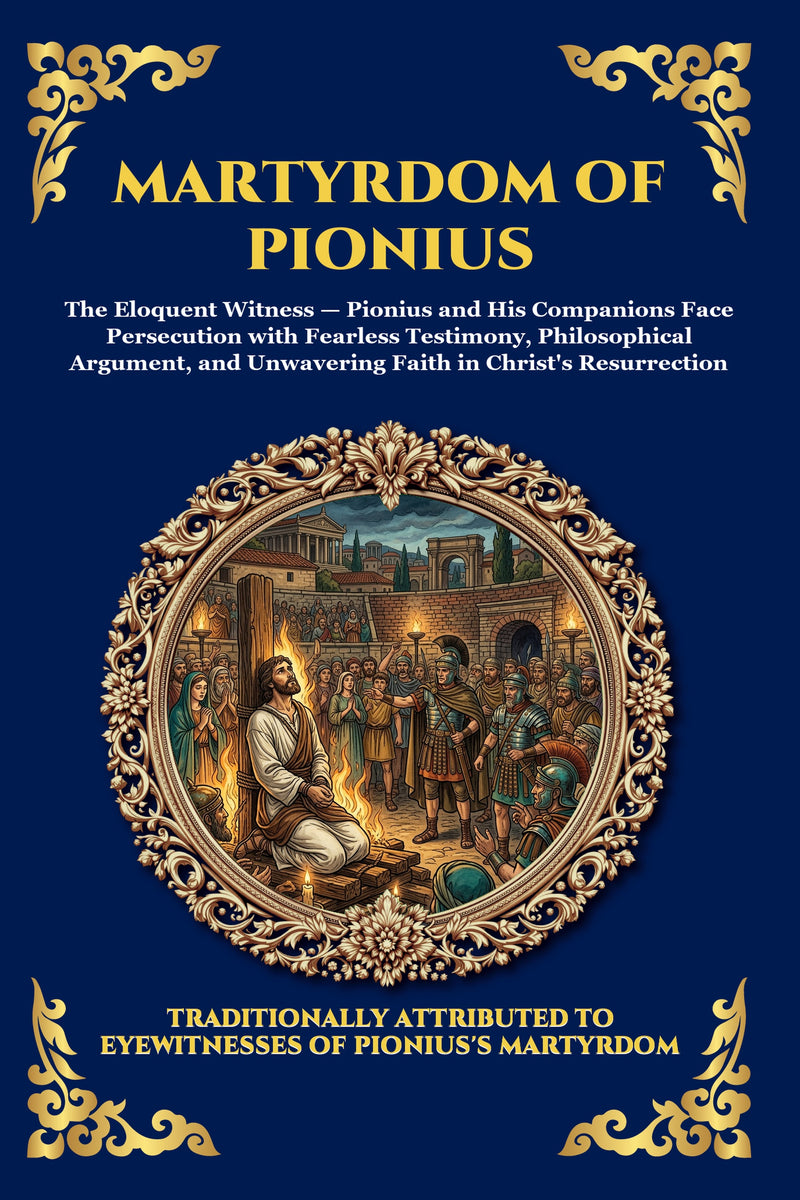
Martyrdom of Pionius
During the brutal Decian persecution, Pionius and his companions faced arrest, imprisonment, and execution rather than deny their faith. This vivid account, once excluded from many religious texts, reveals the profound loyalty and sacrifices early Christians made for spiritual truth.
or free app
10,000+ hrs library
30-day guarantee
The Martyrdom of Pionius is a complete modern-English translation of the ancient Christian martyrdom account, readable online with audiobook included through Library of Alexandria Press membership.
The Martyrdom of Pionius stands as one of the earliest and most historically reliable accounts of Christian persecution, dating to approximately 250 CE during Emperor Decius's systematic campaign against the faith.
The Martyrdom of Pionius provides a compelling and highly authentic modern translation of one of the most powerful works of early Christian history. This ancient text recounts the harrowing events during the Decian persecution in the city of Smyrna, focusing on the arrest, imprisonment, and eventual execution of the Christian presbyter Pionius and his faithful companions.
Far more than a simple historical chronicle, The Martyrdom of Pionius delves into profound themes of loyalty, theological defense, and the incredible sacrifices made in the pursuit of spiritual truth. Arrested on the anniversary of the martyrdom of Polycarp, Pionius uses his trial as a platform to deliver brilliant, eloquent defenses of the Christian faith, directly challenging the religious and social norms of the Roman Empire. Through intense interrogations, public debates, and physical torment, Pionius remains an unshakable pillar of strength, refusing to offer sacrifices to the Roman gods or the emperor.
His story is a vivid exploration of what it means to stand completely firm against an overwhelming empire. It offers an incredibly rare, firsthand glimpse into the legal procedures of Roman antiquity and the social pressures placed upon early Christian communities. Blending historical accuracy with profound spiritual inspiration, this document challenges modern readers to examine their own convictions and the true cost of their beliefs.
What You’ll Discover in This Modern Translation
- The Heroic Story of Pionius and His Companions: Follow the inspiring resistance of Pionius, Sabina, Asclepiades, and others as they fight for religious integrity against the might of Rome.
- Faith in the Face of Persecution: Explore gripping stories of unshakable devotion to God and the power of faith amidst intense public suffering and adversity.
- Lessons on Courage and Sacrifice: Learn timeless principles about resilience, defending your beliefs eloquently, and making ultimate moral choices under pressure.
- A Window into Early Christian History and Roman Culture: Gain a deeper understanding of the historical, legal, and spiritual significance of the events that shaped the early Christian Church and its survival.
Whether you’re exploring this work for its historical value, theological insights, or moral lessons, The Martyrdom of Pionius offers guidance and inspiration for all. Step into a story of unparalleled bravery and discover the timeless lessons of the early church. Begin your journey today.
| Formats | eBook (EPUB + PDF) · Audiobook · Paperback · Hardcover · Large Print |
| Language | English |
| Trim size (print) | 6 × 9 in |
| Binding | Paperback — perfect-bound · Hardcover — casewrap |
| Large Print edition | Same text in a larger, easy-read type — a larger font, not a larger trim |
| Print pricing | Every physical book at our true cost — at-cost, no profit (members) |
| Library | 873 restored titles, always growing |
| Composed | 3rd century AD |
| Original language | Greek |
| Source tradition | Greek and Latin manuscript tradition |
| Translation basis | Public-domain scholarly translation, rendered in clear modern English |
| Length | 8,119 words · ~32 min reading |
| Reading level | Grade 9 · clear and comfortable (this modern-English edition) |
| Edition | Modern English translation · 2026 |
Member reviews for this edition are collected as readers finish it — be the first. Across the library: 12,000+ books shipped, every plan covered by a 365-day print guarantee.
About this edition
The complete, unabridged text in clear modern English — faithful to the original, never simplified. Every paragraph is checked against the source, so nothing is cut, summarised, or paraphrased away. It reads cleanly for today while keeping the original meaning intact.
This text survives in Greek manuscripts and Latin translations from the medieval period. This edition derives from the standard public-domain scholarly translation and renders it in clear modern English.
- Complete & unabridgedVerified paragraph by paragraph against the source — never a scan, never abridged.
- Modern English, faithfulReadable today, with the author’s meaning kept intact. Readable — not simplified.
- Every format, one membershipRead in your browser or the free app, or listen to the full audiobook.
Included free with your membership
Cancel anytime, one click · 30-day money-back guarantee
Edition last updated June 2026
What’s inside
Martyrdom of Pionius — complete and unabridged: all 5 sections included with membership, plus the full audiobook.
Begin reading Martyrdom of Pionius
In clear modern English — the complete text is included with membership.
Arrest of Pionius and Companions
On the second day of the sixth month, on the occasion of a great Sabbath and on the anniversary of the blessed martyr Polycarp, while the persecution of Decius was still underway, the following were arrested: the presbyter Pionius, the holy woman Sabina, Asclepiades, Macedonia, and Limnos, a presbyter of the Catholic Church. Now Pionius had known the day before Polycarp's anniversary that they would all be seized on that day. Being together with Sabina and Asclepiades and keeping a fast, and knowing they were to be taken the following day, he took three woven chains and placed them around his own neck and the necks of Sabina and Asclepiades, and in this way received them as his guests. He did this with an eye to those who would come to arrest him, so that no one could suspect they were being induced to eat forbidden foods as others had been, but so that all would know they were resolved to be led off to prison at once.
Pionius Defends the Faith Before Polemon
It was Saturday, and after they had prayed and received the sacred bread with water, Polemon the temple verger came in with his men to seek out the Christians and drag them off to offer sacrifice and taste forbidden meats.
"Surely you are aware," said the verger, "of the emperor's edict commanding us to sacrifice to the gods."
"We are aware," said Pionius, "of the commandments of God ordering us to worship him alone."
Polemon said: "Come then to the marketplace; there you will change your minds."
Sabina and Asclepiades said: "We obey the living God."
He led them off without restraint, and as they walked along everyone could see they were wearing their chains. Such a crowd rushed up, as though drawn by some strange spectacle, that people jostled one another. As they came into the forum, by the eastern Stoa and the double gate, the entire forum and the upper galleries of the porches were crowded with Greeks, Jews, and women. They were on holiday because it was a great Sabbath. The crowd pressed forward, looking toward the tribunal steps and the voting urns.
Polemon then had the prisoners placed before him and spoke: "Pionius, it would be wise for you to obey and offer sacrifice like everyone else, so that you may not be punished." At this, Pionius stretched out his hand and began his defense with the following words: "You men who boast of the beauty of Smyrna, you who dwell by the river Meles and glory in Homer, and those among this audience who are Jews — listen while I make my brief address.
"I understand that you laughed and rejoiced at those who deserted the faith, and treated as a joke the error of those who voluntarily offered sacrifice. Men of Greece, you ought to have listened to your teacher Homer, who counsels that it is not a holy thing to gloat over those who are about to die. And as for you, men of Judaea, Moses commands: If you see the beast of your enemy fallen under its load, you shall not pass by, but shall go and help it up. In the same spirit, hear what Solomon says: If your enemy falls, do not rejoice, and do not be glad when he stumbles.
"I, for my part, in obedience to my Master, have chosen to die rather than transgress his commands, and I make every effort not to turn away from what I have learned and have myself since taught. At whom, then, do the Jews laugh without compassion? Even if, as they claim, we are their enemies, we are at least men — men who have been treated unjustly. They say we have had our chance to speak. Yes, but whom have we offended? Did we murder anyone? Did we prosecute anyone? Did we force anyone to worship false gods? Or do they perhaps think that our situation is comparable to their own crimes? Their sins differ from ours as much as deliberate wrongs differ from unwilling ones. Who forced the Jews to sacrifice to Baal-Peor? Or to partake of the sacrifices offered to the dead? Or to fornicate with the daughters of foreigners? Or to sacrifice their sons and daughters to idols? To murmur against God? To slander Moses? To be ungrateful to their benefactors? Or in their hearts to turn back to Egypt? Or, while Moses went up to receive the Law, to say to Aaron, Make us gods, and then to make the golden calf, and all the other things they did? For they are capable of deceiving you. Let them read to you the book of Judges, or Kings, or Exodus, or all the other passages that prove them wrong.
"Do they ask why it was that some, without any pressure, came forward to sacrifice of their own accord? But would you condemn all Christians on account of these? Consider the present life as though it were a threshing floor. Which pile is the larger — the chaff or the wheat? When the farmer comes to clear the threshing floor with his winnowing fan, the chaff, being lighter, is easily carried off by the wind, while the wheat remains where it was.
"Consider again the net cast into the sea. Surely not everything it gathers is of value. So it is with the present life. In what light would you prefer us to suffer — as men who are innocent, or as men who are guilty? If we are guilty, then how will you escape the same penalty, being proved wicked by your own deeds? And if we are innocent, then what hope can you have when even the just suffer? If the righteous man is saved only with difficulty, what place will there be for the impious and the sinner? The judgment of the world is near — of this we are convinced for many reasons.
"Once, on a journey, I traveled through all of Palestine, and crossing the Jordan river I saw a land that bears witness even to this day to the divine wrath that has fallen upon it because of the sins of its inhabitants, who killed foreigners, drove them out, or did them violence. I saw smoke rising even now, and a land scorched by fire, stripped of all produce and water. I saw the Dead Sea as well — a body of water transformed and set apart beyond its natural state by the fear of God, unable to sustain any living thing. Anything thrust into it is expelled upward by the water, and it cannot hold even a man's body within it. It refuses to receive man, lest it ever again be punished on man's account.
"But here I speak of things that are far away. You yourselves see and testify how the land of the Lydian Decapolis is scorched by fire and remains as an example of human impiety even to this day; you know the volcanic fire of Etna and Sicily and even Lycia and the islands. And even though this has kept away from you, consider your familiarity with hot water — I mean the sort which gushes up from the earth: how else could it be kindled and heated unless it emerged from an underground fire? Consider too the partial conflagrations and floods, such as you know of, for example, in the case of Deucalion, and we in the case of Noah. They are partial and occur in this way so that we may comprehend the nature of the whole from the part.
"Therefore we bear witness to you of the judgment by fire that is to come, accomplished by God through his Word, Jesus Christ. And for this reason we do not worship your so-called gods, nor will we adore the golden idol."
Pionius said all this and a great deal more, and he did not stop for a long time. The temple verger and his assistants and the entire crowd listened attentively, and the silence was so complete that no one uttered a sound. Pionius once more repeated his words: "We do not worship your gods, nor will we adore the golden idol." At this they were brought out into the open in front of everyone, and they were surrounded by a number of advocates who, together with Polemon, began to entreat Pionius, saying: "Listen to us, Pionius — we love you. There are many reasons why you deserve to live, for your character and your righteousness. It is good to live and to see the light," and many other things of this nature.
Pionius replied: "I too agree that life is good, but the life we long for is better; and so too with light — that one true light. All these things are indeed good, and we do not run from them as though we are eager to die or because we hate God's works. Rather, we turn away from these things which ensnare us because of the surpassing greatness of those other goods."
There was a lawyer by the name of Alexander, a wicked man, who spoke: "Listen to us, Pionius." "You should be concerned," said Pionius, "to listen to me. What you know, I know; but what I know, you are ignorant of." Alexander chose to mock him, and said to him with a sneer: "Why are you wearing those chains?"
"First of all," said Pionius, "so that while passing through your city we might not be suspected of having come to eat forbidden foods; secondly, so that you may understand that we do not consent even to be questioned — we have already made our decision, and we are going not to the temple of Nemesis but to the public gaol. And lastly, so that you may not seize us and drag us off by force, but leave us alone because we are already in chains. As it happened, you did not bring us into your temples in chains."
In this way Alexander was silenced. When they kept begging him once more, he said: "This is our decision." And when Pionius continued to refute them on many points and to speak to them about what was to come, Alexander said: "What use is all this talk of yours, when it is impossible for you to live?"
The people wanted an assembly called in the theatre so that they could hear more of this; but some friends of the strategos approached Polemon the temple verger and said: "Do not allow Pionius to speak, lest when the people go to the theatre there be a disturbance and an investigation be made about the man."
When Polemon heard this, he said: "Pionius, even if you do not wish to sacrifice, at least come into the temple of Nemesis." But Pionius said: "It would not profit your idols if we went there." "Obey us, Pionius," said Polemon. Pionius said: "Would that I were able to persuade you to become Christians." The men laughed aloud at him. "You have not such power that we should be burnt alive," they said. "It is far worse," said Pionius, "to burn after death."
Sabina smiled at this, and the verger and his men said: "You laugh?" "If God so wills," she said, "I do. We are Christians. Those who believe in Christ will laugh without hesitation in everlasting joy." They told her: "You are going to suffer something you will not like. Women who refuse to sacrifice are put into a brothel." "The God who is all holy," she said, "will take care of that."
Again Polemon spoke to Pionius: "Pionius, listen to us."
Pionius said: "You have been ordered either to persuade us or to punish us. You are not persuading us. So inflict the punishment." The verger Polemon made the request once more: "Offer the sacrifice, Pionius." "I am a Christian," answered Pionius.
"Which god do you worship?" asked Polemon. "The God who is almighty," said Pionius, "who made the heavens and the earth and all things that are in them, and all of us; the God who richly furnishes us with everything; the God we know through Christ his Word."
"Make a sacrifice at least to the emperor," said Polemon.
"I am a Christian," said Pionius. "I do not offer sacrifice to men."
Then Polemon interrogated him for the record, while a notary took everything down. "What is your name?" he asked.
"Pionius," was the answer.
"Are you a Christian?" asked Polemon.
"Yes," said Pionius.
Polemon the verger said: "What church do you belong to?"
"The Catholic Church," was the answer. "With Christ there is no other."
Next he came to Sabina. But first Pionius spoke to her: "Call yourself Theodote." He did this so that she might not, on account of her true name, fall into the hands of the immoral Politta, who had been her former mistress. Under the Emperor Gordian, this woman had tried to change the girl's faith by having Sabina bound and cast out on the mountains; but there Sabina received sustenance secretly from the brethren. Efforts were later made to free her from her bonds and from Politta, and since she had for the most part been living with Pionius, she was captured in the present persecution.
At any rate, Polemon then spoke to her: "What is your name?"
"Theodote," she said.
"Are you a Christian?" he asked.
"Yes, I am," she said.
"What is your church?" said Polemon.
Sabina answered: "The Catholic Church."
"Whom do you worship?" said Polemon.
Sabina answered: "Almighty God, who made the heavens and the earth and all of us, and who has been made known to us through his Word, Jesus Christ."
He then interrogated Asclepiades: "Your name?"
"Asclepiades," was the answer.
"Are you a Christian?" asked Polemon.
"Yes," said Asclepiades.
"Whom do you worship?" asked Polemon.
"Jesus Christ," answered Asclepiades.
"Is this the same one or another?" asked Polemon.
"The same one the others have referred to," answered Asclepiades.
After this exchange they were taken off to the jail, and a huge crowd followed so that the marketplace was filled. Some remarked of Pionius: "He has always looked so pale, but now look how ruddy his complexion is!" Sabina held on to his clothing because of the jostling of the crowd, and some said in jest, "Why, how terrified she is that she may be weaned!"
Cancel anytime, one click · 30-day money-back guarantee
Founding annual rate available now — your price locks for life when you join.
Not ready? Get this free chapter by email — read it anytime.
✓ Sent — check your inbox for Martyrdom of Pionius.
Questions about Martyrdom of Pionius
Is the Martyrdom of Pionius considered authentic history?
The Martyrdom of Pionius is widely regarded by scholars as one of the most historically reliable early Christian martyrdom accounts, containing authentic details about the Decian persecution in third-century Smyrna and contemporary legal procedures.
Why isn't the Martyrdom of Pionius in the Bible?
The Martyrdom of Pionius was written after the New Testament period and records historical events rather than apostolic teaching. Early church councils included only apostolic writings in the biblical canon, not later historical accounts of martyrdoms.
What does the Martyrdom of Pionius actually contain?
The Martyrdom of Pionius recounts the arrest, trial, and execution of the Christian presbyter Pionius and his companions during Emperor Decius's persecution, including detailed dialogues with Roman officials and vivid descriptions of their sufferings.
Is Martyrdom of Pionius free to read?
The opening of the text is free to read below. Members read and listen to the complete work — and the entire Lost & Forbidden Library — free.
What is Martyrdom of Pionius?
Have you ever wondered why early Christians were willing to face unimaginable suffering and death rather than renounce their faith?
How long is Martyrdom of Pionius?
5 chapters (~5,724 words) in this restored edition.
Shipping & returns
Billing & membership
More from the library


Explore The Lost & Forbidden Library
- 1 Enoch · Attributed to Enoch
- 1–4 Maccabees · Various Jewish authors
- 2 Baruch · Attributed to Baruch
- 2 Enoch · Attributed to Enoch
- 2 Esdras · Attributed to the prophet Ezra
- 3 Baruch · Attributed to Baruch ben Neriah
- 4 Baruch · Attributed to Baruch ben Neriah
- A Valentinian Exposition · Attributed to a follower of Val...
- Acta Archelai · Attributed to Hegemonius
- Acts of Andrew · Anonymous (Early Christian Apoc...
- Acts of Andrew and Matthias in the City of the Cannibals · Attributed to early Christian a...
- Acts of Barnabas · Attributed to John Mark
- Acts of Bartholomew
- Acts of John · Anonymous (Early Christian Apoc...
- Acts of Matthias · Anonymous early Christian writers
- Acts of Paul · Attributed to an unknown early ...
- Acts of Paul and Thecla · Attributed to Onesiphorus
- Acts of Peter
- Acts of Peter and Andrew · Attributed to various early Chr...
- Acts of Peter and Paul · Attributed to Leucius Charinus
- Acts of Peter and Simon · Attributed to Leucius Charinus
- Acts of Peter and the Twelve Apostles · Attributed to early Christian a...
- Acts of Philip · Anonymous (Early Christian Apoc...
- Acts of Pilate (Gospel of Nicodemus) · Attributed to various early Chr...
- Acts of Saturninus
- Acts of Thaddaeus · Attributed to Thaddaeus the Apo...
- Acts of Thomas
- Acts of Titus · Anonymous early Christian writer
- Acts of Xanthippe, Polyxena, and Rebecca
- Allogenes · Anonymous (Early Gnostic Mystic)
Martyrdom of Pionius
Martyrdom of Pionius
An Authentic Account of Early Christian Persecution – A Powerful Story of Unwavering Faith, Courage, and Sacrifice in the Roman Empire
Library of Alexandria Press
Martyrdom of Pionius
© Copyright 2026 Library of Alexandria Press. All rights reserved.
Published by Library of Alexandria Press
Printed in the United States of America
It is not legal to copy, share, or send any part of this document in either digital or printed form without written permission from the publisher, except short quotes in a book review.
Table of Contents
Introduction
A World on Fire
Why This Story Still Matters
Arrest of Pionius and Companions
Pionius Defends the Faith Before Polemon
Introduction
There are moments in history so charged with moral intensity that they refuse to remain in the past. They reach forward across the centuries and grip us by the collar, demanding that we look, that we reckon, that we ask ourselves what we would have done. The story of Pionius of Smyrna is one of those moments. It unfolds in the middle of the third century of the common era, in a world that looks very different from our own yet feels, in its anxieties and its power struggles and its desperate human longing for meaning, startlingly familiar. It is a story about what happens when the machinery of empire turns its grinding attention toward a community of believers who refuse to pretend, refuse to conform, and refuse to survive at any cost. It is a story about one man who stood at the center of that pressure and did not break.
To read this account is to step into a world where the line between life and death could be crossed with a single public gesture — a pinch of incense dropped onto a flame before a statue of the emperor, a murmured acknowledgment of the gods of Rome. For most people living under Roman rule, this was not a moral crisis. It was civic duty, social ritual, the background noise of imperial life. But for Pionius, a Christian presbyter in the prosperous port city of Smyrna on the western coast of Asia Minor, it was an act of profound betrayal — not merely of an institution or a doctrine, but of a living relationship with a God he believed had died and risen for him personally. That conviction made him dangerous in the eyes of Rome, and it made him extraordinary in the eyes of his community. It makes him fascinating to us, reading his words nearly two thousand years later.
The text you are about to read is among the most remarkable documents to survive from early Christian history. It belongs to a genre known as the Acts of the Martyrs — firsthand or near-firsthand accounts of Christians who were arrested, tried, and executed for their faith during the various waves of Roman persecution. Some of these accounts are heavily embellished, layered over centuries with legend and liturgical elaboration until the historical figure at the center is barely visible beneath the hagiographic ornamentation. The account of Pionius is different. Scholars who have studied it carefully, including the great twentieth-century historian of early Christianity Herbert Musurillo, have consistently noted its exceptional historical credibility. The details are too specific, too unglamorous, too psychologically complex to be the invention of a later pious imagination. We hear Pionius speaking in his own voice — arguing, reasoning, pleading, rebuking, and ultimately accepting a fate he could have avoided at almost any point along the way.
The historical backdrop against which all of this unfolds is the reign of the emperor Decius, who came to power in 249 CE and almost immediately issued an edict requiring all inhabitants of the Roman Empire to perform a public sacrifice to the traditional gods and to obtain a certificate — a libellus — proving they had done so. This was not, strictly speaking, an anti-Christian measure in its stated intent. Decius framed it as a religious renewal, a restoration of the ancient piety that had, in his view, made Rome great. But in practice, it functioned as a lethal trap for Christians, who could not in good conscience perform the required sacrifice. The Decian persecution, as historians call it, was relatively brief — Decius died in battle in 251 CE — but its intensity was shattering. Communities that had grown comfortable during decades of relative tolerance suddenly found themselves facing an existential choice. Many Christians apostatized, some under direct coercion, others preemptively, out of fear. The question of what to do with these lapsed believers — the lapsi — would tear the church apart for years afterward. Against this backdrop of communal crisis and moral collapse, the figure of Pionius stands out with particular sharpness.
He was arrested on a date the account gives us with unusual precision: the anniversary of the martyrdom of Polycarp, the great bishop of Smyrna who had himself been burned alive approximately a century earlier. Whether this date was chosen deliberately by the Roman authorities, or whether it was a coincidence that Pionius and his companions interpreted as providential, the symbolism was not lost on anyone present. Smyrna had a memory. It had a tradition of resistance. And Pionius, who had apparently spent the night before his arrest in fasting and prayer, was ready. He had even prepared chains to wear, a gesture so theatrically bold and so theologically loaded that it immediately reframed the entire encounter. He was not being captured. He was choosing his path.
What follows his arrest is a sustained drama of interrogation, persuasion, pressure, and public spectacle that reveals the Roman imperial system in extraordinary detail. We see the mechanics of persecution up close — the role of the temple wardens, the function of the public assembly, the legal procedures of the Roman court, the social dynamics of a crowd that includes curious pagans, hostile Jews, wavering Christians, and committed believers. We hear the arguments that were made to Pionius, some of them surprisingly sophisticated, even compassionate in their way. We hear his responses, which are learned, sometimes sharp, occasionally tender, and always rooted in a theological conviction so deep it functions less like an opinion than like a bone. And we watch as the pressure intensifies, as imprisonment stretches on, as the physical conditions deteriorate, and as the moment of final decision approaches.
It would be a mistake to read this text as simple propaganda — as a straightforward celebration of heroic Christian virtue designed to shame the cowardly and inspire the faithful. The account is more honest than that, and more interesting. Pionius is not a plaster saint. He is a man of considerable learning and considerable passion, capable of anger and sarcasm as well as gentleness and grace. His speeches, which take up a substantial portion of the narrative, engage seriously with the objections of his interrogators and the anxieties of his fellow Christians. He quotes Homer and Plato alongside the Hebrew prophets. He argues about the nature of divine justice, the meaning of suffering, the relationship between Jewish and Christian understandings of God. He is, in short, a real person — and the account that preserves his story is real history, shaped by real grief and real admiration for a man who chose death over compromise.
For modern readers, this story opens windows onto a world that is at once alien and intimate. The Roman Empire of the mid-third century was a civilization of extraordinary complexity and sophistication, a multicultural, multilingual, religiously pluralistic society that had absorbed and synthesized influences from Greece, Egypt, Persia, and a dozen other cultures. Smyrna itself was one of the great cities of the eastern Mediterranean — wealthy, cosmopolitan, architecturally magnificent, home to a population that included Greeks, Romans, Jews, and a growing number of Christians who were beginning to develop their own distinctive institutions and identity. To understand Pionius, we need to understand this world, not as a backdrop of exotic antiquity but as a living social reality in which people were trying to navigate competing loyalties, make sense of suffering, and find a way to live with integrity.
Arrest of Pionius and Companions
On the second day of the sixth month, on the occasion of a great Sabbath and on the anniversary of the blessed martyr Polycarp, while the persecution of Decius was still underway, the following were arrested: the presbyter Pionius, the holy woman Sabina, Asclepiades, Macedonia, and Limnos, a presbyter of the Catholic Church. Now Pionius had known the day before Polycarp's anniversary that they would all be seized on that day. Being together with Sabina and Asclepiades and keeping a fast, and knowing they were to be taken the following day, he took three woven chains and placed them around his own neck and the necks of Sabina and Asclepiades, and in this way received them as his guests. He did this with an eye to those who would come to arrest him, so that no one could suspect they were being induced to eat forbidden foods as others had been, but so that all would know they were resolved to be led off to prison at once.
Pionius Defends the Faith Before Polemon
It was Saturday, and after they had prayed and received the sacred bread with water, Polemon the temple verger came in with his men to seek out the Christians and drag them off to offer sacrifice and taste forbidden meats.
"Surely you are aware," said the verger, "of the emperor's edict commanding us to sacrifice to the gods."
"We are aware," said Pionius, "of the commandments of God ordering us to worship him alone."
Polemon said: "Come then to the marketplace; there you will change your minds."
Sabina and Asclepiades said: "We obey the living God."
He led them off without restraint, and as they walked along everyone could see they were wearing their chains. Such a crowd rushed up, as though drawn by some strange spectacle, that people jostled one another. As they came into the forum, by the eastern Stoa and the double gate, the entire forum and the upper galleries of the porches were crowded with Greeks, Jews, and women. They were on holiday because it was a great Sabbath. The crowd pressed forward, looking toward the tribunal steps and the voting urns.
Polemon then had the prisoners placed before him and spoke: "Pionius, it would be wise for you to obey and offer sacrifice like everyone else, so that you may not be punished." At this, Pionius stretched out his hand and began his defense with the following words: "You men who boast of the beauty of Smyrna, you who dwell by the river Meles and glory in Homer, and those among this audience who are Jews — listen while I make my brief address.
"I understand that you laughed and rejoiced at those who deserted the faith, and treated as a joke the error of those who voluntarily offered sacrifice. Men of Greece, you ought to have listened to your teacher Homer, who counsels that it is not a holy thing to gloat over those who are about to die. And as for you, men of Judaea, Moses commands: If you see the beast of your enemy fallen under its load, you shall not pass by, but shall go and help it up. In the same spirit, hear what Solomon says: If your enemy falls, do not rejoice, and do not be glad when he stumbles.
"I, for my part, in obedience to my Master, have chosen to die rather than transgress his commands, and I make every effort not to turn away from what I have learned and have myself since taught. At whom, then, do the Jews laugh without compassion? Even if, as they claim, we are their enemies, we are at least men — men who have been treated unjustly. They say we have had our chance to speak. Yes, but whom have we offended? Did we murder anyone? Did we prosecute anyone? Did we force anyone to worship false gods? Or do they perhaps think that our situation is comparable to their own crimes? Their sins differ from ours as much as deliberate wrongs differ from unwilling ones. Who forced the Jews to sacrifice to Baal-Peor? Or to partake of the sacrifices offered to the dead? Or to fornicate with the daughters of foreigners? Or to sacrifice their sons and daughters to idols? To murmur against God? To slander Moses? To be ungrateful to their benefactors? Or in their hearts to turn back to Egypt? Or, while Moses went up to receive the Law, to say to Aaron, Make us gods, and then to make the golden calf, and all the other things they did? For they are capable of deceiving you. Let them read to you the book of Judges, or Kings, or Exodus, or all the other passages that prove them wrong.
"Do they ask why it was that some, without any pressure, came forward to sacrifice of their own accord? But would you condemn all Christians on account of these? Consider the present life as though it were a threshing floor. Which pile is the larger — the chaff or the wheat? When the farmer comes to clear the threshing floor with his winnowing fan, the chaff, being lighter, is easily carried off by the wind, while the wheat remains where it was.
"Consider again the net cast into the sea. Surely not everything it gathers is of value. So it is with the present life. In what light would you prefer us to suffer — as men who are innocent, or as men who are guilty? If we are guilty, then how will you escape the same penalty, being proved wicked by your own deeds? And if we are innocent, then what hope can you have when even the just suffer? If the righteous man is saved only with difficulty, what place will there be for the impious and the sinner? The judgment of the world is near — of this we are convinced for many reasons.
"Once, on a journey, I traveled through all of Palestine, and crossing the Jordan river I saw a land that bears witness even to this day to the divine wrath that has fallen upon it because of the sins of its inhabitants, who killed foreigners, drove them out, or did them violence. I saw smoke rising even now, and a land scorched by fire, stripped of all produce and water. I saw the Dead Sea as well — a body of water transformed and set apart beyond its natural state by the fear of God, unable to sustain any living thing. Anything thrust into it is expelled upward by the water, and it cannot hold even a man's body within it. It refuses to receive man, lest it ever again be punished on man's account.
"But here I speak of things that are far away. You yourselves see and testify how the land of the Lydian Decapolis is scorched by fire and remains as an example of human impiety even to this day; you know the volcanic fire of Etna and Sicily and even Lycia and the islands. And even though this has kept away from you, consider your familiarity with hot water — I mean the sort which gushes up from the earth: how else could it be kindled and heated unless it emerged from an underground fire? Consider too the partial conflagrations and floods, such as you know of, for example, in the case of Deucalion, and we in the case of Noah. They are partial and occur in this way so that we may comprehend the nature of the whole from the part.
"Therefore we bear witness to you of the judgment by fire that is to come, accomplished by God through his Word, Jesus Christ. And for this reason we do not worship your so-called gods, nor will we adore the golden idol."
Pionius said all this and a great deal more, and he did not stop for a long time. The temple verger and his assistants and the entire crowd listened attentively, and the silence was so complete that no one uttered a sound. Pionius once more repeated his words: "We do not worship your gods, nor will we adore the golden idol." At this they were brought out into the open in front of everyone, and they were surrounded by a number of advocates who, together with Polemon, began to entreat Pionius, saying: "Listen to us, Pionius — we love you. There are many reasons why you deserve to live, for your character and your righteousness. It is good to live and to see the light," and many other things of this nature.
Pionius replied: "I too agree that life is good, but the life we long for is better; and so too with light — that one true light. All these things are indeed good, and we do not run from them as though we are eager to die or because we hate God's works. Rather, we turn away from these things which ensnare us because of the surpassing greatness of those other goods."
There was a lawyer by the name of Alexander, a wicked man, who spoke: "Listen to us, Pionius." "You should be concerned," said Pionius, "to listen to me. What you know, I know; but what I know, you are ignorant of." Alexander chose to mock him, and said to him with a sneer: "Why are you wearing those chains?"
"First of all," said Pionius, "so that while passing through your city we might not be suspected of having come to eat forbidden foods; secondly, so that you may understand that we do not consent even to be questioned — we have already made our decision, and we are going not to the temple of Nemesis but to the public gaol. And lastly, so that you may not seize us and drag us off by force, but leave us alone because we are already in chains. As it happened, you did not bring us into your temples in chains."
In this way Alexander was silenced. When they kept begging him once more, he said: "This is our decision." And when Pionius continued to refute them on many points and to speak to them about what was to come, Alexander said: "What use is all this talk of yours, when it is impossible for you to live?"
The people wanted an assembly called in the theatre so that they could hear more of this; but some friends of the strategos approached Polemon the temple verger and said: "Do not allow Pionius to speak, lest when the people go to the theatre there be a disturbance and an investigation be made about the man."
When Polemon heard this, he said: "Pionius, even if you do not wish to sacrifice, at least come into the temple of Nemesis." But Pionius said: "It would not profit your idols if we went there." "Obey us, Pionius," said Polemon. Pionius said: "Would that I were able to persuade you to become Christians." The men laughed aloud at him. "You have not such power that we should be burnt alive," they said. "It is far worse," said Pionius, "to burn after death."
Sabina smiled at this, and the verger and his men said: "You laugh?" "If God so wills," she said, "I do. We are Christians. Those who believe in Christ will laugh without hesitation in everlasting joy." They told her: "You are going to suffer something you will not like. Women who refuse to sacrifice are put into a brothel." "The God who is all holy," she said, "will take care of that."
Again Polemon spoke to Pionius: "Pionius, listen to us."
Pionius said: "You have been ordered either to persuade us or to punish us. You are not persuading us. So inflict the punishment." The verger Polemon made the request once more: "Offer the sacrifice, Pionius." "I am a Christian," answered Pionius.
"Which god do you worship?" asked Polemon. "The God who is almighty," said Pionius, "who made the heavens and the earth and all things that are in them, and all of us; the God who richly furnishes us with everything; the God we know through Christ his Word."
"Make a sacrifice at least to the emperor," said Polemon.
"I am a Christian," said Pionius. "I do not offer sacrifice to men."
Then Polemon interrogated him for the record, while a notary took everything down. "What is your name?" he asked.
"Pionius," was the answer.
"Are you a Christian?" asked Polemon.
"Yes," said Pionius.
Polemon the verger said: "What church do you belong to?"
"The Catholic Church," was the answer. "With Christ there is no other."
Next he came to Sabina. But first Pionius spoke to her: "Call yourself Theodote." He did this so that she might not, on account of her true name, fall into the hands of the immoral Politta, who had been her former mistress. Under the Emperor Gordian, this woman had tried to change the girl's faith by having Sabina bound and cast out on the mountains; but there Sabina received sustenance secretly from the brethren. Efforts were later made to free her from her bonds and from Politta, and since she had for the most part been living with Pionius, she was captured in the present persecution.
At any rate, Polemon then spoke to her: "What is your name?"
"Theodote," she said.
"Are you a Christian?" he asked.
"Yes, I am," she said.
"What is your church?" said Polemon.
Sabina answered: "The Catholic Church."
"Whom do you worship?" said Polemon.
Sabina answered: "Almighty God, who made the heavens and the earth and all of us, and who has been made known to us through his Word, Jesus Christ."
He then interrogated Asclepiades: "Your name?"
"Asclepiades," was the answer.
"Are you a Christian?" asked Polemon.
"Yes," said Asclepiades.
"Whom do you worship?" asked Polemon.
"Jesus Christ," answered Asclepiades.
"Is this the same one or another?" asked Polemon.
"The same one the others have referred to," answered Asclepiades.
After this exchange they were taken off to the jail, and a huge crowd followed so that the marketplace was filled. Some remarked of Pionius: "He has always looked so pale, but now look how ruddy his complexion is!" Sabina held on to his clothing because of the jostling of the crowd, and some said in jest, "Why, how terrified she is that she may be weaned!"
Someone shouted: "If they don't sacrifice they ought to be punished!"
Polemon said: "But the fasces do not allow us to exercise authority."
Someone else said, "Why look, the little fellow is going off to sacrifice!" He was referring to Asclepiades, who was with us.
Pionius said: "You lie; he is doing no such thing."
Still others said: "But this one and that one have offered sacrifice."
Pionius said: "Each man has his own life to lead. This has nothing to do with me. My name is Pionius."
Still others said: "What a terrible chastisement!" and "So indeed it is!"
Pionius said: "This sort of punishment you knew of from times of famine and violent death and other plagues."
And someone said to him: "You too went hungry with us." Pionius said: "Yes, I did, with trust in God."
They were so pressed by the crowd as to be stifled, and after Pionius had said this, they took them with difficulty, handed them over to the jailers, and put them in prison. As they went in they found a presbyter of the Catholic Church imprisoned there by the name of Limnus, a Macedonian woman from the town of Karine, and a man named Eutychian from the sect of the Phrygians. When they were all gathered together the jailers realized that Pionius and his group were not accepting the things brought to them by the faithful.
Pionius had said: "When we had need of much more, we were a burden to no one. Are we to accept it now?"
The jailers therefore became angry, because they used to benefit from whatever came in to the prisoners. So in their anger they cast the prisoners into the inner part of the prison, since they received no gifts from them. The prisoners, however, praised God and remained calm, offering the guards the usual friendship, so that the prison warden changed his mind and had them brought back to their former place. And they kept saying: "Praise to the Lord! This has happened to us for our good." For they were free to speak and to pray night and day.
Even so, while they were in prison many pagans came to try to persuade them, and were surprised by the answers they received. Into the prison as well came many Christian brothers who had been carried off by force, and they made a great lament. They were constantly in deep grief, especially those who had lived a good and devout life, so that Pionius wept as he told them: "I am tormented anew, and torn limb from limb, when I see the pearls of the Church being trampled by swine, the stars of heaven being swept down to earth by the dragon's tail, and the vine which the right hand of God planted being ravaged by the solitary wild boar, so that all those who pass by on the road may pluck its fruit.
"My little children, once again I bear you in travail until Christ shall be formed within you. My tender sons have travelled rough roads. Once again the vicious old men spy on Susanna; now they discover the delicate and lovely girl, fill themselves with her beauty, and utter lies against her. Now again is Haman made drunk, and Esther and the whole city are in terror. Once again there is no hunger or thirst for bread and water, but rather for listening to the word of the Lord. Have all the virgins completely nodded off and fallen asleep? The word of the Lord Jesus is fulfilled: When the Son of Man comes, will he find faith on earth? I also hear that each one is betraying his neighbor, that the word might be fulfilled: Brother will deliver brother up to death. Indeed, Satan has demanded to have us, that he might sift us like wheat, and the fiery winnowing fork is in the hand of the Word of God for the clearing of the threshing floor. It may be that the salt has lost its savor and, cast out, is trodden on by men. But let no one imagine, my little children, that the Lord has failed — rather, we ourselves have. Can my hand be shortened, he says, that it cannot save, or my ear made dull that it cannot hear? But your sins have made a separation between you and your God. For we have sinned, and some of us have indeed been scornful; we have done wrong by backbiting and by accusing one another, and thus we have been destroyed by one another. Our righteousness ought rather to exceed that of the scribes and Pharisees.
"I understand also that the Jews have been inviting some of you to their synagogues. Beware lest you fall into a greater and more deliberate sin, lest anyone commit the unforgivable sin of blasphemy against the Holy Spirit. Do not become with them rulers of Sodom and people of Gomorrah, whose hands are tainted with blood. We did not slay our prophets, nor did we betray Christ and crucify him. But why need I say much to you? Recall what you have heard, and now put into practice what you have learned. For you have also heard the Jews say: Christ was a man, and he died a criminal. But let them tell us — what other criminal has filled the entire world with his disciples? What other criminal had his disciples and others die for the name of their master? By what other criminal's name have devils for so many years been expelled, are still expelled now, and will be in the future? And so it is with all the other wonders that are done in the Catholic Church. What these people forget is that this so-called criminal departed from life at his own choice. Again, they assert that Christ performed necromancy or spirit-divination with the cross. Yet what Scripture — in their possession or in ours — says this of Christ? Did any good man ever say this? Are not those who say it wicked men? How then can you believe the words of the wicked rather than those of the good?
For my part, this lie that is repeated now as though it were recent, I have heard uttered by Jewish people since I was a child. It is written that Saul inquired of a diviner, and that he said to the woman who was performing the necromancy, "Bring up for me Samuel the prophet." And the woman saw a man rising up wrapped in a robe, and Saul recognized that it was Samuel, and put to him the questions he wanted.
Well then, was the diviner able to bring up Samuel or not? If they say she was, then they admit that wickedness has more power than righteousness, and they are accursed for saying so. If they say she was not, then they should not assert it of Christ the Lord. But the explanation of this story is as follows. How could this wicked diviner, herself a creature of demons, bring up the soul of the holy prophet resting in the bosom of Abraham? For the lesser is commanded by the greater. Surely then Samuel was not truly brought back, as these people suppose? Of course not. The truth is something like this. Whenever anyone revolts from God, the rebel angels follow him, and demonic ministers assist him with every sort of drug, magician, priest, and wizard. And no wonder, for the Apostle says: Even Satan disguises himself as an angel of light. Is it any surprise, then, that his servants also disguise themselves as servants of righteousness? Indeed, even the Antichrist will appear as Christ. So Samuel was not brought up from the grave; rather, demons from Hell disguised themselves as Samuel and appeared in that form to the diviner and to the faithless Saul. The Scriptures themselves will show you this. For Samuel in the apparition says to Saul: You too shall be with me today. How could the idolatrous Saul possibly be found together with Samuel? Clearly he is with the wicked demons who have deceived him and become his masters. It cannot, therefore, have been Samuel. But if it is impossible to bring back the soul of the holy prophet, how can it be possible to see rising from the earth Jesus Christ, who is in heaven — whom the disciples saw taken up, and who died rather than deny him?
And if you are unable to maintain this argument against them, tell them: However that may be, we are stronger than you, who committed fornication and worshipped idols without being forced to. Do not yield to them in despair, my brothers, but cleave to Christ through repentance, for he is merciful in receiving you back as his children.
After he had spoken to them and urged them to leave the prison, the temple verger Polemon came upon them with Theophilus, the commander of the cavalry, a group of soldiers, and a huge crowd. They told them: "Look — Euctemon, one of your own leaders, has offered sacrifice. You should be persuaded to do the same. Lepidus and Euctemon are asking for you in the temple of Nemesis."
"It is proper," said Pionius, "that those who have been imprisoned should await the arrival of the proconsul. Why do you take his task upon yourselves?"
They went away very annoyed, and returned with soldiers and a crowd. Then the cavalry commander Theophilus told them deceitfully, "The proconsul has sent word that you are to be transferred to Ephesus."
"Let the one he has sent come forward," said Pionius, "and take us there."
The cavalry commander said: "An imperial officer commands respect! Whether you will or not, I am in charge!"
Then, taking hold of Pionius, he knotted a scarf around his neck so that he was practically choking, and handed him over to one of the soldiers. And so they came to the market-place, with Sabina and the others. When they began to shout in a loud voice, "We are Christians!" and threw themselves on the ground to avoid being dragged to the temple, six soldiers picked up Pionius and carried him head downwards, since they could not otherwise stop him from driving his knees into their sides and tangling their arms and legs.
They carried him shouting and threw him down in front of the altar, beside which Euctemon was still standing in an attitude of worship.
Lepidus said: "Pionius, why do you and your people not sacrifice?"
The group around Pionius said: "Because we are Christians."
"Which god do you worship?" asked Lepidus.
Pionius answered: "The God who made heaven and earth and the sea and all that is in them."
Lepidus said: "You mean, then, the one who was crucified?"
"Yes," said Pionius, "him whom God sent for the redemption of the world."
At this the officials burst into loud laughter, and Lepidus cursed Christ.
Pionius then cried out: "You should have respect for piety, honor justice, feel some sympathy, and live in accordance with your own laws. You punish us for being disobedient, and yet you yourselves are disobedient: you were ordered to punish us, not to force us against our will."
At this a bystander named Rufinus, one of those with a reputation for excellence in rhetoric, said to him: "Stop, Pionius — do not be a fool!"
Pionius answered him: "Is this your rhetoric? Is this your learning? Even Socrates did not suffer this at the hands of the Athenians. But now everyone fancies himself an Anytus or a Meletus. Were Socrates and Aristides and Anaxarchus and all the rest fools in your view, because they practiced philosophy and justice and courage?"
Rufinus, hearing this, simply fell silent.
There was a man present who was prominent in worldly standing, and he and Lepidus together said, "Pionius, do not shout so."
"Then do not try to force me," he answered. "Light a fire and we will climb upon it of our own accord."
A man named Terentius shouted from the crowd: "Do you know that this man has stirred up the others so that they will not sacrifice?"
Finally, crowns were placed on them, but they tore them apart and threw them away. The public servant stood there holding the sacrificial meat. He did not dare approach anyone, but simply ate it in full view of everyone. As they kept shouting, "We are Christians!" and since nothing could be done with them, they were sent back to prison, while the crowd mocked and beat them.
Someone said to Sabina: "Why could you not have died in your own native city?"
Sabina replied: "What is my native city? I am the sister of Pionius."
Terentius, who was at that time in charge of the gladiatorial hunting games, said to Asclepiades, "After your condemnation I shall ask for you to compete in single combat with my son."
Asclepiades answered: "You do not terrify me with this."
And in this way they were led back to prison. As Pionius was going in, one of the soldiers clubbed him heavily on the head and wounded him. Yet he said nothing. But the arm and side of the man who struck him swelled up so badly that he could hardly breathe. They entered the prison and gave glory to God that they had remained unharmed in the name of Christ, and that neither the enemy nor the hypocritical Euctemon had gained control over them; and they continued to strengthen one another with psalms and prayers.
Later it was said that Euctemon had decided to force their hand. He had brought a little lamb to the temple of Nemesis, and after it was roasted and he had eaten of it, he intended to take the rest home. He had indeed made himself ridiculous by his false oath, wearing his crown and swearing by the emperor's genius and the goddesses of Fate that he was not a Christian and that, unlike the rest, he would omit nothing that would make his denial plain.
Later the proconsul came to Smyrna. Pionius was brought before him on the twelfth of March, and gave his testimony with the minutes being taken down by secretaries. Seated before the tribunal, the proconsul Quintillian put the question: "What is your name?"
"Pionius," was the answer.
"Will you offer sacrifice?" the proconsul asked.
"No," he answered.
The proconsul asked: "What is the cult or sect to which you belong?"
"The Catholic," he answered.
"What do you mean, the Catholic?" asked the proconsul.
"I am a presbyter of the Catholic Church," said Pionius.
"Are you one of their teachers?" asked the proconsul.
"Yes," answered Pionius, "I was a teacher."
"You were a teacher of foolishness?" he asked.
"Of piety," was the answer.
"What sort of piety?" he asked.
He answered: "Piety towards God the Father, who has made all things."
The proconsul said: "Offer sacrifice."
"No," he answered. "My prayers must be offered to God."
But he said: "We reverence all the gods; we reverence the heavens and all the gods that are in heaven. So why do you attend to the air? Then sacrifice to the air."
"I do not attend to the air," answered Pionius, "but to him who made the air, the heavens, and all that is in them."
The proconsul said: "Tell me, who did make them?"
Pionius answered: "I cannot tell you."
The proconsul said: "Surely it was the god Zeus, who is in heaven; for he is the ruler of all the gods."
As Pionius was silent, hanging in torture, he was asked: "Will you sacrifice?"
"No," he answered.
Once more he was tortured by his fingernails, and the question was put: "Change your mind. Why have you lost your senses?"
"I have not lost my senses," he answered; "rather I am afraid of the living God."
The proconsul said: "Many others have offered sacrifice, and they are now alive and of sound mind."
"I will not sacrifice," was the answer.
The proconsul said: "Under questioning, reflect within yourself and change your mind."
"No," he answered.
"Why do you rush towards death?" he was asked.
"I am not rushing towards death," he answered, "but towards life."
Quintillian the proconsul said: "You accomplish very little by hastening towards your death. Those who enlist to fight the beasts for a trifling sum of money despise death just as you do. You are merely one of those. Since you are so eager for death, you shall be burnt alive."
The sentence was then read aloud in Latin from a tablet: "Whereas Pionius has admitted that he is a Christian, we hereby sentence him to be burnt alive."
He went eagerly to the amphitheatre, driven by the zeal of his faith, and gladly removed his clothes as the prison-keeper stood by. Then, realizing the holiness and dignity of his own body, he was filled with great joy; and looking up to heaven he gave thanks to God who had preserved him so. Then he stretched himself out on the stake and allowed the soldier to hammer in the nails. When Pionius had been nailed down, the public executioner said to him once again: "Change your mind and the nails will be taken out."
But he answered: "I feel that they are in to stay."
Then after a moment's reflection he said: "I am hurrying, so that I may awaken all the more quickly, manifesting the resurrection from the dead."
And so they raised him up on the stake, and afterwards a man named Metrodorus from the Marcionite sect was raised up beside him. Pionius was on the right and Metrodorus on the left, and both faced the east. After they brought the firewood and piled up the logs in a circle around them, Pionius shut his eyes, so that the crowd thought he was already dead. But he was praying in secret, and when he came to the end of his prayer he opened his eyes. The flames were just beginning to rise when he pronounced his last Amen with a joyful countenance and said: "Lord, receive my soul." Then peacefully and painlessly, as though simply breathing out, he breathed his last and gave his soul in trust to the Father, who has promised to protect all blood and every spirit that has been unjustly condemned.
Such was the innocent, blameless, and incorruptible life which blessed Pionius brought to an end, with his mind ever fixed on almighty God and on Jesus Christ our Lord, the mediator between God and man; of such an end was he deemed worthy. After his victory in the great contest he passed through the narrow gate into the broad and glorious light. Indeed his crown was made manifest through his body. For after the fire had been extinguished, those of us who were present saw his body like that of an athlete in full array at the height of his powers. His ears were not distorted; his hair lay in order on the surface of his head; and his beard was full, as though with the first fresh growth of hair. His face shone once again — wondrous grace! — so that the Christians were all the more confirmed in the faith, and those who had fallen away returned dismayed and with fearful consciences.
This took place when Julius Proculus Quintillianus was proconsul of Asia, under the consulship of the Emperor Gaius Messius Quintus Trajan Decius Augustus for the second time and Vettius Gratus, on the fourth day before the Ides of March by the Roman calendar, and by the Asiatic reckoning on the nineteenth day of the sixth month, a Saturday, at the tenth hour — and by our own reckoning, under the kingship of our Lord Jesus Christ, to whom be glory for ever and ever. Amen.
End of the free sample
Keep reading, free
Members read and listen to the complete book — and the entire library. Cancel anytime, one click · 30-day money-back guarantee.