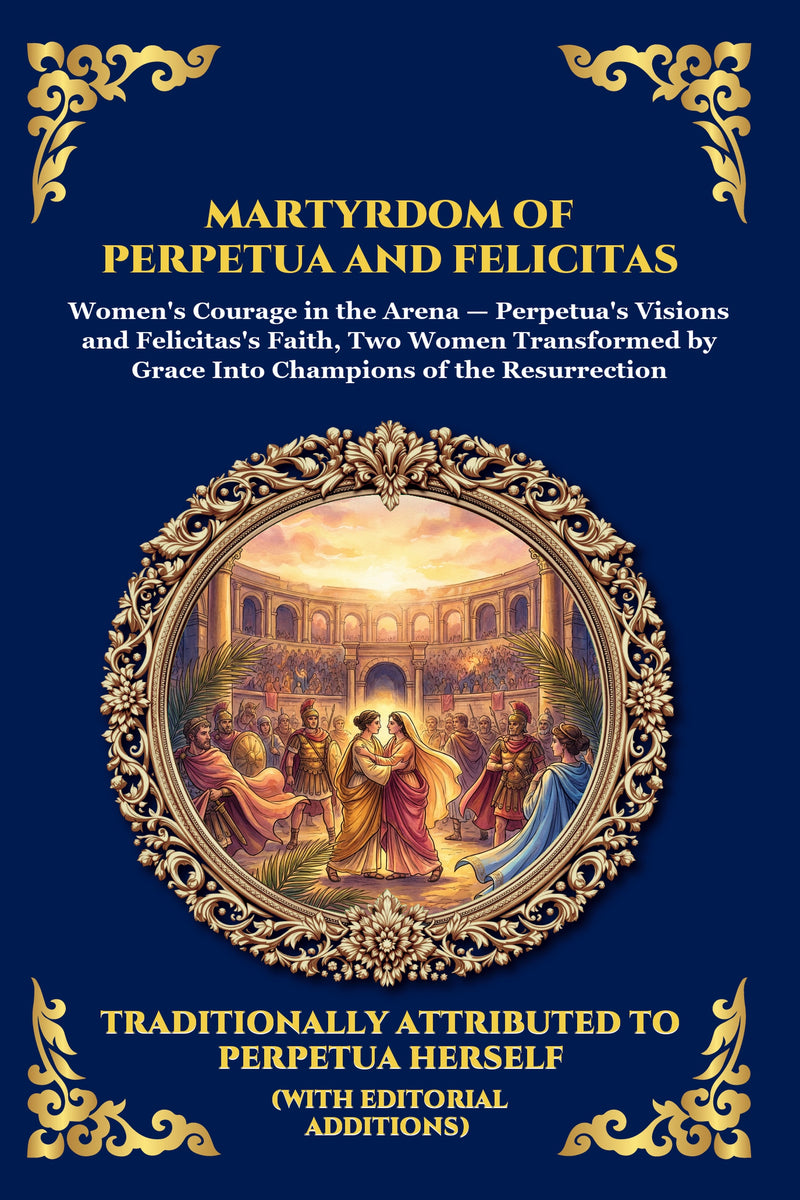
Martyrdom of Perpetua and Felicitas
In Carthage's arena, Vibia Perpetua documented her journey from noblewoman to martyr, leaving behind her infant to stand firm in her faith. This firsthand account, excluded from the Bible, captures the unwavering conviction of Perpetua and her slave, Felicitas, as they faced death with courage.
or free app
10,000+ hrs library
30-day guarantee
The complete Martyrdom of Perpetua and Felicitas in modern English translation, readable online with audiobook narration, brings you this influential 3rd-century Christian text referenced by Augustine of Hippo.
In 203 CE, twenty-two-year-old Vibia Perpetua became one of history's first female authors when she documented her own impending execution in Roman North Africa.
The Martyrdom of Perpetua and Felicitas is a rare and astonishing survival from the ancient world—a firsthand account written by a young noblewoman, Vibia Perpetua, documenting her imprisonment and trial. Alongside her slave, Felicitas, and their fellow believers, Perpetua faces the ultimate test of her faith in the gladiatorial arena of Carthage. This text is not merely a historical record; it is a deeply personal, fiercely emotional narrative of a mother forced to leave her infant child behind to stay true to her spiritual convictions.
Far more than a tale of tragedy, this diary is a story of profound spiritual triumph. It delves into the mystical visions Perpetua experienced in her cell, her tense confrontations with her desperate father who begs her to recant, and the extraordinary solidarity among the condemned. This modern translation brings the ancient text to life, capturing the authentic voices of these early saints and making their struggle vividly real for today's readers. The account bridges the gap between ancient history and modern spirituality, showing how the resilience of the human spirit can withstand the ultimate trials.
What You Will Discover in This Modern Translation
- The Authentic Prison Diary — Read the actual, surviving words of Vibia Perpetua, one of the earliest known texts written by a Christian woman.
- Visions of the Afterlife — Explore the rich, symbolic dreams and visions Perpetua recorded during her harrowing final days.
- Faith in the Face of Persecution — Witness the unyielding devotion of Perpetua, Felicitas, and their companions against the overwhelming might of the Roman Empire.
- Lessons on Courage and Sacrifice — Draw timeless inspiration from a story of ordinary people exhibiting extraordinary bravery and moral clarity.
- A Window into Early Christian History — Gain a profound, firsthand understanding of the struggles and steadfastness of the early Church in North Africa.
Whether you are a student of history, theology, or simply someone drawn to powerful, true stories of human resilience, this text offers wisdom and inspiration that transcend time. Step into the arena of Carthage and discover a legacy of faith that refused to be broken. Begin your journey today.
| Formats | eBook (EPUB + PDF) · Audiobook · Paperback · Hardcover · Large Print |
| Language | English |
| Trim size (print) | 6 × 9 in |
| Binding | Paperback — perfect-bound · Hardcover — casewrap |
| Large Print edition | Same text in a larger, easy-read type — a larger font, not a larger trim |
| Print pricing | Every physical book at our true cost — at-cost, no profit (members) |
| Library | 873 restored titles, always growing |
| Composed | 3rd century AD |
| Original language | Latin |
| Source tradition | Medieval Latin manuscript tradition |
| Translation basis | Public-domain scholarly translation, rendered in clear modern English |
| Length | 5,400 words · ~22 min reading |
| Reading level | Grade 9 · clear and comfortable (this modern-English edition) |
| Edition | Modern English translation · 2026 |
Member reviews for this edition are collected as readers finish it — be the first. Across the library: 12,000+ books shipped, every plan covered by a 365-day print guarantee.
About this edition
The complete, unabridged text in clear modern English — faithful to the original, never simplified. Every paragraph is checked against the source, so nothing is cut, summarised, or paraphrased away. It reads cleanly for today while keeping the original meaning intact.
The text survives in multiple Latin manuscripts from the medieval period, preserving this early Christian martyrdom account. This edition derives from the standard public-domain scholarly translation and renders it in clear modern English.
- Complete & unabridgedVerified paragraph by paragraph against the source — never a scan, never abridged.
- Modern English, faithfulReadable today, with the author’s meaning kept intact. Readable — not simplified.
- Every format, one membershipRead in your browser or the free app, or listen to the full audiobook.
Included free with your membership
Cancel anytime, one click · 30-day money-back guarantee
Edition last updated June 2026
What’s inside
Martyrdom of Perpetua and Felicitas — complete and unabridged: all 8 sections included with membership, plus the full audiobook.
Begin reading Martyrdom of Perpetua and Felicitas
In clear modern English — the complete text is included with membership.
Chapter 1
When ancient accounts of faith are set down in writing — accounts that bear witness to God's grace and serve to build up the faithful — so that reading them is almost like watching the events unfold again, and God is thereby honored and the reader strengthened, why should not new accounts be gathered in the same way and for the same purposes? If for no other reason, consider this: what is modern today will one day be ancient, and will serve future generations just as the old accounts serve us now — even if at present these newer examples are thought to carry less weight, simply because antiquity commands a certain reverence. But let those who hold that view take care, lest they imagine that the power of the Holy Spirit varies according to the age. On the contrary, the things that come later must be reckoned of greater moment, precisely because they stand nearer to the last times, in keeping with the abundance of grace poured out upon the final era of the world. For the Lord says: "In the last days I will pour out of my Spirit upon all flesh, and your sons and your daughters shall prophesy. Upon my servants and upon my handmaidens I will pour out of my Spirit, and your young men shall see visions, and your old men shall dream dreams."
We therefore both acknowledge and honor modern visions as equally promised to us, just as we honor the ancient prophecies, and we regard the other gifts of the Holy Spirit as the ongoing work of the Church — for which purpose the Spirit was sent, distributing all gifts to all people, just as the Lord apportioned to each according to need. For this reason we gather these accounts in writing and proclaim them in public reading to the glory of God, so that no one, weak in faith or sinking into despair, may imagine that divine grace belonged only to the people of former times — whether the grace that raised up martyrs or the grace that granted visions. God always fulfills what he has promised: as a testimony to unbelievers, and as a gift to believers.
And so we declare to you, brothers and sisters, what we ourselves have heard and handled, so that those of you who were present at these events may be reminded of them again to the glory of the Lord, and those of you who know them only by report may enter into fellowship with the blessed martyrs, and through them with the Lord Jesus Christ — to whom be glory and honor, for ever and ever. Amen.
Chapter 2
The young catechumens Revocatus and his fellow slave Felicitas, Saturninus and Secundulus, were arrested. Among them also was Vivia Perpetua, respectably born and liberally educated, a married woman with a father and mother and two brothers, one of whom was a catechumen like herself, and an infant son still at the breast. She was about twenty-two years of age. From this point onward she herself narrates the whole course of her martyrdom, as she left it written in her own hand and in her own words.
"While we were still under guard," she says, "my father, out of the love he bore me, kept trying to turn me away from the faith and break my resolve. 'Father,' I said to him, 'do you see this vessel lying here — this little pitcher, or whatever it is?' He said, 'I see it.' 'Can it be called by any other name than what it is?' He said, 'No.' 'Then neither can I call myself anything other than what I am — a Christian.' At that my father was so angered that he lunged at me as if he would tear my eyes out. But he only hurt me and went away defeated. Then, a few days after I had been without my father, I gave thanks to the Lord, and his absence became a comfort to me. In that same interval we were baptized, and the Spirit made clear to me that in the water of baptism I should ask for nothing except endurance of the body. A few days later we were taken into the dungeon, and I was terrified, for I had never known such darkness. What a dreadful day that was — the suffocating heat, the crush of soldiers, the noise of the crowds! Above all I was tormented by anxiety for my infant. But Tertius and Pomponius, the blessed deacons who were caring for us, arranged through a bribe that we might be taken for a few hours to a more comfortable part of the prison to recover ourselves. Going out of the dungeon, everyone attended to their own needs. I nursed my child, who was by then weak with hunger. Sick with worry for him, I spoke to my mother and comforted my brother, and commended my son to their care. I was worn down because I had seen them worn down on my account. I suffered this anguish for many days, and then I obtained permission for my infant to stay in the dungeon with me. At once I grew strong and was relieved of my distress and anxiety for him, and the dungeon became to me as a palace, so that I would rather have been there than anywhere else.
"Then my brother said to me, 'Dear sister, you are already held in great honor, and you stand in such a position that you may ask for a vision, and that it may be revealed to you whether this is to end in suffering or in escape.' And I, who knew that I was privileged to speak with the Lord and had found his kindness so great, promised him confidently and said, 'Tomorrow I will tell you.' And I asked, and this is what was shown to me. I saw a golden ladder of extraordinary height, reaching all the way up to heaven, and so narrow that only one person could climb it at a time. Fixed to the sides of the ladder were all manner of iron weapons — swords, lances, hooks, daggers — so that anyone who climbed carelessly, or without looking upward, would be torn to pieces and their flesh would catch on the iron. And crouching beneath the ladder was a dragon of enormous size, lying in wait for those who tried to ascend and frightening them back from the climb. Saturus went up first — the same Saturus who later gave himself up freely on our account, not having been present when we were arrested. He reached the top of the ladder, turned toward me, and said, 'Perpetua, I am waiting for you. But be careful that the dragon does not bite you.' And I said, 'In the name of the Lord Jesus Christ, he shall not harm me.' And from beneath the ladder, as if afraid of me, the dragon slowly raised his head, and as I stepped onto the first rung I trod upon his head. I climbed up, and I saw a vast garden, and in the middle of the garden a white-haired man of great stature sitting dressed as a shepherd, milking sheep. Standing all around him were many thousands clothed in white. He raised his head, looked at me, and said, 'You are welcome, daughter.' He called me to him, and from the milk he was drawing he gave me a small morsel of cheese, and I received it with cupped hands and ate it, and all those standing around said Amen. At the sound of their voices I woke, still tasting a sweetness I cannot put into words. I told my brother at once, and we understood that it was to be suffering, and from that moment we gave up all hope in this world.
Chapter 3
After a few days, a rumor spread that we were to be heard. My father came to me from the city, worn out with anxiety. He came to me trying to break my resolve, saying, "Have pity on my grey hairs, my daughter. Have pity on your father, if I am worthy to be called a father by you. If with these hands I have raised you to this flower of your age, if I have preferred you above all your brothers, do not deliver me up to the scorn of men. Have regard for your brothers, have regard for your mother and your aunt, have regard for your son, who will not be able to live after you. Lay aside your courage, and do not bring us all to destruction, for none of us will speak freely if anything happens to you." These things my father said out of love, kissing my hands and throwing himself at my feet, and with tears he called me not Daughter, but Lady. And I grieved over my father's grey hairs, that he alone of all my family would not rejoice in my passion. I comforted him, saying, "On that scaffold, whatever God wills shall happen. Know that we are not placed in our own power, but in God's." And he departed from me in sorrow.
Another day, while we were at dinner, we were suddenly taken away to be heard, and we arrived at the town hall. At once the rumor spread through the neighborhood of the public square, and an immense crowd gathered. We mounted the platform. The rest were interrogated and confessed. Then they came to me, and my father immediately appeared with my child, and drew me down from the step, pleading, "Have pity on your baby." And Hilarianus the procurator, who had just received the power of life and death in place of the proconsul Minucius Timinianus, who had died, said, "Spare your father's grey hairs, spare the infancy of your boy, offer sacrifice for the well-being of the emperors." I replied, "I will not." Hilarianus said, "Are you a Christian?" And I replied, "I am a Christian." And as my father stood there trying to turn me from the faith, Hilarianus ordered him to be thrown down and beaten with rods. My father's misfortune grieved me as if I myself had been beaten; I felt so deeply for his wretched old age. The procurator then passed judgment on all of us and condemned us to the wild beasts, and we went down cheerfully to the dungeon. Then, because my child had been used to nursing from me and staying with me in the prison, I sent Pomponius the deacon to my father to ask for the infant, but my father would not give him up. And as God willed it, the child no longer desired the breast, nor did my breasts cause me discomfort, so that I was spared both anxiety for my baby and the pain of nursing at once.
After a few days, while we were all praying, suddenly in the middle of our prayer a name came to me, and I spoke the name Dinocrates. I was amazed that his name had never entered my mind until that moment, and I was grieved as I remembered his fate. I felt at once that I was worthy to pray for him, and that I was being called to do so. I began to make earnest supplication for him, crying out to the Lord with groaning. Without delay, that very night, this was shown to me in a vision. I saw Dinocrates coming out of a dark place, where there were several others as well. He was parched and desperately thirsty, his face dirty and pale, and he bore the wound on his face that he had when he died. This Dinocrates had been my brother in the flesh, seven years old when he died miserably of disease, his face so eaten away by cancer that his death had been a horror to all who saw it. I had prayed for him, and between him and me there was a great gulf, so that neither of us could reach the other. Moreover, in the same place where Dinocrates stood, there was a pool full of water, but its rim was higher than the boy was tall, and Dinocrates stretched himself up as if to drink. I was grieved that, though the pool held water, he could not reach it because of the height of its rim. I awoke and knew that my brother was in suffering. But I trusted that my prayer would bring relief to his suffering, and I prayed for him every day until we were moved to the prison of the military camp, where we were to fight in the camp games. It was then the birthday of Geta Caesar, and I prayed for my brother day and night, groaning and weeping, that he might be granted to me.
Then, on the day when we remained in chains, this was shown to me. I saw that the place I had formerly seen in darkness was now bright, and Dinocrates, clean and well clothed, was refreshed and at ease. Where the wound had been, I saw only a scar. The pool that I had seen before now had its rim lowered to the level of the boy's navel. Someone drew water from it without ceasing, and on its rim stood a goblet filled with water. Dinocrates came near and began to drink from it, and the goblet did not run dry. When he had drunk his fill, he went away from the water to play joyfully, as children do, and I awoke. Then I understood that he had been taken from the place of punishment.
Cancel anytime, one click · 30-day money-back guarantee
Founding annual rate available now — your price locks for life when you join.
Not ready? Get this free chapter by email — read it anytime.
✓ Sent — check your inbox for Martyrdom of Perpetua and Felicitas.
Questions about Martyrdom of Perpetua and Felicitas
Who wrote the Martyrdom of Perpetua and Felicitas?
The Martyrdom of Perpetua and Felicitas contains sections attributed to Perpetua herself, written during her imprisonment, along with portions by an anonymous editor who compiled the complete account after her death.
Why isn't the Martyrdom of Perpetua and Felicitas in the Bible?
The Martyrdom of Perpetua and Felicitas was excluded from the biblical canon as it was written after the apostolic period and focuses on martyrdom rather than foundational Christian doctrine or apostolic teaching.
What does the Martyrdom of Perpetua and Felicitas contain?
The Martyrdom of Perpetua and Felicitas recounts the imprisonment, trial, and execution of Christian martyrs in Carthage, including Perpetua's own diary entries describing her visions and experiences before her death in the arena.
Is Martyrdom of Perpetua and Felicitas free to read?
The opening of the text is free to read below. Members read and listen to the complete work — and the entire Lost & Forbidden Library — free.
What is Martyrdom of Perpetua and Felicitas?
Have you ever wondered why some are willing to sacrifice absolutely everything for their beliefs?
How long is Martyrdom of Perpetua and Felicitas?
8 chapters (~5,406 words) in this restored edition.
Shipping & returns
Billing & membership
More from the library


Explore The Lost & Forbidden Library
- 1 Enoch · Attributed to Enoch
- 1–4 Maccabees · Various Jewish authors
- 2 Baruch · Attributed to Baruch
- 2 Enoch · Attributed to Enoch
- 2 Esdras · Attributed to the prophet Ezra
- 3 Baruch · Attributed to Baruch ben Neriah
- 4 Baruch · Attributed to Baruch ben Neriah
- A Valentinian Exposition · Attributed to a follower of Val...
- Acta Archelai · Attributed to Hegemonius
- Acts of Andrew · Anonymous (Early Christian Apoc...
- Acts of Andrew and Matthias in the City of the Cannibals · Attributed to early Christian a...
- Acts of Barnabas · Attributed to John Mark
- Acts of Bartholomew
- Acts of John · Anonymous (Early Christian Apoc...
- Acts of Matthias · Anonymous early Christian writers
- Acts of Paul · Attributed to an unknown early ...
- Acts of Paul and Thecla · Attributed to Onesiphorus
- Acts of Peter
- Acts of Peter and Andrew · Attributed to various early Chr...
- Acts of Peter and Paul · Attributed to Leucius Charinus
- Acts of Peter and Simon · Attributed to Leucius Charinus
- Acts of Peter and the Twelve Apostles · Attributed to early Christian a...
- Acts of Philip · Anonymous (Early Christian Apoc...
- Acts of Pilate (Gospel of Nicodemus) · Attributed to various early Chr...
- Acts of Saturninus
- Acts of Thaddaeus · Attributed to Thaddaeus the Apo...
- Acts of Thomas
- Acts of Titus · Anonymous early Christian writer
- Acts of Xanthippe, Polyxena, and Rebecca
- Allogenes · Anonymous (Early Gnostic Mystic)
Martyrdom of Perpetua and Felicitas
The Martyrdom of Perpetua and Felicitas
The Prison Diary and Martyrdom of the Young Mother Perpetua and the Slave Felicitas at Carthage — Her Visions of the Bronze Ladder and the Dragon, of Her Brother Dinocrates, and of Her Combat in the Arena, with the Vision of Saturus and the Day of Their Death in the Amphitheatre
Library of Alexandria Press
The Martyrdom of Perpetua and Felicitas
© Copyright 2026 Library of Alexandria Press. All rights reserved.
Published by Library of Alexandria Press
Printed in the United States of America
It is not legal to copy, share, or send any part of this document in either digital or printed form without written permission from the publisher, except short quotes in a book review.
Table of Contents
Introduction
Chapter 1
Chapter 2
Chapter 3
Chapter 4
Chapter 5
Chapter 6
Chapter 7
Introduction
There are moments in history so vivid, so raw, and so achingly human that they refuse to be buried by the centuries. Most ancient texts reach us as pale shadows of their original selves — copied, corrected, embellished, and filtered through the hands of monks, scholars, and scribes who shaped them to fit the needs of their own eras. But every so often, something survives that feels immediate, unmediated, and startlingly alive. The document you are about to read is one of those rare exceptions. It is a first-person account written from inside a prison cell in the Roman city of Carthage, in the year 203 CE, by a young woman who knew she was going to die.
Her name was Vibia Perpetua. She was twenty-two years old, a noblewoman of good education and high social standing, a nursing mother, a daughter, a sister, and a recent convert to Christianity. She had been arrested along with a small group of fellow catechumens — people in the process of being formally initiated into the Christian faith — and she had been condemned to die in the public arena as part of the celebrations marking the birthday of the Emperor's son Geta. The charge was essentially her refusal to renounce her faith and offer a sacrifice to the Roman gods, an act of loyalty to the empire that she found impossible to perform. In the weeks between her arrest and her execution, she wrote. And what she wrote survived.
That survival is itself something close to miraculous. Christianity in the early third century was not a dominant cultural force — it was a minority religion viewed with deep suspicion by Roman authorities, associated in the popular imagination with antisocial secrecy, strange rituals, and a dangerous indifference to civic duty. The Christians who were executed in the arenas of the Roman world were not celebrated as heroes by the society that killed them. They were meant to serve as warnings. The fact that Perpetua's account was preserved, circulated, cherished, and eventually collected into a formal document tells us something important about the communities that kept it alive. They recognized in her words something irreplaceable: the unfiltered voice of a person facing death with open eyes.
The text that has come down to us is composite in nature, and that is part of what makes it so extraordinary. Perpetua herself wrote a portion of it — the central, autobiographical section in which she describes her imprisonment, her visions, and her anguished negotiations with her father. A fellow prisoner, a young enslaved woman named Felicitas, is the subject of another deeply moving passage, though she does not write in her own voice. A third narrator, widely believed to be Saturus, one of their companions and possibly their catechist, contributed an account of his own prophetic vision. And the whole document is framed and concluded by an anonymous editor — often identified in scholarly tradition as Tertullian, one of the great theological writers of the early church, though this attribution remains debated — who introduces the text with a theological preface and closes it with a vivid eyewitness account of the martyrs' final hours in the arena.
The result is a layered, multi-voiced narrative unlike almost anything else that survives from the ancient world. It is not a polished literary composition designed to impress a sophisticated audience. It is not a theological treatise or an apologetic argument. It is something far stranger and more valuable: a collection of voices speaking across nearly two thousand years with an honesty that can still make a reader catch their breath. Perpetua argues with her father. She worries about her baby. She has dreams that she records in careful detail, trying to make sense of them. She is afraid, and she is brave, and she is both of those things at the same time, in the way that real courage always works.
To read this document without some historical context would be to miss much of its significance, and so it is worth spending some time understanding the world in which these events took place. The Roman Empire in the early third century was vast, complex, and in many respects remarkably tolerant of religious diversity. The Romans were, by ancient standards, unusually pragmatic about religion. They absorbed the gods of conquered peoples, built temples to foreign deities, and generally permitted their subjects to worship as they pleased, provided those subjects also fulfilled their civic and religious obligations to the Roman state. The problem with Christianity — and with Judaism before it, and with certain philosophical schools as well — was precisely this question of civic obligation.
Roman religion was not primarily about personal belief or individual spiritual experience. It was about practice, about the performance of rituals that maintained the proper relationship between the community and the divine powers that governed the world. To refuse to participate in those rituals was not merely a matter of private conscience; it was a public act with public consequences. A city that failed to honor its gods properly could expect disaster — plague, famine, military defeat. Christians who refused to sacrifice were therefore not simply exercising a personal religious preference; they were, from the Roman perspective, endangering the entire community. This is why the Roman authorities were not simply being cruel or irrational when they demanded that Christians sacrifice. They were acting, from within their own framework of understanding, in the public interest.
The Christians, of course, saw things entirely differently. For them, the sacrifice demanded by the Roman authorities was not a neutral civic gesture but an act of apostasy — a formal renunciation of their faith and their God. To sacrifice was to deny everything that gave their lives meaning and to condemn their souls to eternal separation from the divine. The confrontation between Perpetua and the Roman magistrate Hilarianus, which she describes in her own words with remarkable composure and even a certain dry wit, is therefore not simply a clash of personalities or a matter of stubbornness on one side and bureaucratic inflexibility on the other. It is a collision between two entirely different understandings of what the world is, what human beings owe to the powers that govern them, and what it means to live a life of integrity.
It is also, and this cannot be emphasized too strongly, a story about a woman. In the ancient world — Roman, Jewish, Greek, or otherwise — women's voices were systematically excluded from the historical record. Women did not write history. Women did not compose philosophical treatises or legal arguments. Women's letters, diaries, and personal reflections were almost never preserved, because they were almost never considered worth preserving. The overwhelming majority of what we know about women in antiquity comes to us filtered through the words of men who wrote about them, usually in service of arguments that had little to do with the women themselves. Perpetua's account is therefore not merely historically significant as a document of early Christian martyrdom. It is one of the earliest surviving pieces of autobiographical writing by a woman in the Western literary tradition.
This fact deserves to be stated plainly and allowed to sink in. When Perpetua writes about her father's tears, about the weight of her baby at her breast, about the strange calm that descended on her in the moments of greatest danger, she is doing something that almost no woman of her era had the opportunity to do: she is telling her own story, in her own words, for her own reasons. She is not a character in someone else's narrative. She is the narrator. And she brings to that role a quality of self-awareness and emotional intelligence that is, frankly, astonishing — not because it is surprising that a woman should possess those qualities, but because it is so rare to encounter them preserved in writing from this period of history.
A World on the Edge of Change
To fully appreciate what you are about to read, it helps to understand just how unstable and transformative the period was in which these events unfolded. The Roman Empire of 203 CE was ruled by Septimius Severus, a tough, pragmatic soldier-emperor from North Africa who had clawed his way to power through a brutal civil war and who governed with the unsentimental efficiency of a man who had survived by being harder than everyone around him. Severus was not, by the standards of his era, a particularly ferocious persecutor of Christians. His reign did not produce the systematic, empire-wide campaigns of terror that would come later under Decius and Diocletian. But he did issue an edict, around 202 CE, that prohibited conversion to both Christianity and Judaism — and it was under the enforcement of this edict that Perpetua and her companions were arrested.
Carthage, where the story takes place, was one of the great cities of the Roman world. Once the capital of a Phoenician empire that had challenged Rome for dominance of the Mediterranean, it had been destroyed by Roman armies in 146 BCE and then rebuilt as a Roman city, eventually becoming the most important urban center in Roman North Africa and the third or fourth largest city in the entire empire. It was a cosmopolitan, prosperous, culturally vibrant place, home to a significant Christian community that had already produced some of the most important theological thinkers of the early church. Tertullian himself was a Carthaginian, and his fierce, combative Latin prose was shaped by the same intellectual environment that produced Perpetua's more intimate and personal account.
The Christian community in Carthage was diverse, theologically adventurous, and deeply influenced by the Montanist movement — a charismatic renewal within early Christianity that placed enormous emphasis on prophecy, visionary experience, and the direct action of the Holy Spirit in the lives of ordinary believers. Montanism held that the age of prophecy had not ended with the apostles, that God continued to speak directly to his people through dreams and visions, and that the approach of the end times demanded a rigorous, uncompromising commitment to the faith even in the face of persecution. This theological context is crucial for understanding Perpetua's account, because the visions she describes are not peripheral decorations on the main narrative — they are central to it. They are the means by which she understands what is happening to her and finds the courage to face it.
Her visions are also, from a modern perspective, among the most fascinating parts of the text. They are vivid, strange, and psychologically complex in ways that reward careful attention. They draw on the rich symbolic vocabulary of Jewish and Christian apocalyptic literature, but they also have a quality of personal specificity — of images that seem to arise from the particular pressures and preoccupations of this particular person in this particular situation — that gives them an almost dreamlike authenticity. Scholars have spent considerable energy analyzing them from theological, psychological, and literary perspectives, and none of those analyses fully exhausts their meaning. They remain, in the end, what Perpetua herself presents them as: communications from a source beyond herself, mediated through her own imagination and experience, which she records as faithfully as she can because she believes they matter.
Felicitas, whose story is told by another hand but whose presence haunts the entire narrative, offers a different but equally powerful perspective on the same events. She was an enslaved woman, which placed her at the absolute opposite end of the Roman social hierarchy from Perpetua. Roman law treated enslaved people as property, not persons, and the legal and social gulf between a freeborn noblewoman and an enslaved woman in the Roman world was almost impossible to overstate. Yet in the community formed by their shared faith and their shared imprisonment, that gulf was dissolved — or at least profoundly complicated. They faced the same death. They shared the same hope. And the document that preserves their stories treats them as companions in a way that would have struck most Romans as deeply strange and subversive.
This subversiveness is, in fact, one of the most important things about the early Christian movement as it appears in this text. Christianity in the early third century was not yet the powerful institutional force it would become after the conversion of Constantine in the fourth century. It was still, in many respects, a movement of the margins — a community that drew its members from across the social spectrum, that challenged the hierarchies of Roman society in ways both explicit and implicit, and that offered its adherents a framework of meaning and belonging that cut across the divisions of class, gender, and legal status that structured the Roman world. The presence of both Perpetua and Felicitas in this narrative, and the way the text treats both of them as equally significant witnesses to the same truth, is itself a kind of theological statement.
The Roman arena, where their story reaches its conclusion, was one of the most powerful symbolic spaces in the ancient world. The games — the ludi — were not simply entertainment. They were elaborate public rituals that enacted and reinforced the values and hierarchies of Roman civilization. The crowd that gathered to watch was not a passive audience; it was a participant in a collective performance of Roman identity. The criminals, prisoners of war, and condemned individuals who died in the arena were not simply being punished; they were being consumed by the machinery of Roman power in a way that was meant to demonstrate that power's absolute and irresistible nature. For Christians to die in the arena with composure, even with joy, was therefore not merely an act of personal courage. It was a profound challenge to the entire symbolic system that the arena was designed to sustain.
The anonymous editor who frames and concludes the narrative understood this perfectly. His account of the final hours in the arena is written with a careful attention to the way the martyrs' behavior confounded and unsettled the expectations of the crowd. The arena was supposed to break people. It was supposed to reduce them to terror and degradation, to demonstrate in the most visceral possible way the consequences of defying Roman authority. What happened instead — or so the editor tells us, and there is no particular reason to doubt the broad outlines of his account — was something that the crowd found deeply disturbing. The martyrs did not behave like victims. They behaved like people who had already won something the crowd could not see or touch or take away from them.
The theological interpretation of martyrdom that underlies this document is one of the most important and, to modern readers, one of the most challenging aspects of the text. The early Christian understanding of martyrdom was not simply that dying for one's faith was admirable — a view that most people in most cultures could endorse in the abstract. It was something far more specific and far more radical: that death in witness to the faith was itself a participation in the death of Christ, a completion of the baptismal covenant, and a direct passage into the presence of God. The martyr did not merely die bravely; the martyr was transformed by death into something new. This is why Perpetua and her companions could face the arena with something that their observers described as joy. They were not suppressing their fear through willpower or performing courage for an audience. They believed, with every fiber of their being, that they were about to step through a door into a reality more real than anything they had ever known.
Whether you share that belief, whether you find it comprehensible or alien, whether you approach this text as a Christian, as a scholar, as a historian, or simply as a reader in search of a true story powerfully told, it is essential to take that belief seriously on its own terms. The temptation, for modern readers, is to translate the experience of the martyrs into more familiar psychological or sociological categories — to explain their courage as a form of group solidarity, or their visions as the products of stress and sleep deprivation, or their willingness to die as a symptom of a death-wish disguised as theology. All of these interpretations contain partial truths. None of them is adequate to the full complexity of what the text presents. The martyrs were real people, living in a real historical situation, making real choices under conditions of extreme pressure. To reduce their experience to any single explanatory framework is to do them a disservice that the text itself resists.
Reading Across the Centuries
One of the great gifts of a document like this is the way it collapses the distance between past and present. History, when it is taught as a sequence of dates and political events, can feel remote and abstract — a story about people so different from us that their inner lives are essentially inaccessible. But when history speaks in the first person, when it says 'I was afraid' and 'I argued with my father' and 'I could not stop thinking about my baby,' the distance dissolves. Perpetua becomes, across nearly two millennia, someone you feel you know. Her intelligence is evident in every sentence she writes. Her love for her child is palpable. Her grief at the pain she is causing her father is real and unresolved. She is not a plaster saint. She is a human being in an impossible situation, doing her best to understand it and to act with integrity.
This is why the document has continued to speak to readers across so many different historical and cultural contexts. It was read and venerated in the early church as a record of heroic witness. It was studied by medieval theologians as a source of insight into the nature of martyrdom and the afterlife. It was rediscovered by Renaissance humanists interested in the literary culture of late antiquity. It has been analyzed by modern scholars from the perspectives of feminist history, religious studies, psychology, literary criticism, and Roman social history. And it has been read, in every era, by ordinary people who simply found in it something that moved them — a quality of courage and humanity that speaks directly to the most fundamental questions about how to live and how to die.
The question of how to read the visions, in particular, is one that every reader must work out for themselves. Perpetua presents them as genuine communications from God, and the editor of the document shares that interpretation. A modern reader may or may not be prepared to accept that framework. But even a reader who approaches the visions in purely psychological or literary terms will find them extraordinarily rich. They are structured with a symbolic logic that repays careful attention. They engage directly with the specific anxieties and hopes of the person who experienced them. And they have a quality of inner coherence — a sense that each vision is responding to and developing the themes of the previous ones — that is hard to account for as mere random imagery.
The vision of the ladder, which appears early in Perpetua's account, is perhaps the most famous and most analyzed. It is a striking image: a narrow golden ladder reaching to the heavens, its sides hung with weapons of every kind, with a dragon lurking at its base. One of her companions climbs it first, warning her to be careful of the dragon. She steps on the dragon's head and climbs. What she finds at the top is a garden, a white-haired shepherd, and an invitation to eat. The imagery draws on multiple scriptural and cultural sources — the ladder of Jacob from Genesis, the pastoral imagery of the Psalms, the apocalyptic symbolism of early Christian literature — but it also has a quality of personal urgency that makes it feel less like a literary construction and more like a genuine attempt to articulate an experience that exceeded the available vocabulary.
Later visions take her into stranger and more specific territory — a vision in which she becomes a male gladiator and defeats an Egyptian opponent in the arena, which scholars have interpreted in various ways as a symbolic anticipation of her actual death, a statement about gender and spiritual identity, or a complex negotiation with the Roman cultural framework that is about to consume her. Whatever one makes of the symbolism, the vision is remarkable for the calm, analytical attention Perpetua brings to it. She does not simply report what she saw; she reflects on what it means. She is, in a very real sense, doing theology in real time, using the material of her own inner life as the raw data for a sustained meditation on what is happening to her and why.
Saturus's vision, which forms a distinct section of the document, offers a different but complementary perspective. Where Perpetua's visions are intimate and personal, focused on her own spiritual journey and her relationships with the people she loves, Saturus's account is more expansive and ecclesiological — concerned with the life of the Christian community, its conflicts and its hopes, its relationship to the divine. His vision includes a remarkable scene in which the martyrs, already in the heavenly realm, are asked to mediate a dispute between a bishop and a presbyter — a detail that gives us a fascinating glimpse into the very human conflicts and tensions of the early church, even in the midst of a document that is otherwise concerned with transcendence and transformation.
The anonymous editor's contribution deserves recognition as a literary achievement in its own right. The framing preface is a sophisticated theological argument for the continuing validity of prophetic gifts in the church — a position that was controversial in the early third century and that aligns the document with the Montanist tradition. The concluding account of the martyrs' deaths in the arena is written with a controlled intensity that never tips over into sensationalism. The editor clearly had access to eyewitness accounts, and he uses that material with skill, selecting details that illuminate character and meaning rather than simply cataloguing horrors. His account of the final moments — the composure of the martyrs, the confusion of the crowd, the strange tenderness with which the companions face the end together — is one of the most powerful pieces of narrative writing to survive from the ancient world.
It is worth saying something about the translation and editorial choices that have shaped the version of the text you are reading. The original document exists in both Latin and Greek versions, with scholarly debate about which is the original and which the translation. The Latin text has generally been preferred by most modern editors, though the Greek version preserves some readings that appear to be earlier or more authentic. Any translation of an ancient text involves interpretive choices, and the choices made here have been guided by a commitment to accuracy, clarity, and respect for the distinctive voices of the different narrators. Where the Latin is simple and direct — as it often is in Perpetua's own sections — the translation aims to preserve that simplicity. Where it is more elaborate and rhetorical — as in the editor's framing sections — the translation reflects that elevation of register.
The annotations and contextual materials provided alongside the text are designed to give readers the historical and cultural background they need to understand what they are reading without overwhelming the narrative itself. Roman legal procedures, the geography of Carthage, the theology of martyrdom, the social position of women and enslaved people in the Roman world — all of these contexts are relevant to a full understanding of the document, and they are addressed in the notes. But the notes are there to serve the text, not to replace it. The goal, always, is to send the reader back to Perpetua's own words with greater understanding and deeper appreciation.
What you are about to encounter is not a comfortable read, and it was not meant to be. It is a document about people who chose, with full awareness of the consequences, to hold to something they believed was more important than their own survival. It raises questions that have no easy answers — about faith and doubt, about loyalty and betrayal, about the relationship between personal conviction and social obligation, about what we owe to the people who love us and what we owe to the deepest commitments of our own conscience. These are not questions that belong only to the ancient world or only to the Christian tradition. They are questions that every human being, in every era, must find some way to live with.
Perpetua found her way. Felicitas found hers. The small community of believers who faced the arena together in Carthage in the spring of 203 CE found theirs. Whether you agree with the choices they made, whether you share the faith that sustained them, whether you read their story as a triumph or a tragedy or something that refuses to be categorized as either — you will not read it unmoved. That, in the end, is the most important thing to know before you begin. This is a story that has survived nearly two thousand years because it speaks to something in the human heart that does not change with the centuries. It is a story about what it costs to be true to yourself, and about what it means to face the worst that the world can do to you with your eyes open and your spirit intact. Turn the page, and let Perpetua speak.
The Martyrdom of Perpetua and Felicitas
Chapter 1
When ancient accounts of faith are set down in writing — accounts that bear witness to God's grace and serve to build up the faithful — so that reading them is almost like watching the events unfold again, and God is thereby honored and the reader strengthened, why should not new accounts be gathered in the same way and for the same purposes? If for no other reason, consider this: what is modern today will one day be ancient, and will serve future generations just as the old accounts serve us now — even if at present these newer examples are thought to carry less weight, simply because antiquity commands a certain reverence. But let those who hold that view take care, lest they imagine that the power of the Holy Spirit varies according to the age. On the contrary, the things that come later must be reckoned of greater moment, precisely because they stand nearer to the last times, in keeping with the abundance of grace poured out upon the final era of the world. For the Lord says: "In the last days I will pour out of my Spirit upon all flesh, and your sons and your daughters shall prophesy. Upon my servants and upon my handmaidens I will pour out of my Spirit, and your young men shall see visions, and your old men shall dream dreams."
We therefore both acknowledge and honor modern visions as equally promised to us, just as we honor the ancient prophecies, and we regard the other gifts of the Holy Spirit as the ongoing work of the Church — for which purpose the Spirit was sent, distributing all gifts to all people, just as the Lord apportioned to each according to need. For this reason we gather these accounts in writing and proclaim them in public reading to the glory of God, so that no one, weak in faith or sinking into despair, may imagine that divine grace belonged only to the people of former times — whether the grace that raised up martyrs or the grace that granted visions. God always fulfills what he has promised: as a testimony to unbelievers, and as a gift to believers.
And so we declare to you, brothers and sisters, what we ourselves have heard and handled, so that those of you who were present at these events may be reminded of them again to the glory of the Lord, and those of you who know them only by report may enter into fellowship with the blessed martyrs, and through them with the Lord Jesus Christ — to whom be glory and honor, for ever and ever. Amen.
End of the free sample
Keep reading, free
Members read and listen to the complete book — and the entire library. Cancel anytime, one click · 30-day money-back guarantee.