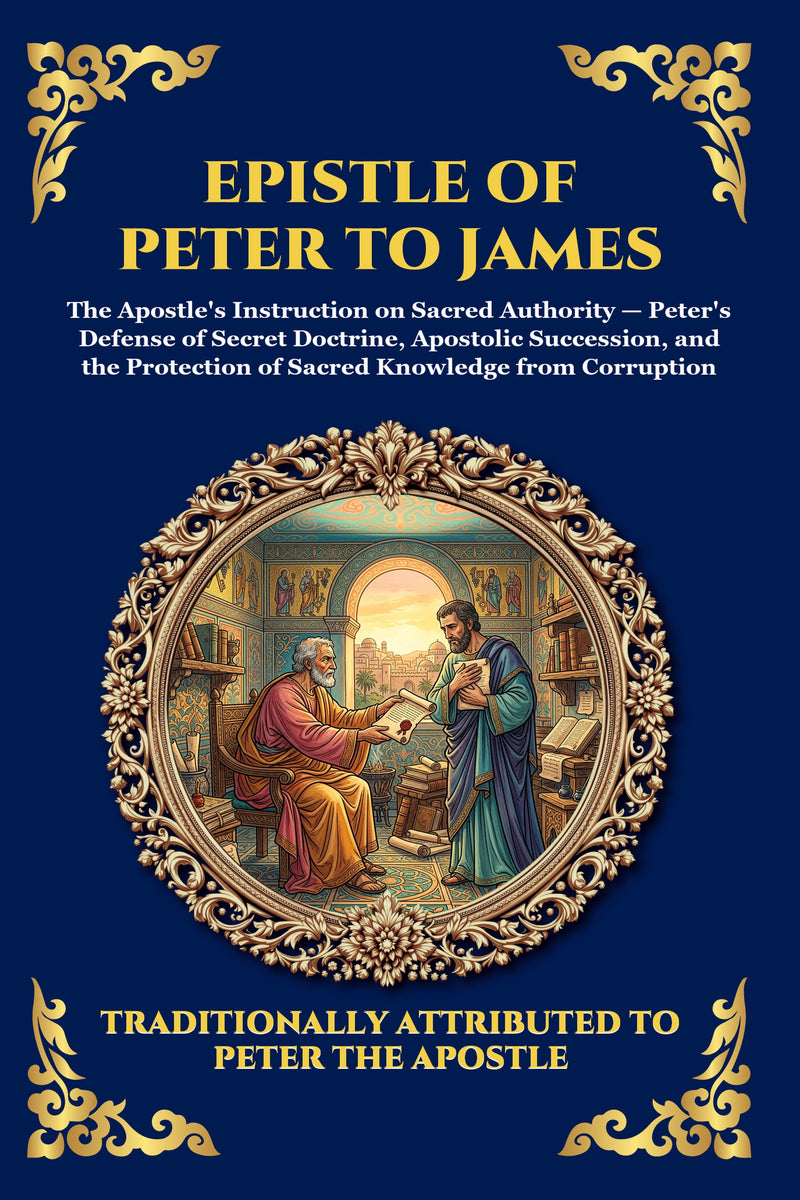
Epistle of Peter to James
Peter’s urgent letter to James, the brother of Jesus, calls for secrecy to protect true teachings from distortion by false prophets. Excluded from the Bible, this text reveals early Christian struggles to preserve authentic doctrine within a community under threat.
or free app
10,000+ hrs library
30-day guarantee
The Epistle of Peter to James, preserved within the 2nd-4th century Pseudo-Clementine Homilies, offers complete modern English translation with online access and audiobook narration included for members.
Peter's urgent words flow across ancient parchment as he warns James of false teachers threatening to corrupt his teachings among the Gentiles. In The Epistle of Peter to James, readers are invited into one of the most fascinating and secretive chapters of early Christian history.
In The Epistle of Peter to James, readers are invited into one of the most fascinating and secretive chapters of early Christian history. This ancient apocryphal text serves as a direct, impassioned plea from the Apostle Peter to James, the brother of Jesus and leader of the Jerusalem assembly. Fearing that his words and teachings would be twisted by false prophets and unauthorized teachers, Peter demands that his writings be kept secret, shared only with those who have proven themselves worthy through rigorous testing and initiation.
Far more than a simple letter, this foundational document from the Clementine literature highlights a deep ideological battle for the very soul of the early church. It exposes the tension between different factions of the first-century faithful and paints a vivid picture of a religious movement fighting to maintain its purity and original vision in a rapidly changing world.
Through this powerful and accessible modern text, you will explore themes of spiritual vigilance, the burden of sacred knowledge, and the profound responsibilities placed upon the earliest leaders of the faith.
What You’ll Discover Inside
- The Secret Teachings of the Apostles — Uncover the guarded traditions and esoteric doctrines that Peter demanded be kept from the uninitiated.
- The Struggle for the Early Church — Understand the deep theological conflicts, the rising threat of false teachers, and the battle to preserve the true message.
- A Direct Plea to James the Just — Read the personal, urgent, and deeply respectful correspondence between two of early Christianity’s most prominent foundational figures.
- A Window into Apocryphal History — Gain a richer, more nuanced understanding of the diverse landscape of Judeo-Christian faith long before the canonical Bible was officially finalized.
Whether you are exploring this work for its immense historical value, its theological implications, or its gripping account of ancient religious preservation, The Epistle of Peter to James offers inspiration and wisdom that challenge our understanding of history.
Step into a story of spiritual guardianship and discover the hidden foundations of the early church. Begin your journey today.
| Formats | eBook (EPUB + PDF) · Audiobook · Paperback · Hardcover · Large Print |
| Language | English |
| Trim size (print) | 6 × 9 in |
| Binding | Paperback — perfect-bound · Hardcover — casewrap |
| Large Print edition | Same text in a larger, easy-read type — a larger font, not a larger trim |
| Print pricing | Every physical book at our true cost — at-cost, no profit (members) |
| Library | 873 restored titles, always growing |
| Composed | 2nd-3rd century AD |
| Original language | Greek |
| Source tradition | Greek and Latin manuscript tradition of the Pseudo-Clementine literature |
| Translation basis | Public-domain scholarly translation, rendered in clear modern English |
| Length | 1,594 words · ~6 min reading |
| Reading level | Grade 13 · rich, literary prose (this modern-English edition) |
| Edition | Modern English translation · 2026 |
Member reviews for this edition are collected as readers finish it — be the first. Across the library: 12,000+ books shipped, every plan covered by a 365-day print guarantee.
About this edition
The complete, unabridged text in clear modern English — faithful to the original, never simplified. Every paragraph is checked against the source, so nothing is cut, summarised, or paraphrased away. It reads cleanly for today while keeping the original meaning intact.
This text survives in the Pseudo-Clementine literature, preserved in Greek and Latin manuscripts. This edition renders the standard scholarly translation into clear modern English for contemporary readers.
- Complete & unabridgedVerified paragraph by paragraph against the source — never a scan, never abridged.
- Modern English, faithfulReadable today, with the author’s meaning kept intact. Readable — not simplified.
- Every format, one membershipRead in your browser or the free app, or listen to the full audiobook.
Included free with your membership
Cancel anytime, one click · 30-day money-back guarantee
Edition last updated June 2026
What’s inside
Epistle of Peter to James — complete and unabridged: all 6 sections included with membership, plus the full audiobook.
Begin reading Epistle of Peter to James
In clear modern English — the complete text is included with membership.
Chapter I
Knowing, my brother, your eager desire for what benefits us all, I beg and entreat you not to share with any of the Gentiles the books of my preachings that I sent to you, nor with any of our own people before they have been tested. But if someone has been proved and found worthy, then entrust the books to him, in the same way that Moses delivered his books to the Seventy who succeeded to his seat. The fruit of that caution is still visible to this day. For his people maintain the same rule of unity and order everywhere, being unable in any way to think differently or to be led astray from the richly instructive Scriptures. Following the rule handed down to them, they work to resolve apparent discrepancies in the Scriptures whenever someone, not yet knowing the traditions, is confused by the varied utterances of the prophets. For this reason they require that no one teach until he has first learned how the Scriptures are to be used. And so they have among them one God, one law, one hope.
Chapter II
In order, then, that what happened to those Seventy may not happen among us as well, give the books of my preachings to our brethren with the same solemn charge of initiation, so that they may instruct those who wish to take part in teaching. For if this is not done, our word of truth will be torn into many conflicting opinions. I know this not as a prophet, but because I can already see the beginning of this very evil. Some from among the Gentiles have rejected my lawful preaching and attached themselves to the worthless and lawless teaching of the man who is my enemy. And some have attempted this even while I am still alive — twisting my words through various interpretations in order to undermine the law, as though I myself held such views but did not openly declare them. God forbid! For that would be to act in direct opposition to the law of God spoken through Moses, and confirmed by our Lord as eternally binding. He said: "Heaven and earth shall pass away, but not one jot or one tittle shall by any means pass from the law." He said this so that everything might be fulfilled. Yet these men, claiming somehow to know my mind, undertake to explain my words — words they heard from my own lips — more intelligently than I who spoke them, telling their students that this is my meaning, when in truth I never thought any such thing. But if they dare to misrepresent me like this while I am still alive, how much more boldly will those who come after me dare to do so?
Chapter III
Therefore, to prevent any such thing from happening, I have prayed and urged you not to share the books of my preaching, which I have sent you, with anyone — whether from our own people or from another nation — before they have been tested. But if someone has been tested and found worthy, then hand the books over to him, following the example of Moses, who delivered his books to the Seventy who succeeded to his chair. In this way they will hold fast to the faith and everywhere uphold the rule of truth, explaining all things according to our tradition, rather than being dragged down by ignorance themselves, led astray by their own speculations, and drawing others into the same pit of destruction. The things that seemed right to me I have set plainly before you. Whatever seems right to you, my lord, carry out as befits you. Farewell.
Chapter IV
Therefore James, having read the epistle, summoned the elders, read it to them, and said: "Our Peter has charged us strictly and fittingly concerning the establishing of the truth — that we should not share the books of his preachings, which have been sent to us, with anyone indiscriminately, but only with someone who is good and devout, who wishes to teach, who is circumcised, and who is faithful. Nor are all the books to be entrusted to such a person at once; for if he proves unwise in handling the first, the rest need not be given to him. Let him therefore be tested for no less than six years. Then, following the manner of Moses, the one who is to deliver the books should bring him to a river or a spring of living water, where the regeneration of the righteous takes place, and should require him — not to swear, for that is not lawful — but to stand by the water and make a solemn declaration, just as we ourselves did when we were regenerated, for the sake of not sinning.
"And let him say: 'I call to witness heaven, earth, and water, in which all things are contained, and beyond all these the air that pervades everything and without which I cannot breathe — that I will always be obedient to the one who gives me the books of the preachings; and those same books, whatever he may give me, I will not share with anyone in any way — neither by writing them out, nor by giving them in written form, nor by handing them to a copyist, whether by my own hand or through another, nor through any other initiation, trick, or method, nor by keeping them carelessly, nor by placing them where anyone might see them, nor by granting anyone permission to read them, nor by communicating them to another in any way or manner whatsoever — unless I have determined that person to be worthy, as I myself was judged worthy, or even more so, and only after a probation of no less than six years; and then only to someone who is devout and good, chosen to teach, committing the books to him as I received them, and doing all this according to the will of my bishop.
"'But otherwise — though he were my son, my brother, my friend, or related to me by any bond of kinship — if he is unworthy, I will not grant him this privilege, as would be improper; and I will not be frightened by threats nor softened by gifts. And if it should ever seem to me that the books of the preachings given to me are not true, I will not pass them on in that case either, but will return them. When I travel, I will carry with me whatever of them I happen to have. But if I am not inclined to carry them with me, I will not leave them in my house; I will deposit them with my bishop, who holds the same faith and traces his origin from the same persons as myself. If I fall ill and face the expectation of death, and if I am without children, I will act in the same manner. And if I die leaving a son who is not yet worthy or not yet capable, I will act in the same manner — I will deposit the books with my bishop, so that if my son, when he grows up, proves worthy of the trust, the bishop may give them to him as his father's bequest, in accordance with the terms of this engagement.
"'And to confirm that I will do all this, I call to witness once more heaven, earth, and water, in which all things are enveloped, and beyond all these the all-pervading air without which I cannot breathe — that I will always be obedient to the one who gives me these books of the preachings, and will observe in all things what I have pledged, or even more. To me, if I keep this covenant, let there be a portion with the holy ones; but if I do anything contrary to what I have covenanted, let the universe be hostile to me, and the all-pervading ether, and the God who is over all, than whom none is higher and none is greater. And if I should ever come to acknowledge another God, I swear by him also now, whether he exists or not, that I will not act otherwise. And beyond all these things, if I lie, let me be accursed in life and in death, and punished with everlasting punishment.'
"After this, let him share bread and salt with the one who has committed the books to him."
Chapter V
James having said this, the elders were seized with dread. Seeing how frightened they were, James spoke again: "Listen to me, brothers and fellow servants. If we were to give these books to everyone indiscriminately, and some reckless men were to corrupt them or twist them through false interpretation — as you have heard has already happened — then even those who genuinely seek the truth will be left wandering in error forever. It is better, therefore, that the books remain in our keeping, and that we share them with all the care I have described, and only with those who wish to live righteously and to bring others to salvation. But if anyone, having taken this oath, acts contrary to it, he will rightly bring eternal punishment upon himself. For how should the one who causes the destruction of others escape destruction himself?" The elders, satisfied with what James had said, cried out, "Blessed be He who, foreseeing all things, has graciously appointed you as our bishop." When they had said this, we all rose and prayed to the Father and God of all, to whom be glory forever. Amen.
Cancel anytime, one click · 30-day money-back guarantee
Founding annual rate available now — your price locks for life when you join.
Not ready? Get this free chapter by email — read it anytime.
✓ Sent — check your inbox for Epistle of Peter to James.
Questions about Epistle of Peter to James
Is the Epistle of Peter to James authentic scripture written by the Apostle Peter?
Modern scholarship considers the Epistle of Peter to James pseudepigraphic, meaning it was written by later Christians using Peter's name. It forms part of the Pseudo-Clementine literature from the 2nd-3rd centuries AD.
Why was the Epistle of Peter to James excluded from the biblical canon?
The Epistle of Peter to James was never considered for biblical inclusion by early church councils. It was recognized as part of later pseudepigraphic literature rather than authentic apostolic writing from the first century.
What does the Epistle of Peter to James actually contain?
The Epistle of Peter to James serves as a preface to the Pseudo-Clementine Homilies, warning against false teachers and emphasizing the need to preserve true apostolic teaching through careful transmission.
Is Epistle of Peter to James free to read?
The opening of the text is free to read below. Members read and listen to the complete work — and the entire Lost & Forbidden Library — free.
What is Epistle of Peter to James?
Have you ever wondered why certain teachings of the early Apostles were kept hidden from the masses? In The Epistle of Peter to James, readers are invited into one of the most fascinating and secretive chapters of early Christian history.
How long is Epistle of Peter to James?
6 chapters (~1,608 words) in this restored edition.
Shipping & returns
Billing & membership
More from the library


Explore The Lost & Forbidden Library
- 1 Enoch · Attributed to Enoch
- 1–4 Maccabees · Various Jewish authors
- 2 Baruch · Attributed to Baruch
- 2 Enoch · Attributed to Enoch
- 2 Esdras · Attributed to the prophet Ezra
- 3 Baruch · Attributed to Baruch ben Neriah
- 4 Baruch · Attributed to Baruch ben Neriah
- A Valentinian Exposition · Attributed to a follower of Val...
- Acta Archelai · Attributed to Hegemonius
- Acts of Andrew · Anonymous (Early Christian Apoc...
- Acts of Andrew and Matthias in the City of the Cannibals · Attributed to early Christian a...
- Acts of Barnabas · Attributed to John Mark
- Acts of Bartholomew
- Acts of John · Anonymous (Early Christian Apoc...
- Acts of Matthias · Anonymous early Christian writers
- Acts of Paul · Attributed to an unknown early ...
- Acts of Paul and Thecla · Attributed to Onesiphorus
- Acts of Peter
- Acts of Peter and Andrew · Attributed to various early Chr...
- Acts of Peter and Paul · Attributed to Leucius Charinus
- Acts of Peter and Simon · Attributed to Leucius Charinus
- Acts of Peter and the Twelve Apostles · Attributed to early Christian a...
- Acts of Philip · Anonymous (Early Christian Apoc...
- Acts of Pilate (Gospel of Nicodemus) · Attributed to various early Chr...
- Acts of Saturninus
- Acts of Thaddaeus · Attributed to Thaddaeus the Apo...
- Acts of Thomas
- Acts of Titus · Anonymous early Christian writer
- Acts of Xanthippe, Polyxena, and Rebecca
- Allogenes · Anonymous (Early Gnostic Mystic)
Epistle of Peter to James
Epistle of Peter to James
The Lost Apostolic Letter – Early Christian Apocrypha, Hidden Teachings, and the Foundations of the Early Church
Library of Alexandria Press
Epistle of Peter to James
© Copyright 2026 Library of Alexandria Press. All rights reserved.
Published by Library of Alexandria Press
Printed in the United States of America
It is not legal to copy, share, or send any part of this document in either digital or printed form without written permission from the publisher, except short quotes in a book review.
Table of Contents
Introduction
Chapter I
Chapter II
Chapter III
Chapter IV
Chapter V
Introduction
Imagine holding in your hands a letter that was never meant for your eyes. A letter written in urgency, sealed with authority, and passed along in secrecy — not because its contents were shameful, but because they were considered too sacred, too explosive, too easily misunderstood by those who had not yet earned the right to receive them. Imagine that this letter was composed by one of the most consequential figures in the history of Western civilization, addressed to another figure of equal stature, and that together these two men were wrestling with a question that would define the shape of Christianity for the next two thousand years: Who gets to speak for Jesus?
That is precisely the situation we find ourselves in when we encounter the remarkable document known as the Epistle of Peter to James. Short in length but staggering in implication, this ancient text presents itself as a personal communication from the Apostle Peter — the fisherman from Galilee, the rock upon whom Christ declared he would build his church — to James, the brother of Jesus and leader of the Jerusalem community. It is a letter about letters, a warning about words, a plea from one pillar of the early movement to another, asking that the teachings being circulated under Peter's name be guarded with the utmost care and shared only with those who have been properly initiated and tested. In a world where ideas traveled by hand, where a single copied manuscript could reshape an entire community's theology, this was not a trivial request. It was a matter of survival.
What makes this document so extraordinary — and so persistently fascinating to scholars, theologians, and curious readers alike — is not merely what it says, but what its very existence reveals about the world in which early Christianity was born. We tend to think of the early church as a unified movement, its doctrines settled, its hierarchy clear, its texts agreed upon. The reality was almost precisely the opposite. The first century and a half of Christian history was a period of breathtaking diversity, fierce debate, and constant negotiation over authority, scripture, and practice. There were communities that followed Paul, communities that distrusted him, communities that had never heard of him. There were gospels that did not make it into the canon, letters that circulated widely and then disappeared, teachings that were preserved in some regions and condemned in others. Into this turbulent landscape, the Epistle of Peter to James arrives like a dispatch from the front lines — a window into the anxieties, the politics, and the theological passions of a movement still in the process of defining itself.
For most readers raised in the mainstream Christian tradition, the very existence of such a document comes as a surprise. The New Testament feels complete, authoritative, final — a closed archive of sacred texts whose selection seems, in retrospect, almost inevitable. But the process by which those texts were selected was neither quick nor clean. It took centuries. It involved councils and controversies, champions and heretics, forgeries and authentic discoveries. Countless texts that were read, revered, and treated as scripture by early Christian communities were eventually set aside, lost, or actively suppressed. The Epistle of Peter to James belongs to this broader world of early Christian apocrypha — a term that originally meant 'hidden' or 'set apart,' and which over time came to designate those writings that existed outside, or on the margins of, the emerging canonical tradition.
To call a text 'apocryphal' is not, in itself, a judgment about its authenticity or its value. Many apocryphal texts are deeply moving, theologically rich, and historically illuminating. Some of them preserve traditions and sayings that may be genuinely ancient, even if the documents themselves were composed or edited at a later date. Others are clearly fictional elaborations, pious inventions designed to fill in the gaps left by the canonical narratives. The Epistle of Peter to James occupies a particularly interesting position in this spectrum. It is preserved as a preface to a much larger work known as the Clementine literature — a sprawling, complex collection of texts associated with Clement of Rome, one of the earliest figures in the post-apostolic church. This context tells us a great deal about the document's origins, its purposes, and the community that produced it. But it does not exhaust its significance. Even as a literary construction, even if we grant that it was not literally written by the historical Peter, it speaks with remarkable directness about real tensions that existed in the early Christian world — tensions between different understandings of the gospel, different claims to apostolic authority, and different visions of what the church should be.
The figure of Peter himself is central to all of this, and any serious engagement with this letter must grapple with the complexity of the man and the myth. In the Gospel narratives, Peter is a study in contradictions: bold and fearful, faithful and denying, the first to confess Jesus as the Messiah and the first to rebuke him for speaking of his death. He walks on water and then sinks. He draws a sword in the garden and then vanishes into the night. After the resurrection, he is restored, recommissioned, and sent out to feed the sheep. In the Book of Acts, he emerges as the undisputed leader of the Jerusalem community, preaching at Pentecost, healing the sick, navigating the first great crisis over the inclusion of Gentiles. And then, in Paul's letter to the Galatians, we see him again — this time as the object of a very public rebuke, accused of hypocrisy and inconsistency in his dealings with Gentile believers. Peter is, in short, a fully human figure caught in the crosscurrents of a revolutionary moment, and the letter attributed to him in this volume reflects that complexity in ways that are both historically plausible and theologically provocative.
James, the recipient of the letter, is if anything an even more shadowy figure in the popular imagination, despite the fact that he was clearly one of the most important people in the early Christian movement. As the brother of Jesus — or, in some traditions, his cousin or step-brother — James held a position of unique authority in the Jerusalem community. He appears in Paul's letters as one of the 'pillars' of the church, someone whose approval Paul sought and whose emissaries caused Peter such discomfort in Antioch. In the Acts of the Apostles, he presides over the Jerusalem Council, delivering the decisive ruling on the question of Gentile observance of the Jewish law. He was, by all accounts, a man of deep piety, known in later tradition as 'James the Just,' a figure of such conspicuous righteousness that even those outside the Christian community reportedly respected him. His death at the hands of the high priest Ananus in 62 CE was remembered as a turning point, an act of injustice that contributed to the growing tensions that would eventually erupt in the Jewish revolt of 66 CE.
The relationship between Peter and James — and more broadly, between the Jerusalem-centered, Torah-observant wing of the early movement and the more expansive, law-free gospel proclaimed by Paul — is one of the great unresolved dramas of early Christian history. The Epistle of Peter to James steps directly into this drama, and reading it carefully requires us to hold in mind the full weight of that context. This is not merely an antiquarian exercise. The questions being debated in this document — about authority, about the proper transmission of sacred teaching, about who has the right to interpret the words of a master — are questions that have never stopped being relevant. They echo through every subsequent century of Christian history, and they resonate with a surprising immediacy in our own moment, when questions of textual authority, institutional legitimacy, and the boundaries of orthodoxy are once again live and contested.
This book is designed to be both an introduction and an invitation. It is an introduction to a document that deserves to be far better known than it is — not just among specialists in early Christianity, but among anyone who is curious about the origins of the faith, the complexity of the apostolic generation, and the rich, messy, endlessly fascinating world that gave birth to one of history's most influential movements. And it is an invitation to read that document with fresh eyes, to set aside the assumptions that canonical familiarity can sometimes impose, and to encounter these ancient voices on their own terms, in all their urgency and strangeness and unexpected wisdom.
A World of Hidden Texts and Rival Voices
To understand why a document like this one exists at all, we need to step back and appreciate just how different the world of early Christianity was from the tidy picture that later centuries would construct. The religion we call Christianity did not spring fully formed from the pages of the New Testament. It emerged, slowly and painfully, from a matrix of Jewish hopes, Greek philosophical concepts, Roman political realities, and the electrifying but ambiguous memory of a Galilean teacher who had been executed by the state and whom his followers believed had risen from the dead. In the decades immediately following the crucifixion, there was no agreed-upon canon of scripture, no universally recognized hierarchy of authority, no settled creed. There were communities — in Jerusalem, in Antioch, in Corinth, in Rome, in Alexandria, in the cities of Asia Minor — each with its own traditions, its own leaders, its own understanding of what had happened and what it meant.
These communities communicated with one another through letters, through traveling teachers and missionaries, through the circulation of written texts that were copied by hand and passed from one congregation to another. The problem — and it was a serious one — was that this system of communication was almost entirely unregulated. Anyone could write a letter in the name of an apostle. Anyone could claim to be transmitting the authentic teaching of Jesus or Peter or Paul. The second letter attributed to Paul in the New Testament, Second Thessalonians, already shows awareness of this problem, warning its readers not to be 'quickly shaken in mind or alarmed, either by a spirit or a spoken word, or a letter seeming to be from us.' The concern was real: pseudonymous letters, texts composed in the name of a revered authority figure, were a common feature of the ancient world, and the early Christian communities were not immune to this practice.
This is the context in which the Epistle of Peter to James makes its most immediate sense. The letter is, at its core, a response to the problem of textual authority in a world where texts could be easily fabricated, miscopied, or deliberately distorted. Peter — or the author writing in Peter's voice — is worried. He has composed teachings, sermons, discourses on the law and the gospel, and he knows that these materials are being circulated among people who do not understand them, people who are twisting them to suit their own purposes, people who are using his words to argue for positions he does not hold. The reference, almost certainly, is to Paul and the Pauline communities, who had indeed appealed to Peter's example — particularly his behavior in Antioch — in support of their argument that Gentile believers were free from the obligations of the Jewish law. Peter, in this letter, wants to draw a clear line. His teachings are not for general circulation. They are not to be handed over to anyone who asks. They are to be entrusted only to those who have undergone a proper process of testing and initiation, who have demonstrated their commitment to the community's values and their readiness to receive and transmit the teaching faithfully.
The irony, of course, is that this very letter — this plea for secrecy and controlled transmission — has survived for nearly two millennia and is now being read by you, a general reader in the twenty-first century. History has a way of defeating the intentions of those who try to contain it. But the irony cuts deeper than that. The fact that this letter was preserved at all, embedded in the Clementine literature and copied by scribes across the centuries, tells us something important about the communities that valued it. For them, it was not an embarrassing artifact of a superseded controversy. It was a living document, a statement of principle about how sacred knowledge should be handled and transmitted. It spoke to their own situation, their own anxieties about the fragmentation of Christian teaching and the proliferation of competing authorities. In preserving it, they were also making a claim — about Peter, about James, about the Jerusalem tradition, and about their own place in the apostolic succession.
The broader world of early Christian apocrypha to which this document belongs is itself a subject of enduring fascination and, in recent decades, of dramatically renewed scholarly attention. The discovery of the Nag Hammadi library in Egypt in 1945 — a cache of Coptic manuscripts containing dozens of previously unknown or poorly attested texts, including the Gospel of Thomas, the Gospel of Philip, and numerous other Gnostic writings — transformed the field of early Christian studies and demonstrated beyond any reasonable doubt that the diversity of early Christianity was far greater than the canonical tradition had suggested. Subsequent discoveries, including the Gospel of Judas, published in 2006, continued to expand the picture. Each new text added another voice to the chorus, another perspective on the foundational questions, another reminder that the Christianity that eventually became dominant was one option among many, not the inevitable outcome of a process that had been clear and linear from the beginning.
The Epistle of Peter to James predates most of these Gnostic texts, or at least belongs to a different stream of tradition. It is not a Gnostic document in the technical sense. It does not traffic in elaborate cosmological myths or esoteric hierarchies of divine beings. Its concerns are more immediately practical and ecclesiological — about community governance, about the proper transmission of teaching, about the relationship between different apostolic traditions. But it shares with the Gnostic texts a certain suspicion of the open marketplace of ideas, a conviction that not all readers are equally prepared to receive the truth, and a preference for structured, hierarchical transmission over free and democratic access. In this sense, it represents a road not taken in the development of Christian epistemology — or perhaps a road that was taken in some communities and then abandoned as the church moved toward a more universalist understanding of scripture and salvation.
Reading these texts alongside the canonical ones does not diminish the canonical tradition. If anything, it enriches it, by showing us the questions that the canonical authors were responding to, the alternatives they were implicitly or explicitly rejecting, the choices they were making in a landscape of genuine options. The Paul of the canonical letters comes into sharper focus when we see him through the eyes of his opponents. The Peter of the Acts of the Apostles looks different when we hold beside him the Peter of this letter — more anxious, more embattled, more aware of the fragility of the tradition he is trying to protect. And the James who presides over the Jerusalem community with such calm authority in the canonical narrative becomes, in the context of this correspondence, a figure of pivotal importance, the guardian of a tradition that saw itself as the authentic continuation of Jesus's own teaching and practice.
For the modern reader, all of this raises questions that go well beyond the merely historical. If the early Christian tradition was this diverse, this contested, this open to multiple interpretations, what does that mean for the authority of the texts that were eventually selected as canonical? If Peter himself was worried about the misuse of his teachings, what confidence can we have that any text accurately represents the intentions of its claimed author? These are not questions designed to undermine faith, but they are questions that honest engagement with the historical evidence makes unavoidable. And they are questions that the document at the center of this volume, in its own way, was already asking — and trying, in its own way, to answer.
Reading Across the Centuries
There is a particular kind of vertigo that comes from reading a very old text with genuine attention. You begin to feel the distance — the vast gulf of time and culture and language and assumption that separates you from the person who first put those words together. And then, without warning, the distance collapses, and you find yourself reading something that feels startlingly contemporary, a concern or a complaint or a flash of human emotion that could have been written yesterday. The best ancient texts do this to you repeatedly, and the document at the heart of this book is no exception. Its anxieties about the misuse of written communication, about the gap between what a teacher intends and what a reader receives, about the dangers of taking words out of their original context — these are anxieties that anyone who has ever published anything on the internet will recognize immediately.
But reading across the centuries requires more than just recognizing the moments of unexpected familiarity. It requires a sustained effort of historical imagination — an attempt to inhabit, however imperfectly, the world in which a text was written and first read. This is the central challenge and the central pleasure of studying early Christian literature, and it is the challenge that this book is designed to help you meet. The pages that follow will guide you through the text itself, through its historical context, through the scholarly debates it has generated, and through the broader landscape of early Christian thought and practice in which it belongs. But they will also, at every step, try to keep the human dimension in view — the real people, with their real fears and hopes and rivalries and convictions, who wrote these words and received them and copied them and argued about them.
One of the most important things to understand about the early Christian movement is that it was, from the very beginning, a movement of texts. Jesus himself, as far as we know, wrote nothing. But his followers were almost immediately engaged in the work of writing — letters, narratives, collections of sayings, apocalyptic visions, liturgical compositions, theological arguments. This textual productivity was partly a reflection of the broader culture of the Greco-Roman world, in which letter-writing and literary composition were central to intellectual and social life. But it was also driven by the specific needs of a movement that was spreading rapidly across a vast geographic area, whose members could not always be in the same place at the same time, and whose founder was no longer physically present to settle disputes and answer questions.
The result was a situation in which texts carried enormous authority — and in which the control of texts was a form of power. To have access to the authentic letters of Paul, or the genuine memoirs of Peter, or the original teachings of Jesus as recorded by an eyewitness, was to possess something precious and potentially decisive in any theological argument. This is why the question of authenticity mattered so much, and why accusations of forgery and distortion were such powerful weapons in the polemical arsenal of the early church. When the author of the letter before us worries about his words being taken out of context and used against his intentions, he is not being paranoid. He is responding to a real and well-documented phenomenon. The early Christian world was full of texts that claimed apostolic authority and did not have it, full of teachings attributed to Jesus that Jesus almost certainly never said, full of letters written in the names of people who had been dead for decades.
This does not mean that all such texts were worthless or dishonest in any simple sense. Ancient attitudes toward authorship and attribution were significantly different from our own. The practice of writing in the name of a revered teacher — of composing a text that expressed what you believed that teacher would have said, or what his authentic tradition implied — was widely accepted and did not necessarily carry the stigma of deception that it would in a modern context. Many of the texts in the New Testament itself are now thought by most scholars to be pseudonymous in this sense — written not by the apostles whose names they bear, but by later followers who were transmitting and developing what they understood to be the authentic apostolic tradition. Understanding this does not require us to dismiss these texts. It requires us to read them differently — to ask not just 'who wrote this?' but 'what community produced this, what situation were they responding to, and what understanding of the tradition were they trying to preserve and transmit?'
These questions are particularly urgent in the case of the Epistle of Peter to James, because the document is so explicitly about the problem of textual transmission and the dangers of misreading. There is something almost self-referential about it — a text about the misuse of texts, a letter about the dangers of letters falling into the wrong hands, now being read by readers who are, by definition, not the intended recipients. Every reader of this document is, in a sense, reading over someone's shoulder, receiving a communication that was explicitly not meant for them. This creates a peculiar reading experience, one that is simultaneously intimate and transgressive, and it is part of what makes the document so compelling.
The scholarly conversation around this text has been rich and sometimes contentious. Debates about its date, its provenance, its relationship to the broader Clementine literature, and its significance for our understanding of Jewish Christianity have occupied some of the finest minds in the field of early Christian studies. This book engages with those debates honestly and rigorously, but it does not assume that you come to it as a specialist. The goal is to make the best of contemporary scholarship accessible to a general reader who is curious, engaged, and willing to think carefully about difficult questions. Technical terminology is explained when it is necessary, and avoided when it is not. The focus, always, is on what the text actually says, what it meant in its original context, and what it continues to mean for anyone who cares about the origins of one of the world's great religious traditions.
There is a final dimension to this document that deserves mention before we dive in, and it is perhaps the most personal one. At its heart, the letter before us is a communication between two people who loved the same teacher, who had staked their lives on the truth of what they had witnessed and experienced, and who were now trying to figure out how to protect that truth in a world that was changing faster than either of them could fully comprehend. The movement they had helped to build was spreading beyond anything they could have imagined. New communities were springing up in cities they had never visited, among people they had never met, speaking languages they did not know. And in each of those communities, the teaching was being received, interpreted, adapted, and sometimes distorted in ways that the original witnesses could neither control nor fully anticipate. The anxiety that runs through this letter is the anxiety of anyone who has ever tried to communicate something important and feared that it would be misunderstood — multiplied by the stakes of eternity.
That anxiety is not resolved in the pages that follow. History did not resolve it. The diversity of early Christianity eventually gave way, through a long and complex process, to something more like institutional unity — but the unity was always partial, always contested, always shadowed by the memory of the roads not taken. The communities that produced and preserved the Epistle of Peter to James eventually disappeared, absorbed or marginalized by the emerging catholic tradition. But their document survived, passed down through the centuries in manuscripts that scribes continued to copy long after the communities that first valued it had ceased to exist. It survived because something in it continued to speak — to later readers in different situations, asking different questions, but recognizing in this ancient letter something that felt true and urgent and alive.
That is the best reason to read it now. Not as a curiosity, not as a weapon in some contemporary theological argument, but as a voice from the very beginning of a tradition that has shaped the world we live in — a voice that is honest about its fears, clear about its convictions, and surprisingly willing to acknowledge the limits of what any written text can do. The words that follow in this volume are an attempt to hear that voice as clearly as possible, across all the centuries and all the silence. We hope you will find, as we have found, that it is very much worth listening to.
Epistle of Peter to James
Chapter I
Knowing, my brother, your eager desire for what benefits us all, I beg and entreat you not to share with any of the Gentiles the books of my preachings that I sent to you, nor with any of our own people before they have been tested. But if someone has been proved and found worthy, then entrust the books to him, in the same way that Moses delivered his books to the Seventy who succeeded to his seat. The fruit of that caution is still visible to this day. For his people maintain the same rule of unity and order everywhere, being unable in any way to think differently or to be led astray from the richly instructive Scriptures. Following the rule handed down to them, they work to resolve apparent discrepancies in the Scriptures whenever someone, not yet knowing the traditions, is confused by the varied utterances of the prophets. For this reason they require that no one teach until he has first learned how the Scriptures are to be used. And so they have among them one God, one law, one hope.
Chapter II
In order, then, that what happened to those Seventy may not happen among us as well, give the books of my preachings to our brethren with the same solemn charge of initiation, so that they may instruct those who wish to take part in teaching. For if this is not done, our word of truth will be torn into many conflicting opinions. I know this not as a prophet, but because I can already see the beginning of this very evil. Some from among the Gentiles have rejected my lawful preaching and attached themselves to the worthless and lawless teaching of the man who is my enemy. And some have attempted this even while I am still alive — twisting my words through various interpretations in order to undermine the law, as though I myself held such views but did not openly declare them. God forbid! For that would be to act in direct opposition to the law of God spoken through Moses, and confirmed by our Lord as eternally binding. He said: "Heaven and earth shall pass away, but not one jot or one tittle shall by any means pass from the law." He said this so that everything might be fulfilled. Yet these men, claiming somehow to know my mind, undertake to explain my words — words they heard from my own lips — more intelligently than I who spoke them, telling their students that this is my meaning, when in truth I never thought any such thing. But if they dare to misrepresent me like this while I am still alive, how much more boldly will those who come after me dare to do so?
End of the free sample
Keep reading, free
Members read and listen to the complete book — and the entire library. Cancel anytime, one click · 30-day money-back guarantee.