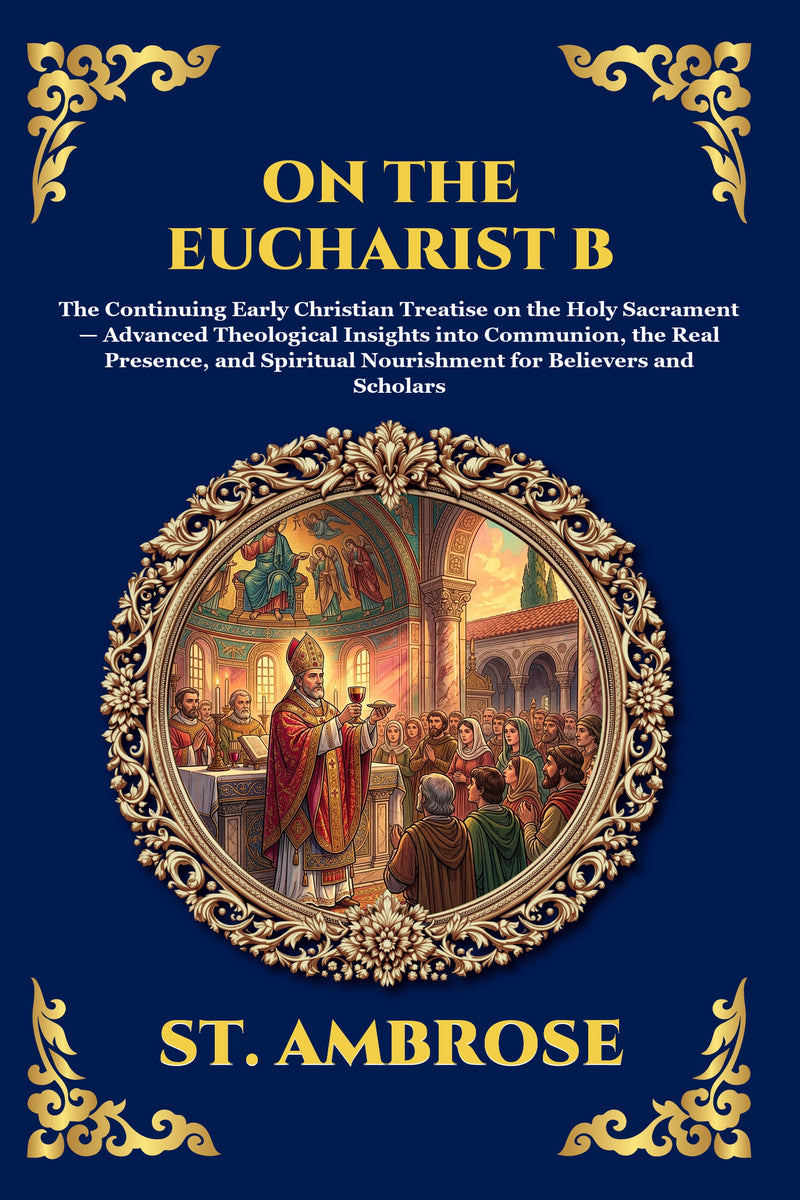
On the Eucharist B — Large Print
St. Ambrose of Milan expands the theological discourse on communion, defending the Real Presence with clarity and intellectual depth. In a time of doctrinal uncertainty, he challenges readers to transcend human senses and skepticism, embracing the miraculous transformation at the altar through divine consecration.
or free app
10,000+ hrs library
30-day guarantee
This 4th century theological treatise "On the Eucharist B" by St. Ambrose appears as a complete modern-English translation, readable online with audiobook narration included for members.
Large Print Edition. The complete, unabridged text set in a larger, easy-on-the-eyes typeface for comfortable reading.
Have you ever wondered why the early church believed communion was far more than just a symbolic meal?
Expanding upon his initial instructions to the newly baptized, St. Ambrose of Milan elevates the theological discourse in On the Eucharist B, offering one of the most compelling defenses of the Real Presence in ancient Christian literature. During a time when the church was navigating complex theological debates and establishing its doctrinal boundaries, Ambrose provided clarity, passion, and profound intellectual depth. He challenges his readers to look beyond the limitations of human senses and intellectual skepticism, urging them to embrace the miraculous transformation that occurs upon the altar through the power of divine consecration.
Far from being a dry theological textbook, this continuing treatise is a vibrant, deeply pastoral call to spiritual maturity. Ambrose meticulously unpacks the Old Testament foreshadowing of the Eucharist, from Melchizedek's offering to the blood of the Passover lamb, demonstrating how ancient prophecies find their ultimate, life-giving fulfillment in the Christian communion. He emphasizes that receiving this holy sacrament is not just a ritualistic obligation, but the very medicine of immortality and the essential spiritual nourishment required to sustain the soul in a fractured and challenging world.
This text has been carefully preserved and presented to ensure that St. Ambrose’s advanced theological insights remain accessible, impactful, and clear for today’s readers. It challenges modern audiences to elevate their understanding of grace, faith, and the profound intimacy of the sacred mysteries that have united believers across millennia.
What You’ll Discover in This Advanced Theological Treatise:
The Mystery of the Real Presence Explore Ambrose’s rigorous and awe-inspiring defense that the elements of communion are truly transformed by divine power.
Old Testament Typology Fulfilled Understand how ancient figures, sacrifices, and prophecies brilliantly point toward and are completed in the Christian sacrament.
The Medicine of Immortality Discover the profound spiritual benefits of the Eucharist, viewed by the early church as essential, life-giving nourishment for the soul.
Advanced Sacramental Theology Dive deeper into the intellectual and spiritual arguments that shaped the orthodox understanding of communion for centuries to come.
Lessons on Reverence and Awe Gain timeless wisdom on how to properly approach the altar with a transformed heart, a purified conscience, and a deepened faith.
Whether you are exploring this work for its immense historical value, its profound theological depth, or its spiritual reassurance, On the Eucharist B remains a cornerstone of early Christian literature. Step further into the mind of St. Ambrose and discover the breathtaking reality of the Holy Sacrament. Begin your journey today.
| Formats | eBook (EPUB + PDF) · Audiobook · Paperback · Hardcover · Large Print |
| Language | English |
| Trim size (print) | 6 × 9 in |
| Binding | Paperback — perfect-bound · Hardcover — casewrap |
| Large Print edition | Same text in a larger, easy-read type — a larger font, not a larger trim |
| Print pricing | Every physical book at our true cost — at-cost, no profit (members) |
| Library | 873 restored titles, always growing |
| Composed | 4th century AD |
| Original language | Latin |
| Source tradition | Latin manuscript tradition |
| Translation basis | Public-domain scholarly translation, rendered in clear modern English |
| Length | 3,882 words · ~16 min reading |
| Reading level | Grade 15 · rich, literary prose (this modern-English edition) |
| Edition | Modern English translation · 2026 |
Member reviews for this edition are collected as readers finish it — be the first. Across the library: 12,000+ books shipped, every plan covered by a 365-day print guarantee.
About this edition
The complete, unabridged text in clear modern English — faithful to the original, never simplified. Every paragraph is checked against the source, so nothing is cut, summarised, or paraphrased away. It reads cleanly for today while keeping the original meaning intact.
This work survives in Latin manuscript tradition from the 4th century. This edition derives from the standard public-domain scholarly translation and renders it in clear modern English.
- Complete & unabridgedVerified paragraph by paragraph against the source — never a scan, never abridged.
- Modern English, faithfulReadable today, with the author’s meaning kept intact. Readable — not simplified.
- Every format, one membershipRead in your browser or the free app, or listen to the full audiobook.
Included free with your membership
Cancel anytime, one click · 30-day money-back guarantee
Edition last updated June 2026
What’s inside
On the Eucharist B — Large Print — complete and unabridged, included in full with membership, plus the full audiobook.
Begin reading On the Eucharist B — Large Print
In clear modern English — the complete text is included with membership.
On the Eucharist B
Introduction
On the Eucharist B
Introduction
There are moments in the life of a reader when a text arrives not merely as information but as an encounter. The pages you are about to enter belong to that rare category. What follows in this volume is not simply a theological treatise in the conventional academic sense, nor is it a devotional manual designed to comfort the already-convinced. It is something more demanding and more rewarding than either of those things: it is an invitation to stand at the very center of Christian faith and look outward from there, to examine with fresh eyes and a disciplined mind the sacrament that has shaped the worship, the controversy, the art, the philosophy, and the communal life of believers across two millennia.
The Eucharist is, by any measure, the most theologically dense and historically consequential ritual in the Christian tradition. From the upper room in Jerusalem to the great basilicas of Rome and Constantinople, from the mud-walled house churches of second-century North Africa to the soaring Gothic cathedrals of medieval Europe, from the simple wooden tables of the Protestant Reformation to the ornate altars of the Counter-Reformation, this act of breaking bread and sharing a cup has stood at the absolute heart of Christian practice. It has been the source of profound unity and devastating schism. It has inspired some of the most sublime theology ever written and some of the most bitter controversy ever conducted. It has fed the hungry soul and, in darker chapters of history, been weaponized as a tool of exclusion and power. To understand the Eucharist is, in a very real sense, to understand Christianity itself.
This present work continues and deepens the theological conversation begun in its predecessor volume, carrying forward an investigation that is rooted in the earliest surviving Christian sources while remaining in vigorous dialogue with contemporary scholarship. The author writes in the tradition of those early Christian thinkers — Ignatius of Antioch, Justin Martyr, Irenaeus of Lyon, Tertullian, Origen, Cyprian of Carthage, Ambrose of Milan, and above all Augustine of Hippo — who understood that the Eucharist demanded not just reverence but rigorous thought. These were men who believed that the God who created human reason expected that reason to be deployed in service of understanding the divine mysteries, not suspended in their presence. The present volume honors that conviction.
What distinguishes this work from the many excellent studies of eucharistic theology already available to readers is its sustained commitment to reading the early Christian sources on their own terms, in their own historical and cultural contexts, while simultaneously drawing out the implications of those sources for believers and thinkers in the present day. Too often, patristic theology is treated either as a museum exhibit — interesting, ancient, safely distant — or as a quarry from which proof texts are extracted to support positions already determined in advance. Neither approach does justice to the extraordinary richness and complexity of what the early church actually thought and wrote about this sacrament. The Fathers were not systematic theologians in the modern sense; they were pastors, apologists, controversialists, mystics, and bishops, writing in response to specific situations and specific challenges, and their eucharistic thought has a vitality and an urgency that formal systematization tends to flatten.
The approach taken here is therefore both historical and theological, both analytical and contemplative. The reader will find careful attention to the Greek and Latin texts of the early church, to the liturgical practices that shaped and were shaped by eucharistic theology, to the philosophical frameworks — Platonic, Stoic, Aristotelian — that the Fathers brought to bear on their understanding of the sacrament, and to the pastoral and ecclesial concerns that gave their theological reflection its particular character. But the reader will also find something that purely academic treatments sometimes lack: a genuine sense of wonder at the mystery being discussed, a willingness to sit with questions that do not resolve neatly, and a conviction that the ancient voices speaking in these pages still have something vital to say.
It is worth pausing at the outset to consider what we mean when we speak of the 'real presence' — that phrase which has generated more controversy, more philosophical ingenuity, more ecclesiastical division, and more profound devotion than perhaps any other two words in the history of Christian theology. The question of how Christ is present in the bread and wine of the Eucharist — whether substantially, spiritually, symbolically, or in some other mode entirely — is not merely a technical question for specialists. It is a question about the nature of matter and spirit, about the relationship between the physical and the divine, about what kind of God Christians believe in and what kind of salvation they believe that God offers. These are not peripheral questions. They go to the very heart of the Christian understanding of creation, incarnation, and redemption.
The early Christians, it must be said, did not approach the Eucharist primarily as a theological problem to be solved. They approached it as a gift to be received, a mystery to be celebrated, a reality to be inhabited. The technical vocabulary of later eucharistic controversy — transubstantiation, consubstantiation, receptionism, memorialism — was not available to them, and in some ways its absence freed them to speak of the sacrament with a directness and a richness that later theological precision, for all its genuine value, sometimes obscured. When Ignatius of Antioch, writing in the early second century, described the Eucharist as 'the medicine of immortality, the antidote against death, and the food that makes us live forever in Jesus Christ,' he was not making a claim that fits neatly into any of the later confessional categories. He was speaking out of a lived experience of eucharistic worship that preceded and exceeded all subsequent theological systematization.
This volume takes that kind of speaking seriously. It takes seriously the possibility that the early church, precisely because it had not yet developed the technical apparatus of later theology, was in some respects closer to the reality it was trying to describe. This is not a romantic or primitivist claim. The author is well aware of the limitations and the blind spots of the early church, of the ways in which its eucharistic practice was shaped by social hierarchies, gender exclusions, and cultural assumptions that contemporary Christians rightly question. The point is not that the early church got everything right. The point is that the early church was grappling with the same fundamental questions that every generation of Christians must grapple with, and that its grappling was extraordinarily resourceful, creative, and theologically serious.
The structure of what follows reflects a conviction that good theological writing, like good music, requires both rigor and rhythm. The chapters move through a series of interconnected themes — the scriptural foundations of eucharistic theology, the development of eucharistic practice in the first three centuries, the great patristic syntheses of the fourth and fifth centuries, the question of real presence in its various dimensions, the relationship between Eucharist and ecclesiology, the Eucharist as spiritual nourishment and its implications for Christian life — in a way that is cumulative rather than merely sequential. Each chapter builds on what has come before and opens onto what comes after, so that the reader who moves through the book from beginning to end will find that the picture assembled is richer and more complex than any single chapter could suggest.
At the same time, the chapters are designed to be sufficiently self-contained that a reader who comes to the book with a particular question or interest can enter at the relevant point and find what they are looking for. The author has tried to write for a readership that is broad without being undifferentiated: for the seminary student encountering these questions for the first time, for the parish priest or minister who has been celebrating the Eucharist for years and wants to think more deeply about what they are doing, for the lay Christian who takes their faith seriously and wants to understand it more fully, for the scholar who brings specialist knowledge to the text and expects to be engaged at that level. This is an ambitious range, and the author makes no claim to have satisfied every reader equally. But the attempt has been made, and the attempt itself reflects a conviction that theological knowledge is not the exclusive property of the academy.
The Living Inheritance of Early Christian Thought
To read the early Christian writers on the Eucharist is to enter a world that is simultaneously strange and familiar. Strange, because the cultural, philosophical, and social world in which they wrote is profoundly different from our own — a world of Roman imperial power, Greek philosophical categories, Jewish scriptural inheritance, and pagan religious competition, a world in which Christians were a minority, often a persecuted one, gathering in secret or semi-secret for worship that could carry the risk of arrest and death. Familiar, because the questions they were asking — What happens in this ritual? How is Christ present here? What does this meal mean for the community that shares it? What does it demand of those who participate? — are questions that every generation of Christians has had to ask anew.
The earliest eucharistic texts are remarkable for their combination of liturgical concreteness and theological depth. The Didache, that extraordinary document from the late first or early second century, preserves eucharistic prayers of great beauty and simplicity that already articulate a sophisticated theology of the sacrament as the gathering of the scattered church into unity, as the anticipation of the eschatological banquet, as the participation of the many in the one. Justin Martyr, writing his First Apology in Rome around the middle of the second century, gives us the earliest detailed description of a Sunday eucharistic assembly and articulates with remarkable clarity the connection between the eucharistic food and the incarnate Word: 'the food over which thanks have been given by the word of prayer which comes from him... is both the flesh and blood of that incarnate Jesus.' This is not yet the technical language of later theology, but it is already a claim of extraordinary weight.
Irenaeus of Lyon, writing against the Gnostic movements that threatened to dissolve the material world into a realm of spiritual abstraction, developed a eucharistic theology that was simultaneously anti-Gnostic and profoundly incarnational. For Irenaeus, the Eucharist was the proof and the enactment of the goodness of creation: if the material elements of bread and wine could become the body and blood of Christ, then matter itself was not the prison of the spirit but its vehicle, not the enemy of salvation but its medium. The Eucharist, for Irenaeus, was the sacrament of creation redeemed, the pledge of the resurrection of the body, the confirmation that the God who made the world was the same God who saved it. This theological vision, developed in the context of a specific controversy, has a scope and a depth that far exceeds its polemical occasion.
The great Alexandrian theologians, Clement and Origen, brought the resources of Platonic philosophy to bear on eucharistic theology in ways that were both illuminating and, in the judgment of some later critics, potentially misleading. For Origen in particular, the Eucharist was above all a spiritual reality: the true body of Christ that nourishes the soul was the Logos, the divine Word, encountered in Scripture and in the sacrament. The physical elements were the vehicle of a spiritual nourishment that transcended them. This spiritualizing tendency has sometimes been read as a proto-Protestant move, an anticipation of the symbolic or memorialist interpretations that would emerge in the Reformation. But this reading is too simple. Origen was not denying the reality of the eucharistic presence; he was insisting on its depth, on the inexhaustibility of what the sacrament offered to those who received it with faith and understanding.
The North African tradition, represented above all by Tertullian and Cyprian, brought a different set of concerns to eucharistic theology: concerns about church order, about the authority of the bishop, about the unity of the church in the face of schism and persecution. For Cyprian in particular, the Eucharist was inseparable from the church: to be cut off from the eucharistic assembly was to be cut off from salvation itself, because salvation was not an individual transaction between the soul and God but a corporate reality enacted in the gathered community of the faithful. This ecclesial dimension of eucharistic theology — the insistence that the sacrament is not just about the individual's relationship with Christ but about the constitution of the body of Christ as a community — is one of the most important and most often neglected aspects of the early Christian inheritance.
It is Augustine of Hippo, however, who stands at the summit of the patristic tradition on the Eucharist, as he stands at the summit of so much else in Western Christian thought. Augustine's eucharistic theology is not a single, systematic treatise but a vision that permeates his entire corpus — his sermons, his commentaries, his great theological works, his letters and polemical writings. For Augustine, the Eucharist is above all the sacrament of unity: the unity of Christ with his body the church, the unity of believers with one another, the unity of the present celebration with the once-for-all sacrifice of the cross. His famous formulation — 'Be what you see, receive what you are' — addressed to the newly baptized at their first Eucharist, captures in a single sentence the entire movement of his eucharistic theology: the sacrament is not just something done to the recipient but something the recipient is called to become.
The patristic inheritance, then, is not a monolithic tradition but a rich and complex conversation, conducted across several centuries and multiple cultural contexts, in which different voices emphasize different aspects of a reality that no single voice can exhaust. One of the great merits of the approach taken in this volume is that it allows these different voices to be heard in their distinctiveness, without forcing them into a false unanimity or reading them as mere anticipations of later theological positions. The Fathers disagreed with one another, sometimes sharply. They were working with different philosophical tools, different pastoral concerns, different understandings of the relationship between Scripture and tradition, different senses of what the most important questions were. Their disagreements are as instructive as their agreements, because they reveal the genuine complexity of the reality they were all trying to understand.
Cancel anytime, one click · 30-day money-back guarantee
Founding annual rate available now — your price locks for life when you join.
Not ready? Get this free chapter by email — read it anytime.
✓ Sent — check your inbox for On the Eucharist B — Large Print.
Questions about On the Eucharist B — Large Print
Who wrote On the Eucharist B?
On the Eucharist B is attributed to St. Ambrose of Milan (c. 340-397 AD), the influential bishop who baptized St. Augustine. However, some modern scholars question this attribution and suggest it may be by another early Christian author.
What does On the Eucharist B teach?
On the Eucharist B presents early Christian theology about communion and the Real Presence, arguing that bread and wine are transformed into Christ's actual body and blood through divine power, challenging believers to accept this mystery beyond human understanding.
Is On the Eucharist B free to read?
The opening of the text is free to read below. Members read and listen to the complete work — and the entire Lost & Forbidden Library — free.
What is On the Eucharist B?
Have you ever wondered why the early church believed communion was far more than just a symbolic meal? Expanding upon his initial instructions to the newly baptized, St.
How long is On the Eucharist B?
1 chapters (~3,905 words) in this restored edition.
Which formats are available?
eBook and audiobook (included with membership), plus paperback, hardcover and large-print editions printed at cost.
Shipping & returns
Billing & membership
More from the library


Explore Early Church Writings
- Didascalia · Attributed to early Christian c...
- Martyrdom of Perpetua and Felicitas · Attributed to Vibia Perpetua
- Martyrdom of Pionius
- Apostolic Canons · Attributed to Clement of Rome
- Polycarp to the Philippians · Attributed to Polycarp of Smyrna
- Ignatius of Antioch: Seven Letters · Attributed to Ignatius of Antioch
- Epistle of Peter to James · Attributed to the Apostle Peter
- 1–4 Maccabees · Various Jewish authors
- Apostolic Fathers · Various early Christian authors
- Letter of Lentulus
- Apostolic Tradition · Attributed to Hippolytus of Rome
- Hegesippus: Memoirs · Attributed to Hegesippus
- Quadratus: Apology · Attributed to Quadratus of Athens
- Martyrdom of Polycarp · Attributed to the Church of Smyrna
- Letter to Diognetus
- Book of the Rolls · Attributed to Clement
- Book of the Bee · Attributed to Solomon of Akhlat
- Martyrdom of Matthew · Attributed to Pseudo-Abdias
- Martyrdom of Andrew · Attributed to various early Chr...
- Martyrdom of Paul · Attributed to early Christian a...
- Martyrdom of Peter · Attributed to Leucius Charinus
- Preaching of Paul · Attributed to the Apostle Paul
- On the Eucharist B · Attributed to St. Ambrose of Milan
- On the Eucharist A · Attributed to St. Ambrose of Milan
- On the Baptism B · Attributed to St. Augustine
- On the Baptism A · Attributed to Tertullian of Car...
- On the Anointing · Various early Christian theolog...
- Letter of Clement to James · Attributed to Clement of Rome
- Clementine Homilies · Attributed to Clement of Rome
- Clementine Recognitions · Attributed to Clement of Rome
On the Eucharist B — Large Print
On the Eucharist B
The Continuing Early Christian Treatise on the Holy Sacrament — Advanced Theological Insights into Communion, the Real Presence, and Spiritual Nourishment for Believers and Scholars
Library of Alexandria Press
On the Eucharist B
© Copyright 2026 Library of Alexandria Press. All rights reserved.
Published by Library of Alexandria Press
Printed in the United States of America
It is not legal to copy, share, or send any part of this document in either digital or printed form without written permission from the publisher, except short quotes in a book review.
Table of Contents
On the Eucharist B
On the Eucharist B
Introduction
On the Eucharist B
Introduction
There are moments in the life of a reader when a text arrives not merely as information but as an encounter. The pages you are about to enter belong to that rare category. What follows in this volume is not simply a theological treatise in the conventional academic sense, nor is it a devotional manual designed to comfort the already-convinced. It is something more demanding and more rewarding than either of those things: it is an invitation to stand at the very center of Christian faith and look outward from there, to examine with fresh eyes and a disciplined mind the sacrament that has shaped the worship, the controversy, the art, the philosophy, and the communal life of believers across two millennia.
The Eucharist is, by any measure, the most theologically dense and historically consequential ritual in the Christian tradition. From the upper room in Jerusalem to the great basilicas of Rome and Constantinople, from the mud-walled house churches of second-century North Africa to the soaring Gothic cathedrals of medieval Europe, from the simple wooden tables of the Protestant Reformation to the ornate altars of the Counter-Reformation, this act of breaking bread and sharing a cup has stood at the absolute heart of Christian practice. It has been the source of profound unity and devastating schism. It has inspired some of the most sublime theology ever written and some of the most bitter controversy ever conducted. It has fed the hungry soul and, in darker chapters of history, been weaponized as a tool of exclusion and power. To understand the Eucharist is, in a very real sense, to understand Christianity itself.
This present work continues and deepens the theological conversation begun in its predecessor volume, carrying forward an investigation that is rooted in the earliest surviving Christian sources while remaining in vigorous dialogue with contemporary scholarship. The author writes in the tradition of those early Christian thinkers — Ignatius of Antioch, Justin Martyr, Irenaeus of Lyon, Tertullian, Origen, Cyprian of Carthage, Ambrose of Milan, and above all Augustine of Hippo — who understood that the Eucharist demanded not just reverence but rigorous thought. These were men who believed that the God who created human reason expected that reason to be deployed in service of understanding the divine mysteries, not suspended in their presence. The present volume honors that conviction.
What distinguishes this work from the many excellent studies of eucharistic theology already available to readers is its sustained commitment to reading the early Christian sources on their own terms, in their own historical and cultural contexts, while simultaneously drawing out the implications of those sources for believers and thinkers in the present day. Too often, patristic theology is treated either as a museum exhibit — interesting, ancient, safely distant — or as a quarry from which proof texts are extracted to support positions already determined in advance. Neither approach does justice to the extraordinary richness and complexity of what the early church actually thought and wrote about this sacrament. The Fathers were not systematic theologians in the modern sense; they were pastors, apologists, controversialists, mystics, and bishops, writing in response to specific situations and specific challenges, and their eucharistic thought has a vitality and an urgency that formal systematization tends to flatten.
The approach taken here is therefore both historical and theological, both analytical and contemplative. The reader will find careful attention to the Greek and Latin texts of the early church, to the liturgical practices that shaped and were shaped by eucharistic theology, to the philosophical frameworks — Platonic, Stoic, Aristotelian — that the Fathers brought to bear on their understanding of the sacrament, and to the pastoral and ecclesial concerns that gave their theological reflection its particular character. But the reader will also find something that purely academic treatments sometimes lack: a genuine sense of wonder at the mystery being discussed, a willingness to sit with questions that do not resolve neatly, and a conviction that the ancient voices speaking in these pages still have something vital to say.
It is worth pausing at the outset to consider what we mean when we speak of the 'real presence' — that phrase which has generated more controversy, more philosophical ingenuity, more ecclesiastical division, and more profound devotion than perhaps any other two words in the history of Christian theology. The question of how Christ is present in the bread and wine of the Eucharist — whether substantially, spiritually, symbolically, or in some other mode entirely — is not merely a technical question for specialists. It is a question about the nature of matter and spirit, about the relationship between the physical and the divine, about what kind of God Christians believe in and what kind of salvation they believe that God offers. These are not peripheral questions. They go to the very heart of the Christian understanding of creation, incarnation, and redemption.
The early Christians, it must be said, did not approach the Eucharist primarily as a theological problem to be solved. They approached it as a gift to be received, a mystery to be celebrated, a reality to be inhabited. The technical vocabulary of later eucharistic controversy — transubstantiation, consubstantiation, receptionism, memorialism — was not available to them, and in some ways its absence freed them to speak of the sacrament with a directness and a richness that later theological precision, for all its genuine value, sometimes obscured. When Ignatius of Antioch, writing in the early second century, described the Eucharist as 'the medicine of immortality, the antidote against death, and the food that makes us live forever in Jesus Christ,' he was not making a claim that fits neatly into any of the later confessional categories. He was speaking out of a lived experience of eucharistic worship that preceded and exceeded all subsequent theological systematization.
This volume takes that kind of speaking seriously. It takes seriously the possibility that the early church, precisely because it had not yet developed the technical apparatus of later theology, was in some respects closer to the reality it was trying to describe. This is not a romantic or primitivist claim. The author is well aware of the limitations and the blind spots of the early church, of the ways in which its eucharistic practice was shaped by social hierarchies, gender exclusions, and cultural assumptions that contemporary Christians rightly question. The point is not that the early church got everything right. The point is that the early church was grappling with the same fundamental questions that every generation of Christians must grapple with, and that its grappling was extraordinarily resourceful, creative, and theologically serious.
The structure of what follows reflects a conviction that good theological writing, like good music, requires both rigor and rhythm. The chapters move through a series of interconnected themes — the scriptural foundations of eucharistic theology, the development of eucharistic practice in the first three centuries, the great patristic syntheses of the fourth and fifth centuries, the question of real presence in its various dimensions, the relationship between Eucharist and ecclesiology, the Eucharist as spiritual nourishment and its implications for Christian life — in a way that is cumulative rather than merely sequential. Each chapter builds on what has come before and opens onto what comes after, so that the reader who moves through the book from beginning to end will find that the picture assembled is richer and more complex than any single chapter could suggest.
At the same time, the chapters are designed to be sufficiently self-contained that a reader who comes to the book with a particular question or interest can enter at the relevant point and find what they are looking for. The author has tried to write for a readership that is broad without being undifferentiated: for the seminary student encountering these questions for the first time, for the parish priest or minister who has been celebrating the Eucharist for years and wants to think more deeply about what they are doing, for the lay Christian who takes their faith seriously and wants to understand it more fully, for the scholar who brings specialist knowledge to the text and expects to be engaged at that level. This is an ambitious range, and the author makes no claim to have satisfied every reader equally. But the attempt has been made, and the attempt itself reflects a conviction that theological knowledge is not the exclusive property of the academy.
The Living Inheritance of Early Christian Thought
To read the early Christian writers on the Eucharist is to enter a world that is simultaneously strange and familiar. Strange, because the cultural, philosophical, and social world in which they wrote is profoundly different from our own — a world of Roman imperial power, Greek philosophical categories, Jewish scriptural inheritance, and pagan religious competition, a world in which Christians were a minority, often a persecuted one, gathering in secret or semi-secret for worship that could carry the risk of arrest and death. Familiar, because the questions they were asking — What happens in this ritual? How is Christ present here? What does this meal mean for the community that shares it? What does it demand of those who participate? — are questions that every generation of Christians has had to ask anew.
The earliest eucharistic texts are remarkable for their combination of liturgical concreteness and theological depth. The Didache, that extraordinary document from the late first or early second century, preserves eucharistic prayers of great beauty and simplicity that already articulate a sophisticated theology of the sacrament as the gathering of the scattered church into unity, as the anticipation of the eschatological banquet, as the participation of the many in the one. Justin Martyr, writing his First Apology in Rome around the middle of the second century, gives us the earliest detailed description of a Sunday eucharistic assembly and articulates with remarkable clarity the connection between the eucharistic food and the incarnate Word: 'the food over which thanks have been given by the word of prayer which comes from him... is both the flesh and blood of that incarnate Jesus.' This is not yet the technical language of later theology, but it is already a claim of extraordinary weight.
Irenaeus of Lyon, writing against the Gnostic movements that threatened to dissolve the material world into a realm of spiritual abstraction, developed a eucharistic theology that was simultaneously anti-Gnostic and profoundly incarnational. For Irenaeus, the Eucharist was the proof and the enactment of the goodness of creation: if the material elements of bread and wine could become the body and blood of Christ, then matter itself was not the prison of the spirit but its vehicle, not the enemy of salvation but its medium. The Eucharist, for Irenaeus, was the sacrament of creation redeemed, the pledge of the resurrection of the body, the confirmation that the God who made the world was the same God who saved it. This theological vision, developed in the context of a specific controversy, has a scope and a depth that far exceeds its polemical occasion.
The great Alexandrian theologians, Clement and Origen, brought the resources of Platonic philosophy to bear on eucharistic theology in ways that were both illuminating and, in the judgment of some later critics, potentially misleading. For Origen in particular, the Eucharist was above all a spiritual reality: the true body of Christ that nourishes the soul was the Logos, the divine Word, encountered in Scripture and in the sacrament. The physical elements were the vehicle of a spiritual nourishment that transcended them. This spiritualizing tendency has sometimes been read as a proto-Protestant move, an anticipation of the symbolic or memorialist interpretations that would emerge in the Reformation. But this reading is too simple. Origen was not denying the reality of the eucharistic presence; he was insisting on its depth, on the inexhaustibility of what the sacrament offered to those who received it with faith and understanding.
The North African tradition, represented above all by Tertullian and Cyprian, brought a different set of concerns to eucharistic theology: concerns about church order, about the authority of the bishop, about the unity of the church in the face of schism and persecution. For Cyprian in particular, the Eucharist was inseparable from the church: to be cut off from the eucharistic assembly was to be cut off from salvation itself, because salvation was not an individual transaction between the soul and God but a corporate reality enacted in the gathered community of the faithful. This ecclesial dimension of eucharistic theology — the insistence that the sacrament is not just about the individual's relationship with Christ but about the constitution of the body of Christ as a community — is one of the most important and most often neglected aspects of the early Christian inheritance.
It is Augustine of Hippo, however, who stands at the summit of the patristic tradition on the Eucharist, as he stands at the summit of so much else in Western Christian thought. Augustine's eucharistic theology is not a single, systematic treatise but a vision that permeates his entire corpus — his sermons, his commentaries, his great theological works, his letters and polemical writings. For Augustine, the Eucharist is above all the sacrament of unity: the unity of Christ with his body the church, the unity of believers with one another, the unity of the present celebration with the once-for-all sacrifice of the cross. His famous formulation — 'Be what you see, receive what you are' — addressed to the newly baptized at their first Eucharist, captures in a single sentence the entire movement of his eucharistic theology: the sacrament is not just something done to the recipient but something the recipient is called to become.
The patristic inheritance, then, is not a monolithic tradition but a rich and complex conversation, conducted across several centuries and multiple cultural contexts, in which different voices emphasize different aspects of a reality that no single voice can exhaust. One of the great merits of the approach taken in this volume is that it allows these different voices to be heard in their distinctiveness, without forcing them into a false unanimity or reading them as mere anticipations of later theological positions. The Fathers disagreed with one another, sometimes sharply. They were working with different philosophical tools, different pastoral concerns, different understandings of the relationship between Scripture and tradition, different senses of what the most important questions were. Their disagreements are as instructive as their agreements, because they reveal the genuine complexity of the reality they were all trying to understand.
For the contemporary reader, whether believer or scholar or both, this complexity is not an obstacle but an invitation. The early Christian conversation about the Eucharist is an invitation to think more carefully, more historically, more philosophically, and more spiritually about a practice that many Christians engage in regularly without fully understanding what they are doing or why. It is an invitation to discover that the questions being asked in the twenty-first century — about presence, about matter and spirit, about community and individual, about memory and anticipation, about the relationship between the sacrament and the ethical demands of Christian life — are not new questions but old ones, asked with new urgency in a new context. And it is an invitation to discover that the old answers, while they cannot be simply repeated without translation, have a depth and a wisdom that contemporary thinking ignores at its peril.
Why This Conversation Still Matters
There is a question that any serious reader will want to ask at this point, and it deserves a serious answer: Why does any of this matter? Why should a twenty-first-century reader — living in a world of climate crisis, political polarization, technological upheaval, and profound uncertainty about the future of religious institutions — invest time and intellectual energy in a detailed study of what second-century Christians thought about a ritual meal? The question is fair, and the answer is not obvious, but it is important.
The first part of the answer is simply historical. The Eucharist has been, for two thousand years, the central act of Christian worship for the vast majority of Christians. It has shaped the architecture of churches, the structure of liturgies, the calendar of the Christian year, the theology of priesthood and ministry, the understanding of sacrifice and atonement, the practice of community and hospitality. To understand Christian history — and therefore to understand a very large part of Western history and an increasingly significant part of global history — it is necessary to understand the Eucharist. This is true whether one is a Christian or not, whether one is a believer or a secular historian, whether one approaches the subject with devotion or with detached scholarly interest.
The second part of the answer is theological. For the approximately two billion people in the world who identify as Christians, the Eucharist is not a historical artifact but a living practice. It is something they do, regularly, as an expression of their faith and as a means of sustaining it. The theological questions it raises — about the nature of Christ's presence, about the relationship between sacrament and salvation, about what it means to be the body of Christ in the world — are not merely academic questions for these people. They are questions about how to live, about what to believe, about what kind of community the church is called to be. Serious engagement with the theological tradition on these questions is not an optional extra for the committed Christian; it is part of what it means to take faith seriously.
The third part of the answer is philosophical. The questions raised by eucharistic theology are not exclusively theological questions. They are also questions about the nature of reality, about the relationship between the physical and the spiritual, about the possibility of the transcendent breaking into the immanent, about what it means for an action performed in time to participate in something eternal. These are questions that philosophy has grappled with from its beginnings, and the eucharistic tradition has engaged with philosophy — Platonic, Aristotelian, Stoic, and more recently phenomenological and process-philosophical — in ways that are genuinely illuminating for both theology and philosophy. The Eucharist, in this sense, is not just a religious practice but a philosophical provocation, a challenge to think more carefully about some of the deepest questions that human beings can ask.
The fourth part of the answer is ethical. This is perhaps the most urgent dimension for contemporary readers. The early Christian writers were unanimous that eucharistic participation carried ethical demands. To receive the body of Christ was to be obligated to the body of Christ — to the poor, to the marginalized, to the excluded, to the suffering. Paul's devastating critique of the Corinthian community in the eleventh chapter of his first letter — 'when you come together, it is not the Lord's supper that you eat, for in eating, each one goes ahead with his own meal. One goes hungry, another gets drunk' — established from the very beginning of the tradition a connection between eucharistic worship and social justice that the best Christian thinkers have never allowed to be severed. Augustine, preaching to his congregation in Hippo, made the same point with characteristic force: 'You are the body of Christ and his members. If, therefore, you are the body of Christ and his members, it is your mystery that is placed on the Lord's table; it is your mystery that you receive.' The implication was clear: to receive the mystery without living it, to participate in the sacrament of unity while perpetuating division and injustice, was a profound contradiction.
This ethical dimension of eucharistic theology is not a modern imposition on an ancient tradition. It is woven into the fabric of the tradition from its earliest documents. And it gives the tradition a contemporary relevance that is both challenging and energizing. At a time when Christian communities around the world are grappling with questions of inclusion and exclusion, of who belongs and who is welcomed, of what the church owes to the poor and the marginalized, the eucharistic tradition has resources that are desperately needed and too often ignored. This volume draws on those resources with care and with conviction.
There is also, it must be said, something simply beautiful about this tradition. The history of eucharistic theology is, among other things, a history of human beings trying to find words for an experience that exceeds words — the experience of encounter with the divine in the most ordinary of materials, bread and wine, the staples of the ancient Mediterranean diet, the stuff of everyday life transformed into the vehicle of eternal life. The language in which the tradition has tried to articulate this experience — the language of mystery, of presence, of nourishment, of sacrifice, of communion, of anticipation — is language of extraordinary richness and resonance. It has inspired poetry, music, painting, architecture, and some of the greatest prose in the history of Western literature. To read deeply in this tradition is to be enriched not just theologically but humanly, to encounter the full range of what human beings are capable of when they bring their best minds and their deepest feelings to bear on the questions that matter most.
The reader who comes to this volume with questions will find, as the pages unfold, that those questions are taken seriously — not dissolved into easy answers, not evaded by pious generalities, but engaged with the full resources of historical scholarship, philosophical analysis, and theological reflection. The reader who comes with doubts will find that the tradition is more capacious and more honest about its own uncertainties than is sometimes supposed. The reader who comes with faith will find that faith deepened and tested and ultimately strengthened by the encounter with the breadth and depth of what the church has thought and prayed and argued about this sacrament across twenty centuries. And the reader who comes simply with curiosity will find, perhaps to their surprise, that the questions raised here are among the most interesting and most important that a human being can ask.
The conversation that began in the earliest days of the church — in the upper room, in the house churches of the first century, in the theological schools of Alexandria and Antioch and Carthage, in the great councils and controversies of the patristic age — is a conversation that has never ended and shows no signs of ending. This volume is a contribution to that conversation, offered in the conviction that the conversation matters, that it has something vital to say to the present moment, and that the voices of the early church, heard carefully and read generously, are still capable of surprising us, challenging us, and nourishing us in ways we do not yet fully understand. The pages that follow are an invitation to listen.
On the Eucharist B
In the word of the Holy One, it is both food and the Son — for he who is our food has given himself to us in the Church. You are pure; you are the Lord. Whenever you die in purity, you will be pure so as to receive him, and everyone who is led by him will be led to food and drink. Glory be to you forever. Amen.
End of the free sample
Keep reading, free
Members read and listen to the complete book — and the entire library. Cancel anytime, one click · 30-day money-back guarantee.