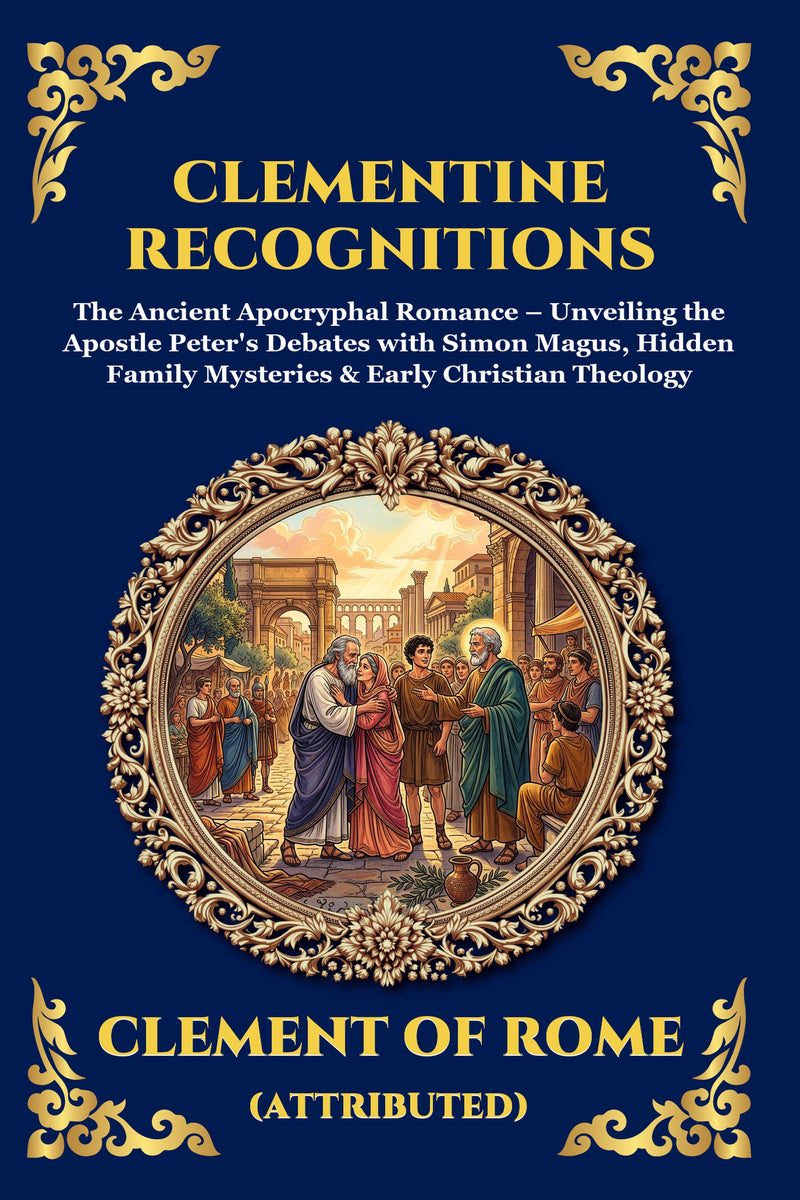
Clementine Recognitions — Large Print
Clementine Recognitions unfolds the odyssey of Clement, a young Roman philosopher seeking truth amidst existential turmoil. Once central to early Christian thought and later excluded from the canon, this narrative blends philosophical debate with adventure, painting a vivid portrait of faith's struggle against doubt.
or free app
10,000+ hrs library
30-day guarantee
The Clementine Recognitions is a complete modern-English translation of the early Christian novel, readable online with audiobook included through Library of Alexandria Press membership.
Large Print Edition. The complete, unabridged text set in a larger, easy-on-the-eyes typeface for comfortable reading.
Have you ever wondered why some of the earliest Christian writings read more like epic adventure novels than standard theological treatises?
The Clementine Recognitions provides a compelling modern translation of a literary masterpiece from the early Christian world. Attributed to Clement of Rome, who would later become a foundational leader in the early church, this expansive text is often considered one of the first Christian novels. It offers a rare, hybrid narrative that brilliantly combines the gripping plot of an ancient romance with the deep philosophical and theological debates of the second and third centuries.
The story begins with Clement, a young Roman philosopher tormented by questions about the immortality of the soul and the origins of the universe. His quest for answers leads him to the Judean province, where he meets the Apostle Peter. Clement becomes Peter's faithful disciple and scribe, following the apostle as he tracks down his arch-nemesis: Simon Magus, the legendary sorcerer who twists scripture, uses dark magic, and claims to be a god. The text records their thrilling, multi-day public debates, offering readers a front-row seat to the intellectual battles that shaped early Christian thought.
But beyond the debates, the heart of the narrative is a deeply moving story of loss and restoration. As Peter and Clement travel from city to city, the apostle's miraculous interventions slowly bring together the scattered, unrecognized members of Clement's family—a mother, father, and twin brothers who had been lost to shipwreck, slavery, and despair.
What You’ll Discover in This Modern Translation:
The Epic Debates with Simon Magus Witness the intense intellectual and theological clashes between the Apostle Peter and the ancient world's most infamous magician, exploring the origins of evil and the true nature of God.
A Gripping Ancient Romance Immerse yourself in a thrilling narrative of travel, shipwreck, mistaken identity, and the ultimate, miraculous "recognition" and reunion of a torn family.
Deep Theological and Philosophical Themes Explore early Christian arguments against astrology, paganism, and fatalism, as Peter defends human free will and divine providence.
A Window into Jewish-Christian Thought Gain a deeper understanding of the diverse theological landscape of the early church, particularly the traditions that heavily emphasized the continuity between the Law of Moses and the teachings of Jesus.
Whether you are exploring this work for its immense historical value, its fascinating philosophical arguments, or simply its beautifully crafted story of family redemption, The Clementine Recognitions offers an unparalleled journey into antiquity. Step into the ancient world and discover a lost classic of early Christianity. Begin your journey today.
| Formats | eBook (EPUB + PDF) · Audiobook · Paperback · Hardcover · Large Print |
| Language | English |
| Trim size (print) | 6 × 9 in |
| Binding | Paperback — perfect-bound · Hardcover — casewrap |
| Large Print edition | Same text in a larger, easy-read type — a larger font, not a larger trim |
| Print pricing | Every physical book at our true cost — at-cost, no profit (members) |
| Library | 873 restored titles, always growing |
| Composed | 4th century AD |
| Original language | Greek (survives in Latin translation) |
| Source tradition | Latin manuscript tradition |
| Translation basis | Public-domain scholarly translation, rendered in clear modern English |
| Length | 3,018 words · ~12 min reading |
| Reading level | Grade 15 · rich, literary prose (this modern-English edition) |
| Edition | Modern English translation · 2026 |
Member reviews for this edition are collected as readers finish it — be the first. Across the library: 12,000+ books shipped, every plan covered by a 365-day print guarantee.
About this edition
The complete, unabridged text in clear modern English — faithful to the original, never simplified. Every paragraph is checked against the source, so nothing is cut, summarised, or paraphrased away. It reads cleanly for today while keeping the original meaning intact.
This text survives primarily through Latin manuscripts, translated from a lost Greek original. This edition derives from the standard public-domain scholarly translation and renders it in clear modern English.
- Complete & unabridgedVerified paragraph by paragraph against the source — never a scan, never abridged.
- Modern English, faithfulReadable today, with the author’s meaning kept intact. Readable — not simplified.
- Every format, one membershipRead in your browser or the free app, or listen to the full audiobook.
Included free with your membership
Cancel anytime, one click · 30-day money-back guarantee
Edition last updated June 2026
What’s inside
Clementine Recognitions — Large Print — complete and unabridged: all 5 sections included with membership, plus the full audiobook.
Begin reading Clementine Recognitions — Large Print
In clear modern English — the complete text is included with membership.
Dedication to Bishop Gaudentius
To Bishop Gaudentius.
Explanation of Translation Plan and Editorial Choices
To you, O Gaudentius, you who are the finest glory among our teachers, belongs such strength of mind and such grace of the Spirit, that whatever you say even in the course of your daily preaching, whatever you deliver in the church, ought to be preserved in books and handed down to posterity for their instruction. But I, whom slenderness of wit makes less ready, and whom old age now makes slow and inactive, though after many delays, at last present to you the work which the virgin Sylvia of venerable memory once enjoined upon me — that I should render Clement into our language — and which you afterwards demanded of me as your rightful inheritance. In this way I contribute to the use and profit of our people no small prize, as I think, taken from the libraries of the Greeks, so that I may feed with foreign nourishment those whom I cannot feed with my own. For foreign things usually seem both more pleasant and sometimes more profitable as well. Indeed, almost everything that brings healing to our bodies, that opposes disease and neutralizes poisons, comes from abroad. Judaea sends us the tears of balsam, Crete the leaf of dittany, Arabia her flower of spices, India her harvest of spikenard; and though these reach us in somewhat more broken condition than when they left their native fields, they still retain the full sweetness of their fragrance and their healing power. Receive, therefore, my soul, Clement returning to you; receive him now in a Roman dress. And do not wonder if perhaps the florid beauty of his eloquence appears somewhat diminished. It does not matter, provided the sense tastes the same. We transport foreign merchandise into our country with great labor. And I do not know with what grateful faces my countrymen will welcome me as I bring them the rich spoils of Greece and unlock hidden treasures of wisdom with the key of our own language. But may God grant your prayers, that no envious eye nor any malicious glance may meet us — lest, by a strange kind of prodigy, those from whom he is taken feel no envy, while those upon whom he is bestowed should begrudge the gift.
It is right, moreover, to explain to you the plan of my translation, since you have read these works in Greek as well, lest in some places you think the order of translation has not been maintained. You are no doubt aware that there are two editions of this work of Clement in Greek — the Anagnōseis, that is, the Recognitions — and that there are two collections of books, differing in some points but in many containing the same narrative. The last part of this work, in which is the account of the transformation of Simon, is contained in one of the collections but is entirely absent from the other. There are also in both collections certain dissertations concerning the Unbegotten God and the Begotten, and on some other subjects which, to say the least, are beyond our comprehension. These, therefore, as being beyond my powers, I have chosen to leave for others rather than to produce in an imperfect state. In the rest, I have endeavored, as far as I could, to depart neither from the meaning nor even from the language and modes of expression; and though this makes the style of the narrative less ornate, it makes it more faithful.
The letter in which Clement himself, writing to James the Lord's brother, informs him of the death of Peter and that Peter had left him as his successor in his chair and teaching — and in which the whole subject of church order is treated — I have not prefixed to this work, both because it is of later date and because I have already translated and published it. But I do not think it out of place to explain here what in that letter will perhaps seem to some to be inconsistent. Some ask: since Linus and Cletus were bishops in the city of Rome before this Clement, how could Clement himself, writing to James, say that the chair of teaching was handed over to him by Peter? The explanation I have heard is this: that Linus and Cletus were indeed bishops in the city of Rome before Clement, but during the lifetime of Peter — that is, they undertook the care of the episcopate while Peter fulfilled the office of apostleship. This is found to have been the case at Caesarea as well, where, even when Peter himself was present, he had Zacchaeus, ordained by himself, serving as bishop. In this way both statements will appear to be true: that these bishops are reckoned before Clement, and yet that Clement received the teacher's seat upon the death of Peter. But now let us see how Clement, writing to James the Lord's brother, begins his narrative.
Cancel anytime, one click · 30-day money-back guarantee
Founding annual rate available now — your price locks for life when you join.
Not ready? Get this free chapter by email — read it anytime.
✓ Sent — check your inbox for Clementine Recognitions — Large Print.
Questions about Clementine Recognitions — Large Print
Who actually wrote the Clementine Recognitions?
The Clementine Recognitions was not written by Clement of Rome, despite its attribution. Modern scholars believe it was composed by an unknown Christian author in the 4th century, using Clement as a literary character to explore early Christian themes and philosophy.
Why isn't the Clementine Recognitions in the Bible?
The Clementine Recognitions was written too late to be considered for the biblical canon and was recognized as a fictional narrative rather than apostolic writing. Early church authorities distinguished between authentic apostolic texts and later literary works like this Christian novel.
What does the Clementine Recognitions actually contain?
The Clementine Recognitions follows Clement's journey seeking religious truth, featuring debates between Peter and Simon Magus, philosophical discussions, adventure elements, and family reunions. It blends Christian apologetics with novelistic storytelling techniques popular in ancient literature.
Is Clementine Recognitions free to read?
The opening of the text is free to read below. Members read and listen to the complete work — and the entire Lost & Forbidden Library — free.
What is Clementine Recognitions?
Have you ever wondered why some of the earliest Christian writings read more like epic adventure novels than standard theological treatises?
How long is Clementine Recognitions?
5 chapters (~828 words) in this restored edition.
Shipping & returns
Billing & membership
More from the library


Explore Early Church Writings
- Didascalia · Attributed to early Christian c...
- Martyrdom of Perpetua and Felicitas · Attributed to Vibia Perpetua
- Martyrdom of Pionius
- Apostolic Canons · Attributed to Clement of Rome
- Polycarp to the Philippians · Attributed to Polycarp of Smyrna
- Ignatius of Antioch: Seven Letters · Attributed to Ignatius of Antioch
- Epistle of Peter to James · Attributed to the Apostle Peter
- 1–4 Maccabees · Various Jewish authors
- Apostolic Fathers · Various early Christian authors
- Letter of Lentulus
- Apostolic Tradition · Attributed to Hippolytus of Rome
- Hegesippus: Memoirs · Attributed to Hegesippus
- Quadratus: Apology · Attributed to Quadratus of Athens
- Martyrdom of Polycarp · Attributed to the Church of Smyrna
- Letter to Diognetus
- Book of the Rolls · Attributed to Clement
- Book of the Bee · Attributed to Solomon of Akhlat
- Martyrdom of Matthew · Attributed to Pseudo-Abdias
- Martyrdom of Andrew · Attributed to various early Chr...
- Martyrdom of Paul · Attributed to early Christian a...
- Martyrdom of Peter · Attributed to Leucius Charinus
- Preaching of Paul · Attributed to the Apostle Paul
- On the Eucharist B · Attributed to St. Ambrose of Milan
- On the Eucharist A · Attributed to St. Ambrose of Milan
- On the Baptism B · Attributed to St. Augustine
- On the Baptism A · Attributed to Tertullian of Car...
- On the Anointing · Various early Christian theolog...
- Letter of Clement to James · Attributed to Clement of Rome
- Clementine Homilies · Attributed to Clement of Rome
- Clementine Recognitions · Attributed to Clement of Rome
Clementine Recognitions — Large Print
Clementine Recognitions
The Ancient Apocryphal Romance – Unveiling the Apostle Peter's Debates with Simon Magus, Hidden Family Mysteries & Early Christian Theology
Library of Alexandria Press
Clementine Recognitions
© Copyright 2026 Library of Alexandria Press. All rights reserved.
Published by Library of Alexandria Press
Printed in the United States of America
It is not legal to copy, share, or send any part of this document in either digital or printed form without written permission from the publisher, except short quotes in a book review.
Table of Contents
Introduction
A Lost World Recovered
How to Read What Follows
Dedication to Bishop Gaudentius
Explanation of Translation Plan and Editorial Choices
Introduction
There are books that sit quietly at the edges of history, neither fully forgotten nor fully remembered, waiting for the right moment to reveal how much they have always mattered. The text you are about to read is one of those books. It is a work of extraordinary antiquity and remarkable ambition — a sprawling, philosophically rich, narratively inventive composition that weaves together adventure, theology, family drama, and debate in ways that feel surprisingly modern even as they carry the unmistakable fragrance of the ancient world. To encounter it for the first time is to feel the ground shift slightly beneath your feet, as you realize that early Christianity was a far more complex, contested, and creatively alive phenomenon than most of us were ever taught.
The Clementine literature, of which this text forms a central part, belongs to a category of early Christian writing that scholars call pseudepigrapha — works written under a name other than the actual author's, typically to lend authority or historical weight to the composition. The name attached here is Clement, and the Clement in question is none other than Clement of Rome, one of the earliest bishops of the Roman church, traditionally counted among the Apostolic Fathers and regarded by some ancient sources as the fourth pope. Whether Clement actually wrote any of this is a question that scholarship settled long ago in the negative, but the choice of his name is itself deeply meaningful, because the entire narrative is structured as Clement's own story — his search for truth, his discovery of the apostle Peter, and his gradual reunification with a family he had believed lost forever.
What we have, then, is something that defies easy categorization. It is not simply a theological treatise, though it contains some of the most fascinating early Christian theology you are likely to encounter outside the canonical New Testament. It is not simply a romance novel in the ancient sense, though it has all the hallmarks of that genre — long-lost relatives, dramatic recognitions, sea voyages, disguises, and reunions charged with emotion. It is not simply a polemical text aimed at discrediting a rival religious figure, though its sustained engagement with Simon Magus, the legendary magician and theological adversary of the apostle Peter, gives it a sharp polemical edge. It is all of these things simultaneously, and the tension between these different registers is precisely what makes it so endlessly fascinating.
The work exists in two main versions, known as the Homilies and the Recognitions, both of which are believed to derive from a common earlier source that scholars call the Basic Writing or Grundschrift. The Recognitions, which forms the primary focus of this edition, survives in a Latin translation made by Rufinus of Aquileia around the year 406 CE, though the underlying Greek original is thought to date from somewhere in the third or fourth century, with some of its source materials reaching back even further, possibly into the second century. The Homilies survive in Greek and present a somewhat different theological profile, in some ways more radical and more explicitly heterodox than the Recognitions. Together, these two versions give us an invaluable window into a form of early Jewish Christianity that was eventually marginalized by what became orthodox Catholic tradition, but which clearly flourished and produced sophisticated literary and theological work during the first several centuries of the common era.
To understand why this text matters, it helps to appreciate just how turbulent and diverse the early Christian world actually was. The picture most people carry in their minds — of a unified apostolic church spreading outward from Jerusalem and Rome, teaching a consistent message and maintaining doctrinal coherence — is a retrospective construction, a story that the eventual winners of the theological battles of the second through fourth centuries told about themselves. The reality was messier, more interesting, and in many ways more human. There were dozens of competing Christian movements, each with their own texts, their own interpretations of Jesus's life and teachings, their own understanding of the relationship between the new faith and the Jewish tradition from which it emerged. The Clementine literature gives us access to one of these movements — a movement that placed enormous importance on Jewish law, that was deeply suspicious of the apostle Paul, that had a sophisticated cosmological theology rooted in a concept of the True Prophet who appears repeatedly throughout human history, and that preserved traditions about Peter and the early Jerusalem church that are found nowhere else in ancient literature.
The figure of Simon Magus, who appears briefly in the Acts of the Apostles as a Samaritan magician who tries to purchase spiritual power from the apostles, becomes in this text something far more significant: a full-scale theological antagonist, a kind of anti-Peter, whose debates with the apostle range across cosmology, ethics, free will, the nature of God, the problem of evil, and the proper interpretation of scripture. These debates are not straw-man exercises in which a cardboard villain is easily demolished by a heroic protagonist. Simon is given real arguments, real rhetorical skill, and real philosophical sophistication. The debates feel alive because they were alive — because the questions being argued were genuinely contested in the world in which this text was composed, and because the author or authors understood that genuine intellectual engagement requires taking the opposing position seriously.
For the modern reader, these debates open a window onto questions that have never stopped being urgent. What is the nature of divine providence? How do we account for the existence of evil in a world created by a good God? What is the relationship between fate and free will? How should we interpret ancient scriptures that seem to attribute morally troubling actions to God? How do we distinguish true prophecy from false? These are not merely antiquarian questions. They are the questions that serious religious thinkers have wrestled with in every generation, and encountering them in this ancient text, argued with such energy and ingenuity, has a way of refreshing our sense of their importance.
The family story that runs through the text alongside these theological debates is, in its own way, equally compelling. Clement's search for his lost family — a mother, brothers, and father who were separated from him and from each other by a series of misfortunes that seem almost cosmically orchestrated — gives the abstract theological arguments an emotional grounding that keeps the narrative human and accessible. The gradual process of recognition by which family members discover each other after years of separation is handled with genuine literary skill, and the moments of reunion carry an emotional charge that readers across the centuries have responded to. This is not accidental. The Greek romance tradition, with its characteristic themes of separation, wandering, and reunion, was one of the most popular literary forms of the Hellenistic and early Roman world, and the author of this text was clearly drawing on that tradition deliberately, using its conventions to make a theological and philosophical argument about the nature of divine providence — about the way in which a caring God works through the apparent chaos of human experience to bring about reunion and restoration.
There is also, woven through the narrative, a sustained meditation on the nature of religious knowledge and religious authority. How do we know what is true? How do we recognize a genuine teacher? What gives someone the right to speak about divine things? Clement's journey is in part a journey through different answers to these questions — through philosophy, through various religious traditions, through the claims of different teachers — before he arrives at Peter and finds in him something that satisfies his deepest intellectual and spiritual longings. The text's answer to these questions is not simple or dogmatic. It involves a complex epistemology in which reason, tradition, experience, and the testimony of witnesses all play roles, and in which the honest acknowledgment of uncertainty is presented as a mark of genuine wisdom rather than a failure of faith.
Dedication to Bishop Gaudentius
To Bishop Gaudentius.
Explanation of Translation Plan and Editorial Choices
To you, O Gaudentius, you who are the finest glory among our teachers, belongs such strength of mind and such grace of the Spirit, that whatever you say even in the course of your daily preaching, whatever you deliver in the church, ought to be preserved in books and handed down to posterity for their instruction. But I, whom slenderness of wit makes less ready, and whom old age now makes slow and inactive, though after many delays, at last present to you the work which the virgin Sylvia of venerable memory once enjoined upon me — that I should render Clement into our language — and which you afterwards demanded of me as your rightful inheritance. In this way I contribute to the use and profit of our people no small prize, as I think, taken from the libraries of the Greeks, so that I may feed with foreign nourishment those whom I cannot feed with my own. For foreign things usually seem both more pleasant and sometimes more profitable as well. Indeed, almost everything that brings healing to our bodies, that opposes disease and neutralizes poisons, comes from abroad. Judaea sends us the tears of balsam, Crete the leaf of dittany, Arabia her flower of spices, India her harvest of spikenard; and though these reach us in somewhat more broken condition than when they left their native fields, they still retain the full sweetness of their fragrance and their healing power. Receive, therefore, my soul, Clement returning to you; receive him now in a Roman dress. And do not wonder if perhaps the florid beauty of his eloquence appears somewhat diminished. It does not matter, provided the sense tastes the same. We transport foreign merchandise into our country with great labor. And I do not know with what grateful faces my countrymen will welcome me as I bring them the rich spoils of Greece and unlock hidden treasures of wisdom with the key of our own language. But may God grant your prayers, that no envious eye nor any malicious glance may meet us — lest, by a strange kind of prodigy, those from whom he is taken feel no envy, while those upon whom he is bestowed should begrudge the gift.
It is right, moreover, to explain to you the plan of my translation, since you have read these works in Greek as well, lest in some places you think the order of translation has not been maintained. You are no doubt aware that there are two editions of this work of Clement in Greek — the Anagnōseis, that is, the Recognitions — and that there are two collections of books, differing in some points but in many containing the same narrative. The last part of this work, in which is the account of the transformation of Simon, is contained in one of the collections but is entirely absent from the other. There are also in both collections certain dissertations concerning the Unbegotten God and the Begotten, and on some other subjects which, to say the least, are beyond our comprehension. These, therefore, as being beyond my powers, I have chosen to leave for others rather than to produce in an imperfect state. In the rest, I have endeavored, as far as I could, to depart neither from the meaning nor even from the language and modes of expression; and though this makes the style of the narrative less ornate, it makes it more faithful.
The letter in which Clement himself, writing to James the Lord's brother, informs him of the death of Peter and that Peter had left him as his successor in his chair and teaching — and in which the whole subject of church order is treated — I have not prefixed to this work, both because it is of later date and because I have already translated and published it. But I do not think it out of place to explain here what in that letter will perhaps seem to some to be inconsistent. Some ask: since Linus and Cletus were bishops in the city of Rome before this Clement, how could Clement himself, writing to James, say that the chair of teaching was handed over to him by Peter? The explanation I have heard is this: that Linus and Cletus were indeed bishops in the city of Rome before Clement, but during the lifetime of Peter — that is, they undertook the care of the episcopate while Peter fulfilled the office of apostleship. This is found to have been the case at Caesarea as well, where, even when Peter himself was present, he had Zacchaeus, ordained by himself, serving as bishop. In this way both statements will appear to be true: that these bishops are reckoned before Clement, and yet that Clement received the teacher's seat upon the death of Peter. But now let us see how Clement, writing to James the Lord's brother, begins his narrative.
End of the free sample
Keep reading, free
Members read and listen to the complete book — and the entire library. Cancel anytime, one click · 30-day money-back guarantee.