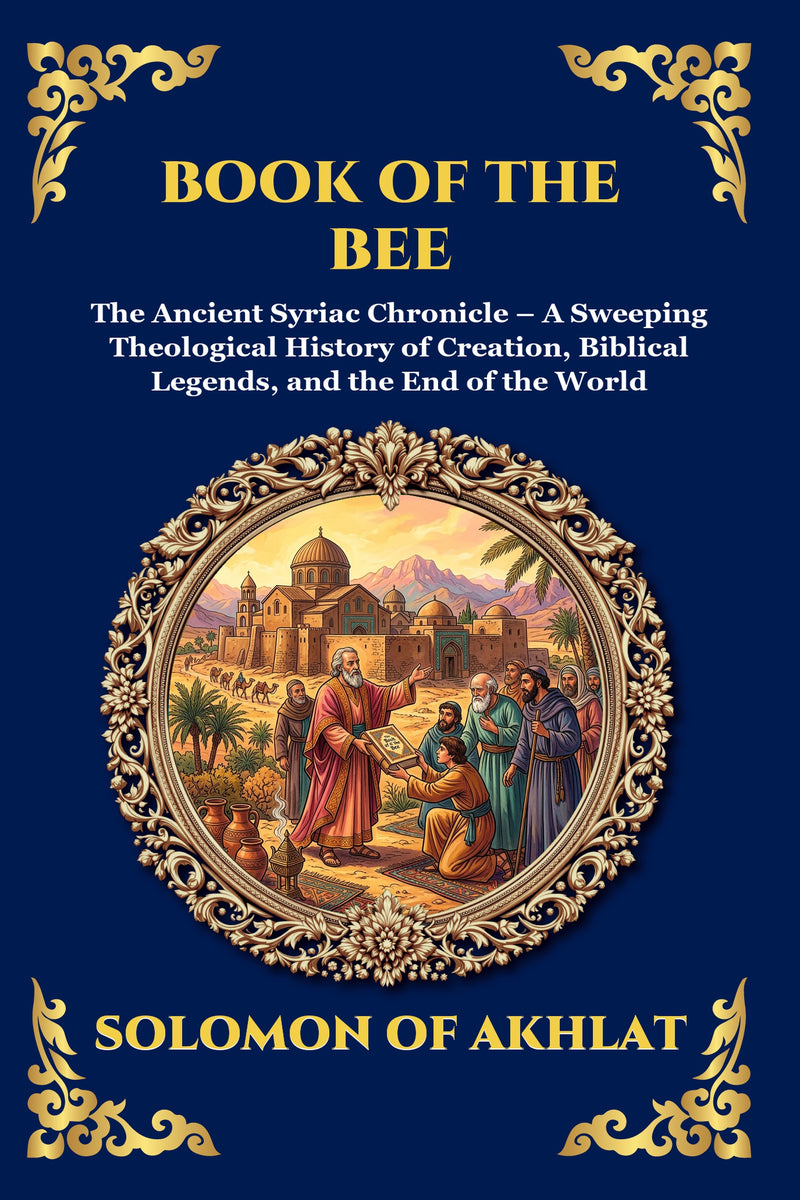
Book of the Bee — Large Print
The Book of the Bee compiles ancient biblical legends and cosmic mysteries omitted from standard histories into a sweeping timeline of the universe. Crafted by 13th-century bishop Solomon of Akhlat, this Syriac masterpiece weaves together scripture, commentaries, and oral traditions to create a singular narrative of existence.
or free app
10,000+ hrs library
30-day guarantee
This 13th-century Syriac Christian encyclopedic text, the Book of the Bee, appears here as a complete modern English translation, readable online with audiobook narration included for members.
Large Print Edition. The complete, unabridged text set in a larger, easy-on-the-eyes typeface for comfortable reading.
Have you ever wondered why so many ancient biblical legends and cosmic mysteries were left out of standard histories, and how early Eastern Christians understood the complete timeline of the universe?
The Book of the Bee is a monumental achievement of medieval Syriac literature that seeks to tell the ultimate story of existence. Authored by the prominent bishop Solomon of Akhlat in the 13th century, this text was designed to be a grand repository of historical, theological, and apocryphal knowledge. Just as a bee meticulously gathers nectar from a thousand different flowers to create something sweet and sustaining, Solomon gathered traditions from scripture, ancient commentaries, and oral legends to construct a complete timeline of the world.
Far more than a standard biblical summary, this chronicle dives deep into the esoteric and the extraordinary. It begins before the dawn of time, detailing the creation of the angelic hierarchies and the fall of Lucifer. It expands upon the lives of the patriarchs, offering fascinating, lesser-known legends about Adam and Eve, the flood, and the prophets. Moving through the life, crucifixion, and resurrection of Jesus Christ, it culminates in a gripping, apocalyptic vision of the end of the world, the final judgment, and the resurrection of the dead.
This modern translation opens the doors to the vibrant, mystical imagination of the Eastern Church. It offers a rare glimpse into a theological tradition that beautifully blends rigorous history with captivating myth.
What You’ll Discover in This Modern Translation:
- The Dawn of Creation — Explore detailed accounts of the formation of the universe, the nature of angels, and the origins of darkness.
- Forgotten Biblical Legends — Discover expanded, apocryphal stories about humanity’s earliest ancestors, from the Garden of Eden to the patriarchs of the Old Testament.
- The Life and Passion of Christ — Read the unique Syriac perspectives on the miracles, crucifixion, and divine triumph of the Savior.
- The Apocalypse and Final Judgment — Uncover ancient prophecies regarding the end of days, the defeat of ultimate evil, and the cosmic renewal of the world.
Whether you are a scholar of early Christianity, a lover of ancient mythology, or a reader seeking a grand, sweeping narrative of human history, The Book of the Bee offers a rich and unforgettable experience. Step into the mind of an ancient bishop and uncover the sweet wisdom gathered from the dawn of time. Begin your journey today.
| Formats | eBook (EPUB + PDF) · Audiobook · Paperback · Hardcover · Large Print |
| Language | English |
| Trim size (print) | 6 × 9 in |
| Binding | Paperback — perfect-bound · Hardcover — casewrap |
| Large Print edition | Same text in a larger, easy-read type — a larger font, not a larger trim |
| Print pricing | Every physical book at our true cost — at-cost, no profit (members) |
| Library | 873 restored titles, always growing |
| Composed | 13th century AD |
| Original language | Syriac |
| Source tradition | Syriac manuscript tradition |
| Translation basis | Public-domain scholarly translation, rendered in clear modern English |
| Length | 41,838 words · ~2 hr 47 min reading |
| Reading level | Grade 9 · clear and comfortable (this modern-English edition) |
| Edition | Modern English translation · 2026 |
Member reviews for this edition are collected as readers finish it — be the first. Across the library: 12,000+ books shipped, every plan covered by a 365-day print guarantee.
About this edition
The complete, unabridged text in clear modern English — faithful to the original, never simplified. Every paragraph is checked against the source, so nothing is cut, summarised, or paraphrased away. It reads cleanly for today while keeping the original meaning intact.
Preserved in Syriac manuscript traditions from medieval monasteries. This edition derives from the standard public-domain scholarly translation and renders it in clear modern English.
- Complete & unabridgedVerified paragraph by paragraph against the source — never a scan, never abridged.
- Modern English, faithfulReadable today, with the author’s meaning kept intact. Readable — not simplified.
- Every format, one membershipRead in your browser or the free app, or listen to the full audiobook.
Included free with your membership
Cancel anytime, one click · 30-day money-back guarantee
Edition last updated June 2026
What’s inside
Book of the Bee — Large Print — complete and unabridged: all 61 sections included with membership, plus the full audiobook.
Begin reading Book of the Bee — Large Print
In clear modern English — the complete text is included with membership.
Chapter 1
It is good for us to draw the materials for our discussion from the divine Scriptures, so that we do not stray from the straight paths of truth. The blessed David says, "Lord, you have been our dwelling-place in all generations, before the mountains were conceived." David, the harpist of the Spirit, makes known by these words that although there was a beginning to the making of Adam and the other creatures when they were formed, yet in the mind of God that making had no beginning. This is so that no one should think God entertains a new thought concerning anything that is renewed day by day, or that the construction of Creation was newly devised in the mind of God. Rather, everything He has created and is yet to create — even the marvellous construction of the world to come — has been planned from everlasting in the immutable mind of God. Just as a child in its mother's womb does not know the one who carries it, nor is aware of its father, who after God is the cause of its formation, so too Adam, while existing in the mind of the Creator, did not know Him. And when Adam was created and recognized himself as a created being, he remained in that knowledge for only six hours, and then a change came over him — from knowledge to ignorance, and from good to evil.
Thus, when Divine Providence purposed to create the world, the forming of Adam was first designed and conceived in the mind of God, and only then the forming of the other creatures — as David says, "Before the mountains were conceived." Adam is therefore older than the other creatures with respect to his conception, while the other creatures are older than Adam with respect to their birth and their actual making. And whereas God created all other creatures in silence and by a word, He brought Adam forth out of His own thoughts, formed him with His holy hands, breathed into him the breath of life from His own Spirit, and Adam became a living soul. God gave him the knowledge of the difference between good and evil. When Adam perceived his Creator, God was formed and conceived within the mind of man, and man became a temple to God his maker, as it is written: "Do you not know that you are the temple of God, and that the Spirit of God dwells in you?" And again: "I will dwell in them, and walk in them."
Chapter 2
When God in His mercy wished to make known all His power and His wisdom, He created, in the beginning — on the evening of the first day, which is Sunday — seven natures or substances in silence, without a word spoken. Since there was as yet no one to hear any sound, He did well to create them in silence, so that nothing would be made in vain. He simply willed it, and heaven, earth, water, air, fire, the angels, and darkness all came into being out of nothing.
Chapter 3
The earth was tohu wa-bohu — that is, unformed and unadorned — submerged in the midst of the waters. The waters lay above it, above the waters was air, and above the air was fire. Earth is by nature cold and dry. Dry land appeared on the third day, when trees and plants were created; and the waters were separated from it on the second day, when the firmament was made from them. Water is by nature cold and moist. As for the Spirit that brooded upon the face of the waters, some have ignorantly taken it to be the Holy Spirit, while others have more correctly understood it to be the air of our world. Air is by nature hot and moist. Fire was active in the upper ether, above the atmosphere; it possessed heat alone and had no luminosity until the fourth day, when the luminaries were created — of which we shall speak in the chapter on the luminaries. Fire is by nature hot and dry.
Chapter 4
Heaven is like a roof over the material world, and will serve as the floor of the new world. It is by nature radiant and glorious, and is the dwelling-place of the invisible hosts. When God spread out the firmament, he raised a third part of the waters above it, and above those waters is the heaven of light and of the luminaries. This is why people speak of "the heaven, and the heaven of heavens," for we call both the firmament and the waters above it by the name heaven. Some interpret the verse "Let the waters that are above the heavens praise the name of the Lord" as referring to the holy angels and to our Lord's humanity, but neither the Church nor the orthodox teachers accept this view.
Chapter 5
The angels are divided into nine classes arranged in three orders: upper, middle, and lower. The upper order consists of Cherubim, Seraphim, and Thrones; these are called priests and chief priests, and bearers of God's throne. The middle order consists of Lords, Powers, and Rulers; these are called priests because they receive revelations from those above them. The lower order consists of Principalities, Archangels, and Angels; these are the ministers who serve created things.
The Cherubim are an intellectual motion that bears the throne of the holy Trinity and stands chief among all motions; they watch perpetually over their own class and those beneath them. The description of them as "full of eyes" signifies the mystery of the revelations of the Trinity. Their head, the foremost and highest among them, is Gabriel, who is the mediator between God and his creation. The Seraphim are a fiery motion that warms those below it with the fire of divine love. The six wings attributed to each of them represent the revelations they receive from the Creator and transmit to mankind. The Thrones are a steadfast motion, unshaken by whatever trials come upon it.
The Lords are a motion entrusted with governing the motions beneath them; it is they who prevent the demons from harming created things. The Powers are a mighty motion, ministers of the Lord's will; they grant victory to some rulers in battle and defeat to others. The Rulers are a motion that has authority over the spiritual treasures, distributing them to their companions according to the will of the Creator. This class of angels governs the luminaries — the sun, moon, and stars.
The Principalities are a defined motion that directs the upper atmosphere: rain, clouds, lightning, thunder, whirlwinds, tempests, winds, and all other disturbances of the sky. The Archangels are a swift and active motion, entrusted with governance over wild beasts, cattle, birds, reptiles, and every living creature from the gnat to the elephant — everything, that is, except man. The Angels are a motion possessing spiritual knowledge of all that exists on earth and in heaven. With each and every one of us there is an angel of this class — called the guardian angel — who guides a person from conception until the general resurrection.
The number of each of these nine classes of angels equals the total number of all human beings from Adam to the resurrection. It is therefore held that the number of people who will ever enter the world equals the number of all the heavenly hosts together. Some say, however, that the number equals only that of a single class, so that humanity may fill the places of those angels who fell by transgressing the law — for the demons fell from three classes, a third part from each. If it is accepted that there are three orders of angels, each order containing three classes, and each class numbering as many as all of mankind, one may consider what the total number of angels must be.
Some say that when the angels were first created and arranged in six divisions — Cherubim, Seraphim, Thrones, Principalities, Archangels, and Angels — the three lower divisions began to reflect among themselves: "Why are those others set above us and we below? They have not done anything more than we have, nor do we fall short of them." Because of this reflection, and in keeping with the manner of divine governance, Justice took from both sides and established three intermediate classes — Lords, Powers, and Rulers — so that the upper orders would not be unduly exalted, nor the lower ones feel themselves wronged.
As for the dwelling-place of the angels, some say that above the firmament there are waters, and above those waters another heaven in the form of infinite light, and that this is the home of the angels. There too God dwells without limit, and the angels, invisible to bodily eyes, surround the throne of his majesty and minister before the tabernacle not made with hands. Others say that from the beginning, when God created the angels, until the second day when the firmament was made, all the classes of angels dwelt in the upper heavens; but when the firmament was made, they all descended below it, with the exception of three classes — the Cherubim, Seraphim, and Thrones — who remained above it. These surrounded and upheld the Shekinah of God from the beginning of the world until our Lord ascended into heaven; and after the Ascension they surround and uphold the throne of Christ God, who is over all, until the end of the world.
The Expositor and his companions say: "The tabernacle that Moses made is a type of the whole world." The outer tabernacle is the likeness of this present world, while the inner tabernacle is the image of the place above the firmament. Just as the priests ministered in the outer tabernacle every day while the high priest alone entered the inner tabernacle once a year, so among all rational beings — angels and men alike — no one has entered the place above the firmament except the High Priest of our confession, Jesus Christ. The fathers, whenever they were found worthy to behold our Lord in a vision, saw him in heaven surrounded by the Cherubim and Seraphim. This is why some hold that there are angels above the heavens.
All these celestial hosts receive revelations both of sight and of hearing, except the Cherubim, who receive revelations by sight alone, because there is no mediator between them and God. The angels possess an intellect superior to that of all other rational beings; man has the stronger capacity for desire; and the demons have the greater degree of anger.
Chapter 6
Darkness is a self-existent nature; and if it had not possessed a nature of its own, it would not have been counted among the seven natures that were created in the beginning in silence. Others say that darkness is not a self-existent nature, but is simply the shadow cast by bodies.
Chapter 7
When the holy angels were created on the evening of the first day, they had no voice, and they did not understand their own creation. They thought within themselves that they were self-existent beings who had never been made. Then, on the morning of the first day, God spoke in an audible and commanding voice: "Let there be light," and immediately the diffused light was created. When the angels saw light come into being, they knew with certainty that the one who had made light had also created them. They shouted with a loud voice, praising him and marveling at his creation of light — as the blessed teacher says, "When the Creator made that light, the angels marveled at it," and as it is written in Job, "When I created the morning star, all my angels praised me." By its nature, light has no warmth.
Chapter 8
Of the Firmament.
On the evening of the second day of the week, God willed to divide the heavens from the earth, so that there might be luminaries and stars beneath the heavens to give light to this world, and that the heavens might be a dwelling place for the righteous and the angels after the resurrection. God said, "Let there be a firmament to divide the waters from the waters," and at once the waters were divided into three parts. One part remained upon the earth for the use of men, cattle, and winged fowl — the rivers and the seas; from another part God made the firmament; and the third part he lifted up above the firmament. On the day of resurrection, the waters will return to their former nature.
Chapter 9
On the third day, God commanded that the waters should be gathered into the pits and depths of the earth, and that the dry land should appear. When the waters had been gathered into the depths of the earth and the mountains and hills had emerged, God set sand as a boundary for the waters of the seas, so that they could not overflow and cover the earth. Then God commanded the earth to bring forth herbage, grass, and every green thing; and the earth produced trees, herbs, and plants of every kind, complete and perfect in their flowers, fruit, and seed, each according to its kind. Some say that before the transgression of the commandment the earth brought forth neither thorns nor briars, and that even the rose had no thorns as it does now; but that after the transgression, the earth put forth thorns and briars on account of the curse it had received. The reason God created the trees and plants before the creation of the luminaries was so that the philosophers who discourse on natural phenomena might not suppose that the earth brought forth herbs and trees through the power of the sun's heat. As for the making of Paradise, the Pentateuch does not mention on which day it was created; but according to the opinion of those who may be relied upon, it was made on the same day as the trees were made — and if the Lord wills, we shall speak of it in its proper place.
Cancel anytime, one click · 30-day money-back guarantee
Founding annual rate available now — your price locks for life when you join.
Not ready? Get this free chapter by email — read it anytime.
✓ Sent — check your inbox for Book of the Bee — Large Print.
Questions about Book of the Bee — Large Print
Who wrote the Book of the Bee?
The Book of the Bee is attributed to Solomon of Akhlat, a 13th-century Syriac Orthodox bishop. This medieval compilation draws together biblical narratives, apocryphal traditions, and theological commentary into a comprehensive chronological framework.
What does the Book of the Bee contain?
The Book of the Bee presents a chronological account of biblical and post-biblical history, incorporating canonical scripture alongside apocryphal traditions and legends that were preserved in Syriac Christian communities but excluded from standard biblical canons.
Is Book of the Bee free to read?
The opening of the text is free to read below. Members read and listen to the complete work — and the entire Lost & Forbidden Library — free.
What is Book of the Bee?
Have you ever wondered why so many ancient biblical legends and cosmic mysteries were left out of standard histories, and how early Eastern Christians understood the complete timeline of the universe?
How long is Book of the Bee?
61 chapters (~41,898 words) in this restored edition.
Which formats are available?
eBook and audiobook (included with membership), plus paperback, hardcover and large-print editions printed at cost.
Shipping & returns
Billing & membership
More from the library


Explore Early Church Writings
- Didascalia · Attributed to early Christian c...
- Martyrdom of Perpetua and Felicitas · Attributed to Vibia Perpetua
- Martyrdom of Pionius
- Apostolic Canons · Attributed to Clement of Rome
- Polycarp to the Philippians · Attributed to Polycarp of Smyrna
- Ignatius of Antioch: Seven Letters · Attributed to Ignatius of Antioch
- Epistle of Peter to James · Attributed to the Apostle Peter
- 1–4 Maccabees · Various Jewish authors
- Apostolic Fathers · Various early Christian authors
- Letter of Lentulus
- Apostolic Tradition · Attributed to Hippolytus of Rome
- Hegesippus: Memoirs · Attributed to Hegesippus
- Quadratus: Apology · Attributed to Quadratus of Athens
- Martyrdom of Polycarp · Attributed to the Church of Smyrna
- Letter to Diognetus
- Book of the Rolls · Attributed to Clement
- Book of the Bee · Attributed to Solomon of Akhlat
- Martyrdom of Matthew · Attributed to Pseudo-Abdias
- Martyrdom of Andrew · Attributed to various early Chr...
- Martyrdom of Paul · Attributed to early Christian a...
- Martyrdom of Peter · Attributed to Leucius Charinus
- Preaching of Paul · Attributed to the Apostle Paul
- On the Eucharist B · Attributed to St. Ambrose of Milan
- On the Eucharist A · Attributed to St. Ambrose of Milan
- On the Baptism B · Attributed to St. Augustine
- On the Baptism A · Attributed to Tertullian of Car...
- On the Anointing · Various early Christian theolog...
- Letter of Clement to James · Attributed to Clement of Rome
- Clementine Homilies · Attributed to Clement of Rome
- Clementine Recognitions · Attributed to Clement of Rome
Book of the Bee — Large Print
The Book of the Bee
The Syriac Compendium of Solomon of Basra — A Sweeping Sacred History in Sixty Chapters, from the Creation of the Universe and the Fall of Adam, Through the Patriarchs, Prophets, and the Life of Christ, to the Coming of Antichrist, the Resurrection of the Dead, and the Final Judgment
Library of Alexandria Press
The Book of the Bee
© Copyright 2026 Library of Alexandria Press. All rights reserved.
Published by Library of Alexandria Press
Printed in the United States of America
It is not legal to copy, share, or send any part of this document in either digital or printed form without written permission from the publisher, except short quotes in a book review.
Table of Contents
Introduction
Chapter 1
Chapter 2
Chapter 3
Chapter 4
Chapter 5
Chapter 6
Chapter 7
Chapter 8
Chapter 9
Chapter 10
Chapter 11
Chapter 12
Chapter 13
Chapter 14
Chapter 15
Chapter 16
Chapter 17
Chapter 18
Chapter 19
Chapter 20
Chapter 21
Chapter 22
Chapter 23
Chapter 24
Chapter 25
Chapter 26
Chapter 27
Chapter 28
Chapter 29
Chapter 30
Chapter 31
Chapter 32
Chapter 33
Chapter 34
Chapter 35
Chapter 36
Chapter 37
Chapter 38
Chapter 39
Chapter 40
Chapter 41
Chapter 42
Chapter 43
Chapter 44
Chapter 45
Chapter 46
Chapter 47
Chapter 48
Chapter 49
Chapter 50
Chapter 51
Chapter 52
Chapter 53
Chapter 54
Chapter 55
Chapter 56
Chapter 57
Chapter 58
Chapter 59
Chapter 60
Introduction
There are books that record history, and then there are books that attempt to contain it — all of it, from the first breath of creation to the last trumpet of judgment. Solomon of Basra's extraordinary medieval chronicle belongs to the second, rarer category. Written in Classical Syriac sometime in the thirteenth century by a bishop whose learning was as vast as his theological ambitions, this text sweeps across the entirety of sacred time with a confidence and a tenderness that is almost breathtaking. To open its pages is to step into a world where Adam still walks in the cool of the Garden, where Noah argues with his neighbors about the coming flood, where the prophets cry out in the wilderness and kings rise and fall like tides. It is a world alive with angels and demons, with miraculous births and terrible deaths, with divine purpose threading through every human event like gold wire through ancient cloth.
Solomon was not writing merely for scholars, though scholars have treasured his work for centuries. He was writing for his community — a Syriac Christian community living under the pressures of a rapidly changing medieval world, a community that needed to understand where it had come from and, perhaps more urgently, where it was going. The chronicle is therefore simultaneously an act of scholarship, an act of pastoral care, and an act of faith. It gathers together an enormous wealth of sources: the Hebrew scriptures, the New Testament, the writings of the Church Fathers, earlier Syriac theological poetry and prose, Jewish midrashic traditions, apocryphal texts that had circulated for centuries on the margins of the official canon, and oral traditions that had been passed down through generations of Eastern Christian communities. Solomon synthesizes all of this material with a calm authority, weaving it into a single continuous narrative that moves from Genesis to the Apocalypse without losing its sense of direction or its warmth of voice.
What makes this text so remarkable to a modern reader is precisely its ambition. We live in an age of specialization, where historians study history, theologians study theology, and literary scholars study literature, each discipline carefully walled off from the others. Solomon recognized no such walls. For him, the story of creation was inseparable from the story of redemption, which was inseparable from the story of human civilization, which was inseparable from the story of the individual soul. Every detail mattered — the dimensions of Noah's ark, the names of the angels who guard the gates of paradise, the genealogies of the patriarchs, the precise sequence of events at the end of time. These were not decorative curiosities but essential data points in a vast theological map of reality. To understand any one of them was to understand something true and important about the nature of God and the nature of humanity.
The Syriac language in which Solomon wrote has its own particular beauty and its own particular weight. Syriac is a dialect of Aramaic, and Aramaic was the language spoken by Jesus of Nazareth and his earliest followers. For Syriac Christians, this linguistic connection was not a trivial historical footnote but a profound spiritual reality. To pray in Syriac, to read scripture in Syriac, to write theology in Syriac, was to participate in a living tradition that stretched back to the very origins of Christianity, indeed to the world of the Hebrew Bible itself. Solomon's prose carries this awareness throughout. There is a gravitas to his sentences, a sense that words are being chosen with great care because words, in this tradition, are understood to be powerful things — capable of conveying divine truth, of preserving sacred memory, of shaping the hearts of those who encounter them.
The text is organized into a series of chapters that move chronologically through sacred history, beginning with the creation of the heavens and the earth and ending with the resurrection of the dead and the final judgment. But to describe it as merely chronological is to miss much of its character. Solomon is as interested in the vertical dimension of reality as he is in the horizontal. At any given moment in the narrative, he is liable to pause and look upward — to consider the angelic hierarchies, the structure of the heavens, the nature of the divine will — or to look inward, to reflect on the moral and spiritual significance of the events he is describing. The result is a text that reads less like a timeline and more like a meditation, a sustained act of contemplation in which the events of sacred history become windows through which the attentive reader can glimpse something of the eternal.
For readers encountering this tradition for the first time, certain aspects of the text may come as a surprise. Solomon draws freely on traditions that were not ultimately included in the canonical scriptures of most Christian churches — stories about the childhood of Adam and Eve, detailed accounts of the wars between angels, elaborate descriptions of the heavenly realms, legends about the lives of the patriarchs and prophets that go far beyond anything found in the Bible itself. These traditions are not presented as speculation or as mere legend. They are presented as genuine knowledge, preserved by the community of faith and worthy of the same respectful attention as the canonical texts. This reflects a fundamentally different understanding of religious authority than the one most modern Western readers will be familiar with — an understanding in which tradition is not a supplement to scripture but a living extension of it, carrying its own kind of truth.
It is also worth noting, at the outset, that Solomon's text is a product of a specific time and place that was itself a crossroads of civilizations. Thirteenth-century Basra sat at the intersection of multiple worlds — Arab, Persian, Jewish, Christian, and increasingly Mongol. The intellectual culture of the region was rich and complex, shaped by centuries of contact and exchange between different religious and philosophical traditions. Solomon was not isolated from this culture. He was part of it, and his text reflects it in subtle but important ways. The care he takes with genealogies and chronologies, for instance, reflects a broader medieval scholarly culture that was deeply invested in establishing the antiquity and continuity of particular traditions. His engagement with Jewish interpretive traditions reflects the long history of Jewish-Christian intellectual exchange in the Syriac-speaking world. His interest in cosmology and the structure of the heavens reflects a culture that had absorbed and was actively engaging with the astronomical and philosophical knowledge of the ancient Greek world as it had been transmitted and transformed by Islamic scholars.
None of this makes the text any less distinctively Christian, or any less distinctively Syriac. But it does make it richer, more layered, more interesting than it might appear at first glance. Solomon is not simply repeating received wisdom. He is thinking, actively and carefully, about the great questions of his tradition — questions about the nature of God, the meaning of human history, the destiny of the soul — and he is bringing to bear on those questions everything he knows, from every source available to him. The result is a text that rewards slow, attentive reading, a text that opens up the more deeply you engage with it.
A Chronicle Unlike Any Other
To understand what Solomon set out to accomplish, it helps to situate his work within the broader tradition of Syriac Christian literature. That tradition is one of the oldest and most distinguished in the history of Christianity, stretching back to figures like Ephrem the Syrian in the fourth century, whose theological poetry is still sung in Syriac churches today, and to the great theological controversies of the fifth century, which left the Syriac-speaking world divided between different ecclesiastical communities — the Church of the East, the Syriac Orthodox Church, and later the Maronite and Melkite traditions. Each of these communities developed its own rich literary culture, producing biblical commentaries, liturgical texts, hagiographies, chronicles, and theological treatises of extraordinary sophistication. Solomon wrote within this tradition as an heir to its full wealth, drawing on texts and authors from across its various branches with an ecumenical generosity that reflects his own broad learning.
The genre of the theological chronicle — a narrative history of sacred time from creation to the end of the world — had a long history in both the Christian and Jewish traditions before Solomon took it up. The great Byzantine chronicler John Malalas had written such a history in the sixth century; the Syriac Orthodox bishop John bar Penkaye had attempted something similar in the seventh; and there were numerous shorter works in Syriac, Arabic, and other languages that traced the outlines of sacred history in various ways. What distinguishes Solomon's contribution is the particular combination of comprehensiveness, narrative skill, and theological depth that he brings to the project. He is not simply compiling a list of events. He is telling a story — a coherent, purposeful story with a beginning, a middle, and an end — and he is doing so with a storyteller's instinct for what matters, what to linger over, and what to pass by quickly.
The opening chapters of the work, which deal with the creation of the heavens and the earth and the nature of the angelic world, establish immediately that Solomon is operating with a cosmological imagination of considerable scope. The universe he describes is not the mechanistic universe of modern science but a living, hierarchical reality saturated with divine presence and purpose. The heavens are not empty space but a populated realm, inhabited by orders of angels whose nature, function, and relationship to the divine are matters of serious theological inquiry. The earth is not a random accident but a carefully crafted dwelling place, designed with specific intentions for the beings who will inhabit it. Every feature of the created order — the separation of light from darkness, the gathering of the waters, the creation of the plants and animals — is understood as a deliberate act of divine wisdom, worthy of careful attention and grateful contemplation.
When Solomon turns to the story of Adam and Eve, he brings to it a wealth of material that goes far beyond the brief account in Genesis. He draws on the rich tradition of Jewish and Christian reflection on the paradise narrative — a tradition that had been developing for over a thousand years by his time — to flesh out the story in ways that are sometimes startling, sometimes deeply moving, and always theologically purposeful. The questions that drive this reflection are perennial ones: What was the nature of human beings before the fall? What exactly was lost when Adam and Eve disobeyed? What does it mean for human beings to be made in the image of God? Solomon approaches these questions not as abstract philosophical puzzles but as living concerns, matters of urgent relevance to his readers' understanding of themselves and their relationship to God.
The narrative of the patriarchs — Noah, Abraham, Isaac, Jacob, Joseph, and the others — occupies a substantial portion of the work and is handled with particular skill. Solomon is an excellent storyteller, and the stories of the patriarchs give him ample material to work with. He knows how to build suspense, how to develop character, how to use detail to make a scene come alive. But he is always more than a storyteller. Every narrative carries a theological payload, a meaning that he is careful to draw out for his readers without being heavy-handed about it. The story of Joseph, for instance, is told in a way that constantly invites the reader to see in it a prefiguration of the story of Christ — the beloved son, betrayed by his brothers, descending into the pit and rising again to save those who had rejected him. This typological reading of the Old Testament, in which events and figures in the Hebrew scriptures are understood as anticipations or foreshadowings of events and figures in the New Testament, is one of the most characteristic features of the Syriac Christian interpretive tradition, and Solomon deploys it with great sophistication throughout his work.
The treatment of the prophets is equally rich. Solomon understands the prophets not simply as predictors of future events but as participants in a divine conversation that spans all of history. Their visions and oracles are not isolated phenomena but part of a continuous divine communication, a sustained effort on God's part to draw human beings back toward the truth and the life for which they were created. The prophetic books of the Hebrew Bible are therefore not merely historical documents but living texts, speaking as directly to Solomon's thirteenth-century readers as they spoke to their original audiences. This conviction — that scripture is not merely a record of past divine activity but a present divine address — is fundamental to Solomon's entire project and gives his work its distinctive urgency and intimacy.
Perhaps the most striking aspect of the work, for modern readers, is the sheer density of the legendary and apocryphal material that Solomon incorporates alongside the canonical texts. Stories about the cave of treasures where Adam and Eve took refuge after the expulsion from paradise, elaborate accounts of the wars in heaven and the fall of the rebel angels, detailed descriptions of the structure of the underworld and the nature of the punishments awaiting the wicked, legends about the discovery of the True Cross and the miraculous powers associated with it — all of this material circulated widely in the Syriac Christian world and was regarded by Solomon and his community as genuine sacred tradition, worthy of preservation and reflection. For the modern reader, this material has a different kind of interest: it offers a remarkable window into the religious imagination of medieval Eastern Christianity, revealing a world far more complex, more colorful, and more theologically adventurous than the simplified versions of Christian history that most of us encounter in standard textbooks.
Reading Solomon Today
There is a particular kind of pleasure that comes from reading a great medieval text — the pleasure of entering a mind that is both deeply familiar and profoundly alien, a mind that shares many of our fundamental human concerns but approaches them from a perspective so different from our own that the encounter is genuinely disorienting in the best possible sense. Solomon of Basra is that kind of writer. He is clearly an intelligent, humane, deeply thoughtful person. His love for his tradition is evident on every page. His care for his readers — his desire to instruct them, to comfort them, to deepen their faith and their understanding — is equally evident. And yet his world is not our world. His assumptions about the nature of reality, about the relationship between the human and the divine, about the meaning of history and the destiny of the cosmos, are radically different from the assumptions that most modern readers bring to a text.
This difference is not a problem to be overcome but an opportunity to be embraced. Reading Solomon carefully and attentively is an exercise in what might be called theological imagination — the capacity to inhabit, at least temporarily, a different vision of reality, to see the world through different eyes, and to return from that experience with a richer and more complex understanding of the range of human possibility. The questions Solomon asks — What is the nature of God? What is the meaning of human suffering? What is the destiny of the soul? — are not questions that have been definitively answered and set aside. They are questions that remain urgently alive, and Solomon's answers, even where we cannot simply adopt them as our own, have the power to illuminate them in new ways.
It is also worth reflecting on the historical significance of the tradition Solomon represents. The Syriac Christian communities for which he wrote have had a long and often difficult history. They survived the Arab conquests of the seventh century, the Mongol invasions of the thirteenth, the Ottoman period, and into the modern era, where they have faced renewed pressures and persecutions that have dramatically reduced their numbers and scattered their communities across the globe. The literary tradition that Solomon participated in — a tradition of extraordinary richness and depth — has been one of the primary means by which these communities have maintained their identity and their sense of continuity with their past. To read his work is therefore not merely an act of historical or literary curiosity. It is an act of solidarity with a living tradition that has survived against remarkable odds and that continues to find in its ancient texts resources for understanding and navigating a difficult present.
The question of how to read a text like this one — how to approach it with the right combination of historical awareness, theological sensitivity, and literary appreciation — is one that every reader must ultimately answer for themselves. But a few suggestions may be helpful. First, resist the temptation to read the text primarily as a curiosity, a collection of strange legends and outdated cosmology. Solomon is not trying to entertain us with exotic material. He is trying to convey truth — truth as he understands it, shaped by a tradition of great depth and sophistication. The legends and the cosmology are not decorations on the surface of the text. They are integral to its meaning, and they deserve to be taken seriously on their own terms before they are evaluated or critiqued.
Second, pay attention to the structure of the narrative. Solomon's chronicle is not a random collection of stories and reflections. It is a carefully organized whole, moving from creation to redemption to final consummation with a clear sense of direction and purpose. The individual chapters and stories gain much of their meaning from their place in this larger structure. The story of Noah, for instance, means something different when it is read as part of a continuous narrative that begins with Adam and Eve and ends with the resurrection of the dead than it does when it is read in isolation. Solomon is always aware of the whole even when he is focused on the particular, and the attentive reader should try to maintain that same dual awareness.
Third, and perhaps most importantly, bring your own questions to the text. Solomon is not writing for an audience that has no prior investment in the questions he is addressing. He is writing for people who are struggling, as we all struggle, to make sense of their lives, to understand their place in the larger order of things, to find meaning in the face of suffering and uncertainty. His answers may not be our answers. But his questions are our questions, and the seriousness and the care with which he pursues them is itself an invitation — an invitation to take those questions seriously in our own lives, to bring to them the same quality of attention and the same depth of engagement that Solomon brought to them in his.
The translation you hold in your hands represents a remarkable act of scholarly dedication, bringing Solomon's Syriac prose into clear and readable English without sacrificing the dignity and the texture of the original. Syriac is not an easy language to translate. Its syntax is quite different from English, its vocabulary carries layers of theological resonance that are difficult to convey in a language without the same history, and its rhetorical conventions — the way it builds sentences, the way it uses repetition and parallelism for emphasis — are quite unlike those of modern English prose. The translator has navigated these challenges with skill and sensitivity, producing an English text that is both faithful to the original and genuinely pleasurable to read.
What awaits you in the pages that follow is nothing less than an entire universe — a universe conceived and narrated by a mind of remarkable scope and depth, shaped by a tradition of extraordinary richness, and offered to you as a gift: the gift of a different way of seeing, a different way of understanding, a different way of being in the world. Solomon of Basra believed that the story he was telling was the most important story ever told — the story of where everything came from, what it means, and where it is going. Whether or not you share that belief, you are about to encounter one of the most ambitious and fascinating attempts in the history of human literature to tell that story. Read slowly. Read carefully. And let yourself be surprised.
The Book of the Bee
Chapter 1
It is good for us to draw the materials for our discussion from the divine Scriptures, so that we do not stray from the straight paths of truth. The blessed David says, "Lord, you have been our dwelling-place in all generations, before the mountains were conceived." David, the harpist of the Spirit, makes known by these words that although there was a beginning to the making of Adam and the other creatures when they were formed, yet in the mind of God that making had no beginning. This is so that no one should think God entertains a new thought concerning anything that is renewed day by day, or that the construction of Creation was newly devised in the mind of God. Rather, everything He has created and is yet to create — even the marvellous construction of the world to come — has been planned from everlasting in the immutable mind of God. Just as a child in its mother's womb does not know the one who carries it, nor is aware of its father, who after God is the cause of its formation, so too Adam, while existing in the mind of the Creator, did not know Him. And when Adam was created and recognized himself as a created being, he remained in that knowledge for only six hours, and then a change came over him — from knowledge to ignorance, and from good to evil.
Thus, when Divine Providence purposed to create the world, the forming of Adam was first designed and conceived in the mind of God, and only then the forming of the other creatures — as David says, "Before the mountains were conceived." Adam is therefore older than the other creatures with respect to his conception, while the other creatures are older than Adam with respect to their birth and their actual making. And whereas God created all other creatures in silence and by a word, He brought Adam forth out of His own thoughts, formed him with His holy hands, breathed into him the breath of life from His own Spirit, and Adam became a living soul. God gave him the knowledge of the difference between good and evil. When Adam perceived his Creator, God was formed and conceived within the mind of man, and man became a temple to God his maker, as it is written: "Do you not know that you are the temple of God, and that the Spirit of God dwells in you?" And again: "I will dwell in them, and walk in them."
End of the free sample
Keep reading, free
Members read and listen to the complete book — and the entire library. Cancel anytime, one click · 30-day money-back guarantee.