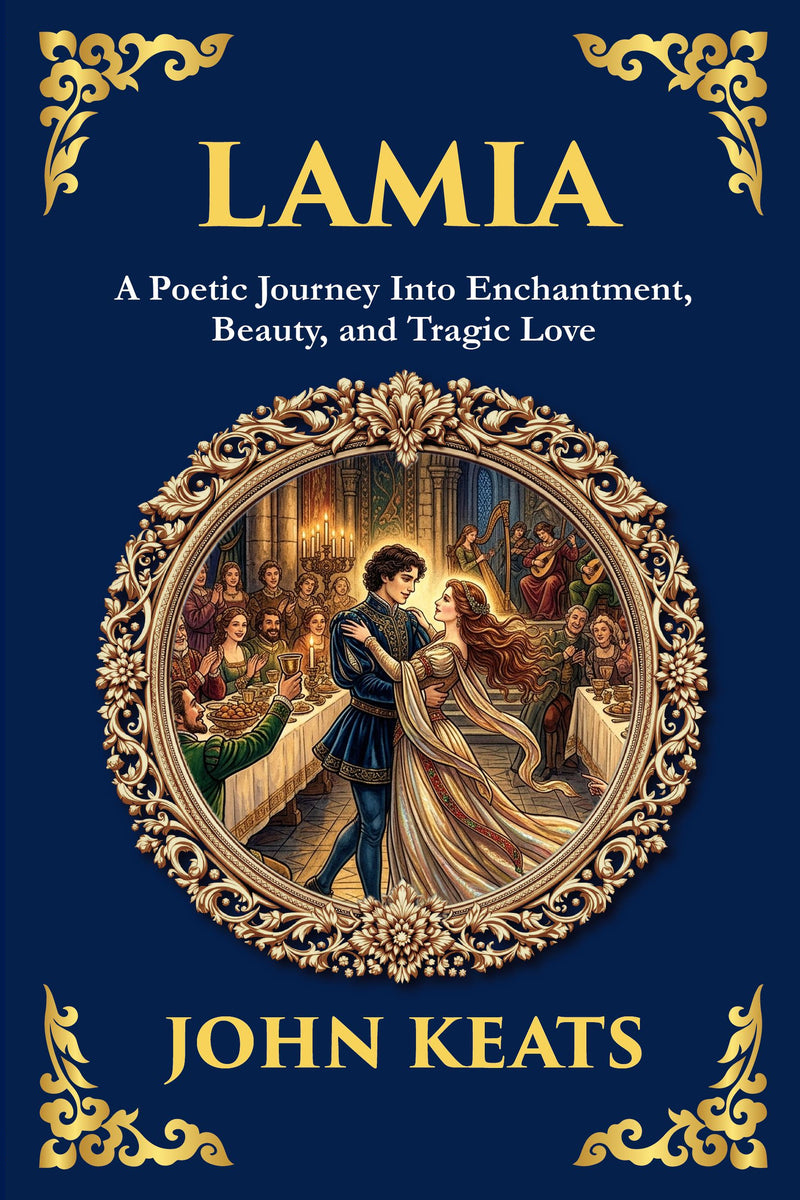
Lamia — Large Print
In a realm where beauty masks deception and love walks hand-in-hand with doom, Lamia unravels the tale of a mysterious woman who hides a serpentine past.
or free app
10,000+ hrs library
30-day guarantee
The complete Lamia appears in modern English through Library of Alexandria Press, available online with audiobook narration included for members.
Have you ever wondered why beauty can be both a blessing and a curse? Lamia by John Keats is a lyrical and haunting exploration of love, illusion, and the conflict between reason and passion. Written during the height of the Romantic era, this poem stands as one of Keats’s most evocative works—a mythological tale that feels deeply human in its emotional resonance.
At the heart of the poem is Lamia, a serpent transformed into a beautiful woman, whose magical allure captures the heart of the young scholar Lycius. Their love blossoms in secrecy, an ecstatic union untouched by the outside world. But when cold reason in the form of the philosopher Apollonius enters their lives, the fragile illusion crumbles—leading to a devastating conclusion.
This edition offers a faithful rendering of Keats’s poetic masterpiece, preserving its lush language and symbolic richness for modern readers.
What you’ll discover in this modern edition
- A Tragic Romance Rooted in Myth Experience the tale of Lamia and Lycius—doomed lovers whose passion is destroyed by harsh truth.
- John Keats’s Sensuous Language and Style Revel in the melodic rhythm, vivid imagery, and emotional intensity that define Keats’s poetry.
- A Deep Exploration of Romantic Themes Explore timeless questions about beauty, illusion, mortality, and the conflict between logic and love.
- The Height of English Romanticism Discover why Keats remains one of the most revered poets in English literature.
- A Poem That Continues to Inspire and Haunt From literature and art to modern retellings, Lamia’s themes echo across centuries.
| Formats | eBook (EPUB + PDF) · Audiobook · Paperback · Hardcover · Large Print |
| Language | English |
| Trim size (print) | 6 × 9 in |
| Binding | Paperback — perfect-bound · Hardcover — casewrap |
| Large Print edition | Same text in a larger, easy-read type — a larger font, not a larger trim |
| Print pricing | Every physical book at our true cost — at-cost, no profit (members) |
| Library | 873 restored titles, always growing |
| Length | 8,999 words · ~36 min reading |
| Reading level | Grade 8 · an easy, flowing read (this modern-English edition) |
| Edition | Modern English translation · 2026 |
Member reviews for this edition are collected as readers finish it — be the first. Across the library: 12,000+ books shipped, every plan covered by a 365-day print guarantee.
About this edition
A faithful, unabridged modern-English edition by The Library of Alexandria — carefully rendered for today's reader and verified paragraph-by-paragraph against the public-domain source. Available as eBook, audiobook, paperback, hardcover, and large print.
- Complete & unabridgedVerified paragraph by paragraph against the source — never a scan, never abridged.
- Modern English, faithfulReadable today, with the author’s meaning kept intact. Readable — not simplified.
- Every format, one membershipRead in your browser or the free app, or listen to the full audiobook.
Included free with your membership
Cancel anytime, one click · 30-day money-back guarantee
Edition last updated July 2026
What’s inside
Lamia — Large Print — complete and unabridged, included in full with membership, plus the full audiobook.
Begin reading Lamia — Large Print
In clear modern English — the complete text is included with membership.
Introduction
There are poems that whisper and poems that sing, and then there are those rare creations that seem to shimmer on the page like something alive and dangerous, half-glimpsed in the corner of the eye. Lamia belongs to this last, enchanted category. Written by John Keats during one of the most astonishing bursts of creative energy in all of English literature, it is a work that refuses to sit still, refuses to resolve neatly, refuses to let the reader rest comfortably in any single emotion. It is by turns sensuous and sorrowful, dazzling and unsettling, intoxicating and quietly devastating. To open this poem is to step into a world where the boundaries between the human and the supernatural blur, where beauty carries a hidden cost, and where the deepest questions about love, illusion, knowledge, and desire are dramatized in language so rich it almost overwhelms the senses.
This edition has been prepared as a modern translation, carefully adapted for the contemporary reader, with the goal of removing the obstacles that can stand between a present-day audience and the full splendor of Keats’s vision. The original poem, composed in 1819 and published in 1820, was written in the heightened poetic idiom of the early nineteenth century, dense with classical allusions, archaic phrasing, and the elaborate syntactic flourishes that Keats so loved. For readers steeped in that tradition, these features are part of the pleasure. But for many modern readers, they can become a thicket through which the poem’s true power struggles to shine. This adaptation seeks to clear that path—to let the story breathe, to let the emotions land, and to let the extraordinary imagery do its work without the friction of unfamiliar diction. What remains is the heart of the poem: the magic, the beauty, the tragedy, and above all, the love.
Before you begin, it is worth pausing to consider what makes this particular work so special, and why it deserves a place among the most cherished poems in the language. To do so is not to spoil the experience that awaits you—indeed, the great pleasure of Lamia lies precisely in the way it unfolds, in the slow revelation of its mysteries and the gathering weight of its emotions—but rather to prepare you, to attune your senses, so that when you do enter the poem, you will be ready to receive everything it has to offer.
To understand the significance of this poem, one must first understand the remarkable circumstances under which it was created. John Keats was born in 1795, the son of a London stable-keeper, and he lived a life that was, by almost any measure, brief and beset by hardship. He lost his father when he was eight and his mother when he was fourteen. He trained as a surgeon and apothecary before abandoning medicine to devote himself entirely to poetry—a decision that, given the precariousness of his circumstances and the lukewarm critical reception his early work received, must have seemed reckless to many around him. He suffered the agony of nursing his beloved younger brother Tom through a fatal illness, and he himself would die of tuberculosis at the age of twenty-five, in a small room in Rome, far from home, convinced that he had failed to achieve the immortality he so desperately craved.
And yet, in the span of just a few short years—indeed, in one almost miraculous period of about eighteen months between 1818 and 1819—Keats produced a body of work that would secure his place among the immortals of English poetry. The year 1819 in particular has come to be known as his annus mirabilis, his miraculous year, during which he composed the great odes—“Ode to a Nightingale,” “Ode on a Grecian Urn,” “To Autumn,” and the others—as well as the unfinished epic “Hyperion,” the haunting ballad “La Belle Dame sans Merci,” and the present poem. It is a record of creative achievement almost without parallel, made all the more extraordinary by the fact that Keats was, throughout much of this time, struggling with illness, financial worry, and the early stirrings of a passionate but ultimately tragic love affair with Fanny Brawne.
Lamia was written in the summer of 1819, and Keats himself regarded it with particular pride. In a letter to his publisher, he expressed his confidence that the poem would “take hold of people in some way—give them either pleasant or unpleasant sensation,” and added that he was determined “to make a sensation of one sort or another.” This was no idle boast. Keats understood that he had crafted something with the power to disturb as well as delight, something that worked upon the reader at a level deeper than mere admiration. He wanted his poetry to be felt as much as understood, to act upon the nerves and the blood, and Lamia is perhaps the most concentrated expression of this ambition. It is a poem designed to seduce its reader, to draw them in with its sumptuous surfaces and then, gradually, to unsettle them with the troubling questions lurking beneath.
It is also worth noting that Keats was writing at a particular moment in literary history, during the great flowering of English Romanticism. The Romantics—Wordsworth, Coleridge, Byron, Shelley, and Keats among them—were united by a shared conviction that imagination, emotion, and the natural world held truths that cold reason and scientific analysis could never capture. They were suspicious of the increasingly mechanized, rationalized world taking shape around them, and they sought in their poetry to recover a sense of wonder, of mystery, of the sublime. Keats was perhaps the most sensuous of all the Romantics, the one most attuned to the pleasures of the body and the senses, the one whose verse most consistently overflowed with color, taste, touch, sound, and scent. In Lamia, this sensuous gift is on full display, but it is also placed in tension with one of the great Romantic preoccupations: the conflict between the warm, living world of feeling and the cold, dissecting eye of intellect. This tension, as you will discover, lies at the very center of the poem.
For all his suffering and for all the brevity of his life, Keats possessed a sensibility of extraordinary richness and a faith in the redemptive power of beauty that never wavered. “Beauty is truth, truth beauty,” he famously wrote, and though scholars have debated the precise meaning of that line for two centuries, it captures something essential about his worldview. For Keats, beauty was not a mere ornament or distraction; it was a profound and serious thing, bound up with the deepest mysteries of existence. Lamia is, among many other things, a meditation on beauty—on its power to enchant and transform, on its fragility, and on the painful question of whether it can survive contact with the harsh light of reality. That this meditation comes to us from a poet who himself lived so briefly, who knew so intimately the fleeting nature of all lovely things, gives it an added poignancy that no reader can fail to feel.
Without revealing the turns of the story—for those are best discovered in the reading—it is worth saying something about the texture and atmosphere of the poem, so that you may know what kind of experience awaits you. Lamia draws upon the rich tradition of classical mythology, transporting the reader to a world where gods and nymphs and magical beings move among mortals, where transformation and enchantment are part of the fabric of reality. Keats found the seed of his story in an old tale, recounted in a seventeenth-century work by Robert Burton, The Anatomy of Melancholy, which Keats reproduced as a note to his poem. But what he made of that seed is entirely his own: a luminous, sensuous, deeply ambiguous fable that resists any single interpretation.
The poem opens in a realm of pure myth, in the days “before the faery broods drove Nymph and Satyr from the prosperous woods,” and from its very first lines it casts a spell of enchantment. Keats’s gift for sensuous detail is everywhere apparent. He describes things not abstractly but in their full physical presence—the gleam of scales, the glow of a jewel, the warmth of a body, the taste of wine, the sound of music drifting through marble halls. Reading the poem is like wandering through a series of richly appointed rooms, each one more dazzling than the last, until you scarcely know whether you are awake or dreaming. This is deliberate. Keats wants you to be seduced, to be drawn into a world of beauty so complete that you forget, for a time, the questions that ought to be troubling you. And then, gently at first and later with mounting force, he begins to ask those questions.
For Lamia is not merely a pretty story. Beneath its glittering surface, it grapples with some of the most enduring concerns of human experience. What is the relationship between love and illusion? Can passion survive the scrutiny of reason? Is there a kind of knowledge that destroys the very thing it seeks to understand? Is it better to live within a beautiful dream, even a false one, or to face the cold truth at the cost of one’s happiness? These are not questions the poem answers in any tidy way. Instead, it dramatizes them, embodies them in characters and situations, and leaves the reader to wrestle with them long after the final lines have been read.
One of the poem’s most remarkable features is its moral ambiguity. The figures who populate its pages cannot be neatly sorted into heroes and villains. Sympathy shifts and wavers as the poem proceeds, and characters who might at first seem to threaten one another reveal unexpected depths of feeling and vulnerability. Keats refuses to tell us how to feel; he presents the situation in all its painful complexity and trusts us to respond as our own hearts dictate. This refusal of easy judgment is one of the things that makes the poem feel so startlingly modern. We live in an age that has grown suspicious of simple moral binaries, that recognizes the tangled, contradictory nature of human motivation, and in this respect Keats was far ahead of his time. The poem’s central conflict—between the world of imaginative enchantment and the world of rational, cold-eyed analysis—remains as relevant today as it was two hundred years ago, perhaps more so, in an era when the warm pleasures of art and feeling are so often weighed against the demands of efficiency, utility, and hard fact.
It is worth dwelling for a moment on Keats’s famous concept of “negative capability,” which illuminates so much of what he was trying to achieve in this poem. In a letter to his brothers written in late 1817, Keats described this as the quality “when a man is capable of being in uncertainties, mysteries, doubts, without any irritable reaching after fact and reason.” He believed that the greatest poetry—and the greatest minds—could hold contradictory truths in suspension, could dwell in mystery and ambiguity without rushing toward premature resolution. Lamia is perhaps the supreme demonstration of negative capability in Keats’s work. It refuses to resolve its central tensions, refuses to deliver a clear verdict, and in doing so it achieves a richness and depth that a more didactic poem could never approach. As you read, you may find yourself reaching for certainty, wanting to know who is right and who is wrong, what is real and what is false—and the poem’s genius lies precisely in the way it withholds these certainties, leaving you suspended in a state of delicious, troubling uncertainty.
The emotional arc of the poem is one of its most powerful elements. It begins in a mood of wonder and delight, builds toward moments of almost unbearable beauty and tenderness, and then moves, with the inexorable logic of tragedy, toward an ending that lingers in the memory like a wound. This is poetry that engages not only the mind but the whole nervous system. Keats wanted his readers to feel his verse in their bodies, and in Lamia he succeeds magnificently. The pacing, the music of the language, the gradual darkening of tone—all of these work together to produce an experience that is genuinely affecting, capable of moving even the most guarded reader to a real and unexpected emotion.
Cancel anytime, one click · 30-day money-back guarantee
Founding annual rate available now — your price locks for life when you join.
Not ready? Get this free chapter by email — read it anytime.
✓ Sent — check your inbox for Lamia — Large Print.
Questions about Lamia — Large Print
What is Lamia about?
In a realm where beauty masks deception and love walks hand-in-hand with doom, Lamia unravels the tale of a mysterious woman who hides a serpentine past. Through sensuous verse and haunting imagery, John Keats crafts a tragic love story between the enchanting Lamia and the noble Lycius—a romance destined to be torn apart by truth and illusion. A masterpiece of Romantic poetry, Lamia is a mesmerizing blend of myth and emotion, rich with symbolic meaning and timeless themes.
Who wrote Lamia?
Lamia was written by John Keats. This edition presents the complete work in clear modern English, faithfully rendered from the public-domain original by Library of Alexandria Press.
Is Lamia free to read?
The opening chapter is free to read on this page. Members read and listen to the complete work — and the entire library — free, and can order any physical book at our true print cost.
How long is Lamia?
2 chapters (~8,999 words) — about 36 min of reading in this modern-English edition.
Is this an abridged version of Lamia?
No. This is the complete, unabridged Lamia, carefully rendered into clear modern English and verified paragraph-by-paragraph against the public-domain source — nothing is cut or summarised.
What formats does Lamia come in?
Lamia is available as eBook, paperback, hardcover and large print. eBook and audiobook are included with membership; printed editions ship at our true print cost.
Shipping & returns
Billing & membership
More from the library


Explore Myths & Legends
- The Red Fairy Book · Andrew Lang
- Vikram and the Vampire: Classic Hindu Tales of Adventure, Magic, and Romance · Unknown
- The Initiates of the Flame · Manly P. Hall
- Gawayne and the Green Knight: A Fairy Tale · Charlton M. Lewis
- The Nibelungenlied · G. H. Needler
- The Aeneid of Virgil · Virgil
- Fifty Famous Stories Retold · James Baldwin
- West African Folk-Tales
- Lamia · John Keats
- The Three Bears · A. E. Kennedy
- The Ballad of the White Horse · G. K. Chesterton
- The Danish History, Books I–IX · Saxo Grammaticus
- Andersen’s Fairy Tales · H. C. Andersen
- Folk-Tales of Bengal · Lal Behari Day
- The Birth of the War-God: A Poem by Kalidasa · Kálidása
- Omens and Superstitions of Southern India · Edgar Thurston
- The Legend of Sleepy Hollow · Washington Irving
- The Hyborian Age · Robert E. Howard
- The Odyssey · Homer
- Grimms’ Fairy Tales · Jacob Grimm and Wilhelm Grimm
- Just So Stories · Rudyard Kipling
- Aeschylus’ Prometheus Bound and the Seven Against Thebes · Aeschylus
- The Iliad · Homer
Lamia — Large Print
Lamia — Large Print
A Poetic Journey Into Magic, Beauty, and Tragic Love
John Keats
Contents
- Introduction
- Lamia
Introduction
There are poems that whisper and poems that sing, and then there are those rare creations that seem to shimmer on the page like something alive and dangerous, half-glimpsed in the corner of the eye. Lamia belongs to this last, enchanted category. Written by John Keats during one of the most astonishing bursts of creative energy in all of English literature, it is a work that refuses to sit still, refuses to resolve neatly, refuses to let the reader rest comfortably in any single emotion. It is by turns sensuous and sorrowful, dazzling and unsettling, intoxicating and quietly devastating. To open this poem is to step into a world where the boundaries between the human and the supernatural blur, where beauty carries a hidden cost, and where the deepest questions about love, illusion, knowledge, and desire are dramatized in language so rich it almost overwhelms the senses.
This edition has been prepared as a modern translation, carefully adapted for the contemporary reader, with the goal of removing the obstacles that can stand between a present-day audience and the full splendor of Keats’s vision. The original poem, composed in 1819 and published in 1820, was written in the heightened poetic idiom of the early nineteenth century, dense with classical allusions, archaic phrasing, and the elaborate syntactic flourishes that Keats so loved. For readers steeped in that tradition, these features are part of the pleasure. But for many modern readers, they can become a thicket through which the poem’s true power struggles to shine. This adaptation seeks to clear that path—to let the story breathe, to let the emotions land, and to let the extraordinary imagery do its work without the friction of unfamiliar diction. What remains is the heart of the poem: the magic, the beauty, the tragedy, and above all, the love.
Before you begin, it is worth pausing to consider what makes this particular work so special, and why it deserves a place among the most cherished poems in the language. To do so is not to spoil the experience that awaits you—indeed, the great pleasure of Lamia lies precisely in the way it unfolds, in the slow revelation of its mysteries and the gathering weight of its emotions—but rather to prepare you, to attune your senses, so that when you do enter the poem, you will be ready to receive everything it has to offer.
To understand the significance of this poem, one must first understand the remarkable circumstances under which it was created. John Keats was born in 1795, the son of a London stable-keeper, and he lived a life that was, by almost any measure, brief and beset by hardship. He lost his father when he was eight and his mother when he was fourteen. He trained as a surgeon and apothecary before abandoning medicine to devote himself entirely to poetry—a decision that, given the precariousness of his circumstances and the lukewarm critical reception his early work received, must have seemed reckless to many around him. He suffered the agony of nursing his beloved younger brother Tom through a fatal illness, and he himself would die of tuberculosis at the age of twenty-five, in a small room in Rome, far from home, convinced that he had failed to achieve the immortality he so desperately craved.
And yet, in the span of just a few short years—indeed, in one almost miraculous period of about eighteen months between 1818 and 1819—Keats produced a body of work that would secure his place among the immortals of English poetry. The year 1819 in particular has come to be known as his annus mirabilis, his miraculous year, during which he composed the great odes—“Ode to a Nightingale,” “Ode on a Grecian Urn,” “To Autumn,” and the others—as well as the unfinished epic “Hyperion,” the haunting ballad “La Belle Dame sans Merci,” and the present poem. It is a record of creative achievement almost without parallel, made all the more extraordinary by the fact that Keats was, throughout much of this time, struggling with illness, financial worry, and the early stirrings of a passionate but ultimately tragic love affair with Fanny Brawne.
Lamia was written in the summer of 1819, and Keats himself regarded it with particular pride. In a letter to his publisher, he expressed his confidence that the poem would “take hold of people in some way—give them either pleasant or unpleasant sensation,” and added that he was determined “to make a sensation of one sort or another.” This was no idle boast. Keats understood that he had crafted something with the power to disturb as well as delight, something that worked upon the reader at a level deeper than mere admiration. He wanted his poetry to be felt as much as understood, to act upon the nerves and the blood, and Lamia is perhaps the most concentrated expression of this ambition. It is a poem designed to seduce its reader, to draw them in with its sumptuous surfaces and then, gradually, to unsettle them with the troubling questions lurking beneath.
It is also worth noting that Keats was writing at a particular moment in literary history, during the great flowering of English Romanticism. The Romantics—Wordsworth, Coleridge, Byron, Shelley, and Keats among them—were united by a shared conviction that imagination, emotion, and the natural world held truths that cold reason and scientific analysis could never capture. They were suspicious of the increasingly mechanized, rationalized world taking shape around them, and they sought in their poetry to recover a sense of wonder, of mystery, of the sublime. Keats was perhaps the most sensuous of all the Romantics, the one most attuned to the pleasures of the body and the senses, the one whose verse most consistently overflowed with color, taste, touch, sound, and scent. In Lamia, this sensuous gift is on full display, but it is also placed in tension with one of the great Romantic preoccupations: the conflict between the warm, living world of feeling and the cold, dissecting eye of intellect. This tension, as you will discover, lies at the very center of the poem.
For all his suffering and for all the brevity of his life, Keats possessed a sensibility of extraordinary richness and a faith in the redemptive power of beauty that never wavered. “Beauty is truth, truth beauty,” he famously wrote, and though scholars have debated the precise meaning of that line for two centuries, it captures something essential about his worldview. For Keats, beauty was not a mere ornament or distraction; it was a profound and serious thing, bound up with the deepest mysteries of existence. Lamia is, among many other things, a meditation on beauty—on its power to enchant and transform, on its fragility, and on the painful question of whether it can survive contact with the harsh light of reality. That this meditation comes to us from a poet who himself lived so briefly, who knew so intimately the fleeting nature of all lovely things, gives it an added poignancy that no reader can fail to feel.
Without revealing the turns of the story—for those are best discovered in the reading—it is worth saying something about the texture and atmosphere of the poem, so that you may know what kind of experience awaits you. Lamia draws upon the rich tradition of classical mythology, transporting the reader to a world where gods and nymphs and magical beings move among mortals, where transformation and enchantment are part of the fabric of reality. Keats found the seed of his story in an old tale, recounted in a seventeenth-century work by Robert Burton, The Anatomy of Melancholy, which Keats reproduced as a note to his poem. But what he made of that seed is entirely his own: a luminous, sensuous, deeply ambiguous fable that resists any single interpretation.
The poem opens in a realm of pure myth, in the days “before the faery broods drove Nymph and Satyr from the prosperous woods,” and from its very first lines it casts a spell of enchantment. Keats’s gift for sensuous detail is everywhere apparent. He describes things not abstractly but in their full physical presence—the gleam of scales, the glow of a jewel, the warmth of a body, the taste of wine, the sound of music drifting through marble halls. Reading the poem is like wandering through a series of richly appointed rooms, each one more dazzling than the last, until you scarcely know whether you are awake or dreaming. This is deliberate. Keats wants you to be seduced, to be drawn into a world of beauty so complete that you forget, for a time, the questions that ought to be troubling you. And then, gently at first and later with mounting force, he begins to ask those questions.
For Lamia is not merely a pretty story. Beneath its glittering surface, it grapples with some of the most enduring concerns of human experience. What is the relationship between love and illusion? Can passion survive the scrutiny of reason? Is there a kind of knowledge that destroys the very thing it seeks to understand? Is it better to live within a beautiful dream, even a false one, or to face the cold truth at the cost of one’s happiness? These are not questions the poem answers in any tidy way. Instead, it dramatizes them, embodies them in characters and situations, and leaves the reader to wrestle with them long after the final lines have been read.
One of the poem’s most remarkable features is its moral ambiguity. The figures who populate its pages cannot be neatly sorted into heroes and villains. Sympathy shifts and wavers as the poem proceeds, and characters who might at first seem to threaten one another reveal unexpected depths of feeling and vulnerability. Keats refuses to tell us how to feel; he presents the situation in all its painful complexity and trusts us to respond as our own hearts dictate. This refusal of easy judgment is one of the things that makes the poem feel so startlingly modern. We live in an age that has grown suspicious of simple moral binaries, that recognizes the tangled, contradictory nature of human motivation, and in this respect Keats was far ahead of his time. The poem’s central conflict—between the world of imaginative enchantment and the world of rational, cold-eyed analysis—remains as relevant today as it was two hundred years ago, perhaps more so, in an era when the warm pleasures of art and feeling are so often weighed against the demands of efficiency, utility, and hard fact.
It is worth dwelling for a moment on Keats’s famous concept of “negative capability,” which illuminates so much of what he was trying to achieve in this poem. In a letter to his brothers written in late 1817, Keats described this as the quality “when a man is capable of being in uncertainties, mysteries, doubts, without any irritable reaching after fact and reason.” He believed that the greatest poetry—and the greatest minds—could hold contradictory truths in suspension, could dwell in mystery and ambiguity without rushing toward premature resolution. Lamia is perhaps the supreme demonstration of negative capability in Keats’s work. It refuses to resolve its central tensions, refuses to deliver a clear verdict, and in doing so it achieves a richness and depth that a more didactic poem could never approach. As you read, you may find yourself reaching for certainty, wanting to know who is right and who is wrong, what is real and what is false—and the poem’s genius lies precisely in the way it withholds these certainties, leaving you suspended in a state of delicious, troubling uncertainty.
The emotional arc of the poem is one of its most powerful elements. It begins in a mood of wonder and delight, builds toward moments of almost unbearable beauty and tenderness, and then moves, with the inexorable logic of tragedy, toward an ending that lingers in the memory like a wound. This is poetry that engages not only the mind but the whole nervous system. Keats wanted his readers to feel his verse in their bodies, and in Lamia he succeeds magnificently. The pacing, the music of the language, the gradual darkening of tone—all of these work together to produce an experience that is genuinely affecting, capable of moving even the most guarded reader to a real and unexpected emotion.
Once upon a time, before the fairy families drove the Nymphs and Satyrs out of the lush forests, and before King Oberon’s brilliant crown, scepter, and gem-studded cloak scared the Dryads and Fauns away from the green reeds, thickets, and cowslip meadows, Hermes left his golden throne. Driven by a passionate desire for a secret romance, he descended from high Olympus to escape the gaze of his superior, Jove, and hid in a forest on the shores of Crete. On that sacred island lived a nymph whom all the hoofed Satyrs admired; the weary Tritons poured pearls at her white feet, while those on land adored her until they wasted away. Near the springs where she usually bathed and the meadows she frequented, rich gifts were scattered—treasures beyond the imagination of any Muse, even if the chest of Fancy were opened. “What a world of love surrounds her!” Hermes thought. A heavenly heat burned from his winged heels to his ears, and his face, once clear as a lily, blushed like a rose amidst the golden curls falling over his bare shoulders. He flew from valley to valley and wood to wood, breathing his new passion onto the flowers, following every river to its source to find where this sweet nymph kept her secret bed. He searched in vain; the nymph was nowhere to be found. He rested on the lonely ground, thoughtful and filled with a painful jealousy of the forest gods and even the trees. As he stood there, he heard a mournful voice—the kind of voice that makes a gentle heart forget all pain except for pity. The lonely voice spoke: “When will I wake from this coiled tomb? When will I move in a beautiful body fit for life, love, pleasure, and the passionate struggle of hearts and lips? Oh, how miserable I am!” The dove-footed god glided silently through the bushes and trees, his speed softly brushing the tall grasses and flowering weeds, until he found a trembling snake, bright and coiled in a dark thicket. She was a complex shape of dazzling colors: spotted with vermilion, gold, green, and blue; striped like a zebra, freckled like a leopard, with eyes like a peacock and crimson bars. She was covered in silver moons that, as she breathed, faded, glowed brighter, or wove their light into the darker patterns. With her rainbow sides and air of misery, she looked like a penitent elf, a demon’s mistress, or perhaps a demon herself. On her head was a pale fire sprinkled with stars, like Ariadne’s crown. Her head was that of a serpent, but—bittersweetly—she had a woman’s mouth with a full set of pearly teeth. As for her eyes, what could such eyes do there but weep because they were born so beautiful? Just as Proserpine still weeps for the air of Sicily. Her throat was a serpent’s, but her words flowed like bubbling honey for the sake of love. While Hermes hovered on his wings, like a falcon poised to strike its prey, she spoke: “Fair Hermes, crowned with feathers and fluttering lightly, I had a magnificent dream of you last night. I saw you sitting on a golden throne among the gods of old Olympus, the only sad one there; for you did not hear the soft songs of the lute-playing Muses, nor even Apollo when he sang alone, deaf to the long, melodic moan of his throbbing throat. I dreamt I saw you, dressed in purple robes, breaking through the clouds like the morning sun, and striking toward the island of Crete as swiftly as a bright arrow of Phoebus; and here you are! Gentle Hermes, have you found the girl?” To this, the star of Lethe did not hesitate to use his charming eloquence and asked: “You smooth-lipped serpent, surely you are highly inspired! You beautiful wreath with melancholy eyes, keep whatever happiness you can imagine, but just tell me where my nymph has fled—where she is breathing!” “Bright planet, you have spoken,” the snake replied, “but seal it with oaths, fair God!” “I swear,” said Hermes, “by my serpent staff, by your eyes, and by your starry crown!” His earnest words flew lightly, carried by the blossoms. Then the brilliant female spoke again: “You are too fragile of heart! As for this lost nymph of yours, she wanders invisibly and free as the air through these thornless wilds. She enjoys her pleasant days unseen; her nimble feet leave traces in the grass and sweet flowers without being noticed. She plucks fruit from tired vines and bowing green branches unseen, and she bathes unseen. By my power, her beauty is veiled to keep her safe from the unwanted glances of ugly eyes—the sighs of Satyrs, Fauns, and the blurred gaze of Silenus. Her immortality grew pale from the grief caused by all these lovers, and she suffered so much that I took pity on her. I told her to soak her hair in magical syrups that would keep her beauty invisible, yet leave her free to wander as she pleases. You shall behold her, Hermes, and you alone, if you grant my request as you have sworn!” Then the charmed god made another oath, and it reached the serpent’s ears, warm, trembling, devout, and melodic. Overwhelmed, she lifted her Circean head, blushed a deep red, and said with a quick lisp, “I was once a woman; let me have a woman’s shape again, as charming as before. I love a youth from Corinth—oh, the bliss! Give me back my womanly form and place me where he is. Lean down, Hermes, let me breathe upon your brow, and you shall see your sweet nymph right now.” The god sank serenely on half-closed wings; she breathed upon his eyes, and suddenly both saw the guarded nymph smiling nearby on the green grass. It was no dream; or if it was, the dreams of gods are real, and their pleasures pass smoothly in a long, immortal dream. For one warm, flushed moment, he seemed dazzled by the wood-nymph’s beauty and burned with passion. Then, landing on the trackless grass, he turned to the fainted serpent and, with a delicate, languid arm, tested the flexible charm of his Caduceus. Having done so, he turned his eyes back to the nymph, full of adoring tears and flattery, and stepped toward her. Like a waning moon, she faded before him, cowering and unable to stop her fearful sobbing, folding into herself like a flower that wilts in the evening. But as the god took her chilled hand, she felt his warmth, her eyelids opened softly, and like new flowers blooming at the morning song of bees, she blossomed and gave her honey to the lees. They flew into the deep green woods; unlike mortal lovers, they did not grow pale. Left alone, the serpent began to change; her elfin blood ran wild, her mouth foamed, and the grass splashed by her fluids withered from a dew that was both sweet and poisonous. Her eyes were fixed in torture and bleak anguish, hot, glazed, and wide, with scorched eyelashes, flashing phosphorus and sharp sparks without a single cooling tear. The colors along her body ignited; she writhed, convulsed with scarlet pain. A deep, volcanic yellow replaced the grace of her moon-colored body. Like lava destroying a meadow, it ruined her silver armor and golden braids, turned her freckles and stripes to gloom, eclipsed her crescents, and licked up her stars. In a few moments, she was stripped of all her sapphires, greens, amethysts, and ruby-silvers; robbed of all these, nothing remained but pain and ugliness. Her crown still shone, but then that too vanished, and she melted and disappeared suddenly. In the air, her new voice sang softly, crying, “Lycius! Gentle Lycius!” These words, carried aloft by the bright mists around the gray mountains, dissolved; the forests of Crete heard them no more. Where did Lamia flee, now a bright lady, a full-grown beauty, new and exquisite? She fled into the valley used by those traveling to Corinth from the shore of Cenchreas. She rested at the foot of those wild hills, the rugged sources of the Peraean streams, and by the other ridge whose barren back stretches southwest toward Cleone. There she stood, just a short distance from a wood, beautiful on a sloping green of mossy ground, by a clear pool where she loved to see herself, escaped from such terrible misery, while her robes fluttered among the daffodils. Oh, happy Lycius! For she was a woman more beautiful than any braided hair, any sigh, or any blush; more beautiful than anyone spreading a green dress on a spring-flowered meadow to the sound of music. She had the lips of the purest virgin, yet she was deeply learned in the secrets of love to the very core of the heart. Though she was not an hour old, her intelligent mind could separate bliss from the pain that borders it, define their moody limits, detach their points of contact, and quickly switch between them. She could navigate the deceptive chaos and separate its most ambiguous parts with sure skill, as if she had spent sweet days as a lovely graduate in Cupid’s college, keeping his rosy terms in idle longing. We shall see why this fair creature chose to linger so beautifully by the roadside. But first, it is right to tell how she could muse and dream while in her serpent prison of whatever she wished, whether strange or magnificent. Her spirit went wherever she willed: whether to the faintness of Elysium, or down through wave-lifting tresses where the fair Nereids wind into Thetis’ bower by many pearly stairs; or where the god Bacchus drains his divine cups, lounging beneath a sticky pine; or where in Pluto’s royal gardens the columns of Mulciber gleam in long plaza lines. Sometimes she would send her dream into cities to join in feasts and revelry. Once, while dreaming among mortals, she saw the young Corinthian Lycius leading the envious race in a chariot, like a young Jove with a calm, effortless face, and she fell into a swooning love for him. She knew that on the moth-time of that dim evening, he would return that way to Corinth from the shore; for the soft eastern wind was blowing, and his galley’s bronze prow was now grating against the quay-stones in the port of Cenchreas, having just anchored from the island of Aegina, where he had been for a while to sacrifice to Jove, whose temple there waits with high marble doors for blood and rare incense. Jove heard his vows and granted his desire; for by some strange chance, he left his companions and set out to walk, perhaps weary of their Corinthian talk. He traveled over the lonely hills, thoughtless at first, but before the evening star appeared, his imagination was lost where reason fades, in the calm twilight of Platonic shadows. Lamia saw him coming, closer and closer. Passing her in dull indifference, his silent sandals swept the mossy green. She stood so close to him, yet remained unseen; he passed by, locked in his own mysteries, his mind wrapped like his cloak, while her eyes followed his steps and her regal white neck turned, whispering, “Ah, bright Lycius, will you leave me alone on the hills? Lycius, look back and show some pity.” He did; not with cold, fearful wonder, but like Orpheus looking at Eurydice. For her sung words were so delicious it seemed he had loved them for a whole summer. Soon his eyes had drunk in her beauty, leaving not a drop in the bewildering cup, yet the cup remained full. Afraid she might vanish before he could pay his proper adoration, he began to worship her. As her soft look grew coy, she saw that he was completely captivated. “Leave you alone! Look back! Ah, Goddess, see if my eyes can ever turn away from you! For pity’s sake, do not betray this sad heart—if you vanish, I shall die. Stay! Even if you are a Naiad of the rivers, stay! Your streams will obey your distant wishes. Stay! Even if the greenest woods are your domain, they alone can drink the morning rain. Even if you are a descended Pleiad, will not one of your harmonious sisters keep your spheres in tune and shine as your silver proxy? Your sweet greeting came so sweetly to my ravished ears that if you fade, the memory of you will waste me away into a shadow—for pity’s sake, do not melt away!” “If I should stay,” Lamia said, “here on this floor of clay, and hurt my steps on these rough flowers, what could you say or do that is charming enough to dull the sharp memory of my home? You cannot ask me to roam with you over these hills and vales where there is no joy—empty of immortality and bliss! You are a scholar, Lycius, and must know that finer spirits cannot breathe or live in human climates. Alas, poor youth, what taste of purer air do you have to soothe my essence? What serene palaces do you offer where I may please my many senses and satisfy a hundred thirsts with mysterious tricks? It cannot be—farewell!” Saying this, she rose on tiptoe with white arms spread. He, sick at the thought of losing the amorous promise of her lonely complaint, swooned, murmuring of love and pale with pain. The cruel lady showed no sorrow for her tender favorite’s woe; instead, with eyes as bright as possible and slow grace, she put her new lips to his and gave back the life she had tangled in her mesh. As he woke from one trance into another, she began to sing—happy in beauty, life, love, and everything—a song of love too sweet for earthly lyres, while the stars, like held breath, drew in their panting fires. Then she whispered in such a trembling tone, like those who meet alone for the first time after many anguished days and use a language other than looks, telling him to raise his drooping head and clear his soul of doubt. She told him she was a woman, with nothing more subtle in her veins than throbbing blood, and that her frail heart felt the same pains as his. Next, she wondered how his eyes could have missed her face for so long in Corinth, where she said she lived only half-secluded and had spent days as happy as gold could buy without the help of love. She had been content until she saw him once as she passed by, where he leaned thoughtfully against a column at the porch of Venus’ temple, among baskets of amorous herbs and flowers freshly picked that evening, the night before the Adonian feast. She had seen nothing more of him and wept alone during those days, for why should she adore him? Lycius awoke from death into amazement to see her still there, singing such sweet songs. Then from amazement he fell into delight to hear her whisper womanly knowledge so well; every word she spoke drew him toward a clear delight and known pleasure. Let mad poets say whatever they want about the sweetness of Fairies, Peris, or Goddesses; there is no such treat among all those who haunt caverns, lakes, and waterfalls as a real woman, truly descended from Pyrrha’s pebbles or old Adam’s seed. Thus gentle Lamia judged, and judged correctly, that Lycius could not love while half-terrified. So she cast off the goddess persona and won his heart more pleasantly by playing the part of a woman, with no more awe than that which her beauty provided—beauty that, while it struck him, guaranteed to save him. Lycius replied eloquently to everything, pairing every word with a twin-born sigh. Finally, pointing toward Corinth, he asked his sweet if it was too far that night for her soft feet. The way was short, for Lamia’s eagerness used a spell to shrink the three-mile distance to a few paces; this was not noticed by the blinded Lycius, who was completely absorbed in her. They passed the city gates—he did not know how they did so noiselessly, nor did he ever think to ask. As men talk in a dream, all of Corinth—through its imperial palaces, populous streets, and lewd temples—muttered like a distant brewing storm to the wide-spread night above its towers. Men, women, rich and poor, in the cool hours, shuffled their sandals over the white pavement, either with companions or alone. Many lights flared here and there from wealthy festivals, throwing moving shadows on the walls, or clustering in the shaded cornices of some arched temple door or dark colonnade. Covering his face, fearing to greet friends, he pressed her fingers hard as a man approached. The man had a curled gray beard, sharp eyes, and a smooth bald crown, stepping slowly and dressed in a philosopher’s gown. Lycius shrank closer as they met and passed, pulling his cloak around him to hurry away, while the hurried Lamia trembled. “Ah,” he said, “why do you shudder so sadly, love? Why is your tender palm damp with dew?” “I am tired,” fair Lamia said. “Tell me, who is that old man? I cannot remember his features—Lycius, why did you hide yourself from his quick eyes?” Lycius replied, “That is the sage Apollonius, my trusty guide and good teacher; but tonight he seems like a ghost of folly haunting my sweet dreams.” While he spoke, they arrived before a pillared porch with a lofty door, where a silver lamp hung. Its phosphorus glow reflected on the slabbed steps below, mild as a star in water; for the marble was so new and unstained that dark veins ran through the crystal polish, as if only divine feet could have ever touched it. Aeolian sounds breathed from the hinges as the wide doors opened to a place unknown to anyone but those two and a few Persian mutes seen in the markets that year. No one knew where they lived; the most curious people failed to trace them to their house. Only the fluttering lines of poetry must tell, for the sake of truth, the woe that happened afterward; it would please many hearts to leave them thus, shut away from the busy world of the more skeptical.
End of the free sample
Keep reading, free
Members read and listen to the complete book — and the entire library. Cancel anytime, one click · 30-day money-back guarantee.