
 13 minSummaryRead it, the 15-minute summary, and print and large print at cost
 Audiobook editionPaperback · 6 × 9 in · printing soonHardcover · 6 × 9 in · printing soon
About this book
What turns a store of words into the power to speak well when no script is at hand?
In Institutio Oratoria, Book X, Quintilian moves from the theory of speaking to the work that builds skill. The Roman teacher asks what you should read, how you should write, and when you should correct your words. His goal is the complete orator: a good person who speaks well.
Reading supplies both words and ideas. Quintilian guides you through Greek and Roman authors, beginning with Homer, whom he treats as the source of later eloquence. He then explores imitation, careful writing, revision, and speaking on the spot. The challenge is to learn from strong models without merely copying them.
What you’ll discover
- Words with something behind them Build a richer command of language by gathering both vocabulary and things worth saying.
- Reading with judgment Follow Quintilian through Greek and Roman writers, considering what each can teach a speaker.
- Models without mere copying Explore how imitation can support learning without becoming a substitute for your own work.
- The discipline of revision See why writing needs correction, and why cutting and polishing belong to the same labour.
- Speech beyond the script Discover how sustained reading and writing prepare a speaker to find words on the spot.
Who will love it
Students of public speaking, writers who want better habits, teachers, lawyers, and anyone curious how the Romans trained a voice and a mind for the courtroom.
What’s inside
The key ideas, in the 15-minute summary
- Practice reading, writing and speaking together
- Choose words by judgment
- Return to speeches and compare sides
- Take useful qualities without copying faults
- Choose authors for what they teach
- Cicero combines strengths without merely copying
- Imitate qualities rather than surfaces
- Careful writing prepares the ready speaker
- Daily practice makes readiness reliable
Formats and delivery
- eBook
- On your phone, tablet or computer, once the book texts are online.
- Large-print eBook
- The same book in bigger, clearer type, once the book texts are online.
- 15-minute summary
- The key ideas in about 13 minutes, to read today.
- Paperback
- 6 × 9 in. Printing soon: leave your email under Paperback or Hardcover above.
- Hardcover
- 6 × 9 in. Printing soon: leave your email under Paperback or Hardcover above.
- Large print paperback
- 8.5 × 11 in. Printing soon: leave your email under Paperback or Hardcover above.
- Large print hardcover
- 8.5 × 11 in. Printing soon: leave your email under Paperback or Hardcover above.
Every printed copy is made when you order it and shipped worldwide; shipping is shown at checkout. The eBook opens when the book texts go online.
How it works
- Start free. Nothing to pay today; the eBook of this book is yours to keep.
- Read and print. 200,000+ classics as eBook, large-print eBook and 15-minute summary, and any book printed at cost as a paperback, hardcover or large print, 5 accounts for the price of one.
- We remind you first. Free for 3 months, and we email you 7 days before your first payment. Then USD 0.14 a day in your first year on the yearly plan and USD 0.27 a day after, or USD 0.66 a day on the monthly plan. Cancel online in two clicks.
Bought on its own? Every eBook and printed book you buy without the plan carries our 30-day money-back guarantee.
25 languages, side by side
Institutio Oratoria, Book X in 25 languages, side by side, paragraph by paragraph, once the book texts are online: the way to learn a language with a book you love.

Institutio Oratoria, Book X
 by Quintilian · 95
A Roman teacher shows how to read, write and speak until eloquence is ready for any emergency.
Challenging10–20 hours to read20 languages
Learn a language with challenging classicsSpanishFrenchGermanItalianJapanesePortugueseEnglishHow we measure levels
Excellent
Free for 3 months · starts right away, on any device
Read free3 months free · cancel anytimeRenews every year · Cancel anytimeHow it works


- Read, large type too
- 25 languages, side by side
- Print and large print at cost
- 5 accounts for the price of one
In short
Imagine you have learned every rule of speaking. Then a friend is dragged before a magistrate this very afternoon.
Institutio Oratoria, Book X at a glance
- Reading time
- About 14 h 20 min11 h 20 min fast, 17 h slow
- Length
- 204,500 words
- Library level
- Challenging long sentences, a rich vocabulary
- First published
- about AD 95by Quintilian
Reading time at 238 words a minute (fast 300, slow 200). How long the classics take to read · Updated
From the 15-minute summary · Key idea 1
Reading, writing and speaking must be practiced together
Quintilian opens with a question students often ask. Which matters most: writing, reading or speaking? He declines to choose. The three are so closely tied that if one is missing, the effort spent on the others is wasted.
Each exercise covers a gap in the others. Eloquence is never solid without much writing. Writing drifts without the models that reading provides. And a person who knows what to say but has no readiness is like someone sitting on a hoard behind locked doors.
Renews every year · Cancel anytime
You looked at
Which edition is right for me
- 15-minute summary
- The key ideas of the whole book in about 13 minutes. A good first look, or a refresher.
Details
- First published
- 95
- Language
- English
- Level
- Challenging
Cite this edition
Quintilian. Institutio Oratoria, Book X. Library of Alexandria, 2026, libraryofalexandria.com/products/institutio-oratoria-book-x.
Quintilian. (2026). Institutio oratoria, book X. Library of Alexandria. https://libraryofalexandria.com/products/institutio-oratoria-book-x (Original work published ca. 95)
Quintilian. Institutio Oratoria, Book X. Library of Alexandria, 2026. https://libraryofalexandria.com/products/institutio-oratoria-book-x.
@book{quintilian2026institutio,
  author = {Quintilian},
  title = {Institutio Oratoria, Book X},
  publisher = {Library of Alexandria},
  year = {2026},
  url = {https://libraryofalexandria.com/products/institutio-oratoria-book-x},
  note = {First published ca. 95}
}
Free gifts
USD 580 in free gifts when you start
Every book in every format and in 25 languages, 5 accounts for the price of one. Nothing to pay today.
- 200,000+ classic eBooksIn 25 languages, side by side
USD 170FREE - Every eBookIn 25 languages, any device
USD 120FREE - 15-minute summariesRead in 25 languages
USD 60FREE - Print at cost, no markupPaperback, hardcover, large print
USD 60FREE - 5 accounts for the price of oneA shelf for everyone at home
USD 170FREE - A part in rebuilding the libraryNew languages and books for all
FREE
Questions about Institutio Oratoria, Book X
Can I read it free?
Yes. The first key idea of the 15-minute summary is free with no sign-up. Start free and the whole book is yours for 3 months, with the eBook to keep, plus 200,000+ more classics and any book printed at cost as a paperback, hardcover or large print. Nothing to pay today: we email you 7 days before your first payment, and you can cancel online in two clicks.
Can I buy the printed book?
Soon. The paperback, hardcover and large print editions are being prepared. Choose Paperback or Hardcover above, leave your email, and we tell you the day you can order it, printed at cost.
How many accounts do I get?
Five, for the price of one: you and 4 more people, each with their own login, shelf and their own place in every book.
Can I cancel anytime?
Yes. Cancel online in two clicks at any time and nothing more is charged. Nothing is charged in your first 3 months, and we email you 7 days before your first payment.
What is Book Ten of Quintilian's Institutio Oratoria about?
It explains how a trained student turns knowledge of rhetoric into lasting skill. Quintilian covers how to read and imitate models, a guide to Greek and Roman authors, and daily habits of writing, thinking and speaking extempore.
Why does Quintilian say reading, writing and speaking cannot be separated?
He holds that each supports the others. Writing builds strength, reading supplies models and guidance, and speaking tests both. If one is missing, the effort spent on the other two is wasted, so a speaker should practice all three.
Which authors does Quintilian recommend in Book Ten?
He surveys Homer, Pindar, the tragedians, Menander, Thucydides, Herodotus, Demosthenes, Lysias, Isocrates and Plato among the Greeks. Among the Romans he names Vergil, Horace, Livy, Sallust and above all Cicero.
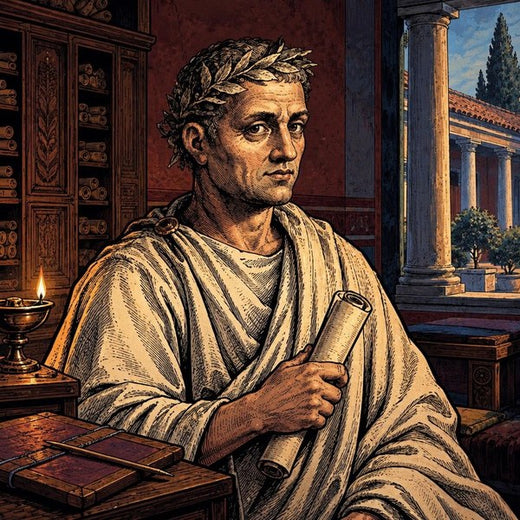
The author
Quintilian
35–96 · Ancient Roman rhetorician
Quintilian was a Roman teacher of rhetoric, born around AD 35 in Calagurris, in what is now Spain. He taught in Rome and died around AD 96. He wrote the twelve-book Institutio Oratoria, completed around AD 95, on the education and training of public speakers.
More like this
Our mission
The library burned once. We are building it back.
Every great book, in every language and every format, for every family. Every plan helps pay for new languages and books for readers who have never had them. Join the movement.
Read our story- Every language25 languages today, side by side, and more every year
- No wastePrinted on demand: no warehouses, no unsold stock, no pulped copies
- For everyonePaperback, hardcover and large print at the cost of printing





